Heritage · Landmark
Lascaux: the cave nobody sees
Four boys and a dog found a painted cave under a Dordogne hillside in September 1940. It opened to the public in 1948, and within fifteen years the breath of the visitors had begun to grow algae on the walls and lay a film of calcite over the animals. France shut it in 1963 and has kept it shut. What stands on the hill instead is a copy, cast from a laser survey of the original, and it is the only Lascaux anyone will ever walk into.Written to last.
By Confinity Heritage Editorial · 2026-08-25 · 7-minute readQuiet tools, kept out of the way.
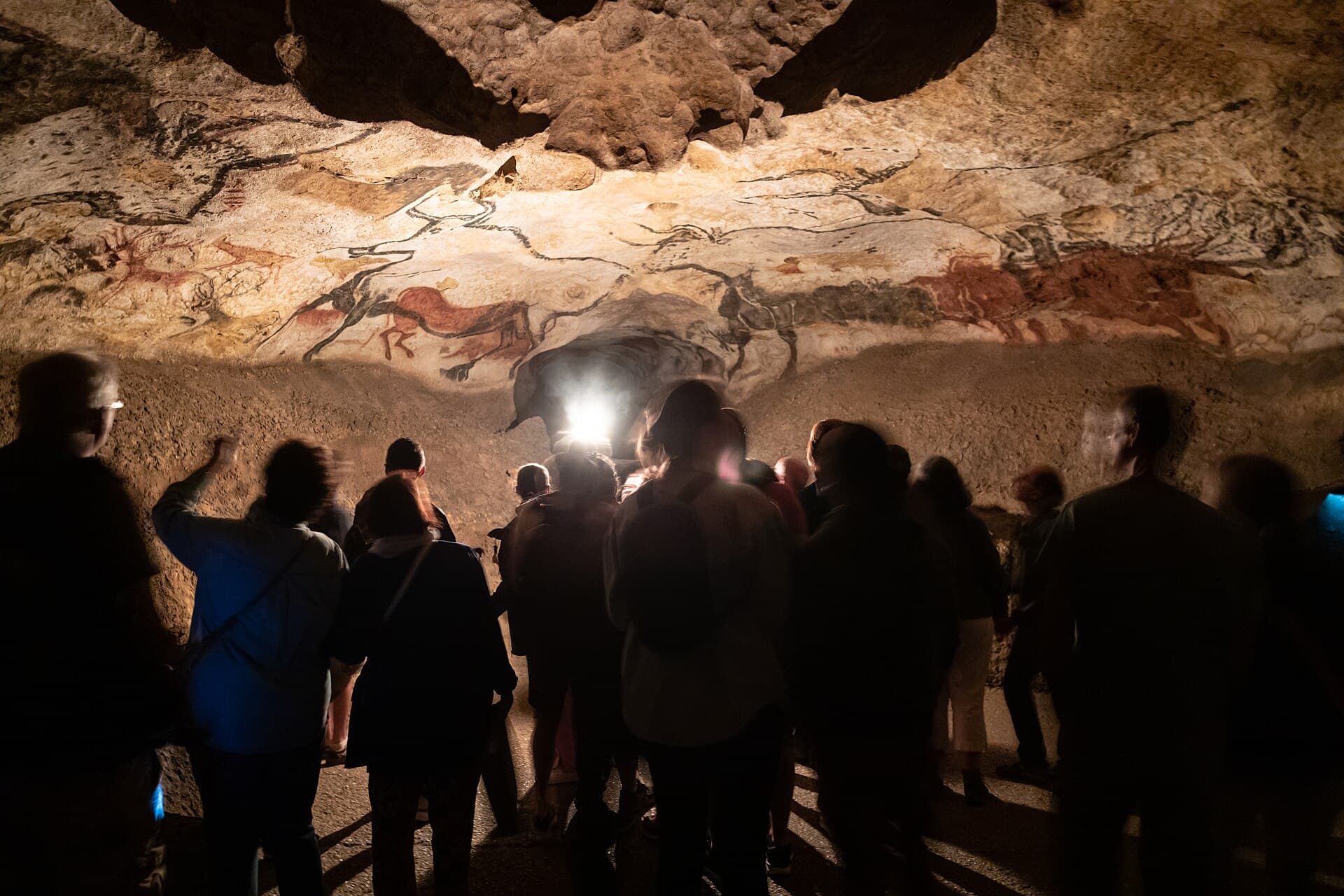
Above the town of Montignac in the Dordogne, in southwestern France, a wooded hill covers a small cave. All its accessible galleries together run no more than 235 metres, and inside that short distance are more than six hundred paintings and nearly six thousand figures in all. Lascaux sits within the UNESCO property "Prehistoric Sites and Decorated Caves of the Vézère Valley," which gathers 147 prehistoric sites and 25 decorated caves and was inscribed in 1979.
Almost nobody has seen it. The cave was open for fifteen summers and has been shut for over sixty years, and most people who say they have been to Lascaux have been inside a reproduction a few hundred metres away.
In the late summer of 1940 a seventeen-year-old apprentice mechanic from Montignac named Marcel Ravidat found an opening in the hillside where a tree had come down. In the version that stuck, his dog Robot chased a rabbit into the hole; the Ministry of Culture's own account of the discovery leaves the dog out.
He came back on 12 September with three others: Georges Agniel, sixteen; Simon Coencas, fifteen, a Paris boy sheltering in Montignac; and Jacques Marsal, fifteen. They widened the hole, Ravidat slid down a cone of scree, and by the light of a homemade lamp the four walked a gallery some thirty metres long until the first animals appeared. Next day they came back with a rope and Ravidat lowered himself eight metres into the shaft in the floor, where he found the strangest image in the cave.
The war took Agniel and Coencas away within days. Ravidat and Marsal guarded the entrance through the winter of 1940, became guides when the cave opened in 1948, and were the two who reported green growth on the walls in 1958 and 1959.
The first chamber, the Hall of the Bulls, is seventeen metres long, six wide and seven high. Four black aurochs dominate the thirty-six animals painted there, and one runs 5.2 metres from nose to tail, the largest animal figure known anywhere in cave art. Two files of aurochs face each other across the room, with about ten horses, the cave's only bear, and an unidentifiable creature nicknamed the unicorn.
The Axial Gallery runs on in the same direction, narrower and roughly as long, its aurochs, horses, deer and ibex climbing onto the ceiling, some apparently rolling from one side to the other. At the base of the Shaft, nineteen metres below the entrance, is the scene nobody has explained: a man with a bird's head lying back as if struck, a bison with its entrails hanging out, a bird on a pole beside him, a rhinoceros walking away.
The age has moved more than once. The LAsCO project re-dated reindeer bone from the main sectors and put the occupation between 21,500 and 21,000 years before present, at the turn from the Badegoulian to the Magdalenian, a thousand years or more later than dates obtained in the late 1990s.
The toolkit was small: some flints, blocks of pigment, grinding stones, a few brushes and swabs, stencils cut from hide, and most often a bare hand.
The wall decided the method. In the Hall of the Bulls and the Axial Gallery the rock is sheathed in white calcite, reflective, coarse-grained and hard, which rules out engraving and invites paint. On the right-hand side the corroded limestone crumbles for a millimetre or two, so there the figures are engraved and colour could only be sprayed on.
Then there is what separates Lascaux from competent cave painting elsewhere. Some figures look unfinished until you notice that a bulge or a ridge in the stone supplies the missing haunch or shoulder, so the animal is completed by the cave rather than by the artist. The Ministry of Culture makes the sharp point: in most caves a great many natural forms could be read as animals, and yet the number of figures actually built this way stays very small. A choice made rarely, not a shortcut taken wherever the rock offered one.
The cave opened to the public on 14 July 1948. Getting it ready had already changed it: the scree cone at the porch, which had worked as a thermal buffer, was dug out, stairs were cut into the Hall of the Bulls, and electric light was strung along a lowered route.
By 1955 the first damage was visible. An air regeneration system went in during 1957 and the visitors kept coming, more than a thousand a day at the peak and by some counts 1,200, releasing roughly 2,500 litres of carbon dioxide and fifty kilograms of water vapour a day into a void of about 1,500 cubic metres.
In 1960 the first of the two maladies arrived. The green sickness, la maladie verte, was algae: colonies spreading over the walls, fed by the warmth, the carbon dioxide and the electric lamps. The white sickness, la maladie blanche, came from the same breath, a veil of calcite settling over the rock and the paintings. Ozone filters stopped neither. On 17 April 1963 André Malraux, then the minister responsible for cultural affairs, closed Lascaux to the public, and it has stayed closed. Marsal, who had walked into it at fifteen, spent the rest of his working life guarding a cave nobody could enter.
Lascaux II, begun in the early 1970s and opened on 18 July 1983, is dug into the same hill about two hundred metres from the original. It reproduces the Hall of the Bulls and the Axial Gallery inside a double shell of reinforced concrete, the relief rebuilt in detail and painted with natural pigments using the techniques of the original artists. Roughly ten million people have walked through it.
Lascaux III has travelled since 2012, five reproductions of the Nave and the Shaft shipped to museums abroad. Lascaux IV, the International Centre for Cave Art, opened in December 2016 and reproduces very nearly the whole cave in a building by the Norwegian practice Snøhetta, chosen from 163 entries in 2012. The cave inside was cast from laser scanning to a tolerance of one millimetre, after which twenty-five artists spent two years hand-painting 900 metres of resin rock with the same pigments to reproduce all 1,900 paintings and engravings.
The photograph at the top of this page was taken in Lascaux II, not in Lascaux. It is the right picture to use, because it is the only view of these animals a visitor can have.
Its condition is managed, not resolved. In 2000 the climate equipment was replaced, and in the spring of 2001 staff reported mould in the entrance airlock: Fusarium solani, a fungus that had shrugged off the formaldehyde used for decades to disinfect visitors' shoes. It covered the floor, then spread onto the paintings as a white fuzz of mycelium, alongside a bacterium that broke down the fungicide, so an antibiotic had to be added. Emergency treatment with compresses, quicklime and biocide sprays ran from July 2001 to December 2003.
Black stains came next, on the vault at the end of 2001 and in the Passage, the Nave and the Apse in July 2007, from two fungi later named after the cave, feeding on the residue of the earlier treatments. A biocide treatment in January 2008 was followed by three months in which the cave was left alone. Vermiculations, small sediment deposits, appeared in the Hall of the Bulls in October 2009 and are still tracked today.
Research programmes on the cave's microbial ecology ran from 2009 to 2011 and from 2014 to 2017, and the state spends around 600,000 euros a year on the site. Access is down to a handful of specialists for a few days a month. The ministry's own summary is that Lascaux has reached relative stability, remains fragile, and that its closure is now agreed to be necessary. Relative stability is not a cure.
Set Lascaux beside the Bamiyan Valley and the two cases invert each other. At Bamiyan the original is gone and the argument is whether to build it again. At Lascaux the original is intact and in fair condition, and has been deliberately hidden, so that a copy is the only thing anyone is permitted to look at. Opposite facts, one question underneath: what is a replica for, and what is it honest to call it?
The distinction that carries the weight is where the copy comes from. The Lascaux facsimiles are transcriptions of a surviving object taken from survey. The ministry commissioned a new digital model between 2012 and 2014, scanning at sub-millimetre resolution and some 500,000 points a second against the 80 a second managed in 2003, and that model is what the Lascaux IV replica was produced from. A copy of that kind claims nothing about the past that the original does not already say; it reports a measurement. Rebuilding a destroyed Buddha is harder, because the parts nobody recorded would have to be invented, and the invention would stand where the record used to be.
The method has spread. Altamira in northern Spain, inscribed by UNESCO in 1985, was closed in 1977, reopened to a trickle in 1982 and shut again after green mould appeared in 2002; its visitors see a replica. Chauvet in the Ardèche, found in 1994, has never been open at all; its facsimile, built on the Lascaux model, opened in April 2015. Elsewhere the answer is rationing rather than concealment: at Newgrange the places in the chamber for the midwinter sunrise are drawn in an annual lottery.
The honest name for the thing on the hill above Montignac is not Lascaux. It is a measurement of Lascaux at full size that a person can walk around inside. What the twentieth century worked out here, at the cost of fifteen years of algae and calcite, is that keeping a thing and showing a thing are two different jobs, and that when they conflict the showing gives way.
Four boys, a dog and a hole in the hill
Six hundred animals in 235 metres
Painting that uses the shape of the rock
You cannot see Lascaux
Lascaux II, III and IV
The cave is not cured
What a replica is for
References and resources
- UNESCO World Heritage Centre. "Prehistoric Sites and Decorated Caves of the Vézère Valley." World Heritage List, property no. 85, inscribed 1979. whc.unesco.org/en/list/85.
- French Ministry of Culture. "Lascaux," official site of the Grands sites archéologiques, covering the discovery, the discoverers, the rock support, dating, the facsimiles, the state commitment and the new digital model. archeologie.culture.gouv.fr/lascaux/en.
- Snøhetta. "Lascaux IV, International Centre for Cave Art." snohetta.com.
- Ducasse, S. and Langlais, M. "Twenty years on, a new date with Lascaux." PALEO 30-1, 2019. journals.openedition.org/paleo/4558.
- Wikipedia. "Lascaux," "Grotte de Lascaux," "Cave of Altamira," "Chauvet Cave." Retrieved 2026.