Heritage · Landmark
Christ the Redeemer: History, Facts and Visitor Guide
Art Deco statue of Jesus completed in 1931 atop Corcovado mountain in Rio de Janeiro, designed by Heitor da Silva Costa with sculptor Paul Landowski.Written to last.
By Confinity Heritage Editorial · Updated 2026-07-31 · 7-minute readQuiet tools, kept out of the way.
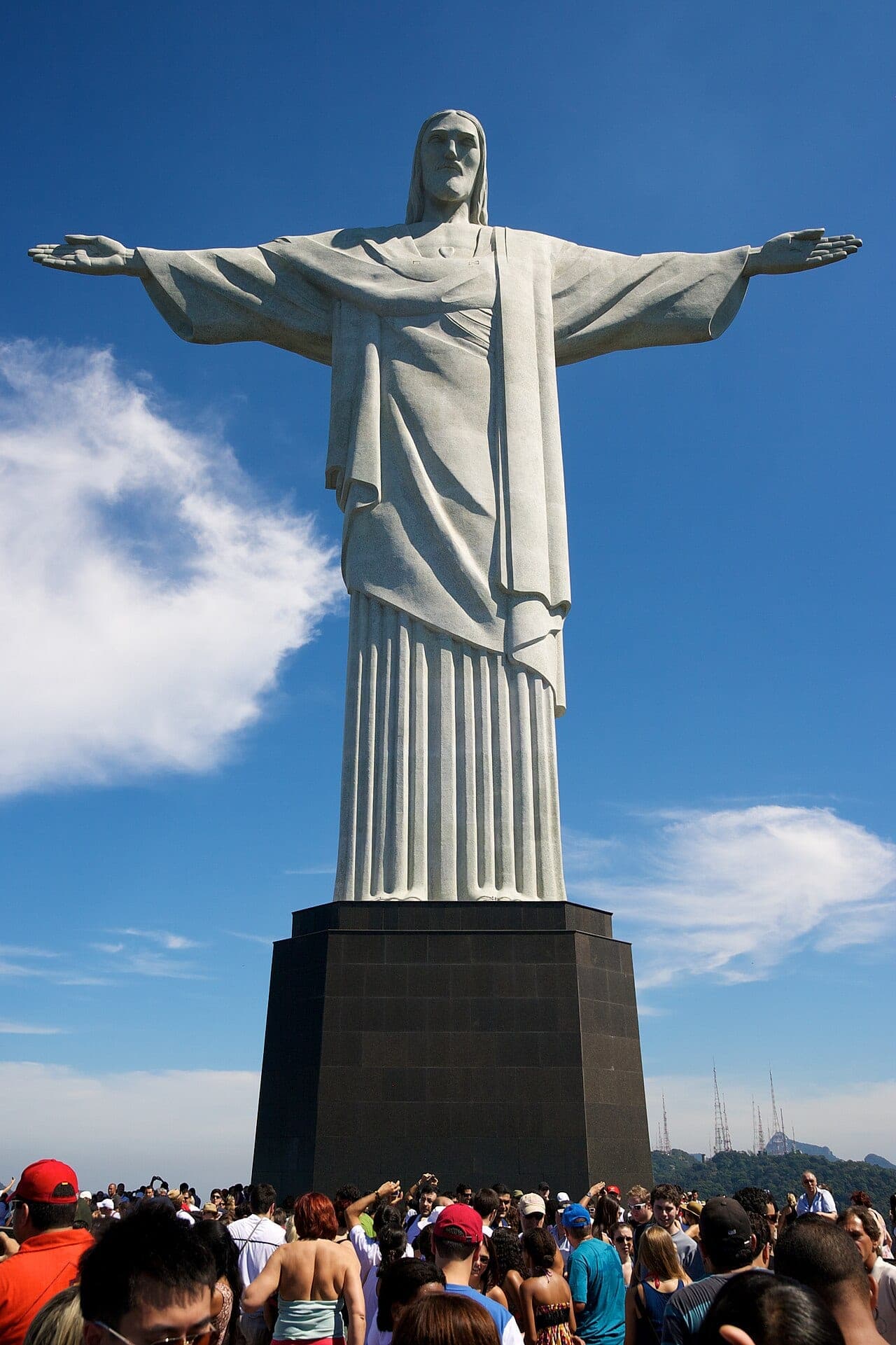
Christ the Redeemer (Cristo Redentor in Portuguese) is an Art Deco statue of Jesus of Nazareth that overlooks Rio de Janeiro from the summit of Corcovado mountain. Completed in 1931, the figure rises about 30 metres (98 feet) above a pedestal of roughly 8 metres (26 feet), and its outstretched arms span some 28 metres (92 feet), a silhouette that has become one of the most recognised in the world. The monument was designed by the Brazilian engineer Heitor da Silva Costa and modelled by the French sculptor Paul Landowski, with the face executed by the Romanian sculptor Gheorghe Leonida.
Set high above the city inside Tijuca National Park, the statue is visible from much of Rio and draws around two million visitors a year. In 2007 it was named one of the New7Wonders of the World in a global public poll, and it remains both an active place of Catholic worship and a civic emblem of Brazil.
The idea of a monument on Corcovado is far older than the statue itself. In the 1850s a Vincentian priest, Father Pedro Maria Boss, proposed a Christian landmark on the peak in honour of Princess Isabel, then heir to the Brazilian throne, but the plan went no further and lapsed after Brazil became a republic in 1889, which separated church and state. The proposal was revived in 1920 by the Catholic Circle of Rio, which organised a petition and a public campaign to build a religious monument as the country approached the centenary of its independence. Funding came largely from Brazil's Catholic community through a series of donation drives known as Monument Week, supported by the archdiocese of Rio de Janeiro.
Construction ran from 1922 to 1931. An early competition favoured a different design, but Silva Costa's revised concept of a standing Christ with open arms was chosen and developed in Paris with Landowski and a team of French and Brazilian engineers. Materials and prefabricated sections were carried up the mountain on the Corcovado rack railway, and the completed monument was inaugurated on 12 October 1931, with Cardinal Sebastião Leme leading the consecration before large crowds.
Silva Costa designed the statue in the Art Deco style then current in the 1920s, favouring clean, geometric lines over naturalistic detail. The figure was built from reinforced concrete, chosen for the strength needed to withstand strong winds at the exposed summit, and then clad in an outer skin of soapstone, a soft grey stone quarried in Minas Gerais that resists weathering and could be cut into thousands of small tiles. Volunteers, many of them parishioners, helped set this mosaic of tiles, and some are said to have written names and messages on the backs.
 The statue stands 30 metres on an 8-metre pedestal, at the top of a 700-metre peak, which is why it is visible from most of the city. Photograph by Donatas Dabravolskas, CC BY-SA 4.0, via Wikimedia Commons.
Landowski modelled the figure in France in stages, producing full-scale plaster sections that were shipped to Brazil for assembly, while the French engineer Albert Caquot contributed to the structural design. The head and hands were sculpted separately at large scale. The face, about 3.75 metres (12 feet) tall, was modelled by Gheorghe Leonida, whose work gave the figure its calm expression. The horizontal arms, which give the monument its cross-like form, presented the hardest engineering problem: their weight and wind load required careful internal reinforcement to keep them from cracking away from the body. In total the statue weighs roughly 635 metric tons.
Christ the Redeemer is a religious monument and remains consecrated for Catholic worship, with a small chapel dedicated to Our Lady of Aparecida, patron saint of Brazil, added into the base in 1965. Masses, weddings, and baptisms are held there. Beyond its devotional meaning, the statue has become a secular emblem of Rio de Janeiro and of Brazil as a whole, appearing in film, photography, and news coverage as shorthand for the city. Its open-armed posture is widely read as a gesture of welcome and protection over the bay below.
In 2007 the statue was chosen as one of the New7Wonders of the World in a worldwide poll organised by the New7Wonders Foundation, alongside sites such as the Great Wall of China and Machu Picchu. The recognition, which is not affiliated with UNESCO, raised the monument's international profile and its visitor numbers.
The statue sits at the top of the Corcovado peak, about 700 metres above sea level, within Tijuca National Park. The traditional way up is the Corcovado Rack Railway, a cog railway opened in 1884 and electrified in 1910, which climbs through the forest to a station near the summit; the same line carried construction materials in the 1920s. From the upper station, visitors reach the base by escalators and stairs added in the 2000s, and licensed vans also serve the site by road. The summit offers wide views over Rio, Guanabara Bay, Sugarloaf Mountain, and the beaches of the south zone. Timed tickets are used to manage the crowds, so booking ahead is advisable.
The statue's exposed position makes weather its main threat. It is struck by lightning many times each year, and although lightning rods protect the structure, direct strikes have still caused damage: bolts in 2008 and 2014 chipped stone from the head, fingers, and arms, and repairs replaced lost soapstone with material from the original quarry. A major restoration in 2010 cleaned and resurfaced the monument, treating fungus and renewing tens of thousands of tiles, and further conservation and lightning-protection work has continued in the years since. The site is maintained by the archdiocese of Rio de Janeiro in cooperation with the national park authorities.
The statue stands 30 metres on an 8-metre pedestal, at the top of a 700-metre peak, which is why it is visible from most of the city. Photograph by Donatas Dabravolskas, CC BY-SA 4.0, via Wikimedia Commons.
Landowski modelled the figure in France in stages, producing full-scale plaster sections that were shipped to Brazil for assembly, while the French engineer Albert Caquot contributed to the structural design. The head and hands were sculpted separately at large scale. The face, about 3.75 metres (12 feet) tall, was modelled by Gheorghe Leonida, whose work gave the figure its calm expression. The horizontal arms, which give the monument its cross-like form, presented the hardest engineering problem: their weight and wind load required careful internal reinforcement to keep them from cracking away from the body. In total the statue weighs roughly 635 metric tons.
Christ the Redeemer is a religious monument and remains consecrated for Catholic worship, with a small chapel dedicated to Our Lady of Aparecida, patron saint of Brazil, added into the base in 1965. Masses, weddings, and baptisms are held there. Beyond its devotional meaning, the statue has become a secular emblem of Rio de Janeiro and of Brazil as a whole, appearing in film, photography, and news coverage as shorthand for the city. Its open-armed posture is widely read as a gesture of welcome and protection over the bay below.
In 2007 the statue was chosen as one of the New7Wonders of the World in a worldwide poll organised by the New7Wonders Foundation, alongside sites such as the Great Wall of China and Machu Picchu. The recognition, which is not affiliated with UNESCO, raised the monument's international profile and its visitor numbers.
The statue sits at the top of the Corcovado peak, about 700 metres above sea level, within Tijuca National Park. The traditional way up is the Corcovado Rack Railway, a cog railway opened in 1884 and electrified in 1910, which climbs through the forest to a station near the summit; the same line carried construction materials in the 1920s. From the upper station, visitors reach the base by escalators and stairs added in the 2000s, and licensed vans also serve the site by road. The summit offers wide views over Rio, Guanabara Bay, Sugarloaf Mountain, and the beaches of the south zone. Timed tickets are used to manage the crowds, so booking ahead is advisable.
The statue's exposed position makes weather its main threat. It is struck by lightning many times each year, and although lightning rods protect the structure, direct strikes have still caused damage: bolts in 2008 and 2014 chipped stone from the head, fingers, and arms, and repairs replaced lost soapstone with material from the original quarry. A major restoration in 2010 cleaned and resurfaced the monument, treating fungus and renewing tens of thousands of tiles, and further conservation and lightning-protection work has continued in the years since. The site is maintained by the archdiocese of Rio de Janeiro in cooperation with the national park authorities.
History
Design and construction
Cultural role
Visiting
Preservation
References and resources
- Encyclopaedia Britannica: Christ the Redeemer: overview of the statue's dimensions, design team, and history.
- Wikipedia: Christ the Redeemer (statue): detailed account of construction, materials, funding, and restorations with sources.
- Wikipedia: Corcovado Rack Railway: history of the cog railway that serves the summit and carried construction materials.