Heritage · Landmark
Newgrange: the mound that catches the midwinter sun
A grass-covered mound in the Boyne Valley hides a stone passage built five thousand years ago, aligned so that on the shortest days of the year the rising sun reaches the burial chamber at its heart. Older than Stonehenge and the pyramids at Giza, Newgrange held a community's dead, entered Irish myth as the house of a god, and still admits seventeen minutes of light each December.Written to last.
By Confinity Heritage Editorial · 2026-08-23 · 7-minute readQuiet tools, kept out of the way.
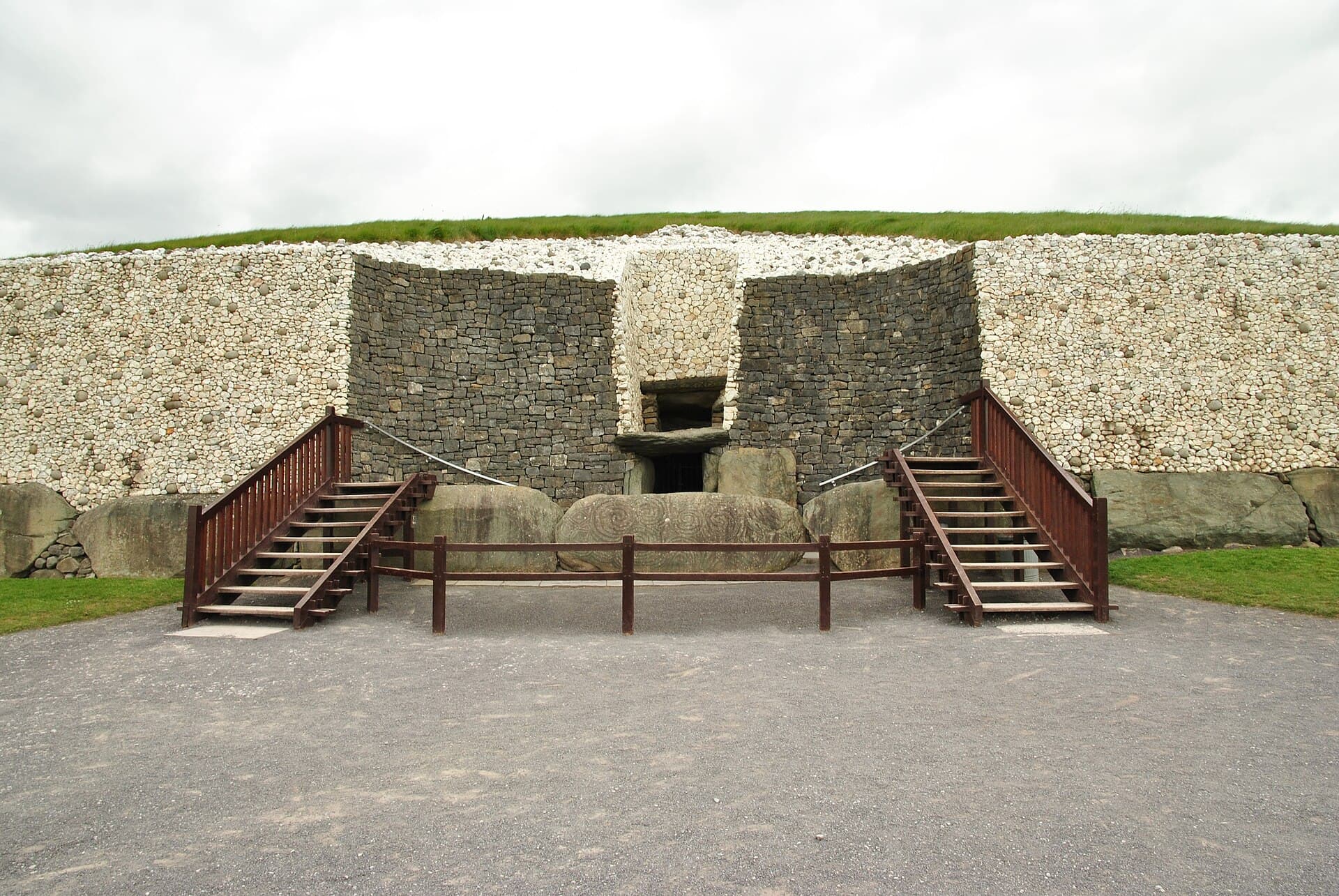
In a bend of the River Boyne in County Meath, Ireland, a wide green mound rises above the fields, ringed at its base by great slabs of carved stone. Newgrange was built around 3200 BC, which makes it older than Stonehenge and older than the pyramids at Giza by several centuries. It is the most famous monument of Brú na Bóinne, a Neolithic landscape of passage tombs, standing stones, and enclosures that UNESCO inscribed on the World Heritage List in 1993 as one of the most important prehistoric ensembles in Europe.
From the outside it reads as a low hill, about 80 metres across and 13 metres high, covering roughly an acre. Inside, a passage of standing stones runs 19 metres into the mound and opens into a cruciform chamber roofed with a corbelled vault of overlapping slabs, still dry after five thousand years without mortar. Above the entrance sits a small rectangular opening, the roof-box, and it is this detail that turned a burial mound into one of the most studied buildings of the ancient world: at dawn on the winter solstice, the rising sun shines through it and reaches the chamber floor.
The people who built Newgrange were farmers, and over generations they turned a fertile river bend into a ceremonial landscape. Britannica places the main construction around 3200 BC, in the same broad period as the neighbouring great mounds of Knowth and Dowth, each of which holds passage tombs of its own. Together the three dominate a complex of about ninety recorded monuments in the bend of the river.
The scale of the undertaking is easiest to grasp in tonnage. The cairn is estimated to contain on the order of two hundred thousand tonnes of stone and earth, gathered, carried, and placed by a society with no metal, no wheel, and no draught animals suited to the work. Estimates of the labour involved run to decades of organised seasonal effort: a community chose to spend an enormous share of its surplus on a house for its dead, and kept choosing it until the mound was closed.
Ninety-seven kerbstones ring the base of the mound, and many of them are carved. The most celebrated is the entrance stone, a slab of greywacke laid on its side before the doorway and covered in deeply picked spirals, lozenges, and arcs, dominated by the tri-spiral: three linked spirals turning into one another, cut with such assurance that the design has become a shorthand for prehistoric Ireland itself. A second richly worked slab, kerbstone 52, stands at the far side of the mound, directly opposite the entrance, and the tri-spiral appears again inside the chamber, carved small on a stone in the end recess where the solstice light falls.
Nobody can say what the carvings meant. They belong to the tradition called megalithic art, and the Brú na Bóinne monuments hold the largest concentration of it in Europe. The motifs are abstract: spirals, zigzags, nested arcs, sun-like circles. What can be said is that the carvers worked before the stones were placed and sometimes carved surfaces that were then hidden against the cairn, which suggests the act of marking mattered as much as the display.
The roof-box is a slot above the entrance, framed in stone and once closed with blocks of quartz. Around the winter solstice, the rising sun clears the ridge across the valley and a narrow beam passes through the opening, over the heads of anyone standing in the passage, and along the floor to the chamber 19 metres in. The light enters shortly before nine in the morning and withdraws again after about seventeen minutes. The effect repeats for a few mornings on either side of the solstice.
Local tradition had long held that the sun entered the tomb, but the alignment was first observed and recorded in modern times by the archaeologist Michael J. O'Kelly, who stood in the chamber at dawn on 21 December 1967 and watched the beam arrive. The precision is no accident: the whole monument is engineered around it, the passage rising gently so that the chamber floor sits level with the roof-box. Demand to witness the event now far exceeds the chamber's capacity, so the Office of Public Works runs an annual lottery for the few dozen places across the solstice mornings, and tens of thousands of people apply each year for the chance to stand in a Stone Age room and wait for the sun.
The structural slabs, the kerbstones, and the passage orthostats are greywacke, a hard grey sandstone found along the coast north of the Boyne estuary. The builders appear to have moved these multi-tonne stones by water, along the coast and up the river, then overland to the ridge. Two other stones came from much farther away, and they came for their colour. White quartz was carried from the Wicklow Mountains, some 70 kilometres to the south, and rounded granite cobbles were gathered from the shores near the Mourne Mountains and Carlingford Lough to the north. Neither holds up a single slab; both were found scattered in quantity at the front of the mound.
Excavating the site between 1962 and 1975, O'Kelly concluded that the quartz and granite had originally formed a facing above the entrance, a glittering white wall studded with dark cobbles, and the reconstruction he oversaw rebuilt it that way: a near-vertical revetment set in concrete, which gives Newgrange its startling modern face. Other archaeologists have argued the quartz could never have stood at that angle, and that it lay instead as a shining apron or plaza on the ground before the entrance, as similar material was left at Knowth. The debate has never fully closed. The white wall a visitor sees today is a twentieth-century argument rendered in Neolithic stone.
Newgrange was a tomb. O'Kelly's excavation recovered burnt and unburnt human bone from the chamber floor and its three recesses, the remains of at least five people, most of them cremated, along with polished stone pendants and beads. The chamber had been open and disturbed for centuries, so five is a floor, not a count; the dead were likely placed over a long period in the great carved basin stones that still sit in the recesses.
In 2020 the bones began to speak in a new register. A team led by geneticists at Trinity College Dublin sequenced ancient DNA from passage tomb burials and published the results in the journal Nature. One adult male from the Newgrange chamber, catalogued as NG10, turned out to be the child of a first-degree union, brother and sister or parent and child. Unions of that kind are close to a universal taboo, and where the ancient world sanctioned them it was among god-kings whose blood was held too sacred to mix. The authors argued that the man's burial in the most prestigious recess of Ireland's most elaborate monument points to a ruling elite of that kind, a dynasty whose members were buried in passage tombs across the island and were distantly related across centuries. They noted, too, a medieval folk tale attached to the neighbouring mound of Dowth, in which a king begins the building by sleeping with his sister: an echo, perhaps, carried four thousand years.
Long after its builders were forgotten, Newgrange kept a life in story. In early Irish literature the mound is Brú na Bóinne, the dwelling of the Boyne, and it belongs to the Dagda, the great father-god of the Tuatha Dé Danann, until his son Aengus wins it from him by asking to stay for a day and a night, then observing that all time is made of days and nights. It stood as a síd, a hollow hill where the old gods lived on after their defeat, a door between the ordinary world and the other one. Medieval tradition also made the ridge a burial place of the kings of Tara. The monument's meaning shifted with each age that inherited it, but no age managed to find it unremarkable.
Its modern history begins by accident. In 1699 workmen employed by the landowner Charles Campbell were carrying away stone from the mound for road building when they uncovered the carved entrance stone and the passage behind it. The Welsh antiquary Edward Lhwyd, travelling in Ireland that year, visited and wrote the first surviving description of the passage and chamber. Three centuries of investigation followed, culminating in O'Kelly's excavation, the state's conservation of the site, and the 1993 UNESCO inscription of the Brú na Bóinne ensemble. Access today is only by guided tour from the Brú na Bóinne Visitor Centre, which keeps the fragile passage from being loved to pieces.
Every year, on the darkest mornings, a beam of sun still travels down a corridor built for it more than five thousand years ago and rests on the floor of a room full of carved spirals. The people who arranged that meeting left no names and no writing, only the work itself: the patience to move a mountain of stone, the observation to fix the sun's turning point on a ridge, the art to mark it all with signs we can no longer read. Newgrange is what remembering looks like when it is done in stone. Its builders could not tell us who they were, so they told us when to stand in their doorway and look east, and seventeen minutes of light each winter has carried the message ever since.
A mound raised before the pyramids
The stones that carry the art
Seventeen minutes of midwinter light
Stone from three landscapes
The dead in the chamber
The house of the Dagda
A chamber that keeps the light
References and resources
- UNESCO World Heritage Centre. "Brú na Bóinne: Archaeological Ensemble of the Bend of the Boyne." World Heritage List, property no. 659, inscribed 1993. whc.unesco.org/en/list/659.
- Encyclopaedia Britannica. "Newgrange." britannica.com/topic/Newgrange.
- Heritage Ireland (Office of Public Works). "Brú na Bóinne Visitor Centre, Newgrange and Knowth." heritageireland.ie.
- Cassidy, L. M., et al. "A dynastic elite in monumental Neolithic society." Nature 582 (2020). nature.com/articles/s41586-020-2378-6.
- Wikipedia. "Newgrange" and "Brú na Bóinne." Retrieved 2026.