Heritage · Landmark
The Bamiyan Valley: the cliff and its empty niches
Two standing Buddhas, 55 and 38 metres tall, were cut into a sandstone cliff in the Afghan highlands around the sixth century, on the road that carried goods and arguments between India, Persia and China. They were destroyed over several weeks in March 2001. What is left is a cliff honeycombed with painted caves, and two vacancies that conservators, archaeologists and the people of the valley have been arguing about ever since.Written to last.
By Confinity Heritage Editorial · 2026-08-25 · 7-minute readQuiet tools, kept out of the way.
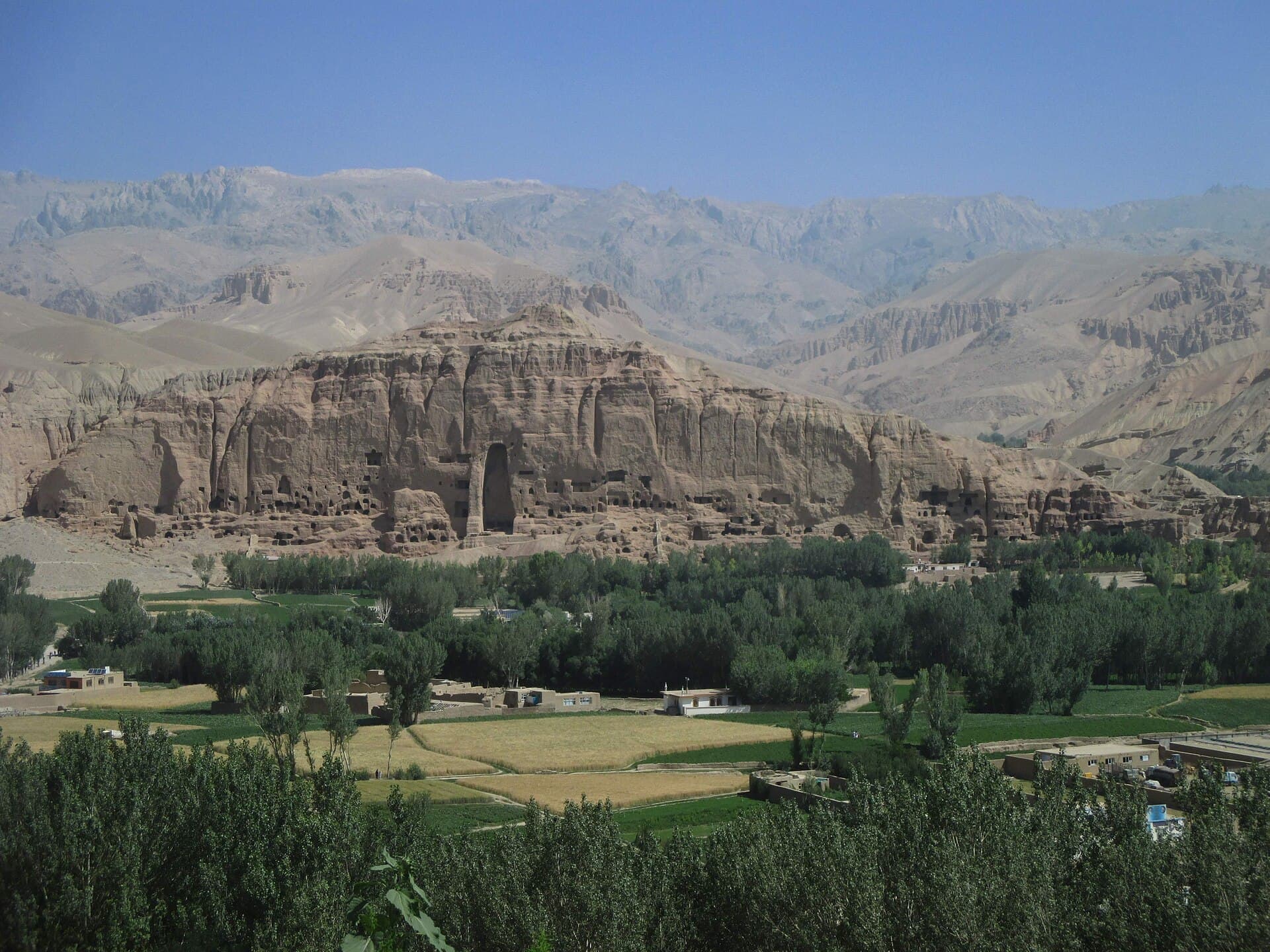
In the central highlands of Afghanistan, enclosed by the mountains of the Hindu Kush, the Bamiyan Valley opens into a wide basin with a long stretch of rock along its northern edge. Two niches are cut into that cliff, one at each end of a kilometre of stone. The larger held a standing Buddha of about 55 metres, the smaller one of about 38 metres, and between and around them the cliff is drilled through with caves, chapels and monastic cells, many of them painted.
The statues have not been there since March 2001. In 2003 UNESCO inscribed the valley on the World Heritage List and placed it on the List of World Heritage in Danger in the same year, a double entry that states plainly what the inscription was for. The property is serial, eight components across the valley and its tributaries, and its citation names both the Gandharan art that flourished here and the destruction of the two figures.
Bamiyan lies roughly 130 kilometres northwest of Kabul at about 2,500 metres, on a corridor through the mountains that carried caravans. At the centre of the basin stand the remains of the fortress of Shahr-i Ghulghulah, of the sixth to tenth centuries, which marks the original settlement as a stopping place on the branch of the Silk Route linking China and India through ancient Bactria.
What arrived along that road is visible in the art. UNESCO's citation describes an interchange of Indian, Hellenistic, Roman, Sasanian and later Islamic influences worked into the Gandharan school. The Chinese pilgrim Xuanzang, who reached the valley on 30 April 630, found more than ten monasteries and over a thousand monks, and recorded that both figures were then decorated with gold and jewels. He also described a third, larger reclining Buddha that has never been found.
Both statues were reliefs, hewn out of the sandstone and merged into the rock at the back, with drapery built up in clay mixed with straw, chaff and animal hair and held to the cliff by ropes fixed to wooden pegs. Conservators at the Technical University of Munich, who examined several hundred fragments after the destruction, found layers up to eight centimetres thick and surfaces smoothed to a finish they compared to fired porcelain. The same team traced repeated repainting: robes dark blue inside, pink and later bright orange outside, and in a later phase the larger figure red and the smaller white, matching an eleventh-century description of one red Buddha and one the colour of the moon.
Until then the age of the statues rested on stylistic comparison. Mass spectrometry at ETH Zurich and the University of Kiel, applied to organic material in the clay, produced narrow ranges instead: 544 to 595 for the smaller eastern Buddha and 591 to 644 for the larger western one. That fixed them in the sixth to seventh century and placed the two carvings a generation or more apart rather than in one campaign. Locally the larger was Salsal and the smaller Shah Mama. The western niche runs about twelve metres deep, the eastern closer to two.
The cliff behind and beside the niches holds a large ensemble of Buddhist monasteries, chapels and sanctuaries, some linked by galleries, with remains of wall paintings and seated Buddha figures inside. The property extends past the main cliff: the Kakrak valley three kilometres to the southeast holds more than a hundred caves of the sixth to thirteenth centuries, fragments of a ten-metre standing Buddha and a sanctuary painted in the Sasanian manner. The painted rooms belong to the same tradition of cutting a monastery into a wall of stone as the rock-cut halls at Ajanta in India.
On 26 February 2001 the Taliban leader Mullah Mohammed Omar issued an edict ordering the destruction of statues across Afghanistan, "so no one can worship or respect them in the future". A public announcement followed on 1 March. Work began at Bamiyan on 2 March and continued for several weeks.
It was slower than expected. The figures were fired on for days with anti-aircraft guns and artillery, which damaged them without bringing them down; the Taliban information minister Qudratullah Jamal said publicly that shelling could not knock out statues carved into a cliff. Anti-tank mines were then laid at the foot of the niches so that falling rock would set them off. In the end men were lowered down the cliff to drill holes and pack them with explosives, and a rocket was fired at one head after a charge failed to remove it.
None of the appeals worked. Ambassadors of the Organisation of the Islamic Conference, including those of Pakistan, Saudi Arabia and the United Arab Emirates, the three states that then recognised the government, asked for the monuments to be spared. Pakistan sent a delegation led by its interior minister, Moinuddin Haider; India offered to take the statues; Japanese delegates proposed covering or buying them. The former king, Mohammed Zahir Shah, objected from exile in Rome.
The legal answer came afterwards. In October 2003 the UNESCO General Conference adopted the Declaration concerning the Intentional Destruction of Cultural Heritage, whose article VI holds that a state which intentionally destroys, or fails to prevent the destruction of, cultural heritage of great importance for humanity bears responsibility for it under international law. UNESCO ties both the Declaration and the double inscription of the valley to what happened here.
While the debate about the niches went on, the cliff produced something nobody had gone looking for. Samples taken from the cave paintings during a UNESCO conservation project were analysed by scientists from the National Research Institute for Cultural Properties in Tokyo, the Centre of Research and Restoration of the French Museums with the CNRS, and the Getty Conservation Institute, using the European Synchrotron Radiation Facility in Grenoble.
In twelve of the fifty caves studied they identified drying oils, probably walnut and poppy seed, in murals painted in the middle of the seventh century. Announced in April 2008 and published in the Journal of Analytical Atomic Spectrometry, the finding was the earliest clear material evidence of oil painting anywhere, several centuries before the technique appears in Europe and well before the twelfth century, which had been the earliest confident date for drying oils in paint. The objection that the oils were contamination from hands touching the images was tested and set aside: the oils lay under later paint layers, and the signal was for deliberate use.
The harder question is what to do now, and it has not been settled. UNESCO's own position, stated at the tenth anniversary in March 2011, is that it does not favour rebuilding the statues. The expert working group that met in Paris that month recommended leaving the larger western niche empty as a monument to the destruction and commissioning a feasibility study on the eastern figure.
On one side is anastylosis, the reassembly of surviving pieces with as little new material as possible. Bert Praxenthaler, a German art historian and sculptor working with ICOMOS, has been recovering fragments since 2004, some weighing up to forty tonnes, and estimates that roughly half the pieces could be put back. He argues that the work is also a local matter, employing and training people in a Hazara community targeted by the same government that blew up the statues. Erwin Emmerling of the Technical University of Munich considers reassembly of the smaller Buddha feasible using an organic silicon consolidant for the porous stone, though it would need either a small factory in the valley or the shipping of some 1,400 blocks to Germany, and he is more sceptical about the larger.
On the other side is the argument that the niches are now the monument. The Italian architect Andrea Bruno, who proposed an underground chamber at the foot of the western niche from which visitors would look up into the void, holds that the empty niche is a defeat for the people who tried to erase the statues, and that rebuilding would be culturally insensitive in a country where most people do not want images restored. Jukka Jokilehto, writing in a UNESCO volume on the question, argues that the society which gave the figures their meaning no longer exists, so any rebuilt Buddha would be inauthentic, and that the effort belongs instead in presenting and interpreting what is still there. The empty niches were part of what was inscribed in 2003, which complicates the idea that filling them would be restoration.
In 2013 the German branch of ICOMOS rebuilt the feet of the smaller Buddha in brick, iron and concrete, and UNESCO halted the work on the grounds that it used new material rather than original fabric and had not been approved. The historian Llewelyn Morgan, who wrote a history of the statues, raises a different objection: Bamiyan pulls archaeological money and attention towards itself in a country where looting, weather and neglect are destroying sites nobody is watching. He also reports that enthusiasm for rebuilding is strongest in the valley itself, and that the national reaction to a reconstructed Buddha would be harder to predict. In 2017 UNESCO convened a technical symposium in Tokyo to weigh the proposals against authenticity, outstanding universal value and the cultural rights of the people who live there. Meanwhile the actual work has been consolidation: the weakened rear wall of the eastern niche took more than fifteen years to stabilise.
In June 2015 two Chinese travellers, Zhang Xinyu and Liang Hong, reached Bamiyan on a journey along the Silk Road, and with permission from the Afghan authorities they set a projector on scaffolding and threw an image of the larger Buddha back into its own niche on the evenings of 6 and 7 June. About a thousand people came. The children of the valley had only ever known the hole in the cliff. The couple, who spent around 120,000 dollars on the equipment, left the projector behind in Bamiyan.
It lasted two evenings and altered nothing, which may be why it was possible at all: it made no claim on the rock and left no new material in the niche. The argument it sidesteps is the one still open, whether a rebuilt figure would return something to Bamiyan or quietly close the record of what was done there in March 2001. An absence can carry a memory as surely as an object, and the empty niches now do work the statues never had to do. Whether that work should end has not been decided.
A basin on the roads between India, Persia and China
Two figures cut from the cliff
The honeycombed cliff
March 2001
Oil under the paint
The argument about the empty niches
One night of light in the western niche
References and resources
- UNESCO World Heritage Centre. "Cultural Landscape and Archaeological Remains of the Bamiyan Valley." World Heritage List, property no. 208, inscribed 2003 and listed as in danger the same year. whc.unesco.org/en/list/208.
- UNESCO World Heritage Centre. "Ten years on, remembering the tragic destruction of the giant Buddha statues of Bamiyan" (2011) and "UNESCO convenes international symposium on the future of the Bamiyan Buddha statues" (2017). whc.unesco.org.
- Technical University of Munich. "Bamiyan Buddhas once glowed in red, white and blue." Press release on the dating and polychromy research of Erwin Emmerling's group. tum.de.
- European Synchrotron Radiation Facility, via ScienceDaily. "Ancient Buddhist paintings from Bamiyan were made of oil, hundreds of years before the technique was invented in Europe" (2008). sciencedaily.com.
- BBC News Magazine. "Bamiyan Buddhas: Should they be rebuilt?" bbc.com/news/magazine-18991066.
- Nagaoka, M. (ed.). "The Future of the Bamiyan Buddha Statues: Heritage Reconstruction in Theory and Practice." UNESCO and Springer, open access, including Jukka Jokilehto, "Reflections on the Case of Bamiyan."
- Wikipedia. "Buddhas of Bamiyan." Retrieved 2026.