Heritage · Landmark
Caral: six pyramids and a knotted cord
On a dry terrace above the Supe valley in Peru, six earthen pyramids and a ring of sunken circular plazas were raised while the pyramids of Giza were going up and Sumer was learning to write. Nobody at Caral fired a pot. Somebody, though, appears to have tied knots in cotton cord to hold information outside a human head.Written to last.
By Confinity Heritage Editorial · 2026-08-25 · 7-minute readQuiet tools, kept out of the way.
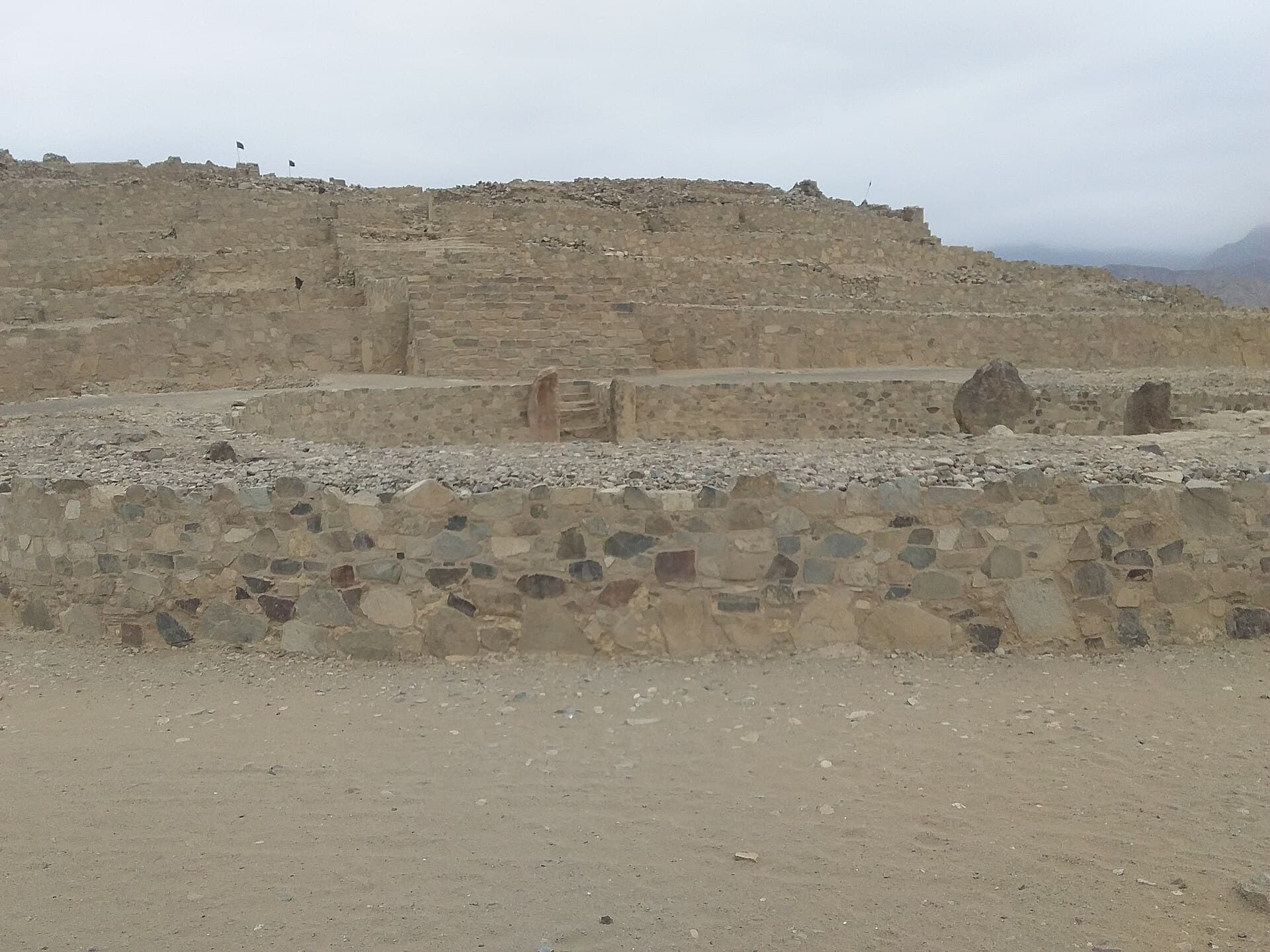
In the Supe valley of Peru, about 180 kilometres north of Lima and some twenty-three kilometres inland from the Pacific, six earthen mounds stand on a dry terrace above a green river floor. From a distance they read as dunes, weathered lumps in a desert pressed between the ocean and the folds of the Andes. They are platform pyramids, and the settlement around them was built and rebuilt between roughly 2600 and 2000 BC. That places it in the same centuries as the pyramids of Giza and the early cities of Sumer. UNESCO inscribed the 626 hectare property in 2009 as the Sacred City of Caral-Supe and described it as the oldest centre of civilisation in the Americas.
The description carries a qualification worth stating at the outset. Caral is usually called the oldest known urban centre in the Americas, and the claim originates with its excavators. Neighbouring sites complicate it: Áspero at the mouth of the Supe and Bandurria further down the coast are of comparable age, and radiocarbon work in the nearby Fortaleza valley has produced an earlier date for a city at Huaricanga. What is not in dispute is that a dense cluster of large, planned, monumental settlements stood on this coast in the third millennium BC, and that Caral is the biggest and by far the most closely studied of them.
The city is laid out in two halves divided by the river valley. The upper half holds six monumental complexes, each built around a platform mound with an open plaza and a cluster of residential buildings; the lower half holds smaller pyramids, more modest houses, and a single large complex known as the Temple of the Amphitheatre. Diet and room size differ sharply between the two, which archaeologists read as a city planned from the start around an unequal social order.
The largest structure, the Pirámide Mayor, covers ground close to the area of four football fields and rises about 18 metres. A staircase nine metres wide climbs from a sunken circular plaza at its foot, over three terraced levels, to an atrium and a large hearth on the summit. Those sunken circular courts, set into the ground before the mounds, are the signature of the place and of the architecture that followed it: the pairing of a raised platform with a recessed round plaza would dominate the Peruvian coast for centuries afterwards.
The mounds were raised with a technique that later gave the site its chronology. Workers wove reeds into carrying bags called shicras, filled them with stone from a hillside quarry about 1.5 kilometres away, and stacked them inside retaining walls. No metal, no wheel, no draught animals: fibre, stone, and organised labour.
Caral was seen and dismissed more than once. Max Uhle recorded the site in 1905 without recognising the hills as pyramids. Paul Kosok surveyed it in 1948 and argued for its antiquity, and was largely disbelieved, because a settlement of that size and complexity was assumed to be recent. Carlos Williams documented the Supe valley sites in 1975. It was Ruth Shady, an archaeologist attached to the National University of San Marcos in Lima, who returned in 1994 and began excavating in 1996, working with a small budget, borrowed soldiers, and often her own money.
In 1999 she sent samples of the shicra reeds for radiocarbon analysis to Jonathan Haas at the Field Museum in Chicago and Winifred Creamer at Northern Illinois University. In December 2000 the results came back at around 4,600 years old. The three published them in Science on 27 April 2001, and the dates moved the earliest known urban centre in the Americas back by more than a thousand years at a stroke. The calibrated range ran from about 2627 BC to about 1977 BC.
The collaboration did not survive the discovery. Shady later accused Haas and Creamer of taking credit for research she had begun in 1994. They were cleared of plagiarism by their institutions, though the Field Museum's science advisory council rebuked Haas for press material that overstated the American role. The episode is a reminder that Caral's public record was shaped by a fight over authorship as well as by the evidence.
Before any of the dating, Shady spent two months with her crew looking for potsherds, the broken pottery that litters almost every archaeological site of any size. They found none. That absence, rather than disappointing her, was the first real signal: Caral was preceramic, built and inhabited before pot-firing reached this part of the Andes.
The practical substitute appears to have been the gourd. Dried squash served as containers and as floats for fishing nets, removing much of the pressure that drives a society toward ceramics. So a city of thousands, with monumental architecture, irrigation canals, long-distance trade in coca leaf and Amazonian fruit, and a visible elite, ran without a single fired pot. The people of Caral skipped a rung that most accounts treat as foundational and built pyramids anyway.
Among the objects recovered at Caral is a piece of knotted cotton cord that the excavators identified as a quipu, or khipu, the Andean knotted-string record. It was found in good condition alongside a deposit of offerings that included cotton fibre balls wrapped in netting, reed baskets, and a ball of cotton thread. The cords are brown cotton wound around thin sticks. Shady and her team reported the object as roughly five thousand years old, within the site's preceramic span, and UNESCO's statement of outstanding universal value cites the early use of the quipu as a recording device as one of the reasons the property was inscribed.
If that identification and that date hold, the implication is large. The khipu is the record-keeping system of the Inca, the people who built Machu Picchu and administered an empire of ten million without an alphabet, tracking tribute, census, and calendar in knots. A khipu at Caral would push the technique back roughly four thousand years before them.
The identification is not secure, and the honest position is that it remains open. Specialists in the khipu literature note that the Caral claim has yet to be thoroughly evaluated, and that objects unambiguously identifiable as khipu first appear in the archaeological record during the Middle Horizon, around 600 to 1000 AD, associated with the Wari. Some researchers regard the spiral-wrapped batons and cords from the Late Paracas site of Cerrillos, around 350 to 200 BC, as a more defensible candidate for an early precursor. Knotted cord is also, plainly, a thing textile people make for many reasons, and distinguishing a record from a bundle of string is hard when there is no comparative material for three thousand years on either side.
Held carefully, though, the object is still the most interesting thing at Caral. At the point where urban life in the Americas begins, in the same generations that raised the first monumental architecture on the continent, somebody appears to have been making a device for keeping information outside a human head. Memory delegated to an object, so that it survives the person who has it.
The Temple of the Amphitheatre, a sunken court that could have held several hundred people, produced the site's other remarkable assemblage. Inside it, Shady's team found thirty-two flutes made from pelican and condor bone, some of them carved. In April 2002 they added thirty-seven cornets of deer and llama bone. The flutes have been radiocarbon dated to around 2170 BC.
Thirty-two of anything is not a household item. A single flute is a person; thirty-two in one ceremonial space is an ensemble, which implies rehearsal, tuning conventions, and an occasion large enough to need that much sound. Condor and pelican tie the highlands and the sea together in one object, matching the trade network that fed the city. Whatever happened in that court was collective, repeated, and worth the bones of large birds.
Caral's excavators have made a further claim that has travelled widely. No fortifications have been found at the site, no defensive walls, no weapons, no burned buildings, no bodies showing the mutilations that mark warfare. Haas, working across the wider Norte Chico region, went as far as stating that there is no evidence of warfare of any kind or at any level during the preceramic period, and that settlement patterns are entirely non-defensive. Shady has argued along similar lines, contrasting Caral with the older site of Sechín Bajo, where weapons are depicted. Fieldwork published in 2025 on the drought that emptied the valley around 2200 BC noted the same continuing absence of fortification at the successor settlements of Vichama and Peñico.
This should be read as an interpretation with named proponents, not as an established fact, and it rests on a weaker kind of argument than a positive find. Absence of evidence is not evidence of absence: only a fraction of the site has been excavated, organic weapons decay, and a society can be coercive without leaving battlements. Caral itself supplies a caution. Human remains recovered in ceremonial and construction contexts have been interpreted as deliberate killings, including what has been described as the earliest known evidence of human sacrifice in the Andes, and infant burials at nearby Áspero have been read the same way. A city with no army may still have had victims.
Caral survived because it was abandoned early, reoccupied only lightly, and held no gold or silver worth looting. Its modern threats are different. In 2021 Shady received death threats from squatters whose land claims and building work were pressing into the archaeological zone, a dispute over ground that has now been contested for four and a half thousand years. Work in the valley continues, and the associated site of Peñico opened to visitors in 2025.
What the place offers is a beginning without the usual accompaniment. No writing, no pottery, no metal, no ramparts. Six mounds, a set of round sunken courts, a valley of cotton, an ensemble of bone flutes, and a handful of knotted cords that may or may not be the oldest attempt in the Americas to make a record that outlasts its maker. That uncertainty is part of why Caral is worth returning to. It is the point where a continent began keeping things, and we are still working out what the first thing it kept was.
Six mounds above the Supe
The reeds that reset the clock
A city that never fired a pot
The knotted cord
Thirty-two flutes in the amphitheatre
The argument from absence
What the valley still holds
References and resources
- UNESCO World Heritage Centre. "Sacred City of Caral-Supe." World Heritage List, property no. 1269, inscribed 2009. whc.unesco.org/en/list/1269.
- Ross, John. "First City in the New World?" Smithsonian Magazine, August 2002. smithsonianmag.com.
- Shady Solís, Ruth, Jonathan Haas, and Winifred Creamer. "Dating Caral, a Preceramic Site in the Supe Valley on the Central Coast of Peru." Science 292, no. 5517 (27 April 2001): 723 to 726.
- Mann, Charles C. "Unraveling Khipu's Secrets." Science 309, no. 5737 (12 August 2005): 1008 to 1009.
- Haas, Jonathan, Winifred Creamer, and Alvaro Ruiz. "Power and the Emergence of Complex Polities in the Peruvian Preceramic." Archeological Papers of the American Anthropological Association 14 (2005).
- BBC. "Horizon: The Lost Pyramids of Caral," transcript, 2001. bbc.co.uk/science/horizon/2001/caraltrans.shtml.
- Collyns, Dan. "Squatters issue death threats to archaeologist who discovered oldest city in the Americas." The Guardian, 3 January 2021.
- Wikipedia. "Caral," "Caral-Supe civilization," "Quipu," and "Ruth Shady." Retrieved 2026.