Heritage · Landmark
Herculaneum: the town Vesuvius carbonised
A seaside Roman town on the Bay of Naples that was not buried in ash but sealed under twenty metres of volcanic rock. The heat blackened wood instead of consuming it, leaving roof beams, doors, a folding screen, bread and rope where they stood, along with the only library to survive from the ancient world.Written to last.
By Confinity Heritage Editorial · 2026-08-25 · 7-minute readQuiet tools, kept out of the way.
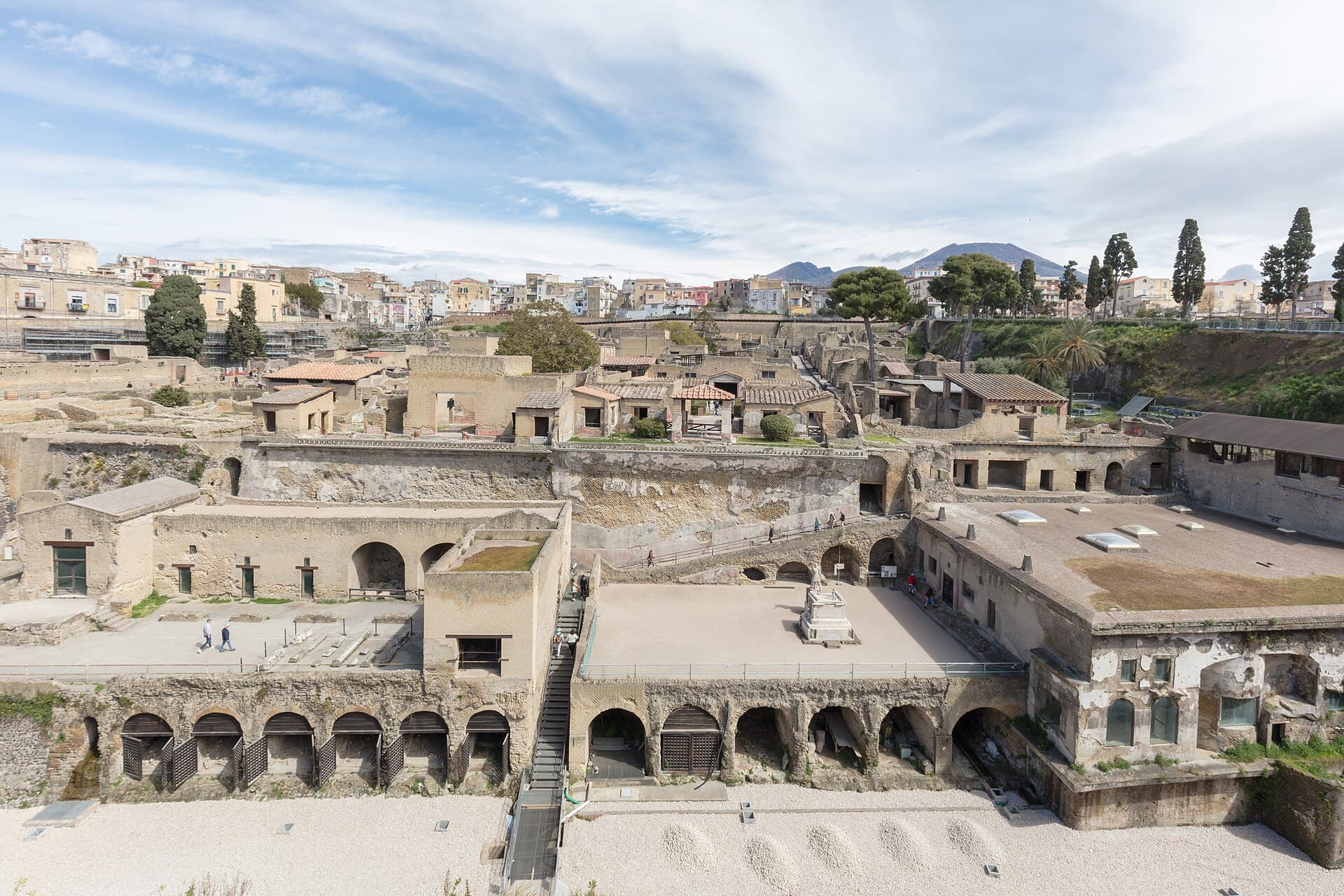
Herculaneum stands on the Bay of Naples in Campania, southern Italy, a few kilometres west of the volcano that killed it. It was smaller than Pompeii and wealthier for its size, a town of perhaps five thousand people whose houses stepped down toward the water. Both towns died in the eruption of Vesuvius in 79 AD, and both are inscribed in a single UNESCO World Heritage property with the villas at Torre Annunziata. They did not die the same way. In Pompeii the roofs fell in under falling stone. In Herculaneum the roof beams are still up there, black as coal and holding.
For most of the first day the eruption column leaned southeast, and the pumice and lapilli it dropped fell on Pompeii, piling on the roofs until timber gave way. Herculaneum lay to the west, out of that fall, and received almost none of it. What reached Herculaneum came later and came at speed: pyroclastic surges, ground-hugging clouds of ash and hot gas moving at roughly 160 kilometres per hour. Six of them arrived in succession.
Each surge laid down its own bed, and each bed set. Pompeii lies under roughly four to six metres of loose ash and stone. Herculaneum lies under about twenty metres of consolidated volcanic deposit, hard enough that early excavators worked it with picks and gunpowder rather than shovels. That difference governs everything else: what survived, how it was dug, how much is still down there, and how hard it is to keep what has been uncovered.
The heat matters as much as the depth. A 2023 study in Scientific Reports used reflectance analysis of charcoal from the town to reconstruct the first surge, and put it at between about 495 and 555 degrees Celsius, and short-lived. Hot enough to kill instantly, brief enough that the wood did not fully burn. Laboratory carbonisation of timber at a steady temperature takes at least a day. What passed over Herculaneum was fast, hot and starved of oxygen, the combination that chars rather than consumes.
The result is a class of evidence Pompeii cannot supply. Roof beams, doors, staircases, lintels, bed frames, a linen press, shelving, small boats and rope all survive here in carbonised form, along with seeds, cereals, fruit and loaves left in a baker's oven. The park's summary of these organic finds is a list of things that do not usually last two thousand years anywhere.
The signature object is a folding wooden screen in the house now named for it, the House of the Wooden Partition. It divided the atrium from the reception room behind, and it survives with panels, frame and hinging mechanism legible, blackened but not deformed. Elsewhere a cradle still rocks on its runners, and a carbonised couch and table give another house its name.
 The folding screen in the House of the Wooden Partition, charred to black but structurally intact, including its hinges. Photograph by Carole Raddato, CC BY-SA 2.0, via Wikimedia Commons.
Because upper storeys were packed rather than crushed, Herculaneum also keeps second floors, balconies and window frames. The town reads as a place rather than a plan.
A little outside the excavated town, under the modern streets of Ercolano, lies a large seafront villa possibly owned by Lucius Calpurnius Piso Caesoninus, the father-in-law of Julius Caesar. Bourbon tunnellers reached it in the 1750s and brought up roughly ninety bronzes and marbles, now in the archaeological museum in Naples. They also found, in a small room, about 1,800 carbonised papyrus rolls. Workmen took some of the blackened cylinders for charcoal and threw them away.
What they had found is the only library from classical antiquity to survive as a collection rather than as copies of copies: an actual set of books, on their shelves, in a house, on a particular day. The 1,800 rolls and fragments are thought to represent something like 800 original works, mostly Greek philosophy, with a heavy concentration of Epicurean writing by Philodemus of Gadara.
For 250 years the library was largely mute, because opening a carbonised roll destroys it. In 1756 the Vatican conservator Antonio Piaggio built a machine that lifted the layers apart with silk threads at a rate of millimetres a day; the first scroll took four years, and the method sacrificed the outer turns of every papyrus it touched. By the middle of the twentieth century 585 rolls or fragments had been fully unrolled and 209 partly so, with roughly 200 texts published. Hundreds were never opened at all, because opening them was the same as losing them.
The way out is to read the ink through the wrapped papyrus. Brent Seales of the University of Kentucky spent years developing virtual unwrapping, in which X-ray tomography maps the layers of a rolled object and software flattens them into readable surfaces. Herculaneum ink is carbon on carbon, with almost no density contrast, which made it the hardest possible target.
In March 2023 Seales, with Nat Friedman and Daniel Gross, launched the Vesuvius Challenge, an open competition with cash prizes for reading scanned scrolls. Casey Handmer noticed a faint crackle texture in the scans that turned out to mark where ink sat. In October 2023 Luke Farritor, then a computer science student, trained a model on that signal and recovered the first word ever read from inside an unopened Herculaneum scroll: porphyras, purple. On 5 February 2024 the $700,000 grand prize went to Farritor, Youssef Nader and Julian Schilliger for about 2,000 characters across fifteen columns, roughly five percent of one scroll, PHerc. Paris. 4, in a passage on pleasure attributed to Philodemus.
Progress since has been real and narrower than the headlines suggest. On 5 May 2025 a $60,000 prize went to Marcel Roth and Micha Nowak of the University of Würzburg, with the same result reached independently by Sean Johnson, for recovering the title and author of PHerc. 172 in Oxford: Philodemus, On Vices, book one. It was the first time a still-rolled scroll had given up its title. On 25 June 2026 the project announced that PHerc. 1667 had been virtually unwrapped and read end to end, about 1.4 metres of papyrus and some twenty-two columns of Greek, an ethical treatise in a Stoic line naming Aristocreon, nephew of Chrysippus. The preprint published two days later also identifies PHerc. 139 as Philodemus, On Gods, book eight.
Set that against the size of the problem. As of mid-2026 the challenge reports 45 scrolls and fragments scanned out of roughly 1,800, and one read from beginning to end. The method works. The library has not been read.
Herculaneum yielded very few bodies for two centuries of digging, and the reasonable inference was that the town had emptied in time. That changed in 1980, when work along the buried shoreline under the site director Giuseppe Maggi opened a row of twelve vaulted chambers, the fornici, that had held boats and gear. People were inside them.
Excavation between 1980 and 1982 recovered more than fifty individuals from the first six chambers and the beach in front. Further work in the 1990s raised the total to around three hundred, and roughly 340 have now been identified. They were adults and children together, some carrying money and jewellery, gathered at the water's edge in the dark waiting for boats that did not come.
The bones carry heat damage, and the 2023 surge study is consistent with death that was immediate rather than prolonged. The mechanism is still argued over: a 2018 hypothesis of rapid vaporisation of body fluids has been questioned by specialists who read the skeletal evidence as requiring longer exposure, and the two accounts may apply to different situations within the site. The correction to the record is not in dispute. The town did not get away.
Herculaneum was found by accident in 1709, when a well shaft struck the stage of the theatre. Systematic work began in 1738 under Charles of Bourbon, directed by the military engineer Roque Joaquín de Alcubierre and later by the Swiss engineer Karl Weber. Under twenty metres of rock there was no possibility of open excavation, so the site was mined: narrow tunnels driven through the deposit by torchlight, in bad air and standing water, looking for statues and marble.
The cost was severe. Objects were prised out and sent to the royal collection with little record of where they had stood. Frescoes were cut from walls and the remainder often abandoned. Tunnels were backfilled with spoil as they advanced, sealing rooms again behind the diggers. Work at the villa stopped around 1765 after complaints from the town above, and its position was lost for two centuries. Weber's plan of the villa is the redeeming document of the period and still the basis for arguments about what lies inside. Open-air excavation only began in 1927, under Amedeo Maiuri, whose campaigns cleared roughly four hectares of a town estimated at twenty.
Maiuri's open trench solved one problem and created another. Herculaneum now sits in a pit with twenty-metre faces of volcanic rock around it and a modern town on top, and water moves through that bank into the ancient streets. The upper storeys that make the site unique are also the most exposed, and carbonised wood stable for two thousand years starts to deteriorate the moment it meets air, light and rain. Since 2001 the Herculaneum Conservation Project, a partnership between the Packard Humanities Institute and the archaeological park, has worked on drainage, roofing, wood consolidation and routine maintenance rather than on new discoveries.
That choice is contested. Over three quarters of the town is still buried, the forum among it, and most of the Villa of the Papyri has never been excavated. In March 2016 a group of British, American and French scholars led by Robert Fowler of Bristol called publicly for digging to resume, arguing that the unexcavated part of the library may hold Greek and Latin works otherwise lost, and that Vesuvius will erupt again. Fowler put it plainly: "The lost works waiting to be found there stagger the imagination." Andrew Wallace-Hadrill, scientific director of the conservation project, argued the other side: the embankments crumble, water is already damaging the levels reached in the 1990s, and no case can be made for uncovering more while what is uncovered is being lost.
Virtual unwrapping has sharpened rather than settled that argument. If sealed scrolls can be read where they lie, the case for hurrying weakens and the case for waiting for better methods grows. The town kept its wooden doors on their hinges for two thousand years under rock. It has kept them for barely a century in the open.
The folding screen in the House of the Wooden Partition, charred to black but structurally intact, including its hinges. Photograph by Carole Raddato, CC BY-SA 2.0, via Wikimedia Commons.
Because upper storeys were packed rather than crushed, Herculaneum also keeps second floors, balconies and window frames. The town reads as a place rather than a plan.
A little outside the excavated town, under the modern streets of Ercolano, lies a large seafront villa possibly owned by Lucius Calpurnius Piso Caesoninus, the father-in-law of Julius Caesar. Bourbon tunnellers reached it in the 1750s and brought up roughly ninety bronzes and marbles, now in the archaeological museum in Naples. They also found, in a small room, about 1,800 carbonised papyrus rolls. Workmen took some of the blackened cylinders for charcoal and threw them away.
What they had found is the only library from classical antiquity to survive as a collection rather than as copies of copies: an actual set of books, on their shelves, in a house, on a particular day. The 1,800 rolls and fragments are thought to represent something like 800 original works, mostly Greek philosophy, with a heavy concentration of Epicurean writing by Philodemus of Gadara.
For 250 years the library was largely mute, because opening a carbonised roll destroys it. In 1756 the Vatican conservator Antonio Piaggio built a machine that lifted the layers apart with silk threads at a rate of millimetres a day; the first scroll took four years, and the method sacrificed the outer turns of every papyrus it touched. By the middle of the twentieth century 585 rolls or fragments had been fully unrolled and 209 partly so, with roughly 200 texts published. Hundreds were never opened at all, because opening them was the same as losing them.
The way out is to read the ink through the wrapped papyrus. Brent Seales of the University of Kentucky spent years developing virtual unwrapping, in which X-ray tomography maps the layers of a rolled object and software flattens them into readable surfaces. Herculaneum ink is carbon on carbon, with almost no density contrast, which made it the hardest possible target.
In March 2023 Seales, with Nat Friedman and Daniel Gross, launched the Vesuvius Challenge, an open competition with cash prizes for reading scanned scrolls. Casey Handmer noticed a faint crackle texture in the scans that turned out to mark where ink sat. In October 2023 Luke Farritor, then a computer science student, trained a model on that signal and recovered the first word ever read from inside an unopened Herculaneum scroll: porphyras, purple. On 5 February 2024 the $700,000 grand prize went to Farritor, Youssef Nader and Julian Schilliger for about 2,000 characters across fifteen columns, roughly five percent of one scroll, PHerc. Paris. 4, in a passage on pleasure attributed to Philodemus.
Progress since has been real and narrower than the headlines suggest. On 5 May 2025 a $60,000 prize went to Marcel Roth and Micha Nowak of the University of Würzburg, with the same result reached independently by Sean Johnson, for recovering the title and author of PHerc. 172 in Oxford: Philodemus, On Vices, book one. It was the first time a still-rolled scroll had given up its title. On 25 June 2026 the project announced that PHerc. 1667 had been virtually unwrapped and read end to end, about 1.4 metres of papyrus and some twenty-two columns of Greek, an ethical treatise in a Stoic line naming Aristocreon, nephew of Chrysippus. The preprint published two days later also identifies PHerc. 139 as Philodemus, On Gods, book eight.
Set that against the size of the problem. As of mid-2026 the challenge reports 45 scrolls and fragments scanned out of roughly 1,800, and one read from beginning to end. The method works. The library has not been read.
Herculaneum yielded very few bodies for two centuries of digging, and the reasonable inference was that the town had emptied in time. That changed in 1980, when work along the buried shoreline under the site director Giuseppe Maggi opened a row of twelve vaulted chambers, the fornici, that had held boats and gear. People were inside them.
Excavation between 1980 and 1982 recovered more than fifty individuals from the first six chambers and the beach in front. Further work in the 1990s raised the total to around three hundred, and roughly 340 have now been identified. They were adults and children together, some carrying money and jewellery, gathered at the water's edge in the dark waiting for boats that did not come.
The bones carry heat damage, and the 2023 surge study is consistent with death that was immediate rather than prolonged. The mechanism is still argued over: a 2018 hypothesis of rapid vaporisation of body fluids has been questioned by specialists who read the skeletal evidence as requiring longer exposure, and the two accounts may apply to different situations within the site. The correction to the record is not in dispute. The town did not get away.
Herculaneum was found by accident in 1709, when a well shaft struck the stage of the theatre. Systematic work began in 1738 under Charles of Bourbon, directed by the military engineer Roque Joaquín de Alcubierre and later by the Swiss engineer Karl Weber. Under twenty metres of rock there was no possibility of open excavation, so the site was mined: narrow tunnels driven through the deposit by torchlight, in bad air and standing water, looking for statues and marble.
The cost was severe. Objects were prised out and sent to the royal collection with little record of where they had stood. Frescoes were cut from walls and the remainder often abandoned. Tunnels were backfilled with spoil as they advanced, sealing rooms again behind the diggers. Work at the villa stopped around 1765 after complaints from the town above, and its position was lost for two centuries. Weber's plan of the villa is the redeeming document of the period and still the basis for arguments about what lies inside. Open-air excavation only began in 1927, under Amedeo Maiuri, whose campaigns cleared roughly four hectares of a town estimated at twenty.
Maiuri's open trench solved one problem and created another. Herculaneum now sits in a pit with twenty-metre faces of volcanic rock around it and a modern town on top, and water moves through that bank into the ancient streets. The upper storeys that make the site unique are also the most exposed, and carbonised wood stable for two thousand years starts to deteriorate the moment it meets air, light and rain. Since 2001 the Herculaneum Conservation Project, a partnership between the Packard Humanities Institute and the archaeological park, has worked on drainage, roofing, wood consolidation and routine maintenance rather than on new discoveries.
That choice is contested. Over three quarters of the town is still buried, the forum among it, and most of the Villa of the Papyri has never been excavated. In March 2016 a group of British, American and French scholars led by Robert Fowler of Bristol called publicly for digging to resume, arguing that the unexcavated part of the library may hold Greek and Latin works otherwise lost, and that Vesuvius will erupt again. Fowler put it plainly: "The lost works waiting to be found there stagger the imagination." Andrew Wallace-Hadrill, scientific director of the conservation project, argued the other side: the embankments crumble, water is already damaging the levels reached in the 1990s, and no case can be made for uncovering more while what is uncovered is being lost.
Virtual unwrapping has sharpened rather than settled that argument. If sealed scrolls can be read where they lie, the case for hurrying weakens and the case for waiting for better methods grows. The town kept its wooden doors on their hinges for two thousand years under rock. It has kept them for barely a century in the open.
Ash fell on one town, rock swallowed the other
Wood that blackened instead of burning
The Villa of the Papyri and its unreadable library
Reading a scroll without opening it
The chambers on the old shoreline
What the Bourbon tunnels cost
Keeping a wet town dry, and the argument about digging further
References and resources
- Archaeological Areas of Pompei, Herculaneum and Torre Annunziata, UNESCO World Heritage Centre, property no. 829, inscribed 1997.
- Organic finds, Parco Archeologico di Ercolano, official site of the archaeological park.
- An entire Herculaneum scroll has been read for the first time, Vesuvius Challenge, announced 25 June 2026, and the 2023 Grand Prize results, awarded 5 February 2024.
- Angelotti, G., Parsons, S., Nicolardi, F., et al. Complete virtual unwrapping and reading of a rolled Herculaneum papyrus, preprint, 27 June 2026.
- Pensa, A., Giordano, G., Corrado, S., and Petrone, P. P. A new hazard scenario at Vesuvius: deadly thermal impact of detached ash cloud surges in 79CE at Herculaneum, Scientific Reports, 2023.
- Herculaneum Conservation Project, Packard Humanities Institute and Parco Archeologico di Ercolano, from 2001.
- Further exploration at Herculaneum could 'stagger the imagination', The Art Newspaper, 18 May 2016.
- Herculaneum and Herculaneum papyri, Wikipedia. Retrieved 2026.