Heritage · Landmark
Mohenjo-daro: the city that left no sentence
A grid of fired brick on the Indus floodplain, laid out around 2500 BC with covered drains along the streets, wells through every quarter and bathing floors in ordinary houses. Its people left thousands of inscribed seals and a bronze girl with her hand on her hip, and after a century of work nobody can read a line of what they wrote.Written to last.
By Confinity Heritage Editorial · 2026-08-25 · 7-minute readQuiet tools, kept out of the way.
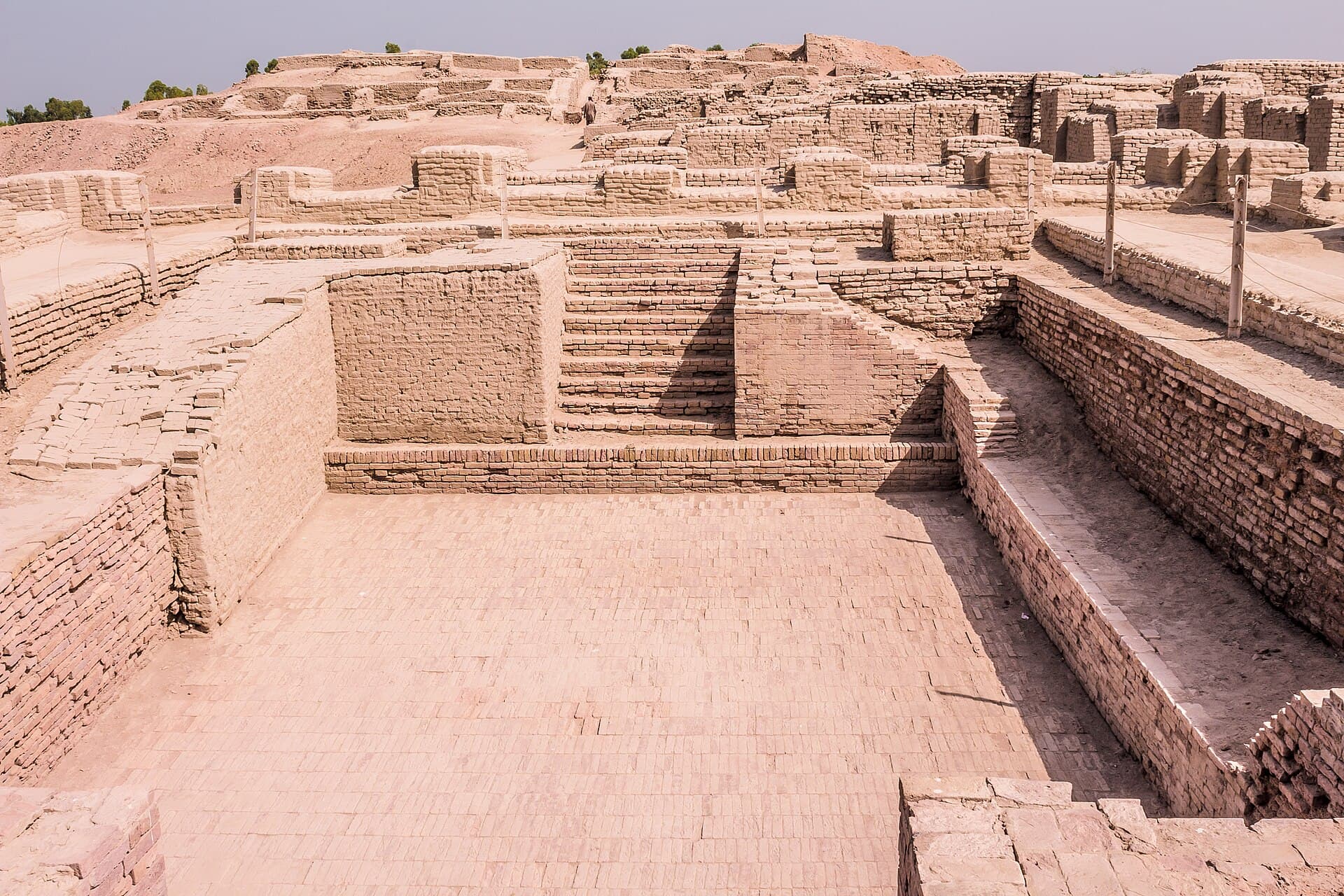
On the right bank of the Indus in Larkana District, in the Sindh province of Pakistan, a grid of brick walls stands a metre or two above a flat river plain. The Sindhi name means something close to the mound of the dead. The city was raised around the middle of the third millennium BC, one of the largest of the Indus civilisation, and UNESCO inscribed the ruins in 1980 as the best preserved urban settlement in South Asia of that date.
What startled the people who dug it was how ordinary the planning is. Streets meet at right angles, the bricks are a standard size, covered drains follow the lanes, wells stand through every quarter, and many houses have a paved floor for bathing. It is municipal engineering four and a half thousand years old, built to a specification. Nobody knows what any of them called it.
For most of recorded history this was a low ridge with a Buddhist stupa of the second century AD on top, raised in unbaked brick over ruins nobody suspected. R. D. Banerji of the Archaeological Survey of India came to study the stupa around 1919 and found seals and worked flints in the mound below; UNESCO dates the discovery to 1922. Within a few years John Marshall and Ernest Mackay were running large excavations, and the urban history of the subcontinent ran back two thousand years further than the textbooks had allowed.
Mackay dug on through the 1930s, Mortimer Wheeler in the later 1940s, George Dales in 1964 and 1965, after which excavation stopped because exposed brick was decaying faster than anyone could conserve it. UNESCO records 240 hectares of burnt brick structures, about a third of it excavated.
The lower city sits on a grid, wide arterial streets dividing blocks threaded with lanes. The brick is fired to a consistent proportion of one to two to four, thickness to width to length, a ratio repeated at Indus sites hundreds of kilometres apart. The weights follow the same discipline, small cubes of chert cut to a standard series used across the whole civilisation.
The water engineering is what stops visitors: covered drains along the streets, fed by chutes from the houses, with soak pits for sewage. More than seven hundred wells have been counted, roughly one for every three houses. Ordinary houses, not only large ones, have a small room with a sloping paved floor and a corner drain for bathing. Whatever the city's politics were, the plumbing was not reserved for a palace.
The western mound, raised on a platform and called the citadel, carries the image of the site. The Great Bath is a sunken tank about 12 metres by 7 and 2.4 metres deep, reached by broad stairs from north and south. Floor and walls are finely fitted bricks laid on edge with a gypsum plaster, backed by bitumen to hold the water. Most archaeologists read it as a setting for ritual bathing, on the evidence of the building's form and much later South Asian practice rather than anything the city says.
Two nearby buildings have names that outlived their evidence. Wheeler identified a structure with air ducts as a granary holding the city's grain reserve; Jonathan Mark Kenoyer later pointed to the complete lack of evidence for grain in it and proposed the neutral label of Great Hall. A block of 78 rooms became the College of Priests on no firmer basis.
The broken soapstone figure 17.5 centimetres high carries the problem furthest. Mackay thought him a priest, Marshall a king-priest, and Wheeler appears to have been the first to say Priest-King, a name that imported a Mesopotamian model of theocratic rule into a city with no palace, no royal tomb and no securely identified temple. Current scholarship prefers authority spread across families or clans, and whether Mohenjo-daro had rulers in any sense we would recognise is unsettled.
Around four thousand inscribed objects survive from the Indus world, most of them small steatite seals carved with an animal and a short line of signs, the rest sealings, copper tablets and marked pottery. The corpus has been catalogued, concordanced and run through every statistical method available, and it remains unread.
Three things make it hard. There is no bilingual, nothing to play the part the Rosetta Stone played for Egyptian. The inscriptions are very short, averaging around five signs, with texts of more than one line rare. And nobody agrees what language would lie underneath: Asko Parpola and others argue for Dravidian, S. R. Rao argued for Indo-Aryan, a Munda hypothesis has had a few supporters, and more than a hundred mutually exclusive decipherments have been published since the 1920s. Even the sign list is disputed, Iravatham Mahadevan counting 419 signs and Bryan Wells putting the number nearer 694, because you cannot tell a separate sign from a variant without knowing how the system works.
In 2004 Steve Farmer, Richard Sproat and Michael Witzel argued that the field had never established its central premise. Their paper, The Collapse of the Indus-Script Thesis, holds that the signs are not writing but non-linguistic symbols standing for families, clans, deities and religious ideas, of a kind used widely in the ancient Near East. Their evidence is the brevity of the texts, the number of signs appearing only once or twice, the absence of the repetition real language produces, and the failure of the system to drift in a linguistic direction over six centuries. They also offered a cash prize for one long inscription, never claimed.
The reply came fast and the argument is still running. In 2009 Rajesh Rao and colleagues measured the conditional entropy of Indus sign sequences and found it closer to known writing systems such as Sumerian than to non-linguistic comparison sets. Rao's own account is careful: the result is consistent with a linguistic system and does not on its own prove one. Sproat answered that the method lacked discriminative power, and that running it on symbol sets nobody thinks are writing produced similar numbers. Most specialists still assume the signs encode language, and the non-script thesis is a minority position whose lasting effect has been to make the majority argue for a premise it once took for granted.
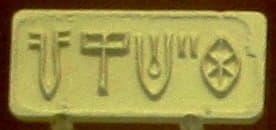 An impression of an Indus seal, five characters set above the animal. Inscriptions of this length are typical, and the brevity is one reason the script has resisted a century of work. Photograph by PHGCOM, CC BY-SA 3.0, via Wikimedia Commons.
When British India was partitioned in 1947 the excavated material was partitioned with it. Roughly 12,000 objects, most of them potsherds, were split between the two new states, and in places the division was taken literally: necklaces and girdles were dismantled and the beads shared into two piles. Pakistan asked for and received the Priest-King; India kept the Dancing Girl, a bronze a little over ten centimetres tall, cast by the lost wax method, standing with one hand on her hip. So the stone head is in Karachi and the bronze from the same city is in New Delhi.
What stayed in Pakistan is held mostly at the National Museum in Karachi and the site museum, and Pakistan built its discipline from the institutions it had, among them the University of the Punjab at Lahore, the country's oldest.
Mohenjo-daro was largely abandoned by around 1700 BC, and for a generation the standard explanation was violent. Wheeler, pointing to groups of skeletons in the lower town, declared that Indra, the war god of the Rigveda, stood accused, and the fall of the Indus cities entered popular history as an Aryan invasion.
It did not survive scrutiny. In 1964 George Dales published The Mythical Massacre at Mohenjo-daro and worked through the skeletons group by group. Nine seasons of digging had produced about 37 skeletons or fragments from the Indus period, scattered across different levels and different centuries, none inside the fortified citadel, and there was no destruction layer, no extensive burning, no armed dead, no sign of a final defence.
What replaced it is less dramatic and better supported. The monsoon belt shifted, the region dried through the second millennium BC, and the Ghaggar-Hakra river system that watered a large share of Indus settlements turned from perennial to seasonal. Salinity rose and people moved east and south into smaller settlements. Indo-Aryan languages did spread into South Asia, and ancient DNA places an influx of Central Asian steppe ancestry in the second millennium BC, but that arrival follows the emptying of the cities rather than explaining it.
The city that survived four and a half thousand years underground is being destroyed by having been dug up. UNESCO states that the foundations are threatened by saline action as the water table of the Indus rises. Groundwater carrying dissolved sulphates climbs through the brickwork by capillary action, and where it evaporates the salts crystallise and push the face off the brick. Walls that lay buried for millennia grew white crusts within seasons of exposure. The rising water table is traced to the barrages and canal irrigation built across Sindh from the 1930s; an International Safeguarding Campaign from 1974 to 1997 slowed the attack without stopping it.
In August 2022 the monsoon broke the record, with rainfall of up to 779.5 millimetres on the site. Walls came down, cavities opened where mud and brick washed out, and the main drain choked with silt. Reporting from the site described ancient walls collapsing and officials warning that the property could be added to the List of World Heritage in Danger. A UNESCO emergency mission catalogued the damage and the repairs required.
All of this feeds an argument that has circled the site for decades: that the best conservation for exposed Indus brickwork is to bury it again. Reburial shields the fabric from salt, thermal stress and rain. It also removes the thing people travel to see, and forecloses the questions only digging can answer. Two thirds of the city has never been touched.
Mohenjo-daro is not the only silent place in the record. Plenty of prehistoric sites left no words at all, and that silence is easy to accept, because nothing they left looks like words. What is different here is that this city left thousands of inscriptions and we cannot read one of them. The signs are cut into steatite, ordered, repeated, plainly meant to be understood by somebody. The city wrote, or did something very like writing, and the meaning has gone.
So the record is a plan, a standard, a water supply, a small bronze girl with her hand on her hip, and a few thousand short texts nobody can open. It is legible as engineering and mute as testimony. A society can leave an enormous quantity of evidence and still not say who it was, because the part of the record that carried meaning was the part that had to be read. What survives is not what mattered most, only what happened to be durable. At Mohenjo-daro the drains outlasted the words.
An impression of an Indus seal, five characters set above the animal. Inscriptions of this length are typical, and the brevity is one reason the script has resisted a century of work. Photograph by PHGCOM, CC BY-SA 3.0, via Wikimedia Commons.
When British India was partitioned in 1947 the excavated material was partitioned with it. Roughly 12,000 objects, most of them potsherds, were split between the two new states, and in places the division was taken literally: necklaces and girdles were dismantled and the beads shared into two piles. Pakistan asked for and received the Priest-King; India kept the Dancing Girl, a bronze a little over ten centimetres tall, cast by the lost wax method, standing with one hand on her hip. So the stone head is in Karachi and the bronze from the same city is in New Delhi.
What stayed in Pakistan is held mostly at the National Museum in Karachi and the site museum, and Pakistan built its discipline from the institutions it had, among them the University of the Punjab at Lahore, the country's oldest.
Mohenjo-daro was largely abandoned by around 1700 BC, and for a generation the standard explanation was violent. Wheeler, pointing to groups of skeletons in the lower town, declared that Indra, the war god of the Rigveda, stood accused, and the fall of the Indus cities entered popular history as an Aryan invasion.
It did not survive scrutiny. In 1964 George Dales published The Mythical Massacre at Mohenjo-daro and worked through the skeletons group by group. Nine seasons of digging had produced about 37 skeletons or fragments from the Indus period, scattered across different levels and different centuries, none inside the fortified citadel, and there was no destruction layer, no extensive burning, no armed dead, no sign of a final defence.
What replaced it is less dramatic and better supported. The monsoon belt shifted, the region dried through the second millennium BC, and the Ghaggar-Hakra river system that watered a large share of Indus settlements turned from perennial to seasonal. Salinity rose and people moved east and south into smaller settlements. Indo-Aryan languages did spread into South Asia, and ancient DNA places an influx of Central Asian steppe ancestry in the second millennium BC, but that arrival follows the emptying of the cities rather than explaining it.
The city that survived four and a half thousand years underground is being destroyed by having been dug up. UNESCO states that the foundations are threatened by saline action as the water table of the Indus rises. Groundwater carrying dissolved sulphates climbs through the brickwork by capillary action, and where it evaporates the salts crystallise and push the face off the brick. Walls that lay buried for millennia grew white crusts within seasons of exposure. The rising water table is traced to the barrages and canal irrigation built across Sindh from the 1930s; an International Safeguarding Campaign from 1974 to 1997 slowed the attack without stopping it.
In August 2022 the monsoon broke the record, with rainfall of up to 779.5 millimetres on the site. Walls came down, cavities opened where mud and brick washed out, and the main drain choked with silt. Reporting from the site described ancient walls collapsing and officials warning that the property could be added to the List of World Heritage in Danger. A UNESCO emergency mission catalogued the damage and the repairs required.
All of this feeds an argument that has circled the site for decades: that the best conservation for exposed Indus brickwork is to bury it again. Reburial shields the fabric from salt, thermal stress and rain. It also removes the thing people travel to see, and forecloses the questions only digging can answer. Two thirds of the city has never been touched.
Mohenjo-daro is not the only silent place in the record. Plenty of prehistoric sites left no words at all, and that silence is easy to accept, because nothing they left looks like words. What is different here is that this city left thousands of inscriptions and we cannot read one of them. The signs are cut into steatite, ordered, repeated, plainly meant to be understood by somebody. The city wrote, or did something very like writing, and the meaning has gone.
So the record is a plan, a standard, a water supply, a small bronze girl with her hand on her hip, and a few thousand short texts nobody can open. It is legible as engineering and mute as testimony. A society can leave an enormous quantity of evidence and still not say who it was, because the part of the record that carried meaning was the part that had to be read. What survives is not what mattered most, only what happened to be durable. At Mohenjo-daro the drains outlasted the words.
A mound that hid a metropolis
Streets, drains and the standard brick
The Great Bath and the buildings nobody can name
The script that will not open
Divided at Partition
Why the city emptied
Salt, flood and the argument for reburial
A city that left no sentence
References and resources
- UNESCO World Heritage Centre. "Archaeological Ruins at Moenjodaro." World Heritage List, property no. 138, inscribed 1980, criteria (ii) and (iii). whc.unesco.org/en/list/138.
- Farmer, S., Sproat, R., and Witzel, M. "The Collapse of the Indus-Script Thesis: The Myth of a Literate Harappan Civilization." Electronic Journal of Vedic Studies 11.2 (2004). safarmer.com/fsw2.pdf.
- Rao, Rajesh P. N. "Probabilistic Analysis of the 4000-year-old Indus Script," collecting the Science and PNAS papers of 2009 and the 2010 reply to Sproat. homes.cs.washington.edu/~rao/indus.html.
- Dales, George F. "The Mythical Massacre at Mohenjo-daro." Expedition 6.3 (1964). Penn Museum. penn.museum/sites/expedition.
- UNESCO and CRAterre. "Moenjodaro UNESCO Emergency Mission Following Disastrous Rainfall in 2022: First Mission Report." hal.science/hal-04111785.
- Wikipedia. "Mohenjo-daro," "Indus script," "Great Bath, Mohenjo-daro," "Priest-King (sculpture)" and "Indus Valley Civilisation." Retrieved 2026.