Heritage · Landmark
Ha Long Bay: Where the dragon came down to the sea
Around 1,600 limestone towers rise from the green water of the Gulf of Tonkin, a seascape Vietnam reads as the work of a descending dragon. Beneath the famous view lies a deeper record: eighteen thousand years of cave-dwelling cultures, a naval battlefield that shaped a nation, and floating villages whose whole way of life ended within a single generation.Written to last.
By Confinity Heritage Editorial · 2026-08-23 · 7-minute readQuiet tools, kept out of the way.
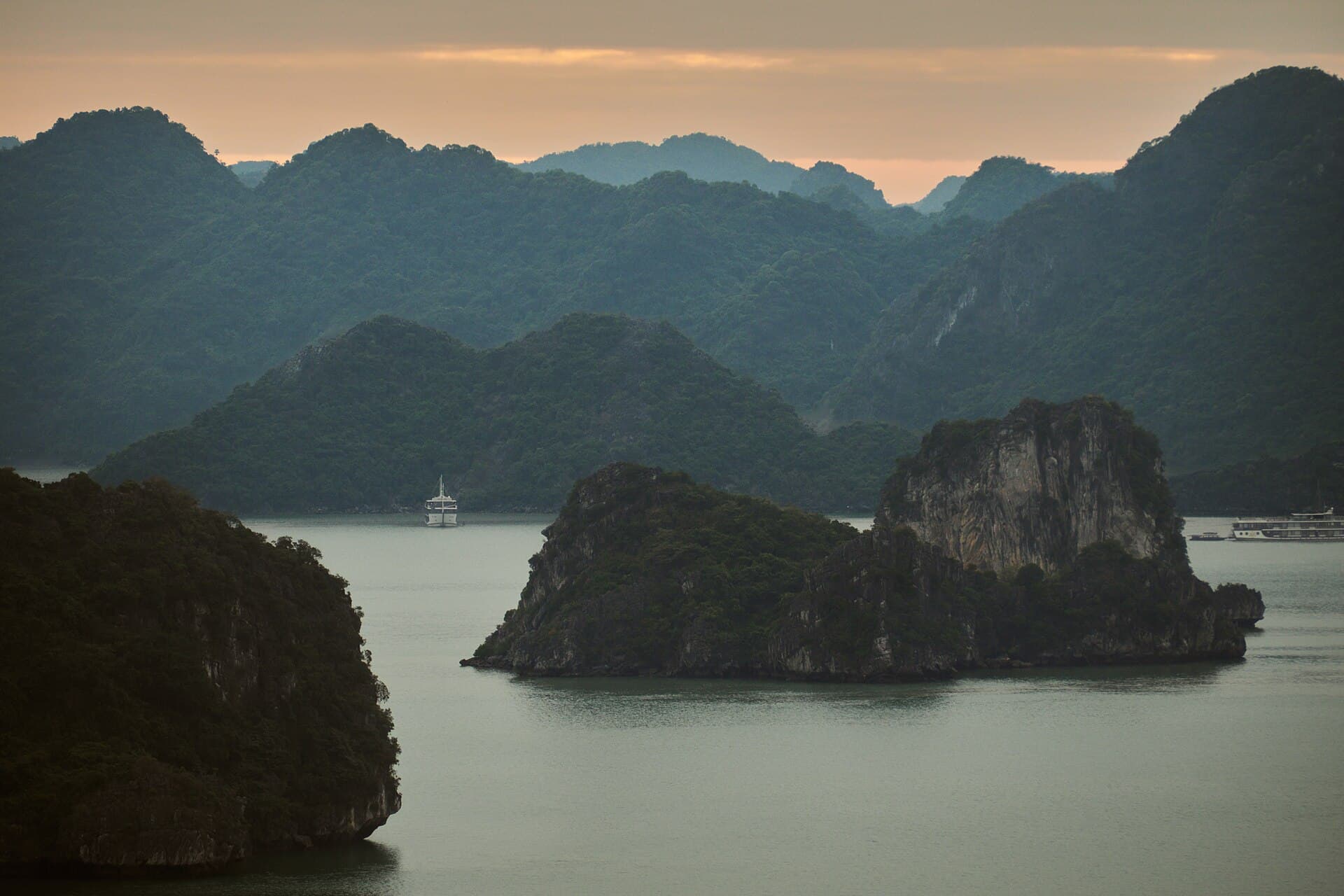
In the far north of Vietnam, where the coast of Quang Ninh Province meets the Gulf of Tonkin, the sea is crowded with stone. Roughly 1,600 limestone islands and islets stand out of the water across some 1,500 square kilometres, most of them sheer-sided towers wrapped in jungle, too steep for anyone to live on. Between them the water lies green and unusually calm, sheltered by the density of the rock itself. This is Ha Long Bay, one of the most recognised seascapes on Earth, inscribed by UNESCO as a natural World Heritage property in 1994 and extended twice since, most recently in 2023 to take in the neighbouring Cat Ba archipelago.
The view is what brings the visitors, but Ha Long Bay carries far more than scenery. Its caves hold one of the longest continuous records of human habitation in Southeast Asia. Its channels were the approaches to a naval battlefield that sits among Vietnam's founding memories. And until very recently its sheltered coves held entire floating villages, communities born, married, and buried on the water, whose way of life ended within a single generation and survives now chiefly as record. The bay is a landscape the nation reads as its own origin story, and a place where remembering has become the only way some of its history still exists.
The stone of Ha Long Bay began forming around 500 million years ago, as layer upon layer of marine limestone settled on ancient sea floors. The beds were lifted, folded, and then dissolved: in the warm, wet climate of the region, rain and groundwater ate into the limestone for some 20 million years, carving the classic forms of mature tropical karst, clusters of conical peaks joined at the base and isolated vertical towers standing alone. Geologists treat the bay as one of the finest displays of this process anywhere, which is why UNESCO added a second criterion, for geological and geomorphological value, when it extended the inscription in 2000.
What makes Ha Long singular is that the sea then came in. Rising waters after the last glacial period flooded the karst plain, drowning the valleys and leaving only the towers above the surface. The result is a mountain range experienced by boat: cliffs that plunge straight into tidal water, sea-notches cut into the rock at the waterline, and hidden lakes enclosed inside island walls, reachable only through low tunnels at certain tides. The bay's biology is as layered as its rock, with mangroves, coral reefs, and, on the larger islands of the 2023 extension, the Cat Ba langur, one of the world's rarest primates.
The name Ha Long means "descending dragon," and the legend behind it is told to every Vietnamese child. When the country was young and threatened by invaders from the sea, the story runs, the Jade Emperor sent the Mother Dragon and her children to defend it. The dragons spat out jewels and jade, and where each struck the water an island rose, until a wall of stone stood across the invaders' path and their ships broke against it. When the fighting was over, the dragons did not return to heaven. They settled in the calm water they had made, the mother in Ha Long, the children in the neighbouring bay of Bai Tu Long, whose name remembers them.
The legend is more than a place-name story. Vietnamese tradition holds that the nation itself descends from a dragon lord and a mountain fairy, so a seascape built by protective dragons reads as a chapter of the national origin myth, written in stone at the country's edge. That the bay later became, in historical fact, the setting of decisive naval defences against real invasion fleets has only tightened the weave between legend and record.
The human history of Ha Long Bay is far older than Vietnam, and most visitors sail past it without knowing it is there. Archaeologists working in the caves and on the shorelines have traced a sequence of three prehistoric cultures. The earliest, named Soi Nhu, occupied the area from roughly 18,000 years ago, when the bay was still dry karst plain, its people living in caves and leaving behind deep middens of mountain snail and freshwater shell. They were followed by the Cai Beo culture, from about 7,000 years ago, whose sites show a turn toward the sea as the waters rose, and then by the Ha Long culture proper, a maritime people of the last few millennia BC whose polished stone tools and distinctive pottery spread along the whole northern coast.
The shell middens are the quiet marvel of the bay. Discarded shells accumulated over thousands of years into compacted layers metres deep, a stratified diary of meals eaten at the mouth of the sea. Read together, the three cultures form one of the longest continuous human occupations known in the region, and a record of people adapting, generation by generation, as the sea swallowed the plain their ancestors had walked. The drowning of the karst was not only a geological event. Somebody watched it happen, over lifetimes, and kept living there.
The channels of Ha Long Bay lead toward the mouth of the Bach Dang River, one of the most storied waterways in Vietnamese history. Twice, commanders defending the country used the same audacious method there. In 938, Ngo Quyen broke a Southern Han fleet and ended a millennium of Chinese domination. Three and a half centuries later, in 1288, the general Tran Hung Dao faced the fleet of the Mongol-ruled Yuan dynasty during its third invasion of Vietnam. He had iron-tipped wooden stakes planted in the riverbed, hidden at high tide. Lured into the estuary as the water fell, the Yuan ships were trapped, impaled, and destroyed almost entirely, with their commander captured. The victory ended the Mongol invasions of Vietnam for good.
Fields of these stakes have been excavated near Quang Yen, west of the bay, blackened timbers pulled from the mud seven centuries after they were set. The battle sits among Vietnam's founding memories, and Tran Hung Dao among the most revered figures in the country's history. The geography of the legend and the geography of the war are the same water: the islands the dragon raised and the tide turned into a weapon belong to one story of the sea defending the land.
Within living memory, Ha Long Bay was home. In sheltered coves stood floating fishing villages, Cua Van, Vung Vieng, Ba Hang, and Cong Dam among them, their houses built on rafts and plastic drums in the lee of the karst. Cua Van, the largest, held hundreds of people. Families there lived their entire lives on the water: children rowed or were ferried to a floating school, couples married between boats, and the dead were taken ashore to rest on the islands. Many families could count generations born on the bay, and ancestor veneration, including the gio, the death-anniversary gathering kept in homes across Vietnam, was kept afloat as it was kept on land.
In 2014 that world ended. Citing conservation, storm safety, and access to schooling and healthcare, the provincial government resettled the floating households ashore in Ha Long city, moving well over a thousand people off the bay. Fishing continues under permit, and some villagers return by day to work the water or row visitors through Vung Vieng, but no children are being raised on the coves now. What remains in place is the Cua Van Floating Cultural Centre, a museum moored where the village stood, keeping boats, tools, photographs, and recorded voices. A way of life measured in generations closed within one, and its whole world now exists chiefly in that keeping.
The interiors of the islands are as dramatic as their walls. Sung Sot, the "Surprise" cave on Bo Hon Island, noted by French visitors at the start of the twentieth century, opens from a modest mouth into chambers of enormous scale hung with stalactites. Thien Cung, the "Heavenly Palace" grotto near Ha Long city, found in the 1990s, is a dense forest of formations. Dozens of other caves riddle the islands, several holding the shell layers of the prehistoric cultures.
Recognition has come in layers of its own: inscription in 1994 for the bay's exceptional beauty, extension in 2000 for its geology, and in 2023 a boundary extension joining it with the Cat Ba archipelago into a single property, Ha Long Bay and Cat Ba Archipelago, reaching across the provincial line into Hai Phong. With fame has come strain. Millions of visitors cruise the bay each year on hundreds of boats, and the adjacent coastline has filled with hotels, ports, and reclamation works. Monitoring has recorded declining water quality, plastic waste among the islands, and shrinking mangrove and coral; managers now cycle tourist routes and restrict where vessels may anchor. The pressures are acknowledged in the site's own conservation reporting, and holding the line has become the work of the present generation.
Ha Long Bay is that rare place where a nation's myth and a nation's archive occupy the same water. The dragon that descended to defend Vietnam, the shell middens that watched the sea rise, the stakes set in the Bach Dang mud, and the tourist boats threading the towers today are all versions of the same act: people binding themselves to a seascape and insisting that it means something. The stone will manage its own permanence. The fragile part of the record is human. The floating villages are the proof: a complete world of raft houses, floating schools, and water-borne generations vanished from the bay within a decade, and survives in a moored museum, in photographs, and in the memories of families now living ashore. The islands, the legend says, were raised as a wall to keep the people safe. Keeping what the people made, now that they have gone ashore, is the quieter duty the bay leaves to everyone who tells its story.
A drowned mountain range
Where the dragon came down
The oldest tenants of the bay
Stakes in the tide
The villages that floated
Grottoes, inscription, and the weight of admiration
A landscape kept as its own story
References and resources
- UNESCO World Heritage Centre. "Ha Long Bay and Cat Ba Archipelago." World Heritage List, property no. 672, inscribed 1994, extended 2000 and 2023. whc.unesco.org/en/list/672.
- Encyclopaedia Britannica. "Ha Long Bay." britannica.com/place/Ha-Long-Bay.
- Wikipedia. "Ha Long Bay," "Battle of Bach Dang (1288)," "Cua Van," and "Sung Sot Cave." Retrieved 2026.
- Vietnam National Authority of Tourism. "Ha Long Bay." vietnam.travel.
- Quang Ninh Provincial Portal and Ha Long Bay Management Department. Conservation and visitor management reporting on the World Heritage property.