Heritage · Country
Zimbabwe Culture and Heritage
On a granite hill in the south rise the mortarless walls of Great Zimbabwe, the largest ancient stone city in sub-Saharan Africa, which gave the nation its name. From those houses of stone to the thundering spray of Victoria Falls, this is a guide to Zimbabwe's heritage and the customs by which its people remember their dead.Written to last.
By Confinity Heritage Editorial · Updated 2026-07-31 · 8-minute readQuiet tools, kept out of the way.
On a granite hilltop in the south of the country, and across the valley below it, stand the dry-stone walls of Great Zimbabwe, the largest ancient stone structure in sub-Saharan Africa. Ancestors of the Shona raised it without mortar between roughly the 11th and 15th centuries, fitting granite blocks so closely that the outer wall of the Great Enclosure still rises some 11 metres after five hundred years (UNESCO). When the country won its independence in 1980, it took its name from these ruins: Zimbabwe, from the Shona dzimba dza mabwe, houses of stone. A carved soapstone bird from the site became the emblem at the centre of the national flag (Wikipedia).
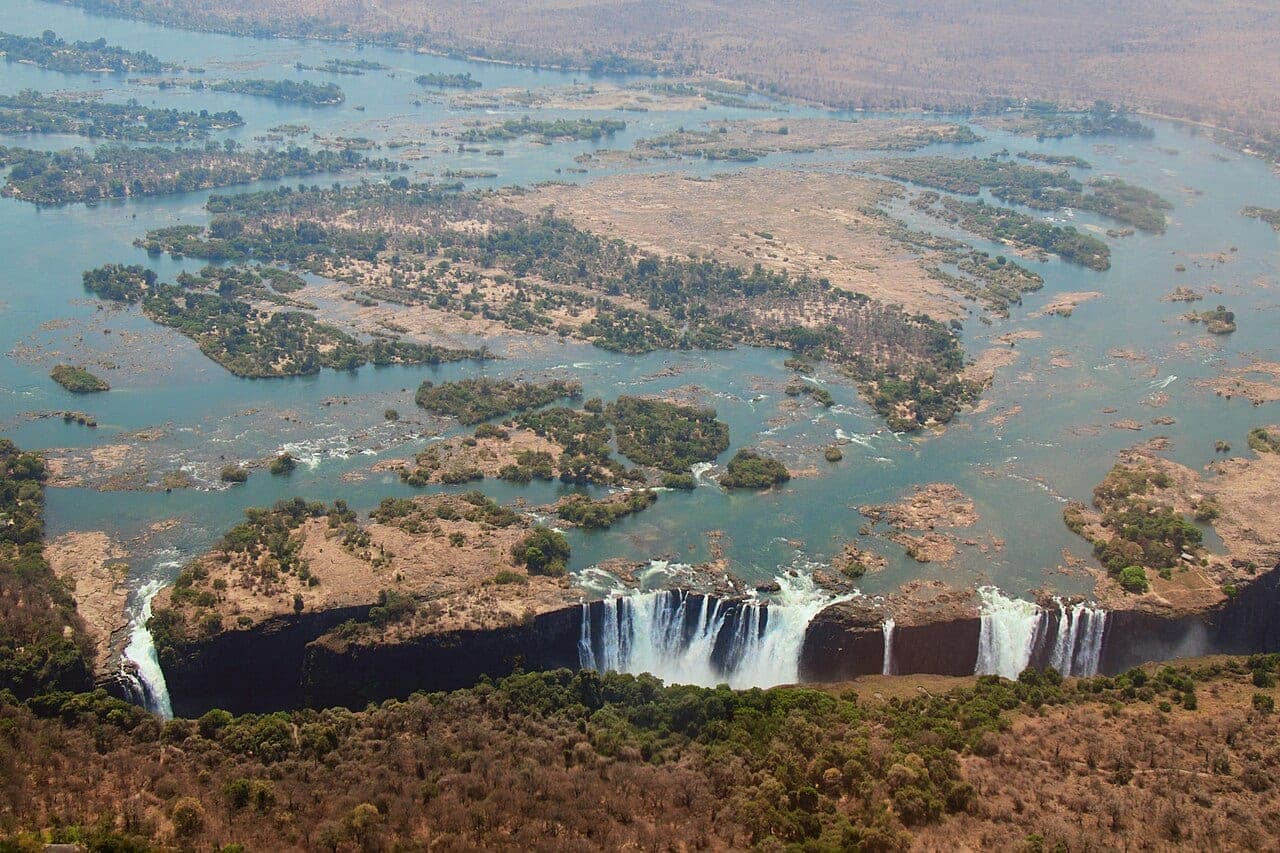
Four hundred kilometres to the north-west, the Zambezi drops more than a hundred metres into a basalt gorge and throws up a column of spray visible from far off. The region's people call it Mosi-oa-Tunya, the smoke that thunders; David Livingstone reached it in 1855 and named it Victoria Falls (David Livingstone Birthplace). Between the stone city and the falling water lies a nation of two large peoples, the Shona and the Ndebele, whose sculptors carve memory into serpentine and whose musicians summon the ancestors with the iron keys of the mbira.
Zimbabwe is a landlocked country of 390,757 square kilometres in south-east Africa, bordered by South Africa across the Limpopo to the south, Botswana to the west, Zambia to the north-west and Mozambique to the east (Wikipedia). Most of it is high grassland plateau, the highveld, rising in the east to the forested Eastern Highlands, and the plateau's granite has weathered into the balancing boulders that recur across the country's art.
The 2022 census recorded 15,178,957 people, with later estimates above 16 million (Wikipedia). The great majority are Shona; the Ndebele are the largest minority, concentrated in the south-west around Bulawayo, and together the two account for roughly nine in ten Zimbabweans. The 2013 constitution recognises 16 officially used languages, though Shona, Ndebele and English carry most public life. About 84 per cent of the population is Christian, most of them Protestant, with traditional belief widely practised alongside the churches. Harare is the capital and largest city, and the nation dates its independence to 18 April 1980, when it emerged from the settler colony of Rhodesia.
Harare. The capital sits at some 1,480 metres on the highveld. Founded in 1890 as Fort Salisbury by the Pioneer Column of Cecil Rhodes's British South Africa Company, it was renamed Harare in 1982, on the second anniversary of independence, after the Shona chief Neharawa whose people lived on the site (South African History Online). It holds the National Gallery of Zimbabwe, the National Archives and the National Heroes' Acre.
Bulawayo. The second city and the heart of Matabeleland grew on a site chosen by the Ndebele king Lobengula, whose royal town of the same name stood nearby from about 1870 until the colonial conquest of 1893 (Bulawayo City Council). It became the colony's industrial and railway centre and keeps the Natural History Museum of Zimbabwe, the reconstructed enclosure of Old Bulawayo, and the strongest living traditions of Ndebele custom.
Masvingo. The oldest colonial town in the country, established in 1890 as Fort Victoria, was renamed Masvingo, a Shona word meaning "the walls" or "the fort", after the great stone site about 30 kilometres to its south-east (Britannica). It is the gateway to the Great Zimbabwe National Monument and to Lake Mutirikwi.
Victoria Falls. The small town on the Zambezi at the country's western edge exists for the waterfall beside it. Its Victorian-era hotel and the 1905 railway bridge over the gorge make it the principal tourist centre and the base for views of Mosi-oa-Tunya from the Zimbabwean bank.
Bantu-speaking farmers and ironworkers settled the plateau in the early first millennium and mined the gold that would shape the region. Between roughly the 11th and 15th centuries their descendants, ancestors of the Shona, built Great Zimbabwe into the capital of a powerful state, the Kingdom of Zimbabwe, whose rulers grew wealthy by channelling gold and ivory to Swahili merchants on the Indian Ocean coast at Sofala (UNESCO). At its height the city may have held 10,000 to 18,000 people, its stone-walling copied at hundreds of smaller sites.
 Great Zimbabwe was built without mortar between the eleventh and fifteenth centuries, and colonial authorities spent decades insisting it could not have been built by Africans. The country took its name from it. Photograph by Janice Bell, CC BY-SA 4.0, via Wikimedia Commons.
As Great Zimbabwe declined in the 15th century, successor states carried on its trade. The Kingdom of Mutapa, known to the Portuguese as Monomotapa, arose to the north from about 1450 and traded with the Portuguese until its decline in the 17th century (World History Encyclopedia). In the south-west the Torwa state built the stepped walls of Khami near modern Bulawayo, and from about 1680 the Rozvi confederacy under Changamire Dombo held the plateau until the 1830s. Then came the Ndebele, a Nguni people led north by Mzilikazi, a former commander of the Zulu king Shaka; during the mfecane they crossed the Limpopo and by around 1840 had built a militarised kingdom in the south-west, with its capital at Bulawayo (Britannica).
Colonisation followed the gold. In 1890 Cecil Rhodes's British South Africa Company occupied Mashonaland, and the territory was soon named Rhodesia after him; the Ndebele kingdom fell in 1893, and in 1896 and 1897 the Shona and Ndebele rose together in the First Chimurenga, led in part by the spirit mediums Mbuya Nehanda and Sekuru Kaguvi. Both were hanged in 1898, and Nehanda's reported promise that her bones would rise again became a rallying cry for later resistance (BlackPast). Southern Rhodesia became a self-governing colony in 1923; in 1965 Ian Smith's white minority government declared independence unilaterally to forestall majority rule, and the liberation war, the Second Chimurenga, followed, fought by the movements of Robert Mugabe and Joshua Nkomo until the 1979 Lancaster House Agreement opened the way to majority rule (Wikipedia).
The country became independent as Zimbabwe on 18 April 1980. The first years were not without grief: violence in the Matabeleland and Midlands regions between 1983 and 1987, known as the Gukurahundi, cost thousands of civilian lives and remains a subject of national mourning. Mugabe led the country from independence, as prime minister and then president from 1987, until his resignation in November 2017, after which Emmerson Mnangagwa took office; the intervening decades brought severe economic difficulty, including hyperinflation in the late 2000s (Wikipedia).
Zimbabwe is among the most linguistically plural states on earth by law: its 2013 constitution names 16 officially recognised languages, from Shona and Ndebele to Tonga, Kalanga, Nambya, Shangani, Venda and Zimbabwean Sign Language (Wikipedia). In practice three carry most public life. Shona, a Bantu language spoken as a first tongue by the large majority, gathers dialects such as Zezuru, Karanga, Manyika and Korekore into a single written standard. Ndebele, or isiNdebele, is a Nguni language close to Zulu, complete with the click consonants the Nguni took from their Khoisan neighbours, and is the everyday tongue of the south-west. English, inherited from the colonial period, serves administration, education and much of the press.
The country's own name records its history. Zimbabwe comes from the Shona dzimba dza mabwe, houses of stone, the term for the walled chiefly residences of which Great Zimbabwe is the greatest (UNESCO). Other charged words entered the national vocabulary from the plateau's languages: Chimurenga, the Shona word for a liberation struggle, names both the 1896 uprising and the guerrilla war of the 1970s, and later a genre of protest music. Place names carry the memory of renaming, as colonial labels such as Salisbury and Fort Victoria gave way after 1980 to Harare and Masvingo.
Zimbabwe's best-known contribution to modern art grew from its oldest material, stone. From 1957, Frank McEwen, first director of the National Gallery in Salisbury, gave local artists space, tools and encouragement to carve; a second community formed from 1966 at Tengenenge, a farm north of the capital (Material Culture). The sculptors work chiefly in serpentine, including the hard variety called springstone; their carvings of ancestral figures and metamorphosing spirits, by artists such as Joram Mariga, Nicholas Mukomberanwa and Henry Munyaradzi, have been exhibited across Europe and North America and count among the most significant African art movements of the twentieth century.
Great Zimbabwe was built without mortar between the eleventh and fifteenth centuries, and colonial authorities spent decades insisting it could not have been built by Africans. The country took its name from it. Photograph by Janice Bell, CC BY-SA 4.0, via Wikimedia Commons.
As Great Zimbabwe declined in the 15th century, successor states carried on its trade. The Kingdom of Mutapa, known to the Portuguese as Monomotapa, arose to the north from about 1450 and traded with the Portuguese until its decline in the 17th century (World History Encyclopedia). In the south-west the Torwa state built the stepped walls of Khami near modern Bulawayo, and from about 1680 the Rozvi confederacy under Changamire Dombo held the plateau until the 1830s. Then came the Ndebele, a Nguni people led north by Mzilikazi, a former commander of the Zulu king Shaka; during the mfecane they crossed the Limpopo and by around 1840 had built a militarised kingdom in the south-west, with its capital at Bulawayo (Britannica).
Colonisation followed the gold. In 1890 Cecil Rhodes's British South Africa Company occupied Mashonaland, and the territory was soon named Rhodesia after him; the Ndebele kingdom fell in 1893, and in 1896 and 1897 the Shona and Ndebele rose together in the First Chimurenga, led in part by the spirit mediums Mbuya Nehanda and Sekuru Kaguvi. Both were hanged in 1898, and Nehanda's reported promise that her bones would rise again became a rallying cry for later resistance (BlackPast). Southern Rhodesia became a self-governing colony in 1923; in 1965 Ian Smith's white minority government declared independence unilaterally to forestall majority rule, and the liberation war, the Second Chimurenga, followed, fought by the movements of Robert Mugabe and Joshua Nkomo until the 1979 Lancaster House Agreement opened the way to majority rule (Wikipedia).
The country became independent as Zimbabwe on 18 April 1980. The first years were not without grief: violence in the Matabeleland and Midlands regions between 1983 and 1987, known as the Gukurahundi, cost thousands of civilian lives and remains a subject of national mourning. Mugabe led the country from independence, as prime minister and then president from 1987, until his resignation in November 2017, after which Emmerson Mnangagwa took office; the intervening decades brought severe economic difficulty, including hyperinflation in the late 2000s (Wikipedia).
Zimbabwe is among the most linguistically plural states on earth by law: its 2013 constitution names 16 officially recognised languages, from Shona and Ndebele to Tonga, Kalanga, Nambya, Shangani, Venda and Zimbabwean Sign Language (Wikipedia). In practice three carry most public life. Shona, a Bantu language spoken as a first tongue by the large majority, gathers dialects such as Zezuru, Karanga, Manyika and Korekore into a single written standard. Ndebele, or isiNdebele, is a Nguni language close to Zulu, complete with the click consonants the Nguni took from their Khoisan neighbours, and is the everyday tongue of the south-west. English, inherited from the colonial period, serves administration, education and much of the press.
The country's own name records its history. Zimbabwe comes from the Shona dzimba dza mabwe, houses of stone, the term for the walled chiefly residences of which Great Zimbabwe is the greatest (UNESCO). Other charged words entered the national vocabulary from the plateau's languages: Chimurenga, the Shona word for a liberation struggle, names both the 1896 uprising and the guerrilla war of the 1970s, and later a genre of protest music. Place names carry the memory of renaming, as colonial labels such as Salisbury and Fort Victoria gave way after 1980 to Harare and Masvingo.
Zimbabwe's best-known contribution to modern art grew from its oldest material, stone. From 1957, Frank McEwen, first director of the National Gallery in Salisbury, gave local artists space, tools and encouragement to carve; a second community formed from 1966 at Tengenenge, a farm north of the capital (Material Culture). The sculptors work chiefly in serpentine, including the hard variety called springstone; their carvings of ancestral figures and metamorphosing spirits, by artists such as Joram Mariga, Nicholas Mukomberanwa and Henry Munyaradzi, have been exhibited across Europe and North America and count among the most significant African art movements of the twentieth century.
 The Matobo Hills hold one of the densest concentrations of rock art in southern Africa, painted over thousands of years and still used as a place of prayer. Photograph by SpiderFitz, CC BY-SA 4.0, via Wikimedia Commons.
Sound carries the culture as surely as stone. The mbira dzavadzimu, the "mbira of the ancestors", is a set of tuned iron keys on a hardwood board set inside a gourd resonator, plucked with the thumbs to produce interlocking, cyclical melodies (mbira.org). In 2020 UNESCO inscribed the art of crafting and playing the mbira on its Representative List of Intangible Cultural Heritage, shared with neighbouring Malawi (UNESCO). Zimbabweans also keep older crafts, from Ndebele beadwork and geometric homestead wall-painting to Tonga basketry and plateau pottery. The staple at table is sadza, a thick maize-meal porridge eaten by hand with relishes of greens, meat or dried fish, joined on ceremonial days by home-brewed sorghum beer and, in season, by the mopane caterpillars known as madora.
About four in five Zimbabweans identify as Christian, the majority Protestant, and the country's Christianity has a strongly African character (Wikipedia). Alongside Catholic, Anglican and Methodist churches, large African-initiated movements flourish, among them the white-robed Apostolic congregations, the vapostori, who worship in the open air. For many the churches sit atop an older spiritual order rather than replacing it, and the two are practised together.
At the centre of Shona and Ndebele traditional belief is a single creator, the High God whom the Shona call Mwari, also known as Musikavanhu, the maker of people. Mwari is approached not directly but through intermediaries: the family ancestors, the vadzimu, who watch over their descendants, and the senior royal spirits, the mhondoro, who speak through mediums called svikiro. The most important Mwari shrine sits among the granite of the Matobo Hills, at the cave known as Njelele or Matonjeni, where for centuries pilgrims have sought guidance on rain, harvest and welfare (UNESCO). When the Ndebele settled the south-west in the 19th century, they too took up reverence for Mwari at these shrines.
For Shona and Ndebele families alike, death does not sever a person from the household; it changes their office within it. Those properly honoured become ancestors, the vadzimu, consulted at births, marriages and times of trouble and thanked through ritual. A funeral is a duty of the whole community: kin and neighbours gather at the family home, the body is watched over through the night, and burial is made wherever possible at the rural home, the musha.
The distinctive act of Shona remembrance comes about a year after burial. In the ceremony called kurova guva, "beating the grave", the family gathers to bring the wandering spirit home from the bush and settle it among the ancestors (African Music Journal, Rhodes University). Beer is brewed, relatives pour libations and speak to the departed at the graveside, and all-night singing and mbira playing accompany the spirit; only when the rite is complete is the deceased fully installed as a mudzimu, a guardian of the living. Among the Ndebele a corresponding ceremony, umbuyiso, brings the spirit back to the homestead. Where Christian practice predominates, these traditional rites often run alongside church funerals rather than in place of them.
The nation remembers collectively as well. On a ridge outside Harare, the National Heroes' Acre, built from 1981 with North Korean design assistance, honours those who fell in the liberation struggle and others accorded national-hero status; its obelisk and Tomb of the Unknown Soldier, crowned by a bronze of three guerrilla fighters, anchor the annual Heroes' Day commemorations (Wikipedia).
Zimbabwe has one of the best-run archives in Africa and one of the least accessible modern records, and the gap between them is political.
The National Archives of Zimbabwe in Harare holds the Rhodesian and colonial series in good order, along with mission registers, land records and a substantial oral history collection. Anglican, Catholic, Methodist and Dutch Reformed missions kept baptism and marriage books from the nineteenth century, and for most Zimbabwean families those are the earliest written record.
The colonial land record is where the country's politics live. The Land Apportionment Act of 1930 and its successors divided the country by race, moved African families off commercial farmland into reserves, and generated the paperwork of that movement. The land reform programme after 2000 reversed the ownership and created a new and contested set of records.
Shona and Ndebele lineage is held through the clan and the totem, the mutupo, which identifies a family and governs marriage, and through the spirit medium tradition that connects the living to named ancestors of the lineage.
The absent record is Gukurahundi. Between 1983 and 1987 the Fifth Brigade killed a large number of civilians in Matabeleland and the Midlands, mostly Ndebele; the figure is usually given as around twenty thousand and has never been officially established. The Chihambakwe and Dumbutshena reports were never published in full. Families have documented it themselves, and exhumations have been obstructed, so the death record for a whole region of the country does not exist.
Heritage protection falls to the National Museums and Monuments of Zimbabwe, which manages the archaeological sites, the national museums in Harare, Bulawayo, Masvingo and Mutare, and the monuments. Zimbabwe holds five UNESCO World Heritage sites, three cultural and two natural. The cultural sites map the plateau's stone-building civilisation: Great Zimbabwe National Monument, inscribed in 1986 (UNESCO); the Khami Ruins near Bulawayo, capital of the Torwa state, also inscribed in 1986 (UNESCO); and the Matobo Hills, inscribed in 2003 for a landscape of balancing granite holding one of southern Africa's densest concentrations of San rock art, together with the living Mwari shrines (UNESCO).
The two natural sites protect the country's water and wildlife. Mana Pools National Park, with the Sapi and Chewore safari areas along the Zambezi, was inscribed in 1984 for its floodplain ecology and concentrations of large mammals (UNESCO), and Mosi-oa-Tunya, the Victoria Falls, was inscribed in 1989 as a transboundary site shared with Zambia (UNESCO). The 2020 UNESCO inscription of mbira craft and performance extended this protection to intangible heritage, aiming to keep the instrument and its ceremonial knowledge alive.
Zimbabwe's heritage increasingly lives online as well as on the ground. The National Archives of Zimbabwe, among the oldest in the region, holds the documentary record of the plateau from the precolonial trade era through the liberation war, and archaeologists have digitally mapped the great stone sites for researchers who cannot reach them.
The diaspora of Zimbabwean art has produced its own digital record. The British Museum holds and publishes online the Frank McEwen collection of Shona sculpture, and galleries abroad maintain catalogues of the movement's leading carvers. For music, organisations such as mbira.org document the mbira's tunings, repertoires and ceremonial contexts, sharing recordings that keep the tradition reachable far from home (mbira.org).
Zimbabwean music travels well beyond its borders. Thomas Mapfumo adapted the mbira's cyclical patterns to the electric guitar to create Chimurenga music, the sound of the liberation years; Oliver Mtukudzi built a global following over four decades of his "Tuku music"; and Stella Chiweshe carried the mbira itself to concert stages worldwide. Younger genres, from the guitar-driven sungura to Zimdancehall, fill the airwaves at home, while gospel remains among the country's most popular music.
The country's writers have earned a wide readership. Tsitsi Dangarembga's Nervous Conditions, the first novel in English by a Black Zimbabwean woman, became a set text abroad, and her later work was shortlisted for the Booker Prize in 2020; NoViolet Bulawayo has twice been shortlisted for the same prize, for We Need New Names and Glory. The stone sculpture movement keeps placing Zimbabwean art in galleries worldwide, and a large diaspora keeps its food, music and mourning customs in circulation abroad.
A national bird comes home. Of the eight soapstone birds carved for Great Zimbabwe, one had been broken and dispersed in the colonial era, its lower half ending up in a Berlin museum. Germany returned the fragment in 2003, and in 2004 the reunited bird was brought home to the site it was carved for, the nation's oldest emblem restored to the ground it came from (VOA News).
The mbira on the world's list. The 2020 UNESCO inscription of mbira craft and performance, shared with Malawi, recognised the instrument not as a museum object but as a living practice, and committed both states to keeping its making, tuning and ceremonial use in new hands (UNESCO).
Stone that became a school. What began in 1957 as carvers encouraged at the National Gallery, and expanded at Tengenenge from 1966, grew into an internationally exhibited movement that has supported generations of sculptors and given the country a recognisable artistic signature abroad (Material Culture).
A landscape honoured for rock and spirit. The 2003 UNESCO listing of the Matobo Hills recognised at once the region's ancient San rock art and its still-active Mwari shrines, a place where the deep human past and living religious practice share the same granite (UNESCO).
The Matobo Hills hold one of the densest concentrations of rock art in southern Africa, painted over thousands of years and still used as a place of prayer. Photograph by SpiderFitz, CC BY-SA 4.0, via Wikimedia Commons.
Sound carries the culture as surely as stone. The mbira dzavadzimu, the "mbira of the ancestors", is a set of tuned iron keys on a hardwood board set inside a gourd resonator, plucked with the thumbs to produce interlocking, cyclical melodies (mbira.org). In 2020 UNESCO inscribed the art of crafting and playing the mbira on its Representative List of Intangible Cultural Heritage, shared with neighbouring Malawi (UNESCO). Zimbabweans also keep older crafts, from Ndebele beadwork and geometric homestead wall-painting to Tonga basketry and plateau pottery. The staple at table is sadza, a thick maize-meal porridge eaten by hand with relishes of greens, meat or dried fish, joined on ceremonial days by home-brewed sorghum beer and, in season, by the mopane caterpillars known as madora.
About four in five Zimbabweans identify as Christian, the majority Protestant, and the country's Christianity has a strongly African character (Wikipedia). Alongside Catholic, Anglican and Methodist churches, large African-initiated movements flourish, among them the white-robed Apostolic congregations, the vapostori, who worship in the open air. For many the churches sit atop an older spiritual order rather than replacing it, and the two are practised together.
At the centre of Shona and Ndebele traditional belief is a single creator, the High God whom the Shona call Mwari, also known as Musikavanhu, the maker of people. Mwari is approached not directly but through intermediaries: the family ancestors, the vadzimu, who watch over their descendants, and the senior royal spirits, the mhondoro, who speak through mediums called svikiro. The most important Mwari shrine sits among the granite of the Matobo Hills, at the cave known as Njelele or Matonjeni, where for centuries pilgrims have sought guidance on rain, harvest and welfare (UNESCO). When the Ndebele settled the south-west in the 19th century, they too took up reverence for Mwari at these shrines.
For Shona and Ndebele families alike, death does not sever a person from the household; it changes their office within it. Those properly honoured become ancestors, the vadzimu, consulted at births, marriages and times of trouble and thanked through ritual. A funeral is a duty of the whole community: kin and neighbours gather at the family home, the body is watched over through the night, and burial is made wherever possible at the rural home, the musha.
The distinctive act of Shona remembrance comes about a year after burial. In the ceremony called kurova guva, "beating the grave", the family gathers to bring the wandering spirit home from the bush and settle it among the ancestors (African Music Journal, Rhodes University). Beer is brewed, relatives pour libations and speak to the departed at the graveside, and all-night singing and mbira playing accompany the spirit; only when the rite is complete is the deceased fully installed as a mudzimu, a guardian of the living. Among the Ndebele a corresponding ceremony, umbuyiso, brings the spirit back to the homestead. Where Christian practice predominates, these traditional rites often run alongside church funerals rather than in place of them.
The nation remembers collectively as well. On a ridge outside Harare, the National Heroes' Acre, built from 1981 with North Korean design assistance, honours those who fell in the liberation struggle and others accorded national-hero status; its obelisk and Tomb of the Unknown Soldier, crowned by a bronze of three guerrilla fighters, anchor the annual Heroes' Day commemorations (Wikipedia).
Zimbabwe has one of the best-run archives in Africa and one of the least accessible modern records, and the gap between them is political.
The National Archives of Zimbabwe in Harare holds the Rhodesian and colonial series in good order, along with mission registers, land records and a substantial oral history collection. Anglican, Catholic, Methodist and Dutch Reformed missions kept baptism and marriage books from the nineteenth century, and for most Zimbabwean families those are the earliest written record.
The colonial land record is where the country's politics live. The Land Apportionment Act of 1930 and its successors divided the country by race, moved African families off commercial farmland into reserves, and generated the paperwork of that movement. The land reform programme after 2000 reversed the ownership and created a new and contested set of records.
Shona and Ndebele lineage is held through the clan and the totem, the mutupo, which identifies a family and governs marriage, and through the spirit medium tradition that connects the living to named ancestors of the lineage.
The absent record is Gukurahundi. Between 1983 and 1987 the Fifth Brigade killed a large number of civilians in Matabeleland and the Midlands, mostly Ndebele; the figure is usually given as around twenty thousand and has never been officially established. The Chihambakwe and Dumbutshena reports were never published in full. Families have documented it themselves, and exhumations have been obstructed, so the death record for a whole region of the country does not exist.
Heritage protection falls to the National Museums and Monuments of Zimbabwe, which manages the archaeological sites, the national museums in Harare, Bulawayo, Masvingo and Mutare, and the monuments. Zimbabwe holds five UNESCO World Heritage sites, three cultural and two natural. The cultural sites map the plateau's stone-building civilisation: Great Zimbabwe National Monument, inscribed in 1986 (UNESCO); the Khami Ruins near Bulawayo, capital of the Torwa state, also inscribed in 1986 (UNESCO); and the Matobo Hills, inscribed in 2003 for a landscape of balancing granite holding one of southern Africa's densest concentrations of San rock art, together with the living Mwari shrines (UNESCO).
The two natural sites protect the country's water and wildlife. Mana Pools National Park, with the Sapi and Chewore safari areas along the Zambezi, was inscribed in 1984 for its floodplain ecology and concentrations of large mammals (UNESCO), and Mosi-oa-Tunya, the Victoria Falls, was inscribed in 1989 as a transboundary site shared with Zambia (UNESCO). The 2020 UNESCO inscription of mbira craft and performance extended this protection to intangible heritage, aiming to keep the instrument and its ceremonial knowledge alive.
Zimbabwe's heritage increasingly lives online as well as on the ground. The National Archives of Zimbabwe, among the oldest in the region, holds the documentary record of the plateau from the precolonial trade era through the liberation war, and archaeologists have digitally mapped the great stone sites for researchers who cannot reach them.
The diaspora of Zimbabwean art has produced its own digital record. The British Museum holds and publishes online the Frank McEwen collection of Shona sculpture, and galleries abroad maintain catalogues of the movement's leading carvers. For music, organisations such as mbira.org document the mbira's tunings, repertoires and ceremonial contexts, sharing recordings that keep the tradition reachable far from home (mbira.org).
Zimbabwean music travels well beyond its borders. Thomas Mapfumo adapted the mbira's cyclical patterns to the electric guitar to create Chimurenga music, the sound of the liberation years; Oliver Mtukudzi built a global following over four decades of his "Tuku music"; and Stella Chiweshe carried the mbira itself to concert stages worldwide. Younger genres, from the guitar-driven sungura to Zimdancehall, fill the airwaves at home, while gospel remains among the country's most popular music.
The country's writers have earned a wide readership. Tsitsi Dangarembga's Nervous Conditions, the first novel in English by a Black Zimbabwean woman, became a set text abroad, and her later work was shortlisted for the Booker Prize in 2020; NoViolet Bulawayo has twice been shortlisted for the same prize, for We Need New Names and Glory. The stone sculpture movement keeps placing Zimbabwean art in galleries worldwide, and a large diaspora keeps its food, music and mourning customs in circulation abroad.
A national bird comes home. Of the eight soapstone birds carved for Great Zimbabwe, one had been broken and dispersed in the colonial era, its lower half ending up in a Berlin museum. Germany returned the fragment in 2003, and in 2004 the reunited bird was brought home to the site it was carved for, the nation's oldest emblem restored to the ground it came from (VOA News).
The mbira on the world's list. The 2020 UNESCO inscription of mbira craft and performance, shared with Malawi, recognised the instrument not as a museum object but as a living practice, and committed both states to keeping its making, tuning and ceremonial use in new hands (UNESCO).
Stone that became a school. What began in 1957 as carvers encouraged at the National Gallery, and expanded at Tengenenge from 1966, grew into an internationally exhibited movement that has supported generations of sculptors and given the country a recognisable artistic signature abroad (Material Culture).
A landscape honoured for rock and spirit. The 2003 UNESCO listing of the Matobo Hills recognised at once the region's ancient San rock art and its still-active Mwari shrines, a place where the deep human past and living religious practice share the same granite (UNESCO).
National Overview
Notable Cities
Historical Foundations
Linguistic and Etymological Roots
Cultural Identity
Religion and Spirituality
Remembrance and Mourning Traditions
Tracing a Family in Zimbabwe
Heritage Preservation Efforts
Digital Heritage
Contemporary Cultural Influences
Success Stories
References and resources
- UNESCO World Heritage Centre: Great Zimbabwe National Monument, the stone capital that gave the nation its name.
- UNESCO World Heritage Centre: Matobo Hills, rock art and the living Mwari shrines of the granite hills.
- UNESCO World Heritage Centre: Mosi-oa-Tunya / Victoria Falls, the transboundary natural site on the Zambezi.
- UNESCO Intangible Cultural Heritage: Mbira / Sansi, the 2020 inscription of mbira craft and performance.
- World History Encyclopedia: Mutapa, the successor kingdom to Great Zimbabwe and its gold trade.
- Britannica: Ndebele (Zimbabwean people), Mzilikazi, the mfecane and the founding of Matabeleland.
- BlackPast: Mbuya Nehanda, the spirit medium and the First Chimurenga of 1896 and 1897.
- Material Culture: Shona Modern, the origins and reach of the Shona stone sculpture movement.
- mbira.org: the role of mbira in Shona culture, the instrument, the bira ceremony and the ancestors.
- Encyclopaedia Britannica: Zimbabwe, geography, peoples, history and government.