Heritage · Landmark
Elmina Castle: the doorway where the record stops
The Portuguese built it in 1482 to hold gold, and it is generally called the oldest surviving European building in sub-Saharan Africa. It ended as a place where people were held and shipped, entered in ledgers by number and price rather than by name, and for millions of descendants the written trail stops at its seaward door.Written to last.
By Confinity Heritage Editorial · 2026-08-25 · 7-minute readQuiet tools, kept out of the way.
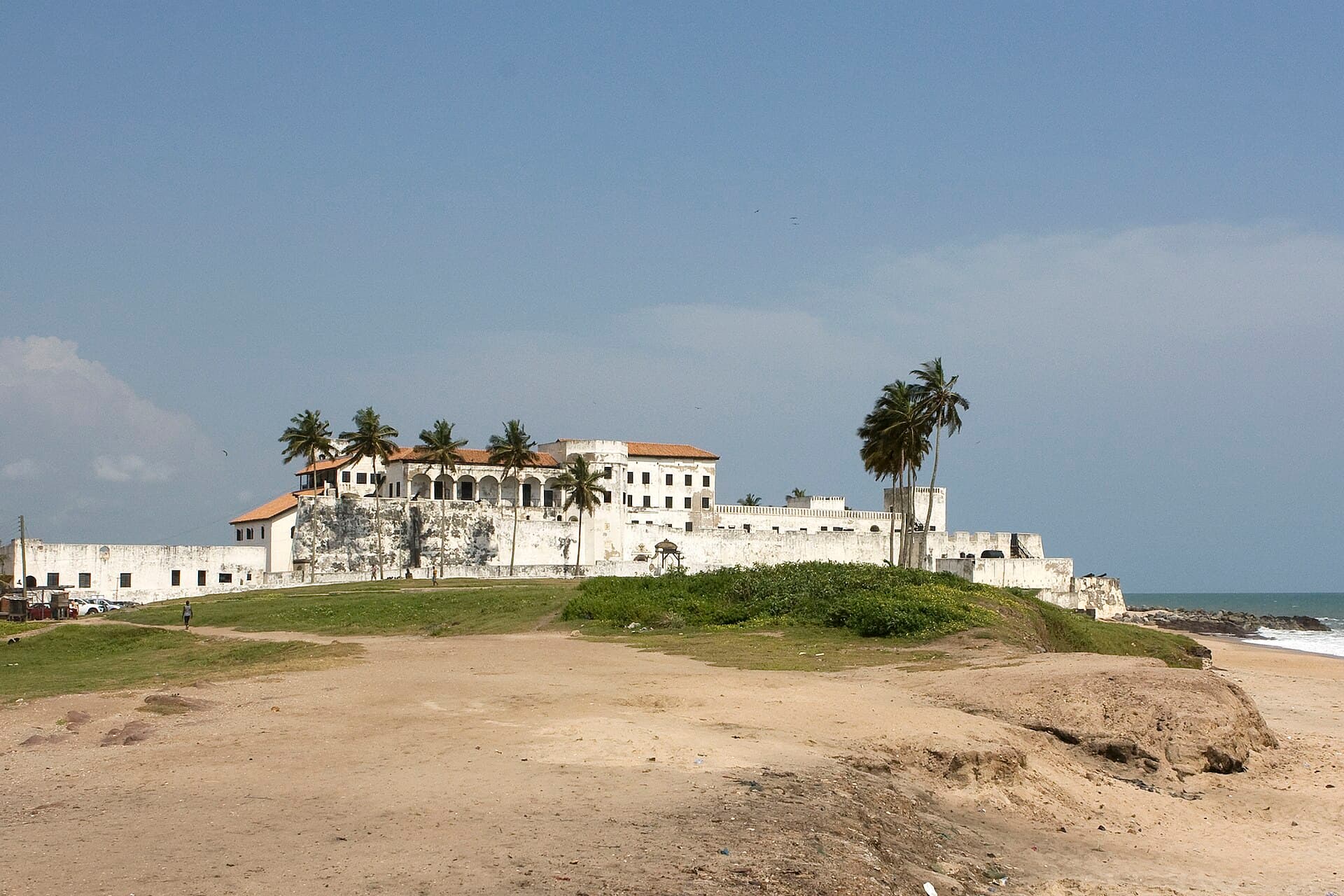
On a low promontory on the coast of Ghana, where the Benya lagoon runs out to the Atlantic, a whitewashed fortress sits above a fishing harbour crowded with painted canoes. The Portuguese began it in January 1482 and named it Castelo de São Jorge da Mina, St George of the Mine. It is commonly described as the oldest surviving European building in sub-Saharan Africa, and its custodian, the Ghana Museums and Monuments Board, calls it the first major European construction in tropical Africa. Since 1979 it has been part of the UNESCO World Heritage property Forts and Castles, Volta, Greater Accra, Central and Western Regions, a serial listing of 28 structures along roughly 500 kilometres of coast between Keta and Beyin, inscribed under criterion (vi).
The castle is famous for something it was not built to do. Its name records its purpose: the mine, the gold. What it became, over the two centuries that followed, was a place where people were held in stone rooms and loaded onto ships.
Portuguese ships reached this coast in 1471 and found a gold trade already running, worked by Akan miners and carried inland by Arab and Berber merchants. The trader Fernão Gomes set up a post and the Portuguese called the place A Mina. In 1481 King John II decided to fortify it, sending ten caravels and two transport ships under Diogo de Azambuja, loaded with pre-cut stone, roof tiles and provisions for six hundred men. The fleet sailed on 12 December 1481 and arrived on 19 January 1482.
The local ruler, known to the Portuguese as Caramansa, agreed reluctantly and had reason to. Building on the most defensible ground meant demolishing houses and quarrying a rock the townspeople held sacred; the work was met with force and answered with the burning of the village. The first storey of the tower went up in twenty days because so much of it had arrived ready-made. At the height of the gold trade in the early sixteenth century some 680,000 grams of gold, about 24,000 ounces, left the Gold Coast each year, roughly a tenth of the world's supply.
For its first decades the castle traded people in the opposite direction from the one it is remembered for. Portuguese policy kept São Jorge out of the export slave trade, since the wars needed to take captives would have disrupted the gold routes inland. Instead the Portuguese bought captives at Benin and São Tomé and sold them at Elmina to Akan miners who needed labour underground. The Ghana Museums and Monuments Board records that importation, in exchange for gold and ivory, as the answer the Portuguese found to a shortage of hands.
Then the terms reversed. Gold and silver from Spanish America pushed European prices down, and by the seventeenth century most European trade on this coast had turned to the sale of captives. The Dutch West India Company failed to take the castle in 1596 and succeeded in 1637, making Elmina the capital of the Dutch Gold Coast. Storerooms built for goods were converted into dungeons. The Dutch rebuilt much of the castle between 1770 and 1775 and continued in the trade until 1814, when an Anglo-Dutch treaty ended it. On 6 April 1872 they ceded the castle to Britain. Ghana took possession at independence in 1957, and the building served as a police training centre and a school before becoming a national museum.
The plan states its arrangement without needing a guide. At courtyard level are the dungeons: stone chambers, low-ceilinged, with almost no light and no drainage, divided between men and women. Accounts of capacity vary and none are audited. The figure given on site is around a thousand people at full occupancy, commonly split as six hundred men and four hundred women; the PBS account of Elmina describes single cells holding as many as two hundred, and states that by the eighteenth century some 30,000 people a year passed through the seaward door, well above what surviving shipping records for the port support. Captives were held for weeks or months while a cargo was assembled and a ship arrived.
Set into one wall is a smaller doorway with a skull and crossbones cut into the stone above it. This was the condemned cell, kept for those who resisted or attempted escape. It has no window and no vent, and those shut in it were not fed.
Above the dungeons are the governor's apartments, large rooms with sea light on three sides, and a church placed directly over the cells. A staircase connects the governor's quarters to the yard below. From the holding rooms a passage narrows toward the sea wall and ends in a single low doorway onto the rocks, where boats waited. The sequence is small, plain and functional: built to move goods, used without alteration to move people.
People shipped from this coast were moved as cargo and recorded as cargo. The paperwork of the trade was commercial paperwork: ships' books, company accounts, insurance entries and customs returns. Captives appear in them as tallies by sex and rough age, as weights of provisioning, as prices, as losses on the voyage. They do not appear as names. Nor do the ledgers record a parent, a town, a language or a lineage, because none of those things had value to the people keeping the books.
The Trans-Atlantic Slave Trade Database estimates that around 12.5 million people were embarked in Africa between 1501 and 1866 and that about 10.7 million survived to land in the Americas. The Gold Coast as a whole accounts for something like a tenth of that total. For Elmina itself no defensible figure exists; the records do not permit one.
Against those millions, the number of people whose African names survive from the trade is very small, and it survives by a legal accident rather than any commercial practice. In the trade's last sixty years, courts around the Atlantic condemned more than two thousand vessels and were required to register those found aboard, names included. The African Names Database was compiled from those registers, held at the Sierra Leone National Archives in Freetown and at the British National Archives, and it holds personal details for roughly 95,000 people. Names exist for them because a court had to write them down while setting them free. For everyone shipped before that regime, the traders had no reason to record a name and did not.
Genealogy works backwards along documents: a census to a parish register, a register to a will, a will to a deed. For families descended from the Atlantic trade, those chains run back through emancipation and plantation records and slave schedules, and then reach a port, a ship, a coast, and stop. At Elmina the break has an address and a doorway you can stand in. Goree Island off Dakar holds the same break at its own door, and neither can be crossed on paper.
In September 2018, in Washington DC, President Nana Akufo-Addo declared 2019 Ghana's Year of Return, marking four hundred years since the first recorded enslaved Africans were landed in Virginia in 1619. Ghana Tourism Authority figures put international arrivals at 1,130,307 in 2019, against 956,372 the year before, with receipts of about 3.3 billion US dollars and the United States the largest source country at 118,009 arrivals. Larger revenue claims circulated during the year and were later revised, so the audited annual reports are the figures worth quoting.
At the castles the effect was real but modest in scale. Elmina recorded 69,544 visitors in 2019 against 64,604 in 2018, and Cape Coast Castle 88,124 against 74,988, a combined rise of just over 18,000 on figures released by the Ghana Museums and Monuments Board. Elmina was the fourth most visited attraction in the country that year. A successor programme, Beyond the Return, was launched at the end of 2019 to run through the following decade, and the travel has continued: Elmina drew 78,870 visitors in 2023.
Alongside the tours, families arrive at Elmina to do something the museum does not schedule. They pour libation in the courtyard, drum, sing, hold naming ceremonies, and stand at the seaward doorway. The practice has grown steadily since the 1990s and is now part of what the site is for, with Ghanaian chiefs and the castle's custodians taking part.
What is unusual about these rites is that they are addressed to people who cannot be identified. A family performing them knows an ancestor passed through a place like this and knows nothing further: not a name, not a year, not which of the forts along this coast. The rite proceeds anyway. It treats the ancestor as real and owed something, and it uses the building as the address. The history is studied at home as well as abroad, at institutions including the University of Ghana, and Ghanaian scholarship has largely settled on describing these practices as memorial work rather than tourism.
Commercial DNA testing is often presented as the way back across the break. Autosomal tests estimate the proportions of a person's ancestry that resemble reference populations grouped by region, and the regions are broad. Mitochondrial and Y-chromosome tests follow a single maternal or paternal line each, two threads out of the thousands that converge in any living person ten generations back.
The limits are measurable. A 2006 study by Ely and colleagues compared African American mitochondrial sequences against a reference set of 3,725 sub-Saharan African samples and found that fewer than one in ten matched a single African ethnic group, while about half matched sequences found in several groups spread across different parts of the continent. Identical haplotypes are shared widely, so a match points to a region and a set of possibilities, not to a people and never to a person. No test recovers a name, a town, a birth year or a household.
What testing does return is living relatives. Cousin matching across large databases has reconnected branches separated by sale and let families rebuild trees forward from emancipation that no archive would have yielded. That gain belongs on the near side of the break. On the far side, at the bottom of a stone stair on a Ghanaian headland, the paper trail ends. What families do there is put a name to a doorway instead, and keep coming back to it, which is the oldest form of remembrance there is and the one that needs no ledger.
Built for the mine
The change of cargo
The building read from the bottom up
Where the record stops
Returning: the Year of Return and after
Rites for ancestors who cannot be named
What a test can and cannot return
References and resources
- UNESCO World Heritage Centre. "Forts and Castles, Volta, Greater Accra, Central and Western Regions." World Heritage List, property no. 34, inscribed 1979, criterion (vi). whc.unesco.org/en/list/34.
- Ghana Museums and Monuments Board. "St. George's Castle (Elmina Castle), Elmina (1482)." gmmb.gov.gh.
- Ghana Tourism Authority. Annual Tourism Report 2023 and Annual Tourism Report 2021. ghana.travel.
- SlaveVoyages. Trans-Atlantic Slave Trade Database, and "Methodology: African Origins" on the African Names Database. slavevoyages.org and legacy.slavevoyages.org.
- Ely, B., Wilson, J. L., Jackson, F., and Jackson, B. A. "African-American mitochondrial DNAs often match mtDNAs found in multiple African ethnic groups." BMC Biology, 2006.
- DeCorse, Christopher R. An Archaeology of Elmina: Africans and Europeans on the Gold Coast, 1400 to 1900. Smithsonian Institution Press, 2001.
- Wikipedia. "Elmina Castle" and "Year of Return, Ghana 2019." Retrieved 2026.