Heritage · Landmark
Goree Island: the door that faces the Atlantic
A small car-free island off Dakar holds pastel houses, baobabs, and the Maison des Esclaves, whose Door of No Return opens onto the open sea. Historians and custodians agree on what Goree has become: the place where the Atlantic slave trade is mourned, whatever share of its ships once anchored here.Written to last.
By Confinity Heritage Editorial · 2026-08-23 · 7-minute readQuiet tools, kept out of the way.
Twenty minutes by ferry from the docks of Dakar, the capital of Senegal, a low basalt island sits in the shelter of the Cap-Vert peninsula. Gorée is small enough to walk end to end in half an hour: not quite a kilometre long, a few hundred metres wide, with sand streets, no cars, bougainvillea spilling over ochre and rose-coloured walls, and old baobabs shading squares where children play football until the light goes. The houses date mostly from the eighteenth and nineteenth centuries, built by European traders and by the island's own Afro-European merchant families, and in 1978 UNESCO inscribed the whole island on the World Heritage List, in the first group of sites the new convention ever recognised.
The beauty is real, and so is the weight. Gorée carries two histories at once. One is documentary: a fortified trading post that European powers fought over for more than three centuries, dealing in hides, gum, gold, and human beings. The other is memorial: a single doorway in a single house, opening from a dark ground floor straight onto the Atlantic, which the twentieth century made into the most recognised threshold of the slave trade anywhere on earth. The island asks its visitors to hold both histories together, and how it came to do so is a story about memory itself.
Portuguese mariners reached the island in 1444, in the first years of Europe's push down the West African coast, and called it Ilha de Palma. The Dutch took it late in the sixteenth century and gave it the name that stuck, after Goedereede in their own delta. From then on the island's harbour, one of the few safe anchorages on this stretch of coast, made it a prize: Portuguese, Dutch, English, and French flags rose and fell over its two small forts, and the island is commonly said to have changed hands more than a dozen times before France secured it, first by capture in 1677 and definitively after 1817.
The odd truth is that Gorée itself produced nothing, and had no spring of fresh water. Its whole value was position and safety. Trading companies kept warehouses and garrisons there, and around them grew a distinctive island society led in part by the signares, women of mixed African and European descent who owned houses, boats, and trading networks, and whose households built much of the elegant architecture that survives. Their world was inseparable from the traffic that ran through the harbour: alongside hides and gum arabic, the companies bought and shipped enslaved people, and the island's fine upper floors stood above cellars and courtyards where captives were held.
Near the eastern shore stands the building that carries the island's meaning: the Maison des Esclaves, the House of Slaves, built in the late 1770s for a family of the island's merchant elite and later owned by the signare Anna Colas Pépin. Its form tells the double life of the place plainly. A graceful curved double staircase rises to an airy upper floor where the household lived and traded. Beneath it, at ground level, is a warren of small dim cells, their names now painted over the lintels: rooms for men, for women, for children.
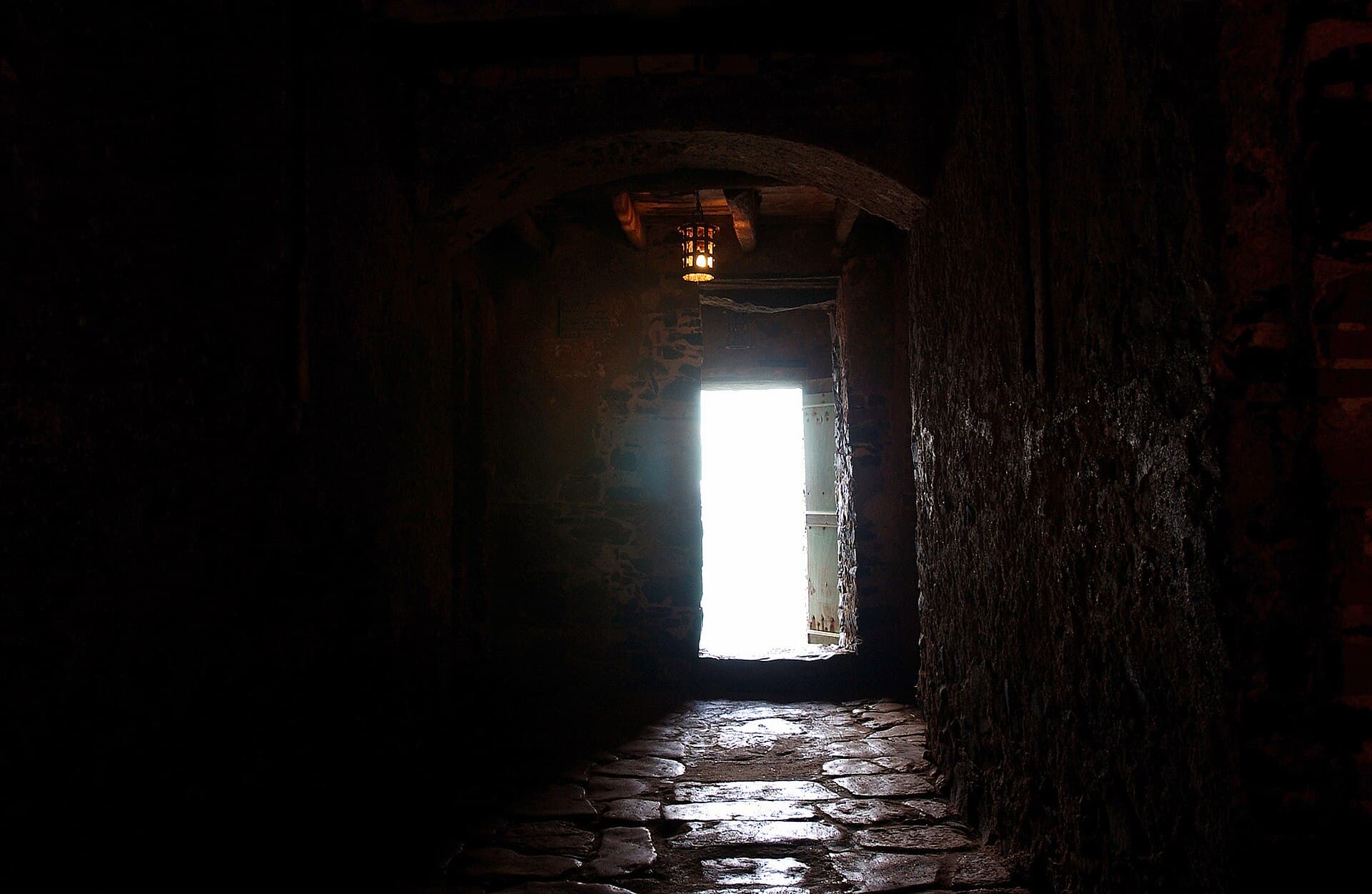
At the centre of the seaward wall, at the end of a short corridor, is a narrow doorway that opens onto nothing but rocks and the open Atlantic. This is the Door of No Return. Whether it served for loading captives into boats, for waste, or for both is argued over; what is not argued is what it looks like, and what it has come to mean. A person standing in that corridor sees a rectangle of sea and sky framed in stone, the last of Africa reduced to a doorway. In 1962 the newly independent Senegalese state opened the house as a museum, and gave it a keeper who would make it speak.
Boubacar Joseph Ndiaye was born in 1922 and fought for France in the Second World War as a tirailleur sénégalais before returning home. From 1962 until shortly before his death in February 2009 he was the curator of the Maison des Esclaves, and over those forty-seven years he turned the post into a vocation with few parallels in the museum world. He did not guide visitors so much as address them. Standing in the courtyard in his fez, he delivered a recited testimony of the trade, chains in hand, voice rising and breaking, and finished at the doorway with the sea behind him.
Presidents, popes, schoolchildren, and returning descendants all received the same performance, and tens of thousands of them recorded in the guest books that it had changed them. Ndiaye told his listeners that millions had passed through the house, and through doors like it; he wept, and his listeners wept. Whatever the registers later showed, his lectern did more than any monograph to fix the Atlantic slave trade in the world's conscience, and to give the mourning of the African diaspora a physical place to land.
From the 1980s onward, historians measuring the trade against shipping records raised a difficulty. The Atlantic slave trade embarked roughly 12.5 million people over three and a half centuries, and the surviving voyage records show that its great volumes flowed through other ports: the Bight of Benin, West Central Africa, and, within the Senegambia region itself, Saint-Louis and the river trades more than Gorée. Scholars including Philip Curtin, and Senegalese researchers working from the island's own records, concluded that Gorée was a minor embarkation point in the trade's overall arithmetic, with the house itself likely serving mainly as a merchant residence where a smaller number of captives were held.
The debate flared publicly in the 1990s and has settled into a considered understanding, one that UNESCO and Senegal's custodians now state openly. No serious historian doubts that enslaved people were bought, held, and shipped from Gorée; the question was always one of scale. And the site's power was never really statistical. The trade left almost no architecture of its own scale: no port preserves twelve million departures. Memory of that size needs an address, and Gorée, intact, beautiful, and terrible, with a door that visibly opens onto the sea, agreed to be it. The door stands for every door. That a symbol can carry a history larger than its own ledger is not a flaw in the island's story; it is a fact about how human remembrance works, and Gorée is where the world can watch it working.
The island's register of visitors reads like a history of the late twentieth century's reckonings. Nelson Mandela came in 1991, the year after his release, and insisted on stooping into one of the holding cells alone. Pope John Paul II stood at the house in 1992 and asked forgiveness for the baptised who had taken part in the trade. American presidents made the crossing in succession: Bill Clinton in 1998, George W. Bush in 2003, and Barack Obama in 2013, who looked out through the doorway with his family beside him.
More important than any of them are the visitors who arrive without motorcades. For families of the African diaspora, from the Americas, the Caribbean, and Europe, the ferry to Gorée has become a return journey, the nearest thing to a homecoming that the trade's erasures allow. Many describe the crossing in the language of pilgrimage, and the island receives them as pilgrims: Britannica notes that Gorée now lives largely from this remembrance, its museums and guides oriented to visitors retracing the trade from its far shore back to this one.
Gorée is not a preserved ruin but a working village of around 1,800 people. Painters and sculptors keep open studios on the lanes climbing the Castel, the basalt height at the island's southern end where Second World War gun emplacements still face the sea. The old Fort d'Estrées holds a historical museum, the church of Saint Charles Borromeo has stood since 1830, and one of Senegal's most respected girls' boarding schools occupies former colonial buildings near the harbour. The ferry from Dakar shuttles residents, schoolchildren, and visitors across the strait many times a day.
Stewardship falls to Senegal, which has treated the island as a national trust since independence, and to UNESCO, whose Slave Route project, launched in 1994, placed Gorée within a wider map of remembrance. Conservation is unending work: salt air eats at render and timber, the sea gnaws the shoreline, and keeping an inhabited island authentic without freezing it is a harder problem than restoring a monument. Annual commemorations and diaspora festivals bring the island's two populations, residents and returnees, into the same squares each year.
What Gorée keeps is a division of labour that most heritage sites never have to make explicit. The numbers belong to the archives: the voyage registers, the port books, the databases that let historians say with growing confidence where twelve million people were forced onto ships. The mourning belongs to the living, and mourning has requirements the archives cannot meet. It needs a place to stand, a threshold to look through, a keeper to say the words aloud. For forty-seven years a veteran in a fez said them, and the world came to listen. The island offshore of Dakar holds both truths without letting either cancel the other: a modest port in the ledgers, and the agreed address of one of humanity's deepest griefs. Keeping a memory, Gorée shows, is not only a matter of keeping records. Somebody must also keep the door.
A rock the empires kept trading
The house with the door
The curator who made the house a lectern
The archives and the symbol
Pilgrims at the door
The living island
An address for the mourning
References and resources
- UNESCO World Heritage Centre. "Island of Gorée." World Heritage List, property no. 26, inscribed 1978. whc.unesco.org/en/list/26.
- Encyclopaedia Britannica. "Gorée Island." britannica.com/place/Goree-Island.
- Wikipedia. "Gorée," "House of Slaves," and "Boubacar Joseph Ndiaye." Retrieved 2026.
- SlaveVoyages. Trans-Atlantic Slave Trade Database. slavevoyages.org.
- UNESCO. "The Slave Route" project, launched 1994. unesco.org.