Heritage · Landmark
The Acropolis of Athens: History and Visitor Guide
The Acropolis of Athens is a 5th-century BC citadel crowned by the Parthenon, Erechtheion, Propylaea, and Temple of Athena Nike. A UNESCO site since 1987.Written to last.
By Confinity Heritage Editorial · Updated 2026-07-31 · 7-minute readQuiet tools, kept out of the way.
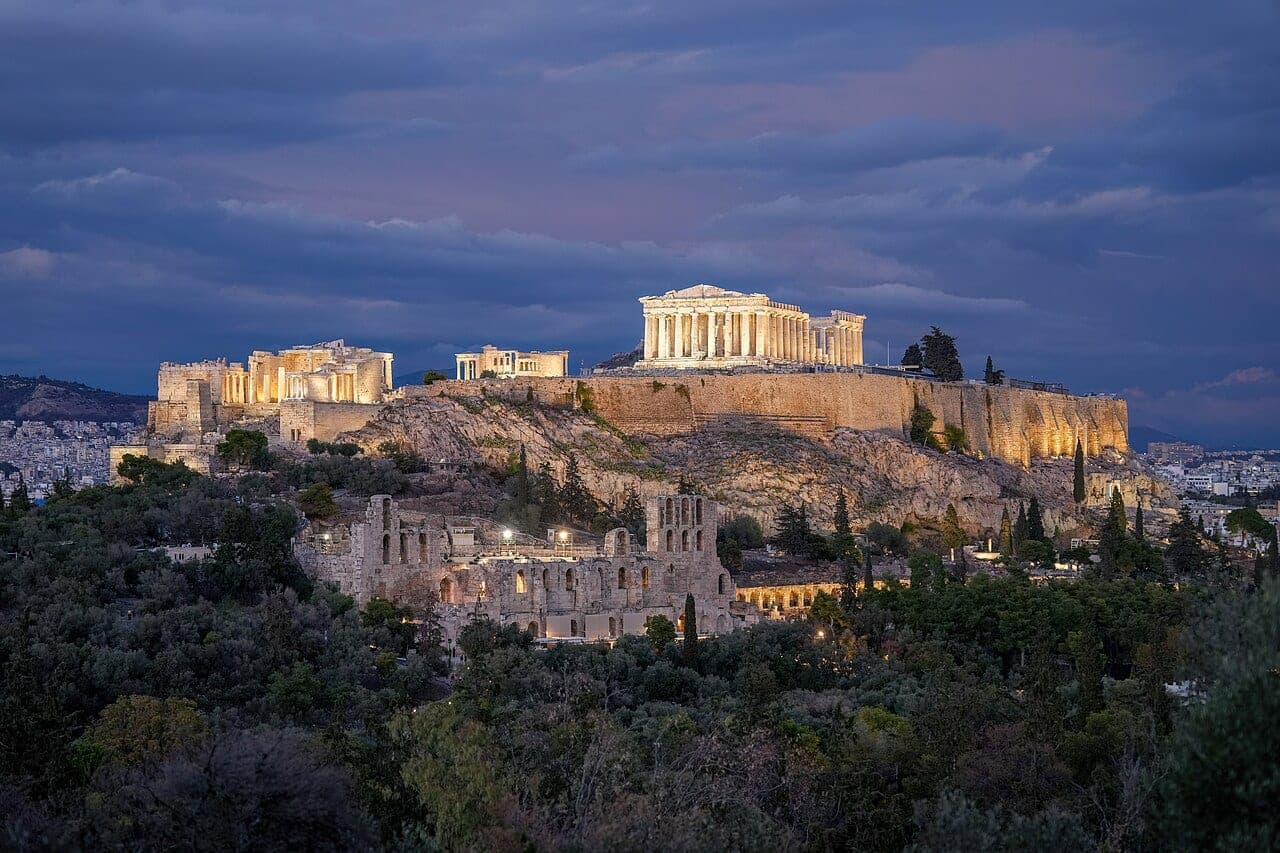
The Acropolis of Athens rises about 150 metres above the modern city on a limestone outcrop that has been settled since the Neolithic period. Its name comes from the Greek words for "high" and "city," and for centuries the rock served as both a fortress and a sanctuary. The monuments that survive today belong mostly to a single burst of building in the 5th century BC, when Athens was at the height of its power and Pericles directed the reconstruction of temples destroyed by the Persians in 480 BC. The Parthenon, the Erechtheion, the Propylaea, and the small Temple of Athena Nike still crown the summit, and the site was inscribed on the UNESCO World Heritage List in 1987 (UNESCO).
People occupied the Acropolis long before the classical age; there is evidence of habitation and of Mycenaean fortification walls dating to the Bronze Age. The buildings visitors recognise today, however, followed the Persian sack of Athens in 480 BC, when the earlier temples on the rock were burned. Under Pericles, and funded partly by the treasury of the Delian League, Athens began an ambitious program of reconstruction around 447 BC (Britannica). Most of the major structures were finished within a few decades.
In later centuries the monuments were adapted rather than abandoned. The Parthenon became a Christian church dedicated to the Virgin Mary during the Byzantine period, and after the Ottoman conquest it was converted into a mosque. The Acropolis also served as a garrison and fortress. In 1687, during the Morean War between Venice and the Ottoman Empire, Venetian forces under Francesco Morosini bombarded the citadel. The Ottomans were storing gunpowder inside the Parthenon, and a mortar round detonated it, blowing out the centre of the temple and destroying much of its sculpture and colonnade. That explosion is the single greatest cause of the building's ruined state (Wikipedia).
The Parthenon was built between 447 and 432 BC as a temple to Athena Parthenos, the city's patron goddess. Its architects were Ictinus and Callicrates, and the sculptural program was supervised by Phidias, who also created the temple's lost chryselephantine (gold and ivory) statue of Athena (Britannica). The Parthenon is a Doric temple built almost entirely of Pentelic marble, and it is famous for the subtle refinements of its design: the columns lean slightly inward, and the platform curves gently upward at the centre, corrections that counter optical distortion and give the structure its balanced appearance.
 The colonnade. Almost nothing here is straight: the columns lean inward and swell at the middle, and the platform curves, corrections made so the building would read as regular to the eye. Photograph by Jebulon, CC0, via Wikimedia Commons.
The other buildings each served distinct purposes. The Propylaea, the monumental gateway to the sanctuary, was designed by Mnesicles and built between about 437 and 432 BC. The Erechtheion, an Ionic temple on the north side built from about 421 to 406 BC, housed several older cults and is best known for its Porch of the Caryatids, where sculpted female figures replace ordinary columns. The Temple of Athena Nike, a small Ionic temple completed around 421 to 409 BC, sits on a bastion beside the entrance. Together the buildings show the range of 5th-century Greek architecture, combining Doric and Ionic orders on a single hilltop.
The Acropolis has long been read as a symbol of classical Greece and, more specifically, of Athenian democracy, since the building program coincided with the democratic reforms of the 5th century BC. That association deserves some nuance. The construction was financed in part by tribute from allied city-states, and Athenian democracy of the period excluded women, enslaved people, and foreign residents. Even so, the monuments remain among the most influential works of Western architecture, and their proportions and sculpture have shaped public buildings across Europe and the Americas for centuries.
A substantial portion of the Parthenon's surviving sculpture is not in Athens but in London. Between 1801 and 1812, agents of Thomas Bruce, 7th Earl of Elgin, then British ambassador to the Ottoman Empire, removed roughly half of the remaining sculptures, including large sections of the frieze and pedimental figures. The British government purchased the collection in 1816, and it has been displayed in the British Museum ever since (Wikipedia).
The removal is disputed. Greece argues that Elgin lacked clear legal authority and that the sculptures should be reunited with the rest of the collection in the Acropolis Museum, where they could be seen in their original context. The British Museum maintains that the marbles were acquired legally under the conditions of the time and that a single institution displaying works from many cultures serves a broad public; it also notes that UK law has historically restricted the museum from permanently giving away objects. Discussions between Greek and British officials about a possible loan or partnership arrangement have continued in recent years, but no transfer of ownership has been agreed.
The Acropolis is open year round and is reached on foot from the surrounding pedestrian streets; the main entrance is through the Propylaea on the west side. The nearby Acropolis Museum, which opened in 2009 at the foot of the hill, displays finds from the site, including original sculptures and casts arranged to match the Parthenon's layout. Timed tickets and early or late visits help avoid the largest crowds and the midday heat, and comfortable shoes are useful because the marble paths are uneven and can be slippery.
The colonnade. Almost nothing here is straight: the columns lean inward and swell at the middle, and the platform curves, corrections made so the building would read as regular to the eye. Photograph by Jebulon, CC0, via Wikimedia Commons.
The other buildings each served distinct purposes. The Propylaea, the monumental gateway to the sanctuary, was designed by Mnesicles and built between about 437 and 432 BC. The Erechtheion, an Ionic temple on the north side built from about 421 to 406 BC, housed several older cults and is best known for its Porch of the Caryatids, where sculpted female figures replace ordinary columns. The Temple of Athena Nike, a small Ionic temple completed around 421 to 409 BC, sits on a bastion beside the entrance. Together the buildings show the range of 5th-century Greek architecture, combining Doric and Ionic orders on a single hilltop.
The Acropolis has long been read as a symbol of classical Greece and, more specifically, of Athenian democracy, since the building program coincided with the democratic reforms of the 5th century BC. That association deserves some nuance. The construction was financed in part by tribute from allied city-states, and Athenian democracy of the period excluded women, enslaved people, and foreign residents. Even so, the monuments remain among the most influential works of Western architecture, and their proportions and sculpture have shaped public buildings across Europe and the Americas for centuries.
A substantial portion of the Parthenon's surviving sculpture is not in Athens but in London. Between 1801 and 1812, agents of Thomas Bruce, 7th Earl of Elgin, then British ambassador to the Ottoman Empire, removed roughly half of the remaining sculptures, including large sections of the frieze and pedimental figures. The British government purchased the collection in 1816, and it has been displayed in the British Museum ever since (Wikipedia).
The removal is disputed. Greece argues that Elgin lacked clear legal authority and that the sculptures should be reunited with the rest of the collection in the Acropolis Museum, where they could be seen in their original context. The British Museum maintains that the marbles were acquired legally under the conditions of the time and that a single institution displaying works from many cultures serves a broad public; it also notes that UK law has historically restricted the museum from permanently giving away objects. Discussions between Greek and British officials about a possible loan or partnership arrangement have continued in recent years, but no transfer of ownership has been agreed.
The Acropolis is open year round and is reached on foot from the surrounding pedestrian streets; the main entrance is through the Propylaea on the west side. The nearby Acropolis Museum, which opened in 2009 at the foot of the hill, displays finds from the site, including original sculptures and casts arranged to match the Parthenon's layout. Timed tickets and early or late visits help avoid the largest crowds and the midday heat, and comfortable shoes are useful because the marble paths are uneven and can be slippery.
History
The Parthenon and the buildings
Cultural role
The Parthenon Marbles
Visiting
References and resources
- UNESCO World Heritage Centre, "Acropolis, Athens." https://whc.unesco.org/en/list/404/
- Encyclopaedia Britannica, "Acropolis." https://www.britannica.com/topic/Acropolis-Athens-Greece
- Wikipedia, "Acropolis of Athens." https://en.wikipedia.org/wiki/Acropolis_of_Athens
- Wikipedia, "Elgin Marbles." https://en.wikipedia.org/wiki/Elgin_Marbles