Heritage · Landmark
Church of the Holy Sepulchre: the building that cannot change
In the Christian Quarter of Jerusalem's Old City stands a church that most Christian traditions hold to contain both Golgotha and the tomb of Jesus. Six communities share it under an arrangement inherited from Ottoman decrees, and because none of them may alter anything without the consent of the rest, a wooden ladder has stood at the same window for roughly three hundred years.Written to last.
By Confinity Heritage Editorial · 2026-08-25 · 7-minute readQuiet tools, kept out of the way.
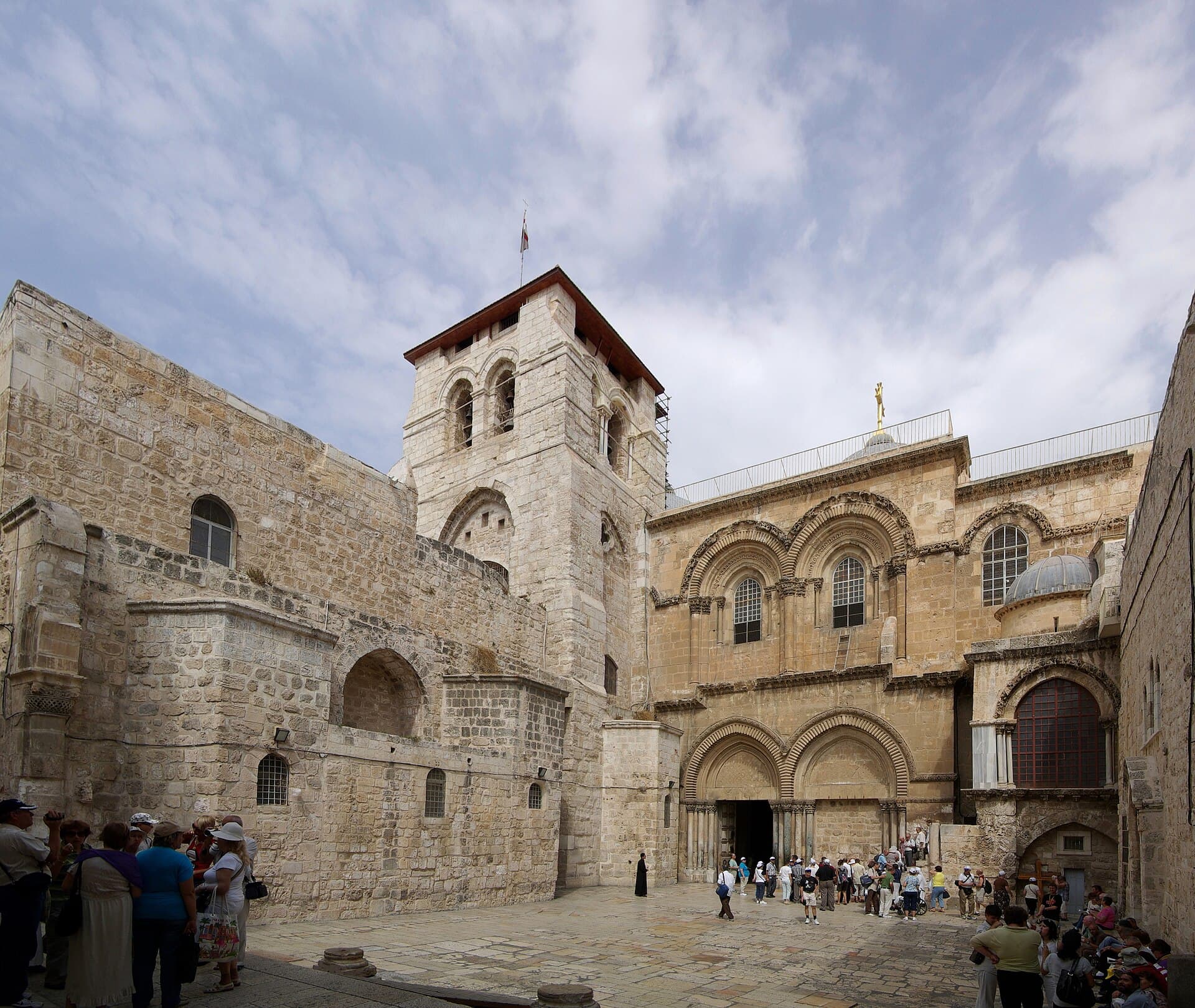
In the Christian Quarter of the Old City of Jerusalem, in territory administered by Israel since 1967, one doorway opens off a small stone courtyard into a building that most Christian traditions hold to contain two places at once. A steep stair inside the entrance climbs to the rock outcrop venerated as Golgotha, the hill of the crucifixion. Beneath a domed rotunda a few paces on stands a marble shrine over what is venerated as the tomb from which Jesus rose. The Church of the Holy Sepulchre has kept both under one roof since the fourth century.
The Old City and its walls were inscribed on the UNESCO World Heritage List in 1981 as property number 148, on a nomination submitted by Jordan, and have stood on the List of World Heritage in Danger continuously since 1982. The status of the Old City is disputed under international law, and this page takes no position on it. Six Christian communities share the church, and rules inherited from Ottoman decrees govern which of them may touch which stone.
The ground under the church had three earlier lives. Excavation since 2022 under Francesca Romana Stasolla of Sapienza University of Rome has traced the sequence: a limestone quarry in the Iron Age, then cultivated ground where pollen and seed samples show olive trees and grapevines, then rock-cut tombs by the first century AD, when the area lay outside the walls, where Jewish law required burials to be.
Around AD 135, when Hadrian rebuilt Jerusalem as the colony of Aelia Capitolina, the site was filled and levelled and a temple raised over it. Two centuries later Constantine had the temple pulled down. Eusebius of Caesarea, writing as a contemporary, records that a rock-cut tomb was found beneath the fill and identified by Bishop Macarius as the sepulchre of Jesus. Building began about 326, and the complex was consecrated on 13 September 335: a colonnaded basilica, an open courtyard holding the rock of Golgotha, and a domed rotunda over the tomb, whose surrounding hillside had been cut away so the chamber stood free.
On 18 October 1009 the Fatimid caliph al-Hakim bi-Amr Allah ordered the church destroyed, and the work was thorough: labourers pulled the buildings down and hacked the rock chamber back towards bedrock, leaving a stump of the original shelf. A reduced rebuilding under the Byzantine emperor Constantine IX Monomachos was complete by about 1048, restoring the rotunda but not the basilica.
Crusader armies took Jerusalem on 15 July 1099 and spent the next half century turning the remains into one building, roofing the old courtyard, adding a Romanesque chancel east of the rotunda, and raising the twin-arched south facade visitors still enter by. The rebuilt church was consecrated on 15 July 1149, the fiftieth anniversary of the conquest, in the reign of Queen Melisende. It was the first time Golgotha and the tomb stood inside the same walls. A fire in 1808 brought down the dome of the rotunda; it and the shrine over the tomb were rebuilt between 1809 and 1810 by Nikolaos Komnenos of Mytilene, and the Stone of Unction near the door dates from that work, not antiquity.
Six communities hold rights inside the building. The Greek Orthodox Patriarchate, the Armenian Apostolic Church and the Roman Catholic Franciscans of the Custody of the Holy Land are the three major parties; the Coptic Orthodox, Syriac Orthodox and Ethiopian Orthodox churches hold smaller and more specific rights. Their shares are not a modern settlement. A firman issued in 1757 froze possession as it then stood, decrees of 1852 and 1853 under Sultan Abdulmejid I confirmed it, and the arrangement entered international law through Article 9 of the Treaty of Paris in 1856 and Article 62 of the Treaty of Berlin in 1878, surviving the British Mandate intact. Nine holy places in Jerusalem and Bethlehem fall under the same rules.
The principle is simple to state and difficult to live with: in a shared space, nothing may be moved, cleaned, repaired or rearranged without the agreement of every party with an interest in it. Ownership is proved by use, so every routine act is also a legal argument. Sweeping a step, hanging a lamp, censing at a particular hour, standing in a doorway during a procession: each is a claim on the record, and each is watched. The reverse holds too: letting another community repair something can be read as conceding that the thing is theirs, which is why cracked plaster waits for decades. The pressure occasionally breaks. In July 2002 a Coptic monk moved his chair into the shade on a contested roof, and the fight that followed put eleven monks in hospital.
What this produces is a building with a different relationship to time than almost any other. Most old buildings change by accretion, each generation leaving its improvements behind. Here the default is that nothing changes, and each generation inherits not only the fabric but the arrangement of the fabric, down to the position of individual objects. Preservation is not a policy anyone adopted; it is the residue of six parties who cannot agree, and it has held the interior closer to its nineteenth-century state than any conservation plan could have.
The most quoted product of that rule is a short wooden ladder resting on a cornice under the right-hand upper window of the facade, on a ledge within Armenian jurisdiction. Nobody knows who put it there or why; the usual explanations, a mason who left it or monks who used it to reach the ledge, are conjecture. What is documented is the ladder's presence. The oldest known depiction is an engraving by the Franciscan Elzear Horn that the Custody of the Holy Land dates to 1728, an engraving of 1834 shows it in place, and the earliest photograph is from the 1850s. It has left the ledge once on record, in 1997, when a visitor hid it inside the church and it was put back. Three centuries of pictures, no known purpose, and a rule that turns moving it into a negotiation among six churches. An ordinary object left alone long enough became a monument by accident.
The keys work the same way and are older. The main door is opened and shut each day by two Muslim Jerusalemite families: the Joudeh family keeps the iron key, about thirty centimetres long, and carries it to the church; a Nuseibeh turns it and works the bolts, using a ladder passed out through a hatch in the door to reach the upper lock. The families' own accounts reach back further than the paperwork does. Nuseibeh tradition traces the role to the caliph Umar's entry into Jerusalem in 638, while the family acknowledges that surviving documents mention it only from the twelfth century. The accepted starting point is the period after Saladin retook the city in 1187, with a treaty of 1192 regulating Christian pilgrimage; Ottoman sultans confirmed the arrangement by decree from the sixteenth century, and the Joudeh family still holds a written Ottoman contract. The seventh century is family tradition; the medieval and Ottoman record is evidence.
The shrine over the tomb is called the Aedicule, from the Latin for a small house; inside are an antechamber and the burial chamber itself. The earthquake of 11 July 1927 damaged the structure badly and weakened the rotunda above it. Two decades later, after a survey found the shrine close to instability, the British Mandate authorities in 1947 bound it in an external cage of steel girders. The emergency measure stayed for sixty-nine years, a rusting exoskeleton in every photograph of the holiest spot in the building, because removing it required agreement on who would pay, who would supervise and who would touch what.
The agreement came in the end. The Greek Orthodox Patriarchate invited the National Technical University of Athens to study the shrine, the Armenian and Franciscan communities assented, and restoration ran from spring 2016 to March 2017 under Antonia Moropoulou. The stones were dismantled, cleaned, grouted and tied with titanium, and the girders cut away with a plasma saw. The engineering was ordinary conservation practice. The consent was the hard part.
On 26 October 2016 the marble slab over the burial bed was lifted for the first time in centuries and the rock surface beneath was exposed for about sixty hours. Under the top slab, in place since at least 1555, the team found fill, then a second broken slab incised with a cross, then bedrock. Mortar bonding the lower slab to the rock was dated by optically stimulated luminescence to around AD 345, with a margin of about 165 years, placing the enshrinement in the Constantinian period rather than in the Crusader rebuilding some scholars had assumed.
That result is worth stating with care. It shows that this rock shelf was cased in stone and treated as a shrine in the fourth century, matching what Eusebius wrote at the time. It says nothing about who was buried there. The wider excavation supports the setting rather than the identification: a first-century cemetery outside the walls as they then ran, beside lately cultivated ground, which fits the Gospel accounts of a burial place near a garden. Radiocarbon dating of the botanical samples has not yet been published. Whether the shelf inside the Aedicule is the tomb of Jesus rests on a tradition reaching back to the fourth century, and the archaeology neither proves nor disproves it.
Visitors expecting grandeur are often startled. The interior is dark, smoke-stained and architecturally incoherent, a collision of fourth-century plan, twelfth-century masonry, nineteenth-century marble and modern scaffolding, all of it crowded. Pilgrims kneel at the Stone of Unction inside the door and press cloths and rosaries to it; a queue folds around the rotunda, moving people into the Aedicule a few at a time. Liturgies in Greek, Latin, Armenian, Coptic, Syriac and Ge'ez run to a timetable negotiated to the minute, and on Holy Saturday in the Orthodox calendar thousands pack the rotunda for the ceremony of the Holy Fire.
None of it matches, because nothing here was allowed to be tidied. A ladder no one can explain has stood at a window since before the United States existed, kept there by the cost of the argument moving it would start. A key crosses the courtyard every morning in the hands of one family and is turned by another. A short walk away at the Western Wall, other people press written prayers into other stones. What this church preserves is not only a tomb and a rock. It is an agreement to leave things alone, renewed daily by people who agree on very little else, and in keeping it they have saved more than any of them set out to save.
A quarry, a garden, and Constantine's basilica
Ruin in 1009, and the church consecrated in 1149
The Status Quo, and what it does to time
A ladder nobody moves, and a key two families turn
The Aedicule, the earthquake, and the girders
Under the floor, what is known and what is believed
The church on an ordinary morning
References and resources
- UNESCO World Heritage Centre: Old City of Jerusalem and its Walls (property 148)
- Latin Patriarchate of Jerusalem: The Stones Speak, Excavations Reshaping the History of the Holy Sepulchre
- National Geographic: Christ's Burial Place Exposed for First Time in Centuries
- Custodia Terrae Sanctae: The Dedication of the Basilica of the Holy Sepulchre
- Wikipedia: Church of the Holy Sepulchre
- Wikipedia: Status Quo (Jerusalem and Bethlehem)
- Wikipedia: Immovable Ladder
- Wikipedia: Nusaybah family