Heritage · Landmark
Church of the Nativity: History, Attractions & Visitor Guide
The Church of the Nativity in Bethlehem stands over the cave Christians have held to be the birthplace of Jesus since at least the second century.Written to last.
By Confinity Heritage Editorial · Updated 2026-07-20 · 7-minute readQuiet tools, kept out of the way.
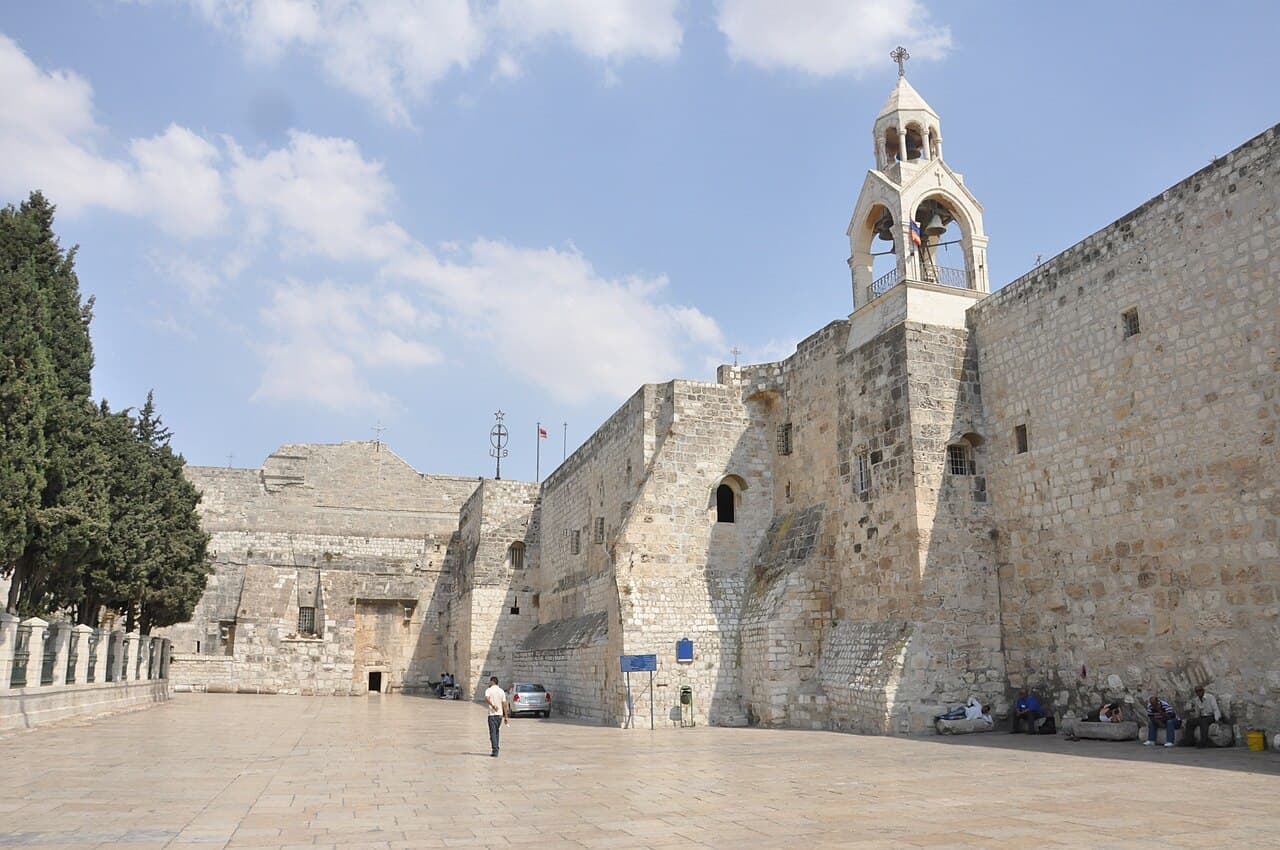
The Church of the Nativity stands in the centre of Bethlehem, in the West Bank, over a cave that Christian tradition has held since at least the second century to be the birthplace of Jesus. That grotto, and the basilica raised above it, form what UNESCO describes as one of the oldest sites in continuous use as a place of Christian worship. For pilgrims the destination is not the building but the small marble-lined chamber beneath its floor, reached by two worn stone staircases, where a silver star marks the spot associated with the Nativity.
What survives above ground is largely a sixth-century church, one of the oldest Christian sanctuaries still in regular use anywhere. It has been shared for centuries by three communities, Greek Orthodox, Armenian Apostolic and Roman Catholic, under a fixed set of arrangements that govern almost every stone and hour of the day. It has also carried the weight of the region's history, from the pilgrims of late antiquity to a thirty-nine-day siege in 2002, and, in 2012, it became the first site inscribed on the World Heritage List under Palestine.
The first church on the site was commissioned in the reign of the Roman emperor Constantine the Great, following the pilgrimage his mother Helena made to Jerusalem and Bethlehem in about 325 to 326. Work is generally dated to the late 320s, and the Bordeaux Pilgrim recorded a basilica here in 333; the dedication is traditionally placed on 31 May 339. Constantine's church was an octagonal structure built directly over the grotto, with an opening in its floor through which pilgrims could look down into the cave. Fragments of its geometric mosaic pavement still survive beneath the present floor.
That first basilica did not last. It was probably destroyed by fire during the Samaritan revolts of the early sixth century, around 529. The emperor Justinian I, who reigned from 527 to 565, rebuilt it on a larger plan, and it is this Justinianic basilica, much repaired but never again demolished, that visitors enter today. Dendrochronological study of timber embedded in the walls has returned dates spanning the sixth and seventh centuries, consistent with a rebuilding in Justinian's era and later maintenance.
A frequently repeated tradition holds that the church was spared when the Persians under Khosrow II invaded in 614 and destroyed many Christian sites. According to the account, the invaders recognised the Three Magi shown in Persian dress in a mosaic above the entrance and left the building intact. The mosaic itself has not survived, but the story explains why the Nativity church, almost alone among the region's early basilicas, came through that period standing.
During the Crusader kingdom the church was richly redecorated. In the twelfth century its walls received gilded wall mosaics and its columns were painted with images of saints; Baldwin I and Baldwin II were both crowned here. Much of that work was later lost or faded, but portions of the Crusader mosaics remain on the nave walls, and traces of the column paintings can still be made out. Under the Mamluks and then the Ottomans the fabric was neglected rather than rebuilt, and marble and fittings were removed over the centuries. An earthquake in 1834 and a fire in 1869 damaged the interior, particularly in the grotto, without bringing the structure down.
The most immediate feature of the church is the way one enters it. The main west doorway, the Door of Humility, is barely over a metre high, so that every visitor must stoop to pass through. The opening was reduced to its present size in the medieval and Ottoman periods, in part to stop carts and animals being driven inside; above the low lintel the outline of an earlier, taller pointed arch is still visible in the stonework, and above that an older squared Justinianic opening.
 The nave columns and much of the plan are Justinian's, from the 560s, which makes this one of the oldest churches still in daily use anywhere. Photograph by Diego Delso, CC BY-SA 3.0, via Wikimedia Commons.
Inside, the plan is that of a classic Roman basilica: a long central nave flanked by double aisles and ending in an eastern apse. Four rows of columns, forty-four in all, run the length of the interior, cut from local reddish limestone and topped with Corinthian capitals. Several still carry faint twelfth-century paintings of saints. Overhead is a high timber roof, and the upper walls retain sections of the Crusader-era gold-ground mosaics. Set into the floor of the nave are wooden trapdoors that lift to reveal the mosaic pavement of Constantine's fourth-century church below.
Beneath the raised chancel lies the Grotto of the Nativity, the cave that gives the church its purpose. It is entered by two curving staircases, one used by the Greek Orthodox and one by the Armenians, that descend into a rectangular chamber lined with marble and hung with lamps. At its eastern end, set into the floor beneath a small altar, is a fourteen-pointed silver star bearing the Latin inscription "Hic De Virgine Maria Jesus Christus Natus Est" (Here Jesus Christ was born of the Virgin Mary) and the date 1717. The star marks the traditional place of the birth; the fourteen points are often read as echoing the three sets of fourteen generations in the genealogy of Jesus given in Matthew's Gospel. Around it hang fifteen silver lamps belonging to the three communities. A few steps away, opposite, is the Chapel of the Manger, with the Altar of the Adoration of the Magi nearby, marking where tradition places the crib and the visit of the wise men.
Adjoining the basilica to the north is the Roman Catholic Church of St Catherine, rebuilt in the nineteenth and twentieth centuries and connected to the older building and to further grottoes, including one associated with Saint Jerome, who is said to have translated much of the Bible into Latin here. It is from St Catherine's that the Latin Patriarch's Midnight Mass is broadcast each Christmas Eve.
The Church of the Nativity is one of the principal shrines governed by the Status Quo, an arrangement that freezes the rights, movements and responsibilities of the different Christian communities in the holy places of the region. Three churches hold the main shares of the Nativity: the Greek Orthodox Patriarchate, which controls the basilica and the grotto's high altar; the Armenian Apostolic Church; and the Roman Catholic Church, represented by the Franciscan Custody of the Holy Land. The Coptic Orthodox and Syriac Orthodox churches hold lesser rights to worship at particular spots.
The Status Quo took shape from an Ottoman decree of 1757 and was reaffirmed in 1852, then acknowledged in the international treaties that followed the Crimean War. It fixes, in fine detail, which community may clean or repair which surface, when each may hold its services, and along which route each may process. Because any change to a lamp or a floor tile can be read as a change to a community's rights, ordinary maintenance has often been difficult, and disputes over the shared spaces have sometimes turned to open quarrels among the resident clergy.
That sensitivity is not new. In 1847 the silver star was removed from the grotto, an act widely reported at the time and blamed on rival parties. The dispute over the star and over custody of the holy places fed into the wider Franco-Russian tension that helped bring on the Crimean War; the star was replaced by the Ottoman authorities in 1853. The episode is a reminder that control of these few square metres of stone has at times carried consequences far beyond Bethlehem.
The shared calendar is visible above all at Christmas, which is celebrated three times. The Roman Catholic and Protestant communities keep 25 December; the Greek Orthodox and most Eastern Orthodox keep 7 January, following the older Julian reckoning; and the Armenian Apostolic Church observes the Nativity together with the Epiphany in January as well. Each celebration brings its own procession into Bethlehem and its own liturgy in and around the grotto. Manger Square, immediately outside the church, serves as the gathering place for these events and for the town's public life.
The compound also stood at the centre of a modern conflict. Between 2 April and 10 May 2002, during the Israeli military operation known as Defensive Shield in the Second Intifada, the church was placed under a thirty-nine-day siege. Dozens of armed Palestinians, sought by Israeli forces, took refuge inside along with roughly two hundred clergy and civilians. Eight Palestinians were killed during the standoff, among them the church bell-ringer, and a gunfight on 8 April started a fire that damaged part of the compound. The siege ended in a negotiated agreement under which thirteen of the men were exiled to European countries and twenty-six to the Gaza Strip, and the remaining occupants were released.
In June 2012 the site was inscribed on the World Heritage List as "Birthplace of Jesus: Church of the Nativity and the Pilgrimage Route, Bethlehem." It was the first site inscribed under Palestine, and the listing was granted under cultural criteria (iv) and (vi). The inscription covers not only the church and its associated convents but also the traditional pilgrimage route, known as Star Street, along which processions have long entered the town.
The site was placed on the List of World Heritage in Danger at the same moment it was inscribed. The reason was the poor condition of the church, above all rainwater leaking through the ancient timber roof, which threatened the structure below and had damaged plaster, wall mosaics and the wooden fabric. From about 2013 a major conservation campaign, funded largely by the Palestinian Authority and international donors and carried out by specialist teams, addressed these problems in stages. The roof was repaired, the exterior facades cleaned and consolidated, the surviving wall mosaics conserved, the wooden doors treated, and the columns and floor mosaics restored, with newly uncovered mosaic panels revealed in the process.
Alongside the physical work, the authorities adopted a conservation management plan for the site and shelved a proposed tunnel project under Manger Square that had raised concern about the setting. On the strength of that work, the World Heritage Committee, meeting in Baku in 2019, removed the Church of the Nativity from the Danger List. It remains a World Heritage Site in good standing, and conservation of the mosaics and fabric has continued since.
The church sits on the eastern side of Manger Square in the centre of Bethlehem, a short distance south of Jerusalem in the West Bank. It is a working place of worship rather than a museum, open to visitors on most days, though hours shift around the many services held by the three communities. There is generally no admission charge, and donations support the upkeep of the site.
Visitors enter through the Door of Humility and cross the broad nave to reach the two staircases down to the grotto. The grotto is small and much visited, so at busy times, and especially around the three Christmas seasons, there can be long queues to descend and only a brief moment at the star itself. Early morning and the quieter spring and autumn weeks are the easiest times to see it. Because this is an active shrine, modest dress covering shoulders and knees is expected, and quiet respect is asked for during the frequent liturgies. Photography is normally allowed, but restraint is expected while services are underway.
Several related sites lie within walking distance. The Church of St Catherine adjoins the basilica to the north. Nearby are the Milk Grotto, a chapel associated with the Holy Family's flight, and, a short way out of town, the Shepherds' Field at Beit Sahour, linked to the announcement of the birth. Manger Square itself, with its shops selling the olive-wood carvings for which Bethlehem is known, is the natural place to begin or end a visit.
The nave columns and much of the plan are Justinian's, from the 560s, which makes this one of the oldest churches still in daily use anywhere. Photograph by Diego Delso, CC BY-SA 3.0, via Wikimedia Commons.
Inside, the plan is that of a classic Roman basilica: a long central nave flanked by double aisles and ending in an eastern apse. Four rows of columns, forty-four in all, run the length of the interior, cut from local reddish limestone and topped with Corinthian capitals. Several still carry faint twelfth-century paintings of saints. Overhead is a high timber roof, and the upper walls retain sections of the Crusader-era gold-ground mosaics. Set into the floor of the nave are wooden trapdoors that lift to reveal the mosaic pavement of Constantine's fourth-century church below.
Beneath the raised chancel lies the Grotto of the Nativity, the cave that gives the church its purpose. It is entered by two curving staircases, one used by the Greek Orthodox and one by the Armenians, that descend into a rectangular chamber lined with marble and hung with lamps. At its eastern end, set into the floor beneath a small altar, is a fourteen-pointed silver star bearing the Latin inscription "Hic De Virgine Maria Jesus Christus Natus Est" (Here Jesus Christ was born of the Virgin Mary) and the date 1717. The star marks the traditional place of the birth; the fourteen points are often read as echoing the three sets of fourteen generations in the genealogy of Jesus given in Matthew's Gospel. Around it hang fifteen silver lamps belonging to the three communities. A few steps away, opposite, is the Chapel of the Manger, with the Altar of the Adoration of the Magi nearby, marking where tradition places the crib and the visit of the wise men.
Adjoining the basilica to the north is the Roman Catholic Church of St Catherine, rebuilt in the nineteenth and twentieth centuries and connected to the older building and to further grottoes, including one associated with Saint Jerome, who is said to have translated much of the Bible into Latin here. It is from St Catherine's that the Latin Patriarch's Midnight Mass is broadcast each Christmas Eve.
The Church of the Nativity is one of the principal shrines governed by the Status Quo, an arrangement that freezes the rights, movements and responsibilities of the different Christian communities in the holy places of the region. Three churches hold the main shares of the Nativity: the Greek Orthodox Patriarchate, which controls the basilica and the grotto's high altar; the Armenian Apostolic Church; and the Roman Catholic Church, represented by the Franciscan Custody of the Holy Land. The Coptic Orthodox and Syriac Orthodox churches hold lesser rights to worship at particular spots.
The Status Quo took shape from an Ottoman decree of 1757 and was reaffirmed in 1852, then acknowledged in the international treaties that followed the Crimean War. It fixes, in fine detail, which community may clean or repair which surface, when each may hold its services, and along which route each may process. Because any change to a lamp or a floor tile can be read as a change to a community's rights, ordinary maintenance has often been difficult, and disputes over the shared spaces have sometimes turned to open quarrels among the resident clergy.
That sensitivity is not new. In 1847 the silver star was removed from the grotto, an act widely reported at the time and blamed on rival parties. The dispute over the star and over custody of the holy places fed into the wider Franco-Russian tension that helped bring on the Crimean War; the star was replaced by the Ottoman authorities in 1853. The episode is a reminder that control of these few square metres of stone has at times carried consequences far beyond Bethlehem.
The shared calendar is visible above all at Christmas, which is celebrated three times. The Roman Catholic and Protestant communities keep 25 December; the Greek Orthodox and most Eastern Orthodox keep 7 January, following the older Julian reckoning; and the Armenian Apostolic Church observes the Nativity together with the Epiphany in January as well. Each celebration brings its own procession into Bethlehem and its own liturgy in and around the grotto. Manger Square, immediately outside the church, serves as the gathering place for these events and for the town's public life.
The compound also stood at the centre of a modern conflict. Between 2 April and 10 May 2002, during the Israeli military operation known as Defensive Shield in the Second Intifada, the church was placed under a thirty-nine-day siege. Dozens of armed Palestinians, sought by Israeli forces, took refuge inside along with roughly two hundred clergy and civilians. Eight Palestinians were killed during the standoff, among them the church bell-ringer, and a gunfight on 8 April started a fire that damaged part of the compound. The siege ended in a negotiated agreement under which thirteen of the men were exiled to European countries and twenty-six to the Gaza Strip, and the remaining occupants were released.
In June 2012 the site was inscribed on the World Heritage List as "Birthplace of Jesus: Church of the Nativity and the Pilgrimage Route, Bethlehem." It was the first site inscribed under Palestine, and the listing was granted under cultural criteria (iv) and (vi). The inscription covers not only the church and its associated convents but also the traditional pilgrimage route, known as Star Street, along which processions have long entered the town.
The site was placed on the List of World Heritage in Danger at the same moment it was inscribed. The reason was the poor condition of the church, above all rainwater leaking through the ancient timber roof, which threatened the structure below and had damaged plaster, wall mosaics and the wooden fabric. From about 2013 a major conservation campaign, funded largely by the Palestinian Authority and international donors and carried out by specialist teams, addressed these problems in stages. The roof was repaired, the exterior facades cleaned and consolidated, the surviving wall mosaics conserved, the wooden doors treated, and the columns and floor mosaics restored, with newly uncovered mosaic panels revealed in the process.
Alongside the physical work, the authorities adopted a conservation management plan for the site and shelved a proposed tunnel project under Manger Square that had raised concern about the setting. On the strength of that work, the World Heritage Committee, meeting in Baku in 2019, removed the Church of the Nativity from the Danger List. It remains a World Heritage Site in good standing, and conservation of the mosaics and fabric has continued since.
The church sits on the eastern side of Manger Square in the centre of Bethlehem, a short distance south of Jerusalem in the West Bank. It is a working place of worship rather than a museum, open to visitors on most days, though hours shift around the many services held by the three communities. There is generally no admission charge, and donations support the upkeep of the site.
Visitors enter through the Door of Humility and cross the broad nave to reach the two staircases down to the grotto. The grotto is small and much visited, so at busy times, and especially around the three Christmas seasons, there can be long queues to descend and only a brief moment at the star itself. Early morning and the quieter spring and autumn weeks are the easiest times to see it. Because this is an active shrine, modest dress covering shoulders and knees is expected, and quiet respect is asked for during the frequent liturgies. Photography is normally allowed, but restraint is expected while services are underway.
Several related sites lie within walking distance. The Church of St Catherine adjoins the basilica to the north. Nearby are the Milk Grotto, a chapel associated with the Holy Family's flight, and, a short way out of town, the Shepherds' Field at Beit Sahour, linked to the announcement of the birth. Manger Square itself, with its shops selling the olive-wood carvings for which Bethlehem is known, is the natural place to begin or end a visit.
History
The church and the grotto
Shared custody and traditions
Preservation and UNESCO
Visiting
References and resources
- UNESCO World Heritage Centre: Birthplace of Jesus (List 1433)
- UNESCO: site removed from the List of World Heritage in Danger (2019)
- UNESCO news: 2012 inscription of the Church of the Nativity
- Encyclopaedia Britannica: Church of the Nativity
- Wikipedia: Church of the Nativity
- Wikipedia: Siege of the Church of the Nativity (2002)
- Wikipedia: Status Quo (Holy Land sites)
- UNESCO World Heritage Centre: State of Conservation reports