Heritage · Country
Zambia Culture and Heritage
Zambia keeps its memory where water meets stone: the thundering curtain of Mosi-oa-Tunya at Livingstone, the Litunga's striped barge riding the Zambezi flood, and rock shelters near Kasama older than any map. A guide to the country's heritage and the people who keep it alive.Written to last.
By Confinity Heritage Editorial · Updated 2026-07-31 · 8-minute readQuiet tools, kept out of the way.
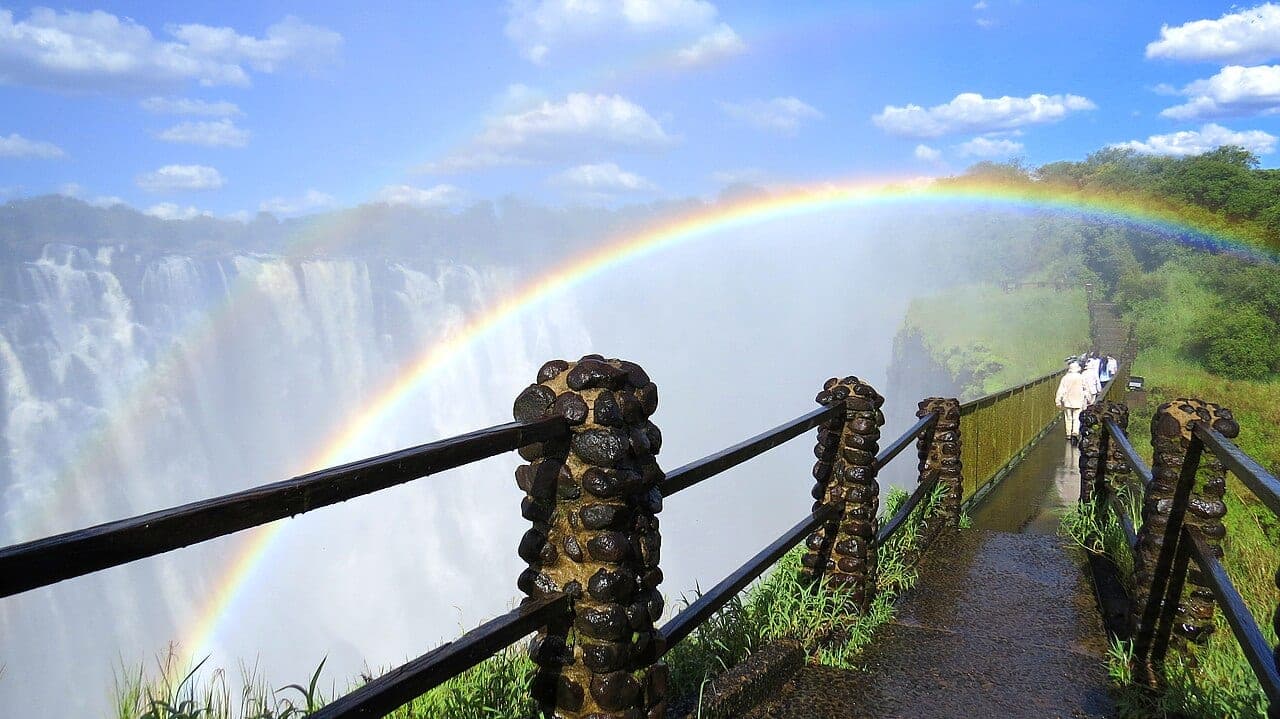
At Livingstone, on Zambia's southern edge, the Zambezi River meets a fault in the basalt and drops into a chasm more than a hundred metres deep. The Tonga who have lived along the river for centuries named the place Mosi-oa-Tunya, "the smoke that thunders", for the spray that rises hundreds of metres and the roar that carries across the plateau. In 1855 the missionary David Livingstone became the first European to record the falls and renamed them for Queen Victoria; the two names have travelled together ever since. Inscribed by UNESCO in 1989 and shared with Zimbabwe across the gorge, the falls are the widest sheet of falling water on earth, roughly 1,700 metres across.
Yet the falls are only the loudest of Zambia's inheritances. Behind them lies a landlocked plateau where more than seventy peoples have made their homes, among them the Bemba, Tonga, Lozi, Chewa and Ngoni, each with its own language, ceremonies and ways of remembering the dead. The country also holds some of the oldest evidence of human life anywhere: a skull from Kabwe close to three hundred thousand years old, and notched logs at Kalambo Falls that may be the earliest wooden structure ever found.
Zambia is a landlocked country of 752,618 square kilometres in south-central Africa, bordered by eight neighbours: the Democratic Republic of the Congo and Tanzania to the north, Malawi and Mozambique to the east, Zimbabwe, Botswana and Namibia to the south, and Angola to the west. Its shape follows the rivers: the Zambezi runs along the southern border and gathers the Kafue and the Luangwa, while the north holds part of Lake Tanganyika and the reed-fringed Bangweulu swamps. Most of the land is high plateau, and the year turns on rains from November to April and dry months after.
The population of roughly twenty million is young and increasingly urban, concentrated along the line of rail that runs from Livingstone through Lusaka to the Copperbelt. Copper has shaped the modern nation more than anything else: it drew the railway, built the northern cities, and still earns most of the country's foreign exchange. The currency, the kwacha, takes its name from a Bemba and Nyanja word for dawn, chosen at independence as an image of a new day, and the national motto, "One Zambia, One Nation", was Kenneth Kaunda's answer to a country of more than seventy language groups.
Lusaka. The capital began in 1913 as a settlement on the railway, taking its name from a village headman, Lusaaka, of the Soli people. It became the seat of Northern Rhodesia's government in 1935 and the capital of independent Zambia in 1964. Today it is the country's political and commercial centre, home to the National Assembly, the University of Zambia and the Lusaka National Museum.
Livingstone. Founded in 1905 beside the falls and named for the explorer, Livingstone was the colonial capital from 1911 until Lusaka took the role in 1935. Its wealth came from the railway and the bridge across the Zambezi gorge, and it remains the gateway to Mosi-oa-Tunya. The Livingstone Museum, opened in 1934, is the oldest and largest in the country, keeping David Livingstone's own letters alongside archaeology and ethnography.
Ndola. The commercial capital of the Copperbelt was laid out in 1904 and grew with the mines and the railway that reached it in 1909. Nearby is the memorial marking the 1961 air crash that killed Dag Hammarskjöld, the United Nations Secretary-General, as he flew toward ceasefire talks over neighbouring Katanga, a quiet site of international remembrance on Zambian soil.
Kitwe. Founded in 1936 around the Nkana mine, Kitwe became the industrial heart of the Copperbelt and the country's second city. Its story is that of Zambian mining labour: the compounds, unions and football clubs that formed around the shafts.
Zambia's human record is among the deepest on earth. In 1921 miners at Broken Hill, now Kabwe, uncovered a fossil skull, since dated to about 299,000 years ago and classified as Homo heidelbergensis, the first archaic human fossil found in Africa. At Kalambo Falls in the far north, archaeologists in 2023 reported interlocking notched logs shaped by deliberate cutting around 476,000 years ago, possibly the oldest wooden structure known. Near Kasama, hunter-gatherers left several hundred painted images over some two thousand years.
Bantu-speaking farmers, ironworkers and herders moved into the region across the first and second millennia AD, and by the eighteenth century organised kingdoms had formed, many tracing their origins to the Luba and Lunda states of the Congo basin. The Bemba built a powerful chieftaincy in the north-east under the Chitimukulu, the Lunda of Kazembe controlled the Luapula valley, and the Chewa and Ngoni held the east. In the upper Zambezi floodplain the Lozi created the kingdom of Barotseland, ruled by the Litunga through an elaborate order of officials and a seasonal migration between flood and dry-season capitals. Long-distance trade in ivory and copper joined these states, and, in its cruel turn, so did a trade in enslaved people.
The missionary David Livingstone reached the falls in 1855, and after him came the agents of Cecil Rhodes. Through treaties, some contested to this day, the British South Africa Company took control in the 1890s and administered the territory as Northern Rhodesia until the British Crown assumed direct rule in 1924. The discovery of vast copper deposits in the 1920s reshaped everything: mines opened across the Copperbelt, towns rose around them, and the African labourers who dug the ore built the unions and movements that would seek self-rule. That movement gathered force after the Second World War, in opposition to the settler-dominated Central African Federation of 1953. Kenneth Kaunda led the United National Independence Party to victory as the Federation collapsed, and on 24 October 1964 Northern Rhodesia became the independent Republic of Zambia with Kaunda as its first president.
The name Zambia was coined at independence from the Zambezi River, itself from Bantu roots often glossed as "the great river". The choice was deliberate: in place of Northern Rhodesia, named for Cecil Rhodes, the new republic anchored its identity in the water that runs through it. Other place names carry similar memory, from Lusaka, honouring a village headman, to Mosi-oa-Tunya, the Tonga name for the falls the colonial map had renamed.
English is the official language, a neutral choice among many, used in government, courts and schools. Beneath it Zambians speak more than seventy languages, almost all of them Bantu, of which seven join English as officially recognised regional languages: Bemba, the most widely spoken and the lingua franca of the Copperbelt and the north; Nyanja, the language of Lusaka and the east; Tonga in the south; Lozi in the west; and Kaonde, Lunda and Luvale in the north-west. Bemba and Nyanja in particular have spread far beyond their home regions through radio, church and popular music, which have made these tongues a shared daily inheritance.
Zambian identity is expressed above all in its ceremonies, of which the country counts more than twenty major ones through the year. The best known is the Kuomboka of the Lozi, whose name means "to get out of water". When the Zambezi floods the Barotse plain, usually around March or April, the Litunga leaves his flooded capital at Lealui for higher ground at Limulunga aboard the Nalikwanda, a black-and-white royal barge crowned with a carved elephant and driven by scores of paddlers. In the east the Ngoni hold the Ncwala, a first-fruits ceremony of Zulu descent in which the paramount chief tastes the new harvest amid war dances and shields; the Tonga of the south gather at Gonde near Monze for the Lwiindi; and in the north-west the Luvale mark Likumbi Lya Mize.
 The Lozi and Tonga names for the falls, Mosi-oa-Tunya, the smoke that thunders, are now used alongside the one Livingstone gave them. Photograph by Diego Delso, CC BY-SA 4.0, via Wikimedia Commons.
That last ceremony brings out the Makishi, masked figures who embody the spirits of ancestors and appear at the close of the mukanda, the boys' initiation. Carved masks, beadwork, woven baskets and pottery belong to a strong material culture. Music runs through everything: kalindula, the guitar-and-drum dance style that rose in the 1970s and 1980s, gave Zambia a distinctive popular sound, while church choirs, ceremonial drumming and a busy hip-hop scene keep the airwaves full. Football, followed with devotion under the national team's name Chipolopolo, "the Copper Bullets", is a shared language of its own.
Zambia is overwhelmingly Christian, with roughly nine in ten citizens belonging to Protestant, Catholic, Pentecostal and African independent churches; the 1996 constitution's preamble declares Zambia a Christian nation while guaranteeing freedom of worship, and small Muslim, Hindu, Baha'i and Jewish communities live mainly in the towns. Missions arrived in the nineteenth and early twentieth centuries and built many of the country's first schools and hospitals, and Sunday worship, choir singing and church funerals are woven into ordinary life.
Older beliefs endure alongside the churches rather than beneath them. Most Zambian peoples recognise a creator, known as Lesa among the Bemba and by other names elsewhere, approached less directly than the ancestors, who remain part of the family and are consulted at moments of birth, marriage, illness and death. Traditional healers and diviners are still sought for misfortune and protection, and many Zambians move without contradiction between church on Sunday and the observances owed to their ancestors.
Nothing gathers a Zambian community like a death. A funeral halts ordinary life; work stops, relatives travel from far away, and the home of the bereaved fills for days with mourners who arrive bearing food and money, often organised through the burial societies to which many families belong. Women gather to sing and to voice the ritual cries that announce a death to the neighbourhood, an all-night wake is kept beside the body, and burial usually follows within a few days. Among matrilineal peoples such as the Bemba, inheritance and succession pass through the mother's line, and a gathering of relatives after the burial settles who will carry the deceased's name and responsibilities forward.
Beneath these forms lies the conviction that the dead are not gone but changed, becoming ancestors who watch over the living. Whether a person joins the benign ancestors or the restless spirits was long held to depend on how the funeral was conducted, which is one reason the rites are performed with such care. Widows and widowers observe periods of mourning and cleansing that readmit them to ordinary life, customs now discussed and sometimes softened where they fall harder on women than on men.
The passage between the living and the dead is dramatised most fully in the Makishi of the north-western peoples. At the end of the mukanda, in which boys withdraw to bush camps to be taught and circumcised and then return as men, the Makishi appear as masked figures understood to have come back from the world of the dead to guide the initiates. Each character carries meaning, and the masquerade is treated as sacred instruction rather than performance, closed to outsiders. Over most funerals today a Christian service is held as well, with hymns, scripture and burial in a cemetery, so that grief in Zambia is often expressed twice over, in the language of the church and in the older language of the ancestors.
Zambian family records are mission records and mine records, and between them they cover most of the twentieth century.
The London Missionary Society, the White Fathers, the Paris Evangelical Mission and others were in the territory from the late nineteenth century, and their baptism, marriage and burial registers are the earliest written vital records for Zambian families. The National Archives of Zambia in Lusaka holds the Northern Rhodesia and post-independence series, with parallel material at Kew.
The Copperbelt is the other archive. From the 1930s the mines drew hundreds of thousands of workers from across the territory and from Malawi, Tanzania and Congo, and the mining companies kept employment, housing, medical and death records for a workforce that constituted a large share of the country's men. Those files document internal migration that nothing else records.
Zambian societies are largely matrilineal, among the Bemba, Chewa, Lunda, Luvale and others, so descent and inheritance pass through the mother's line and a man's heirs are often his sister's children. That is the single most important thing to know before starting, because assuming patrilineal descent will produce a wrong tree.
Chieftainship follows the same principle, and the succession of chiefs is held by the royal establishment of each chiefdom.
Civil registration is compulsory and improving, but a substantial share of older Zambians have no birth certificate, and the national registration card issued at sixteen is often the earliest official document a person holds.
Zambia's heritage is safeguarded chiefly by the National Heritage Conservation Commission, a statutory body under the Ministry of Tourism that traces its origins to a colonial-era monuments commission and took its present name in 1989. The Commission maintains a register of more than four thousand sites, from the Kabwe fossil locality and the Kasama rock shelters to colonial buildings and industrial structures, and it manages the country's national monuments and museums.
Zambia's single UNESCO World Heritage site is Mosi-oa-Tunya / Victoria Falls, inscribed in 1989 as a natural property shared with Zimbabwe, whose management the two countries coordinate across the gorge. On the intangible side, the Makishi masquerade was proclaimed by UNESCO in 2005 and carried onto the Representative List of the Intangible Cultural Heritage of Humanity. Living heritage is also kept alive by the ceremonies themselves: the Kuomboka, the Ncwala, the Lwiindi and Likumbi Lya Mize draw thousands each year and pass their knowledge to a new generation. Zambia's tentative list for future nomination includes the Barotse cultural landscape, the archaeology of Kalambo Falls, and the rock art of Kasama.
The oldest of Zambia's stories are increasingly told in digital form. The Kalambo Falls discovery was published in open-access journals and shared widely online, bringing a half-million-year-old structure to readers who will never reach the site, and the British Museum's African rock art image project has placed photographs of Zambian panels, including those near Kasama, on the open web for study without harm to the fragile surfaces. The Livingstone Museum and other institutions have begun to catalogue and share their collections digitally, though funding and equipment remain constant constraints.
Language has its own digital frontier: Zambian researchers and international partners have built speech and text datasets for Bemba and other national languages, helping keep them usable online. Informally, Zambians have made social media a living archive, where recordings of the Kuomboka barge and the Makishi dancers, kalindula and gospel performances, and Nyanja and Bemba storytelling circulate daily, far beyond the villages where they began.
Zambia's contemporary culture reaches well beyond its borders. In literature, Namwali Serpell's 2019 novel The Old Drift, a multi-generational story that opens at the falls, won the Arthur C. Clarke Award and drew international attention to Zambian fiction, following an earlier tradition that included the novelist Dominic Mulaisho. In music, the Zamrock bands of the 1970s, among them WITCH and Amanaz, who fused rock with Zambian rhythms in the Copperbelt's mining towns, have found a global second life through reissues and touring, while kalindula and a busy scene of Zambian pop, gospel and hip-hop hold the home audience.
Beyond the arts and sport, Zambian designers, chefs and film-makers have begun to carry the country's imagery outward, and a large diaspora in Southern Africa, Britain and North America keeps ceremonies, languages and recipes alive abroad, so that Zambian culture is now made in Lusaka and Kitwe and also in London and Johannesburg.
A trophy carried home to the fallen. In February 2012 Zambia won the Africa Cup of Nations for the first time, beating Ivory Coast on penalties in Libreville, Gabon, the same city off whose coast the entire national team had died in an air crash in 1993. Players visited the crash site before the final, and the victory was received at home as an act of remembrance as much as a sporting triumph.
The oldest known wood. In 2023 archaeologists at Kalambo Falls reported notched, interlocking logs shaped by human hands roughly 476,000 years ago, the earliest known example of structural woodwork, placing a Zambian site at the centre of human-origins research.
A skull that reset a date. The Broken Hill cranium found at Kabwe in 1921, the first archaic human fossil recovered in Africa, was redated in 2020 to about 299,000 years ago, revising scholars' understanding of when Homo heidelbergensis lived.
A Zambian novel goes global. Namwali Serpell's The Old Drift won the Arthur C. Clarke Award and wide acclaim, telling a century of Zambian history through three interwoven families and holding a world readership on its own terms.
The Lozi and Tonga names for the falls, Mosi-oa-Tunya, the smoke that thunders, are now used alongside the one Livingstone gave them. Photograph by Diego Delso, CC BY-SA 4.0, via Wikimedia Commons.
That last ceremony brings out the Makishi, masked figures who embody the spirits of ancestors and appear at the close of the mukanda, the boys' initiation. Carved masks, beadwork, woven baskets and pottery belong to a strong material culture. Music runs through everything: kalindula, the guitar-and-drum dance style that rose in the 1970s and 1980s, gave Zambia a distinctive popular sound, while church choirs, ceremonial drumming and a busy hip-hop scene keep the airwaves full. Football, followed with devotion under the national team's name Chipolopolo, "the Copper Bullets", is a shared language of its own.
Zambia is overwhelmingly Christian, with roughly nine in ten citizens belonging to Protestant, Catholic, Pentecostal and African independent churches; the 1996 constitution's preamble declares Zambia a Christian nation while guaranteeing freedom of worship, and small Muslim, Hindu, Baha'i and Jewish communities live mainly in the towns. Missions arrived in the nineteenth and early twentieth centuries and built many of the country's first schools and hospitals, and Sunday worship, choir singing and church funerals are woven into ordinary life.
Older beliefs endure alongside the churches rather than beneath them. Most Zambian peoples recognise a creator, known as Lesa among the Bemba and by other names elsewhere, approached less directly than the ancestors, who remain part of the family and are consulted at moments of birth, marriage, illness and death. Traditional healers and diviners are still sought for misfortune and protection, and many Zambians move without contradiction between church on Sunday and the observances owed to their ancestors.
Nothing gathers a Zambian community like a death. A funeral halts ordinary life; work stops, relatives travel from far away, and the home of the bereaved fills for days with mourners who arrive bearing food and money, often organised through the burial societies to which many families belong. Women gather to sing and to voice the ritual cries that announce a death to the neighbourhood, an all-night wake is kept beside the body, and burial usually follows within a few days. Among matrilineal peoples such as the Bemba, inheritance and succession pass through the mother's line, and a gathering of relatives after the burial settles who will carry the deceased's name and responsibilities forward.
Beneath these forms lies the conviction that the dead are not gone but changed, becoming ancestors who watch over the living. Whether a person joins the benign ancestors or the restless spirits was long held to depend on how the funeral was conducted, which is one reason the rites are performed with such care. Widows and widowers observe periods of mourning and cleansing that readmit them to ordinary life, customs now discussed and sometimes softened where they fall harder on women than on men.
The passage between the living and the dead is dramatised most fully in the Makishi of the north-western peoples. At the end of the mukanda, in which boys withdraw to bush camps to be taught and circumcised and then return as men, the Makishi appear as masked figures understood to have come back from the world of the dead to guide the initiates. Each character carries meaning, and the masquerade is treated as sacred instruction rather than performance, closed to outsiders. Over most funerals today a Christian service is held as well, with hymns, scripture and burial in a cemetery, so that grief in Zambia is often expressed twice over, in the language of the church and in the older language of the ancestors.
Zambian family records are mission records and mine records, and between them they cover most of the twentieth century.
The London Missionary Society, the White Fathers, the Paris Evangelical Mission and others were in the territory from the late nineteenth century, and their baptism, marriage and burial registers are the earliest written vital records for Zambian families. The National Archives of Zambia in Lusaka holds the Northern Rhodesia and post-independence series, with parallel material at Kew.
The Copperbelt is the other archive. From the 1930s the mines drew hundreds of thousands of workers from across the territory and from Malawi, Tanzania and Congo, and the mining companies kept employment, housing, medical and death records for a workforce that constituted a large share of the country's men. Those files document internal migration that nothing else records.
Zambian societies are largely matrilineal, among the Bemba, Chewa, Lunda, Luvale and others, so descent and inheritance pass through the mother's line and a man's heirs are often his sister's children. That is the single most important thing to know before starting, because assuming patrilineal descent will produce a wrong tree.
Chieftainship follows the same principle, and the succession of chiefs is held by the royal establishment of each chiefdom.
Civil registration is compulsory and improving, but a substantial share of older Zambians have no birth certificate, and the national registration card issued at sixteen is often the earliest official document a person holds.
Zambia's heritage is safeguarded chiefly by the National Heritage Conservation Commission, a statutory body under the Ministry of Tourism that traces its origins to a colonial-era monuments commission and took its present name in 1989. The Commission maintains a register of more than four thousand sites, from the Kabwe fossil locality and the Kasama rock shelters to colonial buildings and industrial structures, and it manages the country's national monuments and museums.
Zambia's single UNESCO World Heritage site is Mosi-oa-Tunya / Victoria Falls, inscribed in 1989 as a natural property shared with Zimbabwe, whose management the two countries coordinate across the gorge. On the intangible side, the Makishi masquerade was proclaimed by UNESCO in 2005 and carried onto the Representative List of the Intangible Cultural Heritage of Humanity. Living heritage is also kept alive by the ceremonies themselves: the Kuomboka, the Ncwala, the Lwiindi and Likumbi Lya Mize draw thousands each year and pass their knowledge to a new generation. Zambia's tentative list for future nomination includes the Barotse cultural landscape, the archaeology of Kalambo Falls, and the rock art of Kasama.
The oldest of Zambia's stories are increasingly told in digital form. The Kalambo Falls discovery was published in open-access journals and shared widely online, bringing a half-million-year-old structure to readers who will never reach the site, and the British Museum's African rock art image project has placed photographs of Zambian panels, including those near Kasama, on the open web for study without harm to the fragile surfaces. The Livingstone Museum and other institutions have begun to catalogue and share their collections digitally, though funding and equipment remain constant constraints.
Language has its own digital frontier: Zambian researchers and international partners have built speech and text datasets for Bemba and other national languages, helping keep them usable online. Informally, Zambians have made social media a living archive, where recordings of the Kuomboka barge and the Makishi dancers, kalindula and gospel performances, and Nyanja and Bemba storytelling circulate daily, far beyond the villages where they began.
Zambia's contemporary culture reaches well beyond its borders. In literature, Namwali Serpell's 2019 novel The Old Drift, a multi-generational story that opens at the falls, won the Arthur C. Clarke Award and drew international attention to Zambian fiction, following an earlier tradition that included the novelist Dominic Mulaisho. In music, the Zamrock bands of the 1970s, among them WITCH and Amanaz, who fused rock with Zambian rhythms in the Copperbelt's mining towns, have found a global second life through reissues and touring, while kalindula and a busy scene of Zambian pop, gospel and hip-hop hold the home audience.
Beyond the arts and sport, Zambian designers, chefs and film-makers have begun to carry the country's imagery outward, and a large diaspora in Southern Africa, Britain and North America keeps ceremonies, languages and recipes alive abroad, so that Zambian culture is now made in Lusaka and Kitwe and also in London and Johannesburg.
A trophy carried home to the fallen. In February 2012 Zambia won the Africa Cup of Nations for the first time, beating Ivory Coast on penalties in Libreville, Gabon, the same city off whose coast the entire national team had died in an air crash in 1993. Players visited the crash site before the final, and the victory was received at home as an act of remembrance as much as a sporting triumph.
The oldest known wood. In 2023 archaeologists at Kalambo Falls reported notched, interlocking logs shaped by human hands roughly 476,000 years ago, the earliest known example of structural woodwork, placing a Zambian site at the centre of human-origins research.
A skull that reset a date. The Broken Hill cranium found at Kabwe in 1921, the first archaic human fossil recovered in Africa, was redated in 2020 to about 299,000 years ago, revising scholars' understanding of when Homo heidelbergensis lived.
A Zambian novel goes global. Namwali Serpell's The Old Drift won the Arthur C. Clarke Award and wide acclaim, telling a century of Zambian history through three interwoven families and holding a world readership on its own terms.
National Overview
Notable Cities
Historical Foundations
Linguistic and Etymological Roots
Cultural Identity
Religion and Spirituality
Remembrance and Mourning Traditions
Tracing a Family in Zambia
Heritage Preservation Efforts
Digital Heritage
Contemporary Cultural Influences
Success Stories
References and resources
- UNESCO World Heritage Centre: Mosi-oa-Tunya / Victoria Falls. Inscription record for the 1989 natural site shared by Zambia and Zimbabwe.
- UNESCO Intangible Cultural Heritage: Makishi masquerade. The mukanda initiation and its masked ancestral figures.
- Encyclopaedia Britannica: History of Zambia. Early kingdoms, colonial rule and independence.
- Encyclopaedia Britannica: Kabwe cranium. The Broken Hill skull and its place in human evolution.
- Nature: Dating the skull from Broken Hill, Zambia. The 2020 redating to about 299,000 years ago.
- University of Liverpool: Archaeologists discover the oldest wooden structure. The Kalambo Falls logs dated to at least 476,000 years.
- National Heritage Conservation Commission of Zambia. The statutory body responsible for monuments, sites and museums.
- Ministry of Tourism, Zambia: Kuomboka Ceremony. The Lozi royal migration and the Nalikwanda barge.
- Encyclopaedia Britannica: Copperbelt. The mining region and the towns copper built.
- Wikipedia: 1993 Zambia national football team plane crash. The Libreville disaster remembered in the 2012 title.