Heritage · Country
Malawi Culture and Heritage
Malawi keeps its memory in painted granite, in masked dancers who carry the spirits of the dead, and in a lake so full of fish that scientists study it beside the Galápagos. This is a guide to the heritage of the Warm Heart of Africa and the people who keep it alive.Written to last.
By Confinity Heritage Editorial · Updated 2026-07-31 · 8-minute readQuiet tools, kept out of the way.
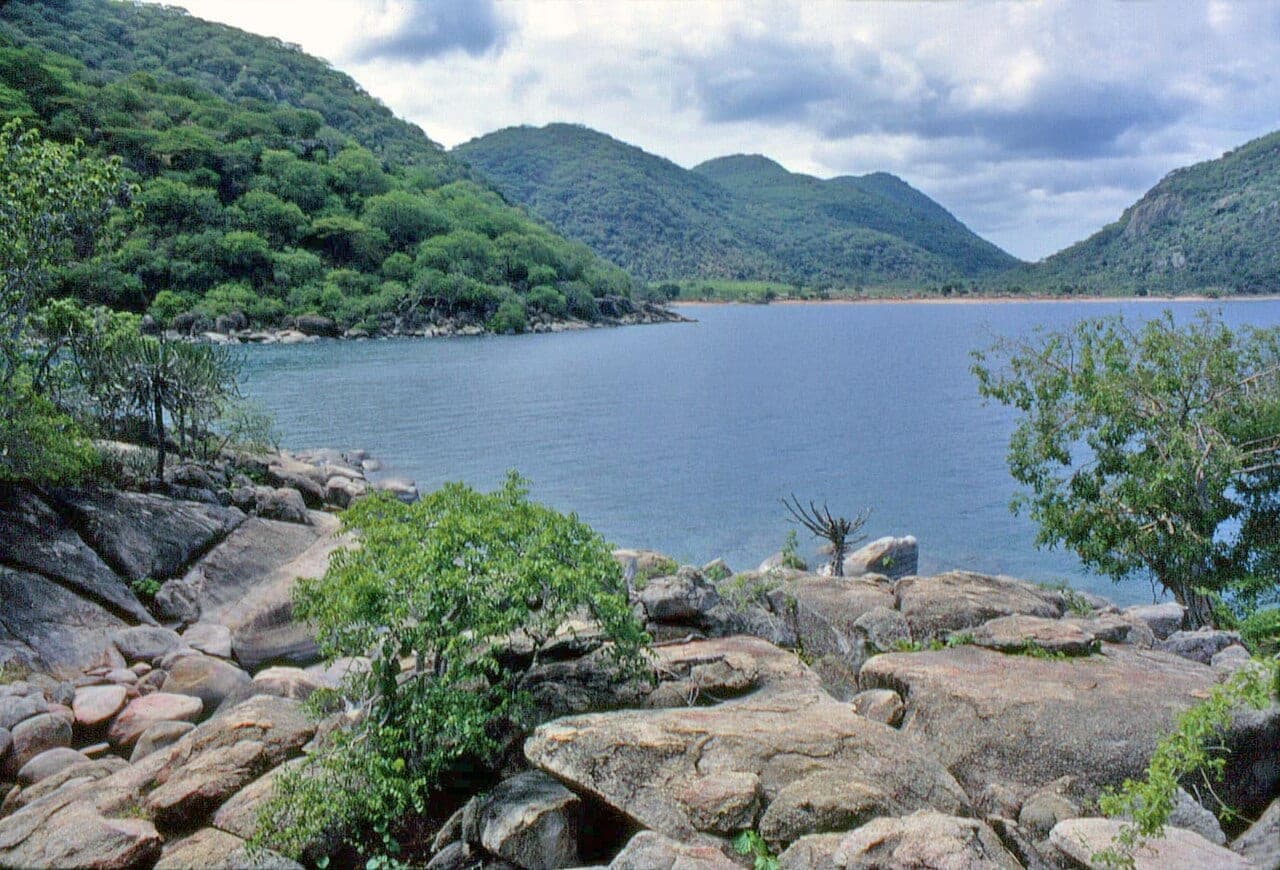
Along a trench of the Great Rift Valley some 560 kilometres long lies Lake Malawi, the third-largest lake in Africa and the water that gives the country its name. Its clear shallows hold more species of fish than any other lake on earth, more than 800 kinds of cichlid known to Malawians as mbuna, almost all of them found nowhere else, and their explosion of forms has made the lake a study of evolution that biologists set beside the finches of the Galápagos. The southern shore, protected since 1980 and inscribed by UNESCO in 1984 as Lake Malawi National Park, was among the first freshwater parks in the world listed chiefly for the diversity of its fish.
Inland, the country keeps a second and older archive. In the granite hills of the central plateau, the Chongoni Rock Art Area holds the densest concentration of rock art in Central Africa, painted by Stone Age hunter-gatherers and by Chewa farmers still adding to the walls in the twentieth century. Those same hills are ceremonial ground for the Nyau, whose masked Gule Wamkulu, the Great Dance, brings the spirits of the dead among the living. Malawi calls itself the Warm Heart of Africa, and this profile follows its heritage from lake and rock to language, faith and the customs by which its peoples remember their dead.
Malawi is a landlocked country of about 118,000 square kilometres in south-eastern Africa, bordered by Tanzania to the north-east, Mozambique to the east, south and south-west, and Zambia to the west. Its defining feature is the lake, which fills much of the eastern border and covers more than a fifth of the national territory. From the lake's southern end the Shire River, its only outlet, runs through the fertile Shire Highlands to the Zambezi, while the land rises to plateaux and massifs such as Zomba and Mulanje, the highest ground in Central Africa.
The population is roughly 21 million, among the youngest and most rural in the region and supported mainly by farming, with maize as the staple and tobacco, tea and sugar as leading exports. Malawians belong to several peoples: the Chewa, the largest group, in the centre; the Lomwe and Yao in the south; the Ngoni across the centre and south; the Tumbuka and Tonga in the north; the Sena along the lower Shire. Chichewa is the national language and English the official one, and the currency is the Malawian kwacha. The unhurried courtesy for which the country is known earned it its familiar name, the Warm Heart of Africa.
Lilongwe. The capital and largest city grew from a river settlement and colonial trading post into the seat of government when the administration moved here from Zomba in 1975 to place the capital near the country's centre. It is divided between the older Old Town, with its markets, and the planned City Centre of ministries and embassies.
Blantyre. Malawi's commercial and financial hub is also its oldest town, founded in 1876 by missionaries of the Church of Scotland and named for the Scottish birthplace of David Livingstone. Its St Michael and All Angels Church, raised by missionaries without a trained architect, remains a landmark of early mission craftsmanship, and the city holds the principal Museums of Malawi branch at Chichiri.
Mzuzu. The largest town of the northern region and the country's third city, Mzuzu is the gateway to the northern lakeshore and the highlands beyond. Known for its cool upland climate and its coffee, it is the commercial and educational centre of the north and a hub for the Tumbuka and Tonga.
Zomba. Set below the forested Zomba Plateau in the Shire Highlands, Zomba was the administrative centre of the British Central African Protectorate and Nyasaland, and the capital of independent Malawi until 1975. Its colonial-era buildings and the University of Malawi's Chancellor College have kept it a place of learning.
Bantu-speaking farmers and iron-workers settled the region during the first millennium, absorbing the earlier hunter-gatherers whose descendants left their marks on the rock shelters of the plateau. From about 1480 these settlers coalesced into the Maravi Confederacy, a system of related chiefdoms that reached its height in the seventeenth century, administering a wide territory from north of the Zambezi toward the coast, according to Encyclopaedia Britannica. The Chewa and Nyanja of modern Malawi descend from these Maravi clans; the confederacy loosened into autonomous factions during the eighteenth century, but its name endured.
The nineteenth century brought newcomers and hard trade. The Yao, moving in from the east and adopting Islam through contact with Swahili and Arab merchants, were drawn into the Indian Ocean commerce that reached the coast at Kilwa and Zanzibar, and some Yao groups took part in the capture and sale of people. The trade caused deep suffering across the lake region and remains a sober chapter in the country's past. From the south came the Ngoni, war-bands displaced by the upheavals of the Mfecane around 1815 to 1840; under leaders such as Zwangendaba they crossed the Zambezi in 1835 and settled among the peoples of the centre and north.
Into this landscape came the Scottish missionary David Livingstone, who reached the lake in 1859 and whose reports of the slave trade helped mobilise British opposition to it. His example inspired the Livingstonia Mission of the Free Church of Scotland, the Church of Scotland's Blantyre in 1876, and the Universities' Mission to Central Africa, according to Wikipedia. Britain declared the protectorate that became Nyasaland in 1891. In 1915 the Reverend John Chilembwe, an American-educated pastor near Blantyre, led a brief rising against colonial rule and its burdens on African tenants and soldiers; it was crushed within days and Chilembwe killed, yet he is honoured today as a forerunner of Malawian nationalism and appears on the country's banknotes.
From 1953 to 1963 Nyasaland was joined, over strong African objection, to the Federation of Rhodesia and Nyasaland, and opposition to that link sharpened the drive for self-rule. Independence came on 6 July 1964. The country became a republic in 1966 under Hastings Kamuzu Banda, who governed as a one-party state and later President for Life until a referendum opened the way to the first multiparty elections in 1994.
The name Malawi comes from the Maravi, and behind it lies an image of light. In Chichewa the word is linked to flames or rays of light, connected by tradition either to the glow of many iron-smelting kilns lighting the night or to the shimmer of the sun on the lake, the same play of light that gives Lake Malawi its other name, the Lake of Stars, for the lanterns of night fishermen scattered across the dark water. When the country cast off the colonial name Nyasaland at independence, it reached back past the protectorate to the old confederacy for a word of its own.
Chichewa, a Bantu language of the wider Nyanja group, is the national language and the common speech of daily life, while English, inherited from the protectorate, is the official language of government, courts and higher education. Alongside them the regions keep their own tongues: Chitumbuka in the north, Chiyao among the Yao, and Chilomwe, Chingoni, Chisena and Chitonga among their peoples. Chichewa's reach into Zambia and Mozambique follows the old spread of the Maravi and Chewa themselves.
At the centre of Chewa cultural life is the Nyau brotherhood and its Gule Wamkulu, the Great Dance, recognised by UNESCO in 2005 on the Representative List of the Intangible Cultural Heritage of Humanity. In the matrilineal society of the Chewa, where descent and residence long ran through women, the Nyau gave initiated men a bond and a role across village lines. Its dancers appear in elaborate masks and costumes representing animals, spirits and human characters, moving to fast drum rhythms at initiations, the installation of chiefs, weddings and funerals; the masked figures are understood not as men in disguise but as spirits from the world of the dead.
 Chongoni holds the densest concentration of rock art in central Africa, and some of it was still being painted in the twentieth century by women of the Chewa nyau societies. Photograph by Lazare Eloundou Assomo, CC BY-SA 3.0 IGO, via Wikimedia Commons.
In the north the Tumbuka keep the Vimbuza healing dance, also recognised by UNESCO, part of the wider ng'oma tradition of Bantu-speaking Africa. A patient, most often a woman, dances within a circle of singers while men beat spirit-specific rhythms, entering a trance in which the illness is drawn out and named; healers run a temphiri where patients stay for treatment. Mission churches once forbade the dance, yet it survived as both therapy and heritage, and Malawian woodcarvers keep a parallel craft in chief's stools, masks and lakeshore chairs.
Food gathers the household. The staple is nsima, a thick maize porridge eaten by hand with relishes of vegetables, beans, meat or lake fish such as the prized chambo. So central is the dish that UNESCO inscribed nsima as a culinary tradition of Malawi in 2017, honouring the shared knowledge of growing, pounding and cooking it that binds families together.
Malawi is a predominantly Christian country, with adherence usually put around four-fifths of the population, spread across the Presbyterian Church of Central Africa (heir of the Scottish missions), the Roman Catholic Church, Anglicans, and a growing number of Pentecostal and African independent congregations. Islam is the faith of roughly one in eight Malawians and is strongest among the Yao of the south and the lakeshore, whose conversion dates back to the coastal trade. The constitution protects freedom of religion, and Christian and Muslim communities generally live in close contact.
Older beliefs continue beneath and beside the world religions. Traditional Chewa cosmology recognises a creator, called Chiuta or Mulungu, approached less directly than the mizimu, the ancestral spirits who remain concerned with their descendants and are honoured at moments of birth, marriage, sickness and death. The Nyau, and the masked dead who appear through it, express this conviction that the ancestors are present and active, and traditional healers are still consulted for illness and misfortune. Many families hold these understandings alongside church or mosque without any sense of contradiction.
A death in Malawi is the affair of a whole community. Word spreads quickly, and neighbours, kin and colleagues gather at the bereaved home to keep company with the family, cook and contribute through the nights before burial. Grief is expressed openly in weeping and song, and among the matrilineal peoples of the centre it is often the mother's brothers and the wider maternal line who take charge. Burial follows soon after death, in a village graveyard or ancestral ground, for to lie among one's people is felt to matter greatly.
Among the Chewa the Nyau brotherhood has a particular office at the funerals of its members and of important figures. The masked Gule Wamkulu dancers appear at the burial and the ceremonies that follow, representing the spirits of the dead and of the wild, escorting the deceased into the company of the ancestors. Mourning is observed for a set period, after which a further gathering may release the bereaved from its restrictions, while commemorations at the grave and remembrance of the mizimu keep the relationship with the dead in repair.
Christian and Muslim rites shape these customs where they are followed. Christian funerals bring hymns, scripture and a graveside service, often followed later by the unveiling of a tombstone at which the stone is dedicated and the life recalled. Muslim burials among the Yao follow Islamic practice, with washing and shrouding of the body, prayer and swift interment, and remembrance on the customary days. Across all these forms the conviction is shared: the dead are not gone but changed, and remembrance is a standing obligation rather than a single event.
Malawi's records are Scottish mission records, colonial files and the paperwork of men going away to work.
David Livingstone reached Lake Nyasa in 1859, and the Scottish missions that followed, Livingstonia in the north and Blantyre in the south, kept baptism, marriage and school registers from the 1870s. Those are the earliest written vital records for Malawian families and they are unusually good, because the missions ran schools and recorded who attended them. The National Archives of Malawi at Zomba hold the protectorate and post-independence series, with parallel material at Kew and in Edinburgh.
Most Malawian societies are matrilineal, the Chewa, Yao, Lomwe and Mang'anja among them, so descent and land pass through the mother and a man traditionally moved to his wife's village. Assuming a father's line will produce a wrong tree, and the mbumba, the matrilineal group a man is responsible for as his sisters' brother, is the working unit.
The labour migration is the largest movement in the record. From the 1900s Malawian men went in enormous numbers to the mines of South Africa and Southern Rhodesia and to the Zambian Copperbelt, recruited through formal schemes, and their employment, medical and death records are in Johannesburg, Harare and Kitwe rather than in Malawi.
The Banda years, from 1964 to 1994, left detention files that were partly destroyed and partly opened, and the truth commission of the 1990s documented what it could.
Malawi holds two World Heritage sites, both entrusted in part to the communities that live with them. Lake Malawi National Park, inscribed in 1984, protects the southern lake and its unmatched cichlid diversity for science and for the fishing villages within its bounds, while the Chongoni Rock Art Area, inscribed in 2006, safeguards 127 painted sites across forested granite hills that remain in active ritual use by the Chewa and the Nyau. On the intangible side the country has been notably active, with Gule Wamkulu, the Vimbuza healing dance and the culinary tradition of nsima all carried on UNESCO's lists, each accompanied by safeguarding work with the practitioners themselves.
The institutional anchor is the Museums of Malawi, established by legislation in 1957 as the Nyasaland Museum, whose principal branch is the Chichiri Museum in Blantyre, with displays of ethnography, archaeology, history and natural history, according to Wikipedia. The Department of Antiquities and the national archives care for monuments and records, and the Scottish mission archives preserve the memory of the protectorate era. At Chongoni the meaning of the paintings is inseparable from the living Nyau tradition, so custodianship rests with the community itself.
Malawi's heritage is steadily gaining an online life. UNESCO's own records make the country's World Heritage and intangible listings freely available, with descriptions, photographs and documentation of Lake Malawi National Park, Chongoni, Gule Wamkulu, Vimbuza and nsima that scholars and Malawians abroad can consult from anywhere. Research on the lake's cichlids, one of the most studied cases of rapid speciation, has produced open datasets and genome projects that turn the fish of the lake into a shared global resource.
Language and culture are moving online too. Chichewa is increasingly represented in digital dictionaries, translations and educational material, and Malawian musicians, comedians and storytellers use social media to circulate work in Chichewa and the regional languages at home and across the diaspora. Documentation projects have recorded the endangered mask-making crafts of the Nyau and the songs of the healing dances, capturing traditions once transmitted only in person and only to the initiated.
Malawian music carries the country's name furthest. Reggae and gospel from a generation of lakeshore musicians, acoustic storytelling in Chichewa, and a growing hip-hop and Afro-pop scene in Lilongwe and Blantyre keep local languages and rhythms in daily circulation. The annual Lake of Stars festival, held on the lakeshore since 2004, has brought Malawian and international performers together and drawn global attention to the country's music and its setting.
In letters, Malawi has produced a distinguished line of writers, among them the poet Jack Mapanje, whose work confronted the constraints of the one-party years, and the novelist Legson Kayira, whose account of walking much of the length of the continent in search of education became widely read. A younger audience worldwide met the country through William Kamkwamba, whose story of building a wind turbine from scrap to power his village, The Boy Who Harnessed the Wind, became a book and film that carried a Malawian voice to a global readership.
A lake recognised for its fish. The inscription of Lake Malawi National Park in 1984, among the first freshwater sites honoured for aquatic biodiversity, placed the lake's more than 800 cichlid species under international protection and made Malawi a reference point for the study of evolution.
Living traditions safeguarded. Within little more than a decade Malawi secured UNESCO recognition for three living traditions, the Gule Wamkulu of the Nyau, the Vimbuza healing dance of the Tumbuka and the culinary tradition of nsima, each backed by work with the communities who keep them.
Rock art kept in living hands. At Chongoni the country and UNESCO chose to protect not a set of ruins but a landscape still in ceremonial use, recognising the Chewa and the Nyau as custodians of the images their ancestors painted.
A voice carried to the world. From William Kamkwamba's windmill to the Lake of Stars festival, Malawians have turned local ingenuity and lakeshore music into work that reaches far beyond the country's borders while remaining rooted in it.
Chongoni holds the densest concentration of rock art in central Africa, and some of it was still being painted in the twentieth century by women of the Chewa nyau societies. Photograph by Lazare Eloundou Assomo, CC BY-SA 3.0 IGO, via Wikimedia Commons.
In the north the Tumbuka keep the Vimbuza healing dance, also recognised by UNESCO, part of the wider ng'oma tradition of Bantu-speaking Africa. A patient, most often a woman, dances within a circle of singers while men beat spirit-specific rhythms, entering a trance in which the illness is drawn out and named; healers run a temphiri where patients stay for treatment. Mission churches once forbade the dance, yet it survived as both therapy and heritage, and Malawian woodcarvers keep a parallel craft in chief's stools, masks and lakeshore chairs.
Food gathers the household. The staple is nsima, a thick maize porridge eaten by hand with relishes of vegetables, beans, meat or lake fish such as the prized chambo. So central is the dish that UNESCO inscribed nsima as a culinary tradition of Malawi in 2017, honouring the shared knowledge of growing, pounding and cooking it that binds families together.
Malawi is a predominantly Christian country, with adherence usually put around four-fifths of the population, spread across the Presbyterian Church of Central Africa (heir of the Scottish missions), the Roman Catholic Church, Anglicans, and a growing number of Pentecostal and African independent congregations. Islam is the faith of roughly one in eight Malawians and is strongest among the Yao of the south and the lakeshore, whose conversion dates back to the coastal trade. The constitution protects freedom of religion, and Christian and Muslim communities generally live in close contact.
Older beliefs continue beneath and beside the world religions. Traditional Chewa cosmology recognises a creator, called Chiuta or Mulungu, approached less directly than the mizimu, the ancestral spirits who remain concerned with their descendants and are honoured at moments of birth, marriage, sickness and death. The Nyau, and the masked dead who appear through it, express this conviction that the ancestors are present and active, and traditional healers are still consulted for illness and misfortune. Many families hold these understandings alongside church or mosque without any sense of contradiction.
A death in Malawi is the affair of a whole community. Word spreads quickly, and neighbours, kin and colleagues gather at the bereaved home to keep company with the family, cook and contribute through the nights before burial. Grief is expressed openly in weeping and song, and among the matrilineal peoples of the centre it is often the mother's brothers and the wider maternal line who take charge. Burial follows soon after death, in a village graveyard or ancestral ground, for to lie among one's people is felt to matter greatly.
Among the Chewa the Nyau brotherhood has a particular office at the funerals of its members and of important figures. The masked Gule Wamkulu dancers appear at the burial and the ceremonies that follow, representing the spirits of the dead and of the wild, escorting the deceased into the company of the ancestors. Mourning is observed for a set period, after which a further gathering may release the bereaved from its restrictions, while commemorations at the grave and remembrance of the mizimu keep the relationship with the dead in repair.
Christian and Muslim rites shape these customs where they are followed. Christian funerals bring hymns, scripture and a graveside service, often followed later by the unveiling of a tombstone at which the stone is dedicated and the life recalled. Muslim burials among the Yao follow Islamic practice, with washing and shrouding of the body, prayer and swift interment, and remembrance on the customary days. Across all these forms the conviction is shared: the dead are not gone but changed, and remembrance is a standing obligation rather than a single event.
Malawi's records are Scottish mission records, colonial files and the paperwork of men going away to work.
David Livingstone reached Lake Nyasa in 1859, and the Scottish missions that followed, Livingstonia in the north and Blantyre in the south, kept baptism, marriage and school registers from the 1870s. Those are the earliest written vital records for Malawian families and they are unusually good, because the missions ran schools and recorded who attended them. The National Archives of Malawi at Zomba hold the protectorate and post-independence series, with parallel material at Kew and in Edinburgh.
Most Malawian societies are matrilineal, the Chewa, Yao, Lomwe and Mang'anja among them, so descent and land pass through the mother and a man traditionally moved to his wife's village. Assuming a father's line will produce a wrong tree, and the mbumba, the matrilineal group a man is responsible for as his sisters' brother, is the working unit.
The labour migration is the largest movement in the record. From the 1900s Malawian men went in enormous numbers to the mines of South Africa and Southern Rhodesia and to the Zambian Copperbelt, recruited through formal schemes, and their employment, medical and death records are in Johannesburg, Harare and Kitwe rather than in Malawi.
The Banda years, from 1964 to 1994, left detention files that were partly destroyed and partly opened, and the truth commission of the 1990s documented what it could.
Malawi holds two World Heritage sites, both entrusted in part to the communities that live with them. Lake Malawi National Park, inscribed in 1984, protects the southern lake and its unmatched cichlid diversity for science and for the fishing villages within its bounds, while the Chongoni Rock Art Area, inscribed in 2006, safeguards 127 painted sites across forested granite hills that remain in active ritual use by the Chewa and the Nyau. On the intangible side the country has been notably active, with Gule Wamkulu, the Vimbuza healing dance and the culinary tradition of nsima all carried on UNESCO's lists, each accompanied by safeguarding work with the practitioners themselves.
The institutional anchor is the Museums of Malawi, established by legislation in 1957 as the Nyasaland Museum, whose principal branch is the Chichiri Museum in Blantyre, with displays of ethnography, archaeology, history and natural history, according to Wikipedia. The Department of Antiquities and the national archives care for monuments and records, and the Scottish mission archives preserve the memory of the protectorate era. At Chongoni the meaning of the paintings is inseparable from the living Nyau tradition, so custodianship rests with the community itself.
Malawi's heritage is steadily gaining an online life. UNESCO's own records make the country's World Heritage and intangible listings freely available, with descriptions, photographs and documentation of Lake Malawi National Park, Chongoni, Gule Wamkulu, Vimbuza and nsima that scholars and Malawians abroad can consult from anywhere. Research on the lake's cichlids, one of the most studied cases of rapid speciation, has produced open datasets and genome projects that turn the fish of the lake into a shared global resource.
Language and culture are moving online too. Chichewa is increasingly represented in digital dictionaries, translations and educational material, and Malawian musicians, comedians and storytellers use social media to circulate work in Chichewa and the regional languages at home and across the diaspora. Documentation projects have recorded the endangered mask-making crafts of the Nyau and the songs of the healing dances, capturing traditions once transmitted only in person and only to the initiated.
Malawian music carries the country's name furthest. Reggae and gospel from a generation of lakeshore musicians, acoustic storytelling in Chichewa, and a growing hip-hop and Afro-pop scene in Lilongwe and Blantyre keep local languages and rhythms in daily circulation. The annual Lake of Stars festival, held on the lakeshore since 2004, has brought Malawian and international performers together and drawn global attention to the country's music and its setting.
In letters, Malawi has produced a distinguished line of writers, among them the poet Jack Mapanje, whose work confronted the constraints of the one-party years, and the novelist Legson Kayira, whose account of walking much of the length of the continent in search of education became widely read. A younger audience worldwide met the country through William Kamkwamba, whose story of building a wind turbine from scrap to power his village, The Boy Who Harnessed the Wind, became a book and film that carried a Malawian voice to a global readership.
A lake recognised for its fish. The inscription of Lake Malawi National Park in 1984, among the first freshwater sites honoured for aquatic biodiversity, placed the lake's more than 800 cichlid species under international protection and made Malawi a reference point for the study of evolution.
Living traditions safeguarded. Within little more than a decade Malawi secured UNESCO recognition for three living traditions, the Gule Wamkulu of the Nyau, the Vimbuza healing dance of the Tumbuka and the culinary tradition of nsima, each backed by work with the communities who keep them.
Rock art kept in living hands. At Chongoni the country and UNESCO chose to protect not a set of ruins but a landscape still in ceremonial use, recognising the Chewa and the Nyau as custodians of the images their ancestors painted.
A voice carried to the world. From William Kamkwamba's windmill to the Lake of Stars festival, Malawians have turned local ingenuity and lakeshore music into work that reaches far beyond the country's borders while remaining rooted in it.
National Overview
Notable Cities
Historical Foundations
Linguistic and Etymological Roots
Cultural Identity
Religion and Spirituality
Remembrance and Mourning Traditions
Tracing a Family in Malawi
Heritage Preservation Efforts
Digital Heritage
Contemporary Cultural Influences
Success Stories
References and resources
- UNESCO World Heritage Centre: Lake Malawi National Park. Inscription record for the lake, its national park and its cichlid diversity.
- UNESCO World Heritage Centre: Chongoni Rock-Art Area. The 127 painted sites and their link to the Chewa and the Nyau.
- UNESCO Intangible Cultural Heritage: Gule Wamkulu. The Great Dance of the Nyau brotherhood.
- UNESCO Intangible Cultural Heritage: Vimbuza healing dance. The Tumbuka healing tradition of the north.
- UNESCO Intangible Cultural Heritage: Nsima, culinary tradition of Malawi. The maize-porridge tradition inscribed in 2017.
- Encyclopaedia Britannica: Maravi Confederacy. The confederacy that gave the country its name.
- Encyclopaedia Britannica: John Chilembwe. The 1915 uprising and the making of a national hero.
- Wikipedia: Livingstonia Mission. The Scottish missions of the lake region.
- Wikipedia: Chichiri Museum. The principal branch of the Museums of Malawi in Blantyre.
- Wikipedia: Lake Malawi National Park. Geography, ecology and history of the park.