Culture · Essay
Gule Wamkulu: the dead arrive in person, and nobody asks who is under the mask
Among the Chewa of Malawi, Zambia and Mozambique, masked dancers appear at funerals and initiations as the spirits of the dead and of animals. While masked they are not men in costume. On the Nyau, the masks that satirise, and the UNESCO listing.Written to last.
By Confinity Editorial · 2026-08-21 · 6-minute readQuiet tools, kept out of the way.
The rule that governs Gule Wamkulu is a rule about language. When a masked figure comes into the village, it is not referred to as a person. Nobody says who is inside. Nobody comments on the height or the walk. The figure is a spirit, of an ancestor or an animal, and it is spoken to and about on that basis for as long as it is there.
Afterwards, the men of the Nyau, the brotherhood that performs it, go back to being farmers, and the subject is closed.
This is not a polite fiction that everybody privately sees through. It is a working rule, enforced by an initiated society, and breaking it, particularly by a woman or an uninitiated person, has consequences.
The great dance is not a performance staged for an audience on a schedule. It arrives when something has happened.
It comes to funerals, and to the commemorations that follow them, which is where the spirits of the dead are most obviously the point. It comes to the initiation of young women, and to the installation of chiefs. It comes after the harvest, in the dry season, when there is time.
The Chewa are matrilineal, so the men who make up the Nyau occupy an interesting position: descent, land and the household run through women, and the brotherhood is the institution through which men hold a distinct and formidable role. The literature on Gule Wamkulu returns to this repeatedly.
The masks and costumes run to a very large number of characters, and each carries a name, a walk, a set of songs and a lesson.
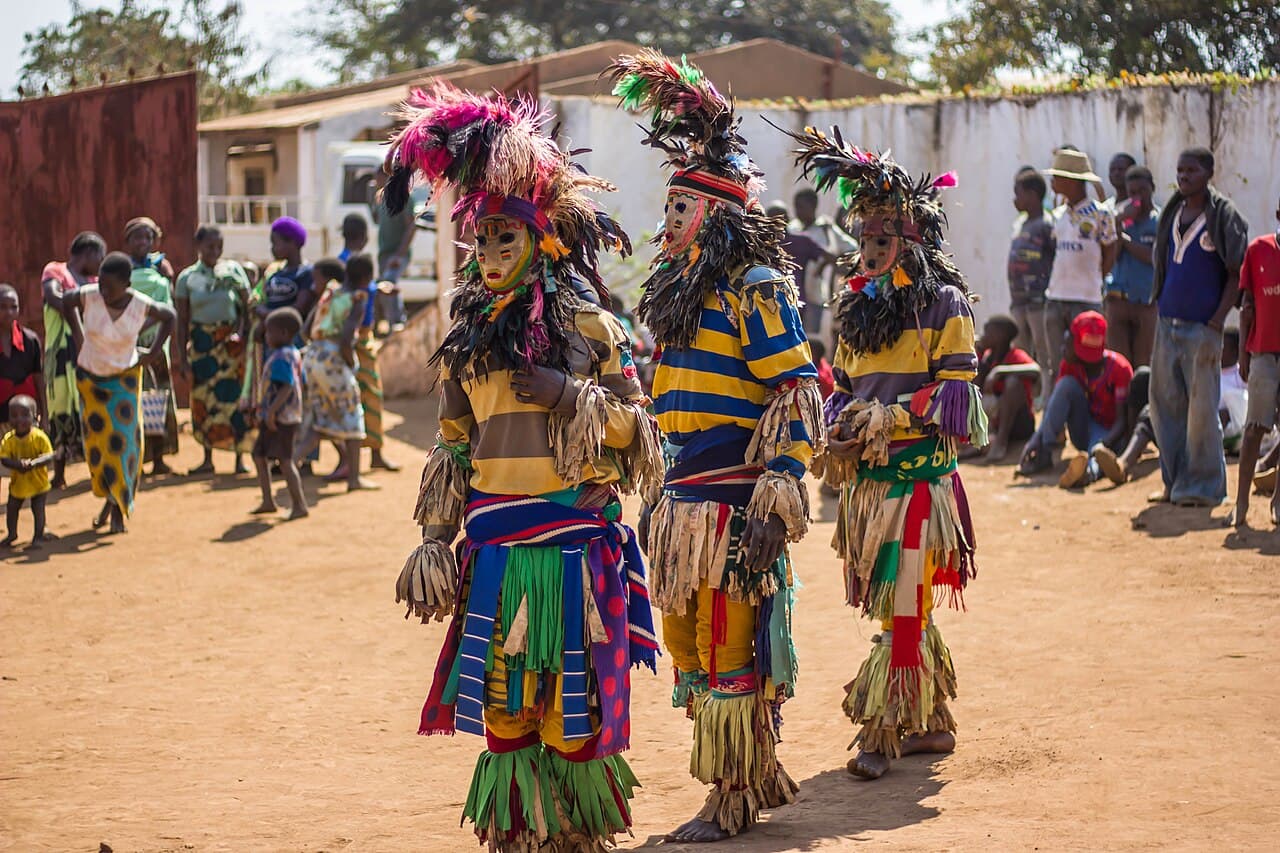 A Gule Wamkulu figure. For as long as it is masked it is not a man in costume, and nobody present says otherwise. Photograph by Twiggalite, CC BY-SA 4.0, via Wikimedia Commons.
Some are animals: the kasiya maliro, a great woven antelope structure worn by several men at once, associated with the mother and with mourning. Some are ancestors. Some are figures of instruction, appearing at an initiation to say something to the young women present that would be difficult to say directly.
And a good many are satirical. There are masks for the colonial official, for the missionary, for the corrupt politician, for the drunk, for the man who beats his wife, for the aid worker. The European figure known as Simoni is one of the best known. A masked character walks into the village and behaves as that person behaves, in front of everybody, and the village laughs.
That is the part usually left out of the summaries. Gule Wamkulu is a medium of social comment, delivered by figures who cannot be answered back to because they are not, formally speaking, anybody.
The dance is the Chewa institution for saying difficult things.
It teaches at initiations. It reproves at funerals. It comments on the chief and on the government. It carries the moral content that in other societies is distributed among a church, a school, a newspaper and a comedian, and it does it through characters that everybody has known since childhood and that arrive without an author.
UNESCO's listing describes it as a ritual dance transmitting knowledge and values, which is accurate and drier than the thing itself.
The tradition has been in tension with the churches since the missionaries arrived, and the tension is not resolved.
Some Christian denominations in Malawi and Zambia forbid members from participating in Nyau; others accommodate it; and many Chewa families are simply in both, with the Nyau on one side of the year and the church on the other. Colonial administrations attempted to restrict Nyau activity, without much success.
The newer pressures are economic. Performances get staged for tourists and for political rallies, which detaches the masks from the occasions they belong to; young men migrate for work; and the transmission of a very large repertoire of characters, songs and choreography depends on there being enough initiated men in one place at one time.
Gule Wamkulu belongs with the West African masking traditions in which the masked figure is the ancestor rather than a representation of one. The Egungun of the Yoruba works on the same principle, with the same prohibition on naming the wearer.
Set against a European remembrance calendar, the difference is one of tense. Zaduszki and Saturday of Souls are about people who are gone and are being thought of. Gule Wamkulu is about people who have arrived and are in the village, saying things.
The tradition holds a great deal of a culture's memory in a form nothing else quite matches. It is embodied rather than written or spoken, in a repertoire of characters that a village recognises instantly and that carry the lesson without needing to explain it.
That is durable while the society is intact and extremely fragile when it is not. A mask is only meaningful to somebody who has grown up seeing it. Move the young men to Johannesburg for fifteen years and the character walks into an empty street.
The families keeping it are doing something Confinity cannot substitute for and does not try to. What a record can do is hold the second layer, the one no masquerade preserves: which grandmother, in which village, in which year, and what she was actually like.
A Gule Wamkulu figure. For as long as it is masked it is not a man in costume, and nobody present says otherwise. Photograph by Twiggalite, CC BY-SA 4.0, via Wikimedia Commons.
Some are animals: the kasiya maliro, a great woven antelope structure worn by several men at once, associated with the mother and with mourning. Some are ancestors. Some are figures of instruction, appearing at an initiation to say something to the young women present that would be difficult to say directly.
And a good many are satirical. There are masks for the colonial official, for the missionary, for the corrupt politician, for the drunk, for the man who beats his wife, for the aid worker. The European figure known as Simoni is one of the best known. A masked character walks into the village and behaves as that person behaves, in front of everybody, and the village laughs.
That is the part usually left out of the summaries. Gule Wamkulu is a medium of social comment, delivered by figures who cannot be answered back to because they are not, formally speaking, anybody.
The dance is the Chewa institution for saying difficult things.
It teaches at initiations. It reproves at funerals. It comments on the chief and on the government. It carries the moral content that in other societies is distributed among a church, a school, a newspaper and a comedian, and it does it through characters that everybody has known since childhood and that arrive without an author.
UNESCO's listing describes it as a ritual dance transmitting knowledge and values, which is accurate and drier than the thing itself.
The tradition has been in tension with the churches since the missionaries arrived, and the tension is not resolved.
Some Christian denominations in Malawi and Zambia forbid members from participating in Nyau; others accommodate it; and many Chewa families are simply in both, with the Nyau on one side of the year and the church on the other. Colonial administrations attempted to restrict Nyau activity, without much success.
The newer pressures are economic. Performances get staged for tourists and for political rallies, which detaches the masks from the occasions they belong to; young men migrate for work; and the transmission of a very large repertoire of characters, songs and choreography depends on there being enough initiated men in one place at one time.
Gule Wamkulu belongs with the West African masking traditions in which the masked figure is the ancestor rather than a representation of one. The Egungun of the Yoruba works on the same principle, with the same prohibition on naming the wearer.
Set against a European remembrance calendar, the difference is one of tense. Zaduszki and Saturday of Souls are about people who are gone and are being thought of. Gule Wamkulu is about people who have arrived and are in the village, saying things.
The tradition holds a great deal of a culture's memory in a form nothing else quite matches. It is embodied rather than written or spoken, in a repertoire of characters that a village recognises instantly and that carry the lesson without needing to explain it.
That is durable while the society is intact and extremely fragile when it is not. A mask is only meaningful to somebody who has grown up seeing it. Move the young men to Johannesburg for fifteen years and the character walks into an empty street.
The families keeping it are doing something Confinity cannot substitute for and does not try to. What a record can do is hold the second layer, the one no masquerade preserves: which grandmother, in which village, in which year, and what she was actually like.
When it appears
What the masks are