Heritage · Country
Botswana Culture and Heritage
Botswana keeps its memory in rock, cattle and conversation: the painted hills of Tsodilo, the kgotla assemblies where consensus is built aloud, and mourning customs that turn the dead into ancestors. A guide to the country's heritage and the people preserving it.Written to last.
By Confinity Heritage Editorial · 2026-07-10 · 8-minute readQuiet tools, kept out of the way.
In the far north-west of Botswana, four quartzite hills rise out of the Kalahari sands. The Tsodilo Hills carry more than 4,500 rock paintings within roughly ten square kilometres, one of the densest concentrations of rock art anywhere on earth, and the archaeological record beneath them reaches back some 100,000 years. UNESCO has called Tsodilo the "Louvre of the Desert", and for the San and Hambukushu communities who live beside it the hills are not a gallery but a dwelling place of ancestral spirits.
Botswana's other great memory institution is not a monument at all. The kgotla, the open-air assembly of every Tswana village, is where disputes are settled, decisions argued to consensus and the community's shared story rehearsed aloud, generation after generation. A country that was one of the poorest in the world at independence in 1966 has built a stable democracy on exactly this habit of patient, collective speech.
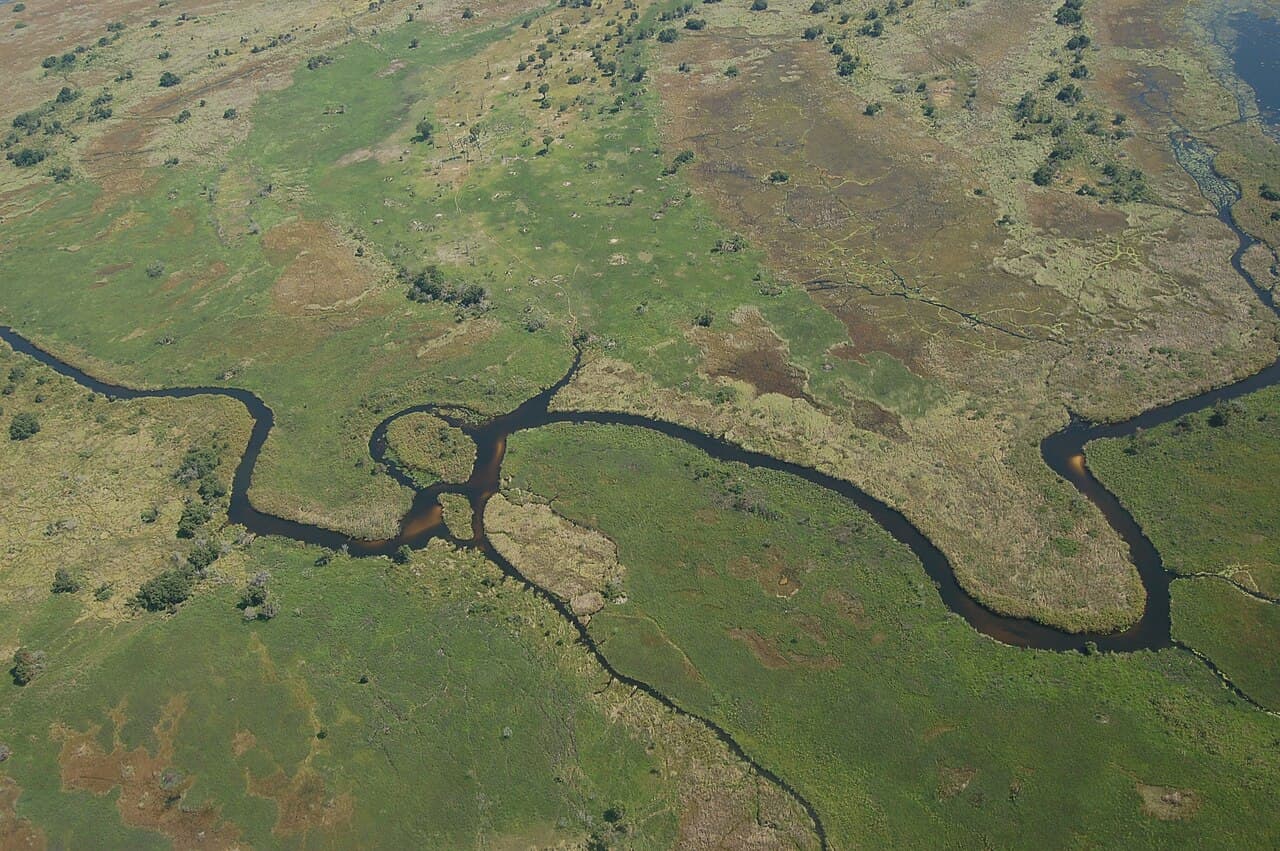
Botswana is a landlocked country of 581,730 square kilometres in the centre of Southern Africa, bordered by South Africa to the south and south-east, Namibia to the west and north, Zimbabwe to the east and Zambia at a short crossing point on the Zambezi. Around seventy per cent of its territory lies under the sands of the Kalahari, yet the country also holds two of the continent's most remarkable landscapes: the Okavango Delta, a vast inland delta whose floodwaters arrive from the Angolan highlands and vanish into the desert, and the Makgadikgadi Pans, the glittering salt bed of an ancient super-lake.
The population of roughly 2.4 million is concentrated along the wetter eastern corridor between Gaborone and Francistown. Most citizens belong to Tswana communities organised historically into merafe, chiefdoms such as the Bangwato, Bakwena, Bangwaketse and Bakgatla, but the nation also includes the Kalanga of the north-east, the Bakgalagadi of the desert margins, the Bayei, Hambukushu and Basubiya of the river country, Herero communities, and the San, the region's first people. All share the civic name Batswana. Since the discovery of diamonds at Orapa in 1967, mining has funded schools, roads and one of Africa's longest unbroken democratic records. The currency is the pula, the Setswana word for rain, which is also the national motto and the customary blessing: in the Kalahari, rain is wealth, welcome and grace in a single syllable.
Gaborone. The capital was a modest administrative village when it was chosen to lead the new republic in 1966; it has since grown into the country's political, commercial and creative centre. It takes its name from Chief Gaborone of the Batlokwa, whose settlement stood nearby. The city holds the Botswana National Museum, the University of Botswana, and the Three Dikgosi Monument, bronze figures of the chiefs Khama III, Sebele I and Bathoen I, whose 1895 journey to London preserved the country's separate existence.
Francistown. Botswana's second city grew from Southern Africa's first gold rush, when prospectors flocked to the Tati River in the late nineteenth century; it is named after the prospector Daniel Francis. Today it is the hub of the north-east and the heartland of the Kalanga, whose language, music and rain-shrine traditions give the region a distinct cultural voice.
Serowe. One of Africa's largest traditional villages and the historic capital of the Bangwato, Serowe is a place of royal graves and literary pilgrimage. The Khama III Memorial Museum keeps the papers of the Khama dynasty and of the writer Bessie Head, who settled in Serowe in 1964 and made the village the setting of her best-known books.
Molepolole. The great village of the Bakwena stands at the gateway to the Kalahari. Its annual Dithubaruba Cultural Festival gathers praise poetry, traditional dress, music and games at the community's historic seat, and the ruins of David Livingstone's mission at nearby Kolobeng mark the earliest sustained encounter between Tswana society and Christianity.
Maun. The tourism capital on the Thamalakane River is the gateway to the Okavango Delta and the traditional capital of the Batawana. Its name is usually traced to a San word for the reeds that line the waterways, and its craft markets carry the basketry of the delta peoples to the world.
Human history in Botswana begins among the oldest anywhere. Excavations at Tsodilo show occupation, fishing and long-distance exchange reaching back tens of millennia, and the San communities of the Kalahari carry forward ways of knowing the desert that archaeologists trace deep into the Stone Age. Bantu-speaking farmers and herders arrived during the first millennium AD, and by the eighteenth century Tswana chiefdoms had built large, well-ordered towns across the region, governed through the kgotla and bound together by cattle wealth and age regiments.
The nineteenth century brought upheaval: the wars and migrations of the difaqane, then pressure from Boer expansion in the Transvaal. In 1885 Britain declared the Bechuanaland Protectorate, partly at the request of Tswana leaders seeking protection. When Cecil Rhodes's British South Africa Company moved to absorb the territory in 1895, three dikgosi, Khama III, Sebele I and Bathoen I, sailed to Britain and campaigned publicly until the government agreed the protectorate would remain under the Crown. That mission, remembered as a founding act of national self-defence, spared Botswana the settler colonisation and apartheid of its neighbours.
Independence came peacefully on 30 September 1966 under Seretse Khama, grandson of Khama III, whose marriage to Ruth Williams had earlier cost him exile. A year later diamonds were found at Orapa, and Botswana's leaders used the revenue with unusual discipline, turning the world's third-poorest country at independence into one of Africa's steadiest states. Elections have been held without interruption since; in 2024 the ballot box delivered the first change of governing party in the republic's history, and power passed calmly, a reminder that the kgotla's habits still shape the state.
The country's name is a sentence in miniature. Setswana builds meaning through prefixes attached to the root Tswana: Botswana is the land of the Tswana, Batswana the people, Motswana a single person, and Setswana the language and way of life. The colonial name Bechuanaland preserved an English attempt at the same root. Place names carry their own memory: Gaborone honours a chief, Maun recalls the reeds of the delta, and Francistown a gold prospector, three layers of the national story in three town signs.
Setswana is the national language, spoken by nearly everyone, with English the official language of government and instruction. Beneath these two lie more than two dozen other languages: Ikalanga in the north-east, Shekgalagadi along the desert edge, the languages of the river peoples, and the Khoisan languages of the San, among them Naro and !Xóõ, whose intricate click consonants are studied worldwide. Several of these languages are endangered as younger speakers shift to Setswana and English for school and work, and their loss would carry away oral histories that exist nowhere else. The spoken arts remain central: maboko, Setswana praise poems, compress the deeds of chiefs and communities into performed verse, and proverbs such as motho ke motho ka batho, a person is a person through other people, still open speeches and settle arguments.
Botswana's social order rests on the kgotla and on botho, the ethic of mutual respect and humaneness. The Setswana saying mafoko a kgotla a mantle otlhe, all words spoken in the kgotla are beautiful, captures the ideal: everyone may speak, and decisions bind because everyone has been heard. Cattle remain the deep measure of wealth and relationship; bogadi, the gift of cattle from a groom's family to the bride's, still joins families in obligations that endure across generations, surfacing again at every funeral and feast.
 Tsodilo carries thousands of paintings in a landscape the San regard as the place where creation happened, and where people still leave offerings. Photograph by Oliver Vass, CC BY-SA 3.0, via Wikimedia Commons.
The ceremonial year keeps agriculture and community joined. In dikgafela, celebrated after a good harvest, women of each ward carry baskets of sorghum to the chief's kgotla in thanksgiving, with songs, praise poetry and traditional beer, and an embedded prayer for the next season's rain. Cuisine centres on seswaa, slow-pounded beef prepared by men at weddings and funerals, with sorghum porridge, morogo greens and, in season, mophane worms. Dress for great occasions favours leteisi, the indigo-rooted printed cotton (known elsewhere as shweshwe), worn with blankets and beadwork.
Music is dominated by the voice. Choral call-and-response singing, from church choirs to the competitive dikopelo folk choirs of the Bakgatla, needs no instruments, though the segaba one-string fiddle and the setinkane thumb piano accompany quieter songs. Dance carries regional identities: setapa among the Bangwaketse, the Kalanga hosana rain dances, the San healing dances of the Kalahari, and seperu among the Veekuhane of the Chobe, with its layered skirts flared like a peacock's tail. Football unites the country behind the Zebras, who reached the Africa Cup of Nations for the first time in 2012, and athletics has become a second national passion.
Botswana is a predominantly Christian country; censuses put adherence near eighty to ninety per cent, spread across Anglican, Methodist, Catholic, Pentecostal and, above all, African independent churches such as the Zionist congregations, whose night vigils and healing services blend scripture with Tswana idiom. The constitution protects freedom of religion, and small Muslim, Hindu and Bahá'í communities worship mainly in the towns.
Older understandings run beneath and alongside the churches. Tswana cosmology honours Modimo, the creator, approached less directly than the badimo, the ancestors, who watch over their descendants and are addressed at moments of trouble and transition. Dingaka, traditional doctors, are still consulted for illness, misfortune and protection, and many families see no contradiction in attending church on Sunday and honouring the badimo at home. Among the Kalanga, the Mwali cult links rain, morality and the land through shrines and the wosana dancers who intercede for rain. For the San, the healing trance dance remains the centre of spiritual life, and Tsodilo is a landscape of presence: tradition holds that the spirits of the dead rest among its hills and that killing near them invites misfortune. At Matsieng, near Mochudi, footprints pressed into the rock mark the place where, in Tswana tradition, the first ancestor climbed out of the earth with the animals behind him.
Nothing gathers a Botswana community like a death. Funerals are large, unhurried and profoundly communal; Saturdays across the country belong to them. In the days between death and burial the family home fills each evening for prayers, hymns and condolence, and neighbours, workmates and distant kin arrive with contributions of money, food and labour, often organised through burial societies to which most families subscribe. An ox is slaughtered to feed the mourners, an act that is hospitality and offering at once; in older practice the animal's fat accompanied the deceased into the grave. Historically the head of a homestead was buried in the cattle kraal, the ritual heart of the family's wealth, and though cemeteries now serve the towns, burial in one's home village, among one's people, remains the strong preference. To be buried far from home is felt as a second loss.
Mourning is worn on the body. A widow traditionally dresses in black (or another marked mourning colour) for up to a year, observes restrictions on travel and social life, and is released at the end by a cleansing ceremony that readmits her fully to the community; close kin may shave their heads as an outward sign that the household has been changed. These widowhood observances are debated within Botswana today, especially where they weigh more heavily on women than on men, and churches, courts and families negotiate gentler forms. The end of deep mourning is often now marked by a tombstone unveiling, a second gathering at the grave, common across Southern Africa, at which the stone is dedicated, the life remembered aloud and the family formally returns to ordinary time. A newer custom, the "after tears" gathering that follows a burial, softens the day's grief with food and remembrance, though elders argue over its propriety.
Beneath these forms lies the older conviction that death is a promotion rather than an erasure: the dead become badimo, ancestors who remain interested parties in the family's affairs, invoked at births, marriages and crises. Remembrance in Botswana is therefore less an annual event than a standing relationship, maintained at the grave, the kraal and the kgotla. The nation remembers in the same way it mourns, collectively and aloud: the Three Dikgosi Monument in Gaborone holds the founding chiefs in public memory, and the oral history programme of the Botswana National Archives has, since 1982, recorded elders so that testimony, the country's oldest archive, outlives its speakers.
The Setswana harvest brings Dikgafela, the offering of first fruits, when women of a ward carry the season's grain in baskets to the kgotla and present it to the chief with song. The offering is made on behalf of the ward rather than the household, and it is understood to be owed to the ancestors who held the land before it was anybody's to harvest.
Botswana keeps its family record in cattle, in the kgotla and increasingly in a very good national archive.
The London Missionary Society reached Bechuanaland in the early nineteenth century and its stations kept baptism and marriage registers that are, for many families, the earliest written record. The protectorate was declared in 1885 and administered lightly, partly from Mafikeng outside its own borders, so colonial records are split between Gaborone and South Africa and Britain.
The older and still active record is the kgotla. Each village has one, the assembly where disputes are heard and decisions are made in public, and it maintains the knowledge of who belongs to which ward and which family. Cattle brands and the mafisa system of lending cattle out to relatives record relationships in a form that had to be reliable, because livestock and marriage payments depended on it.
Botswana National Archives and Records Services in Gaborone holds the protectorate and post-independence material and has been digitising steadily. Civil registration is compulsory and reasonably complete for the modern period.
The specific Batswana difficulty is mobility. Labour migration to the South African mines took a large share of Botswana's men for much of the twentieth century, and their employment, medical and death records were made by the Chamber of Mines in another country. For a family whose grandfather died on the Rand, the document that says so is in Johannesburg.
Botswana's framework for heritage rests on the Monuments and Relics Act of 2001, which protects sites and artefacts, and the National Policy on Culture of the same year, which commits the state to safeguarding both tangible and intangible heritage. The Botswana National Museum in Gaborone, established by statute in 1967 and opened in 1968, anchors the institutional landscape together with the Botswana National Archives and Records Services and community museums such as the Khama III Memorial Museum in Serowe. The country holds two World Heritage sites: Tsodilo, inscribed in 2001 and managed with the communities who hold it sacred, and the Okavango Delta, inscribed in 2014 as the World Heritage List's 1,000th site, a listing actively supported by the delta's resident peoples.
Botswana has been notably active under UNESCO's 2003 intangible heritage convention. Three elements stand on the List of Intangible Cultural Heritage in Need of Urgent Safeguarding: the earthenware pottery-making skills of the Kgatleng District (2012), the dikopelo folk music of the Bakgatla ba Kgafela (2017) and the seperu folk dance of the Veekuhane (2019), each inscription accompanied by state-funded safeguarding plans, training and festivals. In December 2023 the country hosted the convention's intergovernmental committee in Kasane, placing Botswana at the centre of the global conversation on living heritage. Community festivals do much of the everyday work: Dithubaruba for the Bakwena, Domboshaba for the Kalanga at the stone-walled ruins of the same name, and the Kuru Dance Festival, which gathers San dance groups from across the Kalahari each year at D'Kar.
The most consequential digital project may be the quietest: the digitisation of the oral history collection at the Botswana National Archives and Records Services, which converts four decades of recorded testimony from fragile analogue tapes into durable digital form. Researchers studying the programme note familiar obstacles, thin budgets, equipment and format obsolescence, but the direction is set, and recording itself is now born digital.
Botswana's rock art has an expanding online life. The British Museum's African rock art image project has published thousands of freely accessible photographs from across the continent, including Tsodilo, allowing students and descendants of the painters' world to study panels without touching them. The University of Botswana sustains research repositories and digital scholarship on Setswana language and history, and the national push toward e-government has extended to standards for preserving digital records. Informally, young Batswana have made social media a folk archive: wedding videos rich with leteisi and praise poetry, choir performances, Setswana-language storytelling and comedy circulate daily, while diaspora associations abroad keep ceremonies and recipes in practice and post them home.
Botswana's literary reputation was forged by an adopted daughter. Bessie Head, who arrived from South Africa in 1964, wrote When Rain Clouds Gather, Maru and A Question of Power in Serowe, and her portrait of the village, Serowe: Village of the Rain Wind, remains one of Africa's great works of listening; her papers rest in the village museum. Unity Dow, the judge whose 1992 citizenship case reshaped Botswana law, carries social questions into fiction, and a younger generation has arrived with force, notably Gothataone Moeng, whose story collection Call and Response moves between Serowe and Gaborone. Abroad, Alexander McCall Smith's No. 1 Ladies' Detective Agency novels, whatever their vantage, fixed an affectionate image of Gaborone in the global imagination.
Performance culture thrives on competition and festival. The Maitisong festival in Gaborone has presented local and international work since the late 1980s; President's Day competitions bring choirs, dancers and poets from every district to the capital each July; and popular music runs from gospel and Tswana choral traditions to kwasa-kwasa dance bands and a lively hip-hop scene. Design and craft travel well: the woven baskets of Ngamiland, made by Bayei and Hambukushu women with patterns named for the world around them, are collected internationally, and Gaborone's fashion designers have taken leteisi from the kgotla to the runway.
A gold medal and a half-day holiday. When Letsile Tebogo won the 200 metres at the Paris Olympics in 2024, in an African record of 19.46 seconds, he became Botswana's first Olympic champion and the first African to win the event. The president declared a half-day public holiday, and more than 30,000 people filled the national stadium to welcome the team home, national pride expressed, characteristically, as a mass gathering.
The delta becomes the 1,000th. In 2014 the Okavango Delta was inscribed as the 1,000th site on the World Heritage List, with the support of the communities who live in and around it, joining Tsodilo to give Botswana custody of two landscapes of global significance.
Living heritage, funded and staged. Botswana secured three inscriptions on UNESCO's urgent safeguarding list in under a decade, backed its commitments with government-funded training and festivals for potters, choirs and seperu dancers, and in 2023 hosted the world's intangible-heritage committee in Kasane.
A writer's archive kept at home. Bessie Head's manuscripts and letters remain in Serowe at the Khama III Memorial Museum, alongside the Khama family papers, an African literary archive preserved in the community that shaped it.
Tsodilo carries thousands of paintings in a landscape the San regard as the place where creation happened, and where people still leave offerings. Photograph by Oliver Vass, CC BY-SA 3.0, via Wikimedia Commons.
The ceremonial year keeps agriculture and community joined. In dikgafela, celebrated after a good harvest, women of each ward carry baskets of sorghum to the chief's kgotla in thanksgiving, with songs, praise poetry and traditional beer, and an embedded prayer for the next season's rain. Cuisine centres on seswaa, slow-pounded beef prepared by men at weddings and funerals, with sorghum porridge, morogo greens and, in season, mophane worms. Dress for great occasions favours leteisi, the indigo-rooted printed cotton (known elsewhere as shweshwe), worn with blankets and beadwork.
Music is dominated by the voice. Choral call-and-response singing, from church choirs to the competitive dikopelo folk choirs of the Bakgatla, needs no instruments, though the segaba one-string fiddle and the setinkane thumb piano accompany quieter songs. Dance carries regional identities: setapa among the Bangwaketse, the Kalanga hosana rain dances, the San healing dances of the Kalahari, and seperu among the Veekuhane of the Chobe, with its layered skirts flared like a peacock's tail. Football unites the country behind the Zebras, who reached the Africa Cup of Nations for the first time in 2012, and athletics has become a second national passion.
Botswana is a predominantly Christian country; censuses put adherence near eighty to ninety per cent, spread across Anglican, Methodist, Catholic, Pentecostal and, above all, African independent churches such as the Zionist congregations, whose night vigils and healing services blend scripture with Tswana idiom. The constitution protects freedom of religion, and small Muslim, Hindu and Bahá'í communities worship mainly in the towns.
Older understandings run beneath and alongside the churches. Tswana cosmology honours Modimo, the creator, approached less directly than the badimo, the ancestors, who watch over their descendants and are addressed at moments of trouble and transition. Dingaka, traditional doctors, are still consulted for illness, misfortune and protection, and many families see no contradiction in attending church on Sunday and honouring the badimo at home. Among the Kalanga, the Mwali cult links rain, morality and the land through shrines and the wosana dancers who intercede for rain. For the San, the healing trance dance remains the centre of spiritual life, and Tsodilo is a landscape of presence: tradition holds that the spirits of the dead rest among its hills and that killing near them invites misfortune. At Matsieng, near Mochudi, footprints pressed into the rock mark the place where, in Tswana tradition, the first ancestor climbed out of the earth with the animals behind him.
Nothing gathers a Botswana community like a death. Funerals are large, unhurried and profoundly communal; Saturdays across the country belong to them. In the days between death and burial the family home fills each evening for prayers, hymns and condolence, and neighbours, workmates and distant kin arrive with contributions of money, food and labour, often organised through burial societies to which most families subscribe. An ox is slaughtered to feed the mourners, an act that is hospitality and offering at once; in older practice the animal's fat accompanied the deceased into the grave. Historically the head of a homestead was buried in the cattle kraal, the ritual heart of the family's wealth, and though cemeteries now serve the towns, burial in one's home village, among one's people, remains the strong preference. To be buried far from home is felt as a second loss.
Mourning is worn on the body. A widow traditionally dresses in black (or another marked mourning colour) for up to a year, observes restrictions on travel and social life, and is released at the end by a cleansing ceremony that readmits her fully to the community; close kin may shave their heads as an outward sign that the household has been changed. These widowhood observances are debated within Botswana today, especially where they weigh more heavily on women than on men, and churches, courts and families negotiate gentler forms. The end of deep mourning is often now marked by a tombstone unveiling, a second gathering at the grave, common across Southern Africa, at which the stone is dedicated, the life remembered aloud and the family formally returns to ordinary time. A newer custom, the "after tears" gathering that follows a burial, softens the day's grief with food and remembrance, though elders argue over its propriety.
Beneath these forms lies the older conviction that death is a promotion rather than an erasure: the dead become badimo, ancestors who remain interested parties in the family's affairs, invoked at births, marriages and crises. Remembrance in Botswana is therefore less an annual event than a standing relationship, maintained at the grave, the kraal and the kgotla. The nation remembers in the same way it mourns, collectively and aloud: the Three Dikgosi Monument in Gaborone holds the founding chiefs in public memory, and the oral history programme of the Botswana National Archives has, since 1982, recorded elders so that testimony, the country's oldest archive, outlives its speakers.
The Setswana harvest brings Dikgafela, the offering of first fruits, when women of a ward carry the season's grain in baskets to the kgotla and present it to the chief with song. The offering is made on behalf of the ward rather than the household, and it is understood to be owed to the ancestors who held the land before it was anybody's to harvest.
Botswana keeps its family record in cattle, in the kgotla and increasingly in a very good national archive.
The London Missionary Society reached Bechuanaland in the early nineteenth century and its stations kept baptism and marriage registers that are, for many families, the earliest written record. The protectorate was declared in 1885 and administered lightly, partly from Mafikeng outside its own borders, so colonial records are split between Gaborone and South Africa and Britain.
The older and still active record is the kgotla. Each village has one, the assembly where disputes are heard and decisions are made in public, and it maintains the knowledge of who belongs to which ward and which family. Cattle brands and the mafisa system of lending cattle out to relatives record relationships in a form that had to be reliable, because livestock and marriage payments depended on it.
Botswana National Archives and Records Services in Gaborone holds the protectorate and post-independence material and has been digitising steadily. Civil registration is compulsory and reasonably complete for the modern period.
The specific Batswana difficulty is mobility. Labour migration to the South African mines took a large share of Botswana's men for much of the twentieth century, and their employment, medical and death records were made by the Chamber of Mines in another country. For a family whose grandfather died on the Rand, the document that says so is in Johannesburg.
Botswana's framework for heritage rests on the Monuments and Relics Act of 2001, which protects sites and artefacts, and the National Policy on Culture of the same year, which commits the state to safeguarding both tangible and intangible heritage. The Botswana National Museum in Gaborone, established by statute in 1967 and opened in 1968, anchors the institutional landscape together with the Botswana National Archives and Records Services and community museums such as the Khama III Memorial Museum in Serowe. The country holds two World Heritage sites: Tsodilo, inscribed in 2001 and managed with the communities who hold it sacred, and the Okavango Delta, inscribed in 2014 as the World Heritage List's 1,000th site, a listing actively supported by the delta's resident peoples.
Botswana has been notably active under UNESCO's 2003 intangible heritage convention. Three elements stand on the List of Intangible Cultural Heritage in Need of Urgent Safeguarding: the earthenware pottery-making skills of the Kgatleng District (2012), the dikopelo folk music of the Bakgatla ba Kgafela (2017) and the seperu folk dance of the Veekuhane (2019), each inscription accompanied by state-funded safeguarding plans, training and festivals. In December 2023 the country hosted the convention's intergovernmental committee in Kasane, placing Botswana at the centre of the global conversation on living heritage. Community festivals do much of the everyday work: Dithubaruba for the Bakwena, Domboshaba for the Kalanga at the stone-walled ruins of the same name, and the Kuru Dance Festival, which gathers San dance groups from across the Kalahari each year at D'Kar.
The most consequential digital project may be the quietest: the digitisation of the oral history collection at the Botswana National Archives and Records Services, which converts four decades of recorded testimony from fragile analogue tapes into durable digital form. Researchers studying the programme note familiar obstacles, thin budgets, equipment and format obsolescence, but the direction is set, and recording itself is now born digital.
Botswana's rock art has an expanding online life. The British Museum's African rock art image project has published thousands of freely accessible photographs from across the continent, including Tsodilo, allowing students and descendants of the painters' world to study panels without touching them. The University of Botswana sustains research repositories and digital scholarship on Setswana language and history, and the national push toward e-government has extended to standards for preserving digital records. Informally, young Batswana have made social media a folk archive: wedding videos rich with leteisi and praise poetry, choir performances, Setswana-language storytelling and comedy circulate daily, while diaspora associations abroad keep ceremonies and recipes in practice and post them home.
Botswana's literary reputation was forged by an adopted daughter. Bessie Head, who arrived from South Africa in 1964, wrote When Rain Clouds Gather, Maru and A Question of Power in Serowe, and her portrait of the village, Serowe: Village of the Rain Wind, remains one of Africa's great works of listening; her papers rest in the village museum. Unity Dow, the judge whose 1992 citizenship case reshaped Botswana law, carries social questions into fiction, and a younger generation has arrived with force, notably Gothataone Moeng, whose story collection Call and Response moves between Serowe and Gaborone. Abroad, Alexander McCall Smith's No. 1 Ladies' Detective Agency novels, whatever their vantage, fixed an affectionate image of Gaborone in the global imagination.
Performance culture thrives on competition and festival. The Maitisong festival in Gaborone has presented local and international work since the late 1980s; President's Day competitions bring choirs, dancers and poets from every district to the capital each July; and popular music runs from gospel and Tswana choral traditions to kwasa-kwasa dance bands and a lively hip-hop scene. Design and craft travel well: the woven baskets of Ngamiland, made by Bayei and Hambukushu women with patterns named for the world around them, are collected internationally, and Gaborone's fashion designers have taken leteisi from the kgotla to the runway.
A gold medal and a half-day holiday. When Letsile Tebogo won the 200 metres at the Paris Olympics in 2024, in an African record of 19.46 seconds, he became Botswana's first Olympic champion and the first African to win the event. The president declared a half-day public holiday, and more than 30,000 people filled the national stadium to welcome the team home, national pride expressed, characteristically, as a mass gathering.
The delta becomes the 1,000th. In 2014 the Okavango Delta was inscribed as the 1,000th site on the World Heritage List, with the support of the communities who live in and around it, joining Tsodilo to give Botswana custody of two landscapes of global significance.
Living heritage, funded and staged. Botswana secured three inscriptions on UNESCO's urgent safeguarding list in under a decade, backed its commitments with government-funded training and festivals for potters, choirs and seperu dancers, and in 2023 hosted the world's intangible-heritage committee in Kasane.
A writer's archive kept at home. Bessie Head's manuscripts and letters remain in Serowe at the Khama III Memorial Museum, alongside the Khama family papers, an African literary archive preserved in the community that shaped it.
National Overview
Notable Cities
Historical Foundations
Linguistic and Etymological Roots
Cultural Identity
Religion and Spirituality
Remembrance and Mourning Traditions
Tracing a Family in Botswana
Heritage Preservation Efforts
Digital Heritage
Contemporary Cultural Influences
Success Stories
References and resources
- UNESCO World Heritage Centre, Tsodilo, inscription record for the "Louvre of the Desert" and its 4,500 rock paintings.
- UNESCO World Heritage Centre, Okavango Delta, the delta's outstanding universal value and 2014 listing.
- UNESCO, World Heritage List reaches 1000 sites with inscription of Okavango Delta, announcement of the 1,000th site.
- UNESCO Intangible Cultural Heritage, Seperu folkdance and associated practices, 2019 urgent safeguarding inscription.
- UNESCO Intangible Cultural Heritage, Dikopelo folk music of Bakgatla ba Kgafela, 2017 urgent safeguarding inscription.
- British Museum, African rock art image project: Botswana, open-access photographic documentation of Tsodilo and other sites.
- Journal of the South African Society of Archivists, Digitising the oral history collection at Botswana National Archives and Records Services, scholarship on the national oral history programme.
- Participedia, Kgotla (Botswana public assembly), the kgotla as a consensus institution.
- Olympics.com, Botswana erupts in celebration as Olympic medallists return from Paris 2024, Tebogo's homecoming.
- Encyclopaedia Britannica, Botswana, geography, history and political background.