Heritage · Country
Yemen Culture and Heritage
The kingdom of Saba built a dam at Marib that watered an oasis for more than a thousand years and grew wealthy on the frankincense road, while the tower-houses of Sana'a and the mud skyscrapers of Shibam still rise from the same ground. This is a guide to how one of Arabia's oldest heritages keeps its memory across five UNESCO sites, an ancient script, and the songs sung in its courtyards.Written to last.
By Confinity Heritage Editorial · Updated 2026-07-31 · 8-minute readQuiet tools, kept out of the way.
Long before the map of Arabia settled into its modern lines, its southwestern corner was the wealthy end of the peninsula. Greek and Roman geographers called it Arabia Felix, fortunate Arabia, because the monsoon rains that fade over most of Arabia still reach these mountains, and because the caravan roads that carried frankincense and myrrh north to the Mediterranean began here. The kingdom of Saba, the biblical Sheba, raised a great dam at Marib around the eighth century BCE and watered a vast oasis for more than a thousand years, and the incense trade made its rulers rich enough to enter scripture.
Yemen carries that antiquity into the present more visibly than almost anywhere in the Arab world. The old city of Sana'a survives as decorated tower-houses people still live in; Shibam raises mud-brick towers up to eleven storeys in the desert of the Hadhramaut; Socotra grows trees found on no other coast. Much of this heritage is now listed by UNESCO, and much of it is also at risk, caught in a conflict this profile treats plainly and briefly. What follows traces Yemeni memory from the Sabaean dam to the digital archive, with particular attention to how Yemenis mourn and remember their dead.
Yemen occupies the southwestern tip of the Arabian Peninsula, bordered by Saudi Arabia and Oman, with the Red Sea on one side and the Gulf of Aden on the other. Where they meet, at the strait of Bab-el-Mandeb, sits one of the busiest shipping choke points on earth. The land climbs from the hot Tihama coastal plain into highlands where Sana'a lies above 2,200 metres, then falls eastward into the deep valleys of the Hadhramaut and the sands of the Empty Quarter. Some 380 kilometres out in the Indian Ocean lies Socotra, an ancient island with an ecology all its own.
Roughly 34 million people live here, almost all Arab, Arabic-speaking and Muslim, divided mainly between Shafi'i Sunnis in the south and coast and Zaydi Shia in the northern highlands. Sana'a is the constitutional capital, while Aden has served as the interim seat of the internationally recognised government during the recent conflict. Yemen is among the poorest countries in the Arab world in monetary terms, yet among the oldest in cultural terms. Daily life still turns on customs a medieval traveller would recognise: the afternoon gathering where friends chew the mild stimulant leaf qat, coffee brewed from beans the country first sent to the world, and towns whose skylines have barely changed in centuries.
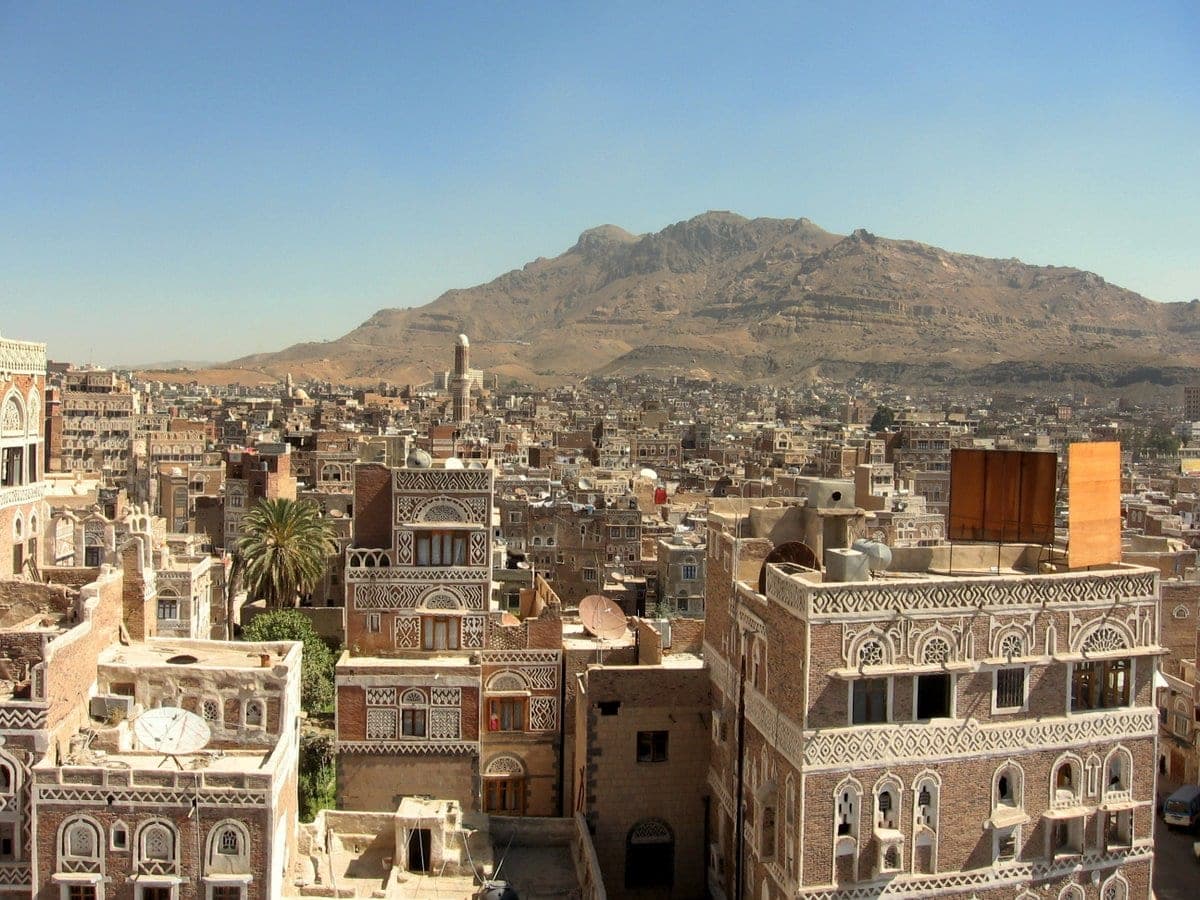
Sana'a. One of the longest continuously inhabited cities on earth, and by local tradition founded by Shem, son of Noah. Its walled old city, inscribed by UNESCO in 1986, packs thousands of tower-houses of rammed earth and fired brick, decorated with white gypsum tracery and crowned with coloured-glass fanlights, around dozens of mosques. It is a living city, which is both its glory and its fragility.
 Shibam has been called the oldest city of tower blocks, its houses rising seven and eight storeys in mud brick, and the whole town needs replastering against the rain. Photograph by Ljuba Brank, CC BY-SA 3.0, via Wikimedia Commons.
Aden. Built around the crater of an extinct volcano on a superb natural harbour, Aden has been a trading port since antiquity. The British seized it in 1839 as a free port on the route to India, and it grew into a crossroads of Arabs, Indians, Somalis and Jews before becoming capital of independent South Yemen. Its rock-cut cisterns of Tawila still overlook the bay.
Shibam. In the Wadi Hadhramaut stands a walled town of some 500 mud-brick towers rising five to eleven storeys, often called the oldest example of vertical urban planning in the world and nicknamed the Manhattan of the Desert. Inscribed in 1982, its towers were built tall for defence, and each generation must re-plaster them against wind and rain.
Zabid. On the Tihama plain, Zabid was founded around 820 CE and became one of the great centres of Islamic learning in Arabia, with a famous mosque-university and a role in the early study of algebra. Inscribed in 1993, its historic fabric has suffered heavy rebuilding in concrete.
Taiz. On the slopes of Jabal Sabir in the southern highlands, Taiz flourished as a capital under the Rasulid dynasty and remains a centre of education and of the highland coffee trade. Its Ashrafiya mosque and the Cairo Castle above the city mark a skyline scarred by the current war.
Yemen's recorded past opens with caravan kingdoms that grew rich on aromatics: Saba, Ma'in, Qataban, Awsan and Hadhramaut, the last the homeland of the frankincense tree. Saba, the earliest and greatest, centred on Marib, where its engineers built the Great Dam to spread the twice-yearly monsoon floods across an irrigated oasis. That waterwork sustained a dense population for over a millennium until repeated breaches, remembered in the Quran as the flood of the dam, ended it in the sixth century CE. Marib's rulers controlled the incense road, and it is to Saba that both the Hebrew Bible and the Quran assign the Queen of Sheba, whose visit to Solomon most historians read as legend rather than record.
Shibam has been called the oldest city of tower blocks, its houses rising seven and eight storeys in mud brick, and the whole town needs replastering against the rain. Photograph by Ljuba Brank, CC BY-SA 3.0, via Wikimedia Commons.
Aden. Built around the crater of an extinct volcano on a superb natural harbour, Aden has been a trading port since antiquity. The British seized it in 1839 as a free port on the route to India, and it grew into a crossroads of Arabs, Indians, Somalis and Jews before becoming capital of independent South Yemen. Its rock-cut cisterns of Tawila still overlook the bay.
Shibam. In the Wadi Hadhramaut stands a walled town of some 500 mud-brick towers rising five to eleven storeys, often called the oldest example of vertical urban planning in the world and nicknamed the Manhattan of the Desert. Inscribed in 1982, its towers were built tall for defence, and each generation must re-plaster them against wind and rain.
Zabid. On the Tihama plain, Zabid was founded around 820 CE and became one of the great centres of Islamic learning in Arabia, with a famous mosque-university and a role in the early study of algebra. Inscribed in 1993, its historic fabric has suffered heavy rebuilding in concrete.
Taiz. On the slopes of Jabal Sabir in the southern highlands, Taiz flourished as a capital under the Rasulid dynasty and remains a centre of education and of the highland coffee trade. Its Ashrafiya mosque and the Cairo Castle above the city mark a skyline scarred by the current war.
Yemen's recorded past opens with caravan kingdoms that grew rich on aromatics: Saba, Ma'in, Qataban, Awsan and Hadhramaut, the last the homeland of the frankincense tree. Saba, the earliest and greatest, centred on Marib, where its engineers built the Great Dam to spread the twice-yearly monsoon floods across an irrigated oasis. That waterwork sustained a dense population for over a millennium until repeated breaches, remembered in the Quran as the flood of the dam, ended it in the sixth century CE. Marib's rulers controlled the incense road, and it is to Saba that both the Hebrew Bible and the Quran assign the Queen of Sheba, whose visit to Solomon most historians read as legend rather than record.
 Sanaa has been lived in for more than two and a half thousand years, and its old city was placed on the List of World Heritage in Danger in 2015. Photograph by Hamza Shiban, CC BY-SA 3.0, via Wikimedia Commons.
Around 275 CE the highland kingdom of Himyar absorbed Saba and unified much of the south. Its later kings adopted Judaism, and the religious conflict that followed drew in outside powers: a Christian Aksumite army invaded around 525 CE, and Sasanian Persia took the country soon after. Islam arrived around 630 CE, when the Prophet Muhammad sent envoys and the Banu Hamdan and other tribes converted, among the first peoples to do so. In 897 CE the scholar Yahya al-Hadi founded a Zaydi imamate at Sa'dah that would govern parts of the highlands, in one form or another, for over a thousand years, while the medieval centuries brought local dynasties, the greatest the Rasulids (1229–1454), whose court at Taiz and Zabid patronised science and architecture.
Foreign empires later contended for the coast. The Ottomans held parts of Yemen in the sixteenth century, were expelled by the Qasimid imams, and returned in the nineteenth after the Suez Canal opened, while Britain ruled Aden and southern protectorates from 1839. When the Ottomans withdrew after 1918 the imams restored a kingdom in the north; a 1962 revolution created the Yemen Arab Republic, and Britain's departure from Aden in 1967 produced a separate, Marxist South Yemen. The two states united on 22 May 1990. A brief war of secession followed in 1994, and from 2014 to 2015 a new conflict began that continues at the time of writing; this profile notes it soberly and takes no side, returning below to its effect on the country's monuments.
The name Yemen comes from the Arabic root y-m-n, which carries the senses of the right hand and, for someone facing the sunrise, the south, with connotations of good fortune. It is the southern, right-hand quarter of Arabia, and the same associations of prosperity lie behind the Latin label Arabia Felix. Today the country speaks Arabic in distinctive Yemeni dialects that preserve many older features, while classical Arabic remains the language of religion and learning.
Beneath Arabic lies one of the oldest written languages of the peninsula. The caravan kingdoms recorded their laws and trade in Old South Arabian, a Semitic family including Sabaic, Minaic, Qatabanic and Hadramitic, written in the geometric musnad script; thousands of these inscriptions survive on stone and bronze. That ancient world is not wholly gone: in the far east and on Socotra, small communities still speak Modern South Arabian languages, Mehri and Soqotri among them, which descend from the same deep Semitic stock rather than from Arabic.
Yemeni architecture is among the most distinctive in the Islamic world. The tower-house, of rammed earth, stone or mud brick, keeps animals and stores below and family rooms above, culminating in the mafraj sitting room with its coloured-glass qamariyah fanlights. On the body, the marker of identity is the jambiya, the curved dagger worn at the belt by men, its hilt a sign of rank: the most prized are of aged rhinoceros horn, called saifani, graded by colour and passed down as heirlooms. Around the dagger grew a tradition of silverwork, much of it historically the craft of Yemen's Jewish silversmiths.
The Song of Sana'a, a repertoire of sung poetry dating to at least the fourteenth century, is performed by a solo singer with the qanbus lute and a struck copper tray, the sahn, and its verses form the most quoted body of poetry in the country. At weddings men perform the bara', a line dance stepped with drawn jambiyas. The kitchen centres on saltah, the national dish, a stew crowned with a whipped fenugreek froth called hulba; on mandi, rice and meat cooked in a pit oven; and on bint al-sahn, a layered pastry eaten with Sidr honey. And it was from the terraces around Mocha that coffee first reached the world, the port of al-Mukha giving its name to the mocha bean.
Islam is the faith of nearly all Yemenis and the frame of daily life. The country was among the earliest to embrace it, and it developed two enduring traditions: Shafi'i Sunnism, dominant in the south, coast and eastern valleys, and Zaydi Shiism, a moderate school rooted in the northern highlands that sustained the imamate for centuries. The mosque and the Quran school have long been the spine of Yemeni learning, and towns such as Zabid drew students from across the Muslim world.
The Hadhramaut holds a spiritual tradition of its own. The valley town of Tarim, with its many mosques and great libraries, has been a centre of Sufi scholarship and of the Ba Alawi sada, families claiming descent from the Prophet, whose missionaries carried Islam and Hadhrami culture across the Indian Ocean to East Africa and Southeast Asia. Yemen was also home to one of the world's oldest Jewish communities, renowned for scholarship and craft, though almost all its members have since emigrated, chiefly to Israel, leaving synagogues and cemeteries as part of the country's layered religious heritage.
Death in Yemen is handled according to Islamic law, quickly, communally and with restraint toward display. The body is washed in the ritual ghusl by family members of the same sex, then wrapped in a plain white shroud, the kafan, of a few unstitched cloths. Relatives and neighbours gather for the funeral prayer, the Salat al-Janazah, offered standing, a duty that falls on the community as a whole. Burial follows as soon as possible, ideally before the next sunset, and the body is laid in a simple grave on its right side, the face turned toward the qibla and Mecca. Coffins are generally not used, cremation is forbidden, and graves are kept low and unadorned, in keeping with the principle that all are equal before God.
Mourning then unfolds over a defined span. The family receives condolences, the aza, for three days, during which visitors come to sit, offer the formula of patience and share in Quran recitation, often of the chapter Ya-Sin, while food is brought to the bereaved household rather than prepared by it. Charity and continued prayer on behalf of the dead are held to benefit the soul, and a widow observes the iddah, a waiting period of four months and ten days. Yemeni practice adds local textures: coffee and qat served to those who keep the family company, and, in some regions, women's sung laments recalling the virtues of the dead, a custom older than Islam that religious teachers have long viewed with caution. The constant is that grief is not borne alone.
Yemeni families keep records in the courts and in the tribe, and the courts are the older of the two.
Sharia court archives, the sijill, record marriages, divorces, inheritance settlements, endowments and property transfers going back centuries in the towns, and because inheritance under Islamic law requires establishing exactly who the heirs are, an inheritance file is a genealogy in legal form. Waqf endowment deeds do the same work, naming a founder and the descendants entitled to benefit.
The sayyid families, who trace descent from the Prophet through the Rassid line, maintain written genealogies of great depth, and Zaydi scholarly households in the northern highlands kept manuscript libraries that include family chronicles. Tribal genealogy in the rest of the country is oral and equally precise.
Yemen's Jewish community was one of the oldest continuous Jewish populations anywhere, and almost all of it left between 1949 and 1950. Its records, and much of its manuscript tradition, are now in Israel, so a Yemeni Jewish family's archive and a Yemeni Muslim family's archive are in different countries.
The war since 2014 has damaged all of this. Archives and manuscript collections have been shelled, looted and dispersed, the old city of Sana'a and the mud towers of Shibam have taken direct damage, and the practical work of Yemeni heritage preservation has become the work of getting collections out or getting them documented before something happens to them.
Yemen holds five UNESCO World Heritage sites, and the story of their care is inseparable from the country's recent troubles. The Old City of Sana'a (inscribed 1986), the Old Walled City of Shibam (1982) and the Historic Town of Zabid (1993) are all cultural sites; Zabid was placed on the List of World Heritage in Danger in 2000 for the loss of its houses to concrete, and both Sana'a and Shibam were added in 2015 as the conflict spread. In 2023 UNESCO used an emergency procedure to inscribe the Landmarks of the Ancient Kingdom of Saba, Marib, seven archaeological sites including the Awam and Barran temples, the old dam and the city of Sirwah, placing them on the danger list at the same moment. On the intangible side, the Song of Sana'a joined UNESCO's Representative List in 2008.
The fifth site is natural: the Socotra Archipelago, inscribed in 2008 for a biodiversity found nowhere else on earth. Some 37 percent of its plants and 90 percent of its reptiles are endemic, from the umbrella-crowned dragon's blood tree, whose crimson resin has been traded since antiquity, to the swollen-trunked desert rose. Its threats are ecological rather than military: overgrazing, storms, climate stress and invasive species. Across all these places, protection now depends on international bodies, national authorities and, above all, local craftsmen who re-plaster the towers and keep the old skills alive. The framing that best fits Yemen today is heritage under threat and heritage defended, monuments that have survived earlier upheavals and are being held onto through this one.
Because so much of Yemen's heritage is fragile and hard to reach, digital preservation has become one of the most practical ways to keep it. The Yemeni Manuscript Digitization Initiative, a collaboration among Princeton University, the Free University of Berlin and Yemeni partners, has photographed and catalogued private manuscript libraries whose centuries-old volumes might otherwise be lost, making high-resolution images freely available online. The British Library's Endangered Archives Programme has funded similar in-country digitisation before conflict or decay could claim the records.
Alongside the scholarly archive runs an informal one. Photographers, architects and residents have documented the towers of Sana'a and Shibam, the temples of Marib and the trees of Socotra in images and video that circulate widely, so that places now dangerous to visit remain visible abroad. Museums and cultural bodies have begun to publish collections and virtual tours online, and Arabic-language content about Yemeni history and music grows year on year.
Yemeni culture reaches well beyond the country's borders, largely through a long history of migration. Hadhrami traders and scholars settled across the Indian Ocean world centuries ago, and their descendants remain visible in Indonesia, Malaysia, India and East Africa. More recent diasporas have taken root in Britain, where the Yemeni community in Cardiff is among the country's oldest Muslim populations, and in the United States, where the family coffee trade has fuelled a wave of Yemeni cafes.
That coffee is itself an ambassador, as specialty roasters draw global attention back to the highland beans of Yemen's origin. In music, singers of Yemeni heritage such as Balqees Fathi carry the country's melodies to Gulf-wide audiences. And in public life the journalist and activist Tawakkol Karman became, in 2011, the first Arab woman and the first Yemeni to win the Nobel Peace Prize, a reminder that the country's contribution is not only its past.
Marib mobilised. The 2023 emergency inscription placed the temples and dam of Marib on the danger list, opening international assistance at their moment of greatest risk.
Sana'a re-plastered. After heavy rains in 2020 collapsed dozens of historic houses, UNESCO and Yemeni partners paid local masons to rebuild them in traditional materials, sustaining both the fabric and the craft.
Socotra's trees nursed. With dragon's blood forests struggling to regenerate under grazing, Socotri communities and conservation projects have built fenced nurseries to raise seedlings, a patient defence of a species that grows on no other island.
Manuscripts saved to the cloud. The Yemeni Manuscript Digitization Initiative and allied programmes have brought thousands of pages of Yemeni scholarship online, so that texts once locked in private libraries in a war zone can be read anywhere.
Sanaa has been lived in for more than two and a half thousand years, and its old city was placed on the List of World Heritage in Danger in 2015. Photograph by Hamza Shiban, CC BY-SA 3.0, via Wikimedia Commons.
Around 275 CE the highland kingdom of Himyar absorbed Saba and unified much of the south. Its later kings adopted Judaism, and the religious conflict that followed drew in outside powers: a Christian Aksumite army invaded around 525 CE, and Sasanian Persia took the country soon after. Islam arrived around 630 CE, when the Prophet Muhammad sent envoys and the Banu Hamdan and other tribes converted, among the first peoples to do so. In 897 CE the scholar Yahya al-Hadi founded a Zaydi imamate at Sa'dah that would govern parts of the highlands, in one form or another, for over a thousand years, while the medieval centuries brought local dynasties, the greatest the Rasulids (1229–1454), whose court at Taiz and Zabid patronised science and architecture.
Foreign empires later contended for the coast. The Ottomans held parts of Yemen in the sixteenth century, were expelled by the Qasimid imams, and returned in the nineteenth after the Suez Canal opened, while Britain ruled Aden and southern protectorates from 1839. When the Ottomans withdrew after 1918 the imams restored a kingdom in the north; a 1962 revolution created the Yemen Arab Republic, and Britain's departure from Aden in 1967 produced a separate, Marxist South Yemen. The two states united on 22 May 1990. A brief war of secession followed in 1994, and from 2014 to 2015 a new conflict began that continues at the time of writing; this profile notes it soberly and takes no side, returning below to its effect on the country's monuments.
The name Yemen comes from the Arabic root y-m-n, which carries the senses of the right hand and, for someone facing the sunrise, the south, with connotations of good fortune. It is the southern, right-hand quarter of Arabia, and the same associations of prosperity lie behind the Latin label Arabia Felix. Today the country speaks Arabic in distinctive Yemeni dialects that preserve many older features, while classical Arabic remains the language of religion and learning.
Beneath Arabic lies one of the oldest written languages of the peninsula. The caravan kingdoms recorded their laws and trade in Old South Arabian, a Semitic family including Sabaic, Minaic, Qatabanic and Hadramitic, written in the geometric musnad script; thousands of these inscriptions survive on stone and bronze. That ancient world is not wholly gone: in the far east and on Socotra, small communities still speak Modern South Arabian languages, Mehri and Soqotri among them, which descend from the same deep Semitic stock rather than from Arabic.
Yemeni architecture is among the most distinctive in the Islamic world. The tower-house, of rammed earth, stone or mud brick, keeps animals and stores below and family rooms above, culminating in the mafraj sitting room with its coloured-glass qamariyah fanlights. On the body, the marker of identity is the jambiya, the curved dagger worn at the belt by men, its hilt a sign of rank: the most prized are of aged rhinoceros horn, called saifani, graded by colour and passed down as heirlooms. Around the dagger grew a tradition of silverwork, much of it historically the craft of Yemen's Jewish silversmiths.
The Song of Sana'a, a repertoire of sung poetry dating to at least the fourteenth century, is performed by a solo singer with the qanbus lute and a struck copper tray, the sahn, and its verses form the most quoted body of poetry in the country. At weddings men perform the bara', a line dance stepped with drawn jambiyas. The kitchen centres on saltah, the national dish, a stew crowned with a whipped fenugreek froth called hulba; on mandi, rice and meat cooked in a pit oven; and on bint al-sahn, a layered pastry eaten with Sidr honey. And it was from the terraces around Mocha that coffee first reached the world, the port of al-Mukha giving its name to the mocha bean.
Islam is the faith of nearly all Yemenis and the frame of daily life. The country was among the earliest to embrace it, and it developed two enduring traditions: Shafi'i Sunnism, dominant in the south, coast and eastern valleys, and Zaydi Shiism, a moderate school rooted in the northern highlands that sustained the imamate for centuries. The mosque and the Quran school have long been the spine of Yemeni learning, and towns such as Zabid drew students from across the Muslim world.
The Hadhramaut holds a spiritual tradition of its own. The valley town of Tarim, with its many mosques and great libraries, has been a centre of Sufi scholarship and of the Ba Alawi sada, families claiming descent from the Prophet, whose missionaries carried Islam and Hadhrami culture across the Indian Ocean to East Africa and Southeast Asia. Yemen was also home to one of the world's oldest Jewish communities, renowned for scholarship and craft, though almost all its members have since emigrated, chiefly to Israel, leaving synagogues and cemeteries as part of the country's layered religious heritage.
Death in Yemen is handled according to Islamic law, quickly, communally and with restraint toward display. The body is washed in the ritual ghusl by family members of the same sex, then wrapped in a plain white shroud, the kafan, of a few unstitched cloths. Relatives and neighbours gather for the funeral prayer, the Salat al-Janazah, offered standing, a duty that falls on the community as a whole. Burial follows as soon as possible, ideally before the next sunset, and the body is laid in a simple grave on its right side, the face turned toward the qibla and Mecca. Coffins are generally not used, cremation is forbidden, and graves are kept low and unadorned, in keeping with the principle that all are equal before God.
Mourning then unfolds over a defined span. The family receives condolences, the aza, for three days, during which visitors come to sit, offer the formula of patience and share in Quran recitation, often of the chapter Ya-Sin, while food is brought to the bereaved household rather than prepared by it. Charity and continued prayer on behalf of the dead are held to benefit the soul, and a widow observes the iddah, a waiting period of four months and ten days. Yemeni practice adds local textures: coffee and qat served to those who keep the family company, and, in some regions, women's sung laments recalling the virtues of the dead, a custom older than Islam that religious teachers have long viewed with caution. The constant is that grief is not borne alone.
Yemeni families keep records in the courts and in the tribe, and the courts are the older of the two.
Sharia court archives, the sijill, record marriages, divorces, inheritance settlements, endowments and property transfers going back centuries in the towns, and because inheritance under Islamic law requires establishing exactly who the heirs are, an inheritance file is a genealogy in legal form. Waqf endowment deeds do the same work, naming a founder and the descendants entitled to benefit.
The sayyid families, who trace descent from the Prophet through the Rassid line, maintain written genealogies of great depth, and Zaydi scholarly households in the northern highlands kept manuscript libraries that include family chronicles. Tribal genealogy in the rest of the country is oral and equally precise.
Yemen's Jewish community was one of the oldest continuous Jewish populations anywhere, and almost all of it left between 1949 and 1950. Its records, and much of its manuscript tradition, are now in Israel, so a Yemeni Jewish family's archive and a Yemeni Muslim family's archive are in different countries.
The war since 2014 has damaged all of this. Archives and manuscript collections have been shelled, looted and dispersed, the old city of Sana'a and the mud towers of Shibam have taken direct damage, and the practical work of Yemeni heritage preservation has become the work of getting collections out or getting them documented before something happens to them.
Yemen holds five UNESCO World Heritage sites, and the story of their care is inseparable from the country's recent troubles. The Old City of Sana'a (inscribed 1986), the Old Walled City of Shibam (1982) and the Historic Town of Zabid (1993) are all cultural sites; Zabid was placed on the List of World Heritage in Danger in 2000 for the loss of its houses to concrete, and both Sana'a and Shibam were added in 2015 as the conflict spread. In 2023 UNESCO used an emergency procedure to inscribe the Landmarks of the Ancient Kingdom of Saba, Marib, seven archaeological sites including the Awam and Barran temples, the old dam and the city of Sirwah, placing them on the danger list at the same moment. On the intangible side, the Song of Sana'a joined UNESCO's Representative List in 2008.
The fifth site is natural: the Socotra Archipelago, inscribed in 2008 for a biodiversity found nowhere else on earth. Some 37 percent of its plants and 90 percent of its reptiles are endemic, from the umbrella-crowned dragon's blood tree, whose crimson resin has been traded since antiquity, to the swollen-trunked desert rose. Its threats are ecological rather than military: overgrazing, storms, climate stress and invasive species. Across all these places, protection now depends on international bodies, national authorities and, above all, local craftsmen who re-plaster the towers and keep the old skills alive. The framing that best fits Yemen today is heritage under threat and heritage defended, monuments that have survived earlier upheavals and are being held onto through this one.
Because so much of Yemen's heritage is fragile and hard to reach, digital preservation has become one of the most practical ways to keep it. The Yemeni Manuscript Digitization Initiative, a collaboration among Princeton University, the Free University of Berlin and Yemeni partners, has photographed and catalogued private manuscript libraries whose centuries-old volumes might otherwise be lost, making high-resolution images freely available online. The British Library's Endangered Archives Programme has funded similar in-country digitisation before conflict or decay could claim the records.
Alongside the scholarly archive runs an informal one. Photographers, architects and residents have documented the towers of Sana'a and Shibam, the temples of Marib and the trees of Socotra in images and video that circulate widely, so that places now dangerous to visit remain visible abroad. Museums and cultural bodies have begun to publish collections and virtual tours online, and Arabic-language content about Yemeni history and music grows year on year.
Yemeni culture reaches well beyond the country's borders, largely through a long history of migration. Hadhrami traders and scholars settled across the Indian Ocean world centuries ago, and their descendants remain visible in Indonesia, Malaysia, India and East Africa. More recent diasporas have taken root in Britain, where the Yemeni community in Cardiff is among the country's oldest Muslim populations, and in the United States, where the family coffee trade has fuelled a wave of Yemeni cafes.
That coffee is itself an ambassador, as specialty roasters draw global attention back to the highland beans of Yemen's origin. In music, singers of Yemeni heritage such as Balqees Fathi carry the country's melodies to Gulf-wide audiences. And in public life the journalist and activist Tawakkol Karman became, in 2011, the first Arab woman and the first Yemeni to win the Nobel Peace Prize, a reminder that the country's contribution is not only its past.
Marib mobilised. The 2023 emergency inscription placed the temples and dam of Marib on the danger list, opening international assistance at their moment of greatest risk.
Sana'a re-plastered. After heavy rains in 2020 collapsed dozens of historic houses, UNESCO and Yemeni partners paid local masons to rebuild them in traditional materials, sustaining both the fabric and the craft.
Socotra's trees nursed. With dragon's blood forests struggling to regenerate under grazing, Socotri communities and conservation projects have built fenced nurseries to raise seedlings, a patient defence of a species that grows on no other island.
Manuscripts saved to the cloud. The Yemeni Manuscript Digitization Initiative and allied programmes have brought thousands of pages of Yemeni scholarship online, so that texts once locked in private libraries in a war zone can be read anywhere.
National Overview
Notable Cities
Historical Foundations
Linguistic and Etymological Roots
Cultural Identity
Religion and Spirituality
Remembrance and Mourning Traditions
Tracing a Family in Yemen
Heritage Preservation Efforts
Digital Heritage
Contemporary Cultural Influences
Success Stories
References and resources
- UNESCO World Heritage Centre, Yemen. State-party page listing all five World Heritage sites.
- UNESCO World Heritage Centre, Old City of Sana'a. Inscription record for the tower-house city and its danger listing.
- UNESCO World Heritage Centre, Old Walled City of Shibam. The record for the mud-brick towers of the Hadhramaut.
- UNESCO World Heritage Centre, Historic Town of Zabid. The record for the medieval centre of learning on the Tihama.
- UNESCO World Heritage Centre, Socotra Archipelago. The natural site and its endemic flora.
- UNESCO, Landmarks of the Ancient Kingdom of Saba, Marib. The 2023 emergency inscription and danger listing.
- UNESCO Intangible Cultural Heritage, Song of Sana'a. The inscription of al-ghina al-san'ani.
- Encyclopaedia Britannica, Yemen. Geography, history and cultural background.
- Encyclopaedia Britannica, Arabia Felix. The Sabaeans, Himyarites and the incense economy.
- Yemeni Manuscript Digitization Initiative. The Princeton and Berlin project preserving private manuscript libraries.