Heritage · Country
Saudi Arabia Culture and Heritage
The birthplace of Islam and guardian of Mecca and Medina, Saudi Arabia holds a place in the spiritual geography of humanity that belongs to no other country. A guide to its faith, its Nabataean and Bedouin heritage, and the customs by which Saudis remember their dead.Written to last.
By Confinity Heritage Editorial · Updated 2026-07-31 · 8-minute readQuiet tools, kept out of the way.
Five times each day, in mosques from Jakarta to Chicago, the world's Muslims turn to face a single point on the map: the Kaaba at the heart of Mecca, in the west of the Arabian Peninsula. For that reason Saudi Arabia occupies a place in the spiritual life of humanity that belongs to no other country. It is the land where, Muslims believe, the Prophet Muhammad received in the seventh century the revelation recorded in the Quran, and its two holiest cities, Mecca and Medina, draw the annual Hajj pilgrimage, among the largest peaceful gatherings of people anywhere on earth.
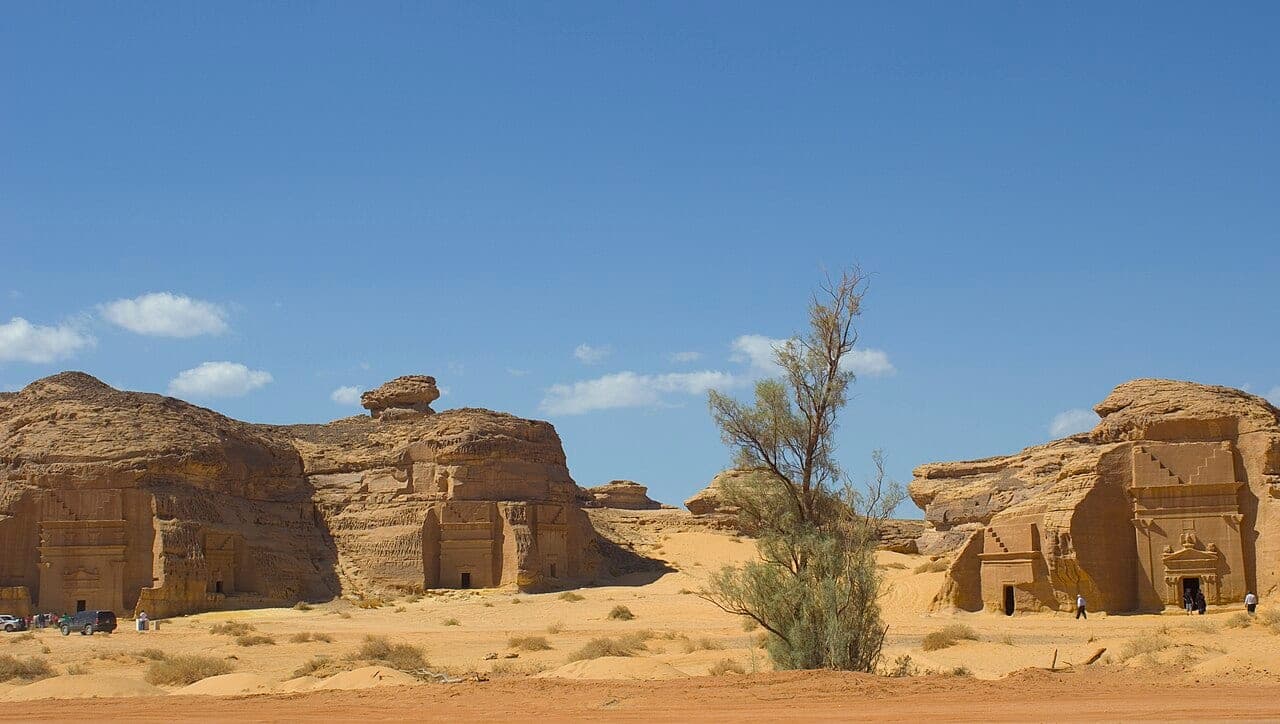
Yet the peninsula's memory runs far deeper than the seventh century. In the north-west, the Nabataean traders who raised Petra carved a second city of rock-cut tombs at Hegra, and generations of desert peoples left inscriptions across the sandstone of Ḥimā that span some seven thousand years. Long the keeper of the pilgrim routes and the old incense trade, the kingdom that Ibn Saud proclaimed in 1932 now sits above vast oil reserves and is opening its past to visitors for the first time, through heritage projects at AlUla and Diriyah conceived under the Vision 2030 reform programme. This guide surveys that heritage, the faith at its centre, and the traditions by which Saudis mourn and remember.
Saudi Arabia is the largest country in the Middle East, covering about 2.15 million square kilometres and filling most of the Arabian Peninsula, with coasts on the Red Sea to the west and the Arabian Gulf to the east. Much of the interior is desert, from the plateau of Najd in the centre to the Rub' al-Khali, the "Empty Quarter", the largest continuous body of sand on the planet. The western edge rises in the Hejaz and Asir mountains, while palm oases such as Al-Ahsa in the east have sustained settled life for thousands of years. There are no permanent rivers.
The population is roughly 32 million, of whom a large share are foreign residents drawn by the economy that oil built after the first commercial strike in 1938. Riyadh, the capital, is home to more than seven million people. The kingdom is a monarchy governed by the House of Saud, from which the country takes its name; its ruler carries the title Custodian of the Two Holy Mosques. Arabic is the official language and Islam the state religion. Since 2016 the government has pursued Vision 2030, a programme intended to diversify the economy beyond oil and to develop tourism and the heritage sector, changes noted here as matters of record.
Riyadh. The capital sits on the Najd plateau and grew from a walled mud-brick town around the Masmak Fortress, the fort whose capture in 1902 launched Ibn Saud's campaign of unification. It is now one of the fastest-growing cities in the region, its towers rising near the restored earthen architecture of old Diriyah.
Mecca (Makkah). The holiest city in Islam and the birthplace of the Prophet Muhammad, Mecca is built around the Masjid al-Haram, the Great Mosque, which encloses the cube-shaped Kaaba toward which Muslims pray. Set in a valley in the Hejaz, the city receives millions of pilgrims each year; by long-standing rule, entry to the city is reserved for Muslims.
Medina (Madinah). The second holiest city, Medina received the Prophet and his followers when they migrated from Mecca in 622, the event that opens the Islamic calendar. Its centre is Al-Masjid an-Nabawi, the Prophet's Mosque, which holds his tomb beneath its green dome. As at Mecca, access to the central sanctuary is reserved for Muslims.
Jeddah. The Red Sea port has for centuries been the gateway through which pilgrims arrive by sea for Mecca. Its old quarter, Historic Jeddah, preserves tall coral-stone houses fronted by carved wooden bay windows called rawashin, and was inscribed by UNESCO in 2014. Jeddah remains the kingdom's commercial capital and its most open, cosmopolitan city.
AlUla. An oasis strung along a valley in the north-west, AlUla holds more than two hundred thousand years of human history, from the ancient kingdoms of Dadan and Lihyan to the Nabataean tombs of Hegra and the labyrinth of the mud-brick Old Town. It has become the centrepiece of the kingdom's heritage tourism, developed by a dedicated royal commission.
Long before Islam, the peninsula was crossed by caravan routes carrying frankincense and myrrh north from southern Arabia, and its oases supported organised kingdoms: Dadan and Lihyan around AlUla, and the Kingdom of Kindah centred on Al-Faw. From roughly the second century BCE the Nabataeans made Hegra their southern city, cutting monumental tombs into the sandstone and mastering the storage of scarce water. Rock art and inscriptions at Ḥimā and in the Hail region record still older peoples and their herds across thousands of years.
 At-Turaif at Diriyah, the first Saudi capital, destroyed in 1818 and left in ruins for most of two centuries. Photograph by Radoslaw Botev, CC BY 3.0 PL, via Wikimedia Commons.
The decisive turn came in the seventh century. Around 610 the Prophet Muhammad began preaching in Mecca; facing hostility, he and his followers migrated to Medina in 622, an event known as the Hijra that founded the first Muslim community. Within a century of his death in 632, the Rashidun or "rightly guided" caliphs and the Umayyad and Abbasid dynasties that followed had carried Islam from Arabia across three continents. Political power soon shifted to Damascus and Baghdad, and for much of the medieval period the Hejaz was governed by local sharifs while the interior remained the domain of Bedouin tribes.
The roots of the modern state lie in the eighteenth century, when the ruler of the small Najdi town of Diriyah, Muhammad ibn Saud, allied in 1744 with the religious reformer Muhammad ibn Abd al-Wahhab. Their pact created the first Saudi state, whose capital At-Turaif in Diriyah is now a World Heritage site. After two earlier Saudi realms rose and fell, Abdulaziz ibn Saud recaptured Riyadh in 1902 and spent three decades uniting the regions of Najd, Hejaz, Asir and Al-Hasa, proclaiming the Kingdom of Saudi Arabia on 23 September 1932. Six years later, drillers struck oil at the Dammam No. 7 well, a discovery that transformed a largely pastoral society into one of the world's principal oil producers within a generation.
The language of Saudi Arabia is Arabic, a Semitic tongue written in a flowing cursive script from right to left. Its classical form is the language of the Quran, which Muslims regard as the direct word of God, and for that reason Classical Arabic became the shared liturgical and literary language of the entire Muslim world. Its modern standard descendant serves for writing, broadcasting and formal speech across the Arab countries, while Saudis speak regional dialects at home, chiefly Najdi in the centre, Hejazi in the west and Gulf Arabic in the east.
The country's name joins the ruling family to the peninsula: the Arabic Al-Mamlaka al-Arabiyya as-Suʿudiyya means "the Saudi Arab Kingdom", the only modern nation named for its dynasty. The word Arab itself is ancient, appearing in Assyrian records of the ninth century BCE and later giving its name to the whole peninsula. Because the Quran is recited in Arabic wherever Muslims pray, the language reaches far beyond the peninsula: for more than a billion people it carries the cadence of daily worship, and Saudi Arabia's role as its heartland lends the country a cultural weight out of proportion to its population.
Saudi identity draws deeply on the Bedouin heritage of the desert interior, where survival depended on the tribe, the camel and the code of hospitality. That code endures in the ritual of coffee: bitter Arabic coffee, scented with cardamom and poured from a long-spouted dallah, is served with dates to any guest as a mark of honour. The majlis, the sitting room where men gather to talk and settle affairs, remains a central institution, and Nabati verse, the vernacular poetry of the Bedouin, is still composed and recited in televised competitions that draw large audiences.
Other traditions carry the same lineage. Falconry survives as a prized pursuit and is inscribed on UNESCO's intangible heritage lists alongside the Najdi Ardah, a martial line dance in which rows of men move with swords to the beat of drums and the chant of poetry. Craft traditions include Sadu weaving in wool and the geometric wall painting of Asir known as Al-Qatt Al-Asiri, made by the women of the south-west. Dress signals both climate and identity: men wear the ankle-length thobe with a headcloth held by the black cord of the agal, and many women wear the flowing black abaya. These customs bind a society that, within living memory, moved from tents and oasis villages into modern cities without letting go of the older forms.
Islam shapes every part of Saudi life. Its five pillars, the declaration of faith, prayer five times a day, almsgiving, the fast of Ramadan and the pilgrimage to Mecca, order the rhythm of the year, and the call to prayer sets the pace of each day. The kingdom's foremost duty, expressed in its ruler's title, is the care of the Two Holy Mosques: the Great Mosque of Mecca, which surrounds the Kaaba, and the Prophet's Mosque in Medina. Both have been enlarged over the decades to receive the millions who come to worship.
The Hajj is the fifth pillar, a pilgrimage every able Muslim aspires to make once in a lifetime. Performed in the month of Dhu al-Hijjah, it gathers the faithful from every nation in a set of shared rites: circling the Kaaba seven times, walking between the hills of Safa and Marwa, and standing together in prayer on the plain of Arafat, all dressed in simple white cloth that erases distinctions of wealth and rank. In 2024 some 1.8 million pilgrims took part. The Umrah, the "lesser pilgrimage", may be undertaken at any time of year and draws millions more. For Muslims these journeys are among the most profound experiences of a life of faith, and the kingdom treats their conduct as a sacred trust.
Islamic funerary custom, followed throughout Saudi Arabia, is marked by speed, simplicity and equality before God. Burial takes place as soon as possible, ideally within a day of death, so that the body is returned quickly to the earth. The deceased is washed in a ritual cleansing called ghusl and wrapped in a plain white shroud, the kafan, the same humble cloth for rich and poor alike. There is no embalming and, in keeping with local practice, usually no coffin.
At-Turaif at Diriyah, the first Saudi capital, destroyed in 1818 and left in ruins for most of two centuries. Photograph by Radoslaw Botev, CC BY 3.0 PL, via Wikimedia Commons.
The decisive turn came in the seventh century. Around 610 the Prophet Muhammad began preaching in Mecca; facing hostility, he and his followers migrated to Medina in 622, an event known as the Hijra that founded the first Muslim community. Within a century of his death in 632, the Rashidun or "rightly guided" caliphs and the Umayyad and Abbasid dynasties that followed had carried Islam from Arabia across three continents. Political power soon shifted to Damascus and Baghdad, and for much of the medieval period the Hejaz was governed by local sharifs while the interior remained the domain of Bedouin tribes.
The roots of the modern state lie in the eighteenth century, when the ruler of the small Najdi town of Diriyah, Muhammad ibn Saud, allied in 1744 with the religious reformer Muhammad ibn Abd al-Wahhab. Their pact created the first Saudi state, whose capital At-Turaif in Diriyah is now a World Heritage site. After two earlier Saudi realms rose and fell, Abdulaziz ibn Saud recaptured Riyadh in 1902 and spent three decades uniting the regions of Najd, Hejaz, Asir and Al-Hasa, proclaiming the Kingdom of Saudi Arabia on 23 September 1932. Six years later, drillers struck oil at the Dammam No. 7 well, a discovery that transformed a largely pastoral society into one of the world's principal oil producers within a generation.
The language of Saudi Arabia is Arabic, a Semitic tongue written in a flowing cursive script from right to left. Its classical form is the language of the Quran, which Muslims regard as the direct word of God, and for that reason Classical Arabic became the shared liturgical and literary language of the entire Muslim world. Its modern standard descendant serves for writing, broadcasting and formal speech across the Arab countries, while Saudis speak regional dialects at home, chiefly Najdi in the centre, Hejazi in the west and Gulf Arabic in the east.
The country's name joins the ruling family to the peninsula: the Arabic Al-Mamlaka al-Arabiyya as-Suʿudiyya means "the Saudi Arab Kingdom", the only modern nation named for its dynasty. The word Arab itself is ancient, appearing in Assyrian records of the ninth century BCE and later giving its name to the whole peninsula. Because the Quran is recited in Arabic wherever Muslims pray, the language reaches far beyond the peninsula: for more than a billion people it carries the cadence of daily worship, and Saudi Arabia's role as its heartland lends the country a cultural weight out of proportion to its population.
Saudi identity draws deeply on the Bedouin heritage of the desert interior, where survival depended on the tribe, the camel and the code of hospitality. That code endures in the ritual of coffee: bitter Arabic coffee, scented with cardamom and poured from a long-spouted dallah, is served with dates to any guest as a mark of honour. The majlis, the sitting room where men gather to talk and settle affairs, remains a central institution, and Nabati verse, the vernacular poetry of the Bedouin, is still composed and recited in televised competitions that draw large audiences.
Other traditions carry the same lineage. Falconry survives as a prized pursuit and is inscribed on UNESCO's intangible heritage lists alongside the Najdi Ardah, a martial line dance in which rows of men move with swords to the beat of drums and the chant of poetry. Craft traditions include Sadu weaving in wool and the geometric wall painting of Asir known as Al-Qatt Al-Asiri, made by the women of the south-west. Dress signals both climate and identity: men wear the ankle-length thobe with a headcloth held by the black cord of the agal, and many women wear the flowing black abaya. These customs bind a society that, within living memory, moved from tents and oasis villages into modern cities without letting go of the older forms.
Islam shapes every part of Saudi life. Its five pillars, the declaration of faith, prayer five times a day, almsgiving, the fast of Ramadan and the pilgrimage to Mecca, order the rhythm of the year, and the call to prayer sets the pace of each day. The kingdom's foremost duty, expressed in its ruler's title, is the care of the Two Holy Mosques: the Great Mosque of Mecca, which surrounds the Kaaba, and the Prophet's Mosque in Medina. Both have been enlarged over the decades to receive the millions who come to worship.
The Hajj is the fifth pillar, a pilgrimage every able Muslim aspires to make once in a lifetime. Performed in the month of Dhu al-Hijjah, it gathers the faithful from every nation in a set of shared rites: circling the Kaaba seven times, walking between the hills of Safa and Marwa, and standing together in prayer on the plain of Arafat, all dressed in simple white cloth that erases distinctions of wealth and rank. In 2024 some 1.8 million pilgrims took part. The Umrah, the "lesser pilgrimage", may be undertaken at any time of year and draws millions more. For Muslims these journeys are among the most profound experiences of a life of faith, and the kingdom treats their conduct as a sacred trust.
Islamic funerary custom, followed throughout Saudi Arabia, is marked by speed, simplicity and equality before God. Burial takes place as soon as possible, ideally within a day of death, so that the body is returned quickly to the earth. The deceased is washed in a ritual cleansing called ghusl and wrapped in a plain white shroud, the kafan, the same humble cloth for rich and poor alike. There is no embalming and, in keeping with local practice, usually no coffin.
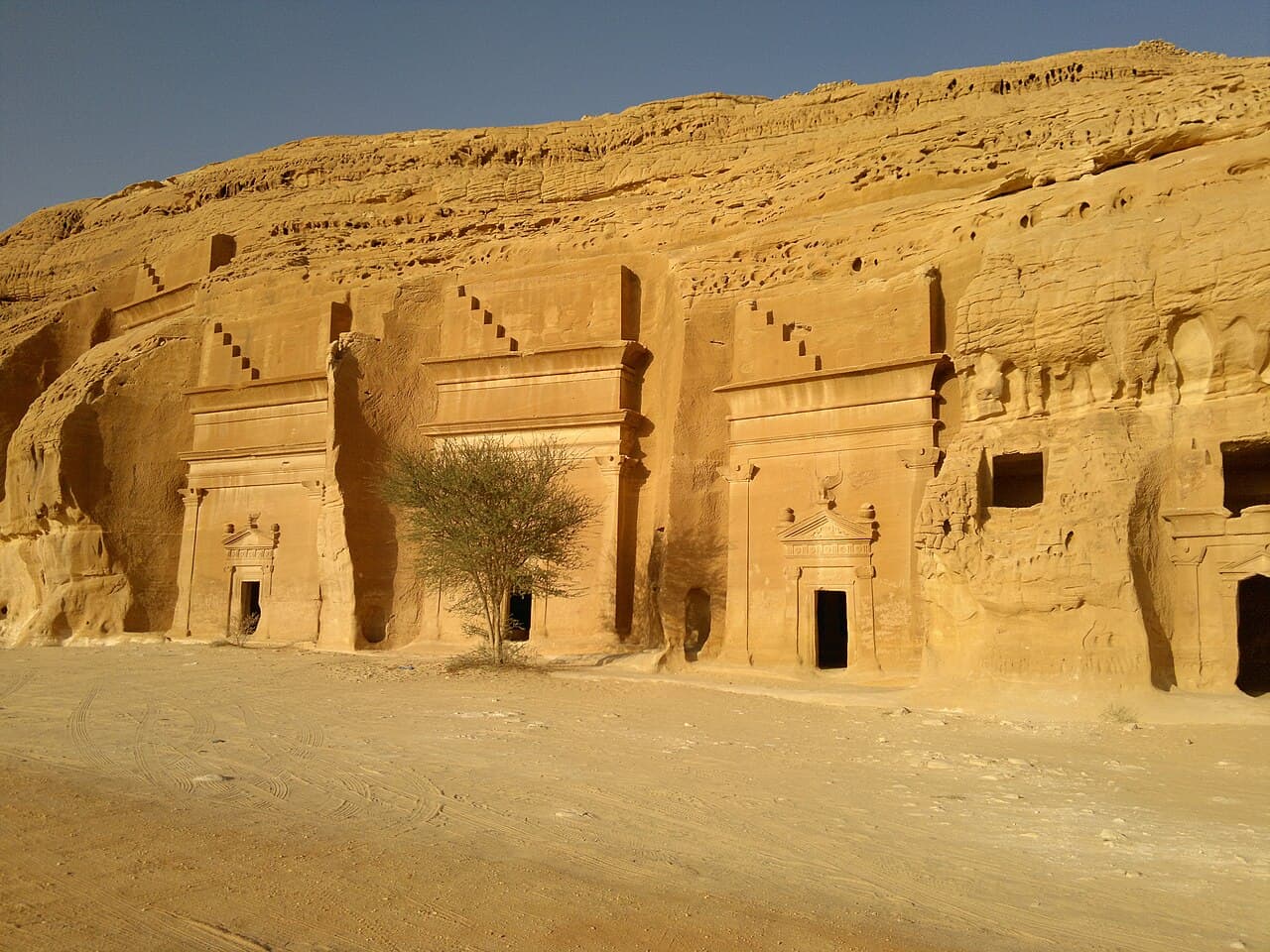 The tombs at Hegra were cut from the top down into free-standing rocks, and the facades carry the names of the families who commissioned them. Photograph by Roman, CC BY-SA 4.0, via Wikimedia Commons.
Before burial the community performs the Salat al-Janazah, the funeral prayer, offered standing and without bowing or prostration, a collective duty on those present. The body is then carried to the cemetery and laid in the grave on its right side, the face turned toward Mecca. Graves are traditionally kept plain and level with the ground, often unmarked or bearing only a simple stone, so that no monument sets one soul above another. Mourning is quiet: loud wailing is discouraged, and the family receives condolences over a period of three days, when relatives and neighbours visit, share food and recite from the Quran. A widow observes a longer period of mourning, the iddah, lasting four months and ten days. The restraint of these customs reflects a belief that death is a return to God and that the truest remembrance is prayer for the departed.
Saudi family records are tribal, legal and, for outsiders, largely closed.
Genealogy here is a serious and public matter. Families place themselves by tribe and by clan, the lines are recited, and descent is consequential for marriage, employment and standing. Sharif and sayyid families maintain written genealogies of descent from the Prophet, and the tribal nasab is transmitted with care. There is no need for a state register for any of this to work, and there never was.
The written record that does exist is legal and religious. Sharia court registers hold marriage, inheritance and property, and because Islamic inheritance requires naming heirs exactly, an estate file is a family document. Waqf endowment deeds name founders and the descendants entitled to administer them, and some run for centuries. Mecca and Medina generated their own archives around the pilgrimage, the guilds of guides and the endowments that supported them.
The modern civil register dates from the twentieth century and is administered by the interior ministry through the family card, which lists a household under its head.
Two large populations are documented differently. The descendants of enslaved Africans and others brought into the peninsula before abolition in 1962 appear in the tribal and household record rather than in any separate series. And roughly a third of the residents of the country are foreign workers, whose record is the kafala sponsorship file and whose families are documented in Nepal, India, the Philippines and Egypt.
Saudi Arabia now has eight sites on the UNESCO World Heritage List. Hegra (Al-Hijr) became the first in 2008, followed by At-Turaif in Diriyah in 2010, Historic Jeddah in 2014, the rock art of the Hail region in 2015, the Al-Ahsa Oasis in 2018, the Ḥimā Cultural Area with its ancient inscriptions in 2021, the desert nature reserve of ʻUruq Bani Maʼarid in 2023, and the archaeological landscape of Al-Faw in 2024. A dozen Saudi traditions, from Najdi Ardah to Khawlani coffee cultivation, appear on the intangible heritage lists.
Since 2020 a national Heritage Commission has overseen antiquities and museums, part of a broad expansion of cultural institutions under Vision 2030. Two projects lead the effort. The Royal Commission for AlUla, created in 2017, is conserving Hegra, the Dadanite sites and AlUla Old Town while developing the valley for careful, low-density tourism. At Diriyah, the birthplace of the first Saudi state, the mud-brick district of At-Turaif has been restored as a museum quarter, and in Jeddah the coral houses of the old town are being repaired. These programmes treat heritage as a national resource.
The kingdom's memory is increasingly recorded in digital form. The King Abdulaziz Foundation for Research and Archives, known as Darah, gathers documents, photographs and oral histories of the modern state and makes much of its holdings available online. The King Fahd National Library and the Saudi Digital Library, the largest academic digital library in the Arab world, have digitised manuscripts, books and periodicals for researchers.
Heritage sites are being captured in three dimensions as well. The Royal Commission for AlUla has used laser scanning and photogrammetry to record the tombs of Hegra in fine detail, both for conservation and for virtual visitors. The King Abdulaziz Center for World Culture in Dhahran, known as Ithra, maintains digital archives and online exhibitions of Saudi art and history, and Saudi collections now feature on global platforms such as Google Arts & Culture, extending access to audiences who may never travel to the sites themselves.
Public cinemas, closed for decades, reopened in 2018, and a domestic film industry has taken shape around directors such as Haifaa al-Mansour, whose film Wadjda was the first feature shot entirely in the kingdom. The Red Sea International Film Festival in Jeddah now draws filmmakers from Africa, Asia and the Arab world.
The visual arts have grown alongside. The Diriyah Contemporary Art Biennale and the Desert X exhibition at AlUla have placed large-scale installations in historic and desert settings, while Ithra supports Saudi artists and a national collection. Beyond the kingdom's borders, its deepest cultural influence remains the one it has always held: as the destination of the Hajj and the guardian of Arabic scripture, Saudi Arabia is woven into the devotional life of Muslims on every continent, a bond that predates the modern state by more than a thousand years.
Hegra reopened. The Nabataean city that became the kingdom's first World Heritage site in 2008 was for decades closed to casual visitors; conserved and carefully opened by the Royal Commission for AlUla, it now welcomes travellers to walk among tombs unseen by the wider world for generations.
Diriyah restored. At-Turaif, the earthen birthplace of the first Saudi state, has been stabilised and reborn as a heritage district, allowing Saudis to trace the origins of their nation in the very walls where it began.
Jeddah's old town saved. The coral-stone houses and carved wooden windows of Historic Jeddah, long threatened by decay, have been repaired and celebrated since their UNESCO inscription in 2014, keeping alive the architecture that greeted centuries of pilgrims.
Ḥimā's inscriptions recognised. The rock art and desert inscriptions of Ḥimā, near Najran, spanning some seven thousand years of hunters, travellers and pilgrims, joined the World Heritage List in 2021, giving global recognition to one of the oldest records of human passage in Arabia.
Living traditions honoured. From falconry and Arabic coffee to the Najdi Ardah and the geometric painting of Asir, Saudi customs have been inscribed on UNESCO's intangible heritage lists, ensuring that the practices of the desert and the oasis are transmitted to a new generation.
The tombs at Hegra were cut from the top down into free-standing rocks, and the facades carry the names of the families who commissioned them. Photograph by Roman, CC BY-SA 4.0, via Wikimedia Commons.
Before burial the community performs the Salat al-Janazah, the funeral prayer, offered standing and without bowing or prostration, a collective duty on those present. The body is then carried to the cemetery and laid in the grave on its right side, the face turned toward Mecca. Graves are traditionally kept plain and level with the ground, often unmarked or bearing only a simple stone, so that no monument sets one soul above another. Mourning is quiet: loud wailing is discouraged, and the family receives condolences over a period of three days, when relatives and neighbours visit, share food and recite from the Quran. A widow observes a longer period of mourning, the iddah, lasting four months and ten days. The restraint of these customs reflects a belief that death is a return to God and that the truest remembrance is prayer for the departed.
Saudi family records are tribal, legal and, for outsiders, largely closed.
Genealogy here is a serious and public matter. Families place themselves by tribe and by clan, the lines are recited, and descent is consequential for marriage, employment and standing. Sharif and sayyid families maintain written genealogies of descent from the Prophet, and the tribal nasab is transmitted with care. There is no need for a state register for any of this to work, and there never was.
The written record that does exist is legal and religious. Sharia court registers hold marriage, inheritance and property, and because Islamic inheritance requires naming heirs exactly, an estate file is a family document. Waqf endowment deeds name founders and the descendants entitled to administer them, and some run for centuries. Mecca and Medina generated their own archives around the pilgrimage, the guilds of guides and the endowments that supported them.
The modern civil register dates from the twentieth century and is administered by the interior ministry through the family card, which lists a household under its head.
Two large populations are documented differently. The descendants of enslaved Africans and others brought into the peninsula before abolition in 1962 appear in the tribal and household record rather than in any separate series. And roughly a third of the residents of the country are foreign workers, whose record is the kafala sponsorship file and whose families are documented in Nepal, India, the Philippines and Egypt.
Saudi Arabia now has eight sites on the UNESCO World Heritage List. Hegra (Al-Hijr) became the first in 2008, followed by At-Turaif in Diriyah in 2010, Historic Jeddah in 2014, the rock art of the Hail region in 2015, the Al-Ahsa Oasis in 2018, the Ḥimā Cultural Area with its ancient inscriptions in 2021, the desert nature reserve of ʻUruq Bani Maʼarid in 2023, and the archaeological landscape of Al-Faw in 2024. A dozen Saudi traditions, from Najdi Ardah to Khawlani coffee cultivation, appear on the intangible heritage lists.
Since 2020 a national Heritage Commission has overseen antiquities and museums, part of a broad expansion of cultural institutions under Vision 2030. Two projects lead the effort. The Royal Commission for AlUla, created in 2017, is conserving Hegra, the Dadanite sites and AlUla Old Town while developing the valley for careful, low-density tourism. At Diriyah, the birthplace of the first Saudi state, the mud-brick district of At-Turaif has been restored as a museum quarter, and in Jeddah the coral houses of the old town are being repaired. These programmes treat heritage as a national resource.
The kingdom's memory is increasingly recorded in digital form. The King Abdulaziz Foundation for Research and Archives, known as Darah, gathers documents, photographs and oral histories of the modern state and makes much of its holdings available online. The King Fahd National Library and the Saudi Digital Library, the largest academic digital library in the Arab world, have digitised manuscripts, books and periodicals for researchers.
Heritage sites are being captured in three dimensions as well. The Royal Commission for AlUla has used laser scanning and photogrammetry to record the tombs of Hegra in fine detail, both for conservation and for virtual visitors. The King Abdulaziz Center for World Culture in Dhahran, known as Ithra, maintains digital archives and online exhibitions of Saudi art and history, and Saudi collections now feature on global platforms such as Google Arts & Culture, extending access to audiences who may never travel to the sites themselves.
Public cinemas, closed for decades, reopened in 2018, and a domestic film industry has taken shape around directors such as Haifaa al-Mansour, whose film Wadjda was the first feature shot entirely in the kingdom. The Red Sea International Film Festival in Jeddah now draws filmmakers from Africa, Asia and the Arab world.
The visual arts have grown alongside. The Diriyah Contemporary Art Biennale and the Desert X exhibition at AlUla have placed large-scale installations in historic and desert settings, while Ithra supports Saudi artists and a national collection. Beyond the kingdom's borders, its deepest cultural influence remains the one it has always held: as the destination of the Hajj and the guardian of Arabic scripture, Saudi Arabia is woven into the devotional life of Muslims on every continent, a bond that predates the modern state by more than a thousand years.
Hegra reopened. The Nabataean city that became the kingdom's first World Heritage site in 2008 was for decades closed to casual visitors; conserved and carefully opened by the Royal Commission for AlUla, it now welcomes travellers to walk among tombs unseen by the wider world for generations.
Diriyah restored. At-Turaif, the earthen birthplace of the first Saudi state, has been stabilised and reborn as a heritage district, allowing Saudis to trace the origins of their nation in the very walls where it began.
Jeddah's old town saved. The coral-stone houses and carved wooden windows of Historic Jeddah, long threatened by decay, have been repaired and celebrated since their UNESCO inscription in 2014, keeping alive the architecture that greeted centuries of pilgrims.
Ḥimā's inscriptions recognised. The rock art and desert inscriptions of Ḥimā, near Najran, spanning some seven thousand years of hunters, travellers and pilgrims, joined the World Heritage List in 2021, giving global recognition to one of the oldest records of human passage in Arabia.
Living traditions honoured. From falconry and Arabic coffee to the Najdi Ardah and the geometric painting of Asir, Saudi customs have been inscribed on UNESCO's intangible heritage lists, ensuring that the practices of the desert and the oasis are transmitted to a new generation.
National Overview
Notable Cities
Historical Foundations
Linguistic and Etymological Roots
Cultural Identity
Religion and Spirituality
Remembrance and Mourning Traditions
Tracing a Family in Saudi Arabia
Heritage Preservation Efforts
Digital Heritage
Contemporary Cultural Influences
Success Stories
References and resources
- UNESCO World Heritage Centre: Saudi Arabia. The kingdom's eight inscribed sites, from Hegra to Al-Faw.
- UNESCO World Heritage Centre: Hegra (Al-Hijr / Mada'in Salih). The Nabataean tombs and the country's first World Heritage property.
- UNESCO Intangible Cultural Heritage: Saudi Arabia. Arabic coffee, falconry, Najdi Ardah and the kingdom's other living traditions.
- Encyclopaedia Britannica: Saudi Arabia. Geography, history, religion and society.
- Encyclopaedia Britannica: Ibn Saud. The founder of the modern kingdom and the unification completed in 1932.
- Encyclopaedia Britannica: Hijrah. The migration to Medina in 622 that founded the first Muslim community.
- Encyclopaedia Britannica: Hajj. The pilgrimage to Mecca and its rites.
- Saudi Vision 2030: AlUla. The heritage development of the north-western oasis.
- Wikipedia: Masjid al-Haram. The Great Mosque of Mecca and the Kaaba.
- Wikipedia: Salat al-Janazah. The Islamic funeral prayer and burial customs.