Heritage · Country
Wallis and Futuna Culture and Heritage
Three kingdoms with reigning kings are still recognised in French law here, across two island groups some 240 kilometres apart holding about 11,000 people. This guide covers the Tongan stone fort at Talietumu, the martyr's basilica at Poi, and funerals settled in tapa and mats.Written to last.
By Confinity Heritage Editorial · Updated 2026-08-17 · 8-minute readQuiet tools, kept out of the way.
France abolished monarchy at home in stages between 1792 and 1870, then kept three of them in the Pacific. On the island of Uvea, better known as Wallis, a king called the Lavelua reigns from a palace at Mata Utu. On Futuna, some 240 kilometres to the southwest, there are two more: the Tuʻi Sigave in the west of the island and the Tuʻi Agaifo in the east. All three are recognised in French law, receive a state stipend, and sit on the territorial council beside the senior French official. President Macron, visiting in 2021, called the statute that arranged this the most unconventional in the Republic, which is close to an official admission that nobody has fully written down how it works.
About 11,000 people live under that arrangement, and roughly twice that many Wallisians and Futunans live in New Caledonia. Almost all are Catholic, in a territory converted by Marist priests from 1837 and marked permanently by the killing of one of them at Poi in 1841. So a small place carries three overlapping authorities, the kingdoms, the church and the French state, and a heritage held less in institutions than in what families are still obliged to do for one another when somebody dies.
Wallis and Futuna is a French overseas collectivity of 142 square kilometres in two groups. Uvea, the island Europeans call Wallis, is low and volcanic inside a lagoon ringed with islets, about 360 kilometres west of Samoa. Futuna and its almost uninhabited neighbour Alofi are steep and reef-fringed, rising to Mont Puke at 524 metres; published figures for the gap between the two groups range from about 230 to 260 kilometres, and the practical link is a short flight from Hihifo on Wallis to Vele on Futuna.
The 2023 census counted 11,151 residents, 72.5 percent of them on Wallis, against 14,944 twenty years earlier, a fall of nearly a quarter in a single generation (Wallis and Futuna, Wikipedia). A senior administrator represents the state, and the territory elects a twenty-member Territorial Assembly, one deputy and one senator to the French parliament, with the three customary kings sitting on the territorial council. Most people live from gardens, pigs and fishing, while the cash economy runs on French transfers, public salaries, fishing licences and money sent home from Nouméa.
There are no cities, only some forty villages.
Mata Utu. Capital of the territory and seat of the kingdom of Uvea, on the east coast of Wallis. Its centre is a single open square with the royal palace on one side and the Cathedral of Notre-Dame-de-l'Assomption on the other. That is the political geography of the island in one view: the king's ceremonial ground and the church's front steps facing each other across the grass where the katoaga is laid out.
Leava. Port and administrative centre of the kingdom of Sigave, in a bay on southwest Futuna, where the supply ship anchors.
Ono and Poi. Ono is the seat of the kingdom of Alo in eastern Futuna. A few kilometres away at Poi stands the Basilica of Saint Peter Chanel, built where the missionary was killed in 1841.
Nouméa. It belongs to another territory 2,000 kilometres away, and it is where a large share of the population lives.
People first reached these islands roughly three thousand years ago carrying the decorated pottery archaeologists call Lapita, and the settlement site of Utuleve on Wallis is one place where that early presence has been excavated. Local chiefdoms followed, and then Tonga arrived.
Uvea was drawn into the Tuʻi Tonga empire, and it kept the physical evidence. Talietumu, also called Kolo Nui, lies nine kilometres southwest of Mata Utu: a fortified settlement enclosed by a dry-stone basalt wall with several gateways, built around 1450, with paved raised walkways running inward to a ceremonial platform now standing about five metres high and eighty metres long (Talietumu, Wikipedia). It was the last Tongan stronghold on the island, taken when Uvean forces broke the overlordship. Stone fortification on this scale is rare in western Polynesia, and Talietumu, with the related enclosures nearby, is among the most substantial archaeological remains in the region. Futuna, less thoroughly overrun, kept closer ties to Samoa, which is part of why the two islands speak different languages.
Willem Schouten and Jacob Le Maire charted Futuna in 1616 and named it the Hoorn Islands after Schouten's home town; Samuel Wallis passed Uvea in 1767 and left his name on the charts. The change that mattered came in 1837, when the Marists landed, Pierre Bataillon on Wallis and Pierre Chanel on Futuna. Chanel was clubbed to death at Poi on 28 April 1841 on the orders of the chief Niuliki, whose son had asked for baptism, and within a few years both islands had converted almost completely (Peter Chanel, Wikipedia).
French protection followed the church. The queen of Uvea signed a protectorate treaty on 5 April 1887, the kings of Sigave and Alo signed theirs on 16 February 1888, and the three kingdoms were annexed in 1917 and administered from New Caledonia. An American base arrived on Wallis in May 1942, putting thousands of servicemen on an island of a few thousand people. In 1959 the inhabitants voted to become a separate overseas territory, and the law of 29 July 1961 detached them from New Caledonia and wrote the three kings into the constitutional order (Customary kings of Wallis and Futuna, Wikipedia).
What the statute did not do was define what the kings could actually do. Kingship here is elective within noble families rather than strictly hereditary, and deposition happens: clan representatives call on the king, announce his removal and present a kava plant. In 2005 King Tomasi Kulimoetoke II, then in his forty-eighth year on the throne, sheltered his grandson in the palace after a manslaughter conviction, a rival faction enthroned an alternative king, France withheld the royal stipends, and the island saw barricades and an occupation of the airport before mediation restored him. He died on 7 May 2007, and the kingdom mourned for six months before Kapeliele Faupala was installed in July 2008 over the objections of parts of the royal clan; Faupala was deposed in 2014. In April 2016 two men were enthroned at once, the French state recognised only Patalione Kanimoa, and rival customary administrations have coexisted since. These are not folkloric squabbles. They close roads, split villages and reach the courts.
Two distinct Polynesian languages are spoken here. Wallisian, Faka'uvea, is the language of Uvea, and centuries of Tongan rule left it so heavily marked that some linguists group it with Tongic rather than Nuclear Polynesian; its closest relative is the speech of Niuafoʻou in northern Tonga (Wallisian language, Wikipedia). Futunan, Faka Futuna, is spoken on Futuna and Alofi and sits closer to Samoan, with dialect differences between Sigave and Alo (Futunan language, Wikipedia). They are not mutually intelligible in any useful sense, which is why a territory of eleven thousand people needs two of everything in print.
Wallisian keeps registers most European languages lost long ago: an honorific vocabulary for the king and for God, an ordinary one and a coarse one, so the verb for remaining is ʻafio, nofo or tagutu depending on who is doing it. Neither language was written until the Marists produced vocabularies from 1840, and the missionary orthography survives, with the velar nasal written as g.
French has been the language of school since 1961. The 2018 census found 59.1 percent of residents speaking Wallisian at home and 27.9 percent Futunan against 12.7 percent French, while more than eight in ten of those aged fourteen and over could speak French. UNESCO does not class Wallisian as endangered, which for a Pacific language with a shrinking home population is a real achievement; Futunan, with roughly six thousand speakers and a steady decline since the war, is weaker placed. Uvea is the island's own name and Wallis a navigator's, while Futuna, Alofi, Sigave and Alo are all local.
Two institutions carry most of the weight: kava and the katoaga. Kava is prepared and served under strict protocol at every enthronement, every major church occasion and every serious negotiation, brewed in a multi-legged wooden bowl called a tana that is itself a valued carved object, with the order of serving fixed by rank. The katoaga is the larger frame, a customary gathering held for a religious feast, a royal installation, the territorial festival, a wedding, a first communion or a funeral, at which villages bring pigs, baskets of yams and taro, woven mats, tapa and envelopes of banknotes, and at which everything brought is redistributed to the dignitaries and the assembly according to the rank of the person receiving it (Katoaga, Wikipedia). Watching one is watching a society state its own hierarchy in public with pigs and mats, then rebalance it, in an afternoon.
The wealth exchanged is made by women. Tapa, beaten from paper mulberry and breadfruit bark and painted with plant dyes, and fine pandanus mats are the currency of ceremony, take weeks of work, and change hands at prices between about 420 and 1,000 euros apiece. Making them supports a few hundred people, and records obligation: a family that gave mats at one funeral is owed at the next.
Dance is plentiful and codified, with more than a dozen recognised forms, among them the kailao, a paddle-club dance performed to percussion without singing. Food is cooked in the umu, the earth oven, and pigs are the ceremonial animal, carried whole on plaited palm frames. Houses in the older style, the fale, are open-sided under a pandanus roof laid in overlapping combs, still made that way at Vaisei on Futuna.
Catholicism here is close to total, and it arrived in a single generation. The territory is a diocese of its own, suffragan to Nouméa, with 26 religious monuments on Wallis and 22 on Futuna for a population of eleven thousand, and the diocese runs primary schooling under contract with the state, so the church sits inside the education system as well as beside it. The 1961 statute itself acknowledged the church's place, which is unusual in a republic that separated church and state in 1905.
 The cathedral stands beside the royal palace, and the three customary kingdoms still function alongside the French administration, which is unusual anywhere in the Pacific. Photograph by Brigitte and Heinz, CC BY-SA 2.0, via Wikimedia Commons.
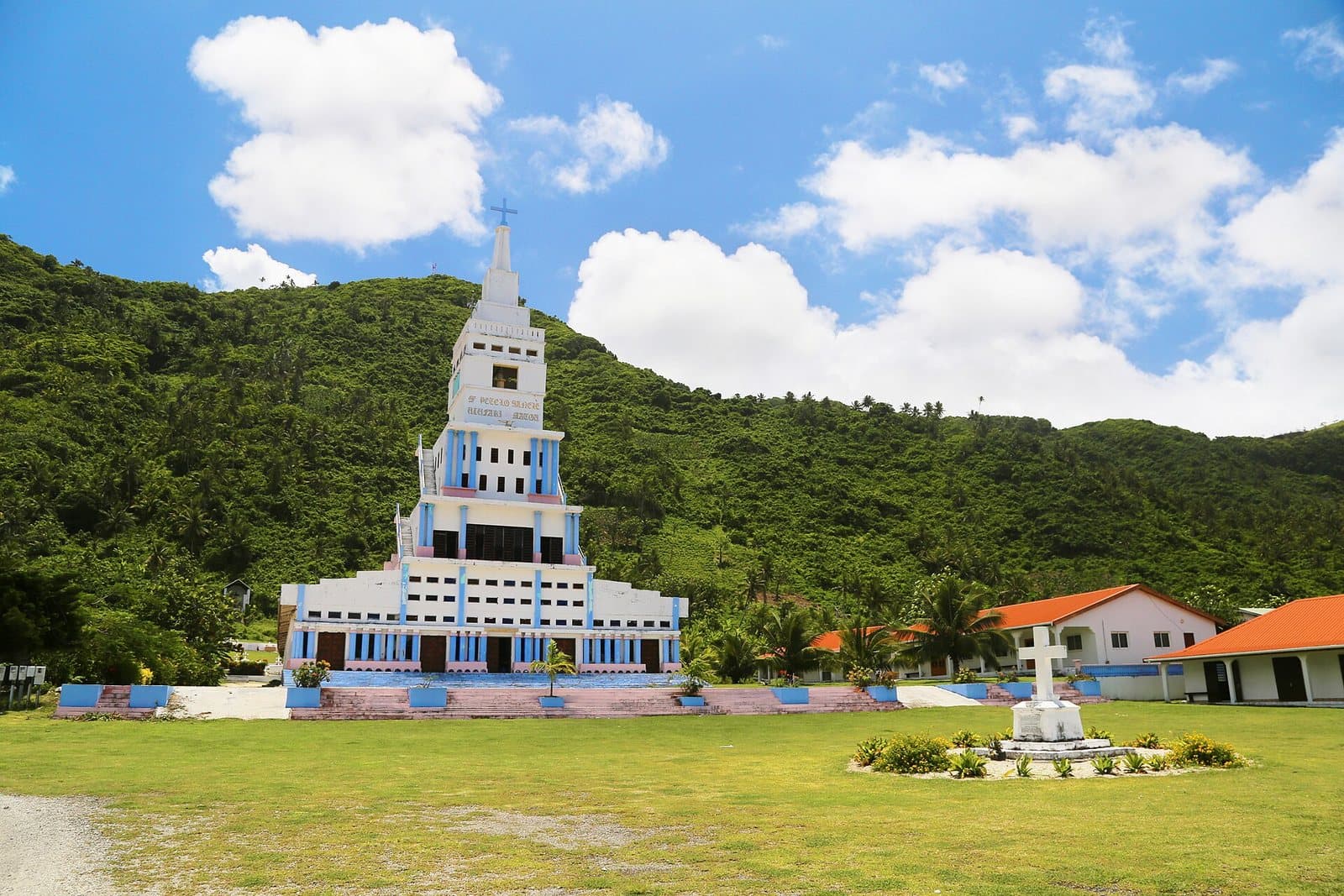
The centre of devotion is Poi. The Basilica of Saint Peter Chanel, completed in 1986 with a tall stepped tower, stands where Chanel was killed; his relics were brought back to Futuna in 1977, his fractured skull in 1985, and the bones are kept in a glass case in a chapel beside the church, with a small museum added in 1991. Chanel was beatified in 1889 and canonised by Pius XII in 1954 as the protomartyr and patron saint of Oceania, and his feast on 28 April is a public holiday. Each 27 April the faithful of both Futunan kingdoms gather at Tamana and process to the basilica with the relics, which makes Poi the principal Catholic pilgrimage site in Polynesia. The grave of Musumusu, the warrior who killed him, lies nearby and is also shown to visitors.
Older belief survives as attitude rather than practice, and the protocols governing kava, rank and speech carry a good deal of pre-Christian order inside a Catholic frame.
A death produces the largest gathering a family will ever organise. Funerals draw kin from both islands and from New Caledonia, and returning for one is a serious expense that families meet anyway, because being present is not treated as optional. The rites are Catholic, with vigil, mass and burial, but the surrounding exchange is customary: a katoaga is mounted, and pigs, mats, tapa and money move between the household of the deceased, the in-laws and the chieftainship in a settlement that can take months to prepare and years to reciprocate. Mats laid over a coffin are afterwards given away, which is why weaving is not a hobby.
Burial is close to home. Family plots sit beside houses, at the edges of villages and around churches, and the graves are built up, tiled, painted, railed and covered with fresh and artificial flowers, so that the domestic landscape of both islands is legibly full of the dead. Land is held bilaterally, through both parents, and a grave marks a family's claim on ground as plainly as a garden does.
When a king dies the kingdom mourns as an institution. The death of Tomasi Kulimoetoke II in May 2007 opened six months in which the throne stayed vacant, custom restrained ordinary festivity and the noble families deliberated over a successor. Mourning and succession are the same process here, which is one reason a royal death is a national event and a slow one.
The written record is thin. There is no substantial published ethnography of Wallisian and Futunan funeral practice in English, and the photographic record before the late twentieth century amounts to a handful of images, among them a burial on Wallis photographed around 1900. What is known is known because people still do it.
Wallis and Futuna is the only French territory where customary kingdoms still function alongside the state, and both keep records.
Three kingdoms exist here: Uvea on Wallis, and Sigave and Alo on Futuna. Each has a king and a chiefly hierarchy, and titles are conferred within families that hold them, so genealogy determines authority. The customary structures administer land, which is not registered in the French sense, and the knowledge of who holds what is held by the chiefs and the families.
French civil registration applies and runs from the establishment of the protectorate in 1887, held at Mata Utu. Catholic records are older and more substantial: the Marist mission arrived in 1837, the islands converted quickly, and the church has been the dominant institution ever since, running the schools for most of the twentieth century. Its registers are the earliest vital record.
The population is falling and the emigration is documented elsewhere: far more Wallisians and Futunans live in New Caledonia than at home, having gone for work in the nickel industry from the 1950s, with a further community in metropolitan France. Their records are New Caledonian.
The 2023 census counted around 11,000 residents against nearly 15,000 twenty years earlier.
Saint Pierre Chanel, killed on Futuna in 1841 and canonised in 1954, is the reason the islands are Catholic, and the church at Poi where he is buried is the centre of the territory's ritual year.
There is no national museum. The Territorial Service of Cultural Affairs, created by a decree of 16 March 1982, is the body responsible for heritage, and it has concentrated on sites and on oral record rather than on collections (Service Territorial des Affaires Culturelles). Its restoration work covers the early settlement site of Utuleve, the Tongan fort of Kolonui and the chiefly residence at Talietumu on Wallis, and the site of Asipani on Futuna.
Talietumu was excavated and rebuilt between the late 1980s and 1997 by the French archaeologists Daniel Frimigacci, Jean-Pierre Siorat and Maurice Hardy, using traditional methods to re-lay the walls and the platform. It is the one place where a visitor can stand inside a structure from the Tongan period and read its plan, and it carries most of the weight a museum would carry elsewhere.
A heritage section was added in 2014 to interview elderly people holding specialised knowledge. Plans for two museum buildings, one per island, have been discussed for years without being built, and meanwhile the movable heritage of the territory, the mats, the tapa, the tana bowls and the carved objects, stays in households and in ceremonial use. That is a preservation strategy of a kind, and a fragile one, since an object in circulation can be worn out, lost or sold.
For a territory this size the online record is better than might be expected, and almost all of it is hosted elsewhere. The cultural affairs service publishes its site inventories and oral-heritage programme at culture.malo.wf. The public broadcaster Wallis-et-Futuna La 1ère streams radio and television, and its coverage of enthronements, katoaga and the Chanel procession is now the most detailed running record of public life in the islands (Wallis-et-Futuna La 1ère).
The most useful single intervention was photographic. The Wikimedia campaign Photographiez les Outre-mer, run in 2018 and 2019, invited residents of the French overseas territories to upload freely licensed images, and it produced most of the openly licensed photography of Wallis and Futuna now in circulation, including the pandanus roofing at Vaisei, the kava of the territorial festival and the basilica at Poi that illustrates this page.
Linguistic and ethnographic recordings exist, mostly made by French researchers and held in metropolitan institutions. The gap is local: no territorial repository takes photographs, recordings or genealogies from a family and keeps them findable by a grandchild in Nouméa.
The defining fact of contemporary life is that most of the community lives somewhere else. The 2019 New Caledonian census counted 22,520 people identifying as Wallisian and Futunan, 8.3 percent of that territory's population and roughly double the population at home; migration began in the late 1940s and accelerated with the nickel boom of the 1960s.
That diaspora sustains the islands and complicates them. Remittances pay for funerals and church building, and Wallisian dance groups and parish networks are established features of Nouméa and its outskirts. It also places the community awkwardly, since Wallisians and Futunans in New Caledonia are neither Kanak nor European and have been pulled at from both directions through that territory's long constitutional argument, including the unrest of 2024. At home the effects are emptier villages, a shrinking school roll and a customary system selecting kings and chiefs from a pool much smaller than it was.
A Tongan fort rebuilt stone by stone. Talietumu was excavated and restored by French archaeologists working to 1997, giving the territory a legible fifteenth-century monument where it has no museum.
Three kingdoms still functioning. Whatever the crises, Uvea, Sigave and Alo have kept elective customary kingship alive and legally recognised inside a European republic for more than sixty years.
Oceania's pilgrimage centre. The basilica at Poi holds the relics of the first martyr of the Pacific and draws pilgrims from across the region each April.
A language that has held. Wallisian remains the household language of most residents of Uvea and is not classed by UNESCO as endangered, an outcome that many larger Pacific communities, with far more institutional support behind them, have not managed.
The cathedral stands beside the royal palace, and the three customary kingdoms still function alongside the French administration, which is unusual anywhere in the Pacific. Photograph by Brigitte and Heinz, CC BY-SA 2.0, via Wikimedia Commons.
The centre of devotion is Poi. The Basilica of Saint Peter Chanel, completed in 1986 with a tall stepped tower, stands where Chanel was killed; his relics were brought back to Futuna in 1977, his fractured skull in 1985, and the bones are kept in a glass case in a chapel beside the church, with a small museum added in 1991. Chanel was beatified in 1889 and canonised by Pius XII in 1954 as the protomartyr and patron saint of Oceania, and his feast on 28 April is a public holiday. Each 27 April the faithful of both Futunan kingdoms gather at Tamana and process to the basilica with the relics, which makes Poi the principal Catholic pilgrimage site in Polynesia. The grave of Musumusu, the warrior who killed him, lies nearby and is also shown to visitors.
Older belief survives as attitude rather than practice, and the protocols governing kava, rank and speech carry a good deal of pre-Christian order inside a Catholic frame.
A death produces the largest gathering a family will ever organise. Funerals draw kin from both islands and from New Caledonia, and returning for one is a serious expense that families meet anyway, because being present is not treated as optional. The rites are Catholic, with vigil, mass and burial, but the surrounding exchange is customary: a katoaga is mounted, and pigs, mats, tapa and money move between the household of the deceased, the in-laws and the chieftainship in a settlement that can take months to prepare and years to reciprocate. Mats laid over a coffin are afterwards given away, which is why weaving is not a hobby.
Burial is close to home. Family plots sit beside houses, at the edges of villages and around churches, and the graves are built up, tiled, painted, railed and covered with fresh and artificial flowers, so that the domestic landscape of both islands is legibly full of the dead. Land is held bilaterally, through both parents, and a grave marks a family's claim on ground as plainly as a garden does.
When a king dies the kingdom mourns as an institution. The death of Tomasi Kulimoetoke II in May 2007 opened six months in which the throne stayed vacant, custom restrained ordinary festivity and the noble families deliberated over a successor. Mourning and succession are the same process here, which is one reason a royal death is a national event and a slow one.
The written record is thin. There is no substantial published ethnography of Wallisian and Futunan funeral practice in English, and the photographic record before the late twentieth century amounts to a handful of images, among them a burial on Wallis photographed around 1900. What is known is known because people still do it.
Wallis and Futuna is the only French territory where customary kingdoms still function alongside the state, and both keep records.
Three kingdoms exist here: Uvea on Wallis, and Sigave and Alo on Futuna. Each has a king and a chiefly hierarchy, and titles are conferred within families that hold them, so genealogy determines authority. The customary structures administer land, which is not registered in the French sense, and the knowledge of who holds what is held by the chiefs and the families.
French civil registration applies and runs from the establishment of the protectorate in 1887, held at Mata Utu. Catholic records are older and more substantial: the Marist mission arrived in 1837, the islands converted quickly, and the church has been the dominant institution ever since, running the schools for most of the twentieth century. Its registers are the earliest vital record.
The population is falling and the emigration is documented elsewhere: far more Wallisians and Futunans live in New Caledonia than at home, having gone for work in the nickel industry from the 1950s, with a further community in metropolitan France. Their records are New Caledonian.
The 2023 census counted around 11,000 residents against nearly 15,000 twenty years earlier.
Saint Pierre Chanel, killed on Futuna in 1841 and canonised in 1954, is the reason the islands are Catholic, and the church at Poi where he is buried is the centre of the territory's ritual year.
There is no national museum. The Territorial Service of Cultural Affairs, created by a decree of 16 March 1982, is the body responsible for heritage, and it has concentrated on sites and on oral record rather than on collections (Service Territorial des Affaires Culturelles). Its restoration work covers the early settlement site of Utuleve, the Tongan fort of Kolonui and the chiefly residence at Talietumu on Wallis, and the site of Asipani on Futuna.
Talietumu was excavated and rebuilt between the late 1980s and 1997 by the French archaeologists Daniel Frimigacci, Jean-Pierre Siorat and Maurice Hardy, using traditional methods to re-lay the walls and the platform. It is the one place where a visitor can stand inside a structure from the Tongan period and read its plan, and it carries most of the weight a museum would carry elsewhere.
A heritage section was added in 2014 to interview elderly people holding specialised knowledge. Plans for two museum buildings, one per island, have been discussed for years without being built, and meanwhile the movable heritage of the territory, the mats, the tapa, the tana bowls and the carved objects, stays in households and in ceremonial use. That is a preservation strategy of a kind, and a fragile one, since an object in circulation can be worn out, lost or sold.
For a territory this size the online record is better than might be expected, and almost all of it is hosted elsewhere. The cultural affairs service publishes its site inventories and oral-heritage programme at culture.malo.wf. The public broadcaster Wallis-et-Futuna La 1ère streams radio and television, and its coverage of enthronements, katoaga and the Chanel procession is now the most detailed running record of public life in the islands (Wallis-et-Futuna La 1ère).
The most useful single intervention was photographic. The Wikimedia campaign Photographiez les Outre-mer, run in 2018 and 2019, invited residents of the French overseas territories to upload freely licensed images, and it produced most of the openly licensed photography of Wallis and Futuna now in circulation, including the pandanus roofing at Vaisei, the kava of the territorial festival and the basilica at Poi that illustrates this page.
Linguistic and ethnographic recordings exist, mostly made by French researchers and held in metropolitan institutions. The gap is local: no territorial repository takes photographs, recordings or genealogies from a family and keeps them findable by a grandchild in Nouméa.
The defining fact of contemporary life is that most of the community lives somewhere else. The 2019 New Caledonian census counted 22,520 people identifying as Wallisian and Futunan, 8.3 percent of that territory's population and roughly double the population at home; migration began in the late 1940s and accelerated with the nickel boom of the 1960s.
That diaspora sustains the islands and complicates them. Remittances pay for funerals and church building, and Wallisian dance groups and parish networks are established features of Nouméa and its outskirts. It also places the community awkwardly, since Wallisians and Futunans in New Caledonia are neither Kanak nor European and have been pulled at from both directions through that territory's long constitutional argument, including the unrest of 2024. At home the effects are emptier villages, a shrinking school roll and a customary system selecting kings and chiefs from a pool much smaller than it was.
A Tongan fort rebuilt stone by stone. Talietumu was excavated and restored by French archaeologists working to 1997, giving the territory a legible fifteenth-century monument where it has no museum.
Three kingdoms still functioning. Whatever the crises, Uvea, Sigave and Alo have kept elective customary kingship alive and legally recognised inside a European republic for more than sixty years.
Oceania's pilgrimage centre. The basilica at Poi holds the relics of the first martyr of the Pacific and draws pilgrims from across the region each April.
A language that has held. Wallisian remains the household language of most residents of Uvea and is not classed by UNESCO as endangered, an outcome that many larger Pacific communities, with far more institutional support behind them, have not managed.
National Overview
Notable Cities
Historical Foundations
Linguistic and Etymological Roots
Cultural Identity
Religion and Spirituality
Remembrance and Mourning Traditions
Tracing a Family in Wallis and Futuna
Heritage Preservation Efforts
Digital Heritage
Contemporary Cultural Influences
Success Stories
References and resources
- Wallis and Futuna, Wikipedia: geography, censuses and the protectorate treaties.
- Encyclopaedia Britannica, Wallis and Futuna: overview of the islands.
- Customary kings of Wallis and Futuna, Wikipedia: the three thrones, selection, and the crises of 2005 and 2016.
- Talietumu, Wikipedia: the Tongan fort, its date, dimensions and restoration.
- Peter Chanel, Wikipedia: the Marist mission of 1837, the killing at Poi and the canonisation of 1954.
- Katoaga, Wikipedia: the customary festival and the redistribution of gifts by rank.
- Wallisian language, Wikipedia: Tongan influence, honorific registers and speaker numbers.
- Futunan language, Wikipedia: classification, orthography and decline.
- Culture of Wallis and Futuna, Wikipedia: tapa, dance, kava and food.
- Service Territorial des Affaires Culturelles: site restoration and the oral-heritage surveys.
- Services de l'État à Wallis et Futuna, Culture et patrimoine: the state's account of custom and the katoaga.
- Wallis-et-Futuna La 1ère: the public broadcaster's record of customary and religious life.
- Countries and Their Cultures, Wallis and Futuna: kinship, land and funerals.