Heritage · Country
Solomon Islands Culture and Heritage
A Melanesian archipelago of nearly a thousand islands, from the world's largest raised coral atoll at East Rennell to the hand-built islands and shell money of Malaita. A guide to kastom, to shell-inlaid carving and 'Are'are panpipes, and to how Solomon Islanders keep faith with their dead.Written to last.
By Confinity Heritage Editorial · Updated 2026-07-31 · 8-minute readQuiet tools, kept out of the way.
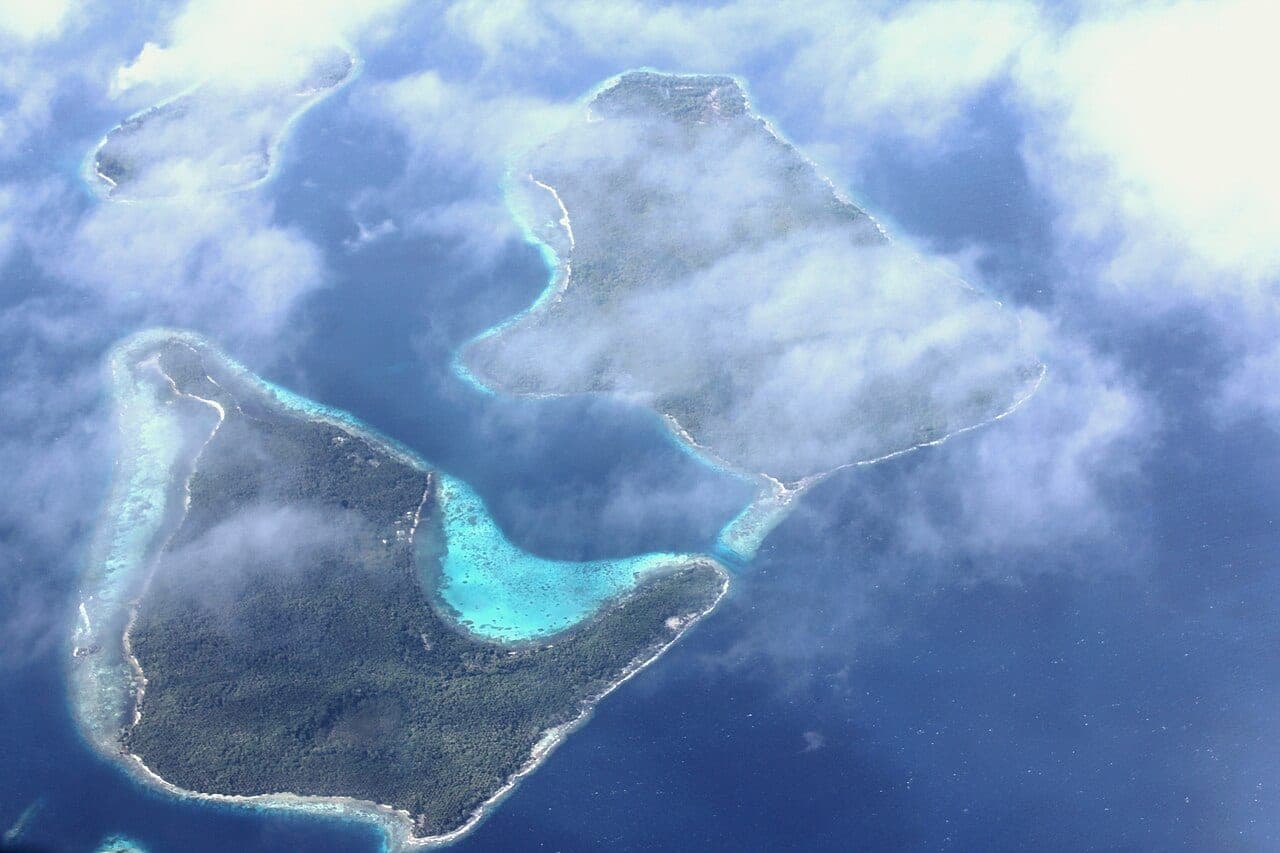
The Solomon Islands scatter across the south-western Pacific in a double chain of nearly a thousand islands, from the volcanic peaks of Guadalcanal and Malaita to the low coral of Rennell in the south. On that last island lies one of the natural wonders of the Pacific: East Rennell, the southern third of the largest raised coral atoll on earth, its interior filled by brackish Lake Tegano, a former lagoon lifted above the sea and now the largest body of enclosed water in the insular Pacific (UNESCO World Heritage Centre). Around the New Georgia group spread the Marovo and Roviana lagoons, sheltered by reefs and threaded by the carved canoes for which the western islands are known.
Heritage here is held less in monuments than in obligation: in the artificial islands built stone by stone in the lagoons of Malaita, in the shell money still counted at a marriage or a reconciliation, in the interlocking bamboo panpipes of the 'Are'are, and in the care given to ancestors whose presence is felt in daily life.
The Solomon Islands lie east of Papua New Guinea and north-east of Australia, a sovereign nation of nearly a thousand islands of which fewer than a hundred are permanently settled. The six largest, Guadalcanal, Malaita, Makira, Santa Isabel, Choiseul and New Georgia, carry most of a population of roughly 700,000 people, the great majority of them Melanesian (Britannica). The land is mountainous and forested, the sea restless with the same volcanism that built it; the submarine volcano Kavachi off New Georgia erupts often enough to have earned a place on the charts, and cyclones sweep the archipelago most years.
Most Solomon Islanders live in villages and work the land and reef, growing yam, pana, taro, sweet potato and cassava, tending coconut and cocoa, and fishing the lagoons. Honiara on Guadalcanal is the capital and only sizeable town. The country keeps its own dollar, and the overwhelming majority of its people are Christian, though older custom belief runs close beneath. Two features draw the eye of the wider world: East Rennell, inscribed by UNESCO in 1998 as the largest raised coral atoll on earth, and Marovo Lagoon, the largest double-barrier-reef lagoon anywhere, on UNESCO's Tentative List since 2008 (UNESCO; Wikipedia).
Honiara. The capital sits at the mouth of the Mataniko River on the north coast of Guadalcanal. It did not exist before the Second World War; it grew up around the site of the American military headquarters and in 1952 replaced Tulagi as the seat of government (Britannica). Honiara is the country's administrative and commercial centre and the home of the Solomon Islands National Museum, the National Archives and the central market where produce and shell craft from across the islands change hands.
Auki. The main town of Malaita and the gateway to the Langa Langa Lagoon, Auki serves the most populous province in the country. From here visitors reach the artificial islands and the shell-money workshops for which Malaita is renowned.
Gizo. The principal town of the Western Province, set among the reefs and islands of the New Georgia group, Gizo is a base for the Marovo and Roviana lagoons and for the diving on the region's coral and wartime wrecks. It was heavily damaged by the tsunami of April 2007 and rebuilt.
Tulagi. The small island off Florida (Nggela) was the administrative seat of the British Solomon Islands Protectorate from 1896 for its deep, sheltered harbour. It was captured and later destroyed during the fighting of 1942 and never regained its former role, ceding the capital to Honiara (Britannica).
Human presence in the Solomons archipelago reaches deep into the Pleistocene. The oldest dated occupation, at Kilu Cave in the northern islands, goes back some 30,000 years, when Papuan-speaking peoples crossed open sea from New Guinea to settle these coasts (Wikipedia). Around three thousand years ago a second movement arrived: seafarers of the Lapita culture, makers of a distinctive dentate-stamped pottery and ancestors of much of the Austronesian-speaking Pacific, whose descendants overlaid and mingled with the earlier populations (Britannica). From these layered settlements grew the lagoon societies of Malaita, whose people built dwelling islands by hand on the reef flats of the Langa Langa and Lau lagoons, piling coral stone above the tide as refuge and as home, and developed the manufacture of shell money into a specialised craft that supplied much of the archipelago (Wikipedia).
European contact began in 1568, when the Spanish navigator Álvaro de Mendaña reached the islands and, associating their promise with the legendary wealth of the biblical King Solomon, gave them the name they still carry (Britannica). Little followed for two centuries. In the nineteenth century the islands were drawn into the Pacific labour trade, the practice known as blackbirding, through which many thousands of Solomon Islanders were recruited or seized to work the sugar plantations of Queensland and Fiji, often by coercion and sometimes by outright kidnap. It is a history of loss remembered soberly in the islands to this day. Partly to regulate that trade and to check rival powers, Britain declared the British Solomon Islands Protectorate in 1893, extending it over the following years.
The Second World War brought the wider world's armies to Guadalcanal. Between August 1942 and February 1943 the island and the seas around it saw one of the hardest-fought campaigns of the Pacific war, a series of land and naval battles that ended with the Japanese withdrawal and cost tens of thousands of lives on both sides (Britannica; The National WWII Museum). The wrecked ships and aircraft that give the strait between Guadalcanal and Florida its name, Iron Bottom Sound, are war graves as much as they are relics. The protectorate was renamed Solomon Islands in 1975, and the country became independent on 7 July 1978. Between 1998 and 2003 an internal conflict, remembered as the Tensions, arose from disputes over land and migration between communities of Guadalcanal and Malaita; at the government's request an Australian-led Regional Assistance Mission to Solomon Islands deployed in 2003 to help restore order (Britannica; RAMSI).
The Solomon Islands are among the most linguistically varied countries on earth. More than seventy indigenous languages are spoken across the archipelago, most of them Oceanic members of the Austronesian family, together with a small group of Papuan languages, the Central Solomonic tongues, that descend from the older settlement (Wikipedia). No single vernacular serves the whole country. English is the official language, used in government and higher education, but everyday communication across community lines runs through Solomon Islands Pijin, an English-lexified creole closely related to Tok Pisin of Papua New Guinea and Bislama of Vanuatu, and understood by most of the population (Wikipedia). The name of the country itself is a European inheritance, bestowed by Mendaña and tied to the biblical King Solomon rather than to any island word, yet it has been claimed and made the nation's own.
The visual signature of the western Solomons is carving in dark wood inlaid with the pale iridescence of nautilus and other shell. Figures and bowls are cut from close-grained wood, stained black, and set with cut shell that catches the light, a contrast that carvers understood as more than decoration (The Metropolitan Museum of Art). Its most famous form is the nguzunguzu, the small guardian head lashed to the prow of a war canoe, or tomako, of the Roviana and New Georgia lagoons, carved with a jutting jaw and shell-inlaid features and set to skim the water, watching for reefs and warding off the spirits of the sea (Smarthistory; Wikipedia).
Shell money remains a living currency of ceremony. On Malaita, strung discs of ground and polished shell, known as tafuliae in their longest ceremonial lengths, are counted out for bride price, compensation and reconciliation, made largely in the Langa Langa Lagoon whose workshops have long held a near monopoly on the craft (Wikipedia). Music carries equal weight. Among the 'Are'are of southern Malaita, bamboo panpipes, called 'au after the bamboo itself, are played in ensembles whose full melody emerges only from the interlocking of several musicians, an interwoven polyphony organised into named genres and once rewarded with shell money, pigs or food (Britannica). Custom dance, drummed and sung, marks feasts and life passages across the provinces, and the table draws on the reef and the garden: fish and shellfish, yam and pana, taro, cassava and sweet potato, coconut and canarium nut, cooked slowly in the earth oven called a motu (Wikipedia).
Christianity reached the Solomons through nineteenth- and twentieth-century missions and is today professed by nearly the whole population, with Anglican, Roman Catholic, South Seas Evangelical, Seventh-day Adventist and United churches the largest among many. Yet belief is rarely lived as a clean break with the past. Across the islands, Christian worship is woven together with kastom, the inherited body of custom, law and ancestral knowledge, so that a family may attend Sunday service and still observe the tabu that protects a sacred site or honour the spirits of its forebears (University of Queensland). In the lagoon communities of Malaita, ancestral spirits are understood to remain active among the living, offering guidance or withholding it, and certain sharks are regarded as ancestral guardians in the shark-calling traditions of islands such as Laulasi. This double inheritance, church and custom held together rather than opposed, is one of the defining features of Solomon Islands spiritual life.
In Solomon Islands custom a death draws in the whole community, and the care of the dead has long been the deepest expression of kastom. Before Christianity, many communities did not bury their dead at once; the body was exposed until the flesh was gone, and the skull was then set apart and kept, in some places in a shrine on a small islet or coastal site where the skulls of leading men and ancestors were honoured and those of others gathered below. These skull shrines, several of which survive along the Malaitan lagoons and elsewhere as sacred places with their own access protocols, held the remembered dead close to the living and made the ancestors' presence tangible in the landscape (Solomon Islands National Museum). The practice is now largely of the past, but the reverence behind it endures.
 The Vilu museum is a private collection of aircraft and guns dragged out of the bush by a Solomon Islander family. The fighting of 1942 and 1943 was between other people's armies, and the wreckage was left behind for the islanders to live among. Photograph by Stefan Krasowski, CC BY 2.0, via Wikimedia Commons.
Around any death the customary economy of grief still operates: relatives gather from across the island, mourning is announced and kept, and pigs, food and shell money move between the kin of the deceased in exchanges that honour the dead and mend the ties that the loss has strained. Feasting marks the passage and, in many communities, later commemorations recall the dead at set intervals after burial. Today most funerals centre on a Christian service and a marked grave, with the pastor and the church women's fellowship at the heart of the rites, while the custom obligations of feasting and exchange continue around that Christian core. Reconciliation is itself a form of remembrance here, a settling of old grievances between families and communities so that the dead may rest and the living may be at peace.
Solomon Islands land is customary, and customary land is held by lineage, so genealogy here is title.
Around eighty-seven per cent of land is held under custom rather than registered title, and rights descend through the line, matrilineal in much of the country and patrilineal in parts. Establishing who may speak for a piece of ground means reciting descent, and logging and mining agreements have made those recitations financially consequential in ways they were not before. The Local Courts and the Customary Land Appeal Courts hear the evidence and their records hold a great deal of it.
The written record is mission and colonial. Anglican Melanesian Mission, Catholic, Methodist and South Seas Evangelical Church registers from the nineteenth century carry vital events, and the British Solomon Islands Protectorate files are split between Honiara and Kew.
The labour trade is the archive that reaches furthest. Between the 1860s and 1900s tens of thousands of Solomon Islanders were recruited or taken to work sugar plantations in Queensland and Fiji, and their names are in Australian immigration and plantation records. The Australian South Sea Islander community descends from those who stayed after the deportations of 1906.
The Second World War is the other. Guadalcanal was fought over by two foreign armies, and the wreckage is still in the bush; the coastwatchers' reports and the American and Japanese unit records name places and, occasionally, the islanders who guided them.
The tensions of 1998 to 2003 displaced tens of thousands and destroyed provincial records.
The country's foremost heritage site is East Rennell, inscribed on the World Heritage List in 1998 for the natural values of the largest raised coral atoll on earth and its brackish Lake Tegano, and notable as a site owned and managed under customary tenure rather than by the state (UNESCO). In 2013 the World Heritage Committee placed East Rennell on the List of World Heritage in Danger, chiefly because of the threat that logging posed to the values for which it was recognised, and it remains inscribed as in danger, a standing reminder of how fragile such places are (IUCN World Heritage Outlook). The Solomon Islands National Museum in Honiara, established in 1969, gathers and cares for the material and living heritage of the archipelago, from carving and shell valuables to custom knowledge, and works with communities to keep those traditions taught rather than only displayed (Solomon Islands National Museum). Marovo Lagoon, on the Tentative List since 2008, is a further candidate for international recognition (Wikipedia). Much of the real work of preservation, though, is done in the villages, where kastom passes from one generation to the next in language, dance, carving and the keeping of sacred sites.
Because so much Solomon Islands material culture left the islands during the colonial and mission eras, a significant part of the country's tangible heritage now lives in museums abroad, and digitisation is bringing it back within reach. Collections of shell-inlaid carving, canoe ornaments and shell valuables held by institutions such as the Metropolitan Museum of Art and the Australian Museum are catalogued online with photographs and provenance, so that objects which once required travel to see can be studied from the islands (The Metropolitan Museum of Art). Regional platforms such as Digital Pasifik aggregate records from Pacific institutions, including the Solomon Islands National Museum, into a shared point of access (Digital Pasifik). Sound heritage matters as much as objects: mid-twentieth-century field recordings of custom music, among them the 'Are'are panpipe repertoire, survive in ethnomusicological archives and increasingly circulate in digital form, so that a polyphony once heard only at a feast can be returned to the communities that made it.
Solomon Islands music has travelled further than the country's size might suggest. In 1992 the French duo Deep Forest built their track "Sweet Lullaby" on a recording of "Rorogwela," a Baegu lullaby from Malaita captured by the ethnomusicologist Hugo Zemp; the result became one of the most widely heard fragments of Solomon Islands music in the world, and an early lesson in the questions of consent and credit that surround such borrowing. At home, string bands and Pijin-language gospel and pop are the popular sound of the towns, while custom groups keep panpipes, drums and dance alive at festivals and national days. Carvers in the western islands continue to work shell-inlaid figures and bowls for a market that reaches collectors abroad, and the wartime heritage of Guadalcanal draws visitors to memorials and to the wrecks of Iron Bottom Sound. Across all of it runs the same anchor: kastom, land and the ancestral tie, carried into modern forms rather than left behind.
A raised atoll under customary care. East Rennell entered the World Heritage List in 1998 as the largest raised coral atoll on earth and as a rare site held and managed under customary ownership. Its later listing as in danger has made it a focus of conservation attention and of efforts by its Rennellese owners and national authorities to balance livelihood and protection (UNESCO).
A national museum keeping custom taught. Founded in 1969, the Solomon Islands National Museum has gathered and safeguarded the country's material and living heritage across a period of rapid change, working with communities so that carving, dance and custom knowledge are passed on and not only preserved behind glass (Solomon Islands National Museum).
Shell money that never became a relic. On Malaita the making and use of shell money endured through the colonial and cash economies alike, and tafuliae are still counted at marriages, compensations and reconciliations, a customary valuable that remains in genuine circulation rather than surviving only as craft (Wikipedia).
The Vilu museum is a private collection of aircraft and guns dragged out of the bush by a Solomon Islander family. The fighting of 1942 and 1943 was between other people's armies, and the wreckage was left behind for the islanders to live among. Photograph by Stefan Krasowski, CC BY 2.0, via Wikimedia Commons.
Around any death the customary economy of grief still operates: relatives gather from across the island, mourning is announced and kept, and pigs, food and shell money move between the kin of the deceased in exchanges that honour the dead and mend the ties that the loss has strained. Feasting marks the passage and, in many communities, later commemorations recall the dead at set intervals after burial. Today most funerals centre on a Christian service and a marked grave, with the pastor and the church women's fellowship at the heart of the rites, while the custom obligations of feasting and exchange continue around that Christian core. Reconciliation is itself a form of remembrance here, a settling of old grievances between families and communities so that the dead may rest and the living may be at peace.
Solomon Islands land is customary, and customary land is held by lineage, so genealogy here is title.
Around eighty-seven per cent of land is held under custom rather than registered title, and rights descend through the line, matrilineal in much of the country and patrilineal in parts. Establishing who may speak for a piece of ground means reciting descent, and logging and mining agreements have made those recitations financially consequential in ways they were not before. The Local Courts and the Customary Land Appeal Courts hear the evidence and their records hold a great deal of it.
The written record is mission and colonial. Anglican Melanesian Mission, Catholic, Methodist and South Seas Evangelical Church registers from the nineteenth century carry vital events, and the British Solomon Islands Protectorate files are split between Honiara and Kew.
The labour trade is the archive that reaches furthest. Between the 1860s and 1900s tens of thousands of Solomon Islanders were recruited or taken to work sugar plantations in Queensland and Fiji, and their names are in Australian immigration and plantation records. The Australian South Sea Islander community descends from those who stayed after the deportations of 1906.
The Second World War is the other. Guadalcanal was fought over by two foreign armies, and the wreckage is still in the bush; the coastwatchers' reports and the American and Japanese unit records name places and, occasionally, the islanders who guided them.
The tensions of 1998 to 2003 displaced tens of thousands and destroyed provincial records.
The country's foremost heritage site is East Rennell, inscribed on the World Heritage List in 1998 for the natural values of the largest raised coral atoll on earth and its brackish Lake Tegano, and notable as a site owned and managed under customary tenure rather than by the state (UNESCO). In 2013 the World Heritage Committee placed East Rennell on the List of World Heritage in Danger, chiefly because of the threat that logging posed to the values for which it was recognised, and it remains inscribed as in danger, a standing reminder of how fragile such places are (IUCN World Heritage Outlook). The Solomon Islands National Museum in Honiara, established in 1969, gathers and cares for the material and living heritage of the archipelago, from carving and shell valuables to custom knowledge, and works with communities to keep those traditions taught rather than only displayed (Solomon Islands National Museum). Marovo Lagoon, on the Tentative List since 2008, is a further candidate for international recognition (Wikipedia). Much of the real work of preservation, though, is done in the villages, where kastom passes from one generation to the next in language, dance, carving and the keeping of sacred sites.
Because so much Solomon Islands material culture left the islands during the colonial and mission eras, a significant part of the country's tangible heritage now lives in museums abroad, and digitisation is bringing it back within reach. Collections of shell-inlaid carving, canoe ornaments and shell valuables held by institutions such as the Metropolitan Museum of Art and the Australian Museum are catalogued online with photographs and provenance, so that objects which once required travel to see can be studied from the islands (The Metropolitan Museum of Art). Regional platforms such as Digital Pasifik aggregate records from Pacific institutions, including the Solomon Islands National Museum, into a shared point of access (Digital Pasifik). Sound heritage matters as much as objects: mid-twentieth-century field recordings of custom music, among them the 'Are'are panpipe repertoire, survive in ethnomusicological archives and increasingly circulate in digital form, so that a polyphony once heard only at a feast can be returned to the communities that made it.
Solomon Islands music has travelled further than the country's size might suggest. In 1992 the French duo Deep Forest built their track "Sweet Lullaby" on a recording of "Rorogwela," a Baegu lullaby from Malaita captured by the ethnomusicologist Hugo Zemp; the result became one of the most widely heard fragments of Solomon Islands music in the world, and an early lesson in the questions of consent and credit that surround such borrowing. At home, string bands and Pijin-language gospel and pop are the popular sound of the towns, while custom groups keep panpipes, drums and dance alive at festivals and national days. Carvers in the western islands continue to work shell-inlaid figures and bowls for a market that reaches collectors abroad, and the wartime heritage of Guadalcanal draws visitors to memorials and to the wrecks of Iron Bottom Sound. Across all of it runs the same anchor: kastom, land and the ancestral tie, carried into modern forms rather than left behind.
A raised atoll under customary care. East Rennell entered the World Heritage List in 1998 as the largest raised coral atoll on earth and as a rare site held and managed under customary ownership. Its later listing as in danger has made it a focus of conservation attention and of efforts by its Rennellese owners and national authorities to balance livelihood and protection (UNESCO).
A national museum keeping custom taught. Founded in 1969, the Solomon Islands National Museum has gathered and safeguarded the country's material and living heritage across a period of rapid change, working with communities so that carving, dance and custom knowledge are passed on and not only preserved behind glass (Solomon Islands National Museum).
Shell money that never became a relic. On Malaita the making and use of shell money endured through the colonial and cash economies alike, and tafuliae are still counted at marriages, compensations and reconciliations, a customary valuable that remains in genuine circulation rather than surviving only as craft (Wikipedia).
National Overview
Notable Cities
Historical Foundations
Linguistic and Etymological Roots
Cultural Identity
Religion and Spirituality
Remembrance and Mourning Traditions
Tracing a Family in Solomon Islands
Heritage Preservation Efforts
Digital Heritage
Contemporary Cultural Influences
Success Stories
References and resources
- UNESCO World Heritage Centre: East Rennell
- IUCN World Heritage Outlook: East Rennell
- Encyclopaedia Britannica: Solomon Islands, History
- Encyclopaedia Britannica: Battle of Guadalcanal
- The National WWII Museum: The Solomon Islands Campaign, Guadalcanal
- Encyclopaedia Britannica: Honiara
- Encyclopaedia Britannica: Tulagi
- Wikipedia: Kilu Cave
- Wikipedia: Langa Langa Lagoon
- Wikipedia: Marovo Lagoon
- Wikipedia: Languages of the Solomon Islands
- Wikipedia: Pijin
- Smarthistory: Nguzunguzu, canoe prow figurehead
- The Metropolitan Museum of Art: Body Adornment in Solomon Islands
- Encyclopaedia Britannica: Oceanic music, The Solomon Islands
- Wikipedia: Solomon Islands National Museum
- RAMSI: Regional Assistance Mission to Solomon Islands