Heritage · Country
New Caledonia Culture and Heritage
A French collectivity in the southwest Pacific where Kanak clans have held the same valleys for three thousand years, and where any serious meeting still opens with a gift and a spoken word. This guide follows New Caledonian heritage from the Lapita potters to the Tjibaou Centre.Written to last.
By Confinity Heritage Editorial · Updated 2026-08-17 · 8-minute readQuiet tools, kept out of the way.
Nothing of consequence begins in New Caledonia without a gift. A folded length of cloth, a note of money, a twist of tobacco, offered with a short speech naming who you are and which clan and valley you speak for: this is la coutume, and it opens a wedding, a funeral, a land negotiation and a first visit to a chief's house alike. The object matters less than the words that carry it. The gesture says the visitor accepts the authority of the ground he stands on, and that the exchange will one day be answered.
The archipelago that France administers as a sui generis collectivity, and that its independence movement calls Kanaky, holds one of the older continuous human presences in the Pacific and one of its most contested political arguments. Lapita voyagers landed here about three thousand years ago and left the stamped pottery that gives an entire prehistoric culture its name; James Cook sailed the east coast in 1774 and borrowed a Latin word for Scotland; France annexed the islands in 1853 and ran a penal colony on them for more than thirty years. Three referendums on independence were held between 2018 and 2021, the last of them boycotted, and in May 2024 the question of who may vote set the capital alight.
New Caledonia covers about 18,575 square kilometres of land in the southwest Pacific, most of it in the long, mountainous island of Grande Terre, with the Loyalty Islands of Ouvéa, Lifou and Maré to the east, the Isle of Pines to the south and the Belep group to the north. The 2019 census counted 271,407 residents, of whom around 41 per cent identified as Kanak, roughly a quarter as European, and about 8 per cent as Wallisian or Futunian (ISEE). Three provinces divide the territory, which is governed under an arrangement of shared and transferred powers unlike anything else in the French republic: its own congress, a collegial government, a New Caledonian citizenship, and a Customary Senate of sixteen members drawn from eight customary areas. Grande Terre holds a large share of the world's nickel reserves, and its barrier reef, one of the longest on earth, encloses a lagoon inscribed on the World Heritage List in 2008 (UNESCO).
Nouméa. The capital sits on a peninsula of bays in the far south of Grande Terre, holds roughly a third of the population, and carries the double character of the territory: a French provincial city of colonial squares and marinas that is also the seat of Kanak cultural institutions. The Musée de Nouvelle-Calédonie keeps the ethnographic collections, carved doorposts, ceremonial axes and shell money, while the Tjibaou Cultural Centre gives Kanak art a building of its own.
Koné. The administrative centre of the Northern Province was chosen under the Matignon Accords for a deliberate rebalancing of wealth and population away from Nouméa, with the Koniambo nickel plant as the centrepiece. Along the coast lies the Foué peninsula, where the archaeological site of Lapita gave its name to the pottery of the first Pacific voyagers.
Hienghène. On the northeast coast, under black limestone rocks that rise straight from the sea, Hienghène is the home village of Jean-Marie Tjibaou and one of the emotional centres of the independence movement. Ten men from the nearby hamlets, two of them Tjibaou's brothers, were killed in an ambush there in December 1984, and the graves at Tiendanite are visited as political memory as much as family grief.
Wé and the Loyalty Islands. On the raised coral platforms of Lifou, Maré and Ouvéa, chieftaincies are strong, land is almost entirely customary, and the Protestant churches brought by Samoan and Rarotongan teachers in the 1840s shaped village life. Gossanah on Ouvéa is where the 1988 crisis ended.
The first settlers arrived about three thousand years ago as part of the Lapita expansion, the seaborne movement of Austronesian-speaking communities out of the Bismarck Archipelago into the unpeopled islands of Remote Oceania. The name is New Caledonian: the site of Lapita on the Foué peninsula, excavated in 1952, produced the finely dentate-stamped pottery archaeologists have since traced from the Bismarcks to Tonga and Samoa, so that the type site for the ancestral culture of much of the Pacific sits on the west coast of Grande Terre (Wikipedia). Their descendants built the clan and chieftaincy system, terraced hillsides for irrigated taro, and organised the year around the yam.
Cook sighted Grande Terre in September 1774 and named it after the Latin word for Scotland. Sandalwood traders followed, then Marist missionaries in 1843, and on 24 September 1853 Rear Admiral Auguste Febvrier Despointes took possession for France. From 1864 to 1897 the colony served as a penal settlement, receiving roughly 22,000 convicts, among them some 4,000 Communards deported after the fall of the Paris Commune. One was Louise Michel, who took the side of the Kanak during the revolt of 1878 and afterwards published a collection of their legends and songs, a position almost none of her fellow deportees shared (Wikipedia).
Settler cattle ranching drove the dispossession that followed. Clans were confined to reserves under the policy of cantonnement, and from 1887 the indigénat, a separate body of law for colonised subjects, controlled Kanak movement, labour and punishment until its abolition in 1946 (Wikipedia). Against that background the great chief Ataï of Komalé led an insurrection in 1878 that spread through the centre of Grande Terre; several hundred settlers and around a thousand Kanak died, Ataï was killed that September, and his head was cut off and sent to Paris (Wikipedia). A second revolt broke out in the north in 1917, in a war year of requisitions, and was put down partly with auxiliaries from rival chiefdoms, a division local memory has never closed.
Kanak received French citizenship in 1946 and universal suffrage came in 1957. The nickel boom of the early 1970s brought money, migration and a sharpened sense of imbalance, and by 1984 the pro-independence parties had gathered into the FLNKS under Jean-Marie Tjibaou. The years that followed, known simply as les Événements, brought roadblocks, the Hienghène ambush of December 1984, the killing of the FLNKS leader Éloi Machoro by police marksmen in January 1985, and finally Ouvéa, where in April 1988 militants killed four gendarmes and held hostages in a cave at Gossanah; the assault ordered during the presidential campaign left nineteen Kanak and two soldiers dead, and evidence that some Kanak died after capture has been disputed ever since (Wikipedia).
The Matignon Accords of June 1988, negotiated between Tjibaou, the loyalist leader Jacques Lafleur and the government of Michel Rocard, ended the fighting and created the three provinces. Tjibaou and his deputy Yeiwéné Yeiwéné were assassinated on Ouvéa in May 1989 by a Kanak militant who rejected the agreement. The Nouméa Accord of 5 May 1998 went further, acknowledging in its preamble the shadows of the colonial period, creating a New Caledonian citizenship and a restricted electoral roll, transferring powers irreversibly from Paris, and providing for up to three referendums (Wikipedia).
Those referendums came in 2018, 2020 and 2021. The first two returned majorities against independence of 56.7 and 53.3 per cent on very high turnout. The third, in December 2021, fell within a customary mourning period following heavy Covid-19 losses in Kanak communities; the FLNKS asked for a postponement, did not get one, and boycotted, so the recorded 96.5 per cent against independence rested on a turnout of about 44 per cent (Wikipedia). France and the loyalist parties hold that the vote was valid and the accord's process complete; the independence movement holds that a boycotted ballot settled nothing. In May 2024 a constitutional amendment to widen the frozen provincial electorate brought the disagreement into the streets: pro-independence organisations read it as a dilution of the Kanak vote, its supporters as the correction of an anomaly that left long-settled residents disenfranchised. Rioting from 13 May left at least thirteen dead and much of Nouméa's commerce burned, and the reform was suspended the following month (Wikipedia).
French is the language of administration and school, but the archipelago's older linguistic map is unusually dense. Around twenty-eight Kanak languages are spoken, all in the Oceanic branch of the Austronesian family, and none is understood across the whole territory (Wikipedia). Drehu on Lifou has the most speakers, then Nengone on Maré, Paicî and Ajië in the centre and north, and Xârâcùù in the south, while several smaller languages have only a few hundred speakers left. Since 1992 some may be taken in the baccalauréat, and the Académie des Langues Kanak, created under the Nouméa Accord and working since 2007, fixes their spelling and publishes teaching material (ALK). A French-based creole, Tayo, grew up in the mission village of Saint-Louis and is spoken there as a first language.
The names record the collision. Caledonia was Cook's Latin for Scotland, applied to a coast he had only seen from the sea. Kanak comes by a longer road: the Hawaiian word kanaka, meaning person, was picked up by nineteenth-century sailors and turned into the French canaque, used as a slur for the better part of a century, then reclaimed by the independence movement in the 1970s and respelled without the French ending. Kanaky, the movement's name for the country, is built on that reclaimed word.
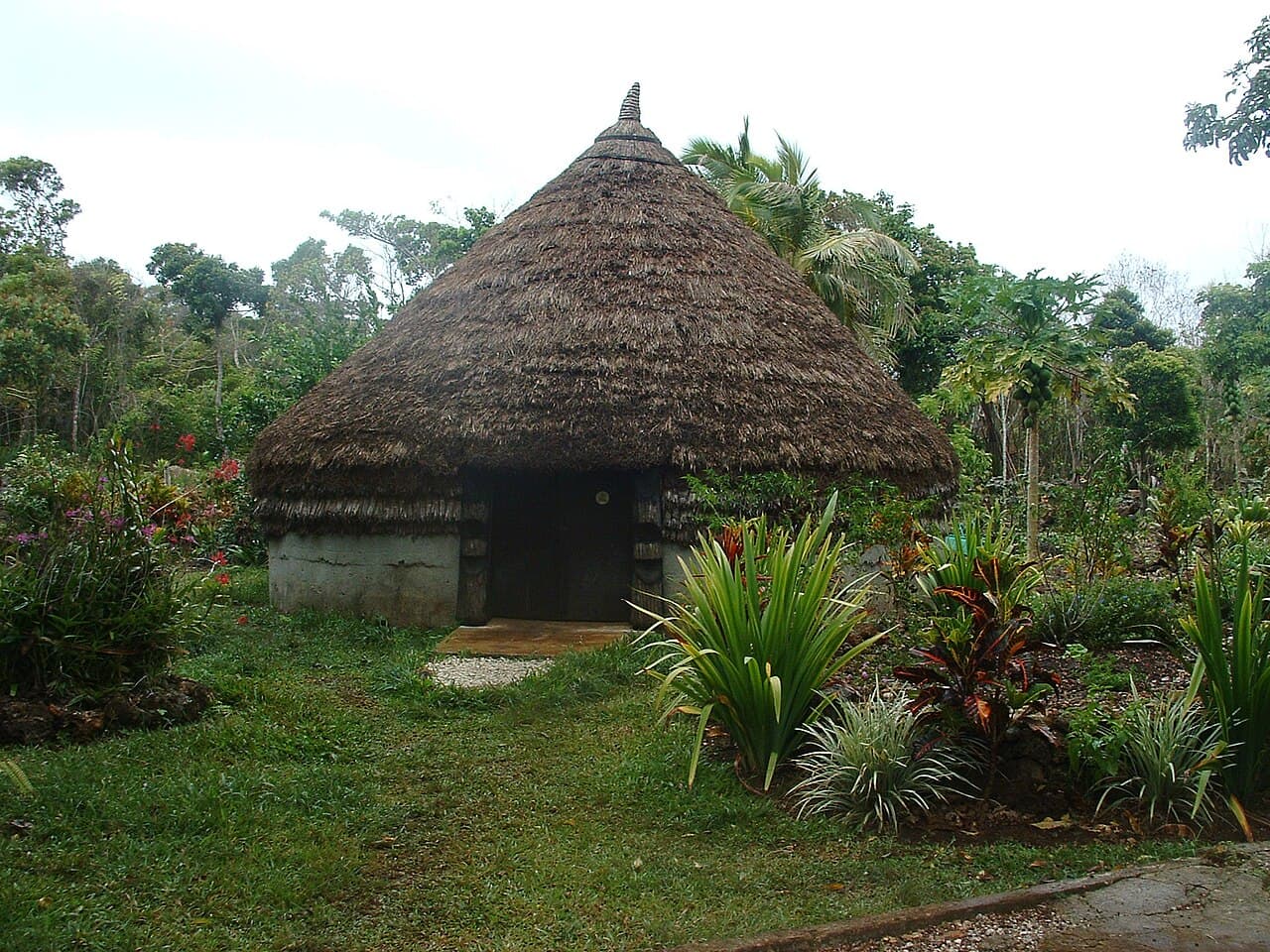
The grande case is the clearest single object of Kanak culture. Conical, thatched, raised on a low earth mound, the chief's house is entered through a doorway flanked by carved wooden chambranles representing ancestors, and its whole weight rests on a central pillar understood to be the chief himself. At the apex stands the flèche faîtière, a carved spear threaded with conus shells and bristling with wooden needles, which holds the spirits of the ancestors and rises above the settlement as the sign of the lineage; it became a territorial emblem in 2010 (Wikipedia). Before it runs the ceremonial alley, planted with coconut and araucaria, along which visitors approach to make the coutume.
 The centre is named for the Kanak leader assassinated in 1989, and it was built to hold Kanak culture on Kanak terms, its shells drawn from the form of the traditional great house. Photograph by gerard, CC BY-SA 2.0, via Wikimedia Commons.
The yam sets the calendar. Planting, first fruits and harvest structure the ceremonial year, and the first yam is offered to the chief and the ancestors before anyone eats. Wealth moves as woven mats, lengths of cloth, and monnaie kanak, cords of shell beads and flying-fox fur still counted out at marriages and funerals. Kanak art includes the jade ceremonial axes of the south, the sculpted masks of the north, and the engraved bamboos of the nineteenth century, on which artists incised whole scenes of ships, missionaries and soldiers as the colony arrived.
Christianity arrived twice, from opposite directions, and the split still shows on the map. French Marist priests landed at Balade in 1843 and built a Catholic presence across much of Grande Terre; Protestant teachers from Samoa and Rarotonga, sent by the London Missionary Society, reached the Loyalty Islands in the 1840s and made Maré, Lifou and Ouvéa strongly Protestant. Most New Caledonians today are Christian, with a Catholic majority and a substantial Protestant minority in the islands.
Underneath the churches, and often inside them, runs an older account of the world in which the living, the dead and the land are one system. Clans hold totems, an animal or natural phenomenon belonging to the lineage; certain rocks, springs and groves house ancestral spirits and are approached with the same protocol of gift and speech that governs human relations; and a clan's claim to its ground rests on the ancestors buried in it. Missionaries suppressed a great deal of this, but custom was never a private matter that could be given up, because it regulates land, marriage and the settling of disputes.
A Kanak death is a matter for the clan and its allies, and it is handled through the same exchange that handles everything else. Word is carried to related lineages, who arrive bearing cloth, yams, mats and money, and each delivery is made with a speech from a designated speaker to a designated receiver, so grief moves through formal address rather than falling on individuals. The body is buried on clan land, near the ancestors whose presence gives the living their title to it, and for a period often running to a year the bereaved household observes restrictions on movement, planting, marriage, sometimes on the dead person's name. The mourning is then lifted in a further ceremony, the fin de deuil, at which the gifts travel back the other way and the household returns to ordinary life. The dead do not depart; they change status, joining the ancestors who guarantee the clan's ground and who are addressed whenever custom is made.
Political death has its own memory here, and it is exact about dates. The graves at Tiendanite, where Tjibaou and the men killed in the 1984 ambush lie, and the commemorations at Gossanah each May, are attended year after year with the same protocol of speech and gift. The most striking act of remembrance in recent decades concerned a man dead for more than a century. The head of the chief Ataï, taken after the 1878 revolt and held in Paris scientific collections for 136 years, was returned to his descendants of the Komalé clan at the Muséum national d'Histoire naturelle in August 2014, then carried home for burial by the customary authorities who had asked for it since the 1980s. A skull in a museum drawer had been, for four generations, an unfinished funeral.
New Caledonia keeps two registers, and which one a family is in was for a long time a matter of law.
Until 1946 the Kanak population lived under the indigénat, a separate legal regime, and Kanak civil status remains distinct today: a person of Kanak status is recorded in a special civil register, the état civil coutumier, which records clan, tribe and customary land rather than the categories of French civil law. It exists because Kanak descent works through clans and the exchange of names and land, and French civil status could not hold that. The result is that New Caledonia has two parallel systems of personal law, and the customary one is a genealogical register maintained by customary authorities.
For everyone else the French état civil applies and runs from the nineteenth century, held in Nouméa.
The distinctive colonial record is the bagne. France used New Caledonia as a penal colony from 1864, transporting around twenty thousand convicts and, after 1871, several thousand Communards and Algerian rebels. Their dossiers are detailed, and many Caldoche families descend from them, so the convict file is often the founding document.
Indentured labour brought Javanese, Vietnamese and Japanese workers to the nickel mines and plantations, and their contracts and repatriation records survive.
The Tjibaou Cultural Centre and the Kanak language academy hold the oral material, and the clan histories that establish land claims are recorded with the communities that own them.
The instrument of Kanak cultural policy is the Agency for the Development of Kanak Culture, created after the Matignon Accords, and its building is the Jean-Marie Tjibaou Cultural Centre, opened on the Tina peninsula in May 1998, ten years after the accords and nine after Tjibaou's assassination (ADCK). Renzo Piano designed it as ten curved shells of laminated iroko and steel, ribbed like unfinished cases and set along a ridge above the lagoon so the sea wind moves through their double skins and cools them, with a customary path through gardens planted in the species of Kanak agriculture and myth. Conceived with Kanak advisers as a house for a living culture rather than a display case, it is among the most admired buildings in the Pacific (Wikipedia).
Other work is quieter. The Musée de Nouvelle-Calédonie has taken up the slow business of documenting provenance and reconnecting objects with the clans they came from. Several hundred rock-engraving sites are catalogued and protected, and the Lapita type site remains under archaeological management. The lagoon inscription is administered with customary committees, which is where conservation science meets local tenure. Nickel complicates all of it: open-cast mining has stripped hillsides, choked rivers with red laterite and reached into customary land, and the compromises between extraction, employment and protection are argued over constantly (Wikipedia).
Digital work here has concentrated on language and scholarship. The Académie des Langues Kanak publishes lexicons, spelling rules and audio recordings online, which for languages with a few hundred speakers is the difference between documentation and disappearance. The Journal de la Société des Océanistes, the main French-language journal of Pacific studies, is freely readable online (OpenEdition). Colonial-era photographs and the records of the penal settlement sit in French national digital collections, which means the archive of the colonisation is more accessible than the archive of what it displaced, an imbalance the language and oral-history programmes work against.
Kaneka, the music that emerged from the independence movement in the 1980s, set Kanak rhythms and vernacular lyrics against reggae and rock and remains the popular soundtrack of the territory. Writers carried the same material into French: Déwé Gorodey, the first Kanak woman to publish fiction and later a minister in the collegial government, wrote about custom, colonisation and the position of women within both (Wikipedia). Kanak cricket, adapted from the missionary game and played by women in long mission dresses with teams of any size and rules of their own, is one of the more unexpected survivals of the encounter. Politics keeps reopening the cultural questions: the destruction of May 2024, the collapse of nickel operations, and the unresolved status of the Nouméa Accord all bear on museums, festivals and customary institutions.
A building that argues for a culture. The Jean-Marie Tjibaou Cultural Centre, opened in 1998 and named for the leader killed nine years earlier, gave Kanak art an institution at the scale of a national museum, in a form drawn from the case.
A chief brought home. After 136 years in Parisian collections, the remains of the 1878 leader Ataï were returned to his clan in 2014, closing a funeral four generations of his descendants had been unable to complete.
Twenty-eight languages written down. The Académie des Langues Kanak has given standard spellings, dictionaries and school material to languages colonial schooling had pushed out of the classroom, several of which now count toward the baccalauréat.
A reef under shared management. The 2008 World Heritage inscription brought scientific monitoring and customary marine committees into one framework over one of the largest reef systems on earth.
The centre is named for the Kanak leader assassinated in 1989, and it was built to hold Kanak culture on Kanak terms, its shells drawn from the form of the traditional great house. Photograph by gerard, CC BY-SA 2.0, via Wikimedia Commons.
The yam sets the calendar. Planting, first fruits and harvest structure the ceremonial year, and the first yam is offered to the chief and the ancestors before anyone eats. Wealth moves as woven mats, lengths of cloth, and monnaie kanak, cords of shell beads and flying-fox fur still counted out at marriages and funerals. Kanak art includes the jade ceremonial axes of the south, the sculpted masks of the north, and the engraved bamboos of the nineteenth century, on which artists incised whole scenes of ships, missionaries and soldiers as the colony arrived.
Christianity arrived twice, from opposite directions, and the split still shows on the map. French Marist priests landed at Balade in 1843 and built a Catholic presence across much of Grande Terre; Protestant teachers from Samoa and Rarotonga, sent by the London Missionary Society, reached the Loyalty Islands in the 1840s and made Maré, Lifou and Ouvéa strongly Protestant. Most New Caledonians today are Christian, with a Catholic majority and a substantial Protestant minority in the islands.
Underneath the churches, and often inside them, runs an older account of the world in which the living, the dead and the land are one system. Clans hold totems, an animal or natural phenomenon belonging to the lineage; certain rocks, springs and groves house ancestral spirits and are approached with the same protocol of gift and speech that governs human relations; and a clan's claim to its ground rests on the ancestors buried in it. Missionaries suppressed a great deal of this, but custom was never a private matter that could be given up, because it regulates land, marriage and the settling of disputes.
A Kanak death is a matter for the clan and its allies, and it is handled through the same exchange that handles everything else. Word is carried to related lineages, who arrive bearing cloth, yams, mats and money, and each delivery is made with a speech from a designated speaker to a designated receiver, so grief moves through formal address rather than falling on individuals. The body is buried on clan land, near the ancestors whose presence gives the living their title to it, and for a period often running to a year the bereaved household observes restrictions on movement, planting, marriage, sometimes on the dead person's name. The mourning is then lifted in a further ceremony, the fin de deuil, at which the gifts travel back the other way and the household returns to ordinary life. The dead do not depart; they change status, joining the ancestors who guarantee the clan's ground and who are addressed whenever custom is made.
Political death has its own memory here, and it is exact about dates. The graves at Tiendanite, where Tjibaou and the men killed in the 1984 ambush lie, and the commemorations at Gossanah each May, are attended year after year with the same protocol of speech and gift. The most striking act of remembrance in recent decades concerned a man dead for more than a century. The head of the chief Ataï, taken after the 1878 revolt and held in Paris scientific collections for 136 years, was returned to his descendants of the Komalé clan at the Muséum national d'Histoire naturelle in August 2014, then carried home for burial by the customary authorities who had asked for it since the 1980s. A skull in a museum drawer had been, for four generations, an unfinished funeral.
New Caledonia keeps two registers, and which one a family is in was for a long time a matter of law.
Until 1946 the Kanak population lived under the indigénat, a separate legal regime, and Kanak civil status remains distinct today: a person of Kanak status is recorded in a special civil register, the état civil coutumier, which records clan, tribe and customary land rather than the categories of French civil law. It exists because Kanak descent works through clans and the exchange of names and land, and French civil status could not hold that. The result is that New Caledonia has two parallel systems of personal law, and the customary one is a genealogical register maintained by customary authorities.
For everyone else the French état civil applies and runs from the nineteenth century, held in Nouméa.
The distinctive colonial record is the bagne. France used New Caledonia as a penal colony from 1864, transporting around twenty thousand convicts and, after 1871, several thousand Communards and Algerian rebels. Their dossiers are detailed, and many Caldoche families descend from them, so the convict file is often the founding document.
Indentured labour brought Javanese, Vietnamese and Japanese workers to the nickel mines and plantations, and their contracts and repatriation records survive.
The Tjibaou Cultural Centre and the Kanak language academy hold the oral material, and the clan histories that establish land claims are recorded with the communities that own them.
The instrument of Kanak cultural policy is the Agency for the Development of Kanak Culture, created after the Matignon Accords, and its building is the Jean-Marie Tjibaou Cultural Centre, opened on the Tina peninsula in May 1998, ten years after the accords and nine after Tjibaou's assassination (ADCK). Renzo Piano designed it as ten curved shells of laminated iroko and steel, ribbed like unfinished cases and set along a ridge above the lagoon so the sea wind moves through their double skins and cools them, with a customary path through gardens planted in the species of Kanak agriculture and myth. Conceived with Kanak advisers as a house for a living culture rather than a display case, it is among the most admired buildings in the Pacific (Wikipedia).
Other work is quieter. The Musée de Nouvelle-Calédonie has taken up the slow business of documenting provenance and reconnecting objects with the clans they came from. Several hundred rock-engraving sites are catalogued and protected, and the Lapita type site remains under archaeological management. The lagoon inscription is administered with customary committees, which is where conservation science meets local tenure. Nickel complicates all of it: open-cast mining has stripped hillsides, choked rivers with red laterite and reached into customary land, and the compromises between extraction, employment and protection are argued over constantly (Wikipedia).
Digital work here has concentrated on language and scholarship. The Académie des Langues Kanak publishes lexicons, spelling rules and audio recordings online, which for languages with a few hundred speakers is the difference between documentation and disappearance. The Journal de la Société des Océanistes, the main French-language journal of Pacific studies, is freely readable online (OpenEdition). Colonial-era photographs and the records of the penal settlement sit in French national digital collections, which means the archive of the colonisation is more accessible than the archive of what it displaced, an imbalance the language and oral-history programmes work against.
Kaneka, the music that emerged from the independence movement in the 1980s, set Kanak rhythms and vernacular lyrics against reggae and rock and remains the popular soundtrack of the territory. Writers carried the same material into French: Déwé Gorodey, the first Kanak woman to publish fiction and later a minister in the collegial government, wrote about custom, colonisation and the position of women within both (Wikipedia). Kanak cricket, adapted from the missionary game and played by women in long mission dresses with teams of any size and rules of their own, is one of the more unexpected survivals of the encounter. Politics keeps reopening the cultural questions: the destruction of May 2024, the collapse of nickel operations, and the unresolved status of the Nouméa Accord all bear on museums, festivals and customary institutions.
A building that argues for a culture. The Jean-Marie Tjibaou Cultural Centre, opened in 1998 and named for the leader killed nine years earlier, gave Kanak art an institution at the scale of a national museum, in a form drawn from the case.
A chief brought home. After 136 years in Parisian collections, the remains of the 1878 leader Ataï were returned to his clan in 2014, closing a funeral four generations of his descendants had been unable to complete.
Twenty-eight languages written down. The Académie des Langues Kanak has given standard spellings, dictionaries and school material to languages colonial schooling had pushed out of the classroom, several of which now count toward the baccalauréat.
A reef under shared management. The 2008 World Heritage inscription brought scientific monitoring and customary marine committees into one framework over one of the largest reef systems on earth.
National Overview
Notable Cities
Historical Foundations
Linguistic and Etymological Roots
Cultural Identity
Religion and Spirituality
Remembrance and Mourning Traditions
Tracing a Family in New Caledonia
Heritage Preservation Efforts
Digital Heritage
Contemporary Cultural Influences
Success Stories
References and resources
- UNESCO, Lagoons of New Caledonia: the 2008 inscription.
- Agency for the Development of Kanak Culture: the body behind the Tjibaou Centre.
- Jean-Marie Tjibaou Cultural Centre, Wikipedia: Piano's design and the customary path.
- Académie des Langues Kanak: spelling standards and teaching material.
- New Caledonian languages, Wikipedia: the twenty-eight languages and their speakers.
- Lapita culture, Wikipedia: the type site on the Foué peninsula.
- 1878 Kanak revolt, Wikipedia: Ataï and the insurrection.
- Native code (France), Wikipedia: the indigénat regime until 1946.
- Ouvéa cave hostage taking, Wikipedia: the crisis of April 1988.
- Nouméa Accord, Wikipedia: the 1998 agreement and its referendum provisions.
- 2021 New Caledonian independence referendum, Wikipedia: the boycott and the contested outcome.
- 2024 New Caledonia unrest, Wikipedia: the electoral-roll amendment and its aftermath.
- Nickel mining in New Caledonia, Wikipedia: the industry and its environmental record.
- Journal de la Société des Océanistes: open-access Pacific scholarship.