Heritage · Country
Fiji Culture and Heritage
From the Lapita seafarers who first read these reefs three thousand years ago to the girmit descendants who turned indenture into a homeland, Fiji carries two great streams of memory. This is a guide to the vanua and the reguregu, and to how iTaukei, Christian, and Hindu Fijians keep faith with their dead.Written to last.
By Confinity Heritage Editorial · Updated 2026-07-31 · 8-minute readQuiet tools, kept out of the way.
Fiji is an archipelago of more than 330 islands scattered across the south-western Pacific, of which about a third are inhabited, and its life turns on a single binding idea: the vanua. To the iTaukei, the Indigenous Fijians, the vanua is land, people, and ancestors held together as one living whole, so that to belong to a place is to be answerable to the generations who lie in its soil. Around that idea grew the chiefly confederacies, the meke danced at dusk, the yaqona bowl passed from hand to hand, and the whale's tooth offered when ordinary words are not enough.
Two great streams of memory meet on these islands. One is the iTaukei inheritance of the yavusa and the mataqali, the lali drum and the reguregu, in which every death draws the clans together to settle their obligations to the dead. The other arrived by ship: between 1879 and 1916 more than sixty thousand indentured labourers were carried from India to the cane fields, and their descendants, the Indo-Fijians, wove temples, mosques, and a language of their own into the fabric of the country. This is a guide to both, and to how Fijians of every faith keep faith with those they have lost.
Fiji lies in Melanesia, north of New Zealand and east of Vanuatu, its islands spread over a wide reach of ocean crossed by the 180th meridian. Two large volcanic islands dominate: Viti Levu, which holds the capital and about seven in ten of the country's roughly 900,000 people, and Vanua Levu to its north. Around them lie hundreds of smaller islands and coral cays, from the Mamanuca and Yasawa groups in the west to the remote Lau chain in the east.
The population divides mainly into two communities: the iTaukei, a little under three-fifths, and the Indo-Fijians, descended from the indentured labourers, at roughly a third, alongside smaller Rotuman, European, and Chinese populations. The currency is the Fijian dollar. Land carries the weight of identity here: about 87 percent of Fiji remains under customary iTaukei ownership, held collectively by the mataqali (landholding clans) rather than bought and sold. Traditional authority still runs through the nested social units of the tokatoka, mataqali, and yavusa, and through the chiefs who lead them. Fiji also lives with a restless climate, and cyclones such as Winston in 2016 have tested its communities.
Suva. The capital since 1882 and the largest city in the South Pacific, Suva sits on a peninsula on Viti Levu's humid south-eastern coast. It is the administrative and cultural heart of the country, home to government, the University of the South Pacific, and a mixed population in which iTaukei, Indo-Fijian, and other communities live side by side. In Thurston Gardens near the old colonial centre stands the Fiji Museum, the national repository of the archipelago's material past.
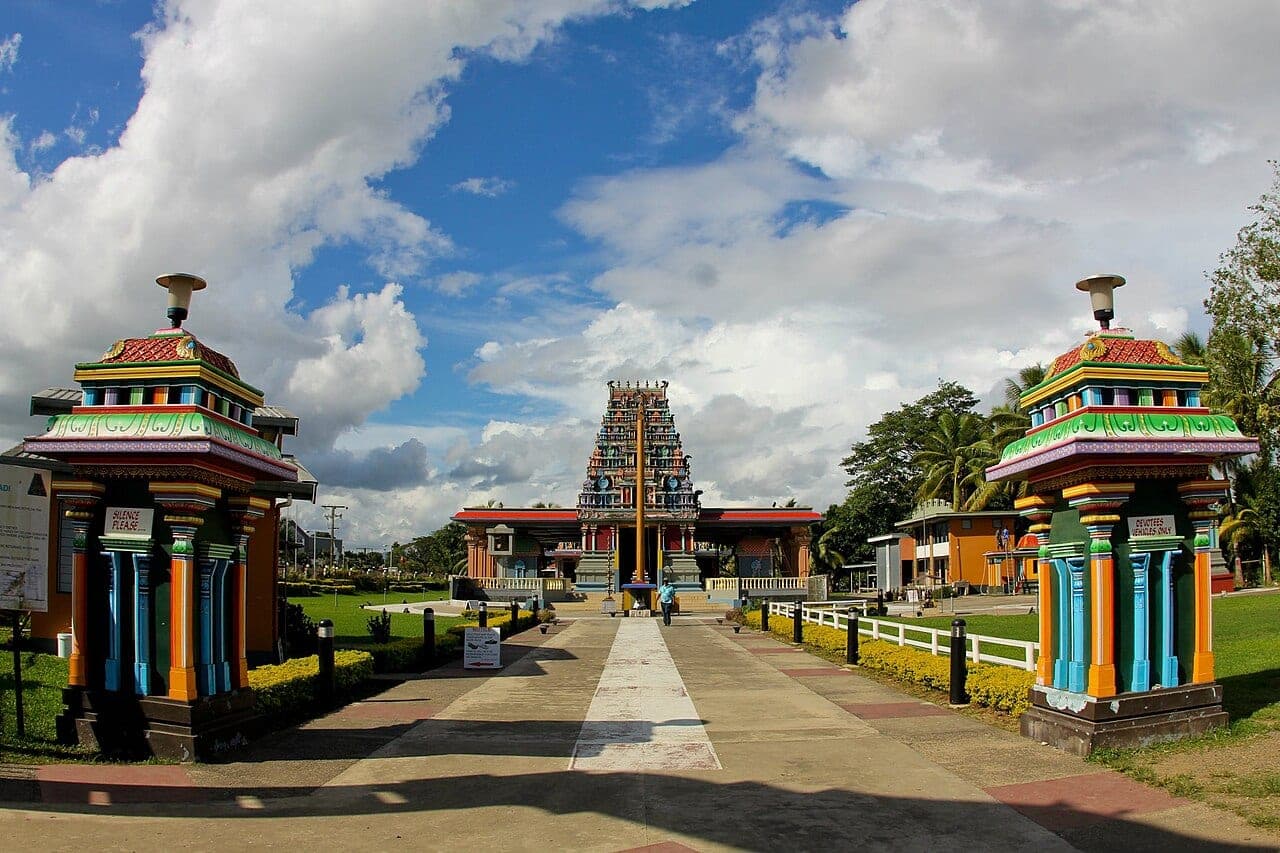
Nadi. On the drier western side of Viti Levu, Nadi is the gateway through which most visitors arrive, its international airport the busiest in the region. It has long been a centre of Indo-Fijian settlement, and at the southern end of its main street rises the Sri Siva Subramaniya Temple, a Dravidian-style Hindu temple dedicated to Lord Murugan and reckoned among the largest in the Southern Hemisphere.
Levuka. On the eastern shore of Ovalau, Levuka was Fiji's first colonial capital and remains the country's only UNESCO World Heritage site. Its weatherboard shopfronts, churches, and harbour preserve the appearance of a nineteenth-century Pacific port town.
Lautoka. Fiji's second city, on the north-western coast of Viti Levu, grew around the sugar industry and is still known as the Sugar City. Its mill, one of the largest in the Southern Hemisphere, and its busy port anchor a population with deep Indo-Fijian roots.
Fiji was settled during one of the great achievements of human navigation. Around 1000 BCE, seafarers of the Lapita culture, the Austronesian ancestors of much of the remote Pacific, reached the archipelago as part of an eastward expansion that carried them from the Bismarck Archipelago as far as Tonga and Samoa. Their signature is a fine dentate-stamped pottery, its geometric bands pressed into the clay with a toothed tool, found at coastal sites such as Bourewa on Viti Levu. From these first landfalls grew the distinct Fijian societies of later centuries, organised into chiefdoms and, in time, into powerful confederacies such as Bau, Rewa, Verata, and Cakaudrove, whose rivalries dominated the islands on the eve of European contact.
Europeans came slowly. Abel Tasman sighted the islands in 1643 and James Cook touched the southern Lau group in 1774, but it was the traders of sandalwood and beche-de-mer, with whalers and missionaries, who from the 1820s established a foothold at Levuka. Their arrival brought firearms and disease, sharpening the wars between the chiefdoms. The Bauan chief Seru Epenisa Cakobau rose to pre-eminence and, after his conversion to Christianity and years of mounting debt and disorder, led the chiefs who signed the Deed of Cession on 10 October 1874, placing Fiji under British sovereignty. Levuka served as the first capital until the seat of government moved to Suva in 1882.
Colonial policy reshaped the population. To supply labour for sugar plantations without disturbing iTaukei land and society, the administration turned to indentured workers from British India. The first ship, the Leonidas, reached Levuka from Calcutta in May 1879, and over the next thirty-seven years more than sixty thousand people came under the system known as girmit, from the English word "agreement". Most came from what are now Uttar Pradesh and Bihar, with later arrivals from southern India, and most chose to remain when their contracts ended, building the Indo-Fijian community that forms roughly a third of the nation. The colony endured from 1874 to 1970, when Fiji became independent on 10 October, ninety-six years to the day after cession. Since independence the country has passed through periods of political change, including several non-constitutional changes of government from 1987 onward and the adoption of a new constitution in 2013; the account here keeps to heritage rather than to those contests.
Three languages hold official status in Fiji. iTaukei Fijian, an Oceanic member of the Austronesian family carried by the first settlers, is spoken across dozens of regional communalects, with the Bauan variety serving as a standard. Fiji Hindi, an Indo-Aryan language sometimes called Fiji Baat, is the everyday tongue of most Indo-Fijians: a koine forged on the plantations from the many north Indian dialects the girmityas brought with them, now a distinct language in its own right. English, inherited from the colonial period, remains the common medium of government, commerce, and much schooling.
The country's name records a small accident of pronunciation. The iTaukei call their home Viti, a word from an ancestral Central Pacific root associated with the east or the sunrise, and call themselves Kai Viti, "the people of Viti", or i Taukei, "the owners of the land". Neighbouring Tongans rendered Viti as "Fisi", and it was this Tongan form, transcribed by James Cook and other early visitors, that entered English first as "Feejee" and later as the modern "Fiji".
At the centre of iTaukei ceremonial life is yaqona, the drink prepared from the pounded root of the kava plant. A guest arriving at a village presents a bundle of yaqona in the sevusevu, the formal offering by which strangers are welcomed and permission to enter the vanua is sought. The root is mixed with water in a broad wooden bowl, the tanoa, and served in a cup made from half a coconut shell, the bilo, its passing marked by rhythmic clapping, the cobo.
 Tubou on Lakeba, seat of the Tui Nayau and the burial place of Fijian chiefs, photographed in 1977. Photograph by Panoxis, CC BY-SA 4.0, via Wikimedia Commons.
The great performance tradition is the meke, which binds together poetry, chant, and choreographed movement to carry stories of gods, ancestors, battles, and daily life. Men perform vigorous club and spear dances, women the graceful seated vakamalolo, and both are set to voices, clapping, and the deep voice of the lali, a slit drum hollowed from a log that once summoned people to worship, to assembly, or to war. Bodies and ceremonial spaces are dressed with masi, the bark cloth beaten from the inner bark of the paper mulberry and decorated with stencilled geometric designs in earth-brown and black; masi clothes chiefs, marks weddings and funerals, and serves as a currency of respect. At the table, the lovo, an earth oven of heated stones buried in a pit, slow-cooks fish, pork, taro, and palusami (taro leaves baked in coconut cream) for feasts, while kokoda, raw fish cured in lime juice and coconut cream, is a signature dish. Alongside these, the curries, roti, and sweets of the Indo-Fijian kitchen have become part of the shared national fare.
Faith in Fiji largely follows the country's two main communities. Most iTaukei are Christian, the legacy of nineteenth-century Wesleyan and Catholic missions, and the Methodist Church remains the largest single denomination; the 2017 census recorded that just under 70 percent of Fijians are Christian, with Hindus at about 24 percent and Muslims at nearly 6 percent. Church and village life are closely joined, and Sunday worship, hymn singing in close harmony, and the authority of ministers are woven through iTaukei communities.
Among Indo-Fijians, the majority are Hindu and a substantial minority Muslim, with smaller numbers of Sikhs and Christians. Their temples and mosques, from the great Murugan temple at Nadi to countless village mandirs and jama masjids, mark the western cane belt in particular. The national calendar reflects this plurality, holding Christmas and Easter alongside Diwali, the Hindu festival of lights, and the Islamic Eid. Fire-walking survives in two distinct forms that are often confused: the iTaukei vilavilairevo, in which men of the Sawau people of Beqa island walk unharmed across fire-heated stones by inherited right, and the Tamil Hindu fire-walking performed as an act of devotion at south Indian temples during religious festivals.
For the iTaukei, a death belongs to the whole community, and the response is the reguregu, the gathering in which kin and neighbours come to mourn and to present their offerings to the bereaved. The gifts follow strict etiquette and carry deep meaning: woven pandanus mats, masi, yaqona, food, and above all the tabua, the polished tooth of a sperm whale on a plaited cord, the most honoured of all Fijian valuables, offered as the fullest expression of respect and condolence. Speakers rise on behalf of each village, the exchanges repair the ties that a death has strained, and the mother's line of the deceased holds a special claim. The passing is marked again on the fourth and tenth nights, and a hundred days after the death the period of mourning is closed and its restrictions lifted in the vakataraisulu ceremony, when the family sets aside the observances that bound it and returns to ordinary life.
The Indo-Fijian communities keep the funerary traditions their ancestors carried from India. Hindu families cremate their dead and perform the antyeshti, the last of the life-cycle rites, followed by days of mourning and the shraddha offerings by which the living tend the memory and wellbeing of the departed. Muslim Fijians observe burial according to Islamic custom, with washing, shrouding, and prayer, and mourning marked in the days that follow. Christian Fijians, iTaukei and Indo-Fijian alike, hold church services of hymns and remembrance before burial. Across all three, the pattern is the same one that Confinity's own work takes as its starting point: that remembrance is not a single farewell but a sequence of obligations, faithfully kept, that hold the living and the dead in right relation.
Fiji keeps one of the most complete indigenous genealogical registers in the world, and it has been maintained by hand since 1900.
The Vola ni Kawa Bula, the register of living descent, records every iTaukei Fijian by clan. It grew out of the Native Lands Commission, which sent commissioners province by province to take sworn oral testimony about who held which land and through whom, and to write down the genealogies that testimony contained. The result is three linked series: evidence books of sworn statements, clan pedigrees, and registers listing every member of a mataqali with birth year, parentage and, where known, date of death. Enrolment in the VKB is what makes a person a member of a landowning unit, so the register is simultaneously a genealogy, a title deed and a definition of citizenship in the customary sense. It is now being digitised.
The other Fijian archive belongs to a different arrival. Between 1879 and 1916 more than 60,500 indentured labourers were brought from India to work the sugar plantations, and each was issued an emigration pass recording name, father's name, caste, village, district and physical description. Those passes survive, and they are how a Fiji Indian family finds the village in Uttar Pradesh or Bihar that nobody's grandparents could name. In 2011 UNESCO added the combined Indian indenture records of Fiji, Guyana, Suriname and Trinidad and Tobago to the Memory of the World Register.
Two systems, two registers, and until recently very little movement between them.
Fiji's foremost heritage landmark is Levuka, inscribed on the UNESCO World Heritage List in 2013 as an outstanding and rare example of a late colonial port town whose form was shaped by the Indigenous community as much as by its European settlers. Its low timber buildings, set between the sea and steep green hills, preserve the physical record of the moment when Fiji entered the wider world, and its conservation involves the townspeople who still live among its monuments.
The custodian of the national collections is the Fiji Museum, founded in 1904 and housed since the 1950s in Thurston Gardens in Suva. Its holdings, spanning more than three thousand years, include Lapita pottery, war clubs and tabua, the last of Fiji's great oceangoing drua (double-hulled sailing canoes), the Ratu Finau, and the rudder of HMS Bounty, recovered from the waters where the mutineers' ship met its end. Beyond the museum, the Institute of iTaukei Language and Culture and the iTaukei Trust Fund Board work to document communalects, ceremony, and custom, the National Trust of Fiji protects natural and built heritage, and the National Archives of Fiji preserves the colonial and indenture-era record.
The written traces of Fiji's past are increasingly moving online. The indenture registers held at the National Archives, including the emigration passes that record each girmitya's name, village, and family in India, have become the basis of genealogical projects that allow the descendants of the sixty thousand to trace their forebears back across the ocean, reversing in part the anonymity that the plantation system imposed. Community and academic initiatives have transcribed girmit passenger records so that families across the Indo-Fijian diaspora can recover their origins.
For iTaukei heritage, recordings of meke, chant, and oral tradition made across the twentieth century survive in national and university collections, where digitisation is a race against the decay of old tape. The Fiji Museum and heritage bodies have begun to catalogue and share collections and images, and Levuka and Fiji's intangible traditions are documented through UNESCO's international heritage platforms, extending access to the archipelago's memory beyond those who can reach Suva or Ovalau in person.
No modern expression of Fijian identity travels further than rugby sevens. The abbreviated seven-a-side game suits the flair and improvisation of Fijian play, and the national team turned that gift into history at Rio de Janeiro in 2016, winning the country's first Olympic medal of any colour, a gold, in the sport's Olympic debut. Fiji defended the title at the Tokyo Games in 2021, and the victories were met at home with public holidays, thanksgiving services, and celebration in every village and town. The sport has also become a route by which young Fijians reach professional careers abroad.
Fijian culture also carries beyond the islands through a growing diaspora in New Zealand, Australia, and North America, where iTaukei and Indo-Fijian communities sustain their languages, faiths, and ceremonies far from home. Masi designs, meke, and the yaqona bowl travel with them, and the annual observance of Girmit Day keeps alive the memory of the indenture generation among their descendants worldwide.
A colonial port saved for the world. Levuka's inscription in 2013 as Fiji's first and only World Heritage site secured the survival of a fragile timber townscape and recognised, unusually, the Indigenous contribution to a colonial settlement, giving its residents a stake in preserving their own history.
Gold that stopped a nation. Fiji's rugby sevens victories at the 2016 and 2021 Olympic Games brought the country its first Olympic honours and a moment of shared pride across every community, turning a village pastime into a source of national identity.
The sixty thousand recovered. The digitisation of indenture records has allowed Indo-Fijian families to find, by name, the ancestors who crossed the ocean under girmit, restoring individual identity to a chapter once remembered only in the mass.
A canoe and a rudder kept. Through the Fiji Museum, the last great drua and relics such as the rudder of the Bounty have been preserved for more than a century, anchoring the archipelago's maritime memory for generations who will never see such vessels sail.
Tubou on Lakeba, seat of the Tui Nayau and the burial place of Fijian chiefs, photographed in 1977. Photograph by Panoxis, CC BY-SA 4.0, via Wikimedia Commons.
The great performance tradition is the meke, which binds together poetry, chant, and choreographed movement to carry stories of gods, ancestors, battles, and daily life. Men perform vigorous club and spear dances, women the graceful seated vakamalolo, and both are set to voices, clapping, and the deep voice of the lali, a slit drum hollowed from a log that once summoned people to worship, to assembly, or to war. Bodies and ceremonial spaces are dressed with masi, the bark cloth beaten from the inner bark of the paper mulberry and decorated with stencilled geometric designs in earth-brown and black; masi clothes chiefs, marks weddings and funerals, and serves as a currency of respect. At the table, the lovo, an earth oven of heated stones buried in a pit, slow-cooks fish, pork, taro, and palusami (taro leaves baked in coconut cream) for feasts, while kokoda, raw fish cured in lime juice and coconut cream, is a signature dish. Alongside these, the curries, roti, and sweets of the Indo-Fijian kitchen have become part of the shared national fare.
Faith in Fiji largely follows the country's two main communities. Most iTaukei are Christian, the legacy of nineteenth-century Wesleyan and Catholic missions, and the Methodist Church remains the largest single denomination; the 2017 census recorded that just under 70 percent of Fijians are Christian, with Hindus at about 24 percent and Muslims at nearly 6 percent. Church and village life are closely joined, and Sunday worship, hymn singing in close harmony, and the authority of ministers are woven through iTaukei communities.
Among Indo-Fijians, the majority are Hindu and a substantial minority Muslim, with smaller numbers of Sikhs and Christians. Their temples and mosques, from the great Murugan temple at Nadi to countless village mandirs and jama masjids, mark the western cane belt in particular. The national calendar reflects this plurality, holding Christmas and Easter alongside Diwali, the Hindu festival of lights, and the Islamic Eid. Fire-walking survives in two distinct forms that are often confused: the iTaukei vilavilairevo, in which men of the Sawau people of Beqa island walk unharmed across fire-heated stones by inherited right, and the Tamil Hindu fire-walking performed as an act of devotion at south Indian temples during religious festivals.
For the iTaukei, a death belongs to the whole community, and the response is the reguregu, the gathering in which kin and neighbours come to mourn and to present their offerings to the bereaved. The gifts follow strict etiquette and carry deep meaning: woven pandanus mats, masi, yaqona, food, and above all the tabua, the polished tooth of a sperm whale on a plaited cord, the most honoured of all Fijian valuables, offered as the fullest expression of respect and condolence. Speakers rise on behalf of each village, the exchanges repair the ties that a death has strained, and the mother's line of the deceased holds a special claim. The passing is marked again on the fourth and tenth nights, and a hundred days after the death the period of mourning is closed and its restrictions lifted in the vakataraisulu ceremony, when the family sets aside the observances that bound it and returns to ordinary life.
The Indo-Fijian communities keep the funerary traditions their ancestors carried from India. Hindu families cremate their dead and perform the antyeshti, the last of the life-cycle rites, followed by days of mourning and the shraddha offerings by which the living tend the memory and wellbeing of the departed. Muslim Fijians observe burial according to Islamic custom, with washing, shrouding, and prayer, and mourning marked in the days that follow. Christian Fijians, iTaukei and Indo-Fijian alike, hold church services of hymns and remembrance before burial. Across all three, the pattern is the same one that Confinity's own work takes as its starting point: that remembrance is not a single farewell but a sequence of obligations, faithfully kept, that hold the living and the dead in right relation.
Fiji keeps one of the most complete indigenous genealogical registers in the world, and it has been maintained by hand since 1900.
The Vola ni Kawa Bula, the register of living descent, records every iTaukei Fijian by clan. It grew out of the Native Lands Commission, which sent commissioners province by province to take sworn oral testimony about who held which land and through whom, and to write down the genealogies that testimony contained. The result is three linked series: evidence books of sworn statements, clan pedigrees, and registers listing every member of a mataqali with birth year, parentage and, where known, date of death. Enrolment in the VKB is what makes a person a member of a landowning unit, so the register is simultaneously a genealogy, a title deed and a definition of citizenship in the customary sense. It is now being digitised.
The other Fijian archive belongs to a different arrival. Between 1879 and 1916 more than 60,500 indentured labourers were brought from India to work the sugar plantations, and each was issued an emigration pass recording name, father's name, caste, village, district and physical description. Those passes survive, and they are how a Fiji Indian family finds the village in Uttar Pradesh or Bihar that nobody's grandparents could name. In 2011 UNESCO added the combined Indian indenture records of Fiji, Guyana, Suriname and Trinidad and Tobago to the Memory of the World Register.
Two systems, two registers, and until recently very little movement between them.
Fiji's foremost heritage landmark is Levuka, inscribed on the UNESCO World Heritage List in 2013 as an outstanding and rare example of a late colonial port town whose form was shaped by the Indigenous community as much as by its European settlers. Its low timber buildings, set between the sea and steep green hills, preserve the physical record of the moment when Fiji entered the wider world, and its conservation involves the townspeople who still live among its monuments.
The custodian of the national collections is the Fiji Museum, founded in 1904 and housed since the 1950s in Thurston Gardens in Suva. Its holdings, spanning more than three thousand years, include Lapita pottery, war clubs and tabua, the last of Fiji's great oceangoing drua (double-hulled sailing canoes), the Ratu Finau, and the rudder of HMS Bounty, recovered from the waters where the mutineers' ship met its end. Beyond the museum, the Institute of iTaukei Language and Culture and the iTaukei Trust Fund Board work to document communalects, ceremony, and custom, the National Trust of Fiji protects natural and built heritage, and the National Archives of Fiji preserves the colonial and indenture-era record.
The written traces of Fiji's past are increasingly moving online. The indenture registers held at the National Archives, including the emigration passes that record each girmitya's name, village, and family in India, have become the basis of genealogical projects that allow the descendants of the sixty thousand to trace their forebears back across the ocean, reversing in part the anonymity that the plantation system imposed. Community and academic initiatives have transcribed girmit passenger records so that families across the Indo-Fijian diaspora can recover their origins.
For iTaukei heritage, recordings of meke, chant, and oral tradition made across the twentieth century survive in national and university collections, where digitisation is a race against the decay of old tape. The Fiji Museum and heritage bodies have begun to catalogue and share collections and images, and Levuka and Fiji's intangible traditions are documented through UNESCO's international heritage platforms, extending access to the archipelago's memory beyond those who can reach Suva or Ovalau in person.
No modern expression of Fijian identity travels further than rugby sevens. The abbreviated seven-a-side game suits the flair and improvisation of Fijian play, and the national team turned that gift into history at Rio de Janeiro in 2016, winning the country's first Olympic medal of any colour, a gold, in the sport's Olympic debut. Fiji defended the title at the Tokyo Games in 2021, and the victories were met at home with public holidays, thanksgiving services, and celebration in every village and town. The sport has also become a route by which young Fijians reach professional careers abroad.
Fijian culture also carries beyond the islands through a growing diaspora in New Zealand, Australia, and North America, where iTaukei and Indo-Fijian communities sustain their languages, faiths, and ceremonies far from home. Masi designs, meke, and the yaqona bowl travel with them, and the annual observance of Girmit Day keeps alive the memory of the indenture generation among their descendants worldwide.
A colonial port saved for the world. Levuka's inscription in 2013 as Fiji's first and only World Heritage site secured the survival of a fragile timber townscape and recognised, unusually, the Indigenous contribution to a colonial settlement, giving its residents a stake in preserving their own history.
Gold that stopped a nation. Fiji's rugby sevens victories at the 2016 and 2021 Olympic Games brought the country its first Olympic honours and a moment of shared pride across every community, turning a village pastime into a source of national identity.
The sixty thousand recovered. The digitisation of indenture records has allowed Indo-Fijian families to find, by name, the ancestors who crossed the ocean under girmit, restoring individual identity to a chapter once remembered only in the mass.
A canoe and a rudder kept. Through the Fiji Museum, the last great drua and relics such as the rudder of the Bounty have been preserved for more than a century, anchoring the archipelago's maritime memory for generations who will never see such vessels sail.
National Overview
Notable Cities
Historical Foundations
Linguistic and Etymological Roots
Cultural Identity
Religion and Spirituality
Remembrance and Mourning Traditions
Tracing a Family in Fiji
Heritage Preservation Efforts
Digital Heritage
Contemporary Cultural Influences
Success Stories
References and resources
- UNESCO World Heritage Centre: Levuka Historical Port Town
- Encyclopaedia Britannica: Fiji
- Encyclopaedia Britannica: Levuka
- Encyclopaedia Britannica: Lapita culture
- Wikipedia: Indo-Fijians
- Wikipedia: Colony of Fiji
- Wikipedia: Seru Epenisa Cakobau
- Wikipedia: Fiji Museum
- Wikipedia: Religion in Fiji
- Wikipedia: Sawau (Beqa firewalking)
- Wikipedia: Sri Siva Subramaniya Temple
- Wikipedia: Viti
- Olympics.com: Fiji back-to-back rugby sevens Olympic champions