Heritage · Country
Tonga Culture and Heritage
Tonga is the only Pacific nation never formally colonised and the last Polynesian kingdom still reigning, its thousand-year monarchy written into coral trilithons and terraced royal tombs. A guide to the Friendly Islands and to how Tongans keep faith with their dead.Written to last.
By Confinity Heritage Editorial · Updated 2026-07-31 · 8-minute readQuiet tools, kept out of the way.
Tonga is the only nation of the Pacific never brought under a foreign flag, and its crown is the oldest and the last still reigning in Polynesia. For roughly a thousand years the sacred line of the Tuʻi Tonga governed an island world from the low coral shelf of Tongatapu, and the monarchy that King Tāufaʻāhau Tupou I carried into the nineteenth century descends, in the Tongan understanding, from that ancient kingship. To arrive in Tonga is to enter a country that reckons its life in genealogy rather than in the calendars of European empire, a place that met the outside world on its own terms and kept them.
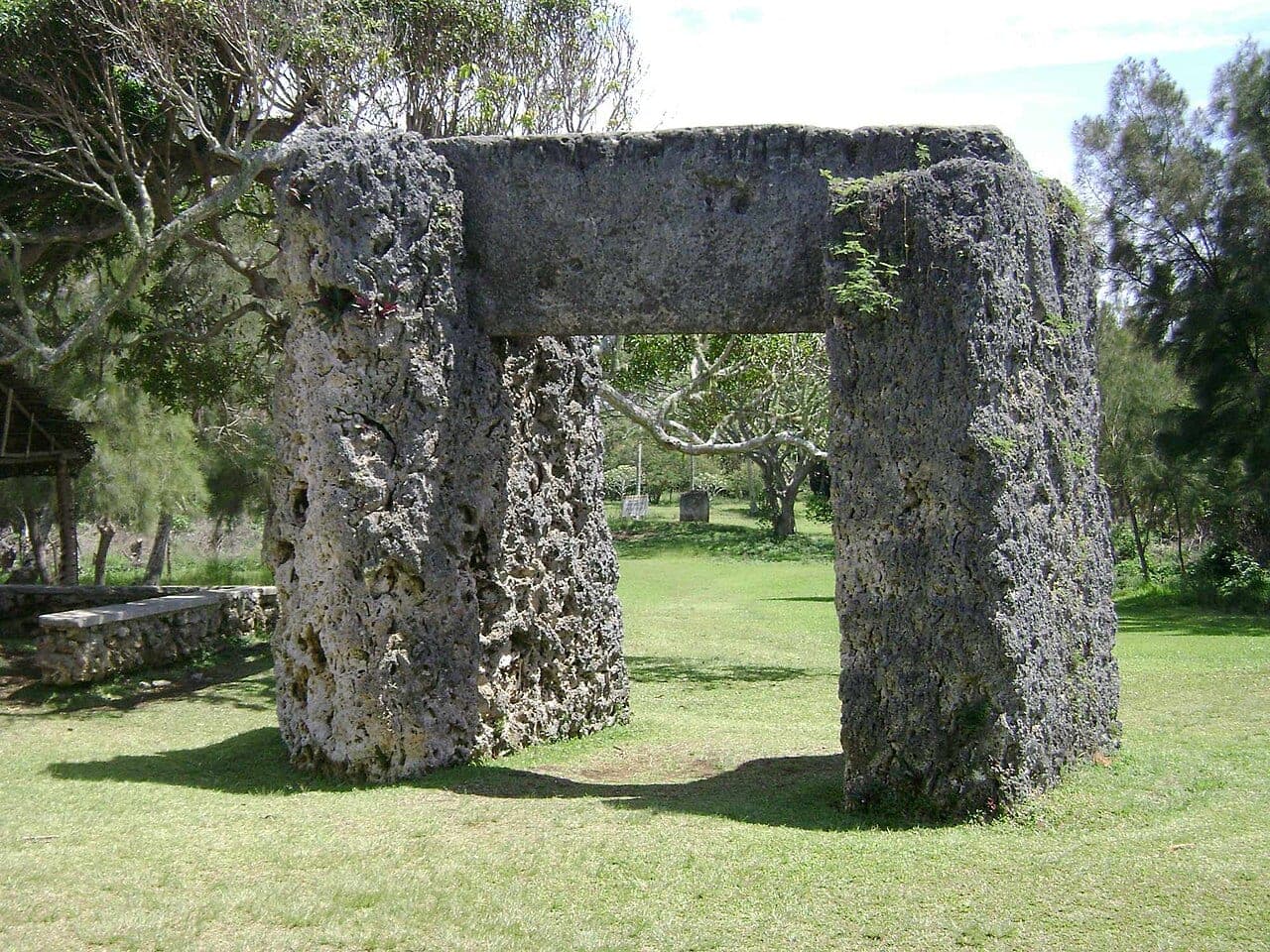
The land holds that long memory in stone. On eastern Tongatapu the Haʻamonga ʻa Maui, a trilithon of three great coral slabs, has stood since about 1200 AD, and a short way off at Muʻa lie the langi, the terraced tombs where the Tuʻi Tonga kings were laid beneath tiers of cut and fitted stone. These are less ruins than addresses, the places where a people remembers where it came from. For a country whose social order turns on fakaʻapaʻapa, respect, and on the duties the living owe the dead, heritage is not a subject to be studied so much as a set of obligations to be kept.
Tonga is an archipelago of some 170 islands, about 40 of them inhabited, scattered along a north-south reach of the south-western Pacific east of Fiji and south of Samoa. They fall into three main groups: Tongatapu in the south, where the capital sits and two-thirds of Tongans live; the low coral cays of Haʻapai in the centre; and the sheltered harbours of Vavaʻu in the north, with the outliers of ʻEua and the remote Niuas beyond. The country lies along the deep Tonga Trench, and its geology is unsettled: the submarine volcano Hunga Tonga-Hunga Haʻapai erupted in January 2022 in one of the most violent explosions ever recorded, sending a tsunami across the kingdom.
The population of a little over 100,000 is almost entirely Tongan, a Polynesian people, overwhelmingly Christian and organised into extended families that hold land under a system in which every adult man was traditionally entitled to an allotment. Tonga is a constitutional monarchy, the only indigenous monarchy in the Pacific, with a reigning king, a titled nobility of some three dozen chiefly houses, and a currency, the paʻanga, bearing the sovereign's image. Tongans describe their society through three anchoring words: faka-Tonga, the Tongan way; fakaʻapaʻapa, respect ordered by rank and kinship; and the church, which shapes the rhythm of the week and the shape of a life.
Nukuʻalofa. The capital, on the northern shore of Tongatapu, is the seat of the monarchy and the heart of national life. Its landmark is the Royal Palace, a white weatherboard house of kauri timber built in 1867 for King George Tupou I, its verandahs and gables framed by Norfolk pines along the waterfront. Nearby stand the royal tombs of the modern dynasty, the Free Wesleyan basilica, and a harbourside market where mats, ngatu and root crops change hands. The town bore the brunt of the 2022 tsunami.
Muʻa. About 12 kilometres east of the capital lies the ancient royal centre of the Tuʻi Tonga. From roughly the thirteenth century the kings ruled from Lapaha here, and it is at Muʻa that the langi, the great terraced stone tombs, rise from the coastal plain. Some two dozen of these monuments survive, their edges faced with quarried and fitted slabs, making the village the ceremonial and archaeological core of the old kingdom.
Neiafu. The principal town of Vavaʻu, in the north, sits above the Port of Refuge, a fjord-like harbour long prized by mariners and whalers. Tonga's second town, it is the gateway to the humpback whales that calve in Vavaʻu's waters each winter and a centre of church, trade and inter-island shipping for the northern islands.
Pangai. The small administrative town of Lifuka island is the seat of Haʻapai, the central group whose flat coral islets were the setting for pivotal moments in Tongan history, including the young Tāufaʻāhau's rise. Pangai remains a quiet gathering point for a group of islands where custom is strong and the sea is never far.
The first people reached Tonga around three thousand years ago, seafarers of the Lapita culture whose dentate-stamped pottery marks the ancestral horizon of Polynesia. From these settlements on Tongatapu and Haʻapai emerged one of the most centralised societies in the Pacific. Tongan tradition holds that the line of the Tuʻi Tonga began with Aho-ʻeitu around the tenth century AD, and from the twelfth to the fifteenth centuries its authority reached far beyond the archipelago. Historians describe this as a thalassocracy, a sea-borne network rather than a territorial empire: traditions in Samoa, Niue, ʻUvea (Wallis), Futuna and Fiji recall Tongan influence held together by marriage alliances, tribute and the constant voyaging of ocean canoes.
 Ha'amonga 'a Maui was raised around 1200 from coral limestone blocks weighing many tonnes, near the langi, the stepped stone tombs of the Tu'i Tonga. Public domain, via Wikimedia Commons.
The monuments belong to this age of confidence. The eleventh Tuʻi Tonga, Tuʻitātui, is remembered as the builder of the Haʻamonga ʻa Maui around 1200 AD, its name meaning "the burden of Maui," after the demigod who fished the islands from the sea. At Lapaha in Muʻa the kings raised the langi, terraced tombs of dressed coral limestone proclaiming the sacred rank of the buried Tuʻi Tonga. When Europeans arrived they met a living kingdom: the Dutch navigator Abel Tasman charted Tongatapu and Haʻapai in 1643, and Captain James Cook, visiting between 1773 and 1777 and received with great hospitality, named the group the Friendly Islands.
The early nineteenth century brought civil war among rival chiefly lines and, from the 1820s, Wesleyan Methodist missionaries. Their most consequential convert was the Haʻapai chief Tāufaʻāhau, baptised George, who by force of arms and alliance unified the islands and took the throne in 1845 as King George Tupou I. His reign remade the country: an Emancipation Edict in 1862 freed commoners from the old bondage to chiefs, and the Constitution of 1875 established a modern monarchy, a nobility, a legislative assembly and equality before the law. Foreign powers recognised Tongan independence, Germany in 1876, Britain in 1879 and the United States in 1888. In 1900 Tonga entered a Treaty of Friendship that made it a British protected state, a shield against annexation that left the monarchy in place and never became colonisation. Tonga resumed full control of its own affairs in 1970. In more recent years the kingdom has broadened its elected representation while keeping the crown at the centre of the state.
Tonga has two official languages, Tongan and English. Tongan is an Austronesian language of the Polynesian branch, closely related to Niuean and more distantly to Samoan, Māori and Hawaiian. Its written form uses the ʻokina, a glottal-stop consonant marked by a raised comma, and the toloi, a macron for long vowels, both of which can change a word's meaning.
The name Tonga itself means "south" in Tongan and across many Polynesian languages, a bearing that placed the archipelago as the southernmost group of central Polynesia. The language preserves the society's order of rank in its very grammar: everyday speech, a chiefly register and a royal register supply different words for the same act, so that eating, sleeping or speaking is named one way for a commoner and another for the sovereign. To speak Tongan correctly is to place oneself, and everyone else, within the web of respect.
At the centre of Tongan cultural life is koloa, the ceremonial wealth made by women and exchanged at every great occasion. Chief among koloa is ngatu, the barkcloth beaten from paper-mulberry bark and decorated in earth pigments with named geometric designs; sheets many metres long are made by groups of women and given at weddings, funerals and royal events. Beside ngatu are the fine mats, fala and the treasured kie, plaited from pandanus and handed down as heirlooms whose age and history add to their value.
The other pillar of ceremony is kava, the mild infusion of the pounded pepper root. The faikava, a seated circle sharing kava through the evening, is at once a social gathering and a school of protocol, while the taumafa kava, the royal kava ceremony, marks the highest occasions of state, including the conferring of titles. Performance carries the country's memory in motion. The lakalaka, a sung and choreographed oration in which rows of men and women perform poetry composed for the occasion, was proclaimed a UNESCO Masterpiece in 2003 and inscribed on the Representative List in 2008; it is joined by the seated maʻuluʻulu and the graceful solo tauʻolunga. Carvers work in wood and whale ivory, and the Tongan table centres on the ʻumu, the earth oven, with dishes such as lu (taro leaves baked in coconut cream) and ota ʻika, raw fish cured in citrus.
Christianity is woven through Tongan life more completely than in almost any other nation. The great majority of Tongans belong to Christian churches, the largest being the Free Wesleyan Church of Tonga, the Methodist tradition brought by the first missionaries and long associated with the crown. The Sabbath is written into the constitution: on Sunday shops close, work and commerce cease, and the day belongs to worship, family and rest. Choirs and brass bands are a source of communal pride, and the hymn sung in four-part harmony is one of the country's characteristic sounds.
What makes Tongan Christianity distinctive is how seamlessly it carries the older values of respect and kinship. The obligations owed to family, to chiefs and to the sovereign are expressed in Christian terms and enacted in the church calendar, so that faith and faka-Tonga reinforce one another rather than compete, drawing on the same instincts of deference and generosity that governed the old sacred kingship.
Death in Tonga summons the whole kin group, and mourning is organised with a precision that reflects rank and relationship. The putu, the funeral, may keep the body at home for several days of vigil while relatives gather from across the islands and overseas, wailing announces grief, and mats and food flow between the families of the dead. Every mourner wears a taʻovala, the woven waist mat of formal Tongan dress, but at a funeral the taʻovala speaks of station: its size, coarseness and condition mark the wearer's rank in relation to the deceased, so that the lowest-ranking maternal kin, the liongi, wear large, ragged mats of coarse pandanus and give themselves to the labour of the funeral, while the fahu, the father's eldest sister's line, holds the highest honour.
These roles are not sentiment but obligation, a distribution of duty and precedence that binds a family together at the moment it is most tested. The pattern reaches its fullest expression in royal funerals, where the whole kingdom observes mourning, ancient prohibitions surround the sovereign's body, and a sacred morning, the pongipongi tapu, follows the burial with a royal kava ceremony. The kings are laid in the langi, the terraced tombs that have received Tongan royalty for eight centuries, so that the act of burial itself joins a new death to the deepest layer of the nation's memory. For most families the grave becomes a tended place, bright with ngatu, quilts and flowers and cared for as an extension of the household.
Tonga never lost its own records, because it was never colonised, and the monarchy has been keeping them for a thousand years.
The line of the Tu'i Tonga is traced back through many generations, and the langi, the terraced stone tombs at Lapaha, are the physical record of it. The present dynasty's genealogies, and those of the noble houses, are held by the Palace Records Office, which is also where land is registered.
Land is the reason the genealogy is administrative rather than sentimental. Under the constitution of 1875 all land belongs to the Crown and is allotted through nobles to male heirs, so a Tongan man's entitlement to a tax allotment and a town allotment descends by rule, and the registry has to know who is whose son. The system has kept a continuous record of Tongan families for a century and a half, and it has also meant that daughters do not inherit, which is a live argument.
Church registers, chiefly Wesleyan from the 1820s and Catholic later, carry baptisms and marriages, and civil registration works alongside them.
The kava ceremony seats participants by rank, which is by genealogy, so the order of a circle is a diagram of who is related to whom and how.
Emigration is the modern layer: more Tongans live in New Zealand, Australia and the United States than in Tonga, and remittances and the church congregations abroad carry a great deal of family life now.
Tonga's foremost heritage sites are gathered under a single nomination on UNESCO's tentative list, "The Ancient Capitals of the Kingdom of Tonga," which brings together the Haʻamonga ʻa Maui at Heketā and the langi of Lapaha at Muʻa as the surviving fabric of the old sacred kingship. National institutions carry the work forward: the Tonga Traditions Committee and the ministry responsible for culture record oral traditions, genealogies and language, and the Tonga National Cultural Centre near Nukuʻalofa presents craft, dance and custom to Tongans and visitors. The Royal Palace and royal tombs remain living monuments, kept as the seat and resting place of a continuous dynasty rather than museum pieces.
Preservation in Tonga is inseparable from practice. Because ngatu, fine mats, kava and dance are made and used at every wedding and funeral, the skills that sustain them pass on through ceremonial life rather than only in archives. The kautaha, the village women's groups that produce barkcloth, and the church and school choirs that keep the lakalaka repertoire alive are the country's most effective conservators.
For a nation of a hundred thousand at home and a large family abroad, digital tools hold the kin group together across oceans. Tongan communities record and share funerals, church anniversaries and title ceremonies online so that relatives in Auckland, Sydney and Salt Lake City can take part in the family's obligations from afar. The 2022 eruption, which isolated the country for weeks, showed how much daily and ceremonial life now depends on that connection.
Institutionally, Tonga's intangible heritage is documented on UNESCO's platforms through the lakalaka inscription, while diaspora churches, genealogists and cultural associations build online repositories of hymns, family histories and Tongan-language resources. Digitisation also serves the language: dictionaries, scripture and teaching materials circulate freely online, helping children raised overseas keep the ʻokina and honorific registers that carry the culture's sense of respect.
Tonga's largest modern presence in the world is its people. Substantial communities in New Zealand, Australia and the United States sustain the homeland through remittances and carry faka-Tonga into new cities, where church, language and the mats and ngatu of ceremony travel with them. Rugby is the great shared passion: the national side, the ʻIkale Tahi, opens every match with the sipi tau, the Tongan challenge dance, and the sport has become a channel of pride and a path abroad for young Tongans.
That diaspora returns culture as well as income. Choirs, dance groups and craftspeople keep the traditions strong in Pacific-city suburbs, Tongan artists and writers reach international audiences, and the annual Heilala festival in Nukuʻalofa gathers Tongans from around the world for dance, ngatu and the crowning of a festival queen. The kingdom's long unbroken sovereignty gives its people a particular confidence in their inheritance, one they carry wherever they settle.
A monarchy and its monuments endure. Tonga entered the modern world without being colonised and kept a monarchy whose line reaches back, in Tongan understanding, a thousand years. The Haʻamonga ʻa Maui and the langi of Muʻa survive as the physical record of that continuity and anchor the country's UNESCO tentative-list nomination.
Lakalaka recognised by the world. The lakalaka, proclaimed a UNESCO Masterpiece in 2003 and inscribed on the Representative List in 2008, is the only Pacific performing art to receive that recognition, and it remains a living form composed anew for royal and community occasions.
A living ceremonial economy. The making and exchange of ngatu, fine mats and kava continues at the heart of every Tongan wedding and funeral, sustaining the crafts and the values of respect and kinship through use rather than preservation alone.
A nation held together across oceans. Through church, sport and digital connection, Tongan communities abroad remain bound to the homeland, returning remittances, language and pride and keeping the family's obligations alive across half a world.
Ha'amonga 'a Maui was raised around 1200 from coral limestone blocks weighing many tonnes, near the langi, the stepped stone tombs of the Tu'i Tonga. Public domain, via Wikimedia Commons.
The monuments belong to this age of confidence. The eleventh Tuʻi Tonga, Tuʻitātui, is remembered as the builder of the Haʻamonga ʻa Maui around 1200 AD, its name meaning "the burden of Maui," after the demigod who fished the islands from the sea. At Lapaha in Muʻa the kings raised the langi, terraced tombs of dressed coral limestone proclaiming the sacred rank of the buried Tuʻi Tonga. When Europeans arrived they met a living kingdom: the Dutch navigator Abel Tasman charted Tongatapu and Haʻapai in 1643, and Captain James Cook, visiting between 1773 and 1777 and received with great hospitality, named the group the Friendly Islands.
The early nineteenth century brought civil war among rival chiefly lines and, from the 1820s, Wesleyan Methodist missionaries. Their most consequential convert was the Haʻapai chief Tāufaʻāhau, baptised George, who by force of arms and alliance unified the islands and took the throne in 1845 as King George Tupou I. His reign remade the country: an Emancipation Edict in 1862 freed commoners from the old bondage to chiefs, and the Constitution of 1875 established a modern monarchy, a nobility, a legislative assembly and equality before the law. Foreign powers recognised Tongan independence, Germany in 1876, Britain in 1879 and the United States in 1888. In 1900 Tonga entered a Treaty of Friendship that made it a British protected state, a shield against annexation that left the monarchy in place and never became colonisation. Tonga resumed full control of its own affairs in 1970. In more recent years the kingdom has broadened its elected representation while keeping the crown at the centre of the state.
Tonga has two official languages, Tongan and English. Tongan is an Austronesian language of the Polynesian branch, closely related to Niuean and more distantly to Samoan, Māori and Hawaiian. Its written form uses the ʻokina, a glottal-stop consonant marked by a raised comma, and the toloi, a macron for long vowels, both of which can change a word's meaning.
The name Tonga itself means "south" in Tongan and across many Polynesian languages, a bearing that placed the archipelago as the southernmost group of central Polynesia. The language preserves the society's order of rank in its very grammar: everyday speech, a chiefly register and a royal register supply different words for the same act, so that eating, sleeping or speaking is named one way for a commoner and another for the sovereign. To speak Tongan correctly is to place oneself, and everyone else, within the web of respect.
At the centre of Tongan cultural life is koloa, the ceremonial wealth made by women and exchanged at every great occasion. Chief among koloa is ngatu, the barkcloth beaten from paper-mulberry bark and decorated in earth pigments with named geometric designs; sheets many metres long are made by groups of women and given at weddings, funerals and royal events. Beside ngatu are the fine mats, fala and the treasured kie, plaited from pandanus and handed down as heirlooms whose age and history add to their value.
The other pillar of ceremony is kava, the mild infusion of the pounded pepper root. The faikava, a seated circle sharing kava through the evening, is at once a social gathering and a school of protocol, while the taumafa kava, the royal kava ceremony, marks the highest occasions of state, including the conferring of titles. Performance carries the country's memory in motion. The lakalaka, a sung and choreographed oration in which rows of men and women perform poetry composed for the occasion, was proclaimed a UNESCO Masterpiece in 2003 and inscribed on the Representative List in 2008; it is joined by the seated maʻuluʻulu and the graceful solo tauʻolunga. Carvers work in wood and whale ivory, and the Tongan table centres on the ʻumu, the earth oven, with dishes such as lu (taro leaves baked in coconut cream) and ota ʻika, raw fish cured in citrus.
Christianity is woven through Tongan life more completely than in almost any other nation. The great majority of Tongans belong to Christian churches, the largest being the Free Wesleyan Church of Tonga, the Methodist tradition brought by the first missionaries and long associated with the crown. The Sabbath is written into the constitution: on Sunday shops close, work and commerce cease, and the day belongs to worship, family and rest. Choirs and brass bands are a source of communal pride, and the hymn sung in four-part harmony is one of the country's characteristic sounds.
What makes Tongan Christianity distinctive is how seamlessly it carries the older values of respect and kinship. The obligations owed to family, to chiefs and to the sovereign are expressed in Christian terms and enacted in the church calendar, so that faith and faka-Tonga reinforce one another rather than compete, drawing on the same instincts of deference and generosity that governed the old sacred kingship.
Death in Tonga summons the whole kin group, and mourning is organised with a precision that reflects rank and relationship. The putu, the funeral, may keep the body at home for several days of vigil while relatives gather from across the islands and overseas, wailing announces grief, and mats and food flow between the families of the dead. Every mourner wears a taʻovala, the woven waist mat of formal Tongan dress, but at a funeral the taʻovala speaks of station: its size, coarseness and condition mark the wearer's rank in relation to the deceased, so that the lowest-ranking maternal kin, the liongi, wear large, ragged mats of coarse pandanus and give themselves to the labour of the funeral, while the fahu, the father's eldest sister's line, holds the highest honour.
These roles are not sentiment but obligation, a distribution of duty and precedence that binds a family together at the moment it is most tested. The pattern reaches its fullest expression in royal funerals, where the whole kingdom observes mourning, ancient prohibitions surround the sovereign's body, and a sacred morning, the pongipongi tapu, follows the burial with a royal kava ceremony. The kings are laid in the langi, the terraced tombs that have received Tongan royalty for eight centuries, so that the act of burial itself joins a new death to the deepest layer of the nation's memory. For most families the grave becomes a tended place, bright with ngatu, quilts and flowers and cared for as an extension of the household.
Tonga never lost its own records, because it was never colonised, and the monarchy has been keeping them for a thousand years.
The line of the Tu'i Tonga is traced back through many generations, and the langi, the terraced stone tombs at Lapaha, are the physical record of it. The present dynasty's genealogies, and those of the noble houses, are held by the Palace Records Office, which is also where land is registered.
Land is the reason the genealogy is administrative rather than sentimental. Under the constitution of 1875 all land belongs to the Crown and is allotted through nobles to male heirs, so a Tongan man's entitlement to a tax allotment and a town allotment descends by rule, and the registry has to know who is whose son. The system has kept a continuous record of Tongan families for a century and a half, and it has also meant that daughters do not inherit, which is a live argument.
Church registers, chiefly Wesleyan from the 1820s and Catholic later, carry baptisms and marriages, and civil registration works alongside them.
The kava ceremony seats participants by rank, which is by genealogy, so the order of a circle is a diagram of who is related to whom and how.
Emigration is the modern layer: more Tongans live in New Zealand, Australia and the United States than in Tonga, and remittances and the church congregations abroad carry a great deal of family life now.
Tonga's foremost heritage sites are gathered under a single nomination on UNESCO's tentative list, "The Ancient Capitals of the Kingdom of Tonga," which brings together the Haʻamonga ʻa Maui at Heketā and the langi of Lapaha at Muʻa as the surviving fabric of the old sacred kingship. National institutions carry the work forward: the Tonga Traditions Committee and the ministry responsible for culture record oral traditions, genealogies and language, and the Tonga National Cultural Centre near Nukuʻalofa presents craft, dance and custom to Tongans and visitors. The Royal Palace and royal tombs remain living monuments, kept as the seat and resting place of a continuous dynasty rather than museum pieces.
Preservation in Tonga is inseparable from practice. Because ngatu, fine mats, kava and dance are made and used at every wedding and funeral, the skills that sustain them pass on through ceremonial life rather than only in archives. The kautaha, the village women's groups that produce barkcloth, and the church and school choirs that keep the lakalaka repertoire alive are the country's most effective conservators.
For a nation of a hundred thousand at home and a large family abroad, digital tools hold the kin group together across oceans. Tongan communities record and share funerals, church anniversaries and title ceremonies online so that relatives in Auckland, Sydney and Salt Lake City can take part in the family's obligations from afar. The 2022 eruption, which isolated the country for weeks, showed how much daily and ceremonial life now depends on that connection.
Institutionally, Tonga's intangible heritage is documented on UNESCO's platforms through the lakalaka inscription, while diaspora churches, genealogists and cultural associations build online repositories of hymns, family histories and Tongan-language resources. Digitisation also serves the language: dictionaries, scripture and teaching materials circulate freely online, helping children raised overseas keep the ʻokina and honorific registers that carry the culture's sense of respect.
Tonga's largest modern presence in the world is its people. Substantial communities in New Zealand, Australia and the United States sustain the homeland through remittances and carry faka-Tonga into new cities, where church, language and the mats and ngatu of ceremony travel with them. Rugby is the great shared passion: the national side, the ʻIkale Tahi, opens every match with the sipi tau, the Tongan challenge dance, and the sport has become a channel of pride and a path abroad for young Tongans.
That diaspora returns culture as well as income. Choirs, dance groups and craftspeople keep the traditions strong in Pacific-city suburbs, Tongan artists and writers reach international audiences, and the annual Heilala festival in Nukuʻalofa gathers Tongans from around the world for dance, ngatu and the crowning of a festival queen. The kingdom's long unbroken sovereignty gives its people a particular confidence in their inheritance, one they carry wherever they settle.
A monarchy and its monuments endure. Tonga entered the modern world without being colonised and kept a monarchy whose line reaches back, in Tongan understanding, a thousand years. The Haʻamonga ʻa Maui and the langi of Muʻa survive as the physical record of that continuity and anchor the country's UNESCO tentative-list nomination.
Lakalaka recognised by the world. The lakalaka, proclaimed a UNESCO Masterpiece in 2003 and inscribed on the Representative List in 2008, is the only Pacific performing art to receive that recognition, and it remains a living form composed anew for royal and community occasions.
A living ceremonial economy. The making and exchange of ngatu, fine mats and kava continues at the heart of every Tongan wedding and funeral, sustaining the crafts and the values of respect and kinship through use rather than preservation alone.
A nation held together across oceans. Through church, sport and digital connection, Tongan communities abroad remain bound to the homeland, returning remittances, language and pride and keeping the family's obligations alive across half a world.
National Overview
Notable Cities
Historical Foundations
Linguistic and Etymological Roots
Cultural Identity
Religion and Spirituality
Remembrance and Mourning Traditions
Tracing a Family in Tonga
Heritage Preservation Efforts
Digital Heritage
Contemporary Cultural Influences
Success Stories
References and resources
- Encyclopaedia Britannica: Tonga, History
- UNESCO World Heritage Centre: The Ancient Capitals of the Kingdom of Tonga (tentative list)
- UNESCO Intangible Cultural Heritage: Lakalaka, dances and sung speeches of Tonga
- Wikipedia: Constitution of Tonga
- Wikipedia: George Tupou I
- Wikipedia: Kingdom of Tonga (1900 to 1970)
- Wikipedia: Tongan funerals
- Wikipedia: Monuments of Tonga
- British Library, Untold Lives: Captain Cook and the Friendly Islands
- Tonga Tourism: The Royal Palace