Heritage · Country
Niue Culture and Heritage
The 2022 census counted 1,681 people on Niue while New Zealand counted 34,944 of Niuean descent, so more than nine in ten Niueans live abroad. A guide to a raised coral island, its painted barkcloth, its endangered language and the museum collection a cyclone took.Written to last.
By Confinity Heritage Editorial · Updated 2026-08-17 · 8-minute readQuiet tools, kept out of the way.
Niue is one island, and most Niueans are not on it. The census of November 2022 counted 1,681 people across the whole of it (Niue Statistics Office). The New Zealand census of 2023 counted 34,944 people of Niuean descent, nearly three quarters of them in Auckland (Stats NZ). Somewhere above nine in ten Niueans live somewhere other than Niue, and every question about what this country keeps, who keeps it and where it is kept follows from that arithmetic.
The island has governed itself in free association with New Zealand since 19 October 1974, running its own assembly, cabinet and laws while sharing a head of state and a citizenship with a partner 2,400 kilometres away. That citizenship made leaving easy, and it is also what keeps the return trips, the language weeks and the repatriated coffins moving in the other direction. What follows is an account of a heritage held by a village of 1,700 people on a limestone rock and by a much larger nation in South Auckland.
Niue is a raised coral atoll of about 261 square kilometres, roughly 500 kilometres east of Tonga and 2,400 kilometres northeast of Auckland (Britannica). Its shape explains most of its history. An old reef was pushed up out of the sea, so the island rises in two terraces to a plateau around 60 metres high, and the whole mass is porous limestone. Rain falls hard and vanishes downward, which means there are no rivers, no lakes and no surface streams anywhere, and the fresh water sits in a lens underground. The same porosity has honeycombed the rock with caves, sinkholes and sea chasms, so a walk of twenty minutes off the ring road can drop you into a roofed cavern with a tidal pool at the bottom.
Fourteen villages ring the coast, and the whole population would fit in a large secondary school. Niue has no citizenship of its own; Niueans are New Zealand citizens, the legal hinge on which the island's demography turns. The economy runs on New Zealand budget support, a small tourism trade built on whales, caves and diving, and modest exports of vanilla, taro and honey. In April 2022 the government placed its entire exclusive economic zone of about 317,500 square kilometres under the Niue Nukutuluea Multiple-Use Marine Park, 40 percent of it legislated in 2020 as a no-take reserve (Wikipedia).
Alofi. The capital is the only settlement that reads as a town, and it is really two villages, Alofi North and Alofi South, strung along the west coast road above a shallow bay with no harbour, so ships stand offshore and lighters run the cargo in. It holds the assembly, the hospital and the Fale Tāoga Niue, the national museum and archive. After Cyclone Heta in 2004 much of the seafront moved back and uphill.
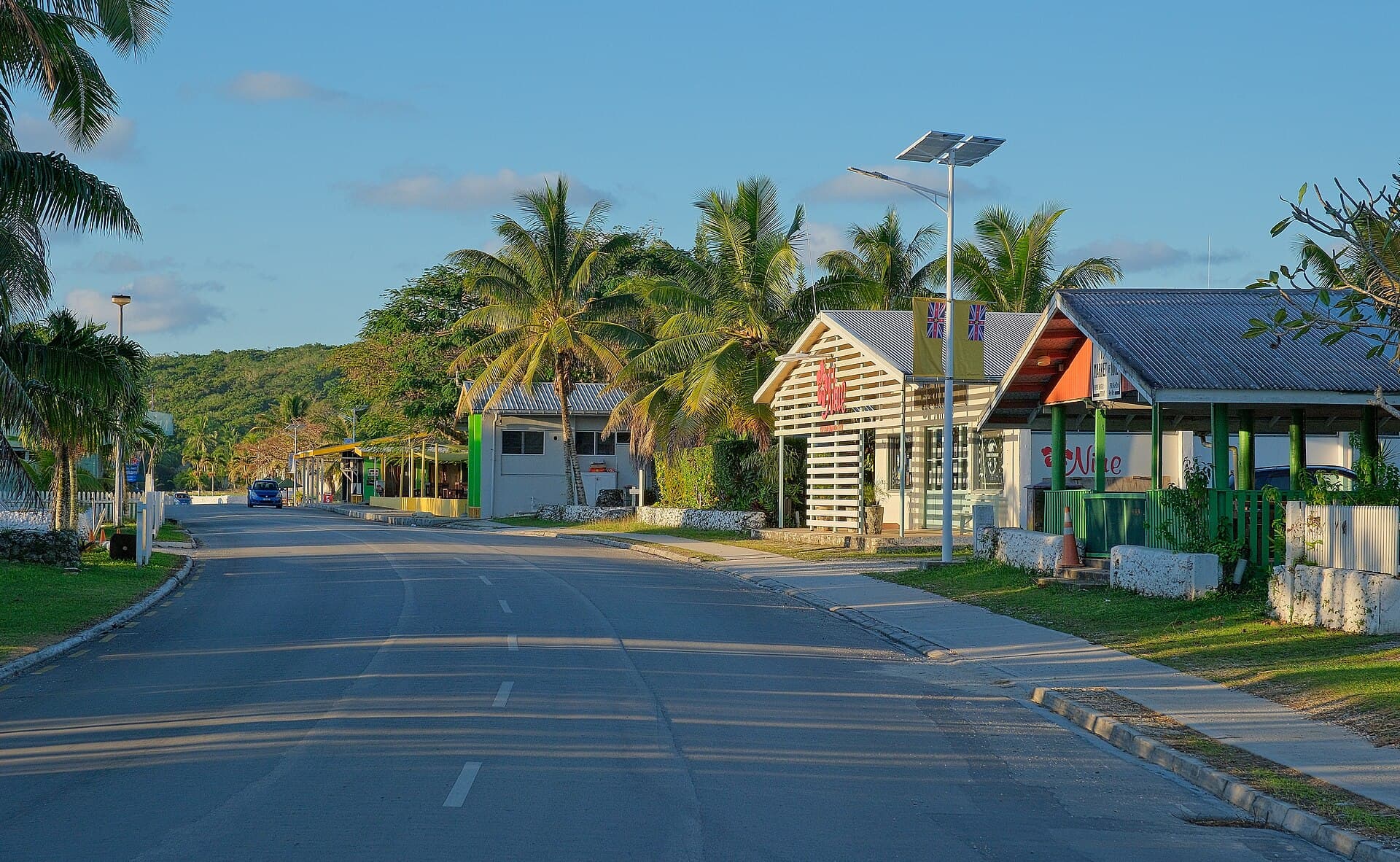
 Niue has fourteen villages and around sixteen hundred residents, against perhaps thirty thousand Niueans in New Zealand, so most of the nation lives somewhere else. Photograph by Pseudopanax, public domain, via Wikimedia Commons.
Mutalau. On the northeastern tip, Mutalau is where Christianity got ashore. Its people agreed in 1846 to receive the Niuean pastor Nukai Peniamina at the landing at Uluvehi and to protect him, at a time when other villages had turned him away and some had threatened to kill him.
Makefu and the northwest. Avaiki Cave at Makefu is remembered as the landing place of the first canoe, its name the same word as Havaiki and Hawaiki, the ancestral homeland named across Polynesia. North of it the track from Hikutavake runs to Matapa Chasm, a cleft in the cliff filled with still water that tradition reserves as the bathing place of the patuiki, the Niuean kings.
Hakupu and Liku. Hakupu in the southeast is the largest village outside the capital and sits at the edge of the Huvalu Forest Conservation Area, old-growth forest covering close to a fifth of the island under customary village management. Liku, on the east coast, is the birthplace of John Pule.
Polynesians reached Niue somewhere around a thousand years ago, arriving from Samoa and later from Tonga, and the island's traditions carry both connections. Because there is no sheltered anchorage and the reef gives way immediately to deep water, Niue was harder to reach and harder to hold than most of its neighbours, and it stayed comparatively isolated. Village-based chiefly authority came first; a single island-wide kingship, the patuiki, appears in the traditions from around the early eighteenth century and ran on into the colonial period.
James Cook found the island in June 1774 and tried three times to land. Each attempt was turned back by armed Niueans on the shore, and Cook sailed away having named the place Savage Island. The name stuck in European atlases for more than a century and appeared on the title pages of missionary books; Niueans reject it, pointing out that a people defending a landing against strangers is a people behaving sensibly. It belongs in the record as European history about Niue rather than anything Niue ever called itself.
Christianity arrived through a Niuean. Nukai Peniamina had been taken to Samoa, trained at the London Missionary Society's seminary, and returned aboard the John Williams in 1846; after repeated refusals elsewhere he was landed at Uluvehi in Mutalau and sheltered there (Wikipedia). Samoan teachers followed, and from 1861 the English missionary George Lawes reduced the language to writing and produced the translation on which literacy in Vagahau Niue was built.
Niue's chiefs asked Britain for protection against annexation by others, and a protectorate was declared in 1900. New Zealand took the island over the following year, bringing it inside its boundaries on 11 June 1901, and administered it through resident commissioners for seven decades. An airport opened in 1970 and made departure routine. A referendum on 3 September 1974 approved the new constitution by about 65 percent, and the Niue Constitution Act came into force on 19 October (NZHistory). That date is Constitution Day, and its fiftieth anniversary fell in 2024.
Vagahau Niue is a Polynesian language closest to Tongan and Samoan, with two historic varieties, the northern Motu and the southern Tafiti, whose differences are now slight. It is official alongside English and is still spoken by most islanders. Off the island it is in serious trouble. UNESCO classes Vagahau Niue as definitely endangered, meaning children are no longer learning it as a first language at home, and New Zealand ministers have cited figures suggesting only around seven percent of Niuean children in New Zealand can speak it (Beehive.govt.nz). Given where the population is, the language's future is being decided in Auckland classrooms rather than in Alofi.
The counterweight is a set of small, persistent institutions: Vagahau Niue Language Week each October, bilingual units and early-childhood groups, NCEA subject recognition, church services in the language, and a steady output of dictionaries, readers and recordings produced on both sides of the ocean (Ministry for Pacific Peoples).
The island's names carry the argument about itself. Niue is usually read as niu, coconut, with e, roughly "behold the coconut", the phrase attributed to the first arrivals sighting palms on the terrace. Older and more formal names include Nukututaha, the island that stands alone, along with Motu Tefua and Nukutuluea. Set beside Savage Island, the contrast in what a name is for is hard to miss.
The most remarkable thing Niue ever made is hiapo, its painted barkcloth. The technique came from Samoan teachers in the 1830s, and within a few decades Niuean makers had taken it somewhere nobody else did. Tongan ngatu and Samoan siapo are largely rubbed or stencilled over carved design tablets; hiapo was painted freehand, so the maker drew directly onto the cloth. By the 1880s that freedom had produced dense, exact compositions of concentric circles and radiating grids, fine hatched line work, botanical motifs from local plants, and in some pieces names written into the design. The flowering lasted perhaps fifty years, production had stopped by the early twentieth century, the makers went unrecorded, and the surviving cloths are scattered through museums in Europe, North America and the Pacific, as John Pule and Nicholas Thomas set out in Hiapo: Past and Present in Niuean Barkcloth (Te Papa). Niue's finest art form exists almost entirely overseas, in small numbers, and mostly without the names of the women who made it.
Weaving carried on where hiapo stopped. Pandanus and coconut leaf are worked into kato baskets, mats, fans and hats, the fine hats a marker of Sunday dress and a standard gift. Food heritage runs to takihi, layered taro and pawpaw baked in coconut cream, and to uga, the coconut crab.
The great family occasions are the rites of passage. A boy's first haircutting, hifi ulu, and a girl's ear-piercing, huki teliga, are the events for which relatives fly in and for which a family will save for years. Guests are called forward in order to cut a ribboned lock of hair or take part in the piercing, and each gives money, quilts, cloth or jewellery in return; the takings are held in trust for the child. These ceremonies are now held as often in Auckland halls as in Niuean villages, and they are the main mechanism by which a dispersed family still assembles in one room. The word takai, incidentally, names something else: the New Year procession in which decorated vehicles circle the island making as much noise as possible.
Christianity is close to universal, and one church dominates. The Ekalesia Niue, direct descendant of the London Missionary Society mission, holds the allegiance of a substantial majority, with Roman Catholics, Latter-day Saints, Jehovah's Witnesses and smaller congregations making up the rest. Each village has its church and its pastor, usually the largest and best-maintained building in the settlement, and Sunday is quiet by convention and by village rule.
The church calendar is also the national calendar. Peniamina Gospel Day, kept in late October, commemorates the 1846 landing at Uluvehi and the decision of the Mutalau people to protect a man other villages had refused, and it is a public holiday with services, feasting and village hosting. Older belief retreated into caution rather than vanishing. Stories of tupua and aitu, spirits attached to particular caves, chasms and stretches of coast, are still told, and there are places people will show a visitor but decline to enter, a form of respect that sits entirely comfortably alongside weekly attendance at church.
A Niuean death draws the family in from wherever it has scattered. The body is watched at home or at the church hall, with hymns and prayers through the night, and the village pastor conducts the funeral; burial is usually on family land or in the village burial ground close by, and the grave is tended, tiled and decorated afterwards rather than simply mown. Formal gift exchange runs through the occasion much as at a haircutting, with cloth, mats, food and money handed to the bereaved household and much of it redistributed.
The distinctive feature is the journey. Because most Niueans die in New Zealand or Australia, families quite routinely bring bodies home for burial on the island; there are no embalming facilities on Niue, so the arrangements run through New Zealand funeral directors and the weekly flight (US Consulate General Auckland). Fundraising for repatriation is ordinary in diaspora church life, and where a person is buried is understood as a statement about which country they belonged to.
One thread joins the mourning customs to the island's lost art. When the artist Cora-Allan Lafaiki Twiss began making hiapo, it was because her Niuean grandparents had asked her for hiapo burial cloths and there was nobody left who knew how to make them (Arts Foundation). That request, and the years of museum research it set off, shows what happens when a craft is lost: the loss turns up first at a funeral.
Niue's genealogy is oral and its most consequential records are New Zealand's.
The island has fourteen villages and the population is now around sixteen hundred, against perhaps thirty thousand Niueans in New Zealand, so most of the nation lives somewhere else and most of the recent record is Auckland's. Niueans are New Zealand citizens, so births, marriages and deaths for the majority of Niuean families are registered in New Zealand.
On the island, descent determines land. Niuean land is customary and held by the magafaoa, the extended family, with a leveki magafaoa appointed to administer it, and rights are established by proving descent. The Land Court hears that evidence and its records hold much of the written genealogy.
The London Missionary Society arrived properly in 1861, after earlier attempts were turned away, and the Ekalesia Niue's registers are the earliest vital records. New Zealand annexed the island in 1901 and administered it until self-government in 1974, so Archives New Zealand holds a substantial part of the administrative series.
Two events emptied the island. Cyclone Heta in 2004 destroyed a large part of Alofi and prompted further departure, and the steady migration for work and schooling has run for sixty years.
The Niuean language is classed as endangered mainly because so few speakers remain on the island, and the preservation work is being done by the diaspora in Auckland.
The central institution is Tāoga Niue, the government department for culture, language and heritage, begun as an initiative in 2003 and formalised in 2006. It runs the national museum and the national archives, administers the language programme and holds the mandate for safeguarding intangible heritage (Tāoga Niue). The archival holdings are modest and specific: files of the New Zealand resident commissioners from the early 1900s to 1969, official reports, staff records and the hurricane housing agreements of 1959 to 1961.
The museum story is the hardest fact on this page. Niue's first national museum, the Huanaki Cultural Centre and Museum, grew out of a government arts and history project begun in 1983, opened in 1987 and was formally opened by the New Zealand Governor-General in October 1989, holding the national collection alongside a library, workshops, an amphitheatre and a botanic garden. On 6 January 2004 Cyclone Heta struck the west coast with a storm surge that reached the Alofi terrace, destroyed the building and took between 90 and 95 percent of the collection with it (Wikipedia). Five to ten percent was salvaged. The director, Moira Enetama, has described the loss as reaching past the objects into belonging and ownership itself (SPREP).
What happened next belongs beside it. Staff went through rubbish dumps recovering what had been swept inland and thrown out, bought work from living weavers and carvers, and rebuilt a collection from nothing. A replacement funded by a New Zealand grant of about US$2.7 million was built from 2018, and the Fale Tāoga Niue opened on 19 October 2018, the anniversary of the constitution (Wikipedia).
Niue got online early and then lost control of the door. In 2003 it became the first country to offer state-funded wireless internet island-wide, free at the point of use, a decade before that was normal anywhere. Behind it sat the island's two-letter internet suffix, .nu, which happens to mean "now" in Swedish, Danish and Dutch and is therefore commercially valuable in northern Europe. Niue's rights in the domain passed to a foundation in 2003 and to the Internet Foundation in Sweden in 2013, and the island spent years in the Swedish courts arguing that a national asset had been taken and monetised without proper consent; the Court of Appeal dismissed the case in June 2025 without compensation (.nu, Wikipedia). It is an unusually literal case of a small country's name generating value the country never saw.
The heritage that has genuinely been digitised sits mostly in New Zealand. Te Papa and Auckland War Memorial Museum publish their Niuean holdings with images and provenance, hiapo included, so a maker in Alofi or a student in Otara can study nineteenth-century cloths that no longer exist within two thousand kilometres of the island (Te Papa). DigitalNZ and Digital Pasifik aggregate that material. Families do the rest informally, streaming funerals, haircuttings and language-week performances so that people who could not travel are still counted as present.
Niuean culture is now produced mainly by people born in New Zealand. John Pule, born at Liku in 1962 and taken to Auckland at two, wrote The Shark That Ate the Sun in 1992, a novel about a Niuean family coming apart in the Auckland diaspora; his paintings adopt the grids and registers of hiapo, and he co-wrote the first book on the barkcloth with the anthropologist Nicholas Thomas (John Pule, Wikipedia). Cora-Allan Lafaiki Twiss, of Māori and Niuean descent, has brought hiapo back into practice from museum study, using ata bark, mangrove ink and pandanus seed, and her work is held by Te Papa and Auckland Museum (Cora-Allan Wickliffe, Wikipedia).
Around those two sits the ordinary machinery of a dispersed nation: Niuean groups at the Pasifika Festival, church choirs, sports clubs, the language week, and the Niuean-language services that are often the only weekly setting in which a New Zealand-born child hears the language used for real business. Politically the island keeps testing what a country of 1,700 residents can be, conducting its own foreign relations, making treaties and joining regional and UN agencies. The unresolved question is the one the census keeps asking, which is whether a place can hold its heritage in working order when the great majority of the people who own it live 2,400 kilometres away.
A museum rebuilt from the dumps. After Cyclone Heta destroyed the Huanaki collection in 2004, staff recovered material from rubbish tips, commissioned new work from living makers, and reopened as the Fale Tāoga Niue on Constitution Day 2018.
Hiapo woken up. A barkcloth tradition unpractised on Niue for about a century has been reconstructed from museum holdings and taught back into the community.
A language week that stuck. Vagahau Niue Language Week has run in New Zealand for decades, and the language now has NCEA recognition, bilingual units and dedicated funding where most of its speakers live.
The whole ocean at once. In 2022 Niue placed its entire exclusive economic zone under a single marine park, 40 percent of it closed to extraction, one of the largest such commitments made by one of the smallest countries.
Niue has fourteen villages and around sixteen hundred residents, against perhaps thirty thousand Niueans in New Zealand, so most of the nation lives somewhere else. Photograph by Pseudopanax, public domain, via Wikimedia Commons.
Mutalau. On the northeastern tip, Mutalau is where Christianity got ashore. Its people agreed in 1846 to receive the Niuean pastor Nukai Peniamina at the landing at Uluvehi and to protect him, at a time when other villages had turned him away and some had threatened to kill him.
Makefu and the northwest. Avaiki Cave at Makefu is remembered as the landing place of the first canoe, its name the same word as Havaiki and Hawaiki, the ancestral homeland named across Polynesia. North of it the track from Hikutavake runs to Matapa Chasm, a cleft in the cliff filled with still water that tradition reserves as the bathing place of the patuiki, the Niuean kings.
Hakupu and Liku. Hakupu in the southeast is the largest village outside the capital and sits at the edge of the Huvalu Forest Conservation Area, old-growth forest covering close to a fifth of the island under customary village management. Liku, on the east coast, is the birthplace of John Pule.
Polynesians reached Niue somewhere around a thousand years ago, arriving from Samoa and later from Tonga, and the island's traditions carry both connections. Because there is no sheltered anchorage and the reef gives way immediately to deep water, Niue was harder to reach and harder to hold than most of its neighbours, and it stayed comparatively isolated. Village-based chiefly authority came first; a single island-wide kingship, the patuiki, appears in the traditions from around the early eighteenth century and ran on into the colonial period.
James Cook found the island in June 1774 and tried three times to land. Each attempt was turned back by armed Niueans on the shore, and Cook sailed away having named the place Savage Island. The name stuck in European atlases for more than a century and appeared on the title pages of missionary books; Niueans reject it, pointing out that a people defending a landing against strangers is a people behaving sensibly. It belongs in the record as European history about Niue rather than anything Niue ever called itself.
Christianity arrived through a Niuean. Nukai Peniamina had been taken to Samoa, trained at the London Missionary Society's seminary, and returned aboard the John Williams in 1846; after repeated refusals elsewhere he was landed at Uluvehi in Mutalau and sheltered there (Wikipedia). Samoan teachers followed, and from 1861 the English missionary George Lawes reduced the language to writing and produced the translation on which literacy in Vagahau Niue was built.
Niue's chiefs asked Britain for protection against annexation by others, and a protectorate was declared in 1900. New Zealand took the island over the following year, bringing it inside its boundaries on 11 June 1901, and administered it through resident commissioners for seven decades. An airport opened in 1970 and made departure routine. A referendum on 3 September 1974 approved the new constitution by about 65 percent, and the Niue Constitution Act came into force on 19 October (NZHistory). That date is Constitution Day, and its fiftieth anniversary fell in 2024.
Vagahau Niue is a Polynesian language closest to Tongan and Samoan, with two historic varieties, the northern Motu and the southern Tafiti, whose differences are now slight. It is official alongside English and is still spoken by most islanders. Off the island it is in serious trouble. UNESCO classes Vagahau Niue as definitely endangered, meaning children are no longer learning it as a first language at home, and New Zealand ministers have cited figures suggesting only around seven percent of Niuean children in New Zealand can speak it (Beehive.govt.nz). Given where the population is, the language's future is being decided in Auckland classrooms rather than in Alofi.
The counterweight is a set of small, persistent institutions: Vagahau Niue Language Week each October, bilingual units and early-childhood groups, NCEA subject recognition, church services in the language, and a steady output of dictionaries, readers and recordings produced on both sides of the ocean (Ministry for Pacific Peoples).
The island's names carry the argument about itself. Niue is usually read as niu, coconut, with e, roughly "behold the coconut", the phrase attributed to the first arrivals sighting palms on the terrace. Older and more formal names include Nukututaha, the island that stands alone, along with Motu Tefua and Nukutuluea. Set beside Savage Island, the contrast in what a name is for is hard to miss.
The most remarkable thing Niue ever made is hiapo, its painted barkcloth. The technique came from Samoan teachers in the 1830s, and within a few decades Niuean makers had taken it somewhere nobody else did. Tongan ngatu and Samoan siapo are largely rubbed or stencilled over carved design tablets; hiapo was painted freehand, so the maker drew directly onto the cloth. By the 1880s that freedom had produced dense, exact compositions of concentric circles and radiating grids, fine hatched line work, botanical motifs from local plants, and in some pieces names written into the design. The flowering lasted perhaps fifty years, production had stopped by the early twentieth century, the makers went unrecorded, and the surviving cloths are scattered through museums in Europe, North America and the Pacific, as John Pule and Nicholas Thomas set out in Hiapo: Past and Present in Niuean Barkcloth (Te Papa). Niue's finest art form exists almost entirely overseas, in small numbers, and mostly without the names of the women who made it.
Weaving carried on where hiapo stopped. Pandanus and coconut leaf are worked into kato baskets, mats, fans and hats, the fine hats a marker of Sunday dress and a standard gift. Food heritage runs to takihi, layered taro and pawpaw baked in coconut cream, and to uga, the coconut crab.
The great family occasions are the rites of passage. A boy's first haircutting, hifi ulu, and a girl's ear-piercing, huki teliga, are the events for which relatives fly in and for which a family will save for years. Guests are called forward in order to cut a ribboned lock of hair or take part in the piercing, and each gives money, quilts, cloth or jewellery in return; the takings are held in trust for the child. These ceremonies are now held as often in Auckland halls as in Niuean villages, and they are the main mechanism by which a dispersed family still assembles in one room. The word takai, incidentally, names something else: the New Year procession in which decorated vehicles circle the island making as much noise as possible.
Christianity is close to universal, and one church dominates. The Ekalesia Niue, direct descendant of the London Missionary Society mission, holds the allegiance of a substantial majority, with Roman Catholics, Latter-day Saints, Jehovah's Witnesses and smaller congregations making up the rest. Each village has its church and its pastor, usually the largest and best-maintained building in the settlement, and Sunday is quiet by convention and by village rule.
The church calendar is also the national calendar. Peniamina Gospel Day, kept in late October, commemorates the 1846 landing at Uluvehi and the decision of the Mutalau people to protect a man other villages had refused, and it is a public holiday with services, feasting and village hosting. Older belief retreated into caution rather than vanishing. Stories of tupua and aitu, spirits attached to particular caves, chasms and stretches of coast, are still told, and there are places people will show a visitor but decline to enter, a form of respect that sits entirely comfortably alongside weekly attendance at church.
A Niuean death draws the family in from wherever it has scattered. The body is watched at home or at the church hall, with hymns and prayers through the night, and the village pastor conducts the funeral; burial is usually on family land or in the village burial ground close by, and the grave is tended, tiled and decorated afterwards rather than simply mown. Formal gift exchange runs through the occasion much as at a haircutting, with cloth, mats, food and money handed to the bereaved household and much of it redistributed.
The distinctive feature is the journey. Because most Niueans die in New Zealand or Australia, families quite routinely bring bodies home for burial on the island; there are no embalming facilities on Niue, so the arrangements run through New Zealand funeral directors and the weekly flight (US Consulate General Auckland). Fundraising for repatriation is ordinary in diaspora church life, and where a person is buried is understood as a statement about which country they belonged to.
One thread joins the mourning customs to the island's lost art. When the artist Cora-Allan Lafaiki Twiss began making hiapo, it was because her Niuean grandparents had asked her for hiapo burial cloths and there was nobody left who knew how to make them (Arts Foundation). That request, and the years of museum research it set off, shows what happens when a craft is lost: the loss turns up first at a funeral.
Niue's genealogy is oral and its most consequential records are New Zealand's.
The island has fourteen villages and the population is now around sixteen hundred, against perhaps thirty thousand Niueans in New Zealand, so most of the nation lives somewhere else and most of the recent record is Auckland's. Niueans are New Zealand citizens, so births, marriages and deaths for the majority of Niuean families are registered in New Zealand.
On the island, descent determines land. Niuean land is customary and held by the magafaoa, the extended family, with a leveki magafaoa appointed to administer it, and rights are established by proving descent. The Land Court hears that evidence and its records hold much of the written genealogy.
The London Missionary Society arrived properly in 1861, after earlier attempts were turned away, and the Ekalesia Niue's registers are the earliest vital records. New Zealand annexed the island in 1901 and administered it until self-government in 1974, so Archives New Zealand holds a substantial part of the administrative series.
Two events emptied the island. Cyclone Heta in 2004 destroyed a large part of Alofi and prompted further departure, and the steady migration for work and schooling has run for sixty years.
The Niuean language is classed as endangered mainly because so few speakers remain on the island, and the preservation work is being done by the diaspora in Auckland.
The central institution is Tāoga Niue, the government department for culture, language and heritage, begun as an initiative in 2003 and formalised in 2006. It runs the national museum and the national archives, administers the language programme and holds the mandate for safeguarding intangible heritage (Tāoga Niue). The archival holdings are modest and specific: files of the New Zealand resident commissioners from the early 1900s to 1969, official reports, staff records and the hurricane housing agreements of 1959 to 1961.
The museum story is the hardest fact on this page. Niue's first national museum, the Huanaki Cultural Centre and Museum, grew out of a government arts and history project begun in 1983, opened in 1987 and was formally opened by the New Zealand Governor-General in October 1989, holding the national collection alongside a library, workshops, an amphitheatre and a botanic garden. On 6 January 2004 Cyclone Heta struck the west coast with a storm surge that reached the Alofi terrace, destroyed the building and took between 90 and 95 percent of the collection with it (Wikipedia). Five to ten percent was salvaged. The director, Moira Enetama, has described the loss as reaching past the objects into belonging and ownership itself (SPREP).
What happened next belongs beside it. Staff went through rubbish dumps recovering what had been swept inland and thrown out, bought work from living weavers and carvers, and rebuilt a collection from nothing. A replacement funded by a New Zealand grant of about US$2.7 million was built from 2018, and the Fale Tāoga Niue opened on 19 October 2018, the anniversary of the constitution (Wikipedia).
Niue got online early and then lost control of the door. In 2003 it became the first country to offer state-funded wireless internet island-wide, free at the point of use, a decade before that was normal anywhere. Behind it sat the island's two-letter internet suffix, .nu, which happens to mean "now" in Swedish, Danish and Dutch and is therefore commercially valuable in northern Europe. Niue's rights in the domain passed to a foundation in 2003 and to the Internet Foundation in Sweden in 2013, and the island spent years in the Swedish courts arguing that a national asset had been taken and monetised without proper consent; the Court of Appeal dismissed the case in June 2025 without compensation (.nu, Wikipedia). It is an unusually literal case of a small country's name generating value the country never saw.
The heritage that has genuinely been digitised sits mostly in New Zealand. Te Papa and Auckland War Memorial Museum publish their Niuean holdings with images and provenance, hiapo included, so a maker in Alofi or a student in Otara can study nineteenth-century cloths that no longer exist within two thousand kilometres of the island (Te Papa). DigitalNZ and Digital Pasifik aggregate that material. Families do the rest informally, streaming funerals, haircuttings and language-week performances so that people who could not travel are still counted as present.
Niuean culture is now produced mainly by people born in New Zealand. John Pule, born at Liku in 1962 and taken to Auckland at two, wrote The Shark That Ate the Sun in 1992, a novel about a Niuean family coming apart in the Auckland diaspora; his paintings adopt the grids and registers of hiapo, and he co-wrote the first book on the barkcloth with the anthropologist Nicholas Thomas (John Pule, Wikipedia). Cora-Allan Lafaiki Twiss, of Māori and Niuean descent, has brought hiapo back into practice from museum study, using ata bark, mangrove ink and pandanus seed, and her work is held by Te Papa and Auckland Museum (Cora-Allan Wickliffe, Wikipedia).
Around those two sits the ordinary machinery of a dispersed nation: Niuean groups at the Pasifika Festival, church choirs, sports clubs, the language week, and the Niuean-language services that are often the only weekly setting in which a New Zealand-born child hears the language used for real business. Politically the island keeps testing what a country of 1,700 residents can be, conducting its own foreign relations, making treaties and joining regional and UN agencies. The unresolved question is the one the census keeps asking, which is whether a place can hold its heritage in working order when the great majority of the people who own it live 2,400 kilometres away.
A museum rebuilt from the dumps. After Cyclone Heta destroyed the Huanaki collection in 2004, staff recovered material from rubbish tips, commissioned new work from living makers, and reopened as the Fale Tāoga Niue on Constitution Day 2018.
Hiapo woken up. A barkcloth tradition unpractised on Niue for about a century has been reconstructed from museum holdings and taught back into the community.
A language week that stuck. Vagahau Niue Language Week has run in New Zealand for decades, and the language now has NCEA recognition, bilingual units and dedicated funding where most of its speakers live.
The whole ocean at once. In 2022 Niue placed its entire exclusive economic zone under a single marine park, 40 percent of it closed to extraction, one of the largest such commitments made by one of the smallest countries.
National Overview
Notable Cities
Historical Foundations
Linguistic and Etymological Roots
Cultural Identity
Religion and Spirituality
Remembrance and Mourning Traditions
Tracing a Family in Niue
Heritage Preservation Efforts
Digital Heritage
Contemporary Cultural Influences
Success Stories
References and resources
- Encyclopaedia Britannica, Niue: geography and government.
- Niue, Wikipedia: free association, Cook's landings and the naming of the island.
- Niue Statistics Office, 2022 census: the resident count of 1,681.
- Stats NZ, ethnic group summary, Niuean: 34,944 people of Niuean descent in 2023.
- Te Ara, Niueans: migration, the diaspora and community life in New Zealand.
- NZHistory, Niue achieves self-government: the 1974 referendum and the Constitution Act.
- Nukai Peniamina, Wikipedia: the 1846 landing at Uluvehi in Mutalau.
- Huanaki Cultural Centre and Museum, Wikipedia: the 1989 opening and the loss of the collection in 2004.
- Tāoga Niue Museum, Wikipedia: the replacement museum and the salvage effort.
- Tāoga Niue: the culture department, national museum and national archives.
- SPREP, the loss and damage of Niue's history: Moira Enetama on what Cyclone Heta took.
- Beehive.govt.nz, loss of Vagahau Niue a real concern: endangerment and speaker figures.
- Cora-Allan Wickliffe, Wikipedia: the hiapo revival and the burial cloths that started it.
- John Pule, Wikipedia: the novelist and painter, and the first book on Niuean barkcloth.
- .nu, Wikipedia: the domain, the Swedish litigation and the 2025 judgment.
- Niue Nukutuluea Multiple-Use Marine Park, Wikipedia: the 2022 declaration and the no-take zone.