Heritage · Country
Samoa Culture and Heritage
Near the centre of Polynesia, Samoa keeps one of the region's oldest living cultures, fa'a Samoa, ordered by chiefly title and the extended family. A guide to the matai, the tatau and the ava bowl, and to how Samoans bury their dead before the family house and keep watch over the grave of Tusitala.Written to last.
By Confinity Heritage Editorial · Updated 2026-07-31 · 8-minute readQuiet tools, kept out of the way.
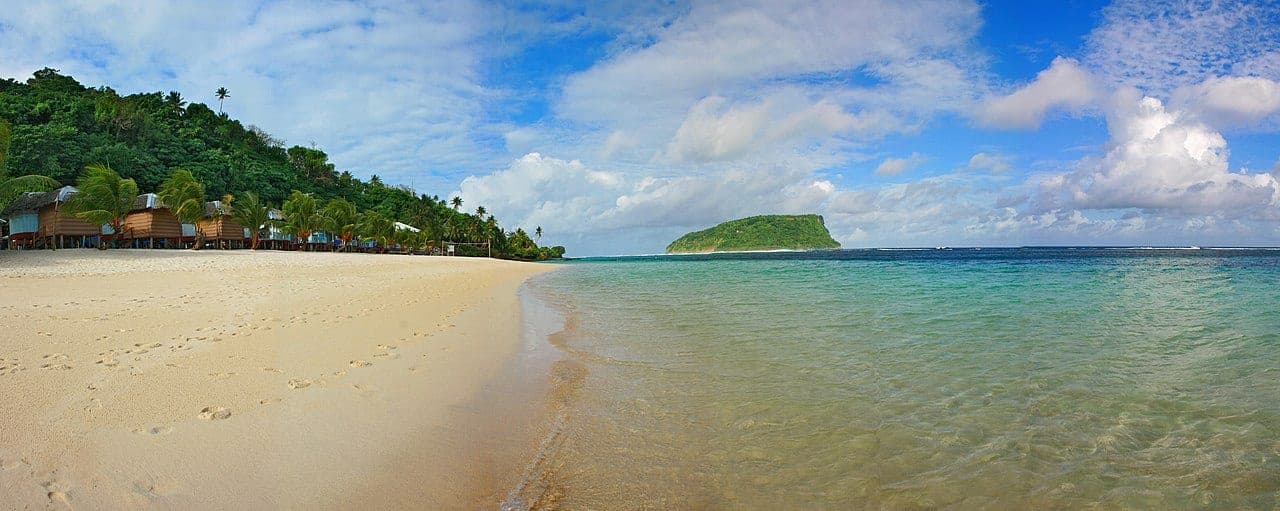
The Independent State of Samoa sits near the centre of Polynesia, a country of two large volcanic islands and a scatter of smaller ones where one of the oldest continuously practised cultures in the Pacific still governs daily life. Samoans call it fa'a Samoa, the Samoan way: an order of family, rank, land and obligation held together by the matai, the titled heads of the aiga or extended family, who speak for their kin, hold the family lands in trust and carry the names of a lineage. To be Samoan is to belong to an aiga and answer to a matai, and much of what a visitor notices, the ceremony, the fine mats, the tattoo, the open house without walls, expresses that quiet architecture.
This is also a country practised in remembrance. Families bury their dead in tombs set before the family house, so the ancestors remain at the doorstep of the living; grief is answered with the exchange of woven treasures that can be generations old; and Samoa keeps, on a hill above its capital, the grave of the Scottish writer Robert Louis Stevenson, whom Samoans named Tusitala, teller of tales. This guide runs from the Lapita voyagers who first settled these shores to the diaspora that now carries fa'a Samoa across the world.
Samoa lies in the South Pacific, roughly halfway between Hawaii and New Zealand, and comprises two main islands, Upolu and Savai'i, with the smaller inhabited islands of Manono and Apolima and several islets. Savai'i is the largest island, while Upolu, where the capital Apia sits, holds nearly three-quarters of the population. The 2021 census counted about 205,557 people across some 2,831 square kilometres, according to Britannica; the islands are volcanic and mountainous, ringed by reef and lagoon.
The country is a unitary parliamentary democracy whose institutions are grafted onto the customary order. The head of state carries the title O le Ao o le Malo, and the unicameral legislature, the Fono, seats members drawn overwhelmingly from the matai, so eligibility to sit is tied to holding a chiefly title. The national languages are Samoan and English, the currency is the tala, and the national motto, Fa'avae i le Atua Samoa, declares that Samoa is founded on God. In 2011 the country moved west of the International Date Line, skipping a calendar day to share a working week with Australia and New Zealand.
Apia. The capital and only city sits on the north coast of Upolu around a wide harbour, the seat of government and commerce and home to the Fono, the main markets and the waterfront cathedral. Above the town, at Vailima, stands the house Robert Louis Stevenson built, now a museum, with his tomb on the summit of Mount Vaea behind it. Apia grew from shoreline villages into a colonial port under German and then New Zealand rule.
 Apia early in the colonial period. Samoa was partitioned between Germany and the United States in 1899, and the western half passed to New Zealand in 1914. Photograph from the JIRCAS Library, CC BY 2.0, via Wikimedia Commons.
The districts and villages of Upolu. Beyond Apia, Upolu is a country of villages, each an autonomous polity governed by its own council of matai, the fono. The south coast holds Lalomanu, the Aleipata district and the To Sua ocean trench, while nearby Manono, in the strait between the two main islands, keeps cars and dogs off its shores and preserves an ancient star mound.
Savai'i. The larger, quieter island is regarded by many Samoans as the cultural heartland, and oral tradition links its name to Savaiki or Hawaiki, the ancestral Polynesian homeland. Its villages ring the coast below a forested volcanic interior; at Palauli lies the Pulemelei Mound, the largest ancient structure in Polynesia, while the north-coast lava fields of the 1905 to 1911 eruptions of Mount Matavanu preserve a buried church at Saleaula.
People of the Lapita culture, the seafaring ancestors of the Polynesians, reached the Samoan islands roughly three thousand years ago, around 1000 to 900 BCE, identified by pottery excavated at Mulifanua on Upolu. From this western Polynesian homeland, of which Samoa and Tonga formed the core, later voyagers set out to settle the far corners of the Pacific triangle, so Samoa is remembered across Polynesia as part of Hawaiki, the place of origin. Over the following centuries a complex order of chiefly titles took shape: the Tui Manu'a of the eastern islands was among the oldest and most sacred of the archipelago, while on Upolu and Savai'i four pāpā titles could be gathered by one leader to make a tafa'ifa, the nearest the islands came to a paramount ruler.
European contact came late: the Dutch navigator Jacob Roggeveen sighted the islands in 1722, and in 1768 Louis-Antoine de Bougainville named them the Navigator Islands. In 1830 the London Missionary Society preacher John Williams landed on Savai'i, and Christianity spread swiftly through the chiefly networks. Rival German, British and American interests followed, and the 1899 Tripartite Convention partitioned the archipelago: the United States took the eastern islands, now American Samoa, and Germany the west, ruling German Samoa from 1900 to 1914 under governor Wilhelm Solf.
At the outbreak of the First World War in 1914, New Zealand forces occupied the German colony and governed Western Samoa thereafter under a League of Nations mandate and later a United Nations trusteeship. Their early record was scarred by the 1918 influenza pandemic, which entered on a ship allowed to dock and killed about a fifth of the population. From that grievance grew the Mau, a disciplined non-violent movement for self-rule whose slogan was Samoa mo Samoa, Samoa for the Samoans, led by the paramount chief Tupua Tamasese Lealofi III and the merchant Olaf Frederick Nelson. On 28 December 1929, remembered soberly as Black Saturday, New Zealand police fired on a peaceful Mau procession in Apia; eleven Samoans died, among them Tamasese, shot in the back, whose last words urged his people to keep the peace and not avenge his blood, as Wikipedia records. After a United Nations plebiscite, Western Samoa became independent on 1 January 1962, the first Pacific island nation to gain independence in the modern era.
Samoan, or Gagana Samoa, is a Polynesian language of the Austronesian family, closely related to Tongan, Tokelauan and the languages of Eastern Polynesia. It preserves a formal register, the gagana fa'aaloalo or chiefly language, reserved for addressing matai and conducting ceremony, so oratory itself is a mark of rank and learning. English is the second language of administration and schooling, an inheritance of the New Zealand era.
The name Samoa is old and its meaning debated. One widely cited reading joins sa, sacred, with moa, centre, giving a sense of sacred centre, though other traditions connect moa to sacred birds or a chiefly lineage. The state was known as Western Samoa from independence until 1997, when it dropped the qualifier and became simply Samoa, distinguishing itself from the neighbouring United States territory.
At the heart of fa'a Samoa is the matai system. Each aiga holds one or more matai titles attached to particular lands and villages, and confers a title on a chosen member in a ceremony called the saofa'i. Matai divide broadly into ali'i, high chiefs of sacred dignity, and tulafale, the orator chiefs who speak on the ali'i's behalf and carry the fue, the fly-whisk, and the to'oto'o, the orator's staff. The village council of matai, the fono, governs local affairs, and this authority reaches into national politics.
The most striking mark of Samoan identity is worn on the body. The tatau, the traditional tattoo from which the English word derives, is applied by hand by a tufuga ta tatau, a master tattooist, using the au, serrated combs of bone and turtle shell struck with a mallet, while assistants stretch the skin. The male pe'a covers the body densely from the waist to the knees; the female malu is lighter, a filigree reaching the upper legs. The process is long and painful, and completing it proves endurance and service to the family, while abandoning it unfinished, a pe'a mutu, is a lasting shame. The right to tattoo has passed within particular families, notably the Sa Su'a of Savai'i, as reference works record.
Everyday life still centres on the fale, the open Samoan house: an oval platform with a domed roof on wooden posts and no permanent walls, closed when needed by blinds of plaited coconut leaf. Ceremony gathers around the ava bowl. The ava drink, made from the pounded root of Piper methysticum, is prepared in a broad wooden tanoa bowl by the aumaga, the untitled men, and served in strict order of rank, beginning with the highest chief present, opening formal gatherings, welcomes and the bestowal of titles. Dance ranges from the seated, clapping sasa to the graceful taualuga, the finale danced by a taupou or high-ranking daughter of the house, and the fireknife dance, the siva afi, in which a performer spins a bladed club wrapped in flame. Food is cooked in the umu, an above-ground earth oven of hot stones; staples include taro, breadfruit, palusami of coconut cream baked in taro leaves, and koko Samoa from local cacao.
Christianity arrived in 1830 and was embraced with a completeness that shapes the country to this day; the 2021 census recorded that nearly ninety-eight per cent of Samoans are Christian. The Congregational Christian Church of Samoa, descended from the London Missionary Society, along with Roman Catholic, Methodist, Latter-day Saint and Pentecostal churches, all have large followings, and the white church is often the finest building in a village. Evening prayer, the sa, is observed in many villages by a dusk curfew during which movement pauses for family devotions.
Rather than displacing fa'a Samoa, Christianity was woven into it, so church and custom now reinforce one another. Beneath the Christian surface older understandings persist: sacred places, ancestral spirits called aitu, and the sense that land and family are held in trust across the generations.
Death in Samoa is a matter for the whole aiga and village, setting in motion the fa'alavelave, the occasions of family obligation for which relatives at home and abroad contribute and gather. The body is commonly returned to the family home to lie in state, where kin keep vigil, sing hymns and receive mourners over several days. Around a Christian funeral service and burial runs the older economy of grief. The mourning owed to a person of rank, the lagi, brings a ceremonial exchange of treasures between the bereaved family and those who come to pay respect, above all the ie toga, fine mats woven from finely split pandanus over months or years, the highest form of Samoan wealth and handed down for generations. Visiting parties present mats, siapo bark cloth, food and money in the si'i, and the bereaved family returns gifts in turn, so grief is answered by a circulation of respect that repairs the ties each death strains.
Where the dead rest is itself a statement of belonging. Samoan families bury their own not in distant cemeteries but in raised concrete tombs set before the family house, so ancestors remain at the centre of daily life. The country's most famous grave belongs to an adopted son. When Robert Louis Stevenson died at Vailima on 3 December 1894, aged forty-four, Samoans kept watch over his body through the night and carried him the next day up Mount Vaea, cutting a path they called the Road of Loving Hearts, O le Ala o le Alofa. His tomb on the summit, inscribed with his own Requiem and looking out to sea, is a place of pilgrimage still, according to accounts collected by his biographers and museum. Christian rites and Samoan custom meet at every graveside, the pastor's service and the exchange of mats a single act of remembrance.
Samoan genealogy is the constitution of the country, and it is recited standing up.
The matai system is the framework: each extended family, the aiga, holds one or more chiefly titles, and the title is conferred by the family on a person chosen from among those with a genealogical claim to it. Deciding who has that claim means reciting descent, and disputes go to the Land and Titles Court, which has heard genealogical evidence for over a century and whose records are consequently the largest formal archive of Samoan whakapapa. Around eighty per cent of land is customary and attached to titles, so the stakes are real.
The fa'alupega is the other form. Each village has a formal salutation naming its titles in order, which is spoken at the beginning of any occasion, and it is a genealogy of the village performed as courtesy.
The written record is missionary and colonial. The London Missionary Society arrived in 1830 and its registers are the earliest vital records; Germany administered Western Samoa from 1900, New Zealand from 1914, and independence came in 1962.
The catastrophe in every Samoan family's memory is 1918. The influenza arrived on a New Zealand ship that was allowed to dock, and it killed something over a fifth of the population of Western Samoa within weeks, including a large share of the matai. American Samoa, which quarantined, lost nobody. The death registers of that autumn are the sharpest document in the country's archive.
The house at Vailima, which Stevenson built in the hills above Apia after buying his estate of five streams in 1890, later served as the residence of the German and New Zealand administrations before falling into disrepair. It was fully restored and opened as the Robert Louis Stevenson Museum on 5 December 1994, the centenary of the writer's death, its rooms furnished to evoke the household of Tusitala.
Samoa's national museum, Falemata'aga, the Museum of Samoa, occupies a former German-built school at Malifa in Apia. Its collections include early missionary photography, displays on fine-mat weaving, siapo and tatau, and archaeological material reaching back some three thousand years. On Savai'i, the Pulemelei Mound at Palauli, known locally as Tia Seu, is the country's foremost archaeological monument: a stepped basalt platform measuring about 65 by 60 metres at the base and rising some twelve metres, built between roughly 1100 and 1400 CE as a ceremonial centre linked to the rise of Samoan chieftaincy, as survey work has established. Beyond such sites, the living framework of matai, fine mats and oratory, tended by village councils and churches, is itself the heritage most carefully kept.
Because so much Samoan knowledge lives in oratory, genealogy and ceremony, its documentation has increasingly moved into digital form. Samoan-language broadcasting and online media serve both the home islands and a diaspora that outnumbers the resident population, while genealogical records kept by churches and the Latter-day Saints have made Samoan family history unusually well documented. Museums in New Zealand and Australia, among them Te Papa Tongarewa, have digitised photographs, fine mats and recordings for families to consult remotely. The COVID-19 pandemic accelerated the joining of funerals and title ceremonies by video link, letting relatives abroad take part in the fa'alavelave in real time. Confinity's own work belongs to the same instinct, treating memory as a set of obligations to be kept rather than an archive apart from life.
Samoa's culture travels with its people. Large, settled communities live in New Zealand, where more than two hundred thousand people identified as Samoan in the 2023 census, in Australia and in the United States, and the remittances, music, faith and food that flow between them and the islands are now part of what fa'a Samoa means.
Rugby is close to a national vocation. The Manu Samoa fifteen have reached every Rugby World Cup since 1991 and, drawing on a talent pool spread through the diaspora, have punched far above the country's size, opening each match with the Siva Tau war challenge. Players of Samoan descent fill the professional game in New Zealand, Australia, England, France and Japan, and rugby has become one of the strongest threads binding the islands to their people overseas.
The first Pacific nation to independence. Sustained by the discipline of the Mau after the sorrow of Black Saturday, Western Samoa became, on 1 January 1962, the first Pacific island country to gain independence in the modern era, building a constitution that seats its matai leadership at the centre of a parliamentary state.
A living chiefly culture. Where many indigenous systems were broken by colonisation, the matai order, the fono, the ava ceremony and the tatau remain in everyday use, an unbroken inheritance rather than a revival.
Tusitala's grave kept for a century and more. The care Samoans gave Robert Louis Stevenson in life and death, from the Road of Loving Hearts to the restored house at Vailima, shows a culture of remembrance strong enough to adopt a foreigner as its own.
A culture carried by its diaspora. With more Samoans living abroad than at home, fa'a Samoa has proved portable, sustaining language, faith, fine-mat exchange and family obligation across oceans and returning wealth and talent to the islands.
Apia early in the colonial period. Samoa was partitioned between Germany and the United States in 1899, and the western half passed to New Zealand in 1914. Photograph from the JIRCAS Library, CC BY 2.0, via Wikimedia Commons.
The districts and villages of Upolu. Beyond Apia, Upolu is a country of villages, each an autonomous polity governed by its own council of matai, the fono. The south coast holds Lalomanu, the Aleipata district and the To Sua ocean trench, while nearby Manono, in the strait between the two main islands, keeps cars and dogs off its shores and preserves an ancient star mound.
Savai'i. The larger, quieter island is regarded by many Samoans as the cultural heartland, and oral tradition links its name to Savaiki or Hawaiki, the ancestral Polynesian homeland. Its villages ring the coast below a forested volcanic interior; at Palauli lies the Pulemelei Mound, the largest ancient structure in Polynesia, while the north-coast lava fields of the 1905 to 1911 eruptions of Mount Matavanu preserve a buried church at Saleaula.
People of the Lapita culture, the seafaring ancestors of the Polynesians, reached the Samoan islands roughly three thousand years ago, around 1000 to 900 BCE, identified by pottery excavated at Mulifanua on Upolu. From this western Polynesian homeland, of which Samoa and Tonga formed the core, later voyagers set out to settle the far corners of the Pacific triangle, so Samoa is remembered across Polynesia as part of Hawaiki, the place of origin. Over the following centuries a complex order of chiefly titles took shape: the Tui Manu'a of the eastern islands was among the oldest and most sacred of the archipelago, while on Upolu and Savai'i four pāpā titles could be gathered by one leader to make a tafa'ifa, the nearest the islands came to a paramount ruler.
European contact came late: the Dutch navigator Jacob Roggeveen sighted the islands in 1722, and in 1768 Louis-Antoine de Bougainville named them the Navigator Islands. In 1830 the London Missionary Society preacher John Williams landed on Savai'i, and Christianity spread swiftly through the chiefly networks. Rival German, British and American interests followed, and the 1899 Tripartite Convention partitioned the archipelago: the United States took the eastern islands, now American Samoa, and Germany the west, ruling German Samoa from 1900 to 1914 under governor Wilhelm Solf.
At the outbreak of the First World War in 1914, New Zealand forces occupied the German colony and governed Western Samoa thereafter under a League of Nations mandate and later a United Nations trusteeship. Their early record was scarred by the 1918 influenza pandemic, which entered on a ship allowed to dock and killed about a fifth of the population. From that grievance grew the Mau, a disciplined non-violent movement for self-rule whose slogan was Samoa mo Samoa, Samoa for the Samoans, led by the paramount chief Tupua Tamasese Lealofi III and the merchant Olaf Frederick Nelson. On 28 December 1929, remembered soberly as Black Saturday, New Zealand police fired on a peaceful Mau procession in Apia; eleven Samoans died, among them Tamasese, shot in the back, whose last words urged his people to keep the peace and not avenge his blood, as Wikipedia records. After a United Nations plebiscite, Western Samoa became independent on 1 January 1962, the first Pacific island nation to gain independence in the modern era.
Samoan, or Gagana Samoa, is a Polynesian language of the Austronesian family, closely related to Tongan, Tokelauan and the languages of Eastern Polynesia. It preserves a formal register, the gagana fa'aaloalo or chiefly language, reserved for addressing matai and conducting ceremony, so oratory itself is a mark of rank and learning. English is the second language of administration and schooling, an inheritance of the New Zealand era.
The name Samoa is old and its meaning debated. One widely cited reading joins sa, sacred, with moa, centre, giving a sense of sacred centre, though other traditions connect moa to sacred birds or a chiefly lineage. The state was known as Western Samoa from independence until 1997, when it dropped the qualifier and became simply Samoa, distinguishing itself from the neighbouring United States territory.
At the heart of fa'a Samoa is the matai system. Each aiga holds one or more matai titles attached to particular lands and villages, and confers a title on a chosen member in a ceremony called the saofa'i. Matai divide broadly into ali'i, high chiefs of sacred dignity, and tulafale, the orator chiefs who speak on the ali'i's behalf and carry the fue, the fly-whisk, and the to'oto'o, the orator's staff. The village council of matai, the fono, governs local affairs, and this authority reaches into national politics.
The most striking mark of Samoan identity is worn on the body. The tatau, the traditional tattoo from which the English word derives, is applied by hand by a tufuga ta tatau, a master tattooist, using the au, serrated combs of bone and turtle shell struck with a mallet, while assistants stretch the skin. The male pe'a covers the body densely from the waist to the knees; the female malu is lighter, a filigree reaching the upper legs. The process is long and painful, and completing it proves endurance and service to the family, while abandoning it unfinished, a pe'a mutu, is a lasting shame. The right to tattoo has passed within particular families, notably the Sa Su'a of Savai'i, as reference works record.
Everyday life still centres on the fale, the open Samoan house: an oval platform with a domed roof on wooden posts and no permanent walls, closed when needed by blinds of plaited coconut leaf. Ceremony gathers around the ava bowl. The ava drink, made from the pounded root of Piper methysticum, is prepared in a broad wooden tanoa bowl by the aumaga, the untitled men, and served in strict order of rank, beginning with the highest chief present, opening formal gatherings, welcomes and the bestowal of titles. Dance ranges from the seated, clapping sasa to the graceful taualuga, the finale danced by a taupou or high-ranking daughter of the house, and the fireknife dance, the siva afi, in which a performer spins a bladed club wrapped in flame. Food is cooked in the umu, an above-ground earth oven of hot stones; staples include taro, breadfruit, palusami of coconut cream baked in taro leaves, and koko Samoa from local cacao.
Christianity arrived in 1830 and was embraced with a completeness that shapes the country to this day; the 2021 census recorded that nearly ninety-eight per cent of Samoans are Christian. The Congregational Christian Church of Samoa, descended from the London Missionary Society, along with Roman Catholic, Methodist, Latter-day Saint and Pentecostal churches, all have large followings, and the white church is often the finest building in a village. Evening prayer, the sa, is observed in many villages by a dusk curfew during which movement pauses for family devotions.
Rather than displacing fa'a Samoa, Christianity was woven into it, so church and custom now reinforce one another. Beneath the Christian surface older understandings persist: sacred places, ancestral spirits called aitu, and the sense that land and family are held in trust across the generations.
Death in Samoa is a matter for the whole aiga and village, setting in motion the fa'alavelave, the occasions of family obligation for which relatives at home and abroad contribute and gather. The body is commonly returned to the family home to lie in state, where kin keep vigil, sing hymns and receive mourners over several days. Around a Christian funeral service and burial runs the older economy of grief. The mourning owed to a person of rank, the lagi, brings a ceremonial exchange of treasures between the bereaved family and those who come to pay respect, above all the ie toga, fine mats woven from finely split pandanus over months or years, the highest form of Samoan wealth and handed down for generations. Visiting parties present mats, siapo bark cloth, food and money in the si'i, and the bereaved family returns gifts in turn, so grief is answered by a circulation of respect that repairs the ties each death strains.
Where the dead rest is itself a statement of belonging. Samoan families bury their own not in distant cemeteries but in raised concrete tombs set before the family house, so ancestors remain at the centre of daily life. The country's most famous grave belongs to an adopted son. When Robert Louis Stevenson died at Vailima on 3 December 1894, aged forty-four, Samoans kept watch over his body through the night and carried him the next day up Mount Vaea, cutting a path they called the Road of Loving Hearts, O le Ala o le Alofa. His tomb on the summit, inscribed with his own Requiem and looking out to sea, is a place of pilgrimage still, according to accounts collected by his biographers and museum. Christian rites and Samoan custom meet at every graveside, the pastor's service and the exchange of mats a single act of remembrance.
Samoan genealogy is the constitution of the country, and it is recited standing up.
The matai system is the framework: each extended family, the aiga, holds one or more chiefly titles, and the title is conferred by the family on a person chosen from among those with a genealogical claim to it. Deciding who has that claim means reciting descent, and disputes go to the Land and Titles Court, which has heard genealogical evidence for over a century and whose records are consequently the largest formal archive of Samoan whakapapa. Around eighty per cent of land is customary and attached to titles, so the stakes are real.
The fa'alupega is the other form. Each village has a formal salutation naming its titles in order, which is spoken at the beginning of any occasion, and it is a genealogy of the village performed as courtesy.
The written record is missionary and colonial. The London Missionary Society arrived in 1830 and its registers are the earliest vital records; Germany administered Western Samoa from 1900, New Zealand from 1914, and independence came in 1962.
The catastrophe in every Samoan family's memory is 1918. The influenza arrived on a New Zealand ship that was allowed to dock, and it killed something over a fifth of the population of Western Samoa within weeks, including a large share of the matai. American Samoa, which quarantined, lost nobody. The death registers of that autumn are the sharpest document in the country's archive.
The house at Vailima, which Stevenson built in the hills above Apia after buying his estate of five streams in 1890, later served as the residence of the German and New Zealand administrations before falling into disrepair. It was fully restored and opened as the Robert Louis Stevenson Museum on 5 December 1994, the centenary of the writer's death, its rooms furnished to evoke the household of Tusitala.
Samoa's national museum, Falemata'aga, the Museum of Samoa, occupies a former German-built school at Malifa in Apia. Its collections include early missionary photography, displays on fine-mat weaving, siapo and tatau, and archaeological material reaching back some three thousand years. On Savai'i, the Pulemelei Mound at Palauli, known locally as Tia Seu, is the country's foremost archaeological monument: a stepped basalt platform measuring about 65 by 60 metres at the base and rising some twelve metres, built between roughly 1100 and 1400 CE as a ceremonial centre linked to the rise of Samoan chieftaincy, as survey work has established. Beyond such sites, the living framework of matai, fine mats and oratory, tended by village councils and churches, is itself the heritage most carefully kept.
Because so much Samoan knowledge lives in oratory, genealogy and ceremony, its documentation has increasingly moved into digital form. Samoan-language broadcasting and online media serve both the home islands and a diaspora that outnumbers the resident population, while genealogical records kept by churches and the Latter-day Saints have made Samoan family history unusually well documented. Museums in New Zealand and Australia, among them Te Papa Tongarewa, have digitised photographs, fine mats and recordings for families to consult remotely. The COVID-19 pandemic accelerated the joining of funerals and title ceremonies by video link, letting relatives abroad take part in the fa'alavelave in real time. Confinity's own work belongs to the same instinct, treating memory as a set of obligations to be kept rather than an archive apart from life.
Samoa's culture travels with its people. Large, settled communities live in New Zealand, where more than two hundred thousand people identified as Samoan in the 2023 census, in Australia and in the United States, and the remittances, music, faith and food that flow between them and the islands are now part of what fa'a Samoa means.
Rugby is close to a national vocation. The Manu Samoa fifteen have reached every Rugby World Cup since 1991 and, drawing on a talent pool spread through the diaspora, have punched far above the country's size, opening each match with the Siva Tau war challenge. Players of Samoan descent fill the professional game in New Zealand, Australia, England, France and Japan, and rugby has become one of the strongest threads binding the islands to their people overseas.
The first Pacific nation to independence. Sustained by the discipline of the Mau after the sorrow of Black Saturday, Western Samoa became, on 1 January 1962, the first Pacific island country to gain independence in the modern era, building a constitution that seats its matai leadership at the centre of a parliamentary state.
A living chiefly culture. Where many indigenous systems were broken by colonisation, the matai order, the fono, the ava ceremony and the tatau remain in everyday use, an unbroken inheritance rather than a revival.
Tusitala's grave kept for a century and more. The care Samoans gave Robert Louis Stevenson in life and death, from the Road of Loving Hearts to the restored house at Vailima, shows a culture of remembrance strong enough to adopt a foreigner as its own.
A culture carried by its diaspora. With more Samoans living abroad than at home, fa'a Samoa has proved portable, sustaining language, faith, fine-mat exchange and family obligation across oceans and returning wealth and talent to the islands.
National Overview
Notable Cities
Historical Foundations
Linguistic and Etymological Roots
Cultural Identity
Religion and Spirituality
Remembrance and Mourning Traditions
Tracing a Family in Samoa
Heritage Preservation Efforts
Digital Heritage
Contemporary Cultural Influences
Success Stories
References and resources
- Encyclopaedia Britannica: Samoa
- Encyclopaedia Britannica: History of Samoa
- Wikipedia: Samoa
- Wikipedia: Mau movement
- Wikipedia: Peʻa (Samoan tatau)
- Wikipedia: ʻAva ceremony
- Wikipedia: Pulemelei Mound
- Robert Louis Stevenson Museum, Vailima
- Falemata'aga, Museum of Samoa
- Te Papa Tongarewa: ʻie tōga (fine mat)