Heritage · Country
Nepal Culture and Heritage
From the summit of Everest to the cremation ghats of the Bagmati, Nepal holds the steepest range on earth and two faiths grown into one. This is a guide to how a Himalayan republic keeps faith with its temples, its languages and its dead.Written to last.
By Confinity Heritage Editorial · Updated 2026-07-31 · 8-minute readQuiet tools, kept out of the way.
Nepal occupies a narrow band of the southern Himalaya, a country roughly the length of England that holds the steepest vertical range on earth. In less than two hundred kilometres the land climbs from the subtropical plains of the Terai, barely above sea level, to the summit of Mount Everest at 8,848.86 metres, the highest point on the planet, which lies within Sagarmatha National Park. Eight of the fourteen mountains on earth above eight thousand metres rise along its northern frontier. Nepalis know Everest as Sagarmatha, the forehead of the sky, and the Sherpa of its valleys call it Chomolungma, older names for the peak that outsiders renamed for a colonial surveyor.
This is a country where the sacred and the ordinary are not held apart. Hindu and Buddhist devotion have grown together here for two thousand years, sharing shrines, festivals and gods, and the same intertwining shapes how Nepalis remember their dead: in the cremation pyres of Pashupatinath, the butter lamps of Boudhanath, and the rites of the high ridges where wood is scarce and older customs hold. What follows is an account of that inheritance, and of the ways a people between two faiths keeps faith with those who came before.
Nepal is a landlocked republic of roughly thirty million people, bordered by the Tibet Autonomous Region of China to the north and by India on its other three sides. Its territory falls into three parallel belts: the flat Terai along the Indian plain; the middle hills that hold the Kathmandu Valley and the town of Pokhara; and the high mountains of the Great Himalaya. That compression of climates, from tropical jungle to permanent ice within a short journey north, has made it one of the most varied countries of its size, as Encyclopaedia Britannica records.
The state recognises more than a hundred and twenty-five caste and ethnic groups. The Newar are the historic inhabitants of the Kathmandu Valley; the Sherpa, Tamang, Rai and Limbu hold the northern and eastern hills; the Magar and Gurung the west; and the Tharu and Madhesi communities the southern plains, blending Indo-Aryan and Tibeto-Burman ancestries across the whole country. Kathmandu is the capital and largest city. The monarchy that had governed for centuries was abolished in 2008, and Nepal is today a secular federal democratic republic under a constitution adopted in 2015.
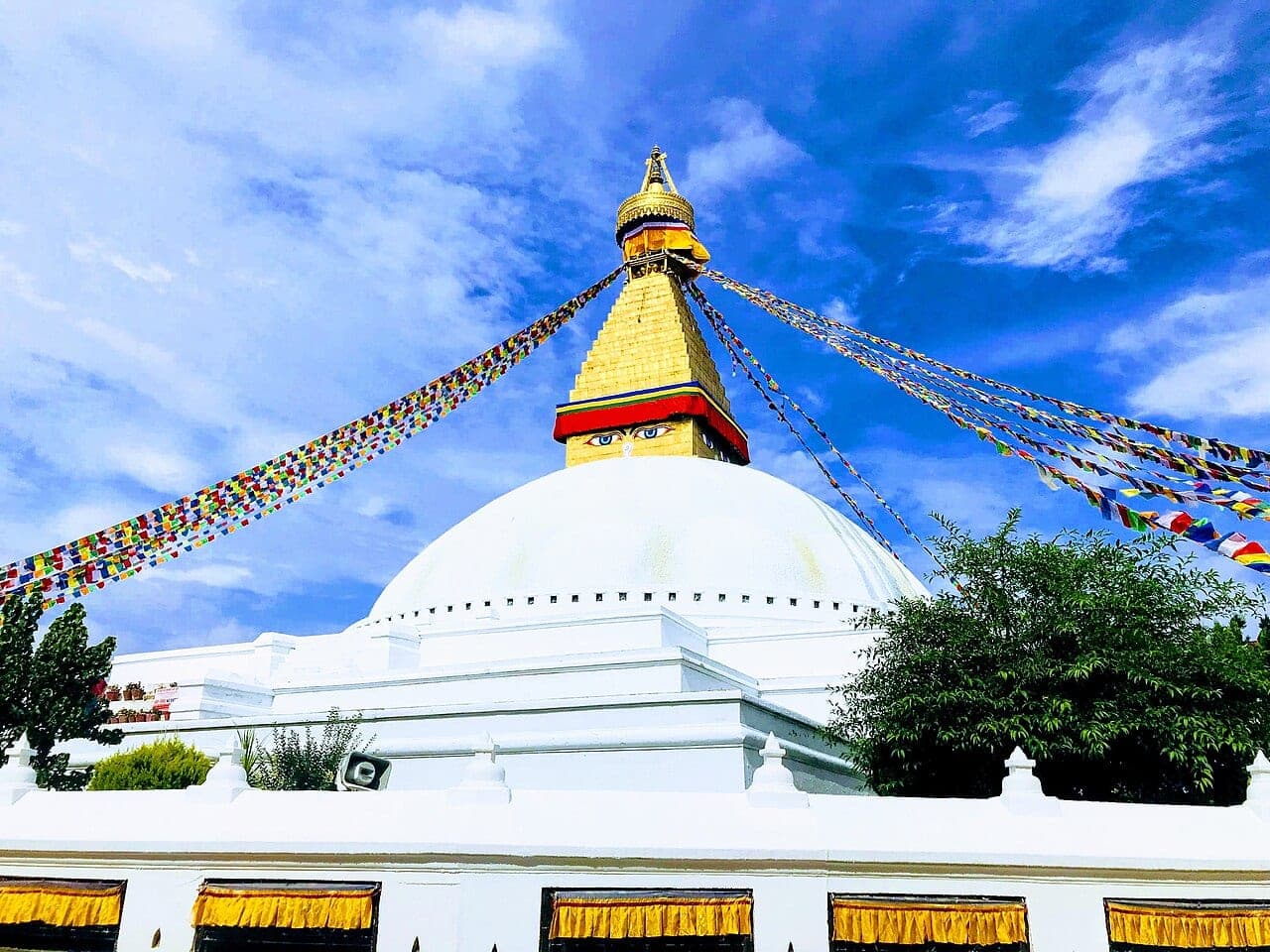
Kathmandu. The capital sits at about 1,400 metres in the valley that carries its name. Its old heart is Kathmandu Durbar Square, the Hanuman Dhoka palace of the Malla and Shah kings, ringed by pagoda temples and the house of the living goddess. The city may take its name from the Kasthamandap, a wooden pavilion which fell in the 2015 earthquake and has since been rebuilt. Nearby rise the Buddhist stupas of Swayambhunath, among the oldest sites in the valley, and Boudhanath, the largest spherical stupa in Nepal.
 Bhaktapur, where the woodcarvers who maintain the temples are the descendants of the men who built them. Photograph by Janak Bhatta, CC BY-SA 4.0, via Wikimedia Commons.
Patan, or Lalitpur. Across the Bagmati just south of the capital, Patan is the city of artisans, home to the metalworkers who kept alive the repoussé and lost-wax casting for which the valley is celebrated, as the Nepal Tourism Board notes. Its Durbar Square holds the stone Krishna Mandir amid Newar temples and Buddhist monastery courtyards.
Bhaktapur. The best preserved of the three medieval capitals keeps its brick lanes, potters' squares and the five-tiered Nyatapola temple, the tallest pagoda in the country, a working town of craftspeople rather than a museum piece.
Pokhara. Set on Phewa Lake beneath the Annapurna range, Pokhara is the gateway to the central Himalaya and the base for much of Nepal's trekking.
Lumbini. In the Terai near the Indian border lies the birthplace of the Buddha, marked by the Maya Devi temple and its sacred garden and pool.
Janakpur. In the eastern plains, Janakpur is the heartland of the Mithila culture and, by tradition, the birthplace of Sita; its Janaki Mandir, completed in 1910 in a blend of Mughal and Rajput styles, draws pilgrims from across the subcontinent.
Nepal's recorded past reaches back to the Kirat peoples who, by tradition, held the Kathmandu Valley through the first millennium BCE. In the same era, at Lumbini in the Terai, Queen Maya Devi of the Shakya clan is said to have given birth to Siddhartha Gautama, the prince who became the Buddha, around the sixth century BCE. A pillar raised by the Mauryan emperor Ashoka in 249 BCE marks the spot and remains the earliest firm evidence that the place was already revered as his birthplace, as the UNESCO World Heritage Centre records.
Under the Licchavi rulers, from roughly 400 to 750 CE, the arts and trade flourished and the valley became a hinge of the routes between India and Tibet, according to Britannica. They raised the first great stone temples, among them Changu Narayan. The Malla period, from about 1200 to 1768, brought an architectural golden age: the valley split into three rival kingdoms at Kathmandu, Patan and Bhaktapur, whose competition filled the durbar squares with the pagodas, carved windows and bronze images that define Newar art to this day.
The kingdoms were welded into one by Prithvi Narayan Shah, ruler of the hill principality of Gorkha, who conquered the valley and proclaimed the Kingdom of Nepal in 1768, moving his capital to Kathmandu, as the account of the unification sets out. His Shah dynasty would reign for almost two and a half centuries, though from 1846 real power passed to the Rana family, hereditary prime ministers who reduced the kings to figureheads and closed the country to outsiders until 1951. The twentieth century restored the crown, then narrowed it: multiparty democracy arrived in 1990, a Maoist insurgency ran from 1996 to 2006, and after a popular movement the monarchy was abolished in 2008 and Nepal declared a republic.
Nepali, historically called Khas Kura, is an Indo-Aryan language written in the Devanagari script and related to Hindi; it is the official language and the common tongue between communities, as the Wikipedia entry on Nepali describes. But it is only one voice among many: Nepal is home to well over a hundred living languages, most belonging either to the Indo-Aryan family of the plains or the Tibeto-Burman family of the hills.
Chief among the second group is Nepal Bhasa, the language of the Newar, which carries its own classical literature and its own Ranjana script and recorded the civilisation that built the valley's temples. The Tibeto-Burman speech of the Tamang, Gurung, Magar, Rai, Limbu and Sherpa fills the hills, while Maithili is widely spoken across the southern Terai. The name of the country is of uncertain origin: some derive it from a Kirati word for the middle or lowland country, others from the sage Ne said to have protected the valley, or from a Sanskrit phrase for a dwelling at the foot of the mountains. Clearer is that the words Newar and Nepal are two forms of one root, the people and the valley named for one another.
Nepali art is above all an art of devotion and of the hand. The Newar tradition produced paubha scroll paintings and gilded bronze deities, carved temple struts and windows, and the metalwork of Patan that still supplies shrines across the Himalayan Buddhist world. In the plains, the women of Mithila paint their walls and courtyards with the bold figures of Mithila art, a folk tradition passed from mother to daughter that now reaches gallery walls abroad.
The year is measured out in festivals. Dashain, the longest and most important, runs for fifteen days in the autumn, honouring the goddess Durga and drawing families home for the blessings of their elders. Tihar, the festival of lights, spreads over five days, giving thanks to the crow, the dog, the cow and the ox before the worship of Lakshmi and the bond of siblings on Bhai Tika. Holi and Buddha Jayanti mark the rest of the year. At the table the staple is dal bhat, lentils and rice, joined by the dumplings called momo and Newar dishes such as bara, chatamari and the platter samay baji.
Roughly four in five Nepalis are Hindu and around a tenth Buddhist, with Muslim, Kirat and Christian communities alongside them, yet these categories describe overlapping practice rather than sealed compartments. The same shrines are visited by both faiths and many deities honoured under two names. The temple of Pashupatinath, the shrine of Shiva on the Bagmati, and the stupas of Swayambhunath and Boudhanath are all held sacred across the divide.
Bhaktapur, where the woodcarvers who maintain the temples are the descendants of the men who built them. Photograph by Janak Bhatta, CC BY-SA 4.0, via Wikimedia Commons.
Patan, or Lalitpur. Across the Bagmati just south of the capital, Patan is the city of artisans, home to the metalworkers who kept alive the repoussé and lost-wax casting for which the valley is celebrated, as the Nepal Tourism Board notes. Its Durbar Square holds the stone Krishna Mandir amid Newar temples and Buddhist monastery courtyards.
Bhaktapur. The best preserved of the three medieval capitals keeps its brick lanes, potters' squares and the five-tiered Nyatapola temple, the tallest pagoda in the country, a working town of craftspeople rather than a museum piece.
Pokhara. Set on Phewa Lake beneath the Annapurna range, Pokhara is the gateway to the central Himalaya and the base for much of Nepal's trekking.
Lumbini. In the Terai near the Indian border lies the birthplace of the Buddha, marked by the Maya Devi temple and its sacred garden and pool.
Janakpur. In the eastern plains, Janakpur is the heartland of the Mithila culture and, by tradition, the birthplace of Sita; its Janaki Mandir, completed in 1910 in a blend of Mughal and Rajput styles, draws pilgrims from across the subcontinent.
Nepal's recorded past reaches back to the Kirat peoples who, by tradition, held the Kathmandu Valley through the first millennium BCE. In the same era, at Lumbini in the Terai, Queen Maya Devi of the Shakya clan is said to have given birth to Siddhartha Gautama, the prince who became the Buddha, around the sixth century BCE. A pillar raised by the Mauryan emperor Ashoka in 249 BCE marks the spot and remains the earliest firm evidence that the place was already revered as his birthplace, as the UNESCO World Heritage Centre records.
Under the Licchavi rulers, from roughly 400 to 750 CE, the arts and trade flourished and the valley became a hinge of the routes between India and Tibet, according to Britannica. They raised the first great stone temples, among them Changu Narayan. The Malla period, from about 1200 to 1768, brought an architectural golden age: the valley split into three rival kingdoms at Kathmandu, Patan and Bhaktapur, whose competition filled the durbar squares with the pagodas, carved windows and bronze images that define Newar art to this day.
The kingdoms were welded into one by Prithvi Narayan Shah, ruler of the hill principality of Gorkha, who conquered the valley and proclaimed the Kingdom of Nepal in 1768, moving his capital to Kathmandu, as the account of the unification sets out. His Shah dynasty would reign for almost two and a half centuries, though from 1846 real power passed to the Rana family, hereditary prime ministers who reduced the kings to figureheads and closed the country to outsiders until 1951. The twentieth century restored the crown, then narrowed it: multiparty democracy arrived in 1990, a Maoist insurgency ran from 1996 to 2006, and after a popular movement the monarchy was abolished in 2008 and Nepal declared a republic.
Nepali, historically called Khas Kura, is an Indo-Aryan language written in the Devanagari script and related to Hindi; it is the official language and the common tongue between communities, as the Wikipedia entry on Nepali describes. But it is only one voice among many: Nepal is home to well over a hundred living languages, most belonging either to the Indo-Aryan family of the plains or the Tibeto-Burman family of the hills.
Chief among the second group is Nepal Bhasa, the language of the Newar, which carries its own classical literature and its own Ranjana script and recorded the civilisation that built the valley's temples. The Tibeto-Burman speech of the Tamang, Gurung, Magar, Rai, Limbu and Sherpa fills the hills, while Maithili is widely spoken across the southern Terai. The name of the country is of uncertain origin: some derive it from a Kirati word for the middle or lowland country, others from the sage Ne said to have protected the valley, or from a Sanskrit phrase for a dwelling at the foot of the mountains. Clearer is that the words Newar and Nepal are two forms of one root, the people and the valley named for one another.
Nepali art is above all an art of devotion and of the hand. The Newar tradition produced paubha scroll paintings and gilded bronze deities, carved temple struts and windows, and the metalwork of Patan that still supplies shrines across the Himalayan Buddhist world. In the plains, the women of Mithila paint their walls and courtyards with the bold figures of Mithila art, a folk tradition passed from mother to daughter that now reaches gallery walls abroad.
The year is measured out in festivals. Dashain, the longest and most important, runs for fifteen days in the autumn, honouring the goddess Durga and drawing families home for the blessings of their elders. Tihar, the festival of lights, spreads over five days, giving thanks to the crow, the dog, the cow and the ox before the worship of Lakshmi and the bond of siblings on Bhai Tika. Holi and Buddha Jayanti mark the rest of the year. At the table the staple is dal bhat, lentils and rice, joined by the dumplings called momo and Newar dishes such as bara, chatamari and the platter samay baji.
Roughly four in five Nepalis are Hindu and around a tenth Buddhist, with Muslim, Kirat and Christian communities alongside them, yet these categories describe overlapping practice rather than sealed compartments. The same shrines are visited by both faiths and many deities honoured under two names. The temple of Pashupatinath, the shrine of Shiva on the Bagmati, and the stupas of Swayambhunath and Boudhanath are all held sacred across the divide.
 Boudhanath, cracked in the earthquake of 2015 and rebuilt largely by public donation. Photograph by Nabin K. Sapkota, CC BY-SA 4.0, via Wikimedia Commons.
Nowhere is that fusion clearer than in the Kumari, the living goddess. A young girl chosen from the Shakya clan of the Newar Buddhist community is worshipped, until she reaches puberty, as the embodiment of the Hindu goddess Taleju, a form of Durga, and revered by Buddhists as a manifestation of divine female energy, as National Geographic has documented. She lives in the Kumari Ghar beside Kathmandu Durbar Square and appears at festivals such as Indra Jatra, a single child at once the most Hindu and the most Buddhist figure in the country, proof that in Nepal the two traditions are one landscape.
For Hindu families, death is met at the river. The body is carried to a cremation ghat, most famously those below Pashupatinath on the Bagmati, washed and wrapped, and given to a pyre lit by the chief mourner, usually the eldest son, who has shaved his head and dressed in white. The ashes are committed to the river, which carries them toward the Ganges. There follows the kriya, a mourning of thirteen days in which the chief mourner lives apart, eating a plain saltless diet and offering rice balls to sustain the departed, until a purification rite on the final day releases the family into ordinary life. Each year afterwards the household performs shraddha, feeding the ancestors and the priests in the name of the dead, so that remembrance becomes a recurring duty rather than a single farewell.
Buddhist practice shares the ground but reads the passage differently. Death opens the bardo, the intermediate state that may last up to forty-nine days, during which monks read prayers to guide the consciousness toward a good rebirth. Cremation is common, and the dead are remembered in butter lamps, carved mani stones and prayer flags raised so the wind carries merit to them. In the high Himalaya, where firewood is scarce and the ground is rock, some Tibetan Buddhist communities of the far north, in regions such as Mustang and Dolpo, have practised sky burial, offering the body to the vultures; within its own understanding this is an act of generosity, a last gift of the body to other living things once the person has gone from it. Across every tradition, Nepal keeps its dead not in family graves but in ritual repeated over days and years.
In the Kathmandu Valley the year has a day on which grief is counted in public. At Gai Jatra, the cow festival held in the month of Bhadra, every household that has lost a member since the last one sends a cow, or a child dressed as one, through the streets, so that the bereaved of a whole town can see each other. By royal design the procession is also licensed to be funny, and the satire of Gai Jatra has been a fixture of Nepali public life for centuries.
Nepali family records are held by the household, and the state has been catching up for about fifty years.
Vamshavali, the written genealogies of ruling houses, priestly lineages and Newar families, are the deep record, some running to considerable length and held privately or in the National Archives in Kathmandu. Brahmin and Chhetri families frequently maintain their own, and the gotra, the exogamous lineage, is remembered and recited in ritual.
Civil registration was introduced by law in 1976 and has become general only gradually, so a Nepali born before then may have no birth certificate at all. The document that does the work is the citizenship certificate, and obtaining one requires proving descent, which has historically meant proving descent through the father. Women's ability to pass citizenship to their children has been restricted in ways that have left substantial numbers of Nepalis undocumented in their own country, and that is a live political question rather than a settled one.
Land records held by the malpot office, and the guthi trusts that endow temples and festivals and pass through named families, are the other reliable sources.
Two archives are elsewhere. The Gurkha recruitment records, kept by the British and later Indian armies from 1815, document generations of men from the hill districts in unusual detail. And the labour migration of the last thirty years, to the Gulf, Malaysia and India, means several million Nepalis have their recent record in someone else's employment file.
Nepal holds four UNESCO World Heritage properties. Two are natural: Sagarmatha National Park, inscribed in 1979 for the Everest region, and Chitwan National Park in the Terai, inscribed in 1984 as the country's first national park, as the World Heritage Centre records. Two are cultural: Lumbini, inscribed in 1997, and the Kathmandu Valley, inscribed in 1979 as seven monument zones taking in the durbar squares of Kathmandu, Patan and Bhaktapur, the stupas of Swayambhunath and Boudhanath, and the Hindu temples of Pashupatinath and Changu Narayan.
That inheritance was gravely tested on 25 April 2015, when the Gorkha earthquake, of magnitude 7.8, struck the country and killed close to nine thousand people. Within the seven monument zones dozens of monuments collapsed and well over a hundred more were damaged, and structures across the three durbar squares fell to rubble. The response has been patient and largely faithful to the old methods: the Department of Archaeology, international partners and, above all, local craft guilds and communities have rebuilt temple by temple, salvaging original carved timbers and stone and reusing traditional brick, mud mortar and hand-cut wood, so that each reconstruction passes on the skills as well as raising the walls. In Bhaktapur especially, residents have led a recovery that treats the rebuilding of their squares as the rebuilding of their common life.
The 2015 earthquake also turned digital recording from a specialist interest into an urgent tool of preservation. Conservators combined laser scanning with ground-level and aerial photogrammetry to capture damaged monuments such as the Nyatapola temple in precise three-dimensional detail, creating records for reconstruction and, where a building was lost, a model from which to raise it again. In several cases, photographs taken by visitors before the disaster were pooled to recover the geometry of monuments for which no survey existed.
That work has continued as partnership and training. The non-profit CyArk, working with the Kathmandu Valley Preservation Trust, documented the Sundari Chowk in Patan's palace in three dimensions and taught local people to carry out the capture themselves, so that the expertise remains in the valley. The digitised palace can now be explored through Google Arts and Culture, while the Digital Archaeology Foundation in Nepal records sites before, rather than only after, they are lost.
Nepal's culture reaches well beyond its borders. Its literature is anchored by Laxmi Prasad Devkota, honoured as the national poet, and its music runs from hill folk to a popular scene. A large diaspora, built by Gurkha soldiers, by the millions who work in the Gulf, Malaysia and India, and by settled communities in Britain, the United States and Australia, carries the festivals and the food with it, so that Dashain and the momo are now familiar far from Kathmandu.
Above all, the mountains have given Nepal a place in the world's imagination. The first ascent of Everest in 1953 by Edmund Hillary and the Sherpa mountaineer Tenzing Norgay opened an era in which the high Himalaya became a global destination, and the Sherpa emerged as one of the most recognised mountain peoples on earth. Tourism built on that reputation, and on the trekking routes of the Annapurna and Everest regions, remains central to the national economy.
A wooden pavilion raised twice. The Kasthamandap, the timber hall that may have given Kathmandu its name, fell in the 2015 earthquake. A community-driven reconstruction using salvaged timber and traditional joinery rebuilt and reopened it, restoring not a replica but a working shrine.
The living goddess endures. Formalised in the eighteenth century, the Kumari tradition continues in Kathmandu and the other valley cities, a rite in which Hindu and Buddhist devotion meet in a single child and which has outlasted the monarchy that once presided over it.
Patan's palace, captured and taught. Through CyArk and the Kathmandu Valley Preservation Trust, the Sundari Chowk was recorded in three dimensions by trainees from the local community, leaving both a durable digital record and Nepalis able to document the rest.
A mountain people known worldwide. From the 1953 ascent onward, the Sherpa of the Everest valleys turned a livelihood on the highest slopes on earth into a recognised culture, sustaining monasteries, festivals and language high in Sagarmatha National Park.
Boudhanath, cracked in the earthquake of 2015 and rebuilt largely by public donation. Photograph by Nabin K. Sapkota, CC BY-SA 4.0, via Wikimedia Commons.
Nowhere is that fusion clearer than in the Kumari, the living goddess. A young girl chosen from the Shakya clan of the Newar Buddhist community is worshipped, until she reaches puberty, as the embodiment of the Hindu goddess Taleju, a form of Durga, and revered by Buddhists as a manifestation of divine female energy, as National Geographic has documented. She lives in the Kumari Ghar beside Kathmandu Durbar Square and appears at festivals such as Indra Jatra, a single child at once the most Hindu and the most Buddhist figure in the country, proof that in Nepal the two traditions are one landscape.
For Hindu families, death is met at the river. The body is carried to a cremation ghat, most famously those below Pashupatinath on the Bagmati, washed and wrapped, and given to a pyre lit by the chief mourner, usually the eldest son, who has shaved his head and dressed in white. The ashes are committed to the river, which carries them toward the Ganges. There follows the kriya, a mourning of thirteen days in which the chief mourner lives apart, eating a plain saltless diet and offering rice balls to sustain the departed, until a purification rite on the final day releases the family into ordinary life. Each year afterwards the household performs shraddha, feeding the ancestors and the priests in the name of the dead, so that remembrance becomes a recurring duty rather than a single farewell.
Buddhist practice shares the ground but reads the passage differently. Death opens the bardo, the intermediate state that may last up to forty-nine days, during which monks read prayers to guide the consciousness toward a good rebirth. Cremation is common, and the dead are remembered in butter lamps, carved mani stones and prayer flags raised so the wind carries merit to them. In the high Himalaya, where firewood is scarce and the ground is rock, some Tibetan Buddhist communities of the far north, in regions such as Mustang and Dolpo, have practised sky burial, offering the body to the vultures; within its own understanding this is an act of generosity, a last gift of the body to other living things once the person has gone from it. Across every tradition, Nepal keeps its dead not in family graves but in ritual repeated over days and years.
In the Kathmandu Valley the year has a day on which grief is counted in public. At Gai Jatra, the cow festival held in the month of Bhadra, every household that has lost a member since the last one sends a cow, or a child dressed as one, through the streets, so that the bereaved of a whole town can see each other. By royal design the procession is also licensed to be funny, and the satire of Gai Jatra has been a fixture of Nepali public life for centuries.
Nepali family records are held by the household, and the state has been catching up for about fifty years.
Vamshavali, the written genealogies of ruling houses, priestly lineages and Newar families, are the deep record, some running to considerable length and held privately or in the National Archives in Kathmandu. Brahmin and Chhetri families frequently maintain their own, and the gotra, the exogamous lineage, is remembered and recited in ritual.
Civil registration was introduced by law in 1976 and has become general only gradually, so a Nepali born before then may have no birth certificate at all. The document that does the work is the citizenship certificate, and obtaining one requires proving descent, which has historically meant proving descent through the father. Women's ability to pass citizenship to their children has been restricted in ways that have left substantial numbers of Nepalis undocumented in their own country, and that is a live political question rather than a settled one.
Land records held by the malpot office, and the guthi trusts that endow temples and festivals and pass through named families, are the other reliable sources.
Two archives are elsewhere. The Gurkha recruitment records, kept by the British and later Indian armies from 1815, document generations of men from the hill districts in unusual detail. And the labour migration of the last thirty years, to the Gulf, Malaysia and India, means several million Nepalis have their recent record in someone else's employment file.
Nepal holds four UNESCO World Heritage properties. Two are natural: Sagarmatha National Park, inscribed in 1979 for the Everest region, and Chitwan National Park in the Terai, inscribed in 1984 as the country's first national park, as the World Heritage Centre records. Two are cultural: Lumbini, inscribed in 1997, and the Kathmandu Valley, inscribed in 1979 as seven monument zones taking in the durbar squares of Kathmandu, Patan and Bhaktapur, the stupas of Swayambhunath and Boudhanath, and the Hindu temples of Pashupatinath and Changu Narayan.
That inheritance was gravely tested on 25 April 2015, when the Gorkha earthquake, of magnitude 7.8, struck the country and killed close to nine thousand people. Within the seven monument zones dozens of monuments collapsed and well over a hundred more were damaged, and structures across the three durbar squares fell to rubble. The response has been patient and largely faithful to the old methods: the Department of Archaeology, international partners and, above all, local craft guilds and communities have rebuilt temple by temple, salvaging original carved timbers and stone and reusing traditional brick, mud mortar and hand-cut wood, so that each reconstruction passes on the skills as well as raising the walls. In Bhaktapur especially, residents have led a recovery that treats the rebuilding of their squares as the rebuilding of their common life.
The 2015 earthquake also turned digital recording from a specialist interest into an urgent tool of preservation. Conservators combined laser scanning with ground-level and aerial photogrammetry to capture damaged monuments such as the Nyatapola temple in precise three-dimensional detail, creating records for reconstruction and, where a building was lost, a model from which to raise it again. In several cases, photographs taken by visitors before the disaster were pooled to recover the geometry of monuments for which no survey existed.
That work has continued as partnership and training. The non-profit CyArk, working with the Kathmandu Valley Preservation Trust, documented the Sundari Chowk in Patan's palace in three dimensions and taught local people to carry out the capture themselves, so that the expertise remains in the valley. The digitised palace can now be explored through Google Arts and Culture, while the Digital Archaeology Foundation in Nepal records sites before, rather than only after, they are lost.
Nepal's culture reaches well beyond its borders. Its literature is anchored by Laxmi Prasad Devkota, honoured as the national poet, and its music runs from hill folk to a popular scene. A large diaspora, built by Gurkha soldiers, by the millions who work in the Gulf, Malaysia and India, and by settled communities in Britain, the United States and Australia, carries the festivals and the food with it, so that Dashain and the momo are now familiar far from Kathmandu.
Above all, the mountains have given Nepal a place in the world's imagination. The first ascent of Everest in 1953 by Edmund Hillary and the Sherpa mountaineer Tenzing Norgay opened an era in which the high Himalaya became a global destination, and the Sherpa emerged as one of the most recognised mountain peoples on earth. Tourism built on that reputation, and on the trekking routes of the Annapurna and Everest regions, remains central to the national economy.
A wooden pavilion raised twice. The Kasthamandap, the timber hall that may have given Kathmandu its name, fell in the 2015 earthquake. A community-driven reconstruction using salvaged timber and traditional joinery rebuilt and reopened it, restoring not a replica but a working shrine.
The living goddess endures. Formalised in the eighteenth century, the Kumari tradition continues in Kathmandu and the other valley cities, a rite in which Hindu and Buddhist devotion meet in a single child and which has outlasted the monarchy that once presided over it.
Patan's palace, captured and taught. Through CyArk and the Kathmandu Valley Preservation Trust, the Sundari Chowk was recorded in three dimensions by trainees from the local community, leaving both a durable digital record and Nepalis able to document the rest.
A mountain people known worldwide. From the 1953 ascent onward, the Sherpa of the Everest valleys turned a livelihood on the highest slopes on earth into a recognised culture, sustaining monasteries, festivals and language high in Sagarmatha National Park.
National Overview
Notable Cities
Historical Foundations
Linguistic and Etymological Roots
Cultural Identity
Religion and Spirituality
Remembrance and Mourning Traditions
Tracing a Family in Nepal
Heritage Preservation Efforts
Digital Heritage
Contemporary Cultural Influences
Success Stories
References and resources
- UNESCO World Heritage Centre: Kathmandu Valley
- UNESCO World Heritage Centre: Lumbini, the Birthplace of the Lord Buddha
- UNESCO World Heritage Centre: Sagarmatha National Park
- UNESCO World Heritage Centre: Chitwan National Park
- Encyclopaedia Britannica: Nepal, History
- Encyclopaedia Britannica: Nepal, People
- Wikipedia: Unification of Nepal
- Wikipedia: Nepali language
- National Geographic: Meet Nepal's Living Goddesses
- CyArk: Sundari Chowk, Patan
- Nepal Tourism Board: Patan