Heritage · Country
Switzerland Culture and Heritage
In Lucerne a wounded lion carved into a cliff has mourned a company of Swiss soldiers for two centuries, and in a country that fought no world war it is the closest thing to a national tomb. A guide to Switzerland's heritage, its four languages, and the careful ways the Swiss keep and remember their dead.Written to last.
By Confinity Heritage Editorial · 2026-07-11 · 8-minute readQuiet tools, kept out of the way.
Above a quiet pond in Lucerne, a dying lion lies carved into the living rock, a broken spear in his side and a shield of the French fleur-de-lis under his paw. Bertel Thorvaldsen designed it and Lukas Ahorn cut it into the sandstone between 1820 and 1821, to remember the Swiss Guards who died on 10 August 1792 defending the Tuileries palace when the Paris mob came for Louis XVI. Mark Twain called it the saddest and most moving piece of stone in the world. It is also a strange kind of national memorial, because Switzerland, alone among the large countries of Europe, sent no generation of its own young men to die in the trenches of the twentieth century. Its most famous monument to the fallen commemorates soldiers who died in someone else's revolution, in a foreign king's service, a reminder that for centuries the country's chief export was men who fought and died abroad.
That absence at the centre shapes how the Swiss remember. Switzerland has no Cenotaph and no Tomb of the Unknown Warrior, and no village cross carries a column of names from 1914 to 1918. Instead the memory work is quieter and more domestic: leased graves tended for a generation and then gently returned to the earth, candles set out on All Saints' night, a mercenary tradition turned into legend, and an astonishing habit of keeping records, manuscripts and archives that reaches back to the monastery libraries of the early Middle Ages.
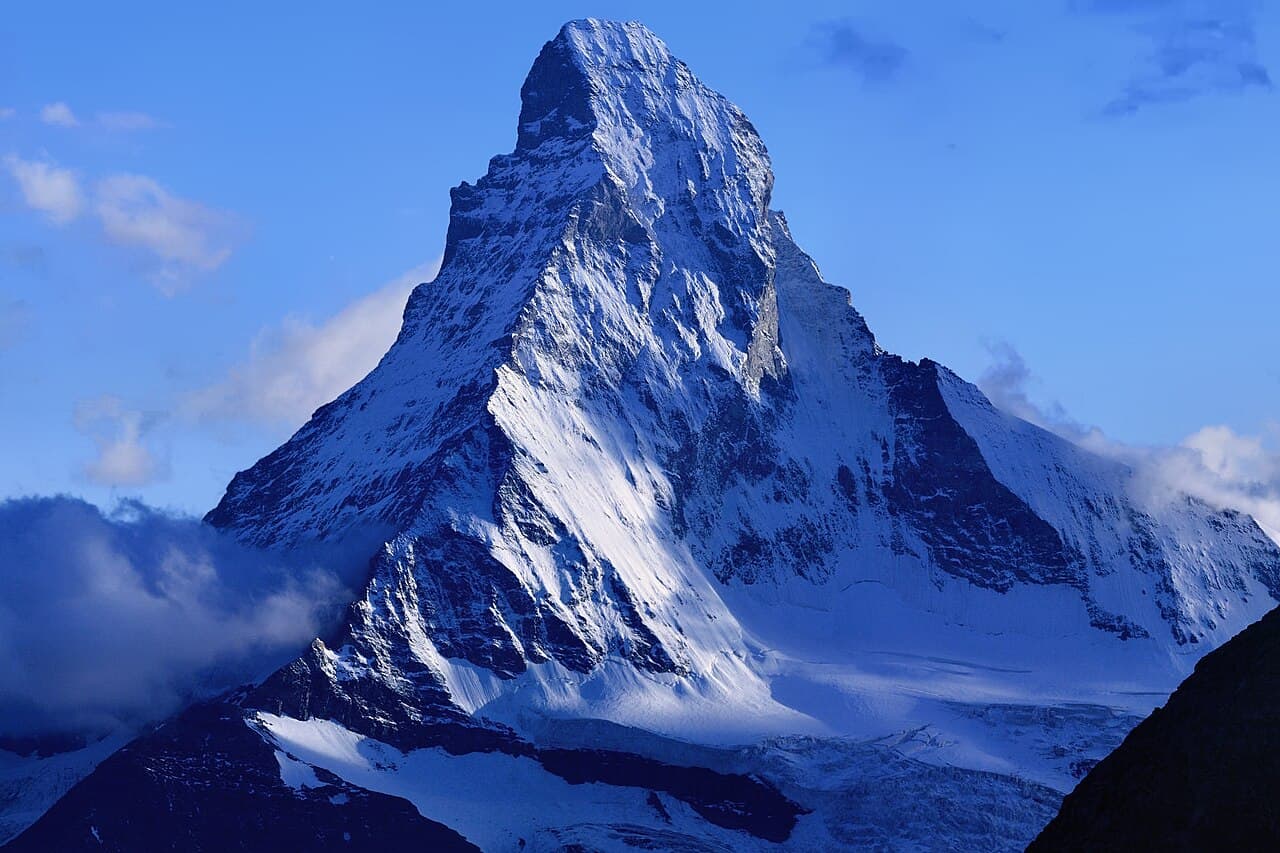
 The Matterhorn above Zermatt, in a photochrom print of the 1890s from the Photoglob company of Zürich. Public domain, via Wikimedia Commons.
Switzerland is a landlocked country of about 41,285 square kilometres in the middle of Europe, wrapped around by Germany, France, Italy, Austria and the small principality of Liechtenstein. Three landscapes divide it: the Jura ridges along the French border, the densely populated Central Plateau, or Mittelland, where most people and cities lie, and the Alps, which cover roughly three-fifths of the territory and hold 48 peaks above four thousand metres. The highest is the Dufourspitze of Monte Rosa at 4,634 metres, though the country's emblem is the sharper, lonelier Matterhorn above Zermatt. The Rhine and the Rhône both rise in the Swiss Alps and flow to opposite seas, and the meltwater lakes, Geneva, Constance, Zürich, Lucerne and Lugano among them, ring the mountains.
About 8.9 million people live here, and roughly a quarter of them are foreign nationals, one of the highest shares in Europe, a legacy of long labour migration from Italy, the Balkans, Portugal and beyond. Switzerland is a federal republic of 26 cantons, each with its own constitution, and it practises direct democracy to a degree found almost nowhere else: citizens vote several times a year on concrete questions through referendums and popular initiatives, and important matters can be forced to the ballot by gathering signatures. There is no single capital in law; Bern serves as the "federal city" and seat of government. The country has been armed and neutral since the Congress of Vienna in 1815, stayed out of both world wars, joined the United Nations only in 2002, and remains outside the European Union while sitting inside the Schengen travel area. Its official abbreviation, CH, stands for the Latin Confoederatio Helvetica, a neutral name chosen so that none of the national languages is favoured.
Zürich. The largest city and financial capital grew from a Roman customs post on the Limmat into a centre of the Reformation and then of global banking. It was here that Huldrych Zwingli preached from the Grossmünster from 1519 and set Swiss Protestantism in motion. The Swiss National Museum, in a fairy-tale castle beside the main station, holds the country's richest collection of its own past, and the city's cemeteries include the grave of James Joyce, who died in exile here in 1941.
Geneva. French-speaking Geneva was Calvin's city, the "Protestant Rome" of the sixteenth century, and became in the modern age the humanitarian capital of the world. Henry Dunant founded the Red Cross here in 1863, the League of Nations sat in the Palais des Nations, and the European seat of the United Nations, the World Health Organization and dozens of other bodies still do. The International Museum of the Red Cross and Red Crescent tells the story of aid and witness in wartime.
The Matterhorn above Zermatt, in a photochrom print of the 1890s from the Photoglob company of Zürich. Public domain, via Wikimedia Commons.
Switzerland is a landlocked country of about 41,285 square kilometres in the middle of Europe, wrapped around by Germany, France, Italy, Austria and the small principality of Liechtenstein. Three landscapes divide it: the Jura ridges along the French border, the densely populated Central Plateau, or Mittelland, where most people and cities lie, and the Alps, which cover roughly three-fifths of the territory and hold 48 peaks above four thousand metres. The highest is the Dufourspitze of Monte Rosa at 4,634 metres, though the country's emblem is the sharper, lonelier Matterhorn above Zermatt. The Rhine and the Rhône both rise in the Swiss Alps and flow to opposite seas, and the meltwater lakes, Geneva, Constance, Zürich, Lucerne and Lugano among them, ring the mountains.
About 8.9 million people live here, and roughly a quarter of them are foreign nationals, one of the highest shares in Europe, a legacy of long labour migration from Italy, the Balkans, Portugal and beyond. Switzerland is a federal republic of 26 cantons, each with its own constitution, and it practises direct democracy to a degree found almost nowhere else: citizens vote several times a year on concrete questions through referendums and popular initiatives, and important matters can be forced to the ballot by gathering signatures. There is no single capital in law; Bern serves as the "federal city" and seat of government. The country has been armed and neutral since the Congress of Vienna in 1815, stayed out of both world wars, joined the United Nations only in 2002, and remains outside the European Union while sitting inside the Schengen travel area. Its official abbreviation, CH, stands for the Latin Confoederatio Helvetica, a neutral name chosen so that none of the national languages is favoured.
Zürich. The largest city and financial capital grew from a Roman customs post on the Limmat into a centre of the Reformation and then of global banking. It was here that Huldrych Zwingli preached from the Grossmünster from 1519 and set Swiss Protestantism in motion. The Swiss National Museum, in a fairy-tale castle beside the main station, holds the country's richest collection of its own past, and the city's cemeteries include the grave of James Joyce, who died in exile here in 1941.
Geneva. French-speaking Geneva was Calvin's city, the "Protestant Rome" of the sixteenth century, and became in the modern age the humanitarian capital of the world. Henry Dunant founded the Red Cross here in 1863, the League of Nations sat in the Palais des Nations, and the European seat of the United Nations, the World Health Organization and dozens of other bodies still do. The International Museum of the Red Cross and Red Crescent tells the story of aid and witness in wartime.
 The town hall of Bern, seat of the city's government since the fifteenth century, in a photochrom print of about 1900. Public domain, via Wikimedia Commons.
Bern. The federal city, founded by the Zähringen dukes in 1191, keeps one of the best-preserved medieval town centres in Europe, six kilometres of covered arcades along sandstone streets in a loop of the river Aare. The astronomical Zytglogge clock has marked the hours since the Middle Ages, and the old town has been a UNESCO World Heritage Site since 1983. Albert Einstein worked out the special theory of relativity in 1905 while employed at the Bern patent office, and his flat on Kramgasse is now a museum.
Basel. On the Rhine at the corner where Switzerland, France and Germany meet, Basel is the country's cultural and pharmaceutical capital, home to Roche and Novartis and to the oldest university in Switzerland, founded in 1460. Its Kunstmuseum holds the world's oldest municipal art collection, open to the public since 1661, and its pre-Lenten Fasnacht carnival is inscribed on UNESCO's list of intangible heritage.
Lucerne. Set where the river Reuss leaves the lake beneath Mount Pilatus, Lucerne keeps the Kapellbrücke, a covered wooden footbridge first built around 1365 and hung with painted panels, the oldest such bridge in Europe despite a fire in 1993. Above the town lies the Lion Monument, and the city's long association with music continues at the Lucerne Festival, one of the great events of the European concert calendar.
The Celtic Helvetii who gave Switzerland its Latin name were subdued by Rome in the first century BC, and Roman Helvetia left towns such as Aventicum, near modern Avenches, with its amphitheatre still standing. In the Middle Ages the land was carved among the Habsburgs, the Savoyards, prince-bishops and mountain communes. The founding legend of the country places its birth in 1291, when men of Uri, Schwyz and Unterwalden are said to have sworn a pact of mutual defence on the meadow of Rütli above Lake Lucerne; the Federal Charter of that year survives, and the tale of the marksman William Tell, who shot an apple from his son's head and killed the tyrant Gessler, grew around it. Whatever the truth of the legend, the confederation was real, and it grew by conquest and alliance from three cantons to thirteen, with famous victories over Habsburg armies at Morgarten in 1315 and Sempach in 1386 that made Swiss pikemen the most feared infantry in Europe.
That military reputation became an industry. For three centuries Swiss men hired themselves out as mercenaries to the kings of France, the Pope and other powers, and the trade in soldiers was one of the poor confederation's chief sources of income; the papal Swiss Guard, founded in 1506, is its last surviving remnant. The Reformation split the country in the 1520s, Zwingli's Zürich and Calvin's Geneva against the Catholic mountain cantons, and the wars of religion left a patchwork of confessions that still maps onto the cantons today. The Peace of Westphalia formally recognised Swiss independence from the Holy Roman Empire in 1648. Napoleon swept the old order away with the short-lived Helvetic Republic of 1798, but the Congress of Vienna restored the confederation in 1815 and guaranteed its perpetual neutrality. A brief civil war, the Sonderbund conflict of 1847, ended in weeks and produced the federal constitution of 1848 that turned a loose league into a modern federal state. In 1863 a Geneva businessman named Henry Dunant, shaken by the carnage he had seen at the Battle of Solferino, founded the International Committee of the Red Cross, and the first Geneva Convention followed in 1864, giving the neutral country a new and lasting vocation.
The English name Switzerland and the German Schweiz both derive from Schwyz, one of the three founding cantons, whose name spread to the whole confederation. The Latin Helvetia, from the Helvetii, survives on coins, stamps and the country code CH precisely because it belongs to no living language and so offends none. For Switzerland has four national languages, and manages them with characteristic care. German is spoken by about 62 per cent of the population, French by around 23 per cent in the west, Italian by some 8 per cent in the south around Ticino, and Romansh, a Romance language descended from the Latin of Roman soldiers and traders, by fewer than 40,000 people in the mountain valleys of Graubünden. Romansh was recognised as a national language by popular vote in 1938 and made a partial official language in 1996, and it survives in several written dialects and a standardised form, Rumantsch Grischun.
The everyday reality is subtler still. German-speaking Switzerland lives in diglossia: people write standard German but speak Swiss German dialects, Schwyzerdütsch, so different from the standard that they carry subtitles on German television. The map of place names records the country's layers, Celtic and Roman roots in the west and south, Alemannic German names across the plateau, Romansh names such as Chur and Scuol in the east, and the Walser German villages high in valleys settled by migrants from the Valais in the Middle Ages. This multilingual settlement is not treated as a problem to be solved but as the constitutional basis of the state, and the willkommen, bienvenue, benvenuto, bainvegni greeting is a small daily statement of what Switzerland understands itself to be.
Swiss culture is federal to its core, more a set of strong local identities held in balance than a single national style. It is a country of associations and clubs, of shooting societies and choral unions and gymnastics federations, where civic life is built from the ground up. The cantons run their own schools, and even the national sport, Schwingen, a form of wrestling in sawdust rings performed in rolled-up trousers, belongs to the world of alpine festivals rather than stadiums, culminating every three years in the vast Eidgenössisches Schwing- und Älplerfest. The alphorn, the flag-throwing, the yodel and the cattle-driving to and from the high pastures are living rural customs as much as tourist images, and the descent of the decorated cows from the alps each autumn, the Alpabzug, still stops traffic in mountain villages.
Food maps the language borders. The fondue and raclette of the melted-cheese tradition, the rösti of the German-speaking plateau (the "Röstigraben", the rösti ditch, is the half-joking name for the cultural line between German and French Switzerland), the risotto and polenta of Ticino, and the chocolate that Swiss makers turned into an art from the nineteenth century, when Daniel Peter invented milk chocolate in 1875, are all part of the national table. In the arts Switzerland has given the world the sculptor Alberto Giacometti, the Dada movement born at the Cabaret Voltaire in Zürich in 1916, the painter Paul Klee, whose Zentrum Paul Klee in Bern holds the largest collection of his work, the architect Le Corbusier, born in La Chaux-de-Fonds, and the kinetic sculptor Jean Tinguely. And it produced Heidi, Johanna Spyri's 1881 orphan of the alps, perhaps the most translated Swiss creation of all.
Christianity in Switzerland runs deep and split. The early Middle Ages saw Irish and other missionaries found monasteries that became engines of learning: Saint Gall, the Irish monk who gave his name to the Abbey of St Gall around the seventh century, and the great Benedictine houses of Einsiedeln, Engelberg and Disentis. The Abbey Library of St Gall, a rococo hall holding manuscripts more than a thousand years old, is one of the oldest libraries in the world and a UNESCO World Heritage Site. The Reformation then broke the country along lines that still hold. Zwingli made Zürich Protestant from 1519; Calvin made Geneva a model reformed city from 1541, drawing exiles from across Europe; and the rural Catholic cantons of the centre held to Rome, so that confession and canton became closely tied.
Today Switzerland is both plural and increasingly secular. Roughly a third of the population is Roman Catholic and around a fifth belongs to the Reformed Protestant churches, but the fastest-growing group reports no religious affiliation at all, now approaching a third, and Muslims make up about 5 per cent, largely from the Balkans and Turkey. Church and state relations vary canton by canton, with several cantons still levying a church tax. Older devotion persists at pilgrimage sites: the Benedictine abbey of Einsiedeln, whose Black Madonna draws pilgrims on the road to Santiago, and the shrine of Sachseln in Obwalden, dedicated to Niklaus von Flüe, the fifteenth-century hermit and mystic known as Brother Klaus, patron saint of Switzerland, whose counsel is credited with holding the confederation together in 1481.
Switzerland remembers its dead in ways shaped by an unusual fact: it has not fought a foreign war since Napoleon's time. There are no fields of war graves here and no generation lost to the Somme, and so remembrance has taken more intimate and more practical forms. Swiss funeral custom is overwhelmingly Christian in form and, more than almost anywhere, favours cremation. The country was an early adopter of the practice: the first crematorium opened in Zürich in 1889, when cremation was still fiercely opposed elsewhere on religious grounds, and today more than 85 per cent of Swiss dead are cremated, one of the highest rates in the world. The dominant custom of the shared grave and the leased plot follows from the pressure on space in a mountainous, densely built country: a burial plot is granted for a fixed term, commonly around 20 to 25 years of grave-peace, the Grabesruhe, after which the grave is cleared and the ground reused. The effect is that Swiss cemeteries are gardens of the recently dead rather than permanent stone archives, and mourning is understood as something that runs its course and then releases the ground back to the living.
The calendar carries the older rhythms of remembrance. In the Catholic cantons All Saints' Day on 1 November and the following All Souls' Day are the great days of the graves, when families clean the plots, lay chrysanthemums and light candles so that whole cemeteries glow after dark. Public memory attaches less to war than to civic deliverance. Geneva keeps the Escalade every 11 and 12 December, commemorating the night in 1602 when the city repelled a surprise attack by the Duke of Savoy's troops; children in costume parade, a cauldron-shaped chocolate is smashed, and the story of Mère Royaume, who is said to have poured a pot of hot vegetable soup on a scaling soldier, is retold each year. Zürich burns winter in effigy at the Sechseläuten each April, when the Böögg, a snowman stuffed with fireworks, is set alight and the guilds parade. And the Lion of Lucerne remains the country's most solemn monument, mourning the Swiss Guards of 1792 and, by extension, the tens of thousands of Swiss mercenaries who died in foreign service over the centuries, a memory the country has never quite settled with.
The town hall of Bern, seat of the city's government since the fifteenth century, in a photochrom print of about 1900. Public domain, via Wikimedia Commons.
Bern. The federal city, founded by the Zähringen dukes in 1191, keeps one of the best-preserved medieval town centres in Europe, six kilometres of covered arcades along sandstone streets in a loop of the river Aare. The astronomical Zytglogge clock has marked the hours since the Middle Ages, and the old town has been a UNESCO World Heritage Site since 1983. Albert Einstein worked out the special theory of relativity in 1905 while employed at the Bern patent office, and his flat on Kramgasse is now a museum.
Basel. On the Rhine at the corner where Switzerland, France and Germany meet, Basel is the country's cultural and pharmaceutical capital, home to Roche and Novartis and to the oldest university in Switzerland, founded in 1460. Its Kunstmuseum holds the world's oldest municipal art collection, open to the public since 1661, and its pre-Lenten Fasnacht carnival is inscribed on UNESCO's list of intangible heritage.
Lucerne. Set where the river Reuss leaves the lake beneath Mount Pilatus, Lucerne keeps the Kapellbrücke, a covered wooden footbridge first built around 1365 and hung with painted panels, the oldest such bridge in Europe despite a fire in 1993. Above the town lies the Lion Monument, and the city's long association with music continues at the Lucerne Festival, one of the great events of the European concert calendar.
The Celtic Helvetii who gave Switzerland its Latin name were subdued by Rome in the first century BC, and Roman Helvetia left towns such as Aventicum, near modern Avenches, with its amphitheatre still standing. In the Middle Ages the land was carved among the Habsburgs, the Savoyards, prince-bishops and mountain communes. The founding legend of the country places its birth in 1291, when men of Uri, Schwyz and Unterwalden are said to have sworn a pact of mutual defence on the meadow of Rütli above Lake Lucerne; the Federal Charter of that year survives, and the tale of the marksman William Tell, who shot an apple from his son's head and killed the tyrant Gessler, grew around it. Whatever the truth of the legend, the confederation was real, and it grew by conquest and alliance from three cantons to thirteen, with famous victories over Habsburg armies at Morgarten in 1315 and Sempach in 1386 that made Swiss pikemen the most feared infantry in Europe.
That military reputation became an industry. For three centuries Swiss men hired themselves out as mercenaries to the kings of France, the Pope and other powers, and the trade in soldiers was one of the poor confederation's chief sources of income; the papal Swiss Guard, founded in 1506, is its last surviving remnant. The Reformation split the country in the 1520s, Zwingli's Zürich and Calvin's Geneva against the Catholic mountain cantons, and the wars of religion left a patchwork of confessions that still maps onto the cantons today. The Peace of Westphalia formally recognised Swiss independence from the Holy Roman Empire in 1648. Napoleon swept the old order away with the short-lived Helvetic Republic of 1798, but the Congress of Vienna restored the confederation in 1815 and guaranteed its perpetual neutrality. A brief civil war, the Sonderbund conflict of 1847, ended in weeks and produced the federal constitution of 1848 that turned a loose league into a modern federal state. In 1863 a Geneva businessman named Henry Dunant, shaken by the carnage he had seen at the Battle of Solferino, founded the International Committee of the Red Cross, and the first Geneva Convention followed in 1864, giving the neutral country a new and lasting vocation.
The English name Switzerland and the German Schweiz both derive from Schwyz, one of the three founding cantons, whose name spread to the whole confederation. The Latin Helvetia, from the Helvetii, survives on coins, stamps and the country code CH precisely because it belongs to no living language and so offends none. For Switzerland has four national languages, and manages them with characteristic care. German is spoken by about 62 per cent of the population, French by around 23 per cent in the west, Italian by some 8 per cent in the south around Ticino, and Romansh, a Romance language descended from the Latin of Roman soldiers and traders, by fewer than 40,000 people in the mountain valleys of Graubünden. Romansh was recognised as a national language by popular vote in 1938 and made a partial official language in 1996, and it survives in several written dialects and a standardised form, Rumantsch Grischun.
The everyday reality is subtler still. German-speaking Switzerland lives in diglossia: people write standard German but speak Swiss German dialects, Schwyzerdütsch, so different from the standard that they carry subtitles on German television. The map of place names records the country's layers, Celtic and Roman roots in the west and south, Alemannic German names across the plateau, Romansh names such as Chur and Scuol in the east, and the Walser German villages high in valleys settled by migrants from the Valais in the Middle Ages. This multilingual settlement is not treated as a problem to be solved but as the constitutional basis of the state, and the willkommen, bienvenue, benvenuto, bainvegni greeting is a small daily statement of what Switzerland understands itself to be.
Swiss culture is federal to its core, more a set of strong local identities held in balance than a single national style. It is a country of associations and clubs, of shooting societies and choral unions and gymnastics federations, where civic life is built from the ground up. The cantons run their own schools, and even the national sport, Schwingen, a form of wrestling in sawdust rings performed in rolled-up trousers, belongs to the world of alpine festivals rather than stadiums, culminating every three years in the vast Eidgenössisches Schwing- und Älplerfest. The alphorn, the flag-throwing, the yodel and the cattle-driving to and from the high pastures are living rural customs as much as tourist images, and the descent of the decorated cows from the alps each autumn, the Alpabzug, still stops traffic in mountain villages.
Food maps the language borders. The fondue and raclette of the melted-cheese tradition, the rösti of the German-speaking plateau (the "Röstigraben", the rösti ditch, is the half-joking name for the cultural line between German and French Switzerland), the risotto and polenta of Ticino, and the chocolate that Swiss makers turned into an art from the nineteenth century, when Daniel Peter invented milk chocolate in 1875, are all part of the national table. In the arts Switzerland has given the world the sculptor Alberto Giacometti, the Dada movement born at the Cabaret Voltaire in Zürich in 1916, the painter Paul Klee, whose Zentrum Paul Klee in Bern holds the largest collection of his work, the architect Le Corbusier, born in La Chaux-de-Fonds, and the kinetic sculptor Jean Tinguely. And it produced Heidi, Johanna Spyri's 1881 orphan of the alps, perhaps the most translated Swiss creation of all.
Christianity in Switzerland runs deep and split. The early Middle Ages saw Irish and other missionaries found monasteries that became engines of learning: Saint Gall, the Irish monk who gave his name to the Abbey of St Gall around the seventh century, and the great Benedictine houses of Einsiedeln, Engelberg and Disentis. The Abbey Library of St Gall, a rococo hall holding manuscripts more than a thousand years old, is one of the oldest libraries in the world and a UNESCO World Heritage Site. The Reformation then broke the country along lines that still hold. Zwingli made Zürich Protestant from 1519; Calvin made Geneva a model reformed city from 1541, drawing exiles from across Europe; and the rural Catholic cantons of the centre held to Rome, so that confession and canton became closely tied.
Today Switzerland is both plural and increasingly secular. Roughly a third of the population is Roman Catholic and around a fifth belongs to the Reformed Protestant churches, but the fastest-growing group reports no religious affiliation at all, now approaching a third, and Muslims make up about 5 per cent, largely from the Balkans and Turkey. Church and state relations vary canton by canton, with several cantons still levying a church tax. Older devotion persists at pilgrimage sites: the Benedictine abbey of Einsiedeln, whose Black Madonna draws pilgrims on the road to Santiago, and the shrine of Sachseln in Obwalden, dedicated to Niklaus von Flüe, the fifteenth-century hermit and mystic known as Brother Klaus, patron saint of Switzerland, whose counsel is credited with holding the confederation together in 1481.
Switzerland remembers its dead in ways shaped by an unusual fact: it has not fought a foreign war since Napoleon's time. There are no fields of war graves here and no generation lost to the Somme, and so remembrance has taken more intimate and more practical forms. Swiss funeral custom is overwhelmingly Christian in form and, more than almost anywhere, favours cremation. The country was an early adopter of the practice: the first crematorium opened in Zürich in 1889, when cremation was still fiercely opposed elsewhere on religious grounds, and today more than 85 per cent of Swiss dead are cremated, one of the highest rates in the world. The dominant custom of the shared grave and the leased plot follows from the pressure on space in a mountainous, densely built country: a burial plot is granted for a fixed term, commonly around 20 to 25 years of grave-peace, the Grabesruhe, after which the grave is cleared and the ground reused. The effect is that Swiss cemeteries are gardens of the recently dead rather than permanent stone archives, and mourning is understood as something that runs its course and then releases the ground back to the living.
The calendar carries the older rhythms of remembrance. In the Catholic cantons All Saints' Day on 1 November and the following All Souls' Day are the great days of the graves, when families clean the plots, lay chrysanthemums and light candles so that whole cemeteries glow after dark. Public memory attaches less to war than to civic deliverance. Geneva keeps the Escalade every 11 and 12 December, commemorating the night in 1602 when the city repelled a surprise attack by the Duke of Savoy's troops; children in costume parade, a cauldron-shaped chocolate is smashed, and the story of Mère Royaume, who is said to have poured a pot of hot vegetable soup on a scaling soldier, is retold each year. Zürich burns winter in effigy at the Sechseläuten each April, when the Böögg, a snowman stuffed with fireworks, is set alight and the guilds parade. And the Lion of Lucerne remains the country's most solemn monument, mourning the Swiss Guards of 1792 and, by extension, the tens of thousands of Swiss mercenaries who died in foreign service over the centuries, a memory the country has never quite settled with.
 The Lion Monument in Lucerne, carved 1820–21 to commemorate the Swiss Guards killed in 1792, in a photochrom print of about 1900. Public domain, via Wikimedia Commons.
Switzerland's neutrality has also made it a keeper of other nations' grief. As the home of the International Committee of the Red Cross, Geneva has run the Central Tracing Agency through two world wars and countless later conflicts, holding tens of millions of index cards that reunite families and confirm the fates of prisoners and the missing, and the modern practice of accounting for the war dead and the disappeared owes much to this quiet Swiss archive. The country's own most distinctive contribution to the culture of death, though, is more contested: since a court ruling and long-standing law made assisted suicide lawful where the motive is not selfish, organisations such as Exit and Dignitas have made Switzerland a place where the terminally ill, including foreigners, come to choose the timing of their deaths, and the national conversation about a good death is unusually open as a result.
Swiss records are organised around a concept no other country uses in quite the same way: the Heimatort, the place of origin. A Swiss citizen belongs to a commune, and belongs to it whether or not they or their parents or their grandparents ever lived there. The family register, the Familienregister, is kept by that commune, and it follows the family down the generations regardless of where they actually are.
This is either the single greatest convenience in European genealogy or an impassable wall, depending on whether you know the Heimatort. If you do, one commune holds the family. If you do not, there is no national index of surnames to help you find it, and the search runs through emigration papers, military records and whatever the family carried abroad.
Civil registration began nationally in 1876. Before that the parish registers carry it, from the sixteenth century in many places, Reformed in some cantons and Catholic in others, with the cantonal archives holding what the parishes no longer do.
The Swiss also produced a genealogical dictionary of unusual ambition, the Historical Dictionary of Switzerland, and a long tradition of published family histories, because bourgeois families in the old cities documented themselves thoroughly. And for the roughly half a million Swiss who emigrated in the nineteenth century, the commune usually knew: leaving often required the commune's permission and its financial release, and the paperwork stayed at home.
Switzerland began organising to protect its heritage early. The Swiss Heritage Society, Schweizer Heimatschutz, was founded in 1905 to defend historic buildings and landscapes, and it still awards the Wakker Prize each year to a commune for exemplary care of its built environment, a coveted civic honour. Protection is shared, as everything in Switzerland is, between the Confederation and the cantons: the Federal Office of Culture oversees national policy and the inventory of sites of national importance, while each canton runs its own heritage office. The Swiss National Museum, with its main house in Zürich and branches at Prangins and Schwyz, gathers the material culture of the country, and the Swiss Federal Archives in Bern keep the records of the modern federal state.
The country's most visited historic monument, the Château de Chillon on a rock in Lake Geneva near Montreux, immortalised by Byron's 1816 poem "The Prisoner of Chillon" after he saw the dungeon where the patriot François Bonivard had been chained, is kept by an independent foundation and draws several hundred thousand visitors a year, an early example of the Swiss habit of entrusting a monument to a dedicated body rather than leaving it to the state alone.
The Lion Monument in Lucerne, carved 1820–21 to commemorate the Swiss Guards killed in 1792, in a photochrom print of about 1900. Public domain, via Wikimedia Commons.
Switzerland's neutrality has also made it a keeper of other nations' grief. As the home of the International Committee of the Red Cross, Geneva has run the Central Tracing Agency through two world wars and countless later conflicts, holding tens of millions of index cards that reunite families and confirm the fates of prisoners and the missing, and the modern practice of accounting for the war dead and the disappeared owes much to this quiet Swiss archive. The country's own most distinctive contribution to the culture of death, though, is more contested: since a court ruling and long-standing law made assisted suicide lawful where the motive is not selfish, organisations such as Exit and Dignitas have made Switzerland a place where the terminally ill, including foreigners, come to choose the timing of their deaths, and the national conversation about a good death is unusually open as a result.
Swiss records are organised around a concept no other country uses in quite the same way: the Heimatort, the place of origin. A Swiss citizen belongs to a commune, and belongs to it whether or not they or their parents or their grandparents ever lived there. The family register, the Familienregister, is kept by that commune, and it follows the family down the generations regardless of where they actually are.
This is either the single greatest convenience in European genealogy or an impassable wall, depending on whether you know the Heimatort. If you do, one commune holds the family. If you do not, there is no national index of surnames to help you find it, and the search runs through emigration papers, military records and whatever the family carried abroad.
Civil registration began nationally in 1876. Before that the parish registers carry it, from the sixteenth century in many places, Reformed in some cantons and Catholic in others, with the cantonal archives holding what the parishes no longer do.
The Swiss also produced a genealogical dictionary of unusual ambition, the Historical Dictionary of Switzerland, and a long tradition of published family histories, because bourgeois families in the old cities documented themselves thoroughly. And for the roughly half a million Swiss who emigrated in the nineteenth century, the commune usually knew: leaving often required the commune's permission and its financial release, and the paperwork stayed at home.
Switzerland began organising to protect its heritage early. The Swiss Heritage Society, Schweizer Heimatschutz, was founded in 1905 to defend historic buildings and landscapes, and it still awards the Wakker Prize each year to a commune for exemplary care of its built environment, a coveted civic honour. Protection is shared, as everything in Switzerland is, between the Confederation and the cantons: the Federal Office of Culture oversees national policy and the inventory of sites of national importance, while each canton runs its own heritage office. The Swiss National Museum, with its main house in Zürich and branches at Prangins and Schwyz, gathers the material culture of the country, and the Swiss Federal Archives in Bern keep the records of the modern federal state.
The country's most visited historic monument, the Château de Chillon on a rock in Lake Geneva near Montreux, immortalised by Byron's 1816 poem "The Prisoner of Chillon" after he saw the dungeon where the patriot François Bonivard had been chained, is kept by an independent foundation and draws several hundred thousand visitors a year, an early example of the Swiss habit of entrusting a monument to a dedicated body rather than leaving it to the state alone.
 The Château de Chillon on Lake Geneva, Switzerland's most visited historic building, in a photochrom print of about 1900. Public domain, via Wikimedia Commons.
The country holds 13 UNESCO World Heritage Sites, and they capture its range: the medieval Old City of Bern; the Abbey of St Gall with its library; the Benedictine Convent of St John at Müstair, with Carolingian frescoes from around 800; the three castles of Bellinzona; the Jungfrau-Aletsch glacier region; the terraced vineyards of Lavaux above Lake Geneva, worked since the eleventh century; the Rhaetian Railway through the Albula and Bernina passes; the watchmaking towns of La Chaux-de-Fonds and Le Locle; and, as parts of transnational listings, the prehistoric pile dwellings around the alpine lakes, the works of Le Corbusier, and the ancient beech forests. The pile-dwelling sites, submerged wooden villages of the Neolithic and Bronze Age preserved in lake mud, have made Switzerland a world centre of wetland archaeology.
For a small country Switzerland has built a formidable digital record. The jewel is e-codices, the Virtual Manuscript Library of Switzerland, coordinated from Fribourg, which has digitised thousands of medieval and early modern manuscripts from the abbey library of St Gall and dozens of other collections, opening to scholars everywhere books once locked in monastery cupboards. The Swiss Federal Archives and the cantonal archives have put growing masses of their holdings online, and e-newspaperarchives.ch, run by the Swiss National Library, offers searchable runs of historic newspapers in all the national languages. Memoriav, the national association for the audiovisual heritage, coordinates the rescue of film, photographs and sound recordings and makes selections available through its Memobase portal.
Family history is served by the deep continuity of Swiss record-keeping. The parish and civil registers, kept meticulously by canton and commune, together with the citizen registers that record every Swiss person's place of origin, the Heimatort or lieu d'origine to which citizenship is tied rather than to a birthplace, make Swiss genealogy unusually traceable, and many of these records have been digitised with FamilySearch and the cantonal archives. The ICRC's Geneva archives, opened in stages under strict rules, have made the tracing records of both world wars available to families seeking the fate of the interned and the missing, a digital extension of the humanitarian mission the country has carried since 1863.
Modern Switzerland exports far more than its size suggests. Its watchmakers, from Patek Philippe and Rolex to the Swatch that saved the industry in the 1980s, remain the world's benchmark for precision; its banks and its chocolate and its cheeses are global shorthand for the country; and CERN, on the border near Geneva, is where the web was invented in 1989 and where the Higgs boson was found in 2012. In sport the tennis player Roger Federer became one of the most admired athletes of his generation, and the ski resorts of the Valais and Graubünden helped invent alpine tourism itself. Swiss design, from Helvetica type to railway clocks and the clean international style of its graphic artists, shaped the twentieth-century eye.
The living culture argues with its own past as much as any. Switzerland has reckoned in recent decades with uncomfortable histories, from the dormant bank accounts of Holocaust victims, settled after a major inquiry in the 1990s, to its wartime refugee policy. Its literature in four languages, from Friedrich Dürrenmatt and Max Frisch to the French-Swiss writers of the Suisse romande, keeps a sharp, self-questioning tone. Immigration has remade the cities, so that a Zürich or a Basel street carries Balkan, Portuguese, Tamil and Turkish life alongside the Swiss, and the annual debates and referendums over integration, naturalisation and identity are conducted, as everything here is, at the ballot box.
A committee that became a movement. In 1863 Henry Dunant and four fellow Genevans founded what became the International Committee of the Red Cross, and within a year the first Geneva Convention had bound states to protect the wounded and those who tend them. The white flag with the red cross, the Swiss flag reversed, is now among the most recognised symbols on earth, and Geneva remains the capital of the laws of war and of humanitarian witness.
The library that survived the centuries. The Abbey Library of St Gall, founded in the eighth century, kept its manuscripts through the dissolution of the monastery and the upheavals of the modern age, and its collection of Carolingian and medieval books, inscribed as World Heritage in 1983, is now being shared with the world page by page through the e-codices project, so that texts once seen by a handful of monks can be read on any screen.
A railway made heritage. The Rhaetian Railway's Albula and Bernina lines, opened between 1904 and 1910 across viaducts and spiral tunnels through the high Alps, were inscribed by UNESCO in 2008 as a masterpiece of landscape engineering, and they still run as a working narrow-gauge railway, proof that infrastructure built for daily use can become a monument without ceasing to serve.
The soup and the story. Geneva's Escalade, marking the failed Savoyard assault of December 1602, has been kept every year for four centuries, one of Europe's longest continuous civic commemorations, showing how a city can carry a single night of danger in living memory generation after generation through parade, song and a pot of soup rendered in chocolate.
Accounting for the vulnerable. After decades of silence, Switzerland faced the history of its Verdingkinder, the indentured foster children of the nineteenth and twentieth centuries, with a national apology in 2013, a reparations fund and an official research programme, turning a hidden chapter into documented public memory and a model of how a country can confront harm done to its own.
The Château de Chillon on Lake Geneva, Switzerland's most visited historic building, in a photochrom print of about 1900. Public domain, via Wikimedia Commons.
The country holds 13 UNESCO World Heritage Sites, and they capture its range: the medieval Old City of Bern; the Abbey of St Gall with its library; the Benedictine Convent of St John at Müstair, with Carolingian frescoes from around 800; the three castles of Bellinzona; the Jungfrau-Aletsch glacier region; the terraced vineyards of Lavaux above Lake Geneva, worked since the eleventh century; the Rhaetian Railway through the Albula and Bernina passes; the watchmaking towns of La Chaux-de-Fonds and Le Locle; and, as parts of transnational listings, the prehistoric pile dwellings around the alpine lakes, the works of Le Corbusier, and the ancient beech forests. The pile-dwelling sites, submerged wooden villages of the Neolithic and Bronze Age preserved in lake mud, have made Switzerland a world centre of wetland archaeology.
For a small country Switzerland has built a formidable digital record. The jewel is e-codices, the Virtual Manuscript Library of Switzerland, coordinated from Fribourg, which has digitised thousands of medieval and early modern manuscripts from the abbey library of St Gall and dozens of other collections, opening to scholars everywhere books once locked in monastery cupboards. The Swiss Federal Archives and the cantonal archives have put growing masses of their holdings online, and e-newspaperarchives.ch, run by the Swiss National Library, offers searchable runs of historic newspapers in all the national languages. Memoriav, the national association for the audiovisual heritage, coordinates the rescue of film, photographs and sound recordings and makes selections available through its Memobase portal.
Family history is served by the deep continuity of Swiss record-keeping. The parish and civil registers, kept meticulously by canton and commune, together with the citizen registers that record every Swiss person's place of origin, the Heimatort or lieu d'origine to which citizenship is tied rather than to a birthplace, make Swiss genealogy unusually traceable, and many of these records have been digitised with FamilySearch and the cantonal archives. The ICRC's Geneva archives, opened in stages under strict rules, have made the tracing records of both world wars available to families seeking the fate of the interned and the missing, a digital extension of the humanitarian mission the country has carried since 1863.
Modern Switzerland exports far more than its size suggests. Its watchmakers, from Patek Philippe and Rolex to the Swatch that saved the industry in the 1980s, remain the world's benchmark for precision; its banks and its chocolate and its cheeses are global shorthand for the country; and CERN, on the border near Geneva, is where the web was invented in 1989 and where the Higgs boson was found in 2012. In sport the tennis player Roger Federer became one of the most admired athletes of his generation, and the ski resorts of the Valais and Graubünden helped invent alpine tourism itself. Swiss design, from Helvetica type to railway clocks and the clean international style of its graphic artists, shaped the twentieth-century eye.
The living culture argues with its own past as much as any. Switzerland has reckoned in recent decades with uncomfortable histories, from the dormant bank accounts of Holocaust victims, settled after a major inquiry in the 1990s, to its wartime refugee policy. Its literature in four languages, from Friedrich Dürrenmatt and Max Frisch to the French-Swiss writers of the Suisse romande, keeps a sharp, self-questioning tone. Immigration has remade the cities, so that a Zürich or a Basel street carries Balkan, Portuguese, Tamil and Turkish life alongside the Swiss, and the annual debates and referendums over integration, naturalisation and identity are conducted, as everything here is, at the ballot box.
A committee that became a movement. In 1863 Henry Dunant and four fellow Genevans founded what became the International Committee of the Red Cross, and within a year the first Geneva Convention had bound states to protect the wounded and those who tend them. The white flag with the red cross, the Swiss flag reversed, is now among the most recognised symbols on earth, and Geneva remains the capital of the laws of war and of humanitarian witness.
The library that survived the centuries. The Abbey Library of St Gall, founded in the eighth century, kept its manuscripts through the dissolution of the monastery and the upheavals of the modern age, and its collection of Carolingian and medieval books, inscribed as World Heritage in 1983, is now being shared with the world page by page through the e-codices project, so that texts once seen by a handful of monks can be read on any screen.
A railway made heritage. The Rhaetian Railway's Albula and Bernina lines, opened between 1904 and 1910 across viaducts and spiral tunnels through the high Alps, were inscribed by UNESCO in 2008 as a masterpiece of landscape engineering, and they still run as a working narrow-gauge railway, proof that infrastructure built for daily use can become a monument without ceasing to serve.
The soup and the story. Geneva's Escalade, marking the failed Savoyard assault of December 1602, has been kept every year for four centuries, one of Europe's longest continuous civic commemorations, showing how a city can carry a single night of danger in living memory generation after generation through parade, song and a pot of soup rendered in chocolate.
Accounting for the vulnerable. After decades of silence, Switzerland faced the history of its Verdingkinder, the indentured foster children of the nineteenth and twentieth centuries, with a national apology in 2013, a reparations fund and an official research programme, turning a hidden chapter into documented public memory and a model of how a country can confront harm done to its own.
National Overview
Notable Cities
Historical Foundations
Linguistic and Etymological Roots
Cultural Identity
Religion and Spirituality
Remembrance and Mourning Traditions
Tracing a Family in Switzerland
Heritage Preservation Efforts
Digital Heritage
Contemporary Cultural Influences
Success Stories
References and resources
- UNESCO World Heritage Centre, Switzerland, the state-party page listing all 13 Swiss World Heritage sites, from Bern to the Rhaetian Railway.
- Swiss National Museum, the country's principal museum of its own history, art and material culture.
- Swiss Federal Archives, the records of the modern Swiss federal state since 1848.
- e-codices, Virtual Manuscript Library of Switzerland, thousands of digitised medieval and early modern manuscripts, including the St Gall collection.
- International Committee of the Red Cross, the Geneva-based humanitarian organisation founded in 1863 and its archives of the war dead and missing.
- Schweizer Heimatschutz (Swiss Heritage Society), the conservation body founded in 1905 and awarder of the annual Wakker Prize.
- Memoriav, the national association for preserving Switzerland's audiovisual heritage, and its Memobase portal.
- Abbey Library of Saint Gall, one of the world's oldest libraries, a UNESCO World Heritage Site.
- Encyclopaedia Britannica, Switzerland, geography, history, languages and government.