Heritage · Country
Kosovo Culture and Heritage
In the old town of Prizren an Ottoman mosque and a medieval Serbian Orthodox church share one narrow river valley, and threads of silver filigree are still twisted by hand. This is a guide to Kosovo's cultural, religious and architectural heritage, and to the customs by which its communities remember their dead.Written to last.
By Confinity Heritage Editorial · Updated 2026-07-31 · 8-minute readQuiet tools, kept out of the way.
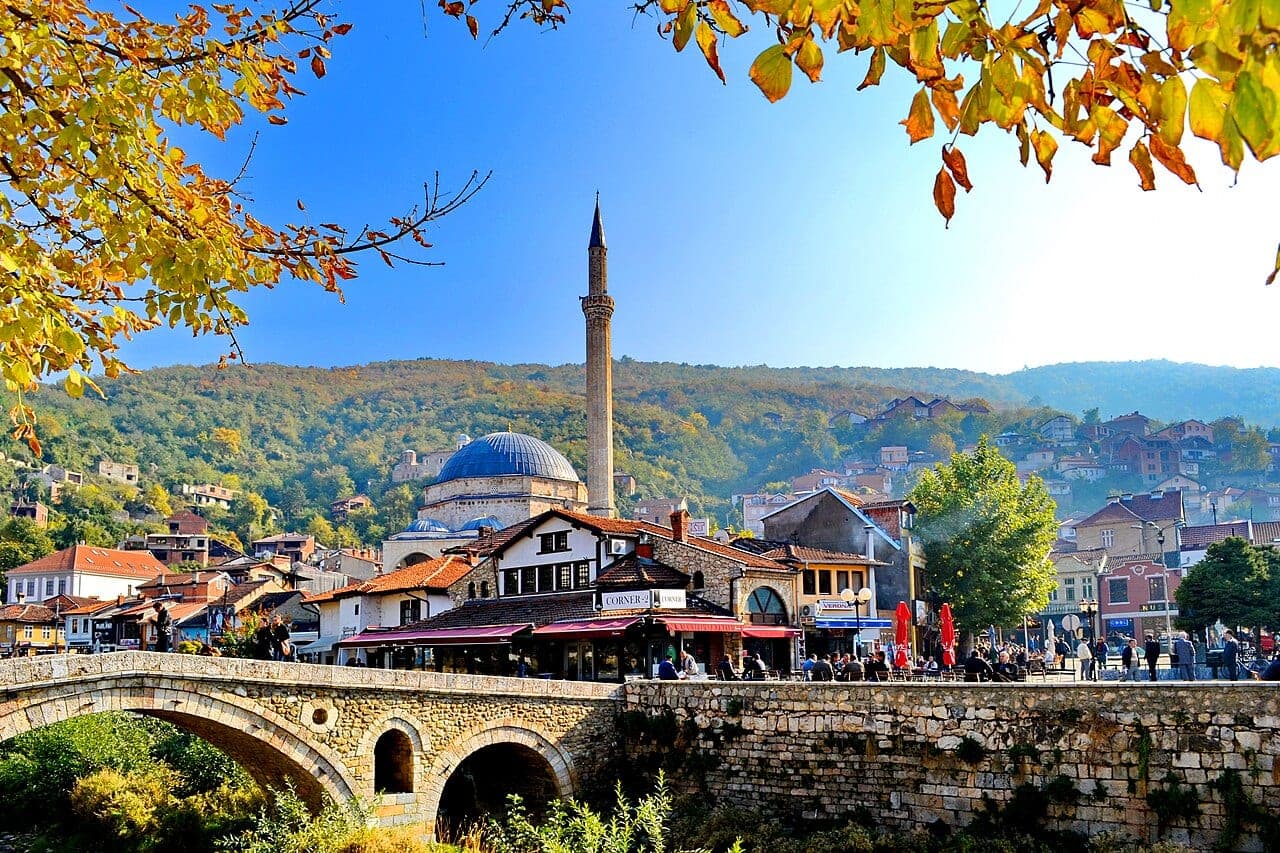
In the old town of Prizren the Bistrica river runs beneath a stone Ottoman bridge, and within a few minutes' walk stand a seventeenth-century mosque, a medieval Serbian Orthodox church and the house where an Albanian national league was proclaimed in 1878. Few places in the Balkans hold so many layers of faith and memory in so small a compass. Kosovo, a landlocked country of the central Balkan peninsula, has been a meeting ground of Illyrian, Roman, Byzantine, medieval Serbian, Ottoman and Albanian worlds, and the trace of each is still legible in its towns, its monasteries and its mosques.
This profile is a guide to that inheritance and to the ways Kosovo's communities remember. It follows the country's cities and its long history, the medieval monasteries inscribed on the UNESCO World Heritage List and the Ottoman monuments of Prizren, the silver filigree worked here for generations, and the Muslim, Orthodox Christian and Catholic customs of mourning that give shape to grief. Kosovo's population is majority Albanian, with Serb, Bosniak, Turkish, Roma, Ashkali, Egyptian and Gorani communities among others, and its heritage belongs to all of them.
Kosovo covers roughly 10,900 square kilometres in the central Balkans, landlocked and bordered by Serbia, Montenegro, Albania and North Macedonia. Much of the territory is a high interior basin framed by mountains: the Accursed Mountains, called Bjeshkët e Nemuna in Albanian and Prokletije in Serbian, rise along the south-western frontier, where Gjeravica reaches about 2,656 metres, while two plains, the Kosovo plain around Pristina and the Dukagjini plain (Metohija) around Peja and Gjakova, form the agricultural heart of the country (Britannica). The White Drin, the Sitnica and the Ibar are its principal rivers.
The population is well under two million and among the youngest in Europe. Ethnic Albanians form the large majority, above nine in ten, and Kosovo Serbs are the second-largest community, concentrated in the north around Mitrovica and in enclaves such as Gračanica and Štrpce; Bosniaks, Turks, Roma, Ashkali, Egyptians and Gorani complete the picture, and both Albanian and Serbian are official languages (Britannica). A large diaspora built by decades of labour migration to Germany, Switzerland and beyond sends home remittances and returns each summer.
Kosovo declared independence from Serbia on 17 February 2008. It has since been recognised by many United Nations member states but not by all; Serbia and a number of other states do not recognise it (Britannica). This profile takes no position on that question and treats Kosovo's cultural, religious and architectural heritage on its own terms.
Pristina. The capital and largest city sits on the Kosovo plain and has grown quickly into the country's centre of government, university life and commerce. Its landmarks reflect the layers of its past: the Imperial Mosque, also called the Fatih Mosque, was built in 1461 in the first decades of Ottoman rule; the Great Hammam and the old clock tower survive nearby; and the National Library of Kosovo, completed in 1982 to a much-discussed design by Andrija Mutnjaković, wears a skin of white domes and metal lattice unlike any other building in the region. The Cathedral of Saint Mother Teresa honours the nun of Albanian heritage, and just outside the city lies the medieval Gračanica Monastery.
Prizren. Widely regarded as Kosovo's most historic town, Prizren rises in tiers below a hilltop fortress, the Kaljaja, above the Bistrica. Its skyline is anchored by the Sinan Pasha Mosque of 1615, whose minaret reaches more than forty metres, while the League of Prizren complex preserves the rooms where the Albanian league of 1878 met, and the medieval Church of the Virgin of Ljeviša and several Ottoman hammams and tekkes stand within the same compact centre (Wikipedia). Prizren has long been the country's leading centre of silver filigree, and each August it hosts Dokufest, an international documentary and short-film festival.
Peja (Peć). Set at the mouth of the dramatic Rugova gorge on the edge of the Accursed Mountains, Peja keeps a restored Ottoman bazaar and serves as the gateway to some of Kosovo's finest mountain scenery. On the town's western edge stands the Patriarchate of Peć, a walled complex of churches that is the historic seat of the Serbian Orthodox Church and one of the country's four UNESCO-listed monuments.
Gjakova (Đakovica). Gjakova grew around its Grand Bazaar, the Çarshia e Madhe, one of the oldest market streets in the region, rebuilt after fire damage in the late twentieth century. The town's Hadum Mosque dates from the late sixteenth century, and Gjakova is known for the savat technique of blackened-silver filigree, distinct from the wire work of Prizren.
Kosovo's recorded past begins with Dardania, the land of the Dardani, a Thraco-Illyrian people who formed a kingdom here from around the fourth century BC (Britannica). Rome absorbed the region into Moesia and later a province it named Dardania; the ruins of the Roman city of Ulpiana, near Pristina, mark the era. As the empire divided, the area passed to Byzantium, whose models shaped its towns and churches for centuries.
In the high Middle Ages Kosovo became a heartland of the medieval Serbian kingdom under the Nemanjić dynasty, and its rulers endowed the monasteries that remain the country's most important medieval architecture: Gračanica, built by King Stefan Milutin around 1321; the Church of the Virgin of Ljeviša in Prizren, rebuilt under the same king in the early fourteenth century; Visoki Dečani, raised for King Stefan Dečanski between 1327 and 1335; and the Patriarchate of Peć, which grew into the seat of the Serbian Church (Wikipedia). On 15 June 1389, the Kosovo plain was the site of the Battle of Kosovo, in which a coalition led by the Serbian prince Lazar met the Ottoman army of Sultan Murad I; both leaders died, and the battle became one of the most enduring symbols in Serbian memory (Wikipedia). The Ottomans completed their control of the region by the mid-fifteenth century.
Nearly five centuries of Ottoman rule reshaped the country, bringing Islam, the mosques and hammams of the towns, and a settled Albanian majority. In June 1878 delegates gathered in Prizren to found the League of Prizren, the first broad organisation of Albanian national life, which sought to unite Albanian-inhabited lands and to resist their partition before it was suppressed in 1881 (Britannica). The Balkan Wars of 1912 and 1913 ended Ottoman rule, and Kosovo passed to the Serbian and then the Yugoslav state. Under socialist Yugoslavia it became the Socialist Autonomous Province of Kosovo, gaining wide autonomy under the 1974 constitution, revoked in 1989 (Balkan Insight). An armed conflict in 1998 and 1999 caused heavy loss of life and the displacement of large numbers of people across communities; it ended in June 1999, after which the territory was placed under a United Nations interim administration (Britannica). Kosovo declared independence on 17 February 2008, recognised by many states though not by all.
Two languages carry most of Kosovo's public life. Albanian, spoken here mainly in its Gheg form, is an Indo-European language that forms a branch of its own, with no close living relatives; Serbian belongs to the South Slavic group. Both are official, and Turkish and Bosnian have official status in some municipalities, reflecting the country's older mix of communities.
The name Kosovo comes from the Serbian phrase Kosovo polje, the "field of blackbirds", from kos, a blackbird, and polje, a field, the plain on which the 1389 battle was fought (Wikipedia). In Albanian the country is Kosova, and some Albanian writers favour the ancient name Dardania, drawing a line back to the Illyrian past. The doubling of names is common across the map: many towns carry both an Albanian and a Serbian form, so that Peja is also Peć, Gjakova is also Đakovica, and the two usages sit side by side in daily speech.
Kosovo's most distinctive craft is filigree, the working of fine silver into lace-like ornament. Historians place the trade's flourishing here by the eighteenth century, with Prizren its main centre; a French consul's report counted forty-seven goldsmith workshops there in 1866 (Balkan Insight). Three regional techniques survive: the twisted silver wire of Prizren, the blackened savat of Gjakova, and a bead-based method associated with Peja. Traditional dress varies by community, from the white felt plis cap of Albanian men to the costumes of the Serb, Turkish and Gorani communities.
Music runs along several lines at once. Albanian song is carried by the çifteli and sharki, plucked long-necked lutes, and by the drum-driven dances of weddings and festivals, while Serb communities keep the epic tradition of the gusle, a single-stringed fiddle that accompanies sung narrative poetry. At the table, Ottoman and Balkan influences meet: flija, a dish of thin batter layers baked slowly over ashes, is a signature of the region, alongside pite and byrek pastries, peppers and ajvar, grilled meats, and sweets such as baklava and tullumba. Coffee, prepared in the Turkish manner, frames hospitality and long visits.
Kosovo is religiously plural, and its heritage of belief is shared unevenly across its communities. The majority of Albanians, Bosniaks and Turks are Sunni Muslims, a legacy of the Ottoman centuries, and the country's mosques range from grand Ottoman foundations such as the Sinan Pasha and Imperial mosques to small neighbourhood buildings. Sufi orders also have a long presence, and Bektashi and other dervish tekkes in Prizren and Gjakova preserve a mystical strand of Islam.
 Gracanica is one of the Medieval Monuments in Kosovo, inscribed by UNESCO in 2004 and extended in 2006. The listing is entered under Serbia and the property has been on the List of World Heritage in Danger since 2006. Photograph by Julian Nyca, CC BY-SA 3.0, via Wikimedia Commons.
Serbian Orthodox Christianity is woven into the same landscape through the medieval monasteries and the Diocese of Raška and Prizren, whose churches and painted interiors are among the finest in the Byzantine world. A Roman Catholic minority, mostly Albanian and concentrated around Gjakova, Klina and Janjevo, has its own long history, and the Cathedral of Saint Mother Teresa in Pristina gives that community a prominent modern landmark. Feast days, saints' days and the Muslim festivals of Bayram mark the calendar for different families, and shrines and pilgrimage sites are honoured across confessional lines.
The two largest religious traditions bury their dead in distinct ways, and both place remembrance at the centre of family life. In Muslim practice the dead are washed and wrapped in a plain white shroud, the funeral prayer, the janazah, is offered by the gathered community, and burial follows quickly, usually within a day, with the body laid facing Mecca. The bereaved receive condolence visits over the following days, the Qur'an is recited, and graves are visited on festival days, so that mourning is a communal duty as much as a private sorrow.
Orthodox Christian custom follows its own long calendar. Burial is soon after death, and memorial services are held at set intervals, most importantly on the fortieth day, when tradition holds the soul completes its passage, and again at anniversaries. At each service a dish of boiled sweetened wheat, called koljivo, is blessed and shared, its grain a symbol of resurrection, and on the Soul Saturdays before the great fasts whole parishes commemorate their dead together. Catholic families keep requiem masses and the autumn commemoration of All Souls. Across all these communities the condolence visit, the ngushëllim in Albanian, gathers relatives and neighbours to sit with the bereaved, and Albanian tradition binds such duties into the besa, the pledge of one's word and honour.
The country's monasteries and mosques are themselves heritage of memory. Painted with the faces of medieval kings, saints and donors, or inscribed with the names of Ottoman benefactors, they were raised so that their builders would be remembered in prayer, and they still hold the collective memory of the communities that maintain them.
Kosovo's records were removed by lorry, and getting them back has been a matter of international negotiation ever since.
In 1999, as Serbian forces withdrew, civil registry books, cadastral records and archival material were taken north into Serbia. Kosovo was left administering a population whose birth, marriage and property records were held by a state that does not recognise it. Reconstruction has been partial: registries were rebuilt from surviving copies and from testimony, and the EU-facilitated dialogue has produced agreements on returning certified copies of the cadastre and the civil registry, implemented slowly.
The older record follows the Ottoman and then Yugoslav pattern. Ottoman defters and sharia court registers cover the territory to 1912; Serbian Orthodox monastery archives, at Peć and Gračanica and Dečani, hold ecclesiastical records of great age; Catholic parishes in the north-west kept registers; and Yugoslav-era civil registration ran through the municipalities.
Albanian Kosovar families keep the fis, the patrilineal clan, and can generally recite descent without reference to a register, which is one reason the loss of the books was survivable at all.
The missing of the 1998 to 1999 war are the open file. More than a thousand people remain unaccounted for, and identification work continues on both sides, using the same DNA methods developed in Bosnia. As there, each identification is a document that two governments have to agree on.
Kosovo's four medieval Orthodox monuments are together inscribed on the UNESCO World Heritage List as "Medieval Monuments in Kosovo": Visoki Dečani, first inscribed in 2004, joined in a 2006 extension by the Patriarchate of Peć, Gračanica Monastery and the Church of the Virgin of Ljeviša. As a factual matter of the listing, the property is entered under the State Party of Serbia, and it has been on the List of World Heritage in Danger since 2006 (UNESCO). The Church of the Virgin of Ljeviša, damaged by fire during unrest in 2004, remains a particular focus of conservation concern in UNESCO's monitoring, and the sites have at times required international protection (UNESCO).
The Ottoman monuments of Prizren are conserved in parallel. The Sinan Pasha Mosque underwent restoration between 2007 and 2011, when its structure and nineteenth-century interior painting were stabilised and the building reopened for worship (Wikipedia), and Prizren's historic centre, with its mosques, churches, hammams and the League of Prizren complex, is recognised as a protected zone. Conservation has drawn on Kosovo's own institutions, the Serbian Orthodox Church, and international partners such as the Council of Europe and the European Union, with special protective arrangements set out for a number of religious and historic sites.
Kosovo's heritage is increasingly documented online, which matters for monuments that are fragile or hard to reach. The BLAGO Fund, a heritage foundation, has produced high-resolution photographic archives of the frescoes of Visoki Dečani and the Patriarchate of Peć, letting the painted interiors be studied wall by wall without disturbing the sites. UNESCO's own state-of-conservation records keep a public account of each monument's condition year by year.
Beyond the monasteries, digitisation is spreading through libraries and festivals. The National Library of Kosovo maintains growing digital collections, Dokufest keeps online archives around its Prizren festival, and Kosovo's museums have begun to publish through European aggregators. For a country with so large a diaspora, these channels also keep distant families connected to the places and images of home.
Kosovo's culture reaches well beyond its borders through a young and mobile population. The pop musicians Dua Lipa and Rita Ora both have Kosovar roots, and Dua Lipa's Sunny Hill Festival has brought international audiences to Pristina. In the visual arts, Petrit Halilaj has represented Kosovo at the Venice Biennale and created a major commission for the roof of the Metropolitan Museum of Art in New York in 2024, work drawn in part from the drawings of schoolchildren of his generation. Pristina hosted the roving European art biennial Manifesta in 2022, turning the city into an open-air gallery for several months.
Sport has given the country some of its proudest international moments, above all when the judoka Majlinda Kelmendi won gold at the 2016 Olympic Games, the first Olympic medal in Kosovo's history. Filmmakers, writers and designers, many educated abroad and returning home, continue to build new institutions, and the diaspora acts as a second Kosovo, carrying language, music and remembrance customs to communities across Western Europe and North America.
The Sinan Pasha Mosque restored. Between 2007 and 2011 the great Ottoman mosque of Prizren was conserved inside and out and returned to worship, securing one of the defining monuments of the old town's skyline (Wikipedia).
Kosovo's first Olympic medal. At the 2016 Olympic Games, Majlinda Kelmendi won gold in judo, the first Olympic medal in the country's history.
The frescoes made permanent. Through digital photography of the painted interiors of Dečani and Peć, the BLAGO Fund has created an enduring record of some of the finest Byzantine wall painting in the Balkans.
Prizren on the world's screens. The Dokufest documentary festival has grown into one of south-eastern Europe's leading film events, filling Prizren's streets and rooftops each summer and connecting the town to filmmakers worldwide.
Gracanica is one of the Medieval Monuments in Kosovo, inscribed by UNESCO in 2004 and extended in 2006. The listing is entered under Serbia and the property has been on the List of World Heritage in Danger since 2006. Photograph by Julian Nyca, CC BY-SA 3.0, via Wikimedia Commons.
Serbian Orthodox Christianity is woven into the same landscape through the medieval monasteries and the Diocese of Raška and Prizren, whose churches and painted interiors are among the finest in the Byzantine world. A Roman Catholic minority, mostly Albanian and concentrated around Gjakova, Klina and Janjevo, has its own long history, and the Cathedral of Saint Mother Teresa in Pristina gives that community a prominent modern landmark. Feast days, saints' days and the Muslim festivals of Bayram mark the calendar for different families, and shrines and pilgrimage sites are honoured across confessional lines.
The two largest religious traditions bury their dead in distinct ways, and both place remembrance at the centre of family life. In Muslim practice the dead are washed and wrapped in a plain white shroud, the funeral prayer, the janazah, is offered by the gathered community, and burial follows quickly, usually within a day, with the body laid facing Mecca. The bereaved receive condolence visits over the following days, the Qur'an is recited, and graves are visited on festival days, so that mourning is a communal duty as much as a private sorrow.
Orthodox Christian custom follows its own long calendar. Burial is soon after death, and memorial services are held at set intervals, most importantly on the fortieth day, when tradition holds the soul completes its passage, and again at anniversaries. At each service a dish of boiled sweetened wheat, called koljivo, is blessed and shared, its grain a symbol of resurrection, and on the Soul Saturdays before the great fasts whole parishes commemorate their dead together. Catholic families keep requiem masses and the autumn commemoration of All Souls. Across all these communities the condolence visit, the ngushëllim in Albanian, gathers relatives and neighbours to sit with the bereaved, and Albanian tradition binds such duties into the besa, the pledge of one's word and honour.
The country's monasteries and mosques are themselves heritage of memory. Painted with the faces of medieval kings, saints and donors, or inscribed with the names of Ottoman benefactors, they were raised so that their builders would be remembered in prayer, and they still hold the collective memory of the communities that maintain them.
Kosovo's records were removed by lorry, and getting them back has been a matter of international negotiation ever since.
In 1999, as Serbian forces withdrew, civil registry books, cadastral records and archival material were taken north into Serbia. Kosovo was left administering a population whose birth, marriage and property records were held by a state that does not recognise it. Reconstruction has been partial: registries were rebuilt from surviving copies and from testimony, and the EU-facilitated dialogue has produced agreements on returning certified copies of the cadastre and the civil registry, implemented slowly.
The older record follows the Ottoman and then Yugoslav pattern. Ottoman defters and sharia court registers cover the territory to 1912; Serbian Orthodox monastery archives, at Peć and Gračanica and Dečani, hold ecclesiastical records of great age; Catholic parishes in the north-west kept registers; and Yugoslav-era civil registration ran through the municipalities.
Albanian Kosovar families keep the fis, the patrilineal clan, and can generally recite descent without reference to a register, which is one reason the loss of the books was survivable at all.
The missing of the 1998 to 1999 war are the open file. More than a thousand people remain unaccounted for, and identification work continues on both sides, using the same DNA methods developed in Bosnia. As there, each identification is a document that two governments have to agree on.
Kosovo's four medieval Orthodox monuments are together inscribed on the UNESCO World Heritage List as "Medieval Monuments in Kosovo": Visoki Dečani, first inscribed in 2004, joined in a 2006 extension by the Patriarchate of Peć, Gračanica Monastery and the Church of the Virgin of Ljeviša. As a factual matter of the listing, the property is entered under the State Party of Serbia, and it has been on the List of World Heritage in Danger since 2006 (UNESCO). The Church of the Virgin of Ljeviša, damaged by fire during unrest in 2004, remains a particular focus of conservation concern in UNESCO's monitoring, and the sites have at times required international protection (UNESCO).
The Ottoman monuments of Prizren are conserved in parallel. The Sinan Pasha Mosque underwent restoration between 2007 and 2011, when its structure and nineteenth-century interior painting were stabilised and the building reopened for worship (Wikipedia), and Prizren's historic centre, with its mosques, churches, hammams and the League of Prizren complex, is recognised as a protected zone. Conservation has drawn on Kosovo's own institutions, the Serbian Orthodox Church, and international partners such as the Council of Europe and the European Union, with special protective arrangements set out for a number of religious and historic sites.
Kosovo's heritage is increasingly documented online, which matters for monuments that are fragile or hard to reach. The BLAGO Fund, a heritage foundation, has produced high-resolution photographic archives of the frescoes of Visoki Dečani and the Patriarchate of Peć, letting the painted interiors be studied wall by wall without disturbing the sites. UNESCO's own state-of-conservation records keep a public account of each monument's condition year by year.
Beyond the monasteries, digitisation is spreading through libraries and festivals. The National Library of Kosovo maintains growing digital collections, Dokufest keeps online archives around its Prizren festival, and Kosovo's museums have begun to publish through European aggregators. For a country with so large a diaspora, these channels also keep distant families connected to the places and images of home.
Kosovo's culture reaches well beyond its borders through a young and mobile population. The pop musicians Dua Lipa and Rita Ora both have Kosovar roots, and Dua Lipa's Sunny Hill Festival has brought international audiences to Pristina. In the visual arts, Petrit Halilaj has represented Kosovo at the Venice Biennale and created a major commission for the roof of the Metropolitan Museum of Art in New York in 2024, work drawn in part from the drawings of schoolchildren of his generation. Pristina hosted the roving European art biennial Manifesta in 2022, turning the city into an open-air gallery for several months.
Sport has given the country some of its proudest international moments, above all when the judoka Majlinda Kelmendi won gold at the 2016 Olympic Games, the first Olympic medal in Kosovo's history. Filmmakers, writers and designers, many educated abroad and returning home, continue to build new institutions, and the diaspora acts as a second Kosovo, carrying language, music and remembrance customs to communities across Western Europe and North America.
The Sinan Pasha Mosque restored. Between 2007 and 2011 the great Ottoman mosque of Prizren was conserved inside and out and returned to worship, securing one of the defining monuments of the old town's skyline (Wikipedia).
Kosovo's first Olympic medal. At the 2016 Olympic Games, Majlinda Kelmendi won gold in judo, the first Olympic medal in the country's history.
The frescoes made permanent. Through digital photography of the painted interiors of Dečani and Peć, the BLAGO Fund has created an enduring record of some of the finest Byzantine wall painting in the Balkans.
Prizren on the world's screens. The Dokufest documentary festival has grown into one of south-eastern Europe's leading film events, filling Prizren's streets and rooftops each summer and connecting the town to filmmakers worldwide.
National Overview
Notable Cities
Historical Foundations
Linguistic and Etymological Roots
Cultural Identity
Religion and Spirituality
Remembrance and Mourning Traditions
Tracing a Family in Kosovo
Heritage Preservation Efforts
Digital Heritage
Contemporary Cultural Influences
Success Stories
References and resources
- UNESCO World Heritage Centre, Medieval Monuments in Kosovo: the four-component property, its inscription and its in-danger status.
- UNESCO, State of Conservation, Medieval Monuments in Kosovo: the most recent conservation monitoring, including the Church of the Virgin of Ljeviša.
- Encyclopaedia Britannica, Kosovo: geography, peoples and history.
- Encyclopaedia Britannica, Kosovo: Self-declared independence: the 2008 declaration and its recognition.
- Encyclopaedia Britannica, Albanian League: the League of Prizren of 1878.
- Wikipedia, Sinan Pasha Mosque (Prizren): the 1615 mosque and its restoration.
- Wikipedia, Visoki Dečani: the monastery of King Stefan Dečanski.
- Wikipedia, Battle of Kosovo: the events of 15 June 1389.
- Wikipedia, Names of Kosovo: the etymology of Kosovo and Kosova.
- Balkan Insight, Prizren's Filigree Workers Keep Ancient Kosovo Craft Alive: the silver craft and its regional techniques.