Heritage · Country
North Macedonia Culture and Heritage
On the shores of Lake Ohrid, one of the oldest lakes on Earth, medieval scribes gave the Slavic world an alphabet and left behind a wall of some eight hundred icons. This is a guide to North Macedonia's heritage, to the Orthodox and Muslim rites that shape how its peoples remember, and to the archives carrying that memory into the digital age.Written to last.
By Confinity Heritage Editorial · Updated 2026-07-31 · 8-minute readQuiet tools, kept out of the way.
North Macedonia keeps its memory by the water. On the eastern shore of Lake Ohrid, one of the oldest lakes on Earth and among the deepest in Europe, a scholar named Clement gathered pupils near the turn of the tenth century and taught them to read and write in their own Slavic speech. The small churches that he and his companion Naum left behind still hold walls of Byzantine fresco and a collection of some eight hundred icons, and the script refined by their school went on to serve Slavic peoples from the Balkans to the Pacific. For a landlocked country of fewer than two million people, that is an unusually large bequest to have made to the world.
This is a land of many peoples layered like the terraces of its ruins: a Macedonian majority alongside a large Albanian community, with Turks, Roma, Serbs, Bosniaks and Vlachs among them, and a religious map divided roughly between Orthodox Christianity and Islam. Its heritage runs from the Paeonian and Roman city of Stobi through the Ottoman bazaars of Skopje to the monasteries above the lake, and its ways of remembering the dead draw on two great ritual traditions.
North Macedonia is a landlocked country in the central Balkan Peninsula, drained by the Vardar River, which cuts the land from the northwest to the southeast and carried the ancient road from the Danube to the Aegean. It borders Kosovo and Serbia to the north, Bulgaria to the east, Greece to the south and Albania to the west, and much of its interior is mountainous, its southwest cupped around three ancient lakes: Ohrid, Prespa and Dojran. Skopje, in the north, is the capital and by far the largest city.
The 2021 census recorded a resident population of 1,836,713, down about nine percent over two decades as emigration thinned its towns and villages (2021 census). By ethnic affiliation, roughly 58 percent declared themselves Macedonians and about 24 percent Albanians, with smaller communities of Turks, Roma, Serbs, Bosniaks and Vlachs. The religious map broadly follows that division: some 46 percent identify as Orthodox Christian and about 32 percent as Muslim, with a small Catholic minority. Independent since 1991, the country joined NATO in 2020 and is a candidate for European Union membership, while a large diaspora abroad keeps its language and customs in daily use.
Skopje. The capital sits on both banks of the Vardar, joined by the Stone Bridge, a fifteenth-century Ottoman crossing of some thirteen arches built under Sultan Mehmed II and long the symbol of the city. On the north bank climbs the Old Bazaar, one of the largest surviving Ottoman marketplaces in the Balkans, once dense with mosques, hans and caravanserais, and above it the medieval Kale fortress. Much of the modern city was rebuilt after the catastrophic earthquake of 26 July 1963, which levelled most of the centre; the Stone Bridge was among the few old structures to survive. Skopje is also the birthplace of Agnes Gonxha Bojaxhiu, later Mother Teresa, born there in 1910.
Ohrid. Set on its lake, Ohrid is one of the oldest continuously inhabited settlements in Europe and the spiritual heart of the country. Its old quarter is crowded with churches, among them the eleventh-century St. Sophia and St. John at Kaneo on its bluff above the water. Nearby, on the Plaošnik plateau, stands the reconstructed monastery of St. Panteleimon, associated with Clement of Ohrid, and some thirty kilometres south, near the Albanian border, the cliff-top monastery of St. Naum, founded in 905.
Bitola. The country's second city, in the south near the Greek frontier, grew wealthy under the Ottomans as a seat of foreign consulates, the "city of consuls." On its edge lie the ruins of Heraclea Lyncestis, founded by Philip II of Macedon in the fourth century BC, whose Early Christian basilicas preserve some of the finest floor mosaics in the region.
Tetovo. In the Polog valley of the northwest, Tetovo is a centre of the Albanian community and home to the Šarena Džamija, the Painted Mosque, whose exterior and interior are covered in floral and architectural frescoes. First built in 1438 and rebuilt in 1833, it is unusual in having been endowed by two local sisters, whose tomb stands in its garden (Šarena Mosque).
Before Rome, the middle Vardar was the country of the Paeonians, an ancient people whose kingdom was absorbed into the expanding realm of Philip II of Macedon in the fourth century BC. Under Roman rule the region became a province of Macedonia, and its greatest city was Stobi, near the meeting of the Vardar and the Crna. Raised to a self-governing municipium in 69 CE under the emperor Vespasian, Stobi minted its own coins and, in the Early Byzantine centuries, became a bishopric adorned with the mosaic floors and basilicas that make it the largest archaeological site in the country today. Earthquakes in the sixth century emptied it, and it lay undisturbed thereafter.
The decisive chapter for the country's identity opened in the Byzantine era. Sent to the region in 886 at the direction of Boris I, Clement established a school at Ohrid that taught the Slavic liturgy and letters, and after 893 his work was continued by Naum. The alphabet devised for Slavic by Cyril and Methodius, the Glagolitic, was carried and adapted here, and the simpler script that grew from it, later named Cyrillic after Cyril, spread from Ohrid across the Orthodox Slavic world (Ohrid Literary School). Around the turn of the first millennium Ohrid was the capital of the empire of Tsar Samuel and remained the seat of an influential archbishopric for centuries.
From the late fourteenth century the region lay within the Ottoman Empire, which shaped its towns for more than five hundred years, endowing them with mosques, bridges and covered bazaars. Ottoman rule ended in the Balkan Wars of 1912–13, after which the central part joined the kingdom that became Yugoslavia. During the Second World War the Anti-Fascist Assembly for the National Liberation of Macedonia (ASNOM) proclaimed a Macedonian republic in 1944, and after the war it became one of the six constituent republics of socialist Yugoslavia. The republic declared independence peacefully in 1991. In 2018 it signed the Prespa Agreement with Greece, which entered into force in February 2019 and settled a long dispute over the country's name by adopting the constitutional title Republic of North Macedonia (Britannica: Prespa Agreement).
The majority language, Macedonian, is a South Slavic tongue closely related to Bulgarian and, more distantly, to Serbian. It is written in a Cyrillic alphabet of thirty-one letters standardized in 1945 by philological commissions as the socialist republic took shape, drawing on the phonemic principles set out earlier by Krste Misirkov (1874–1926) and shaped by the poet and linguist Blaže Koneski. Several of its letters, among them Ѓ, Ѕ and Ќ, are found in no other alphabet (Macedonian alphabet). Albanian, spoken by roughly a quarter of the population, gained the status of a second official language nationwide under legislation adopted in 2019, and Turkish, Romani and other tongues are used locally.
The country's name comes from the ancient kingdom of Macedon and the wider historical region of Macedonia, which today spans parts of several states. Under the Prespa Agreement the country took the qualified name Republic of North Macedonia, while the language and the people it describes retained the adjective "Macedonian." The settlement was reached by treaty between the two governments and is noted here as a matter of record.
The deepest current in the country's visual culture is Byzantine. Ohrid alone holds some eight hundred icons from the eleventh to fourteenth centuries, among the most important such holdings anywhere, and the frescoes of churches like St. Panteleimon and, across the lake at Kurbinovo, St. George count among the masterpieces of medieval Balkan painting. That eye for fine detail carries into filigree, in which threads of drawn silver are twisted into lacework jewellery and ornament, still practiced in the workshops of Ohrid and Bitola.
Music and dance keep the older village world audible. The oro, a circle dance in which dancers link hands and move as one, is the country's characteristic form; its most famous variant is the Teškoto, "the heavy one," a slow and stately men's dance from the Mijak highlands of the west, danced to the drum (tapan) and shawm (zurla) as an image of the hardship of leaving home. Each summer Galičnik stages a wedding festival preserving the region's costumes, songs and dances. At the table, the everyday classic is tavče gravče, beans baked in an earthenware dish, alongside ajvar, a relish of roasted red peppers put up by the jar each autumn, the meat pie called pastrmajlija, and the prized endemic Ohrid trout.
The largest faith is Orthodox Christianity, organized in the Macedonian Orthodox Church, which since 2009 has borne the fuller name of the Ohrid Archbishopric in acknowledgement of its medieval roots. The church declared its independence from the Serbian Orthodox Church in 1967, but that autocephaly went unrecognized by the wider Orthodox world for more than half a century. The isolation ended in 2022, when the Ecumenical Patriarchate received the church back into communion under the name "Ohrid" and the Serbian Church granted it autocephaly, a resolution welcomed across the country (Macedonian Orthodox Church).
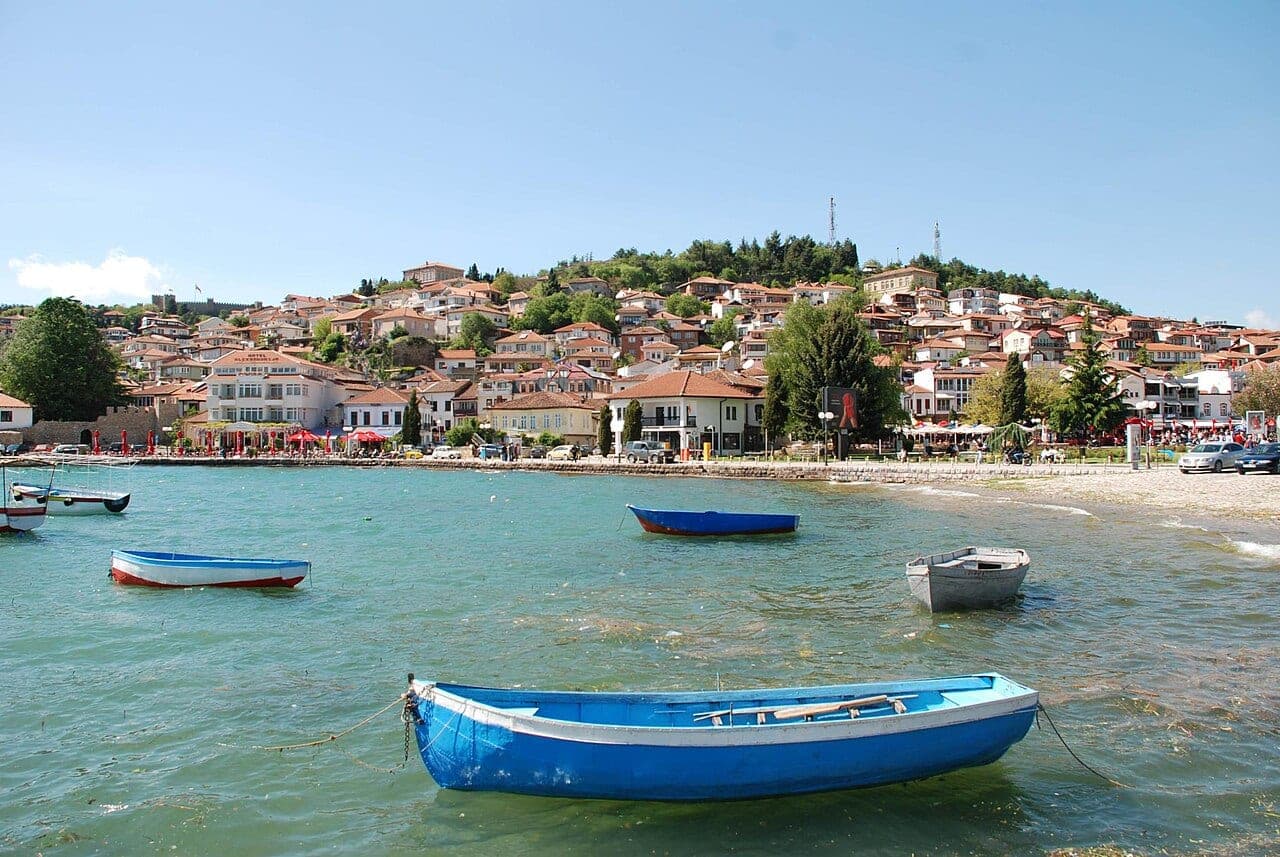
 Ohrid is said once to have had a church for every day of the year, and the town and the lake are inscribed together as a single mixed heritage site. Photograph by kallerna, CC BY-SA 4.0, via Wikimedia Commons.
Islam is the faith of roughly a third of the population, most of them ethnic Albanians, along with Turks, Bosniaks, Roma and the Macedonian-speaking Muslims sometimes called Torbeš. It is a Sunni inheritance of the Ottoman centuries, expressed in the mosques of the old towns, from Skopje's Old Bazaar to the Painted Mosque of Tetovo, and in the Sufi lodges of the west, of which the Arabati Baba Teḱe is the best known. A small Catholic community completes the picture, and includes the country's most famous Catholic daughter, Mother Teresa of Calcutta.
Orthodox mourning follows a measured calendar. The funeral usually takes place within a day or two of death, the body lying in an open coffin, and the community then gathers again for memorial services, the panihida, on the third, ninth and fortieth days, the fortieth marking the soul's completed passage. At each commemoration the family brings koljivo, also called žito, a dish of boiled wheat, blessed in church and shared among those present as a sign of resurrection, since the grain must fall into the earth to bear fruit (Panikhida and Orthodox commemoration). Further memorials follow at three, six, nine and twelve months and at each anniversary, sometimes for as long as seven years; close relatives wear black, tend the grave, and gather the whole parish twice a year on the Zadušnica, the Soul Saturdays on which all the dead are remembered together.
Muslim custom sets its own rhythm, rooted in the same care and speed. The body is washed (the ghusl) and wrapped in a simple white shroud (the kafan), and burial follows quickly, ideally within a day, the deceased laid in the earth on the right side facing Mecca. Before burial the community performs the standing funeral prayer, the salat al-janazah, asking forgiveness for the dead. Formal mourning lasts three days, during which neighbours bring food to the bereaved household, with a longer period of four months and ten days observed by a widow. In both traditions the grave is visited and tended long after the funeral, at the great feasts of Bajram for Muslim families and on the memorial Saturdays and name days for the Orthodox, so that across the country remembrance is a recurring appointment rather than a single farewell.
Macedonian records were made by an empire, divided by a war and complicated by an argument about names that lasted a century.
Ottoman rule to 1912 means the state record is Ottoman: tax registers, nüfus population registers and sharia court books, held in Istanbul and partly in Skopje. The Orthodox Church registered its own community, and monastery archives at Ohrid and elsewhere hold ecclesiastical documents of considerable age. Muslim, Jewish and Vlach communities kept their own.
The Balkan Wars of 1912 and 1913 partitioned the region between Serbia, Greece and Bulgaria, so a Macedonian family's records may now be in Skopje, Thessaloniki or Sofia depending on which side of a line their village fell, and the language of the record changes accordingly. Population exchanges after 1923 moved people again.
The State Archives in Skopje hold the Yugoslav and modern series, and civil registration runs through the twentieth century.
Two absences. The Jewish community of Bitola, Skopje and Štip, around seven thousand people, was deported by Bulgarian occupation authorities in March 1943 and almost none survived; the deportation lists exist and the Holocaust Memorial Centre in Skopje holds them. And the Aegean Macedonians displaced from northern Greece during the Greek civil war, including the children evacuated in 1948, are documented in Yugoslav and eastern bloc resettlement files rather than in Greek ones.
The country's flagship inheritance is the Natural and Cultural Heritage of the Ohrid region, inscribed on the UNESCO World Heritage List in 1979 for the lake's extraordinary biology and extended the following year to cover the town's cultural treasures, one of the world's early combined natural and cultural sites (UNESCO: Ohrid region). In 2019 the property was extended across the border to take in the Albanian third of the lake, so that this ancient body of water, a refuge for endemic species surviving from the Tertiary period, is now protected in its entirety as a transboundary site (IUCN on the 2019 extension). UNESCO has repeatedly urged tighter control of building and tourism along the shore.
Beyond the lake, the National Institution Stobi manages the excavation and conservation of the Roman and Early Byzantine city, whose mosaics require constant care, while the country's hundreds of medieval churches and their fragile frescoes are looked after by conservation institutes and the Orthodox Church together. The icon galleries of Ohrid display the medieval panels off the church walls in controlled conditions, a model of how a small country can safeguard a holding of global significance.
Much of the effort to bring that inheritance online runs through the National and University Library "St. Clement of Ohrid" in Skopje, founded in 1944 as the young republic's central library. Its new building, opened in 2009, houses a digitization centre, and from 2010 the library began digitizing books, periodicals, manuscripts and maps for its Virtual Library of Macedonia (National and University Library on Europeana). As a partner in Europeana, Europe's shared digital heritage platform, the library shares Macedonian records with a continental audience, so a reader in the diaspora can reach manuscripts of the homeland from a screen abroad.
Modern North Macedonia has carried its imagination well beyond its borders. Its best-known film, Milčo Mančevski's Before the Rain (1994), won the Golden Lion at Venice and was nominated for an Academy Award. In popular music, the singer Toše Proeski became the most beloved voice of his generation across the region before his death in a car accident in 2007 at twenty-six, and his memorial house in Kruševo draws visitors from the neighbouring countries.
Kruševo itself, the highest town in the country, holds a central place in national memory as the seat of the short-lived republic proclaimed during the Ilinden Uprising of 1903, commemorated by the space-age Makedonium monument above the town. The diaspora functions as a second homeland: parish churches, cultural associations, folk-dance troupes and language classes from Melbourne to Toronto keep the songs, the scripts and the memorial customs in living use, and remittances support much of what happens at home.
A church out of isolation. After fifty-five years without recognition, the Macedonian Orthodox Church, the Ohrid Archbishopric, was received back into the communion of world Orthodoxy in 2022, when the Ecumenical Patriarchate restored ties and the Serbian Church granted autocephaly.
A lake made whole. The 2019 extension of the Ohrid World Heritage site to include the Albanian shore brought the entire ancient lake under a single international protection, turning a border into a shared responsibility.
A saint's church rebuilt. On the Plaošnik plateau above Ohrid, the monastery church of St. Panteleimon, linked to Clement, was reconstructed in 2002 over its excavated medieval foundations, at the site where Slavic letters were first taught and where Clement's relics are venerated.
Memory going online. From its digitization centre opened in 2009, the National and University Library has steadily moved Macedonian books, manuscripts and periodicals into its Virtual Library and onto Europeana, opening the country's written heritage to scholars and families wherever they live.
Ohrid is said once to have had a church for every day of the year, and the town and the lake are inscribed together as a single mixed heritage site. Photograph by kallerna, CC BY-SA 4.0, via Wikimedia Commons.
Islam is the faith of roughly a third of the population, most of them ethnic Albanians, along with Turks, Bosniaks, Roma and the Macedonian-speaking Muslims sometimes called Torbeš. It is a Sunni inheritance of the Ottoman centuries, expressed in the mosques of the old towns, from Skopje's Old Bazaar to the Painted Mosque of Tetovo, and in the Sufi lodges of the west, of which the Arabati Baba Teḱe is the best known. A small Catholic community completes the picture, and includes the country's most famous Catholic daughter, Mother Teresa of Calcutta.
Orthodox mourning follows a measured calendar. The funeral usually takes place within a day or two of death, the body lying in an open coffin, and the community then gathers again for memorial services, the panihida, on the third, ninth and fortieth days, the fortieth marking the soul's completed passage. At each commemoration the family brings koljivo, also called žito, a dish of boiled wheat, blessed in church and shared among those present as a sign of resurrection, since the grain must fall into the earth to bear fruit (Panikhida and Orthodox commemoration). Further memorials follow at three, six, nine and twelve months and at each anniversary, sometimes for as long as seven years; close relatives wear black, tend the grave, and gather the whole parish twice a year on the Zadušnica, the Soul Saturdays on which all the dead are remembered together.
Muslim custom sets its own rhythm, rooted in the same care and speed. The body is washed (the ghusl) and wrapped in a simple white shroud (the kafan), and burial follows quickly, ideally within a day, the deceased laid in the earth on the right side facing Mecca. Before burial the community performs the standing funeral prayer, the salat al-janazah, asking forgiveness for the dead. Formal mourning lasts three days, during which neighbours bring food to the bereaved household, with a longer period of four months and ten days observed by a widow. In both traditions the grave is visited and tended long after the funeral, at the great feasts of Bajram for Muslim families and on the memorial Saturdays and name days for the Orthodox, so that across the country remembrance is a recurring appointment rather than a single farewell.
Macedonian records were made by an empire, divided by a war and complicated by an argument about names that lasted a century.
Ottoman rule to 1912 means the state record is Ottoman: tax registers, nüfus population registers and sharia court books, held in Istanbul and partly in Skopje. The Orthodox Church registered its own community, and monastery archives at Ohrid and elsewhere hold ecclesiastical documents of considerable age. Muslim, Jewish and Vlach communities kept their own.
The Balkan Wars of 1912 and 1913 partitioned the region between Serbia, Greece and Bulgaria, so a Macedonian family's records may now be in Skopje, Thessaloniki or Sofia depending on which side of a line their village fell, and the language of the record changes accordingly. Population exchanges after 1923 moved people again.
The State Archives in Skopje hold the Yugoslav and modern series, and civil registration runs through the twentieth century.
Two absences. The Jewish community of Bitola, Skopje and Štip, around seven thousand people, was deported by Bulgarian occupation authorities in March 1943 and almost none survived; the deportation lists exist and the Holocaust Memorial Centre in Skopje holds them. And the Aegean Macedonians displaced from northern Greece during the Greek civil war, including the children evacuated in 1948, are documented in Yugoslav and eastern bloc resettlement files rather than in Greek ones.
The country's flagship inheritance is the Natural and Cultural Heritage of the Ohrid region, inscribed on the UNESCO World Heritage List in 1979 for the lake's extraordinary biology and extended the following year to cover the town's cultural treasures, one of the world's early combined natural and cultural sites (UNESCO: Ohrid region). In 2019 the property was extended across the border to take in the Albanian third of the lake, so that this ancient body of water, a refuge for endemic species surviving from the Tertiary period, is now protected in its entirety as a transboundary site (IUCN on the 2019 extension). UNESCO has repeatedly urged tighter control of building and tourism along the shore.
Beyond the lake, the National Institution Stobi manages the excavation and conservation of the Roman and Early Byzantine city, whose mosaics require constant care, while the country's hundreds of medieval churches and their fragile frescoes are looked after by conservation institutes and the Orthodox Church together. The icon galleries of Ohrid display the medieval panels off the church walls in controlled conditions, a model of how a small country can safeguard a holding of global significance.
Much of the effort to bring that inheritance online runs through the National and University Library "St. Clement of Ohrid" in Skopje, founded in 1944 as the young republic's central library. Its new building, opened in 2009, houses a digitization centre, and from 2010 the library began digitizing books, periodicals, manuscripts and maps for its Virtual Library of Macedonia (National and University Library on Europeana). As a partner in Europeana, Europe's shared digital heritage platform, the library shares Macedonian records with a continental audience, so a reader in the diaspora can reach manuscripts of the homeland from a screen abroad.
Modern North Macedonia has carried its imagination well beyond its borders. Its best-known film, Milčo Mančevski's Before the Rain (1994), won the Golden Lion at Venice and was nominated for an Academy Award. In popular music, the singer Toše Proeski became the most beloved voice of his generation across the region before his death in a car accident in 2007 at twenty-six, and his memorial house in Kruševo draws visitors from the neighbouring countries.
Kruševo itself, the highest town in the country, holds a central place in national memory as the seat of the short-lived republic proclaimed during the Ilinden Uprising of 1903, commemorated by the space-age Makedonium monument above the town. The diaspora functions as a second homeland: parish churches, cultural associations, folk-dance troupes and language classes from Melbourne to Toronto keep the songs, the scripts and the memorial customs in living use, and remittances support much of what happens at home.
A church out of isolation. After fifty-five years without recognition, the Macedonian Orthodox Church, the Ohrid Archbishopric, was received back into the communion of world Orthodoxy in 2022, when the Ecumenical Patriarchate restored ties and the Serbian Church granted autocephaly.
A lake made whole. The 2019 extension of the Ohrid World Heritage site to include the Albanian shore brought the entire ancient lake under a single international protection, turning a border into a shared responsibility.
A saint's church rebuilt. On the Plaošnik plateau above Ohrid, the monastery church of St. Panteleimon, linked to Clement, was reconstructed in 2002 over its excavated medieval foundations, at the site where Slavic letters were first taught and where Clement's relics are venerated.
Memory going online. From its digitization centre opened in 2009, the National and University Library has steadily moved Macedonian books, manuscripts and periodicals into its Virtual Library and onto Europeana, opening the country's written heritage to scholars and families wherever they live.
National Overview
Notable Cities
Historical Foundations
Linguistic and Etymological Roots
Cultural Identity
Religion and Spirituality
Remembrance and Mourning Traditions
Tracing a Family in North Macedonia
Heritage Preservation Efforts
Digital Heritage
Contemporary Cultural Influences
Success Stories
References and resources
- UNESCO World Heritage Centre: Natural and Cultural Heritage of the Ohrid region: the combined natural and cultural World Heritage site and its values.
- IUCN: Celebrating the extension of the Ohrid Region World Heritage site in Albania (2019): the 2019 transboundary extension.
- Encyclopaedia Britannica: Prespa Agreement: the 2018 treaty and the 2019 name settlement.
- 2021 North Macedonia census: population, ethnic and religious composition.
- Clement of Ohrid and the Ohrid Literary School: the founding of Slavic letters at Ohrid.
- Macedonian alphabet: the Cyrillic alphabet and its 1945 standardization.
- Macedonian Orthodox Church: Ohrid Archbishopric: the 1967 declaration and 2022 recognition.
- Šarena Mosque, Tetovo: the Painted Mosque and its history.
- Orthodox Church in America: Prayers for the Departed: the panihida, koljivo and memorial calendar.
- National and University Library "St. Clement of Ohrid" on Europeana: the country's digital heritage collections.
- Encyclopaedia Britannica: North Macedonia: geography, history and background.