Heritage · Country
Cape Verde Culture and Heritage
On a volcanic archipelago that Portugal settled from 1462, Cape Verde raised the first European colonial town in the tropics and, from its harbours, a Creole nation that turned the sorrow of the slave trade and the exile of famine into song. This is a guide to how Cabo Verde remembers, from the pillory of Cidade Velha to the morna of Cesária Évora and the sodade of a people scattered across the Atlantic.Written to last.
By Confinity Heritage Editorial · Updated 2026-07-31 · 8-minute readQuiet tools, kept out of the way.
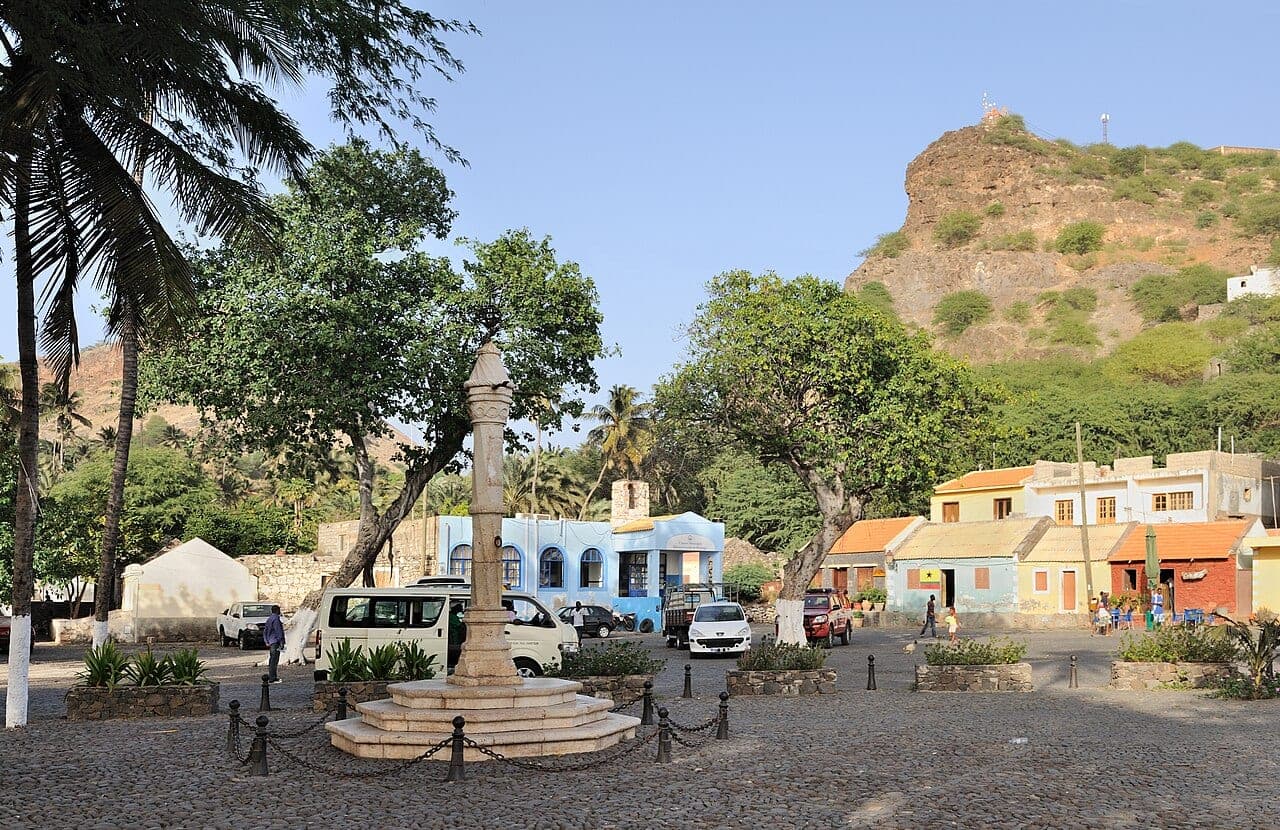
In the small square at the heart of Cidade Velha, on the island of Santiago, a marble pillar rises from the cobbles. It is a pelourinho, a pillory, set in place in the early sixteenth century, and for generations enslaved Africans were bound to it and punished in public view. The column still stands, weathered and unadorned, at the centre of what was once the richest colonial town on the Atlantic's African shore. Around it sit the ruins of a cathedral, and above the valley a fort keeps watch over an empty anchorage. This is where Cape Verde begins its account of itself: with an object of shame kept in plain sight, so that what happened here cannot be forgotten.
Cape Verde is an archipelago of ten volcanic islands some 570 kilometres off the coast of West Africa, and when Portuguese navigators reached it in the 1450s and early 1460s no one lived there. Every islander descends from those who came afterward, the Portuguese settlers and the far greater number of Africans brought against their will, and out of that forced meeting grew one of the oldest Creole societies on earth. The nation that emerged has known drought, famine and a long history of departure, and it has answered them with a music of longing that Cape Verdeans call sodade, carried around the world by an emigration that now outnumbers the people at home. This profile traces how Cabo Verde holds its memory: in the stones of Cidade Velha, in the Roman Catholic wake and the seventh-day mass, in the morna of Cesária Évora, and in the long conversation between the islands and their diaspora.
The Republic of Cabo Verde is a group of ten islands and several islets that rose from the sea floor between roughly 40 and 50 million years ago, along the same volcanic line that built the Canary Islands to the north. They divide into two arcs: the Barlavento, or windward group, of Santo Antão, São Vicente, Santa Luzia, São Nicolau, Sal and Boa Vista, and the Sotavento, or leeward group, of Maio, Santiago, Fogo and Brava. Their landscapes range from the flat, wind-scoured deserts of Sal and Boa Vista to the terraced green valleys of Santo Antão. The high point of the country is Pico do Fogo, an active volcano that reaches 2,829 metres on the island of Fogo and last erupted in 2014, burying two villages inside its ancient crater whose residents have since begun to rebuild on the cooled lava.
Around half a million people live on the islands, the 2021 census counting some 491,000, with the largest numbers on Santiago. The population is overwhelmingly Creole, of mixed African and European descent, young, urban and closely tied to family abroad. With few natural resources and little arable land, the country leans on remittances from emigrants alongside fishing, services and a tourism industry concentrated on the beaches of Sal and Boa Vista, and its currency is the Cape Verdean escudo. Since its first multiparty elections in 1991, Cape Verde has been one of the more stable democracies in Africa, with peaceful transfers of power between its two main parties.
Praia. The capital sits on a coastal plateau on the southern coast of Santiago and is the largest city and the seat of government. Its old core, the Plateau, keeps a grid of colonial streets and squares above the harbour, and the city has grown outward into the hub of Cape Verdean political and commercial life. Praia holds the National Assembly, the main university and the Ethnographic Museum.
Mindelo. On the island of São Vicente, ranged around one of the finest natural harbours in the Atlantic, Mindelo is the cultural capital of the nation. It grew in the nineteenth century as a British coaling station on the transatlantic steamship routes, and that cosmopolitan port life shaped its music, its literature and its famous Carnival. Mindelo was the home of Cesária Évora, and its bars and squares remain the living centre of morna and coladeira.
Cidade Velha. The oldest town in the country and its first capital, Cidade Velha, once Ribeira Grande, lies a short distance west of Praia on Santiago. Small and quiet today, it holds the deepest layer of Cape Verdean and Atlantic history and is the country's only UNESCO World Heritage Site.
Espargos. The main town of Sal grew up beside the island's international airport, long the country's principal air gateway, and serves the salt flats and resort economy of the dry northern islands, a working town of arrivals and departures fitting for a nation so shaped by movement.
The islands were uninhabited when navigators in the service of Portugal, among them the Genoese António da Noli, reached them around 1456 to 1460. Settlement of Santiago began in 1462, when colonists founded Ribeira Grande in a sheltered valley on the south coast. It was the first permanent town built by Europeans in the tropics, meant for trade with the West African mainland. Within a generation that trade was dominated by human beings: Ribeira Grande became a central entrepot of the Atlantic slave trade, a place where captives taken on the Guinea coast were held, baptised, taxed and shipped onward to Europe and, increasingly, to the plantations of the Americas. The town grew wealthy, and its wealth was inseparable from the suffering on which it rested. The pelourinho in the main square, and the ruins of the churches around it, are the surviving fabric of that first, terrible prosperity, and Cape Verde presents them without euphemism.
 Cidade Velha was the first European town built in the tropics, and its wealth came from the slave trade that passed through it. Photograph by Cayambe, CC BY-SA 3.0, via Wikimedia Commons.
The riches of Ribeira Grande drew raiders. The English privateer Francis Drake sacked the town in 1585, and a French squadron under Jacques Cassard did the same in 1712. After Drake's raid the Portuguese crown built the Fortaleza Real de São Filipe on the ridge above the valley between 1587 and 1593, but repeated attacks and the silting of its harbour drove the town into decline, and the capital moved to the more defensible plateau of Praia in the late eighteenth century.
Out of the meeting of Portuguese settlers and enslaved Africans grew a distinct Creole society, the first of its kind in the Atlantic world, with its own language, faith and customs. Its history was harsh. Set on dry islands prone to failed rains, Cape Verde suffered recurring droughts that brought famine, and the famines of the 1940s alone killed tens of thousands, with starving families interned in relief camps outside Praia. These calamities, and the poverty behind them, set in motion the great emigration that has defined the nation, as Cape Verdeans left for the whaling ports of New England, the plantations of São Tomé, and later Portugal, the Netherlands and Senegal.
Independence came not through a rising on the islands but through a shared struggle with Portuguese Guinea. In 1956 Amílcar Cabral, a Cape Verdean agronomist, poet and revolutionary thinker, helped found the African Party for the Independence of Guinea and Cabo Verde, known by its Portuguese initials PAIGC, which waged a guerrilla war in Guinea-Bissau through the 1960s and early 1970s. Cabral was assassinated in January 1973, months before Guinea-Bissau declared independence, and did not live to see the outcome. After the fall of Portugal's dictatorship, Cape Verde gained its own independence on 5 July 1975. A planned union of the two countries ended after a 1980 coup in Guinea-Bissau, and Cape Verde continued alone, adopting a multiparty constitution and holding free elections in 1991.
The country takes its name from the Cap-Vert peninsula on the coast of Senegal, the westernmost point of continental Africa, which Portuguese mariners had named Cabo Verde, or green cape, in 1444, some years before they came upon the islands offshore. The archipelago borrowed the name of the mainland cape that lay nearest to it.
Two languages carry Cape Verdean life. Portuguese is the official language, used in government, schooling and the written word, and it ties the country to the wider Lusophone community. The mother tongue of nearly every islander is Cape Verdean Creole, called Kriolu or Crioulo, which grew in the fifteenth and sixteenth centuries from the encounter of Portuguese with the West African languages of the enslaved. It is among the oldest Creole languages still spoken, and it exists in island variants, the Sotavento speech of Santiago and the Barlavento speech of São Vicente differing in sound and vocabulary. Kriolu is the language of the home, of proverb and joke, and above all of song: the poetry of morna and coladeira is written and sung in it, and the long campaign to give the language a settled written form and a fuller place in schooling is, for many Cape Verdeans, a question of dignity. To hold Kriolu is to hold the memory of how the nation was made.
Cape Verde is known to the world for its music, and at its centre lies the morna, a slow, melancholy song form built on guitar, violin, cavaquinho and voice, its lyrics turning on love, parting, the sea and the ache of absence. In 2019 UNESCO inscribed morna on the Representative List of the Intangible Cultural Heritage of Humanity, recognising a practice woven into weddings, wakes and family gatherings across the islands. Its greatest voice was Cesária Évora, born in Mindelo in 1941, known as the barefoot diva for performing without shoes in solidarity with the poor of her country. Her 1992 album Miss Perfumado and its song "Sodade," a lament of exile, carried Cape Verdean music to concert halls around the world and won her a Grammy before her death in 2011.
Morna has companions. The coladeira is its faster, lighter cousin, often wry or satirical, made for dancing. The funaná, driven by the accordion, called gaita, and the iron scraper known as ferrinho, comes from the interior of Santiago; long discouraged under colonial rule, it surged into popularity after independence as a sound of freedom. Older still is the batuku, a music and dance of the women of Santiago who, denied drums, beat out rhythms on bundled cloth held in the lap while a lead singer improvises sung poetry called finason, and the processional tabanka keeps alive the community festivals of the same island. The islands' cooking tells a parallel story of making much from little: the national dish is cachupa, a slow stew of hominy corn, beans and whatever meat or fish is at hand, cooked in a pot added to across days and fried the next morning as cachupa guisada.
Cape Verde is a predominantly Roman Catholic country, with Catholics forming roughly three-quarters of the population, an inheritance of Portuguese settlement that reaches back to one of the oldest dioceses in the region, founded at Ribeira Grande. The calendar of the church frames the year, from baptisms and first communions to the patron-saint festivals that fill each island's towns with processions, music and family return. Protestant and evangelical congregations, along with the long-established Church of the Nazarene, have grown in recent decades, and small numbers of other faiths complete the picture.
As across the Creole Atlantic, Catholic practice on the islands lives beside older beliefs rather than fully displacing them. Folk custom preserves a sense that the dead remain near, that certain days and places carry spiritual weight, and that the wellbeing of the living is bound up with respect for those who came before. The great festivals blend devotion and celebration without any felt contradiction, and the morna itself, sung at both parties and funerals, carries a quiet religious charge, addressing loss, memory and the hope of reunion in language that a mourner and a worshipper share.
When a death occurs on the islands, the community gathers. The wake, the velório, is central to Cape Verdean mourning: family, neighbours and friends sit with the body through the night, praying, talking and remembering, and the number who come is understood as a measure of the regard in which the dead person was held. In the warm climate the funeral follows quickly, with a Catholic mass and a procession to the cemetery, and the singing of morna at such moments turns the form's themes of parting and longing toward the departed themselves.
Catholic time then shapes the mourning that follows. A mass is said on the seventh day after death, and further masses at the month and the year gather the family again around their loss, while close relatives keep a period of mourning marked by dark clothing and withdrawal from festivity in the Portuguese manner. On All Souls' Day in early November, families visit the cemeteries to clean the graves and lay flowers and candles. For a people so marked by departure, remembrance also crosses the ocean: the diaspora sends money for funerals and masses, returns for burials where it can, and keeps the names of the dead alive in communities far from the islands.
Two griefs sit deeper still. At Cidade Velha, the memory of the slave trade is held in the pillory and the ruined churches, a national reckoning with the suffering on which the first town was built, and heritage work there frames the site as a place of conscience rather than antiquity. And over the whole culture hangs sodade, the Kriolu word for the longing of a nation shaped by emigration, the ache of those who left for a home they may never see again and of those who stayed behind to wait. It is at once a private sorrow and a collective one, and in the morna it has found its lasting voice.
Cape Verdean family history is emigration history, and the records reflect it.
The islands were uninhabited when the Portuguese arrived in the 1460s, so every family here came from somewhere: from Portugal, from the Guinea coast as enslaved people, and later from Lebanon, Italy and elsewhere. Catholic parish registers begin in the sixteenth century in Ribeira Grande on Santiago, which was the first European city in the tropics, and they are among the oldest vital records anywhere in Africa. Portuguese colonial administrative records are divided between Praia and the Arquivo Histórico Ultramarino in Lisbon.
The distinctive Cape Verdean archive is American. From the early nineteenth century New England whaling ships recruited crew in the islands, particularly on Brava and Fogo, and Cape Verdeans settled in New Bedford and Providence. That makes Cape Verde one of the earliest voluntary African migrations to the United States, and the crew lists, ship registers and naturalisation papers of Massachusetts and Rhode Island are a primary source for Cape Verdean families. Later waves went to Portugal, the Netherlands, France and Senegal.
The number usually given is that more Cape Verdeans live abroad than in the country. Family research here therefore tends to run in both directions at once: an island parish register for the older generations, and a receiving country's immigration file for the recent ones, with the two meeting somewhere in the middle of the twentieth century.
The centre of the country's heritage work is Cidade Velha, inscribed on the UNESCO World Heritage List in 2009 as the historic centre of Ribeira Grande, the first European colonial town in the tropics and a site bearing witness to the history of the Atlantic slave trade. The inscription protects the surviving fabric of the town: the pelourinho in the main square; the Rua Banana, one of the oldest colonial streets; the ruins of the cathedral built between 1556 and 1705; the church of Nossa Senhora do Rosário, dating from the close of the fifteenth century and among the oldest colonial churches anywhere; and, on the ridge above, the restored Fortaleza Real de São Filipe. Conservation and interpretation at the site emphasise the memory of slavery rather than picturesque ruin.
Beyond Cidade Velha, the nation's memory is held in its museums. The Ethnographic Museum in Praia, opened in 1997 in a nineteenth-century building on the Plateau, gathers the objects of everyday Cape Verdean life, including the woven cloth known as pano di téra, pottery, tools, musical instruments and religious items. Mindelo holds museums of its own, among them one dedicated to Cesária Évora that keeps her memory and the story of morna, and cultural centres that document the port city's musical and literary past. Together these institutions record a heritage that is as much intangible, in language, music and custom, as it is built.
For a small and dispersed nation, digital tools have become essential to holding memory together across an ocean. The documentary record of the islands is split between archives in Cape Verde and in Portugal, and digitisation projects have begun to make colonial-era papers, parish registers and the historical press consultable from anywhere, opening the sources of family and national history to a diaspora that could never travel to read the originals. Cape Verdean music, the country's most portable heritage, lives fully online, from digitised recordings of morna and the catalogue of Cesária Évora to the streaming of new work by island and diaspora artists.
Community networks carry the everyday labour of remembrance. Cape Verdean associations in the United States, Portugal, the Netherlands and elsewhere maintain websites, social media groups and online radio in Kriolu, circulating funeral notices, festival videos, old photographs and family news between the islands and their scattered communities. This is the same conviction that animates Confinity's own work, that memory must be actively recopied by each generation and place or it thins and fades. For a nation defined by departure, the digital archive has become a way of keeping the absent present.
Cape Verde's largest cultural presence in the wider world is its diaspora, which by most reckonings outnumbers the population of the islands themselves, with major communities in the United States, especially the old whaling ports of southeastern Massachusetts and Rhode Island, and in Portugal, the Netherlands, France and Senegal. That diaspora has kept the islands solvent through remittances and has been the vehicle for Cape Verdean music's reach abroad, from the tours of Cesária Évora to a younger generation of artists such as Mayra Andrade, Sara Tavares, Lura and Tcheka, who work morna, coladeira and funaná into contemporary forms for audiences far beyond the archipelago.
At home, culture is increasingly a matter of festival and homecoming. The Baía das Gatas festival on São Vicente, held on the beach under the first full moon of August, is among the oldest open-air music events in West Africa and a magnet for emigrants returning for the summer, while the Mindelo Carnival draws on the traditions of Brazil and Portugal in a distinctly Cape Verdean key. Through all of it runs the same current of sodade and return, the movement of a people between the islands and the world that has been the shape of Cape Verdean life for five centuries.
Morna joins humanity's heritage list. In 2019 UNESCO inscribed morna on the Representative List of the Intangible Cultural Heritage of Humanity, recognition for a song form that is the emotional core of Cape Verdean life, arriving while the tradition remains fully alive in wakes, weddings and the bars of Mindelo.
Cidade Velha becomes a place of conscience. The 2009 World Heritage inscription of the historic centre of Ribeira Grande gave lasting protection to the first European colonial town in the tropics and reframed it as a memorial to the Atlantic slave trade, preserving the pelourinho and the ruined churches as objects of national reckoning.
The barefoot diva carries a nation abroad. Cesária Évora, singing in Kriolu from a small island port, brought Cape Verdean music to the world's concert halls and won a Grammy, proving that a language and a sorrow born on a poor archipelago could speak to listeners everywhere and giving the diaspora a voice for its longing.
A dispersed nation keeps itself whole. Through remittances, returning festivals and a growing online archive, Cape Verde's diaspora has sustained both the economy and the memory of the islands, turning an emigration born of famine into a lasting bond across the Atlantic.
Cidade Velha was the first European town built in the tropics, and its wealth came from the slave trade that passed through it. Photograph by Cayambe, CC BY-SA 3.0, via Wikimedia Commons.
The riches of Ribeira Grande drew raiders. The English privateer Francis Drake sacked the town in 1585, and a French squadron under Jacques Cassard did the same in 1712. After Drake's raid the Portuguese crown built the Fortaleza Real de São Filipe on the ridge above the valley between 1587 and 1593, but repeated attacks and the silting of its harbour drove the town into decline, and the capital moved to the more defensible plateau of Praia in the late eighteenth century.
Out of the meeting of Portuguese settlers and enslaved Africans grew a distinct Creole society, the first of its kind in the Atlantic world, with its own language, faith and customs. Its history was harsh. Set on dry islands prone to failed rains, Cape Verde suffered recurring droughts that brought famine, and the famines of the 1940s alone killed tens of thousands, with starving families interned in relief camps outside Praia. These calamities, and the poverty behind them, set in motion the great emigration that has defined the nation, as Cape Verdeans left for the whaling ports of New England, the plantations of São Tomé, and later Portugal, the Netherlands and Senegal.
Independence came not through a rising on the islands but through a shared struggle with Portuguese Guinea. In 1956 Amílcar Cabral, a Cape Verdean agronomist, poet and revolutionary thinker, helped found the African Party for the Independence of Guinea and Cabo Verde, known by its Portuguese initials PAIGC, which waged a guerrilla war in Guinea-Bissau through the 1960s and early 1970s. Cabral was assassinated in January 1973, months before Guinea-Bissau declared independence, and did not live to see the outcome. After the fall of Portugal's dictatorship, Cape Verde gained its own independence on 5 July 1975. A planned union of the two countries ended after a 1980 coup in Guinea-Bissau, and Cape Verde continued alone, adopting a multiparty constitution and holding free elections in 1991.
The country takes its name from the Cap-Vert peninsula on the coast of Senegal, the westernmost point of continental Africa, which Portuguese mariners had named Cabo Verde, or green cape, in 1444, some years before they came upon the islands offshore. The archipelago borrowed the name of the mainland cape that lay nearest to it.
Two languages carry Cape Verdean life. Portuguese is the official language, used in government, schooling and the written word, and it ties the country to the wider Lusophone community. The mother tongue of nearly every islander is Cape Verdean Creole, called Kriolu or Crioulo, which grew in the fifteenth and sixteenth centuries from the encounter of Portuguese with the West African languages of the enslaved. It is among the oldest Creole languages still spoken, and it exists in island variants, the Sotavento speech of Santiago and the Barlavento speech of São Vicente differing in sound and vocabulary. Kriolu is the language of the home, of proverb and joke, and above all of song: the poetry of morna and coladeira is written and sung in it, and the long campaign to give the language a settled written form and a fuller place in schooling is, for many Cape Verdeans, a question of dignity. To hold Kriolu is to hold the memory of how the nation was made.
Cape Verde is known to the world for its music, and at its centre lies the morna, a slow, melancholy song form built on guitar, violin, cavaquinho and voice, its lyrics turning on love, parting, the sea and the ache of absence. In 2019 UNESCO inscribed morna on the Representative List of the Intangible Cultural Heritage of Humanity, recognising a practice woven into weddings, wakes and family gatherings across the islands. Its greatest voice was Cesária Évora, born in Mindelo in 1941, known as the barefoot diva for performing without shoes in solidarity with the poor of her country. Her 1992 album Miss Perfumado and its song "Sodade," a lament of exile, carried Cape Verdean music to concert halls around the world and won her a Grammy before her death in 2011.
Morna has companions. The coladeira is its faster, lighter cousin, often wry or satirical, made for dancing. The funaná, driven by the accordion, called gaita, and the iron scraper known as ferrinho, comes from the interior of Santiago; long discouraged under colonial rule, it surged into popularity after independence as a sound of freedom. Older still is the batuku, a music and dance of the women of Santiago who, denied drums, beat out rhythms on bundled cloth held in the lap while a lead singer improvises sung poetry called finason, and the processional tabanka keeps alive the community festivals of the same island. The islands' cooking tells a parallel story of making much from little: the national dish is cachupa, a slow stew of hominy corn, beans and whatever meat or fish is at hand, cooked in a pot added to across days and fried the next morning as cachupa guisada.
Cape Verde is a predominantly Roman Catholic country, with Catholics forming roughly three-quarters of the population, an inheritance of Portuguese settlement that reaches back to one of the oldest dioceses in the region, founded at Ribeira Grande. The calendar of the church frames the year, from baptisms and first communions to the patron-saint festivals that fill each island's towns with processions, music and family return. Protestant and evangelical congregations, along with the long-established Church of the Nazarene, have grown in recent decades, and small numbers of other faiths complete the picture.
As across the Creole Atlantic, Catholic practice on the islands lives beside older beliefs rather than fully displacing them. Folk custom preserves a sense that the dead remain near, that certain days and places carry spiritual weight, and that the wellbeing of the living is bound up with respect for those who came before. The great festivals blend devotion and celebration without any felt contradiction, and the morna itself, sung at both parties and funerals, carries a quiet religious charge, addressing loss, memory and the hope of reunion in language that a mourner and a worshipper share.
When a death occurs on the islands, the community gathers. The wake, the velório, is central to Cape Verdean mourning: family, neighbours and friends sit with the body through the night, praying, talking and remembering, and the number who come is understood as a measure of the regard in which the dead person was held. In the warm climate the funeral follows quickly, with a Catholic mass and a procession to the cemetery, and the singing of morna at such moments turns the form's themes of parting and longing toward the departed themselves.
Catholic time then shapes the mourning that follows. A mass is said on the seventh day after death, and further masses at the month and the year gather the family again around their loss, while close relatives keep a period of mourning marked by dark clothing and withdrawal from festivity in the Portuguese manner. On All Souls' Day in early November, families visit the cemeteries to clean the graves and lay flowers and candles. For a people so marked by departure, remembrance also crosses the ocean: the diaspora sends money for funerals and masses, returns for burials where it can, and keeps the names of the dead alive in communities far from the islands.
Two griefs sit deeper still. At Cidade Velha, the memory of the slave trade is held in the pillory and the ruined churches, a national reckoning with the suffering on which the first town was built, and heritage work there frames the site as a place of conscience rather than antiquity. And over the whole culture hangs sodade, the Kriolu word for the longing of a nation shaped by emigration, the ache of those who left for a home they may never see again and of those who stayed behind to wait. It is at once a private sorrow and a collective one, and in the morna it has found its lasting voice.
Cape Verdean family history is emigration history, and the records reflect it.
The islands were uninhabited when the Portuguese arrived in the 1460s, so every family here came from somewhere: from Portugal, from the Guinea coast as enslaved people, and later from Lebanon, Italy and elsewhere. Catholic parish registers begin in the sixteenth century in Ribeira Grande on Santiago, which was the first European city in the tropics, and they are among the oldest vital records anywhere in Africa. Portuguese colonial administrative records are divided between Praia and the Arquivo Histórico Ultramarino in Lisbon.
The distinctive Cape Verdean archive is American. From the early nineteenth century New England whaling ships recruited crew in the islands, particularly on Brava and Fogo, and Cape Verdeans settled in New Bedford and Providence. That makes Cape Verde one of the earliest voluntary African migrations to the United States, and the crew lists, ship registers and naturalisation papers of Massachusetts and Rhode Island are a primary source for Cape Verdean families. Later waves went to Portugal, the Netherlands, France and Senegal.
The number usually given is that more Cape Verdeans live abroad than in the country. Family research here therefore tends to run in both directions at once: an island parish register for the older generations, and a receiving country's immigration file for the recent ones, with the two meeting somewhere in the middle of the twentieth century.
The centre of the country's heritage work is Cidade Velha, inscribed on the UNESCO World Heritage List in 2009 as the historic centre of Ribeira Grande, the first European colonial town in the tropics and a site bearing witness to the history of the Atlantic slave trade. The inscription protects the surviving fabric of the town: the pelourinho in the main square; the Rua Banana, one of the oldest colonial streets; the ruins of the cathedral built between 1556 and 1705; the church of Nossa Senhora do Rosário, dating from the close of the fifteenth century and among the oldest colonial churches anywhere; and, on the ridge above, the restored Fortaleza Real de São Filipe. Conservation and interpretation at the site emphasise the memory of slavery rather than picturesque ruin.
Beyond Cidade Velha, the nation's memory is held in its museums. The Ethnographic Museum in Praia, opened in 1997 in a nineteenth-century building on the Plateau, gathers the objects of everyday Cape Verdean life, including the woven cloth known as pano di téra, pottery, tools, musical instruments and religious items. Mindelo holds museums of its own, among them one dedicated to Cesária Évora that keeps her memory and the story of morna, and cultural centres that document the port city's musical and literary past. Together these institutions record a heritage that is as much intangible, in language, music and custom, as it is built.
For a small and dispersed nation, digital tools have become essential to holding memory together across an ocean. The documentary record of the islands is split between archives in Cape Verde and in Portugal, and digitisation projects have begun to make colonial-era papers, parish registers and the historical press consultable from anywhere, opening the sources of family and national history to a diaspora that could never travel to read the originals. Cape Verdean music, the country's most portable heritage, lives fully online, from digitised recordings of morna and the catalogue of Cesária Évora to the streaming of new work by island and diaspora artists.
Community networks carry the everyday labour of remembrance. Cape Verdean associations in the United States, Portugal, the Netherlands and elsewhere maintain websites, social media groups and online radio in Kriolu, circulating funeral notices, festival videos, old photographs and family news between the islands and their scattered communities. This is the same conviction that animates Confinity's own work, that memory must be actively recopied by each generation and place or it thins and fades. For a nation defined by departure, the digital archive has become a way of keeping the absent present.
Cape Verde's largest cultural presence in the wider world is its diaspora, which by most reckonings outnumbers the population of the islands themselves, with major communities in the United States, especially the old whaling ports of southeastern Massachusetts and Rhode Island, and in Portugal, the Netherlands, France and Senegal. That diaspora has kept the islands solvent through remittances and has been the vehicle for Cape Verdean music's reach abroad, from the tours of Cesária Évora to a younger generation of artists such as Mayra Andrade, Sara Tavares, Lura and Tcheka, who work morna, coladeira and funaná into contemporary forms for audiences far beyond the archipelago.
At home, culture is increasingly a matter of festival and homecoming. The Baía das Gatas festival on São Vicente, held on the beach under the first full moon of August, is among the oldest open-air music events in West Africa and a magnet for emigrants returning for the summer, while the Mindelo Carnival draws on the traditions of Brazil and Portugal in a distinctly Cape Verdean key. Through all of it runs the same current of sodade and return, the movement of a people between the islands and the world that has been the shape of Cape Verdean life for five centuries.
Morna joins humanity's heritage list. In 2019 UNESCO inscribed morna on the Representative List of the Intangible Cultural Heritage of Humanity, recognition for a song form that is the emotional core of Cape Verdean life, arriving while the tradition remains fully alive in wakes, weddings and the bars of Mindelo.
Cidade Velha becomes a place of conscience. The 2009 World Heritage inscription of the historic centre of Ribeira Grande gave lasting protection to the first European colonial town in the tropics and reframed it as a memorial to the Atlantic slave trade, preserving the pelourinho and the ruined churches as objects of national reckoning.
The barefoot diva carries a nation abroad. Cesária Évora, singing in Kriolu from a small island port, brought Cape Verdean music to the world's concert halls and won a Grammy, proving that a language and a sorrow born on a poor archipelago could speak to listeners everywhere and giving the diaspora a voice for its longing.
A dispersed nation keeps itself whole. Through remittances, returning festivals and a growing online archive, Cape Verde's diaspora has sustained both the economy and the memory of the islands, turning an emigration born of famine into a lasting bond across the Atlantic.
National Overview
Notable Cities
Historical Foundations
Linguistic and Etymological Roots
Cultural Identity
Religion and Spirituality
Remembrance and Mourning Traditions
Tracing a Family in Cape Verde
Heritage Preservation Efforts
Digital Heritage
Contemporary Cultural Influences
Success Stories
References and resources
- UNESCO World Heritage Centre: Cidade Velha, Historic Centre of Ribeira Grande
- UNESCO Intangible Cultural Heritage: Morna, musical practice of Cabo Verde
- Britannica: Cabo Verde
- Britannica: History of Cabo Verde
- Wikipedia: Cape Verde
- Wikipedia: Cidade Velha
- Wikipedia: Pelourinho (Cidade Velha)
- Wikipedia: Forte Real de São Filipe
- Wikipedia: Morna (music)
- Wikipedia: Cesária Évora
- Wikipedia: African Party for the Independence of Guinea and Cape Verde (PAIGC)
- Wikipedia: Museu Etnográfico da Praia