Heritage · Country
American Samoa Culture and Heritage
In the one American territory where nine tenths of the land cannot be sold, chiefly titles still seat half the legislature and families bury their dead in the front yard. A guide to fa'a Samoa under a US flag, from the cession of 1900 to the argument over citizenship.Written to last.
By Confinity Heritage Editorial · Updated 2026-08-17 · 8-minute readQuiet tools, kept out of the way.
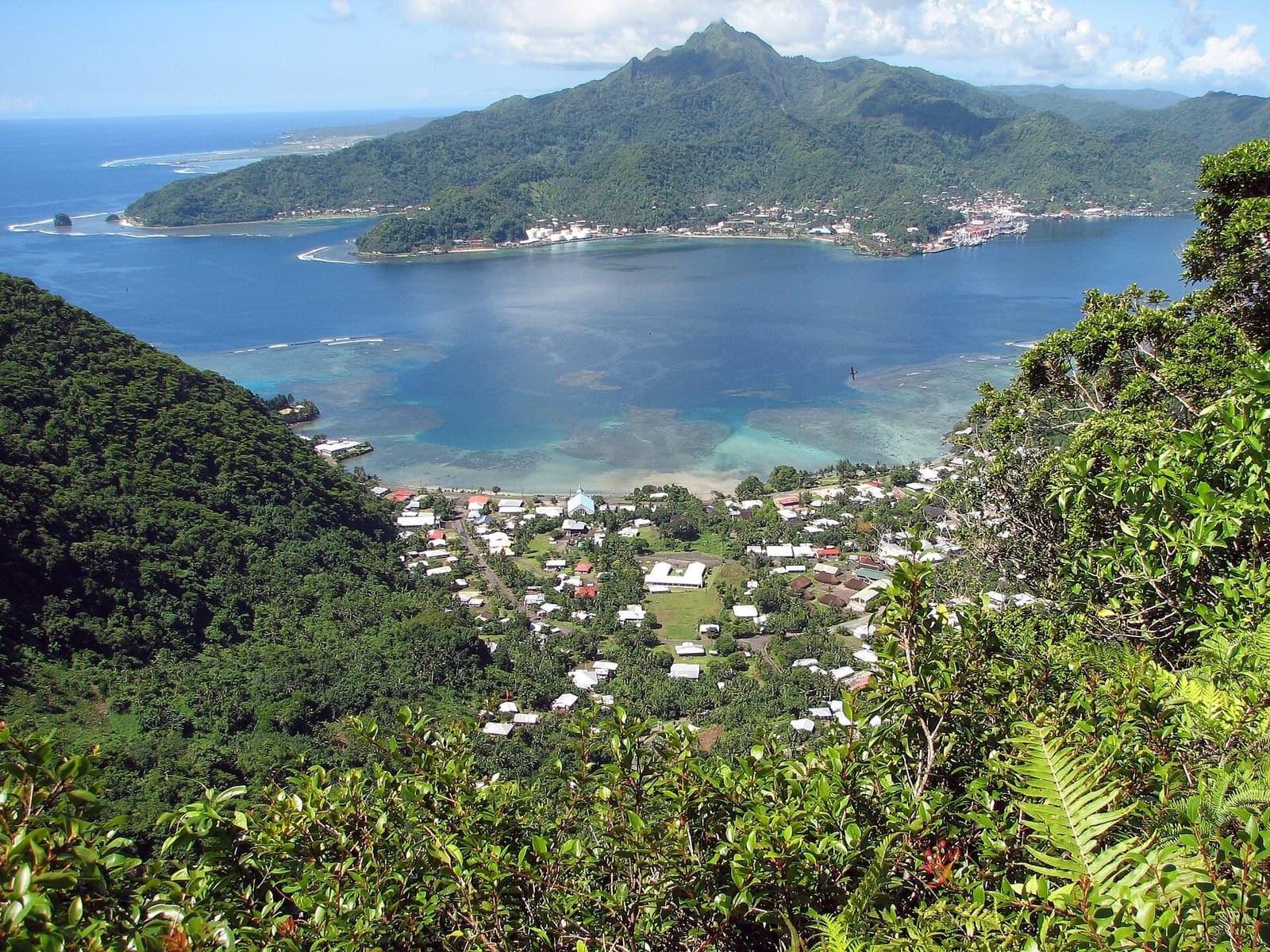
You can't buy land in American Samoa. Roughly nine tenths of the territory is communal land, held by extended families and vested in the matai who carries the family title, and it isn't for sale; a long lease needs the governor's written approval, and the court that decides who holds which acre and which name is a territorial court whose rulings no federal judge reviews. Almost everything distinctive about the place runs back to that arrangement. Because the ground could not be bought out from under the families, the order it supports has stayed in working condition.
That order is fa'a Samoa, the Samoan way, and in the eastern islands it has been carried inside American sovereignty for more than a century. The chiefs of Tutuila handed their islands to the United States in 1900 and the Tui Manu'a followed in 1904, a naval commandant governed until 1951, and the people born here are US nationals who are not US citizens at birth, the only such population left.
Amerika Sāmoa is the eastern half of the Samoan archipelago: Tutuila with its small neighbour Aunu'u, the three islands of the Manu'a group, uninhabited Rose Atoll, and Swains Island far to the north. Land comes to about 199 square kilometres. The 2020 census counted 49,710 residents, down sharply as families move to Hawaii, California, Utah and Washington State, and the drift has continued since (US Census Bureau). Almost everyone lives on Tutuila, around Pago Pago Harbour, a flooded volcanic crater so deep and sheltered that it decided the islands' modern history.
In legal terms this is an unincorporated, unorganised territory: Congress has never passed an organic act for it and the full Constitution has never been extended to it. It wrote its own constitution instead, revised in 1967, whose first article obliges the government to protect people of Samoan ancestry against the alienation of their lands and the destruction of the Samoan way of life. The legislature, the Fono, has a popularly elected House and a Senate of eighteen matai selected by the county councils under customary rules, so chiefly rank is written into the machinery of the state. Tuna processing, the public payroll and remittances carry the economy.
Pago Pago and the harbour villages. Pago Pago gives its name to the harbour and to the territory's centre of gravity, though the settlement is really a string of villages around the water: Fagatogo, where the Fono and the courthouse sit among the old naval station buildings; Utulei with the governor's residence; Atu'u opposite, where the cannery has run since the 1950s. Rainmaker Mountain rises over the entrance and pulls the cloud that gives the harbour its weather. The flat shelf on the south side, at Tafuna and Nu'uuli, holds the airport, the hospital, the college and most of the territory's newer housing.
Leone. The old western capital, and the landing place of the missionary John Williams in 1832, Leone was Tutuila's Polynesian centre before the harbour took over, and it keeps the high titles and salutations that go with that. Its white church with twin towers is one of the most photographed buildings in the territory.
Ta'u and the Manu'a Islands. Ofu, Olosega and Ta'u lie about 100 kilometres east, and Samoans across the archipelago regard Manu'a as the senior place, seat of the Tui Manu'a, among the oldest and most sacred titles in Polynesia. Ta'u is also where Margaret Mead did the fieldwork behind Coming of Age in Samoa, a book still argued about here.
Lapita voyagers reached the Samoan islands roughly three thousand years ago, and the eastern islands grew up inside a single archipelago-wide order of titles, districts and formal salutations, with Manu'a holding particular sanctity. The boundary that now separates American Samoa from independent Samoa was drawn by outsiders across a culture that had never divided itself that way.
Deep-water harbours were scarce in the Pacific and Pago Pago was among the best, which drew American attention from the 1870s. When Germany, Britain and the United States settled their rivalry in the Tripartite Convention of 1899, the eastern islands fell to the Americans. The chiefs of Tutuila and Aunu'u signed a deed of cession on 17 April 1900, and the Tui Manu'a Elisala signed for Manu'a on 16 July 1904; Congress did not ratify either instrument until February 1929 (Britannica). The deeds were agreements rather than conquests, and Samoans still cite them as contracts in which the United States undertook to respect chiefly authority and custom.
From 1900 to 1951 the territory was run as a naval station under a commandant appointed by the Secretary of the Navy, an arrangement that brought a hospital, schools and a wage economy while leaving village government largely alone (Wikipedia). Discontent surfaced anyway. In the 1920s a movement known here as the Mau, led by the veteran Samuelu Ripley, pressed for civil government and an end to rule by naval decree; the Navy suppressed it and barred Ripley from returning, and a congressional commission came in 1930 to hear the complaints. The western half of the archipelago had its own and far bloodier Mau under New Zealand rule, and the two are often confused.
The Second World War turned Tutuila into a base, with thousands of US Marines on an island of about 13,000 people and gun emplacements above the harbour. In 1951 President Truman moved the territory from the Navy to the Department of the Interior. Peter Tali Coleman became the first Samoan appointed governor in 1956, the office became elective in 1977, and a non-voting delegate has sat in the US House since 1981. The territory has never held a plebiscite on its status.
Samoan is the everyday language here, spoken at home by the great majority and used in church, in the fono and in ceremony, with English the language of schooling, courts and business. The pressure on it comes less from the islands than from the diaspora, where children of Samoan families in Utah or Auckland often grow up understanding more than they speak.
Two registers run in parallel. Everyday speech uses a k where the formal register uses a t, and the chiefly language, gagana fa'aaloalo, carries a separate vocabulary for the bodies, actions and possessions of titled people. Above both sits the fa'alupega, the formal salutation of a village or district: a fixed sequence of honorifics that names the ranking titles in order and encodes, in a paragraph, the political history of the place. An orator who greets a village correctly is reciting its constitution; the salutations were gathered in print as the Fa'alupega o Sāmoa, and getting one wrong in public is still a serious matter.
The archipelago's name has several readings, one joining sa, sacred, with moa, centre. The word tattoo reached English from the Polynesian tatau, written down by Cook's crew in Tahiti in 1769; Samoan uses the same word for the same practice, and Samoa is the place where the practice never stopped.
The frame is the aiga, the extended family, and the matai who holds its title. Titles are conferred by family consensus at a saofa'i, can be held by women as well as men, and carry duties rather than property: to speak for the family, to allocate its land, to answer for it in the village fono, the council of matai that governs each village as a small polity. Rank is expressed through the 'ava ceremony, where the cup is called in order of precedence, and through the tulafale, the orator chiefs whose staff and fly whisk mark a profession of memory and formal speech.
Tatau is the most visible inheritance. The pe'a covers a man from waist to knee in dense blackwork and the malu marks a woman's thighs more sparingly, both applied by hand with the au, a toothed comb of bone or tusk bound to a handle and tapped through the skin over many painful sittings (Auckland Museum). The craft descends through hereditary lines of tufuga tā tatau, above all the Su'a and Sulu'ape families. A pe'a left unfinished is a lasting embarrassment, which tells you what the mark is understood to be about.
Two textile traditions matter as much. Siapo is barkcloth beaten from paper mulberry and printed with earth pigments. The 'ie tōga, the fine mat, is the higher form: woven from pandanus split so thin that a large mat can take years, edged with feathers, named and remembered by the occasions at which it changed hands. Fine mats are the currency of ceremony, presented at weddings, title bestowals, apologies and above all funerals, and neighbouring Samoa had the practice inscribed on UNESCO's intangible heritage list in 2019 (UNESCO).
American Samoa is one of the most thoroughly Christian places in the world, with over 98 percent of residents reporting a Christian affiliation and the Congregational tradition, planted by the London Missionary Society from 1830, the largest strand alongside Catholics, Methodists and Latter-day Saints. The village church is usually the largest building in sight, and the pastor ranks close to a high chief.
Sunday is observed strictly, with shops closed and the day running through morning service, the to'ona'i meal and an evening service. The custom that surprises visitors most is the sā, the evening prayer curfew: at dusk a bell or a conch sounds in the village, everyone stops where they are, and for ten or fifteen minutes each household holds the lotu afiafi, its evening prayers, while the untitled young men of the aumaga see that the street stays quiet. Older belief has been folded in rather than erased, and stories of aitu, spirits attached to particular places, are told without embarrassment by people on their way to church.
Death sets a very large machine in motion. A maliu draws the aiga home from across the territory, from Hawaii and the US mainland and from New Zealand and Australia, and the days that follow are structured by exchange between the family of the deceased and the families connected to it by marriage and title. One side brings 'ie tōga, fine mats sometimes generations old, along with siapo and cash; the other answers with food, pigs and money of its own. Orators speak for each party, gifts are counted aloud, and the distribution is remembered, because it sets what is owed at the next funeral in the other direction. This is the obligation network called fa'alavelave, and it is the most demanding thing in Samoan life: families routinely spend thousands of dollars on one funeral, and the strain that puts on households here and in the diaspora is a standing subject of sermons.
 A Japanese submarine shelled Pago Pago in 1942, and American Samoa has sent people into the American military at a higher rate per head than any state ever since. Photograph by the National Park Service, public domain, via Wikimedia Commons.
The burial is the part a visitor notices first. Instead of a municipal cemetery, most families bury their dead in front of the house, in a raised tomb of concrete faced with tile, sometimes roofed, sometimes fitted with a bench and a light, a few paces from the door. Whole villages are laid out this way, with the dead in the yard between the house and the road. The reasoning is plain enough when you ask: the family's land holds the family, living and dead, and a grave on communal ground is also a statement about who belongs to it. Tombs are washed and repainted before a title bestowal or a church anniversary, and a headstone is often unveiled months after the burial.
Memory is also carried in language. A matai title outlives everyone who holds it, so bestowing it is a kind of resurrection performed in public, and long recitations of descent are still produced as evidence in title disputes before the High Court.
American Samoa runs the Samoan matai system inside American law, and both leave records.
The fa'a Samoa applies here as in independent Samoa: extended families hold chiefly titles, titles are conferred by the family from among those with a genealogical claim, and land is customary and attached to titles. Around ninety per cent of land in American Samoa is communal, so lineage is title. The High Court's Land and Titles Division hears the genealogical evidence, and its records are the formal archive of American Samoan descent.
The written record begins with the London Missionary Society in the 1830s, whose registers carry the earliest vital events, and continues with the United States Navy, which administered the territory from 1900 to 1951 and kept censuses, court records and the paperwork of a naval station at Pago Pago.
The most consequential difference from Samoa is quarantine. In 1918 the naval governor closed the port, and American Samoa lost nobody to the influenza that killed more than a fifth of the population of Western Samoa a few miles away.
American Samoans are United States nationals but not citizens by birth, a status that exists nowhere else and has been repeatedly litigated. Establishing descent therefore has consequences for what documents a person can obtain.
Military service is the other record: American Samoa has sent people into the armed forces at a higher rate per head than any state, and those service files are substantial.
The most effective preservation instrument here is the land law itself. Land is classed as communal, individually owned or freehold, with communal land the great bulk of it; its sale is barred outright, alienation to people who are not of Samoan ancestry is restricted, and disputes go to a specialised division of the High Court rather than the federal system (Minority Rights Group). Such rules would be constitutionally awkward in a US state, and the courts have so far accommodated them as protection of an indigenous population inside an unincorporated territory. The effect is easy to see: villages have not been sold to developers, families have somewhere to bury their dead, and the matai system still governs an asset that matters.
The National Park of American Samoa works on the same logic. Authorised by Congress in 1988 and covering rainforest, cliffs and reef on Tutuila, Ta'u and Ofu, it is the only US national park in the southern hemisphere, and the Park Service does not own an acre of it. In 1993 eight villages leased about 9,000 acres to the federal government for fifty years, keeping ownership and a say in management, with two more joining in 2002 (National Park Service). Village councils are still consulted on major decisions inside the park.
Built and archaeological heritage is handled by the American Samoa Historic Preservation Office, which keeps the territory's inventory and its National Register nominations, from prehistoric star mounds, the tia seu lupe once used for the chiefly sport of pigeon snaring, to the coastal batteries of 1941 and the naval buildings in Fagatogo (ASHPO). The Jean P. Haydon Museum, founded in 1970 in the old naval commissary, holds the public collection: fine mats said to be centuries old, tools, siapo, war relics and a lunar sample presented after the Apollo missions, whose splashdown zone lay in Samoan waters (Jean P. Haydon Museum).
Digital work here is modest and practical. ASHPO publishes its historic-property inventory and a walking tour of the harbour district online, which is how most people outside the territory meet its archaeology. The Feleti Barstow Public Library in Utulei keeps a Pacific collection, and the American Samoa Community College's Samoan Studies Institute records oral history and chiefly speech that would otherwise exist only in the heads of a shrinking number of orators.
The most consequential digital heritage here, though, is amateur. Funerals, saofa'i title bestowals and fine-mat presentations are routinely livestreamed so that relatives in Anchorage or Auckland can watch and contribute, and the recordings sit afterwards as an unplanned archive of ceremony and exchange. Diaspora genealogy groups and village pages have become working repositories of photographs, fa'alupega and title histories.
American Samoa's reach is out of proportion to its size. The territory and its diaspora have sent an extraordinary number of players into American football. Enlistment in the US armed forces is higher per head than in any state, which is one of the sharper facts inside the citizenship argument: people who are not citizens by birth volunteer in large numbers.
That argument is the territory's central unresolved question. Under federal law, people born in American Samoa are US nationals but not citizens: free to live and work anywhere in the United States and to hold a US passport, but unable to vote in federal elections or take many public jobs without naturalising (Cornell Law School). Two lawsuits have tested it. In Tuaua v. United States the DC Circuit ruled in 2015 that the Citizenship Clause does not reach the territory, and the Supreme Court declined the case in 2016. In Fitisemanu v. United States a federal judge in Utah found for the plaintiffs in 2019, the Tenth Circuit reversed in December 2021, and the Supreme Court denied review in October 2022 (Wikipedia).
What makes the litigation unusual is who opposed it. The American Samoa Government and the territory's congressional delegate intervened against the plaintiffs, arguing that citizenship imposed by a court, rather than chosen by American Samoans through their own institutions, could expose the pillars of fa'a Samoa to equal-protection challenge: the ban on selling communal land, the ancestry rules attached to landholding, and a Senate seated by matai. The plaintiffs answer that the present status rests on the Insular Cases, a line of early twentieth-century decisions built on frank racial reasoning that several justices have since called shameful, and that no people should have to accept a second-class status in order to keep its customs. Both sides say they are protecting the same thing. How to do it has not been settled, and the territory has never voted on the question.
Land that could not be sold. Communal tenure over most of the territory, protected by local law and a specialised court, has kept villages, burial grounds and the matai system in working order.
A national park held on lease. Villages on Tutuila, Ta'u and Ofu leased land to the National Park Service in 1993 rather than selling it, producing a US national park its traditional owners still own.
An unbroken tattooing line. The pe'a and the malu were never abandoned, and hereditary tufuga carried hand-tapped tatau into Pacific communities worldwide.
Chiefs inside the state. The Senate of the Fono, seated by matai under customary rules, gives chiefly authority formal legal standing.
A Japanese submarine shelled Pago Pago in 1942, and American Samoa has sent people into the American military at a higher rate per head than any state ever since. Photograph by the National Park Service, public domain, via Wikimedia Commons.
The burial is the part a visitor notices first. Instead of a municipal cemetery, most families bury their dead in front of the house, in a raised tomb of concrete faced with tile, sometimes roofed, sometimes fitted with a bench and a light, a few paces from the door. Whole villages are laid out this way, with the dead in the yard between the house and the road. The reasoning is plain enough when you ask: the family's land holds the family, living and dead, and a grave on communal ground is also a statement about who belongs to it. Tombs are washed and repainted before a title bestowal or a church anniversary, and a headstone is often unveiled months after the burial.
Memory is also carried in language. A matai title outlives everyone who holds it, so bestowing it is a kind of resurrection performed in public, and long recitations of descent are still produced as evidence in title disputes before the High Court.
American Samoa runs the Samoan matai system inside American law, and both leave records.
The fa'a Samoa applies here as in independent Samoa: extended families hold chiefly titles, titles are conferred by the family from among those with a genealogical claim, and land is customary and attached to titles. Around ninety per cent of land in American Samoa is communal, so lineage is title. The High Court's Land and Titles Division hears the genealogical evidence, and its records are the formal archive of American Samoan descent.
The written record begins with the London Missionary Society in the 1830s, whose registers carry the earliest vital events, and continues with the United States Navy, which administered the territory from 1900 to 1951 and kept censuses, court records and the paperwork of a naval station at Pago Pago.
The most consequential difference from Samoa is quarantine. In 1918 the naval governor closed the port, and American Samoa lost nobody to the influenza that killed more than a fifth of the population of Western Samoa a few miles away.
American Samoans are United States nationals but not citizens by birth, a status that exists nowhere else and has been repeatedly litigated. Establishing descent therefore has consequences for what documents a person can obtain.
Military service is the other record: American Samoa has sent people into the armed forces at a higher rate per head than any state, and those service files are substantial.
The most effective preservation instrument here is the land law itself. Land is classed as communal, individually owned or freehold, with communal land the great bulk of it; its sale is barred outright, alienation to people who are not of Samoan ancestry is restricted, and disputes go to a specialised division of the High Court rather than the federal system (Minority Rights Group). Such rules would be constitutionally awkward in a US state, and the courts have so far accommodated them as protection of an indigenous population inside an unincorporated territory. The effect is easy to see: villages have not been sold to developers, families have somewhere to bury their dead, and the matai system still governs an asset that matters.
The National Park of American Samoa works on the same logic. Authorised by Congress in 1988 and covering rainforest, cliffs and reef on Tutuila, Ta'u and Ofu, it is the only US national park in the southern hemisphere, and the Park Service does not own an acre of it. In 1993 eight villages leased about 9,000 acres to the federal government for fifty years, keeping ownership and a say in management, with two more joining in 2002 (National Park Service). Village councils are still consulted on major decisions inside the park.
Built and archaeological heritage is handled by the American Samoa Historic Preservation Office, which keeps the territory's inventory and its National Register nominations, from prehistoric star mounds, the tia seu lupe once used for the chiefly sport of pigeon snaring, to the coastal batteries of 1941 and the naval buildings in Fagatogo (ASHPO). The Jean P. Haydon Museum, founded in 1970 in the old naval commissary, holds the public collection: fine mats said to be centuries old, tools, siapo, war relics and a lunar sample presented after the Apollo missions, whose splashdown zone lay in Samoan waters (Jean P. Haydon Museum).
Digital work here is modest and practical. ASHPO publishes its historic-property inventory and a walking tour of the harbour district online, which is how most people outside the territory meet its archaeology. The Feleti Barstow Public Library in Utulei keeps a Pacific collection, and the American Samoa Community College's Samoan Studies Institute records oral history and chiefly speech that would otherwise exist only in the heads of a shrinking number of orators.
The most consequential digital heritage here, though, is amateur. Funerals, saofa'i title bestowals and fine-mat presentations are routinely livestreamed so that relatives in Anchorage or Auckland can watch and contribute, and the recordings sit afterwards as an unplanned archive of ceremony and exchange. Diaspora genealogy groups and village pages have become working repositories of photographs, fa'alupega and title histories.
American Samoa's reach is out of proportion to its size. The territory and its diaspora have sent an extraordinary number of players into American football. Enlistment in the US armed forces is higher per head than in any state, which is one of the sharper facts inside the citizenship argument: people who are not citizens by birth volunteer in large numbers.
That argument is the territory's central unresolved question. Under federal law, people born in American Samoa are US nationals but not citizens: free to live and work anywhere in the United States and to hold a US passport, but unable to vote in federal elections or take many public jobs without naturalising (Cornell Law School). Two lawsuits have tested it. In Tuaua v. United States the DC Circuit ruled in 2015 that the Citizenship Clause does not reach the territory, and the Supreme Court declined the case in 2016. In Fitisemanu v. United States a federal judge in Utah found for the plaintiffs in 2019, the Tenth Circuit reversed in December 2021, and the Supreme Court denied review in October 2022 (Wikipedia).
What makes the litigation unusual is who opposed it. The American Samoa Government and the territory's congressional delegate intervened against the plaintiffs, arguing that citizenship imposed by a court, rather than chosen by American Samoans through their own institutions, could expose the pillars of fa'a Samoa to equal-protection challenge: the ban on selling communal land, the ancestry rules attached to landholding, and a Senate seated by matai. The plaintiffs answer that the present status rests on the Insular Cases, a line of early twentieth-century decisions built on frank racial reasoning that several justices have since called shameful, and that no people should have to accept a second-class status in order to keep its customs. Both sides say they are protecting the same thing. How to do it has not been settled, and the territory has never voted on the question.
Land that could not be sold. Communal tenure over most of the territory, protected by local law and a specialised court, has kept villages, burial grounds and the matai system in working order.
A national park held on lease. Villages on Tutuila, Ta'u and Ofu leased land to the National Park Service in 1993 rather than selling it, producing a US national park its traditional owners still own.
An unbroken tattooing line. The pe'a and the malu were never abandoned, and hereditary tufuga carried hand-tapped tatau into Pacific communities worldwide.
Chiefs inside the state. The Senate of the Fono, seated by matai under customary rules, gives chiefly authority formal legal standing.
National Overview
Notable Cities
Historical Foundations
Linguistic and Etymological Roots
Cultural Identity
Religion and Spirituality
Remembrance and Mourning Traditions
Tracing a Family in American Samoa
Heritage Preservation Efforts
Digital Heritage
Contemporary Cultural Influences
Success Stories
References and resources
- Encyclopaedia Britannica, American Samoa: geography, the cessions of 1900 and 1904, government.
- US Census Bureau, 2020 Census, American Samoa: the count of 49,710 and its decline.
- Minority Rights Group, American Samoa: communal land tenure and the status question.
- 8 U.S.C. § 1408, Cornell Law School: nationals who are not citizens at birth.
- Fitisemanu v. United States, Wikipedia: the 2019 ruling, the 2021 reversal, the 2022 denial of review.
- Insular Cases, Wikipedia: the doctrine behind the territory's constitutional position.
- National Park of American Samoa: the leased park and its village partners.
- American Samoa Historic Preservation Office: the inventory, star mounds and the Fagatogo district.
- Jean P. Haydon Museum: the territory's public collection.
- Auckland Museum, the art of Samoan tatau: the pe'a, the malu and the tools of the tufuga.
- UNESCO, 'Ie Sāmoa, fine mat and its cultural value: the fine mat, inscribed in 2019.