Heritage · Country
Tokelau Culture and Heritage
Three atolls, ten square kilometres of land, no airport, and about 1,600 people who twice voted for self-government and twice fell short of two thirds. A guide to the councils of elders, the inati that divides every catch, and a country running on sunlight since 2012.Written to last.
By Confinity Heritage Editorial · Updated 2026-08-17 · 8-minute readQuiet tools, kept out of the way.
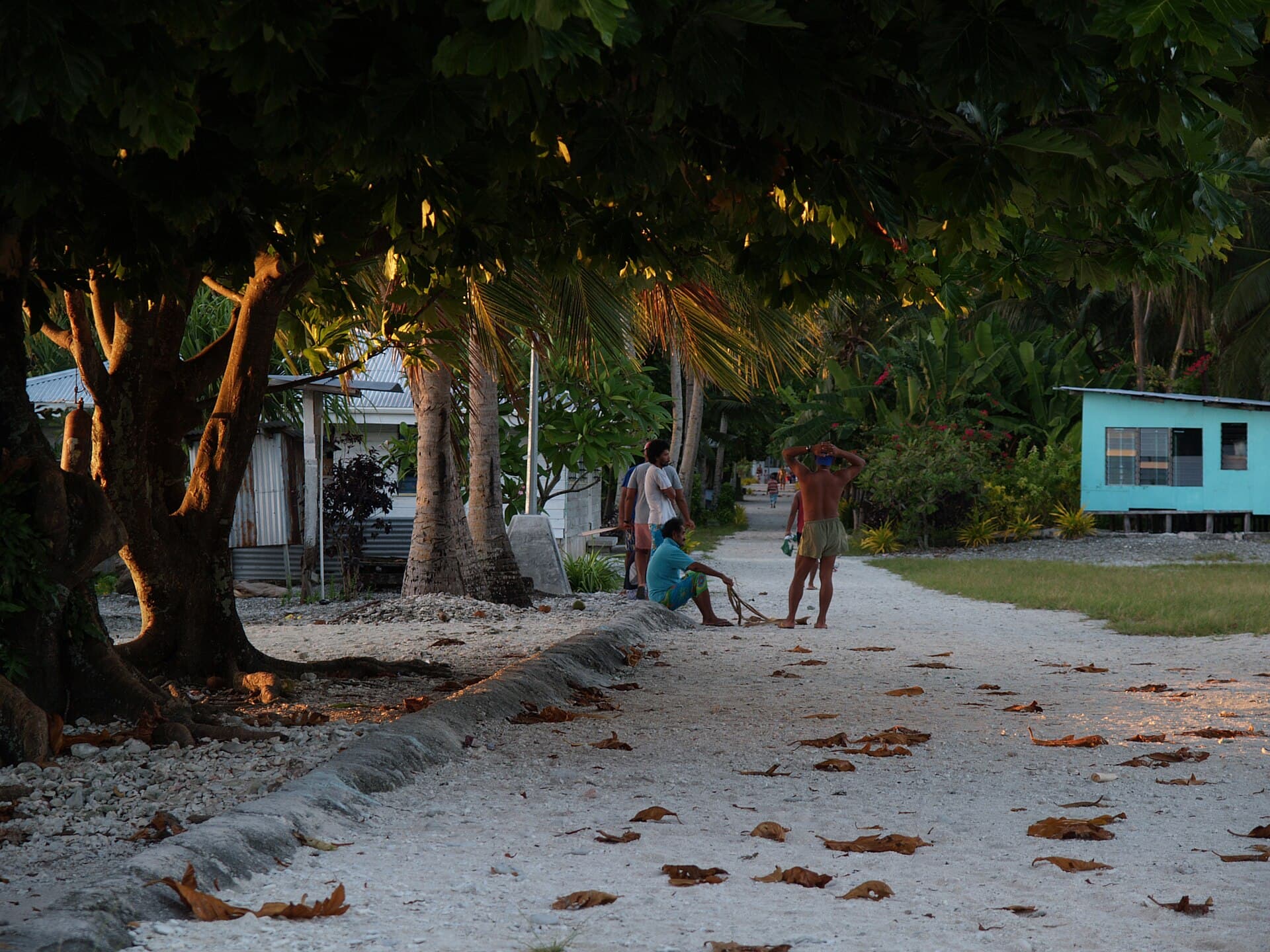
Everything about Tokelau starts with the size of the land. Three atolls, Atafu, Nukunonu and Fakaofo, hold about 10.8 square kilometres between them, spread across sixty to ninety kilometres of open sea, and no point stands more than about five metres above the water (Tokelau, Wikipedia). There is no airport. The way in is a fortnightly boat from Apia in Samoa, roughly 500 kilometres south, which takes rather more than a day. The 2016 census counted 1,499 people and a 2019 count reached 1,647, which shows how far a few departures move the national statistics.
Its constitutional position is unusual and has stayed unresolved by choice. Tokelau remains a non-self-governing territory administered by New Zealand and is still carried on the United Nations decolonisation list, and twice in two years its people were offered self-government in free association and twice declined to cross the threshold their own General Fono had set. The institutions that actually run the place, the councils of elders on each atoll, predate all of that.
Each atoll is a ring of small islets around a lagoon, and on each the population lives on one or two of those islets, packed tight, with the rest given over to coconut, pandanus and burial grounds. Atafu is the northernmost and smallest, Nukunonu has the largest lagoon and the most land, and Fakaofo in the south was historically the dominant power in the group. Fakaofo's main settlement now sits on Fenua Fala, a larger islet two kilometres from the ancestral village islet of Fale, where a second village was built from 1960 with New Zealand help because Fale had run out of room (Fenua Fala, Wikipedia).
Authority sits with the taupulega, the council of elders and family heads on each atoll, which governs by discussion until consensus is reached. Above them the General Fono legislates for the group, and the office of Ulu o Tokelau rotates annually. New Zealand appoints an Administrator, Tokelau has been formally part of it since the Tokelau Act 1948, and Tokelauans are New Zealand citizens. The budget comes largely from New Zealand, with fishing licence revenue and, for a while, a remarkable income from the country's internet suffix. In December 2011 Tokelau followed Samoa across the international date line, skipping 30 December entirely.
There are no cities and no towns, only three villages.
Atafu. The smallest and most religiously homogeneous atoll, with a large Congregational majority and a village laid out as a dense grid of houses along coral-gravel lanes on one islet. It has an unbroken canoe-building tradition and a reputation across the group for paddling.
Nukunonu. The largest atoll by land and lagoon, and the Catholic one, with a church arch standing directly over the village street. It holds the country's only guest accommodation and, because a causeway links two islets, the closest thing Tokelau has to a road.
Fakaofo. Traditionally the senior atoll, seat of the paramount authority that once claimed the other two and home of the coral slab that represented Tui Tokelau, Fakaofo keeps its old village on Fale islet, one of the most densely settled pieces of ground in the Pacific.
Apia. Several capital functions run from Samoa, where the Tokelau Apia Liaison Office handles shipping, medical referrals and procurement.
Polynesians settled the atolls perhaps a thousand years ago, and Tokelauan tradition traces descent and voyaging links to Samoa and Tuvalu, with Fakaofo emerging as the dominant power and imposing tribute on Nukunonu and Atafu. Authority centred on Tui Tokelau, worshipped in the form of a great coral slab on Fakaofo that was dressed in fine mats at an annual gathering (Tui Tokelau, Wikipedia). John Byron sighted Atafu in 1765, and sustained outside contact came only in the nineteenth century.
The catastrophe came in 1863. Peruvian labour ships, operating under the practice known as blackbirding, took away close to all the able-bodied men, some 253 of them, by a mixture of deception and force. Almost none came back; they died of dysentery and smallpox in Peru or on the voyage, and the atolls were left with women, children and the old, a collapse from which recovery took generations and which permanently reshaped landholding, chiefly succession and family structure (Tokelau, Wikipedia). It is one of the least known atrocities of nineteenth-century Pacific history, though not in Tokelau.
Christianity arrived in the same decades and settled into a pattern that still holds. Samoan teachers of the London Missionary Society brought Congregationalism to Atafu; Catholicism came by a stranger route, when Tokelauans blown to Wallis Island met French Marist priests and one of them, a Nukunonu chief usually named as Takua, returned home and converted his own people. Fakaofo took both. Britain declared a protectorate in 1889, the islands were attached to the Gilbert and Ellice Islands Colony in 1916, administration passed to New Zealand in 1925, and the Tokelau Act 1948 made them formally part of it. A cyclone in 1966 and a resettlement scheme moved hundreds of families south, and by 1976 more Tokelauans lived in New Zealand than in Tokelau (Te Ara).
Then came the referendums, and they deserve exact numbers. In February 2006, 584 votes were cast, 3 of them invalid; 349 people voted for self-government in free association and 232 against, just over 60 percent for a change requiring two thirds (2006 referendum, Wikipedia). The vote was held again on 20 and 22 to 24 October 2007, with 789 registered voters and 697 ballots cast, 692 valid: 446 for and 246 against, or 64.45 percent, against a threshold of 462, so it failed by 16 votes (2007 referendum, Wikipedia, UN News). Tokelau asked that the draft treaty stay on the table, and the status quo has held since (Beehive.govt.nz).
Tokelauan is a Polynesian language of the Samoic group, close enough to Tuvaluan and Samoan that speakers of each can follow a good deal of the others, and written Tokelauan developed in the shadow of Samoan, which served for a century as the language of the LMS teachers, of scripture and of schooling. On the atolls it remains the medium of daily life, spoken as a first language by around 94 percent of residents.
Off the atolls, the position is grave. UNESCO classes Tokelauan as severely endangered. The 2023 New Zealand census recorded 9,822 people of Tokelauan ethnicity, most of them in the Wellington region, and only a minority speak the language, with the proportion falling sharply among the young (Tokelauan language, Wikipedia). Since well over four fifths of Tokelauans live in New Zealand, a language secure at home is in decline overall, and the counterweight is a familiar set of instruments: a language week, church use, community classes and resources published with government support (The Conversation).
The country's name is a compass bearing. Tokelau means north, or the northerly quarter, a name given from the perspective of Samoa looking up the ocean. The atolls were long known in English as the Union Group and Fakaofo as Bowditch Island; the atoll names stayed and the imported ones did not.
The institution most worth understanding here is the inati. When a large catch comes ashore, or when turtles, pigs or a shipment of goods are to be divided, the whole take is pooled and split into shares for every household on the atoll by the number of people in it, distributed under the authority of the taupulega through the pulenuku, the village mayor. The person who caught the fish gets a household share like everyone else, and widows, the elderly, the sick and families with no fit fisherman receive the same entitlement as the strongest crew, because the share attaches to the household rather than to the effort. Where a bad month of weather can close the reef and there is no shop to fall back on, a rule of that kind is an insurance system with centuries of operating history behind it (Encyclopedia.com).
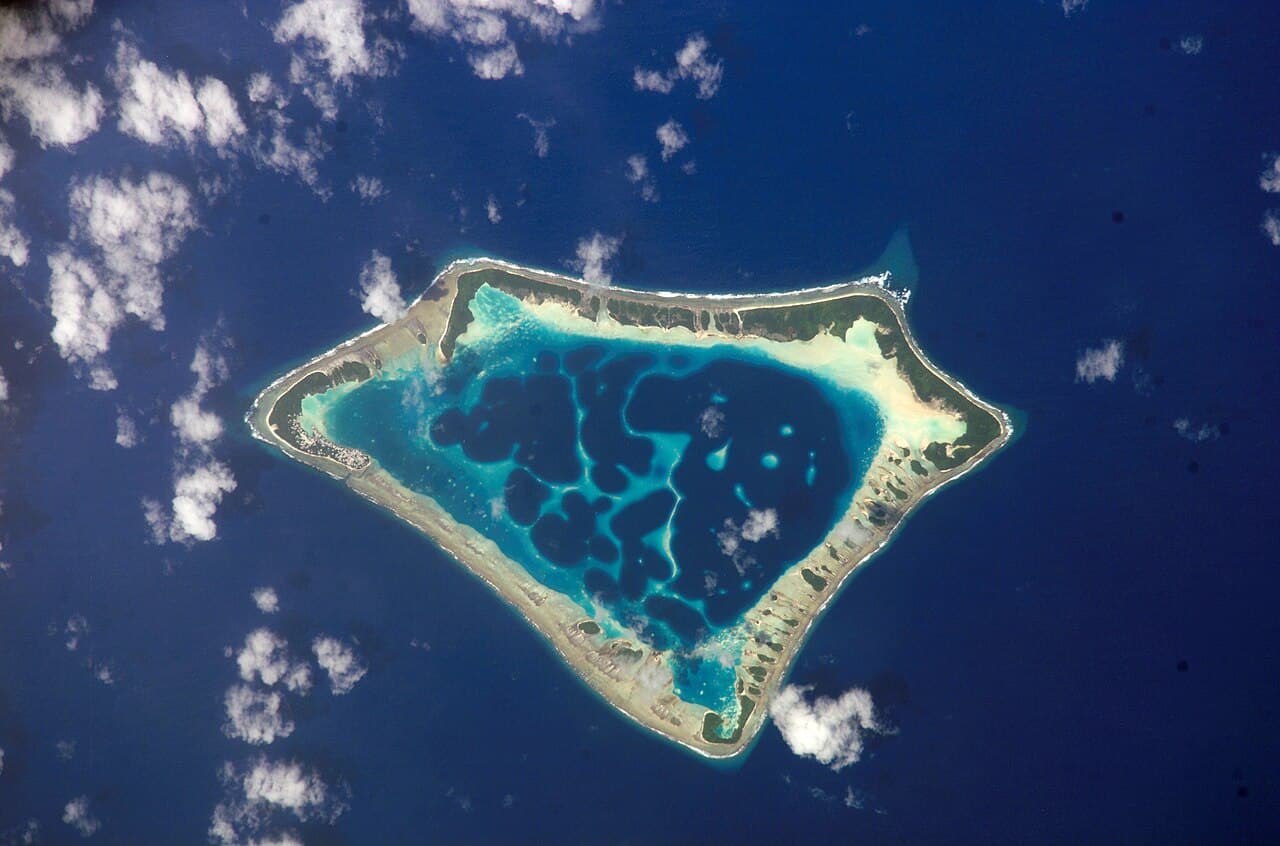 Tokelau's three atolls have no airstrip and are reached by boat from Samoa. Decisions are still taken by the taupulega, the council of elders, on each atoll separately. Photograph by NASA Johnson Space Center, public domain, via Wikimedia Commons.
Alongside it, the aumaga of untitled men does the heavy communal work of fishing and construction, and the fatupaepae, the women of each extended family, hold authority over the household and its resources.
The performing tradition is the fatele. A composed song, usually about a particular occasion, is sung by a seated group with a wooden box or mat used as a drum, and each verse is repeated with rising pitch and tempo until the dancers in front of the singers are moving at a pace the opening bars gave no hint of. The text matters most, and a skilled composer, a pulotu, is a person of standing (Music of Tokelau, Wikipedia). The form is comparatively recent, adopted from Tuvalu and expanded after the missionaries suppressed the older dances, most of which the ethnographer Gordon MacGregor already found forgotten in the 1930s. The fatele absorbed the repertoire that was lost, which is part of why it carries so much.
Material culture is small, portable and made for the sea. The vaka, the Tokelauan outrigger canoe, is built from short planks of whatever timber the atoll produces or the tide delivers, sewn edge to edge with sennit and caulked, since there are no large trees to hollow out. Alongside them sit the tuluma, tightly lidded carved boxes that keep fishing gear dry, and the pandanus mats and sails woven by women.
Tokelau has a denominational map so tidy it looks designed: Congregational on Atafu, Catholic on Nukunonu, and both on Fakaofo. The pattern is the direct fossil of the two missions described above, and it has held for a century and a half because each atoll converted as a unit (Christianity in Tokelau, Wikipedia). The Catholic Church here kept its 150th anniversary in 2015, and well over ninety percent of Tokelauans belong to one of the two churches.
The church is the largest building, the pastor or priest is a central figure, and Sunday shapes the week. Nobody practises the older religion. What survives from that layer is a set of attitudes rather than a faith: respect for particular places, care around burial ground and reef, and a body of navigation and weather knowledge held by named specialists.
A death is announced by the church bell, and once it has rung the village stops; ordinary work is suspended until the burial. The body is laid out in the family house with the women of the immediate family in attendance, and their keening is broken through the day and night by the speeches, hymns and prayers of visitors, who come in a continuous stream, since on an atoll of five hundred people every household has a reason to come. After a final farewell and a Christian service, the coffin goes to the burial ground, and when the last rites are finished the men present take turns to fill the grave by hand. A feast closes the mourning period (Countries and Their Cultures).
The geography constrains all of this in a way that has no parallel in larger countries. Each village occupies one islet, a few hundred metres across in places, and there is no hinterland to put a cemetery in, so the dead are buried close to the living, within or immediately beside the settlement, on the same scarce ground that grows the coconuts and carries the houses. Every plot used is unavailable for anything else, and the graves of many generations are a permanent claim on a land area measured in hectares. Rising seas and storm surge threaten burial ground on the same terms as houses, which turns a climate question into an ancestral one.
Distance does the rest. With no airport, returning a body from New Zealand means a flight to Apia and then a boat, weather permitting. Many Tokelauans who die in Wellington or Auckland are buried there, and the mourning happens twice, once where the person died and once where the family comes from. The detailed record of Tokelauan funeral practice is thin, resting largely on mid-twentieth-century fieldwork and community accounts, and it is better to say so than to generalise from Samoan practice next door.
Tokelau has three atolls, no airstrip, and a genealogy that is entirely a matter of land and council.
Each atoll is governed by its taupulega, a council of elders, and land is held by kaiga, extended family groups, with rights descending through both parents in a system that keeps a person connected to several kaiga at once. Who may use which plot, and which coconut trees, is knowledge held by the family and adjudicated by the council. There is no land court and no register of the kind other Pacific territories keep; the record is the community's.
The written layer is thin. The London Missionary Society and Catholic missions arrived in the nineteenth century and their registers carry baptisms and marriages. New Zealand has administered Tokelau since 1926, so Archives New Zealand holds the official series, and Tokelauans are New Zealand citizens, which means the modern vital records of most Tokelauan families are New Zealand records.
The catastrophe in the record is 1863. Peruvian slave raiders took a very large share of the adult male population from the atolls, and almost none returned; the community was rebuilt around the survivors and incomers, and the raid is remembered precisely.
More Tokelauans live in New Zealand than in Tokelau, by a wide margin. The islands are also among the lowest-lying inhabited places on earth, which makes the question of where the record will be kept an active one.
Tokelau has no national museum and no purpose-built archive on the atolls, and the documentary record is scattered across New Zealand, Samoa and the papers of visiting anthropologists. Against that stands one of the most impressive acts of self-documentation in the region.
Matagi Tokelau was proposed by Ron Crocombe at the University of the South Pacific's Institute of Pacific Studies, as part of a programme encouraging Pacific peoples to write their own histories. The General Fono approved it in May 1981 and appointed a book committee of three representatives from each atoll, chaired by Dr Iona Tinielu, with the anthropologists Antony Hooper and Judith Huntsman as advisers. Tokelauan authors wrote the material in Tokelauan, running from origin traditions through voyages, warfare and early European contact to Christianity and the raids of 1863. The Tokelauan edition appeared in 1990 and the English translation, edited with Ropati Simona, in 1991 (University of Auckland Archives). Matagi means wind, and carries senses of news, memory and vigour with it.
Beyond that book, preservation rests on the taupulega and on oral transmission. Genealogies, land rights, fishing knowledge and village history are held by elders and passed on by instruction rather than deposit, which works while the community is intact and fails quickly when it is not. Hooper and Huntsman's papers, photographs and recordings are held at the University of Auckland, and Tokelauan material sits in Te Papa, Auckland Museum and overseas collections. The pressing problem is sea level rather than neglect: an archive kept a metre and a half above high tide on a coral islet carries a different risk from one in a Wellington basement.
Tokelau's most consequential appearance in world affairs came through two letters. In 2001 the territory agreed with the Dutch entrepreneur Joost Zuurbier, whose company later traded as Freenom, to run the .tk country-code domain on a free-registration model, earning from advertising and the resale of expired names. It worked spectacularly: at its height .tk carried tens of millions of registrations, at times more than any other country-code domain on earth, and the income was a material share of national revenue (.tk, Wikipedia). Free domains also attracted fraud at scale, a lawsuit from Meta followed in 2023, new registrations stopped, and use of the suffix collapsed. A country of 1,600 people had briefly held one of the largest addresses on the internet.
The rest is quieter and more useful. The atolls have satellite connectivity and a telecommunications provider at Fenua Fala, powered by the solar plants of 2012, so fatele performances, church services and General Fono proceedings can reach Wellington the same day. Language resources are published online by New Zealand agencies, collections material is accessible through Te Papa, Auckland Museum, DigitalNZ and Digital Pasifik, and the Hooper and Huntsman papers are catalogued even where the contents are not digitised. The record is thin, and most of it is hosted somewhere else.
The best-known Tokelauan cultural export is music. Opetaia Foaʻi, of Tokelauan and Tuvaluan descent, founded the Pacific group Te Vaka and co-wrote the songs of Disney's Moana with Mark Mancina and Lin-Manuel Miranda; "We Know the Way" opens in Samoan and takes its chorus in Tokelauan, which put the language in front of hundreds of millions of people (Opetaia Foaʻi, Wikipedia). For a severely endangered language with a few thousand speakers, that is an unusual piece of luck.
Closer to home, Tokelauan community life in New Zealand centres on the Wellington region, where the language week, the churches and the fatele groups do the transmitting. Climate is the other place Tokelau appears internationally, and the appearance is not rhetorical: a country whose highest ground is roughly the height of a two-storey house has a direct interest in sea-level projections, and its representatives make that argument in forums where they have no vote. New Zealand's decision in January 2026 to cancel a long-discussed airport project, on cost and environmental grounds, keeps the atolls on a fortnightly boat, and access is bound up with every other question the territory faces (Tokelau, Wikipedia).
A country that switched to the sun. In 2012 Tokelau replaced diesel with three solar plants of 4,032 panels and 1,344 batteries, funded by Tokelau, New Zealand and the UN Development Programme, becoming one of the first places on earth to run entirely on renewable electricity (SPC).
A nation that wrote its own history. Matagi Tokelau, commissioned by the General Fono and written by Tokelauans, appeared in the national language first and remains the standard history of the country.
A sharing system still in daily use. The inati divides catches by household across all three atolls, an institution that survived colonisation, conversion and the cash economy without ever being legislated into existence.
A language carried into a Disney film. Tokelauan lyrics reached a global audience through Te Vaka and the Moana soundtrack.
Tokelau's three atolls have no airstrip and are reached by boat from Samoa. Decisions are still taken by the taupulega, the council of elders, on each atoll separately. Photograph by NASA Johnson Space Center, public domain, via Wikimedia Commons.
Alongside it, the aumaga of untitled men does the heavy communal work of fishing and construction, and the fatupaepae, the women of each extended family, hold authority over the household and its resources.
The performing tradition is the fatele. A composed song, usually about a particular occasion, is sung by a seated group with a wooden box or mat used as a drum, and each verse is repeated with rising pitch and tempo until the dancers in front of the singers are moving at a pace the opening bars gave no hint of. The text matters most, and a skilled composer, a pulotu, is a person of standing (Music of Tokelau, Wikipedia). The form is comparatively recent, adopted from Tuvalu and expanded after the missionaries suppressed the older dances, most of which the ethnographer Gordon MacGregor already found forgotten in the 1930s. The fatele absorbed the repertoire that was lost, which is part of why it carries so much.
Material culture is small, portable and made for the sea. The vaka, the Tokelauan outrigger canoe, is built from short planks of whatever timber the atoll produces or the tide delivers, sewn edge to edge with sennit and caulked, since there are no large trees to hollow out. Alongside them sit the tuluma, tightly lidded carved boxes that keep fishing gear dry, and the pandanus mats and sails woven by women.
Tokelau has a denominational map so tidy it looks designed: Congregational on Atafu, Catholic on Nukunonu, and both on Fakaofo. The pattern is the direct fossil of the two missions described above, and it has held for a century and a half because each atoll converted as a unit (Christianity in Tokelau, Wikipedia). The Catholic Church here kept its 150th anniversary in 2015, and well over ninety percent of Tokelauans belong to one of the two churches.
The church is the largest building, the pastor or priest is a central figure, and Sunday shapes the week. Nobody practises the older religion. What survives from that layer is a set of attitudes rather than a faith: respect for particular places, care around burial ground and reef, and a body of navigation and weather knowledge held by named specialists.
A death is announced by the church bell, and once it has rung the village stops; ordinary work is suspended until the burial. The body is laid out in the family house with the women of the immediate family in attendance, and their keening is broken through the day and night by the speeches, hymns and prayers of visitors, who come in a continuous stream, since on an atoll of five hundred people every household has a reason to come. After a final farewell and a Christian service, the coffin goes to the burial ground, and when the last rites are finished the men present take turns to fill the grave by hand. A feast closes the mourning period (Countries and Their Cultures).
The geography constrains all of this in a way that has no parallel in larger countries. Each village occupies one islet, a few hundred metres across in places, and there is no hinterland to put a cemetery in, so the dead are buried close to the living, within or immediately beside the settlement, on the same scarce ground that grows the coconuts and carries the houses. Every plot used is unavailable for anything else, and the graves of many generations are a permanent claim on a land area measured in hectares. Rising seas and storm surge threaten burial ground on the same terms as houses, which turns a climate question into an ancestral one.
Distance does the rest. With no airport, returning a body from New Zealand means a flight to Apia and then a boat, weather permitting. Many Tokelauans who die in Wellington or Auckland are buried there, and the mourning happens twice, once where the person died and once where the family comes from. The detailed record of Tokelauan funeral practice is thin, resting largely on mid-twentieth-century fieldwork and community accounts, and it is better to say so than to generalise from Samoan practice next door.
Tokelau has three atolls, no airstrip, and a genealogy that is entirely a matter of land and council.
Each atoll is governed by its taupulega, a council of elders, and land is held by kaiga, extended family groups, with rights descending through both parents in a system that keeps a person connected to several kaiga at once. Who may use which plot, and which coconut trees, is knowledge held by the family and adjudicated by the council. There is no land court and no register of the kind other Pacific territories keep; the record is the community's.
The written layer is thin. The London Missionary Society and Catholic missions arrived in the nineteenth century and their registers carry baptisms and marriages. New Zealand has administered Tokelau since 1926, so Archives New Zealand holds the official series, and Tokelauans are New Zealand citizens, which means the modern vital records of most Tokelauan families are New Zealand records.
The catastrophe in the record is 1863. Peruvian slave raiders took a very large share of the adult male population from the atolls, and almost none returned; the community was rebuilt around the survivors and incomers, and the raid is remembered precisely.
More Tokelauans live in New Zealand than in Tokelau, by a wide margin. The islands are also among the lowest-lying inhabited places on earth, which makes the question of where the record will be kept an active one.
Tokelau has no national museum and no purpose-built archive on the atolls, and the documentary record is scattered across New Zealand, Samoa and the papers of visiting anthropologists. Against that stands one of the most impressive acts of self-documentation in the region.
Matagi Tokelau was proposed by Ron Crocombe at the University of the South Pacific's Institute of Pacific Studies, as part of a programme encouraging Pacific peoples to write their own histories. The General Fono approved it in May 1981 and appointed a book committee of three representatives from each atoll, chaired by Dr Iona Tinielu, with the anthropologists Antony Hooper and Judith Huntsman as advisers. Tokelauan authors wrote the material in Tokelauan, running from origin traditions through voyages, warfare and early European contact to Christianity and the raids of 1863. The Tokelauan edition appeared in 1990 and the English translation, edited with Ropati Simona, in 1991 (University of Auckland Archives). Matagi means wind, and carries senses of news, memory and vigour with it.
Beyond that book, preservation rests on the taupulega and on oral transmission. Genealogies, land rights, fishing knowledge and village history are held by elders and passed on by instruction rather than deposit, which works while the community is intact and fails quickly when it is not. Hooper and Huntsman's papers, photographs and recordings are held at the University of Auckland, and Tokelauan material sits in Te Papa, Auckland Museum and overseas collections. The pressing problem is sea level rather than neglect: an archive kept a metre and a half above high tide on a coral islet carries a different risk from one in a Wellington basement.
Tokelau's most consequential appearance in world affairs came through two letters. In 2001 the territory agreed with the Dutch entrepreneur Joost Zuurbier, whose company later traded as Freenom, to run the .tk country-code domain on a free-registration model, earning from advertising and the resale of expired names. It worked spectacularly: at its height .tk carried tens of millions of registrations, at times more than any other country-code domain on earth, and the income was a material share of national revenue (.tk, Wikipedia). Free domains also attracted fraud at scale, a lawsuit from Meta followed in 2023, new registrations stopped, and use of the suffix collapsed. A country of 1,600 people had briefly held one of the largest addresses on the internet.
The rest is quieter and more useful. The atolls have satellite connectivity and a telecommunications provider at Fenua Fala, powered by the solar plants of 2012, so fatele performances, church services and General Fono proceedings can reach Wellington the same day. Language resources are published online by New Zealand agencies, collections material is accessible through Te Papa, Auckland Museum, DigitalNZ and Digital Pasifik, and the Hooper and Huntsman papers are catalogued even where the contents are not digitised. The record is thin, and most of it is hosted somewhere else.
The best-known Tokelauan cultural export is music. Opetaia Foaʻi, of Tokelauan and Tuvaluan descent, founded the Pacific group Te Vaka and co-wrote the songs of Disney's Moana with Mark Mancina and Lin-Manuel Miranda; "We Know the Way" opens in Samoan and takes its chorus in Tokelauan, which put the language in front of hundreds of millions of people (Opetaia Foaʻi, Wikipedia). For a severely endangered language with a few thousand speakers, that is an unusual piece of luck.
Closer to home, Tokelauan community life in New Zealand centres on the Wellington region, where the language week, the churches and the fatele groups do the transmitting. Climate is the other place Tokelau appears internationally, and the appearance is not rhetorical: a country whose highest ground is roughly the height of a two-storey house has a direct interest in sea-level projections, and its representatives make that argument in forums where they have no vote. New Zealand's decision in January 2026 to cancel a long-discussed airport project, on cost and environmental grounds, keeps the atolls on a fortnightly boat, and access is bound up with every other question the territory faces (Tokelau, Wikipedia).
A country that switched to the sun. In 2012 Tokelau replaced diesel with three solar plants of 4,032 panels and 1,344 batteries, funded by Tokelau, New Zealand and the UN Development Programme, becoming one of the first places on earth to run entirely on renewable electricity (SPC).
A nation that wrote its own history. Matagi Tokelau, commissioned by the General Fono and written by Tokelauans, appeared in the national language first and remains the standard history of the country.
A sharing system still in daily use. The inati divides catches by household across all three atolls, an institution that survived colonisation, conversion and the cash economy without ever being legislated into existence.
A language carried into a Disney film. Tokelauan lyrics reached a global audience through Te Vaka and the Moana soundtrack.
National Overview
Notable Cities
Historical Foundations
Linguistic and Etymological Roots
Cultural Identity
Religion and Spirituality
Remembrance and Mourning Traditions
Tracing a Family in Tokelau
Heritage Preservation Efforts
Digital Heritage
Contemporary Cultural Influences
Success Stories
References and resources
- Tokelau, Wikipedia: geography, population, governance and the 1863 raids.
- Encyclopaedia Britannica, Tokelau: the atolls, their history and administration.
- Government of Tokelau: the taupulega, the General Fono and the self-determination package.
- 2006 referendum, Wikipedia: 349 for and 232 against.
- 2007 referendum, Wikipedia: 446 for, 246 against, 16 votes short.
- UN News, Tokelau narrowly rejects self-government: the October 2007 ballot.
- Te Ara, Tokelauans: the resettlement scheme and the New Zealand community.
- Tokelauan language, Wikipedia: speaker numbers and endangerment.
- The Conversation, on the Tokelauan language: more speakers abroad, less safety.
- Music of Tokelau, Wikipedia: the fatele and the forms that were lost.
- Countries and Their Cultures, Tokelau: funeral practice and mourning.
- University of Auckland Archives, Matagi Tokelau: the national history and the Hooper and Huntsman papers.
- .tk, Wikipedia: the domain, its scale and its collapse.
- Pacific Community, Tokelau leads the world in renewable energy: the 2012 solar installation.
- Opetaia Foaʻi, Wikipedia: Te Vaka and the Tokelauan chorus in Moana.