Heritage · Country
Paraguay Culture and Heritage
A country that thinks and prays in an Indigenous language, where red sandstone Jesuit ruins glow at dusk and a million pilgrims walk each December to a small wooden Virgin. A guide to Paraguay's heritage, and to a people who rebuilt themselves after one of history's most destructive wars.Written to last.
By Confinity Heritage Editorial · Updated 2026-07-31 · 8-minute readQuiet tools, kept out of the way.
Paraguay is one of the few countries on earth where most people speak an Indigenous language every day. Guaraní, the tongue of the region's first farmers, is co-official with Spanish and understood by close to nine in ten Paraguayans, carrying the words of the pre-Columbian past into ordinary speech, place names and prayer. Landlocked at the heart of South America and split by the river that names it into the watered east and the dry scrub of the Chaco, the country holds two inheritances at once: the Catholic faith brought by Spain and the older Guaraní feeling for land, kinship and the sacred.
That doubleness runs through how Paraguay remembers. Its identity was shaped partly by catastrophe, for the War of the Triple Alliance (1864–1870) killed a large share of its people and remains the defining wound of the national story, a loss still spoken of with quiet gravity. What Paraguayans built afterward was not forgetting but a patient culture of return: prayers repeated for years after a death, a million walkers converging each December on a small wooden Virgin, red sandstone missions kept as ruins rather than let fall.
Paraguay is one of only two landlocked countries in South America, the other being Bolivia, enclosed by Argentina, Bolivia and Brazil. The Paraguay River runs north to south and divides the country in two. To the west lies the Gran Chaco, a dry plain of thorn forest and ranches covering about two-thirds of the territory yet holding few people; to the east, between the Paraguay and Paraná rivers, lie the fertile hills and farmland where the great majority live.
The 2022 census counted some 6.1 million people, overwhelmingly mestizo, of mixed Guaraní and Spanish descent, a blending that is cultural and linguistic as much as genetic, so that Guaraní custom survives inside a Catholic, Spanish-speaking society rather than beside it. Both Spanish and Guaraní are official under the 1992 constitution, which makes Paraguay among the most genuinely bilingual nations in the Americas. The country holds a single UNESCO World Heritage Site, the Jesuit missions.
Asunción. The capital and largest city is among the oldest settlements in the Río de la Plata region. A Spanish stockade was completed on the Feast of the Assumption, 15 August 1537, giving the city its date and its name; because colonists later set out from here to refound Buenos Aires and other towns, it is called the Mother of Cities. Independence from Spain was declared here at midnight on 14 May 1811, and its riverside centre keeps the Panteón Nacional de los Héroes and belle-époque palaces amid the rhythm of a Guaraní-speaking city.
Ciudad del Este. Paraguay's second city sits on the Brazilian border, founded only in 1957 and long carrying the dictator Stroessner's name before its renaming in 1989. It anchors the Triple Frontier where Paraguay, Brazil and Argentina meet, and lies beside the Itaipú Dam, a binational hydroelectric project shared with Brazil, among the largest power stations in the world.
Encarnación. Set on the Paraná across from Posadas in Argentina, Encarnación is called the Pearl of the South and hosts the largest Carnival in Paraguay each February. It is the base for visiting the Jesuit ruins, and reflects the German, Ukrainian and Japanese settlement of the south.
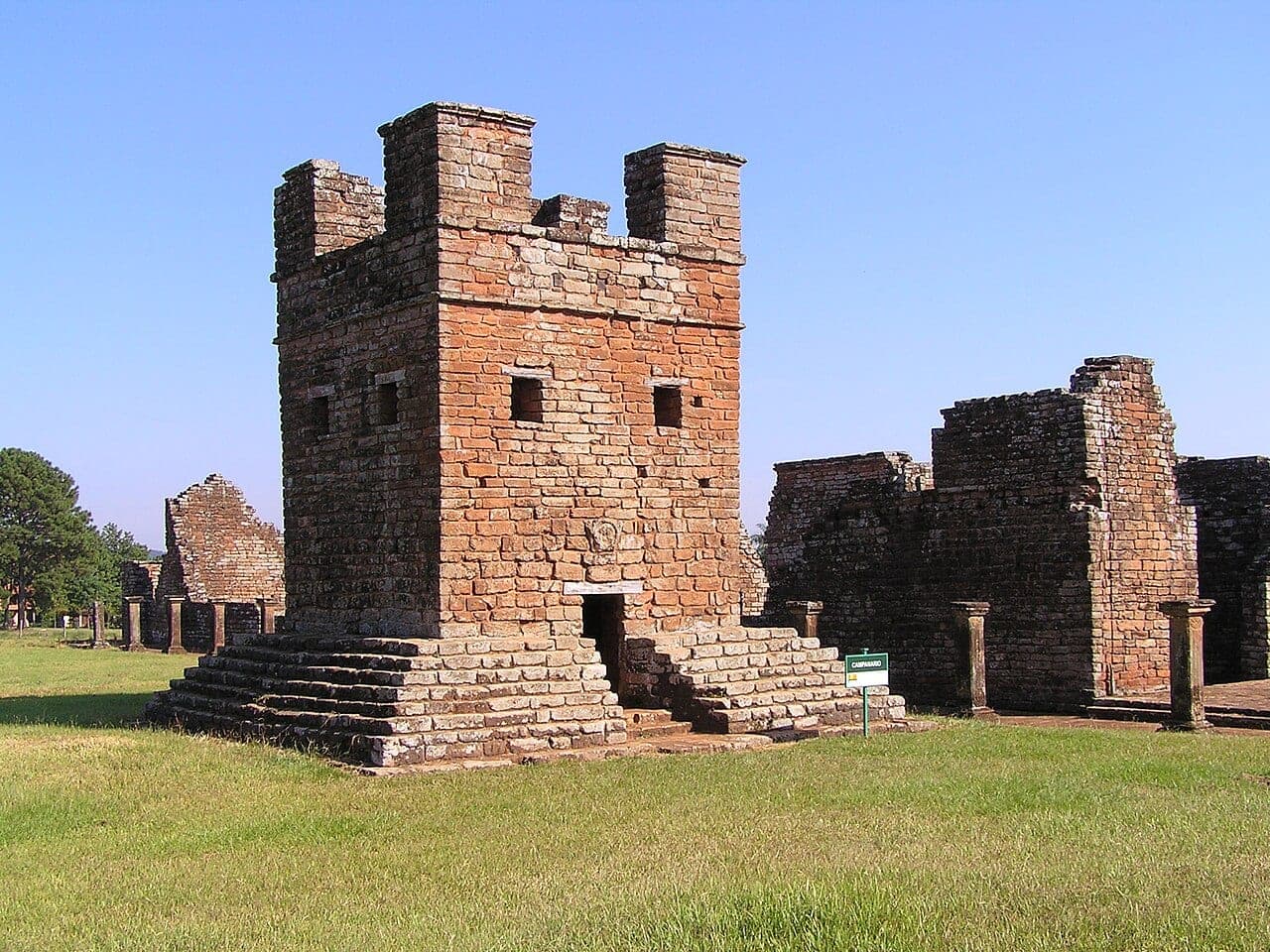
Trinidad. A small town near Encarnación, and the site of La Santísima Trinidad de Paraná, the largest and best preserved of the region's thirty reductions. Founded in 1706 and covering some eight hectares, its red stone church, plaza and workshops are Paraguay's fullest window onto the mission world; a short drive away stands the unfinished church of Jesús de Tavarangue.
Long before Europeans came, the eastern woodlands were home to Guaraní-speaking peoples, farmers who grew cassava, maize and sweet potato and held a spiritual world centred on the word, the ancestors and the land. Their language and foodways would shape everything that followed.
 The Guarani missions were self-governing towns of thousands of people with their own workshops, orchestras and printing, and they were broken up when the Jesuits were expelled in 1767. Photograph by Josep M. Gracia, CC BY-SA 4.0, via Wikimedia Commons.
Spanish explorers reached the upper Paraná seeking a route to the silver of Peru and, finding none, built Asunción in 1537. For much of the sixteenth century it was the heart of Spanish settlement in the La Plata basin, a place of intense mixing between Spanish men and Guaraní women from which the mestizo population descends. The colony stayed poor and remote, valued for its people and its yerba mate.
The colonial era's most distinctive chapter was the work of the Society of Jesus. From the early seventeenth century the Jesuits gathered Guaraní converts into self-governing mission towns, the reductions, some thirty of them across today's Paraguay, Argentina and Brazil. Within their walls Guaraní craftsmen carved altarpieces, cast bells and played European music, while the missions offered protection from the slave-raiding bandeirantes of Brazil. Jesús de Tavarangue was founded in 1685 and Trinidad in 1706, among the last and grandest, before the crown expelled the Jesuits from its American colonies in 1767; deprived of their organisers, the towns declined and dispersed.
Paraguay declared independence in 1811 with little bloodshed, then took a singular turn under José Gaspar Rodríguez de Francia, a lawyer named dictator in 1814 and dictator for life in 1816. Known as El Supremo, he sealed the country off from the outside world until his death in 1840. His successors, Carlos Antonio López and Francisco Solano López, reopened it and built up the army.
That army led Paraguay into the War of the Triple Alliance (1864–1870) against Argentina, Brazil and Uruguay, the deadliest conflict in the history of South America. It ended with Solano López killed in the field in March 1870 and the nation in ruins. The population fell from perhaps half a million before the war to around 221,000 by 1871, and by many estimates the majority of the dead were civilians while a very large share of adult men did not survive; the precise figures are debated, but the scale of the loss is not. A second conflict, the Chaco War (1932–1935) with Bolivia, cost about 100,000 lives before Paraguay was awarded most of the disputed Gran Chaco. The modern republic then endured the long dictatorship of Alfredo Stroessner (1954 to 1989), before a 1989 coup opened a difficult transition to democracy.
Paraguay's bilingualism is its rarest cultural asset. Spanish and Guaraní have shared official status since the 1992 constitution, and Guaraní is spoken by close to nine-tenths of the population, an unusual survival for an Indigenous American language as a majority tongue. Guaraní has served as a language of instruction in schools since the 1990s, while Spanish still dominates government, law and formal business. In daily speech the two braid into jopara, a fluid mix of Spanish grammar and Guaraní words that most Paraguayans move through without thinking.
The country's name comes from the Paraguay River, its meaning drawn from Guaraní though never fully agreed. The elements para and y are usually read as referring to water or a great river, giving readings such as "water that flows to the sea". Others link the name to the Payaguá people of the river, or to a phrase meaning "crown of feathers of the waters". Either way, the country's own name is written in a living Indigenous language still being read.
At the centre of Paraguayan music sits the harp. The Paraguayan harp, a light diatonic instrument grown from European models reworked by Guaraní hands, is the recognised national instrument. Around it developed two signature forms: the lively polka paraguaya and the guarania, a slow, melancholic genre created by the composer José Asunción Flores (1904–1972) in 1925 to voice the feeling of the Paraguayan people. On the genre's centenary in December 2024, UNESCO inscribed the guarania on its Representative List of the Intangible Cultural Heritage of Humanity.
The country's crafts carry the same blend of European technique and Guaraní hand. Ñandutí, whose name means "spider web" in Guaraní, is a radiant circular lace that joins needle-lace traditions, thought to have reached the region by way of Tenerife, with the invention of Paraguayan women; the town of Itauguá became its home. Ao po'i, a fine cotton embroidery associated with Yataity, is worked into shirts and household linen. Many of these crafts took hold in the isolationist years, when women cut off from imported cloth made their own.
Then there is the drink that binds the day together. Yerba mate is taken hot as mate or, in the summer heat, as terère, a cold infusion shared from one cup with a bombilla straw and prepared with pohã ñana, medicinal herbs crushed into the water; UNESCO inscribed the practice in 2020. To pass the cup is to include someone. The kitchen speaks Guaraní too: sopa paraguaya, a dense cornbread; chipa, a chewy cassava-and-cheese bread eaten at Easter; and mandioca on nearly every table.
Paraguay is predominantly Roman Catholic, but its Catholicism is inseparable from the Guaraní world it grew within. Saints and the Virgin are addressed in Guaraní; devotion to the land, to healing herbs and to the dead carries older meanings beneath the Christian surface; and popular faith often runs ahead of the institution. This layering is a clear mark of the mestizo culture.
The nation's spiritual centre is the Virgin of Caacupé, Our Lady of the Miracles, whose small wooden image is kept in the basilica of Caacupé in the Cordillera department. Tradition holds that the figure was carved around 1600 by a Guaraní convert in thanks for his rescue, a founding story that itself joins Indigenous and Catholic threads. Her feast falls on 8 December, the day of the Immaculate Conception and the most important religious date in the calendar; Pope Francis raised the church to a minor basilica in 2015. Each year the shrine draws roughly a million pilgrims.
Paraguayan mourning is unhurried and communal. A death is followed by the velorio, a wake held through the night before burial, when relatives and friends keep company with the family and the deceased. Funerals unfold as a sequence of rites rather than one event, moving from the wake to a funeral mass and then to the burial, where mourners may cast flowers or a handful of earth onto the coffin.
What follows the burial matters as much. The distinctive custom is the rezo, a novena of nine successive days of prayer for the soul of the dead; in many families it is then repeated each year on the anniversary of the death, traditionally for seven years, so that remembrance is measured in years of returning rather than a single farewell. On 2 November, the Day of the Faithful Departed, families tend and visit graves.
The Caacupé pilgrimage is remembrance of another kind, in which many walk the last miles through the night carrying a promise made or a loved one lost. Beneath these customs runs the Guaraní sense that the dead remain within reach of the living through the spoken word, through prayer offered aloud, and through family ties that neither distance nor death is thought to sever.
Paraguay's twentieth-century archive was found in a police station in 1992, and it documented a system that spanned a continent.
An investigator looking for his own file discovered, in a station in Lambaré, several tonnes of records kept by the police of the Stroessner dictatorship: arrest reports, interrogation transcripts, photographs, surveillance logs and correspondence with the security services of Argentina, Chile, Brazil, Bolivia and Uruguay. It became known as the Archive of Terror, and it is the most complete surviving documentation of Operation Condor, the coordinated programme by which those governments hunted each other's exiles. UNESCO added it to the Memory of the World Register in 2009. It is held by the supreme court and is open, and for the families of the disappeared it is where the answer is.
The older record is Jesuit. The reductions of the seventeenth and eighteenth centuries kept baptism, marriage and burial registers for the Guaraní communities they gathered, and those books, together with the parish registers that followed, are the earliest genealogical source in the country.
The demographic catastrophe is the War of the Triple Alliance, from 1864 to 1870, which killed something like half the population and a very large proportion of adult men. Whole family lines end there, and the post-war censuses record a country of women, children and the old.
Civil registration dates from the later nineteenth century and is held by the Registro Civil.
Paraguay's flagship achievement is the pair of Jesuit missions inscribed by UNESCO in 1993, La Santísima Trinidad de Paraná and Jesús de Tavarangue, the country's only World Heritage Site. The listing recognises them as evidence of the Jesuit effort in the Río de la Plata basin during the seventeenth and eighteenth centuries and of a meeting of cultures in which Guaraní converts kept elements of their own traditions. Trinidad, the more complete, preserves its great church, carved stonework and town plan; Jesús was unfinished at the expulsion, its trefoil arches showing a Mudéjar influence rare in the region. Conservation has stabilised the ruins while keeping them honest as ruins.
Beyond the churches, Paraguay maintains a tentative list of further sites, among them the mission of San Cosme y San Damián with its Jesuit astronomical observatory. The most striking recent gains, though, have been for living heritage: alongside the guarania and terère, the poncho para'i de 60 listas joined the UNESCO intangible list in 2023, a run of recognitions protecting practices still carried in daily life.
Efforts to bring Paraguay's heritage online have grown steadily. The National Archive in Asunción holds one of the richest collections of colonial documents in the region, and digitisation projects aim to widen access, with the National Library pursuing parallel work.
Independent projects add reach. Portal Guaraní, a long-running online repository, gathers Paraguayan literature, music and art in one searchable place, much of it in or about the Guaraní language. The Jesuit missions have been documented through a Google Arts and Culture presentation that lets the ruins be explored from anywhere. Digital dictionaries, keyboards and language tools for Guaraní, built by universities and volunteers, carry a spoken tradition into the online world where younger Paraguayans increasingly live.
Paraguay's cultural reach abroad is led by its writers and musicians. Augusto Roa Bastos, the country's foremost novelist, won the Cervantes Prize in 1989 for a body of work, above all "Yo el Supremo", that reckoned with dictatorship and memory. In music, the classical guitarist Berta Rojas has carried Paraguayan repertoire worldwide, while harpists in the Luis Bordón tradition keep the national instrument on tour.
Sport is a shared passion: the national football team reached the World Cup quarter-finals in 1998 and again in 2010, and the goalkeeper José Luis Chilavert became known across the continent. The guarania's centenary and its UNESCO recognition have prompted new recordings and festivals, and a large diaspora in Argentina, Spain and the United States keeps terère circles, harp music and the Guaraní language alive far from home.
The guarania reaches the world. In December 2024, on the hundredth anniversary of its creation by José Asunción Flores, the guarania was inscribed on the UNESCO Representative List, a recognition of a genre widely felt to carry the Paraguayan soul.
A shared cup becomes heritage. The 2020 inscription of terère in the culture of pohã ñana honoured not a drink alone but a way of being together, the codes of preparation and the ritual of sharing.
Ruins kept as classrooms. Since their 1993 listing, the missions of Trinidad and Jesús have been conserved and opened to the public, preserving the fullest record anywhere of the Guaraní mission world.
A language that endures. Guaraní's survival as a co-official, majority-spoken Indigenous language, now taught in schools and supported by digital tools, is a heritage success in itself, unmatched elsewhere in the Americas.
The Guarani missions were self-governing towns of thousands of people with their own workshops, orchestras and printing, and they were broken up when the Jesuits were expelled in 1767. Photograph by Josep M. Gracia, CC BY-SA 4.0, via Wikimedia Commons.
Spanish explorers reached the upper Paraná seeking a route to the silver of Peru and, finding none, built Asunción in 1537. For much of the sixteenth century it was the heart of Spanish settlement in the La Plata basin, a place of intense mixing between Spanish men and Guaraní women from which the mestizo population descends. The colony stayed poor and remote, valued for its people and its yerba mate.
The colonial era's most distinctive chapter was the work of the Society of Jesus. From the early seventeenth century the Jesuits gathered Guaraní converts into self-governing mission towns, the reductions, some thirty of them across today's Paraguay, Argentina and Brazil. Within their walls Guaraní craftsmen carved altarpieces, cast bells and played European music, while the missions offered protection from the slave-raiding bandeirantes of Brazil. Jesús de Tavarangue was founded in 1685 and Trinidad in 1706, among the last and grandest, before the crown expelled the Jesuits from its American colonies in 1767; deprived of their organisers, the towns declined and dispersed.
Paraguay declared independence in 1811 with little bloodshed, then took a singular turn under José Gaspar Rodríguez de Francia, a lawyer named dictator in 1814 and dictator for life in 1816. Known as El Supremo, he sealed the country off from the outside world until his death in 1840. His successors, Carlos Antonio López and Francisco Solano López, reopened it and built up the army.
That army led Paraguay into the War of the Triple Alliance (1864–1870) against Argentina, Brazil and Uruguay, the deadliest conflict in the history of South America. It ended with Solano López killed in the field in March 1870 and the nation in ruins. The population fell from perhaps half a million before the war to around 221,000 by 1871, and by many estimates the majority of the dead were civilians while a very large share of adult men did not survive; the precise figures are debated, but the scale of the loss is not. A second conflict, the Chaco War (1932–1935) with Bolivia, cost about 100,000 lives before Paraguay was awarded most of the disputed Gran Chaco. The modern republic then endured the long dictatorship of Alfredo Stroessner (1954 to 1989), before a 1989 coup opened a difficult transition to democracy.
Paraguay's bilingualism is its rarest cultural asset. Spanish and Guaraní have shared official status since the 1992 constitution, and Guaraní is spoken by close to nine-tenths of the population, an unusual survival for an Indigenous American language as a majority tongue. Guaraní has served as a language of instruction in schools since the 1990s, while Spanish still dominates government, law and formal business. In daily speech the two braid into jopara, a fluid mix of Spanish grammar and Guaraní words that most Paraguayans move through without thinking.
The country's name comes from the Paraguay River, its meaning drawn from Guaraní though never fully agreed. The elements para and y are usually read as referring to water or a great river, giving readings such as "water that flows to the sea". Others link the name to the Payaguá people of the river, or to a phrase meaning "crown of feathers of the waters". Either way, the country's own name is written in a living Indigenous language still being read.
At the centre of Paraguayan music sits the harp. The Paraguayan harp, a light diatonic instrument grown from European models reworked by Guaraní hands, is the recognised national instrument. Around it developed two signature forms: the lively polka paraguaya and the guarania, a slow, melancholic genre created by the composer José Asunción Flores (1904–1972) in 1925 to voice the feeling of the Paraguayan people. On the genre's centenary in December 2024, UNESCO inscribed the guarania on its Representative List of the Intangible Cultural Heritage of Humanity.
The country's crafts carry the same blend of European technique and Guaraní hand. Ñandutí, whose name means "spider web" in Guaraní, is a radiant circular lace that joins needle-lace traditions, thought to have reached the region by way of Tenerife, with the invention of Paraguayan women; the town of Itauguá became its home. Ao po'i, a fine cotton embroidery associated with Yataity, is worked into shirts and household linen. Many of these crafts took hold in the isolationist years, when women cut off from imported cloth made their own.
Then there is the drink that binds the day together. Yerba mate is taken hot as mate or, in the summer heat, as terère, a cold infusion shared from one cup with a bombilla straw and prepared with pohã ñana, medicinal herbs crushed into the water; UNESCO inscribed the practice in 2020. To pass the cup is to include someone. The kitchen speaks Guaraní too: sopa paraguaya, a dense cornbread; chipa, a chewy cassava-and-cheese bread eaten at Easter; and mandioca on nearly every table.
Paraguay is predominantly Roman Catholic, but its Catholicism is inseparable from the Guaraní world it grew within. Saints and the Virgin are addressed in Guaraní; devotion to the land, to healing herbs and to the dead carries older meanings beneath the Christian surface; and popular faith often runs ahead of the institution. This layering is a clear mark of the mestizo culture.
The nation's spiritual centre is the Virgin of Caacupé, Our Lady of the Miracles, whose small wooden image is kept in the basilica of Caacupé in the Cordillera department. Tradition holds that the figure was carved around 1600 by a Guaraní convert in thanks for his rescue, a founding story that itself joins Indigenous and Catholic threads. Her feast falls on 8 December, the day of the Immaculate Conception and the most important religious date in the calendar; Pope Francis raised the church to a minor basilica in 2015. Each year the shrine draws roughly a million pilgrims.
Paraguayan mourning is unhurried and communal. A death is followed by the velorio, a wake held through the night before burial, when relatives and friends keep company with the family and the deceased. Funerals unfold as a sequence of rites rather than one event, moving from the wake to a funeral mass and then to the burial, where mourners may cast flowers or a handful of earth onto the coffin.
What follows the burial matters as much. The distinctive custom is the rezo, a novena of nine successive days of prayer for the soul of the dead; in many families it is then repeated each year on the anniversary of the death, traditionally for seven years, so that remembrance is measured in years of returning rather than a single farewell. On 2 November, the Day of the Faithful Departed, families tend and visit graves.
The Caacupé pilgrimage is remembrance of another kind, in which many walk the last miles through the night carrying a promise made or a loved one lost. Beneath these customs runs the Guaraní sense that the dead remain within reach of the living through the spoken word, through prayer offered aloud, and through family ties that neither distance nor death is thought to sever.
Paraguay's twentieth-century archive was found in a police station in 1992, and it documented a system that spanned a continent.
An investigator looking for his own file discovered, in a station in Lambaré, several tonnes of records kept by the police of the Stroessner dictatorship: arrest reports, interrogation transcripts, photographs, surveillance logs and correspondence with the security services of Argentina, Chile, Brazil, Bolivia and Uruguay. It became known as the Archive of Terror, and it is the most complete surviving documentation of Operation Condor, the coordinated programme by which those governments hunted each other's exiles. UNESCO added it to the Memory of the World Register in 2009. It is held by the supreme court and is open, and for the families of the disappeared it is where the answer is.
The older record is Jesuit. The reductions of the seventeenth and eighteenth centuries kept baptism, marriage and burial registers for the Guaraní communities they gathered, and those books, together with the parish registers that followed, are the earliest genealogical source in the country.
The demographic catastrophe is the War of the Triple Alliance, from 1864 to 1870, which killed something like half the population and a very large proportion of adult men. Whole family lines end there, and the post-war censuses record a country of women, children and the old.
Civil registration dates from the later nineteenth century and is held by the Registro Civil.
Paraguay's flagship achievement is the pair of Jesuit missions inscribed by UNESCO in 1993, La Santísima Trinidad de Paraná and Jesús de Tavarangue, the country's only World Heritage Site. The listing recognises them as evidence of the Jesuit effort in the Río de la Plata basin during the seventeenth and eighteenth centuries and of a meeting of cultures in which Guaraní converts kept elements of their own traditions. Trinidad, the more complete, preserves its great church, carved stonework and town plan; Jesús was unfinished at the expulsion, its trefoil arches showing a Mudéjar influence rare in the region. Conservation has stabilised the ruins while keeping them honest as ruins.
Beyond the churches, Paraguay maintains a tentative list of further sites, among them the mission of San Cosme y San Damián with its Jesuit astronomical observatory. The most striking recent gains, though, have been for living heritage: alongside the guarania and terère, the poncho para'i de 60 listas joined the UNESCO intangible list in 2023, a run of recognitions protecting practices still carried in daily life.
Efforts to bring Paraguay's heritage online have grown steadily. The National Archive in Asunción holds one of the richest collections of colonial documents in the region, and digitisation projects aim to widen access, with the National Library pursuing parallel work.
Independent projects add reach. Portal Guaraní, a long-running online repository, gathers Paraguayan literature, music and art in one searchable place, much of it in or about the Guaraní language. The Jesuit missions have been documented through a Google Arts and Culture presentation that lets the ruins be explored from anywhere. Digital dictionaries, keyboards and language tools for Guaraní, built by universities and volunteers, carry a spoken tradition into the online world where younger Paraguayans increasingly live.
Paraguay's cultural reach abroad is led by its writers and musicians. Augusto Roa Bastos, the country's foremost novelist, won the Cervantes Prize in 1989 for a body of work, above all "Yo el Supremo", that reckoned with dictatorship and memory. In music, the classical guitarist Berta Rojas has carried Paraguayan repertoire worldwide, while harpists in the Luis Bordón tradition keep the national instrument on tour.
Sport is a shared passion: the national football team reached the World Cup quarter-finals in 1998 and again in 2010, and the goalkeeper José Luis Chilavert became known across the continent. The guarania's centenary and its UNESCO recognition have prompted new recordings and festivals, and a large diaspora in Argentina, Spain and the United States keeps terère circles, harp music and the Guaraní language alive far from home.
The guarania reaches the world. In December 2024, on the hundredth anniversary of its creation by José Asunción Flores, the guarania was inscribed on the UNESCO Representative List, a recognition of a genre widely felt to carry the Paraguayan soul.
A shared cup becomes heritage. The 2020 inscription of terère in the culture of pohã ñana honoured not a drink alone but a way of being together, the codes of preparation and the ritual of sharing.
Ruins kept as classrooms. Since their 1993 listing, the missions of Trinidad and Jesús have been conserved and opened to the public, preserving the fullest record anywhere of the Guaraní mission world.
A language that endures. Guaraní's survival as a co-official, majority-spoken Indigenous language, now taught in schools and supported by digital tools, is a heritage success in itself, unmatched elsewhere in the Americas.
National Overview
Notable Cities
Historical Foundations
Linguistic and Etymological Roots
Cultural Identity
Religion and Spirituality
Remembrance and Mourning Traditions
Tracing a Family in Paraguay
Heritage Preservation Efforts
Digital Heritage
Contemporary Cultural Influences
Success Stories
References and resources
- Encyclopaedia Britannica: Paraguay. Geography, population and national history.
- UNESCO World Heritage Centre: Jesuit Missions of La Santísima Trinidad de Paraná and Jesús de Tavarangue. The 1993 inscription and the mission history.
- UNESCO Intangible Cultural Heritage: Guarania, the sound of Paraguay's soul. The 2024 inscription of the musical genre.
- UNESCO Intangible Cultural Heritage: Terère in the culture of Pohã Ñana. The 2020 inscription of the Guaraní drink.
- Encyclopaedia Britannica: War of the Triple Alliance. Causes, course and demographic consequences of the 1864–1870 conflict.
- Encyclopaedia Britannica: Chaco War. The 1932–1935 conflict with Bolivia over the Gran Chaco.
- Encyclopaedia Britannica: Guaraní language. The status and use of Guaraní in Paraguay.
- Encyclopaedia Britannica: Nanduti. The origins and technique of ñandutí lace.
- Encyclopaedia Britannica: Asunción. The founding and role of the capital.
- Encyclopaedia Britannica: José Gaspar Rodríguez de Francia. The early republic and its isolation.