Heritage · Country
Albania Culture and Heritage
From the Greek theatre at Butrint to the men's mourning lament of the northern highlands, Albania has kept memory as a sworn word for centuries. A guide to the country's layered past and to how four faiths, one folk song and an ancient code of honour keep remembrance alive.Written to last.
By Confinity Heritage Editorial · Updated 2026-07-31 · 8-minute readQuiet tools, kept out of the way.
Albania is a small country with a long memory. Its people call themselves shqiptarë and their land Shqipëria, a name popularly read as the land of the eagles, and the black double-headed eagle they fly on a red field was the personal emblem of the fifteenth-century warrior Skanderbeg, carried forward five hundred years to the flag raised at independence in 1912. Between the Adriatic and the mountains, Albanians have kept a code of honour older than any state, a folk music sung in interlocking voices, and funeral customs that four faiths have shaped side by side. Remembrance here is not an abstraction. It is a pledged word, a lament raised over a grave, and a name passed to a grandchild.
The physical inheritance is layered and, in places, very old. Albania holds four UNESCO World Heritage sites: the Greek, Roman and Byzantine ruins of Butrint; the Ottoman-era museum cities of Berat and Gjirokastër; a share of the Ohrid region on the border with North Macedonia; and stands of primeval beech forest in the northern Alps. Its folk iso-polyphony is inscribed on UNESCO's list of intangible cultural heritage.
Albania occupies the western edge of the Balkan Peninsula, facing Italy across the Strait of Otranto, with the Adriatic and Ionian seas along its coast and mountains covering most of the interior. It borders Montenegro and Kosovo to the north and north-east, North Macedonia to the east and Greece to the south, and its territory of roughly 28,700 square kilometres rises from beaches to peaks above 2,700 metres in the Albanian Alps. The capital and largest city is Tirana.
The resident population is about 2.4 million and falling after decades of emigration since 1991, so that the Albanian world abroad, in Italy, Greece and the United States, now rivals the country in size (Britannica). Ethnic Albanians also form the majority in Kosovo and a large community in North Macedonia, so Albanian heritage is shared across several states. The official language is Albanian, and the population is religiously mixed among Muslim, Bektashi, Orthodox and Catholic communities. Albania joined NATO in 2009 and became a candidate for European Union membership in 2014, opening accession negotiations in 2022.
Tirana. The capital was founded in 1614 by an Ottoman general, Sulejman Bargjini, and became the seat of government in 1920. Its centre is Skanderbeg Square, watched over by an equestrian statue of the national hero, with the eighteenth-century Et'hem Bey Mosque, the clock tower and the National History Museum around it. The city is known for the painted facades introduced when the artist Edi Rama was mayor, and for the Bunk'Art museums housed in Enver Hoxha's Cold War bunkers, which turn the machinery of the dictatorship into places of public memory.
Berat. Inscribed by UNESCO in 2008, Berat is called the city of a thousand windows for its tiers of white Ottoman houses below the castle. The hilltop Kala is a rare example of a fortress still lived in, its walls enclosing Byzantine churches and Ottoman mosques together. Inside is the Onufri Museum, named for the sixteenth-century icon painter whose deep reds fill the church of the Dormition.
Gjirokastër. The city of stone, inscribed in 2005, climbs a steep hillside in tall tower houses roofed in grey slate, overlooked by one of the largest castles in the Balkans (UNESCO). It is the birthplace of the novelist Ismail Kadare and of Enver Hoxha, and it hosts a national folklore festival in the castle.
Shkodër. One of the oldest cities in Europe and long the cultural capital of the north, Shkodër sits beside its lake near the Montenegrin border. Above it stands Rozafa Castle, tied to the Balkan legend of a young wife walled into the ramparts so the fortress would hold. Shkodër has been the historic centre of Albanian Catholicism and the home of the Marubi photographic dynasty, whose archive records the Albanian face across a century and a half.
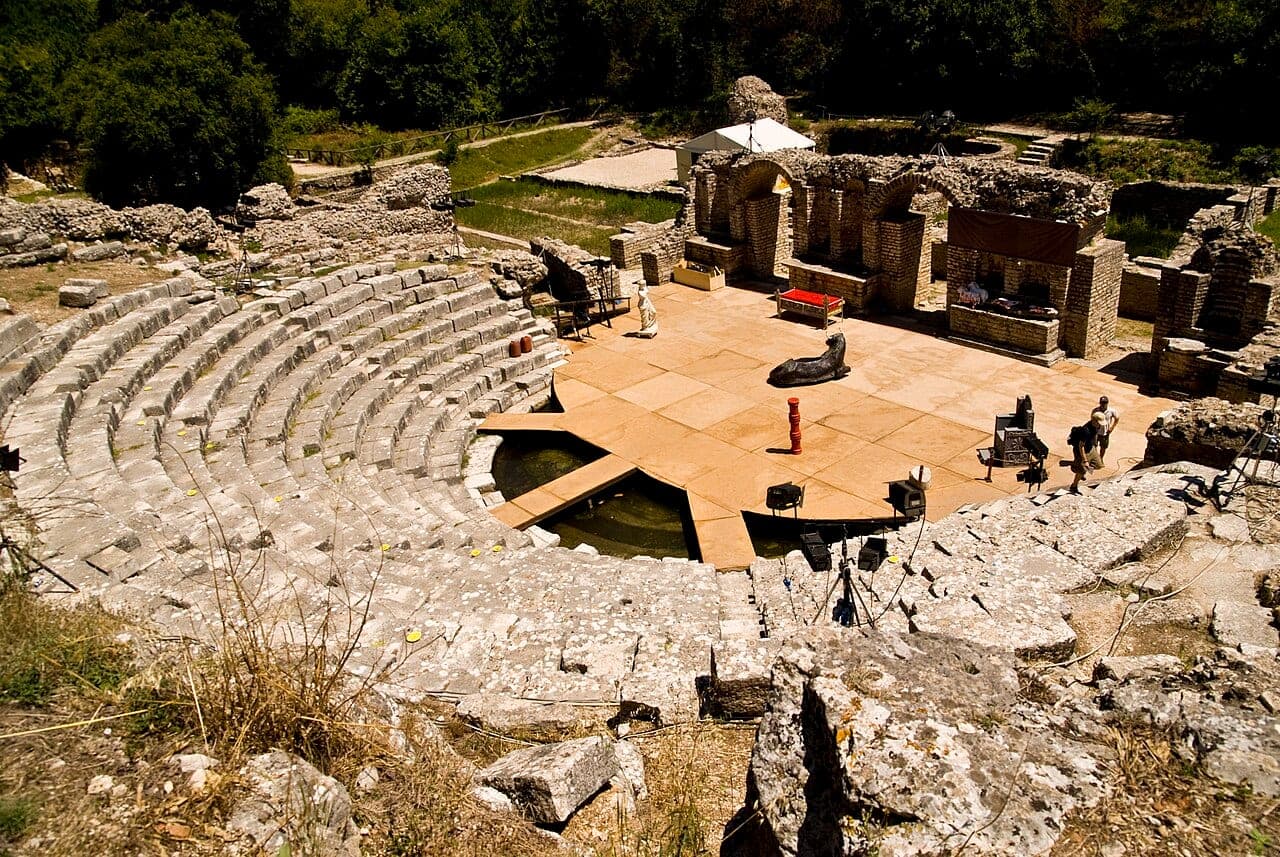
The deep past belongs to the Illyrians, the Indo-European people from whom many Albanians trace descent. Illyrian kingdoms flourished on this coast, one led by the pirate queen Teuta, until Rome absorbed the region by the second century BC. Butrint concentrates these layers: a pre-Greek, likely Illyrian sanctuary became a Greek colony from around the eighth century BC, then a Roman colony under Julius Caesar in 44 BC, and later a Byzantine bishopric before marshes forced its abandonment in the late Middle Ages (UNESCO).
 Butrint was Greek, then Roman, then Byzantine, then Venetian, and was abandoned to the marsh before archaeologists reached it, which is why so much of it survived. Photograph by Adam Jones, CC BY-SA 2.0, via Wikimedia Commons.
Medieval Albania fragmented into feudal principalities, and out of them came the figure who defines the national story. George Kastrioti, taken hostage by the Ottomans as a boy and known by the name Skanderbeg, turned against the empire he had served in 1443, united the Albanian lords in the League of Lezhë in 1444, and held the mountain fortress of Krujë through repeated sieges (Britannica). His resistance delayed Ottoman expansion into Europe for roughly a quarter of a century until his death in 1468, after which the country fell under Ottoman rule. Four and a half centuries of Ottoman administration followed, during which much of the population converted to Islam and the domestic architecture of Berat and Gjirokastër took shape.
The Albanian National Awakening, the Rilindja, revived language and identity through the nineteenth century, led in part by the League of Prizren of 1878. On 28 November 1912, as the Balkan Wars redrew the map, Ismail Qemali proclaimed independence at Vlorë and raised Skanderbeg's eagle as the flag of a new state. After monarchy and the Second World War came the communist era: Enver Hoxha ruled from 1944 until his death in 1985, pursuing severe isolation, banning religion in 1967 and declaring Albania the world's first officially atheist state, and covering the country with hundreds of thousands of concrete bunkers (Britannica). Communism fell between 1990 and 1992, and Albania has since rebuilt as a parliamentary democracy oriented toward Europe.
Albanian forms a distinct branch of the Indo-European family with no close living relatives, a subject of long scholarly attention (Britannica). It has two principal dialect groups, Gheg in the north and Tosk in the south, divided roughly by the Shkumbin river; the modern standard, formalised in 1972, is based mainly on Tosk. The Latin-based alphabet of thirty-six letters used today was agreed at the Congress of Manastir in 1908, a milestone of the national movement.
The country's two names sit side by side. The English Albania descends from a classical exonym, the Albanoi, a tribe recorded by the geographer Ptolemy in the second century AD. Albanians instead call their land Shqipëria and themselves shqiptarë, a name popularly connected to shqiponjë, the eagle, and so read as the land of the eagles, though many linguists link it rather to the verb shqiptoj, to speak clearly, meaning those who share the tongue. Both readings point to the same thing, a people defined by language.
At the centre of Albanian musical heritage is iso-polyphony, a form of group singing from the southern Tosk and Lab regions in which several voices interlock over a sustained drone, the iso, held by the rest of the group. Songs recall history, love, loss and the harvest, and the tradition was inscribed on UNESCO's intangible heritage lists in 2005 and 2008. It sits alongside the older code that governed highland life, the Kanun, a body of customary law transmitted orally and associated with the medieval lord Lekë Dukagjini. Its central value is besa, the pledged word, an obligation of honour that binds a person and their family, most visible in the duty of hospitality that guarantees a guest's safety.
The crafts carry the same continuity: filigree silverwork from Shkodër, wood carving, and traditional dress such as the white felt qeleshe cap and the bell-shaped xhubleta worn by highland women. The table is heritage too: byrek, a filled pastry, appears at every gathering; baked dishes such as tavë kosi, lamb with yoghurt, anchor the everyday meal; and raki, a fruit brandy, opens hospitality and closes the funeral gathering alike.
Albania is unusual in Europe for the balance among its faiths. Centuries of Ottoman rule left a Muslim majority, mostly Sunni, alongside a significant Bektashi community, an Orthodox Christian population organised as the autocephalous Albanian Orthodox Church, and a Catholic community concentrated in the north around Shkodër. Religion was banned outright from 1967 to 1990, and worship of every kind had to be rebuilt after communism fell, a shared recovery rather than a rivalry.
The Bektashi order gives Albania a distinctive place in the Islamic world. A Sufi tradition known for tolerance and the veneration of Ali, it moved its world headquarters to Tirana in 1930 after Sufi orders were suppressed in Turkey, and in 2024 the Albanian government announced plans for a small sovereign Bektashi state within the capital (Britannica). Interfaith harmony and mixed families are a point of national pride, often summarised by a line attributed to the nineteenth-century poet Pashko Vasa, that the faith of Albanians is Albanianism. The country's best-known religious figure, Mother Teresa, was born in 1910 to an Albanian Catholic family in Skopje and was canonised in 2016; she is honoured across all the country's communities.
Holding four faiths, Albania keeps four ways of burying the dead, practised respectfully and often within sight of one another. Muslim families bury quickly, usually within a day, washing the body, wrapping it in a plain shroud and laying it facing Mecca, without cremation, and gathering again for prayers on the seventh and fortieth days. Orthodox Christians hold memorial services at set intervals after death and share blessed boiled wheat in remembrance. Catholics keep the requiem Mass and the visiting of graves at All Souls. The Bektashi honour their dead at the tekke and the tyrbe, the domed tomb of a holy man, and make pilgrimage each August to the shrine on Mount Tomorr.
The northern highlands preserve two of the Balkans' most striking laments. The gjama is a men's mourning ritual, a rhythmic collective wailing once accompanied by the scratching of faces, which served both to voice grief and to carry news of a death across the mountains; forbidden under communism, it was revived after 1990 and is now studied as endangered heritage. Alongside it the vajtim, the sung lament of women, gives sorrow words over the body. In all communities the funeral gathers the extended family and the village, coffee and raki are shared, and the grave is tended and visited. As across the region, children are often named for a grandparent, so that remembrance is built into the family itself.
Albanian records are Ottoman, then Italian and Greek in patches, then one of the most closed states in Europe for forty-five years.
Ottoman defters, the tax and land registers, cover the territory from the fifteenth century and are held in Istanbul. Orthodox and Catholic parish registers survive in the south and north respectively; Muslim families, who are the majority, appear in sharia court records and in the Ottoman population registers rather than in parish books.
The Albanian State Archives in Tirana hold the twentieth-century series, including the civil registration that the interwar state built and the communist state continued. Registration under Hoxha was thorough, because the state wanted to know where everybody was.
The distinctive Albanian record is not written down. The Kanun, the customary law codified in the north, governs descent, inheritance and the blood feud, and it operates on a precise understanding of which families are related to which. In the highlands the fis, the patrilineal clan, is the unit of identity, and a man is expected to know his line. The besa, the given word, and the obligations that follow from it, are traced along those same lines.
The Sigurimi files, the archive of the secret police, were opened by an authority established in 2015, and Albanians can now apply to see their own. As in every country that has done this, the result is that family history and political history turn out to be the same subject, and the informer is frequently a relative.
Albania's four World Heritage sites reflect both its human and natural past. Butrint was inscribed in 1992 and later extended to a national park protecting an exceptional wetland around the ruins (UNESCO). The Historic Centres of Berat and Gjirokastër were listed as museum cities in 2005 and 2008, recognised as rare surviving examples of Ottoman-era town life (UNESCO). The Natural and Cultural Heritage of the Ohrid Region, first inscribed for North Macedonia, was extended in 2019 to take in the Albanian shore of Europe's oldest lake. And the country's primeval beech stands joined the transnational Ancient and Primeval Beech Forests site in 2017 (UNESCO). Iso-polyphony completes the picture on the intangible heritage list.
The work of protection is carried by the Institute of Cultural Monuments and by partnerships that have become models in the region. In Gjirokastër the Gjirokastra Foundation and Cultural Heritage without Borders have restored dozens of the great tower houses, training craftspeople in the old techniques, and at Butrint the government entrusted the site to a dedicated foundation in 2022. The chief pressures are familiar to a fast-developing coast: building along the shoreline, mass tourism, and infrastructure near protected land.
Albania's most remarkable digital archive belongs to Shkodër. The Marubi studio, founded in 1856 by the Italian émigré Pietro Marubbi and continued by three generations of Albanian photographers, produced more than half a million glass and film negatives recording the country from the late Ottoman period onward. Held by the Marubi National Museum of Photography, established in 2016, the archive is being scanned and published online, and it is recognised in UNESCO's Memory of the World programme, so that a face photographed in Shkodër a century ago can be found from anywhere.
Beyond Marubi, state archives and museums are steadily digitising their holdings, and cultural institutions are joining international platforms that put Albanian collections within reach of a diaspora scattered across three continents. For a nation shaped by emigration, the digital archive is a way home.
Albanian culture reaches far beyond the country's borders. Ismail Kadare, whose novels drew on the legends, the Kanun and the history of his homeland, won the inaugural International Booker Prize in 2005 and was read worldwide until his death in 2024. The soprano Inva Mula lent her voice to one of cinema's most famous arias, and pop musicians of Albanian heritage, among them Dua Lipa, Rita Ora, Bebe Rexha and Ava Max, have reached the top of the charts abroad; Dua Lipa's Sunny Hill Festival brings that connection back to the Albanian world each year, while the folklore festival at Gjirokastër gathers the tradition-bearers of village song and dance and Tirana has grown into a capital of galleries, cafés and new architecture.
A new guardian for Butrint. In 2022 the Albanian Parliament placed the World Heritage site of Butrint under a dedicated management foundation, the first such public partnership for a cultural site in the country, to fund archaeology and care for the ruins.
Ohrid recognised on both shores. In 2019 UNESCO extended the Ohrid Region site to the Albanian side of Europe's oldest lake, shared with North Macedonia.
Europe's first wild river park. In March 2023 Albania declared the Vjosa, one of the last free-flowing rivers on the continent, Europe's first Wild River National Park, after a long campaign by communities and conservationists.
A century of faces, brought online. The Marubi archive of more than half a million negatives, recognised by UNESCO's Memory of the World, is being digitised and shared, returning the photographed history of Albania to the families and diaspora who descend from it.
Butrint was Greek, then Roman, then Byzantine, then Venetian, and was abandoned to the marsh before archaeologists reached it, which is why so much of it survived. Photograph by Adam Jones, CC BY-SA 2.0, via Wikimedia Commons.
Medieval Albania fragmented into feudal principalities, and out of them came the figure who defines the national story. George Kastrioti, taken hostage by the Ottomans as a boy and known by the name Skanderbeg, turned against the empire he had served in 1443, united the Albanian lords in the League of Lezhë in 1444, and held the mountain fortress of Krujë through repeated sieges (Britannica). His resistance delayed Ottoman expansion into Europe for roughly a quarter of a century until his death in 1468, after which the country fell under Ottoman rule. Four and a half centuries of Ottoman administration followed, during which much of the population converted to Islam and the domestic architecture of Berat and Gjirokastër took shape.
The Albanian National Awakening, the Rilindja, revived language and identity through the nineteenth century, led in part by the League of Prizren of 1878. On 28 November 1912, as the Balkan Wars redrew the map, Ismail Qemali proclaimed independence at Vlorë and raised Skanderbeg's eagle as the flag of a new state. After monarchy and the Second World War came the communist era: Enver Hoxha ruled from 1944 until his death in 1985, pursuing severe isolation, banning religion in 1967 and declaring Albania the world's first officially atheist state, and covering the country with hundreds of thousands of concrete bunkers (Britannica). Communism fell between 1990 and 1992, and Albania has since rebuilt as a parliamentary democracy oriented toward Europe.
Albanian forms a distinct branch of the Indo-European family with no close living relatives, a subject of long scholarly attention (Britannica). It has two principal dialect groups, Gheg in the north and Tosk in the south, divided roughly by the Shkumbin river; the modern standard, formalised in 1972, is based mainly on Tosk. The Latin-based alphabet of thirty-six letters used today was agreed at the Congress of Manastir in 1908, a milestone of the national movement.
The country's two names sit side by side. The English Albania descends from a classical exonym, the Albanoi, a tribe recorded by the geographer Ptolemy in the second century AD. Albanians instead call their land Shqipëria and themselves shqiptarë, a name popularly connected to shqiponjë, the eagle, and so read as the land of the eagles, though many linguists link it rather to the verb shqiptoj, to speak clearly, meaning those who share the tongue. Both readings point to the same thing, a people defined by language.
At the centre of Albanian musical heritage is iso-polyphony, a form of group singing from the southern Tosk and Lab regions in which several voices interlock over a sustained drone, the iso, held by the rest of the group. Songs recall history, love, loss and the harvest, and the tradition was inscribed on UNESCO's intangible heritage lists in 2005 and 2008. It sits alongside the older code that governed highland life, the Kanun, a body of customary law transmitted orally and associated with the medieval lord Lekë Dukagjini. Its central value is besa, the pledged word, an obligation of honour that binds a person and their family, most visible in the duty of hospitality that guarantees a guest's safety.
The crafts carry the same continuity: filigree silverwork from Shkodër, wood carving, and traditional dress such as the white felt qeleshe cap and the bell-shaped xhubleta worn by highland women. The table is heritage too: byrek, a filled pastry, appears at every gathering; baked dishes such as tavë kosi, lamb with yoghurt, anchor the everyday meal; and raki, a fruit brandy, opens hospitality and closes the funeral gathering alike.
Albania is unusual in Europe for the balance among its faiths. Centuries of Ottoman rule left a Muslim majority, mostly Sunni, alongside a significant Bektashi community, an Orthodox Christian population organised as the autocephalous Albanian Orthodox Church, and a Catholic community concentrated in the north around Shkodër. Religion was banned outright from 1967 to 1990, and worship of every kind had to be rebuilt after communism fell, a shared recovery rather than a rivalry.
The Bektashi order gives Albania a distinctive place in the Islamic world. A Sufi tradition known for tolerance and the veneration of Ali, it moved its world headquarters to Tirana in 1930 after Sufi orders were suppressed in Turkey, and in 2024 the Albanian government announced plans for a small sovereign Bektashi state within the capital (Britannica). Interfaith harmony and mixed families are a point of national pride, often summarised by a line attributed to the nineteenth-century poet Pashko Vasa, that the faith of Albanians is Albanianism. The country's best-known religious figure, Mother Teresa, was born in 1910 to an Albanian Catholic family in Skopje and was canonised in 2016; she is honoured across all the country's communities.
Holding four faiths, Albania keeps four ways of burying the dead, practised respectfully and often within sight of one another. Muslim families bury quickly, usually within a day, washing the body, wrapping it in a plain shroud and laying it facing Mecca, without cremation, and gathering again for prayers on the seventh and fortieth days. Orthodox Christians hold memorial services at set intervals after death and share blessed boiled wheat in remembrance. Catholics keep the requiem Mass and the visiting of graves at All Souls. The Bektashi honour their dead at the tekke and the tyrbe, the domed tomb of a holy man, and make pilgrimage each August to the shrine on Mount Tomorr.
The northern highlands preserve two of the Balkans' most striking laments. The gjama is a men's mourning ritual, a rhythmic collective wailing once accompanied by the scratching of faces, which served both to voice grief and to carry news of a death across the mountains; forbidden under communism, it was revived after 1990 and is now studied as endangered heritage. Alongside it the vajtim, the sung lament of women, gives sorrow words over the body. In all communities the funeral gathers the extended family and the village, coffee and raki are shared, and the grave is tended and visited. As across the region, children are often named for a grandparent, so that remembrance is built into the family itself.
Albanian records are Ottoman, then Italian and Greek in patches, then one of the most closed states in Europe for forty-five years.
Ottoman defters, the tax and land registers, cover the territory from the fifteenth century and are held in Istanbul. Orthodox and Catholic parish registers survive in the south and north respectively; Muslim families, who are the majority, appear in sharia court records and in the Ottoman population registers rather than in parish books.
The Albanian State Archives in Tirana hold the twentieth-century series, including the civil registration that the interwar state built and the communist state continued. Registration under Hoxha was thorough, because the state wanted to know where everybody was.
The distinctive Albanian record is not written down. The Kanun, the customary law codified in the north, governs descent, inheritance and the blood feud, and it operates on a precise understanding of which families are related to which. In the highlands the fis, the patrilineal clan, is the unit of identity, and a man is expected to know his line. The besa, the given word, and the obligations that follow from it, are traced along those same lines.
The Sigurimi files, the archive of the secret police, were opened by an authority established in 2015, and Albanians can now apply to see their own. As in every country that has done this, the result is that family history and political history turn out to be the same subject, and the informer is frequently a relative.
Albania's four World Heritage sites reflect both its human and natural past. Butrint was inscribed in 1992 and later extended to a national park protecting an exceptional wetland around the ruins (UNESCO). The Historic Centres of Berat and Gjirokastër were listed as museum cities in 2005 and 2008, recognised as rare surviving examples of Ottoman-era town life (UNESCO). The Natural and Cultural Heritage of the Ohrid Region, first inscribed for North Macedonia, was extended in 2019 to take in the Albanian shore of Europe's oldest lake. And the country's primeval beech stands joined the transnational Ancient and Primeval Beech Forests site in 2017 (UNESCO). Iso-polyphony completes the picture on the intangible heritage list.
The work of protection is carried by the Institute of Cultural Monuments and by partnerships that have become models in the region. In Gjirokastër the Gjirokastra Foundation and Cultural Heritage without Borders have restored dozens of the great tower houses, training craftspeople in the old techniques, and at Butrint the government entrusted the site to a dedicated foundation in 2022. The chief pressures are familiar to a fast-developing coast: building along the shoreline, mass tourism, and infrastructure near protected land.
Albania's most remarkable digital archive belongs to Shkodër. The Marubi studio, founded in 1856 by the Italian émigré Pietro Marubbi and continued by three generations of Albanian photographers, produced more than half a million glass and film negatives recording the country from the late Ottoman period onward. Held by the Marubi National Museum of Photography, established in 2016, the archive is being scanned and published online, and it is recognised in UNESCO's Memory of the World programme, so that a face photographed in Shkodër a century ago can be found from anywhere.
Beyond Marubi, state archives and museums are steadily digitising their holdings, and cultural institutions are joining international platforms that put Albanian collections within reach of a diaspora scattered across three continents. For a nation shaped by emigration, the digital archive is a way home.
Albanian culture reaches far beyond the country's borders. Ismail Kadare, whose novels drew on the legends, the Kanun and the history of his homeland, won the inaugural International Booker Prize in 2005 and was read worldwide until his death in 2024. The soprano Inva Mula lent her voice to one of cinema's most famous arias, and pop musicians of Albanian heritage, among them Dua Lipa, Rita Ora, Bebe Rexha and Ava Max, have reached the top of the charts abroad; Dua Lipa's Sunny Hill Festival brings that connection back to the Albanian world each year, while the folklore festival at Gjirokastër gathers the tradition-bearers of village song and dance and Tirana has grown into a capital of galleries, cafés and new architecture.
A new guardian for Butrint. In 2022 the Albanian Parliament placed the World Heritage site of Butrint under a dedicated management foundation, the first such public partnership for a cultural site in the country, to fund archaeology and care for the ruins.
Ohrid recognised on both shores. In 2019 UNESCO extended the Ohrid Region site to the Albanian side of Europe's oldest lake, shared with North Macedonia.
Europe's first wild river park. In March 2023 Albania declared the Vjosa, one of the last free-flowing rivers on the continent, Europe's first Wild River National Park, after a long campaign by communities and conservationists.
A century of faces, brought online. The Marubi archive of more than half a million negatives, recognised by UNESCO's Memory of the World, is being digitised and shared, returning the photographed history of Albania to the families and diaspora who descend from it.
National Overview
Notable Cities
Historical Foundations
Linguistic and Etymological Roots
Cultural Identity
Religion and Spirituality
Remembrance and Mourning Traditions
Tracing a Family in Albania
Heritage Preservation Efforts
Digital Heritage
Contemporary Cultural Influences
Success Stories
References and resources
- UNESCO World Heritage Centre: Butrint. The 1992 inscription and the site's Illyrian, Greek, Roman and Byzantine layers.
- UNESCO World Heritage Centre: Historic Centres of Berat and Gjirokastra. The Ottoman-era museum cities, inscribed in 2005 and 2008.
- UNESCO Intangible Cultural Heritage: Albanian folk iso-polyphony. The multipart singing tradition of southern Albania.
- Encyclopaedia Britannica: Albania. Geography, history, language and the communist period.
- Encyclopaedia Britannica: Skanderbeg. The national hero and his fifteenth-century resistance.
- Encyclopaedia Britannica: Bektashi. The Sufi order and its move to Tirana.
- Marubi National Museum of Photography. The Shkodër archive and its digitisation.
- Butrint Management Foundation. The 2022 management agreement for the Butrint World Heritage site.
- IUCN: Vjosa becomes Europe's first Wild River National Park. The 2023 designation.
- Nobel Prize: Mother Teresa, biographical. Her Albanian family and life.