Heritage · Country
Kyrgyzstan Culture and Heritage
On the roof of Central Asia the Kyrgyz kept their memory in motion: a sacred mountain above Osh, a caravanserai on a pass at three and a half thousand metres, and an epic half a million lines long carried in living voices. This guide follows Kyrgyzstan from the Silk Road minaret at Balasagun to the felt of the yurt and the ash feast that gathers a family around its dead.Written to last.
By Confinity Heritage Editorial · Updated 2026-07-31 · 8-minute readQuiet tools, kept out of the way.
Kyrgyzstan is a country of mountains and memory. More than nine-tenths of its land lies above 1,500 metres, folded into the ranges of the Tian Shan, the "Celestial Mountains", whose snows feed the pastures where the Kyrgyz have moved their herds for centuries. This is a nation that carried its heritage not in stone libraries but in the saddle: in the felt walls of the yurt, in the lament sung over the dead, and above all in the voice of the manaschi, who holds an epic of half a million lines in memory and speaks it as though the events were unfolding before him.
That inheritance sits alongside older stone. A sacred mountain has drawn pilgrims above the city of Osh for thousands of years, and a lone minaret survives from a Silk Road capital that vanished into the grass.
The Kyrgyz Republic is a landlocked country of some 200,000 square kilometres in the heart of Central Asia, bordered by Kazakhstan, Uzbekistan, Tajikistan and China, and among the most mountainous nations on earth. The Tian Shan and Pamir-Alay ranges cover the whole territory; the highest point, Jengish Chokusu (Pobeda Peak), rises to 7,439 metres on the Chinese border. Between them lie the two basins that shape the country's life: the temperate Chuy valley in the north, where the capital sits, and the fertile Fergana valley in the south.
At the country's centre lies one of its wonders, Lake Issyk-Kul, the second-largest alpine lake in the world after Titicaca. Ringed by snow peaks at about 1,600 metres, its slightly saline waters never freeze, which gives the lake its Kyrgyz name Ysyk-Köl, the "warm lake". The population of roughly seven million is majority Kyrgyz, with substantial Uzbek and Russian communities and smaller Dungan and Uyghur groups. Since declaring independence from the Soviet Union in 1991, Kyrgyzstan has been a republic with an elected president and parliament, and has changed governments several times through elections and popular protest.
Bishkek. The capital lies in the north, at the foot of the Kyrgyz Ala-Too range. It began as Pishpek, a fort of the Kokand khanate, was taken by Russia in the 1860s, and under Soviet rule was renamed Frunze after the Bolshevik commander born there. Renamed Bishkek at independence, it is laid out on a Soviet grid around Ala-Too Square and holds the State Historical Museum.
Osh. The southern capital and, by tradition, the oldest city in the country, with a past reckoned at close to three thousand years. In the eastern Fergana valley, it grew wealthy on the Silk Road and keeps the Jayma, one of the largest open-air bazaars in Central Asia. Above it rises Sulaiman-Too, the sacred mountain that has made Osh a place of pilgrimage since the medieval period.
Jalal-Abad. North-east of Osh in the same Fergana basin, Jalal-Abad is the third city of the country and a hub of the agricultural south. Long known for the mineral and hot springs in the hills above it, it has drawn health-seekers to its sanatoria for generations.
Karakol. At the eastern tip of Lake Issyk-Kul stands Karakol, founded in 1869 as a Russian garrison and later renamed Przhevalsk for the explorer Nikolai Przhevalsky, who died there and lies buried nearby. The town preserves a double heritage in wood: the Holy Trinity Russian Orthodox cathedral, and the Dungan Mosque, raised around 1904 to 1910 by Chinese Muslim craftsmen in a pagoda style and assembled, by tradition, without a single nail. The town is now the gateway for trekkers heading into the high Tian Shan.
The mountains were peopled long before the Kyrgyz arrived. In antiquity the Saka, Scythian nomads of the steppe, ranged across the Tian Shan, leaving burial mounds and gold. The Kyrgyz themselves are a Turkic people whose earliest recorded homeland lay far to the north, along the upper Yenisei river in southern Siberia. Under pressure from Mongol and later Dzungar expansion, groups bearing the Kyrgyz name migrated south into the Tian Shan between roughly the tenth and seventeenth centuries, blending with the peoples already there.
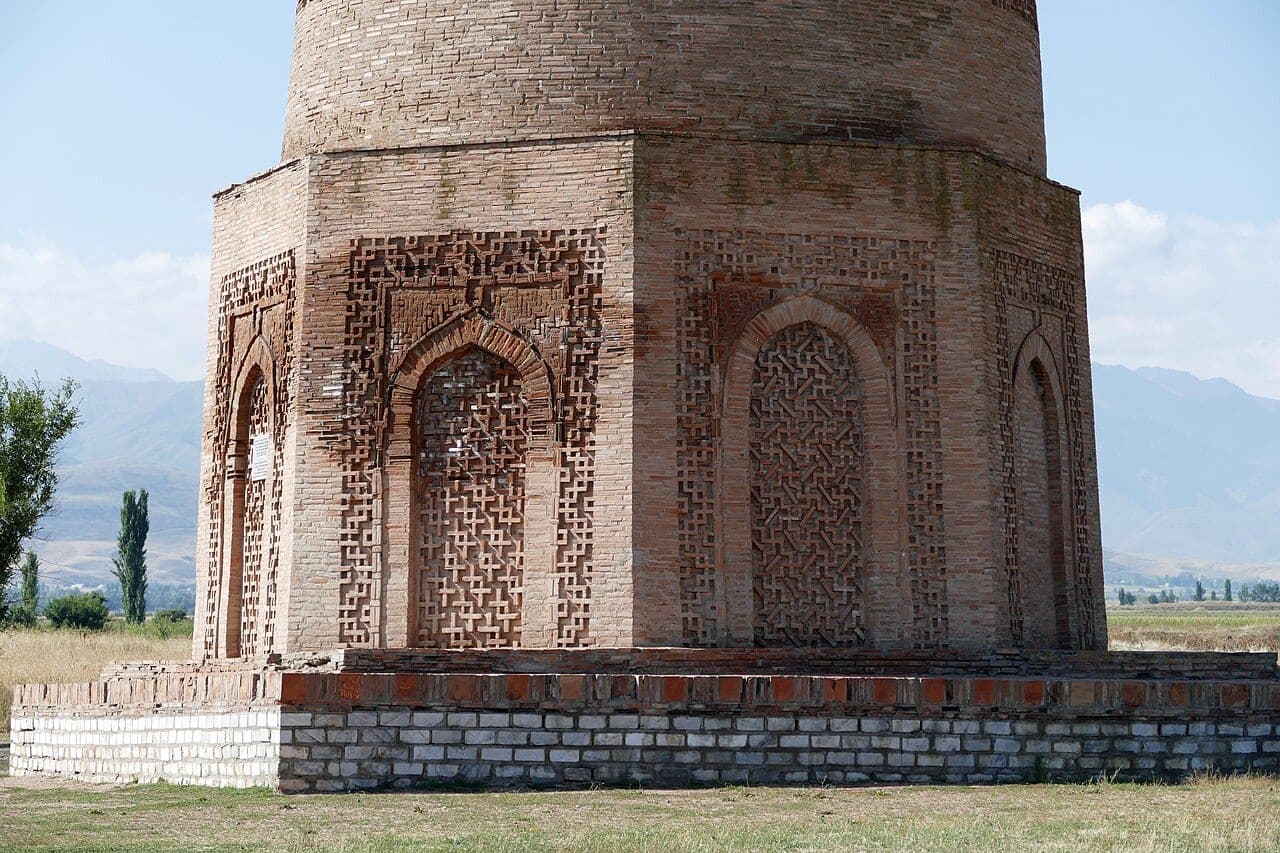
 The Burana Tower is all that stands above ground of Balasagun, a Silk Road city that was already ruined when the Mongols arrived. Photograph by Bgag, CC0, via Wikimedia Commons.
The Chuy valley meanwhile held cities of the Silk Road. Balasagun, a capital of the Kara-Khanid state that ruled much of the region from the tenth century, once stood where only the Burana Tower now rises: a brick minaret of the eleventh century, reduced by earthquakes from an original height of some 45 metres to about 25, ringed by balbals, the carved stone figures that marked ancient graves. To the south, across a pass above 3,500 metres, the stone caravanserai of Tash Rabat, in its present form a fifteenth-century structure raised over an older monastic site, sheltered caravans bound for Kashgar.
By the early nineteenth century the Kyrgyz tribes had come under the Kokand khanate, which built the fort at Pishpek. The Russian Empire annexed the region in 1876, and peasant settlement followed, taking winter pastures and pressing the herders into the higher mountains. That pressure broke open in 1916, when a wartime decree conscripting Central Asians for labour touched off a revolt across the region. The Kyrgyz remember it as the Urkun, the "exodus": in the reprisals and the winter flight over the passes into China a very large number of people died, with estimates ranging into the hundreds of thousands, and it remains among the most solemn events in the national memory. A Kara-Kyrgyz autonomous region formed under Soviet power in 1924 became the Kirghiz Soviet Socialist Republic in 1936, and the Soviet decades brought literacy and industry alongside collectivisation. Kyrgyzstan declared independence on 31 August 1991, the first republic of Soviet Central Asia to do so.
Kyrgyz, a Turkic language of the Kipchak branch, is the state language, written today in a Cyrillic-based alphabet. Russian holds official status as a language of interethnic communication and remains widespread in government, business and the northern cities, so that public life moves easily between the two. Uzbek is spoken across the southern valleys.
The name of the people is itself a piece of heritage. The most widely cited reading takes Kyrgyz from the Turkic kyrk, "forty", with an old plural ending, giving a sense of "the forty tribes" and echoing the story in which the hero Manas unites forty clans into one people; a parallel folk etymology hears kyrk kyz, "forty girls", from whom the Kyrgyz are said to descend. The number forty runs through national symbolism: the sun on the state flag carries forty rays, and at its centre sits the tunduk, the wooden roof-crown of the yurt.
The centre of that identity is the yurt, known in Kyrgyz as the boz üy, the "grey house": a domed tent of felt over a lattice frame, portable and warm, still raised on the summer pastures and for the occasions of birth, marriage and death. Its crown, the tunduk, opens to the sky and appears on the flag as the emblem of the nation. Around the yurt cluster the crafts of felt, above all the shyrdak and ala-kiyiz carpets, made by rolling wool into dense sheets and cutting or inlaying bold mosaic patterns; these felt arts were recognised by UNESCO in 2012 as heritage in need of urgent safeguarding.
Above all there is the Epic of Manas, one of the longest oral poems known, past half a million lines in its fullest versions and telling of the hero Manas, his son Semetey and his grandson Seytek. It is carried by the manaschi, reciters who learn it from elders, often report receiving the calling in a dream, and chant it in a near-trance state with a rhythm all their own; the recitation was inscribed on the UNESCO Representative List in 2013, and the wider art of the akyns, the epic tellers, in 2008. Alongside it run the strings of the komuz, the three-stringed lute, and eagle hunting, the golden eagle flown from the arm to take fox and hare across the winter hills. The everyday table is nomadic too: beshbarmak, "five fingers", boiled meat over hand-cut noodles, and kymyz, fermented mare's milk. The white felt kalpak, the men's tall hat, is so plain a marker of the nation that the country keeps a day in its honour.
Most Kyrgyz are Sunni Muslims of the Hanafi school, a faith that came with the Silk Road. Yet Islam here was received by a people whose older beliefs were never wholly displaced, and the two have long lived layered together. Beneath the mosque lies the sky-worship of Tengrism: the veneration of Tengri the sky, of the mountains and springs, of Umai the protector of mothers and children, and of the arbak, the ancestor spirits whose blessing is sought and whose displeasure is feared.
The Burana Tower is all that stands above ground of Balasagun, a Silk Road city that was already ruined when the Mongols arrived. Photograph by Bgag, CC0, via Wikimedia Commons.
The Chuy valley meanwhile held cities of the Silk Road. Balasagun, a capital of the Kara-Khanid state that ruled much of the region from the tenth century, once stood where only the Burana Tower now rises: a brick minaret of the eleventh century, reduced by earthquakes from an original height of some 45 metres to about 25, ringed by balbals, the carved stone figures that marked ancient graves. To the south, across a pass above 3,500 metres, the stone caravanserai of Tash Rabat, in its present form a fifteenth-century structure raised over an older monastic site, sheltered caravans bound for Kashgar.
By the early nineteenth century the Kyrgyz tribes had come under the Kokand khanate, which built the fort at Pishpek. The Russian Empire annexed the region in 1876, and peasant settlement followed, taking winter pastures and pressing the herders into the higher mountains. That pressure broke open in 1916, when a wartime decree conscripting Central Asians for labour touched off a revolt across the region. The Kyrgyz remember it as the Urkun, the "exodus": in the reprisals and the winter flight over the passes into China a very large number of people died, with estimates ranging into the hundreds of thousands, and it remains among the most solemn events in the national memory. A Kara-Kyrgyz autonomous region formed under Soviet power in 1924 became the Kirghiz Soviet Socialist Republic in 1936, and the Soviet decades brought literacy and industry alongside collectivisation. Kyrgyzstan declared independence on 31 August 1991, the first republic of Soviet Central Asia to do so.
Kyrgyz, a Turkic language of the Kipchak branch, is the state language, written today in a Cyrillic-based alphabet. Russian holds official status as a language of interethnic communication and remains widespread in government, business and the northern cities, so that public life moves easily between the two. Uzbek is spoken across the southern valleys.
The name of the people is itself a piece of heritage. The most widely cited reading takes Kyrgyz from the Turkic kyrk, "forty", with an old plural ending, giving a sense of "the forty tribes" and echoing the story in which the hero Manas unites forty clans into one people; a parallel folk etymology hears kyrk kyz, "forty girls", from whom the Kyrgyz are said to descend. The number forty runs through national symbolism: the sun on the state flag carries forty rays, and at its centre sits the tunduk, the wooden roof-crown of the yurt.
The centre of that identity is the yurt, known in Kyrgyz as the boz üy, the "grey house": a domed tent of felt over a lattice frame, portable and warm, still raised on the summer pastures and for the occasions of birth, marriage and death. Its crown, the tunduk, opens to the sky and appears on the flag as the emblem of the nation. Around the yurt cluster the crafts of felt, above all the shyrdak and ala-kiyiz carpets, made by rolling wool into dense sheets and cutting or inlaying bold mosaic patterns; these felt arts were recognised by UNESCO in 2012 as heritage in need of urgent safeguarding.
Above all there is the Epic of Manas, one of the longest oral poems known, past half a million lines in its fullest versions and telling of the hero Manas, his son Semetey and his grandson Seytek. It is carried by the manaschi, reciters who learn it from elders, often report receiving the calling in a dream, and chant it in a near-trance state with a rhythm all their own; the recitation was inscribed on the UNESCO Representative List in 2013, and the wider art of the akyns, the epic tellers, in 2008. Alongside it run the strings of the komuz, the three-stringed lute, and eagle hunting, the golden eagle flown from the arm to take fox and hare across the winter hills. The everyday table is nomadic too: beshbarmak, "five fingers", boiled meat over hand-cut noodles, and kymyz, fermented mare's milk. The white felt kalpak, the men's tall hat, is so plain a marker of the nation that the country keeps a day in its honour.
Most Kyrgyz are Sunni Muslims of the Hanafi school, a faith that came with the Silk Road. Yet Islam here was received by a people whose older beliefs were never wholly displaced, and the two have long lived layered together. Beneath the mosque lies the sky-worship of Tengrism: the veneration of Tengri the sky, of the mountains and springs, of Umai the protector of mothers and children, and of the arbak, the ancestor spirits whose blessing is sought and whose displeasure is feared.
 Sulaiman-Too above Osh has been a place of pilgrimage for a millennium and a half, and remains one for people who go there to pray for children and for health. Photograph by Radoslaw Botev, CC BY 3.0 PL, via Wikimedia Commons.
That older spirituality is most visible at the mazars, the sacred sites scattered across the country: a saint's tomb, a spring, a lone tree hung with rags of cloth, or the sacred mountain of Sulaiman-Too itself, where cult practice reaches back thousands of years and was absorbed rather than erased by Islam. Pilgrims come to circle a shrine, leave an offering and ask for healing, a child or safe passage. The Russian presence left an Orthodox Christian community, but the characteristic religious landscape of the Kyrgyz remains this weaving of Muslim practice with a spirituality of mountain, sky and ancestor that predates it.
When a Kyrgyz person dies, the community gathers with a completeness that surprises outsiders. Historically the body is laid out in a yurt raised for the purpose, and the women of the family and their neighbours keep vigil beside it, singing the koshok, the funeral lament: improvised verse that recounts the life of the dead, praises their virtues and voices the grief of those left behind. The koshok is among the oldest genres of Kyrgyz oral art, and skilled lamenters have long been sought to lead it; guests come from far off to share a mourning that is public and openly voiced.
Islamic rites govern the burial. The dead are washed, wrapped in a white shroud and interred, usually within about three days, in graveyards that are among the most striking sights of the countryside, their mud-brick and metal mausoleums standing like small cities on the hillsides above the villages. Over the graves of holy men and heroes, some of these tombs became mazars, drawing pilgrims for generations. The mourning then unfolds on a calendar: gatherings on the third, seventh and fortieth days, the kyrk or fortieth-day observance being especially important, and a major memorial a year after the death.
The greatest of these is the ash, the memorial feast held to honour the dead and close the mourning with dignity. Families receive many guests, slaughter livestock and serve meat and kymyz, and in older custom staged horse races, wrestling and the mounted game of kok-boru in the honoured one's name. The antiquity of the custom is written into the Epic of Manas itself, whose "Memorial Feast for Kokotoy Khan" describes exactly such a gathering of the steppe. In the koshok that mourns, the mazar that keeps a name sacred, and the ash that draws a scattered family back together, remembrance in Kyrgyzstan remains an active duty of the living rather than a matter left to stone.
Kyrgyz genealogy is called sanjyra, and like the Kazakh version it is a system rather than a hobby.
A Kyrgyz is expected to know their line of fathers to seven generations, the zheti ata, and to be able to place themselves within a clan and within one of the historic wings of the Kyrgyz people. The rule against marrying within seven generations made the knowledge practical. Sanjyra was carried orally by specialists, written down increasingly in the twentieth century, and it has had a public revival since independence, with published clan genealogies and family trees printed and hung at home.
The written state record follows the Russian and Soviet pattern: imperial administrative and tax lists from the later nineteenth century, then ZAGS registration from the 1920s, held in the archives at Bishkek.
Two events sit inside living memory and inside the records. The Urkun of 1916, the flight into China after the suppression of a revolt against conscription, killed a large share of the Kyrgyz population and dispersed survivors across the Tien Shan; some families never came back, and their descendants are in Xinjiang. And Stalin's terror took the Kyrgyz intelligentsia in 1937 and 1938; the mass grave at Chon-Tash, found in 1991, held 137 people whose names had been withheld from their families for half a century.
The manas is the collective version of the whole thing: an epic of extraordinary length recited by manaschi, tracing a people rather than a household.
Kyrgyzstan holds two properties on the UNESCO World Heritage List. The first, and the country's first, inscribed in 2009, is Sulaiman-Too Sacred Mountain, the massif of five peaks that rises over Osh; it carries 101 sites of petroglyphs, seventeen places of worship still in use and two reconstructed sixteenth-century mosques, a mountain venerated across millennia whose pre-Islamic cult was absorbed into Islam. The second is transnational: in 2014 UNESCO inscribed the Silk Roads: the Routes Network of Chang'an-Tianshan Corridor, shared by China, Kazakhstan and Kyrgyzstan, whose Kyrgyz components are the ruined Silk Road cities of Balasagun, with the Burana Tower, Suyab (Ak-Beshim) and Nevaket (Krasnaya Rechka) in the Chuy valley.
Beyond the inscribed sites, the country's tentative list includes Lake Issyk-Kul, the walnut forests of Sary-Chelek and the caravanserai of Tash Rabat. The State Historical Museum in Bishkek anchors the collections; in the Talas valley the Manas Ordo complex preserves the fourteenth-century Gumbez of Manas, a domed mausoleum long linked in popular memory to the epic hero, and gathers around it an institute, a museum and a yurt where the epic is recited for visitors. Independent Kyrgyzstan has continued the Soviet-era archaeology of the vanished Silk Road cities while restoring monuments and supporting the living bearers of the intangible traditions.
For a heritage held so largely in voice and memory, recording is itself preservation. Audio and video archives of Manas recitation, of akyn singing and of the koshok laments now hold the performances of masters whose art cannot survive on the page alone, and the endangered felt arts of ala-kiyiz and shyrdak are being documented alongside the ageing women who still practise them. Kyrgyzstan shares these intangible-heritage records through the regional ichLinks platform of UNESCO's Asia-Pacific centre.
The open repositories of Wikimedia carry freely licensed photographs of the country's monuments, from the Burana Tower to the wooden mosque of Karakol, and museums have begun to publish their collections online. For the Kyrgyz abroad, and for a young generation raised as much on the phone as on the pasture, these records keep contact with an inheritance that once passed only from elder to child around the hearth of the yurt.
The clearest sign of the country's cultural confidence is the World Nomad Games, which Kyrgyzstan founded in 2014 on the shore of Lake Issyk-Kul at Cholpon-Ata. Conceived as a festival of the sports and arts of the nomadic world, the Games brought together competitors in kok-boru, the mounted contest for a goat carcass hurled into stone goals, in horseback wrestling, in archery and in eagle hunting. What began as a regional event grew into an international gathering drawing athletes from scores of countries.
That revival runs through daily life. The kalpak is worn with new pride by the young; felt cooperatives sell shyrdak carpets to a widening market; manaschi perform at home and abroad, and children learn passages of the epic in school. The heritage of the herders, once thought to be a thing the modern world would leave behind, has instead become a living source of national identity.
A sacred mountain enters the world's record. The inscription of Sulaiman-Too in 2009, Kyrgyzstan's first World Heritage site, brought recognition and protection to a place of pilgrimage that had drawn the faithful for thousands of years.
The epic recognised. The listing of the Manas recitation on the UNESCO Representative List in 2013, following recognition of the wider art of the akyns in 2008, affirmed the manaschi tradition and supported its transmission to new reciters.
Felt rescued from decline. The 2012 designation of ala-kiyiz and shyrdak as heritage in urgent need of safeguarding drew attention to a craft carried by an ageing few, and helped feed a revival of felt cooperatives that give rural women income while keeping the techniques alive.
A festival exported to the world. From its first staging on Issyk-Kul in 2014, the World Nomad Games grew into an international event that has carried kok-boru, eagle hunting and the culture of the yurt onto a global stage, and has since been hosted beyond Kyrgyzstan while keeping its origins in the country.
Sulaiman-Too above Osh has been a place of pilgrimage for a millennium and a half, and remains one for people who go there to pray for children and for health. Photograph by Radoslaw Botev, CC BY 3.0 PL, via Wikimedia Commons.
That older spirituality is most visible at the mazars, the sacred sites scattered across the country: a saint's tomb, a spring, a lone tree hung with rags of cloth, or the sacred mountain of Sulaiman-Too itself, where cult practice reaches back thousands of years and was absorbed rather than erased by Islam. Pilgrims come to circle a shrine, leave an offering and ask for healing, a child or safe passage. The Russian presence left an Orthodox Christian community, but the characteristic religious landscape of the Kyrgyz remains this weaving of Muslim practice with a spirituality of mountain, sky and ancestor that predates it.
When a Kyrgyz person dies, the community gathers with a completeness that surprises outsiders. Historically the body is laid out in a yurt raised for the purpose, and the women of the family and their neighbours keep vigil beside it, singing the koshok, the funeral lament: improvised verse that recounts the life of the dead, praises their virtues and voices the grief of those left behind. The koshok is among the oldest genres of Kyrgyz oral art, and skilled lamenters have long been sought to lead it; guests come from far off to share a mourning that is public and openly voiced.
Islamic rites govern the burial. The dead are washed, wrapped in a white shroud and interred, usually within about three days, in graveyards that are among the most striking sights of the countryside, their mud-brick and metal mausoleums standing like small cities on the hillsides above the villages. Over the graves of holy men and heroes, some of these tombs became mazars, drawing pilgrims for generations. The mourning then unfolds on a calendar: gatherings on the third, seventh and fortieth days, the kyrk or fortieth-day observance being especially important, and a major memorial a year after the death.
The greatest of these is the ash, the memorial feast held to honour the dead and close the mourning with dignity. Families receive many guests, slaughter livestock and serve meat and kymyz, and in older custom staged horse races, wrestling and the mounted game of kok-boru in the honoured one's name. The antiquity of the custom is written into the Epic of Manas itself, whose "Memorial Feast for Kokotoy Khan" describes exactly such a gathering of the steppe. In the koshok that mourns, the mazar that keeps a name sacred, and the ash that draws a scattered family back together, remembrance in Kyrgyzstan remains an active duty of the living rather than a matter left to stone.
Kyrgyz genealogy is called sanjyra, and like the Kazakh version it is a system rather than a hobby.
A Kyrgyz is expected to know their line of fathers to seven generations, the zheti ata, and to be able to place themselves within a clan and within one of the historic wings of the Kyrgyz people. The rule against marrying within seven generations made the knowledge practical. Sanjyra was carried orally by specialists, written down increasingly in the twentieth century, and it has had a public revival since independence, with published clan genealogies and family trees printed and hung at home.
The written state record follows the Russian and Soviet pattern: imperial administrative and tax lists from the later nineteenth century, then ZAGS registration from the 1920s, held in the archives at Bishkek.
Two events sit inside living memory and inside the records. The Urkun of 1916, the flight into China after the suppression of a revolt against conscription, killed a large share of the Kyrgyz population and dispersed survivors across the Tien Shan; some families never came back, and their descendants are in Xinjiang. And Stalin's terror took the Kyrgyz intelligentsia in 1937 and 1938; the mass grave at Chon-Tash, found in 1991, held 137 people whose names had been withheld from their families for half a century.
The manas is the collective version of the whole thing: an epic of extraordinary length recited by manaschi, tracing a people rather than a household.
Kyrgyzstan holds two properties on the UNESCO World Heritage List. The first, and the country's first, inscribed in 2009, is Sulaiman-Too Sacred Mountain, the massif of five peaks that rises over Osh; it carries 101 sites of petroglyphs, seventeen places of worship still in use and two reconstructed sixteenth-century mosques, a mountain venerated across millennia whose pre-Islamic cult was absorbed into Islam. The second is transnational: in 2014 UNESCO inscribed the Silk Roads: the Routes Network of Chang'an-Tianshan Corridor, shared by China, Kazakhstan and Kyrgyzstan, whose Kyrgyz components are the ruined Silk Road cities of Balasagun, with the Burana Tower, Suyab (Ak-Beshim) and Nevaket (Krasnaya Rechka) in the Chuy valley.
Beyond the inscribed sites, the country's tentative list includes Lake Issyk-Kul, the walnut forests of Sary-Chelek and the caravanserai of Tash Rabat. The State Historical Museum in Bishkek anchors the collections; in the Talas valley the Manas Ordo complex preserves the fourteenth-century Gumbez of Manas, a domed mausoleum long linked in popular memory to the epic hero, and gathers around it an institute, a museum and a yurt where the epic is recited for visitors. Independent Kyrgyzstan has continued the Soviet-era archaeology of the vanished Silk Road cities while restoring monuments and supporting the living bearers of the intangible traditions.
For a heritage held so largely in voice and memory, recording is itself preservation. Audio and video archives of Manas recitation, of akyn singing and of the koshok laments now hold the performances of masters whose art cannot survive on the page alone, and the endangered felt arts of ala-kiyiz and shyrdak are being documented alongside the ageing women who still practise them. Kyrgyzstan shares these intangible-heritage records through the regional ichLinks platform of UNESCO's Asia-Pacific centre.
The open repositories of Wikimedia carry freely licensed photographs of the country's monuments, from the Burana Tower to the wooden mosque of Karakol, and museums have begun to publish their collections online. For the Kyrgyz abroad, and for a young generation raised as much on the phone as on the pasture, these records keep contact with an inheritance that once passed only from elder to child around the hearth of the yurt.
The clearest sign of the country's cultural confidence is the World Nomad Games, which Kyrgyzstan founded in 2014 on the shore of Lake Issyk-Kul at Cholpon-Ata. Conceived as a festival of the sports and arts of the nomadic world, the Games brought together competitors in kok-boru, the mounted contest for a goat carcass hurled into stone goals, in horseback wrestling, in archery and in eagle hunting. What began as a regional event grew into an international gathering drawing athletes from scores of countries.
That revival runs through daily life. The kalpak is worn with new pride by the young; felt cooperatives sell shyrdak carpets to a widening market; manaschi perform at home and abroad, and children learn passages of the epic in school. The heritage of the herders, once thought to be a thing the modern world would leave behind, has instead become a living source of national identity.
A sacred mountain enters the world's record. The inscription of Sulaiman-Too in 2009, Kyrgyzstan's first World Heritage site, brought recognition and protection to a place of pilgrimage that had drawn the faithful for thousands of years.
The epic recognised. The listing of the Manas recitation on the UNESCO Representative List in 2013, following recognition of the wider art of the akyns in 2008, affirmed the manaschi tradition and supported its transmission to new reciters.
Felt rescued from decline. The 2012 designation of ala-kiyiz and shyrdak as heritage in urgent need of safeguarding drew attention to a craft carried by an ageing few, and helped feed a revival of felt cooperatives that give rural women income while keeping the techniques alive.
A festival exported to the world. From its first staging on Issyk-Kul in 2014, the World Nomad Games grew into an international event that has carried kok-boru, eagle hunting and the culture of the yurt onto a global stage, and has since been hosted beyond Kyrgyzstan while keeping its origins in the country.
National Overview
Notable Cities
Historical Foundations
Linguistic and Etymological Roots
Cultural Identity
Religion and Spirituality
Remembrance and Mourning Traditions
Tracing a Family in Kyrgyzstan
Heritage Preservation Efforts
Digital Heritage
Contemporary Cultural Influences
Success Stories
References and resources
- UNESCO World Heritage Centre, Sulaiman-Too Sacred Mountain: the 2009 inscription of Kyrgyzstan's first World Heritage site above Osh.
- UNESCO World Heritage Centre, Silk Roads: the Routes Network of Chang'an-Tianshan Corridor: the 2014 transnational listing including Balasagun and the Burana Tower.
- UNESCO Intangible Cultural Heritage, Kyrgyz epic trilogy: Manas, Semetey, Seytek: the 2013 inscription of the epic and its recitation.
- UNESCO Intangible Cultural Heritage, Art of Akyns, Kyrgyz epic tellers: the 2008 recognition of the epic-teller tradition.
- UNESCO Intangible Cultural Heritage, Ala-kiyiz and Shyrdak, art of Kyrgyz traditional felt carpets: the 2012 urgent-safeguarding listing.
- Encyclopaedia Britannica, Kyrgyzstan: History: the Yenisei migration, Kokand, Russian conquest and the Soviet and independence periods.
- University of Central Asia, Kyrgyz Funeral Laments and Lamenters: the koshok tradition and its practitioners.
- Visit Kyrgyzstan, World Nomad Games: the founding and growth of the Games on Lake Issyk-Kul.
- Visit Kyrgyzstan, Tash Rabat: the Silk Road caravanserai of the At-Bashy district in Naryn.