Heritage · Country
Melilla Culture and Heritage
Melilla holds several hundred modernista buildings, the largest concentration of the style outside Barcelona, most of them by one architect who arrived in 1909 and stayed. This is a guide to its heritage: the fortress on the promontory, Enrique Nieto's ornamented city, and the memory of the Rif War.Written to last.
By Confinity Heritage Editorial · Updated 2026-08-17 · 8-minute readQuiet tools, kept out of the way.
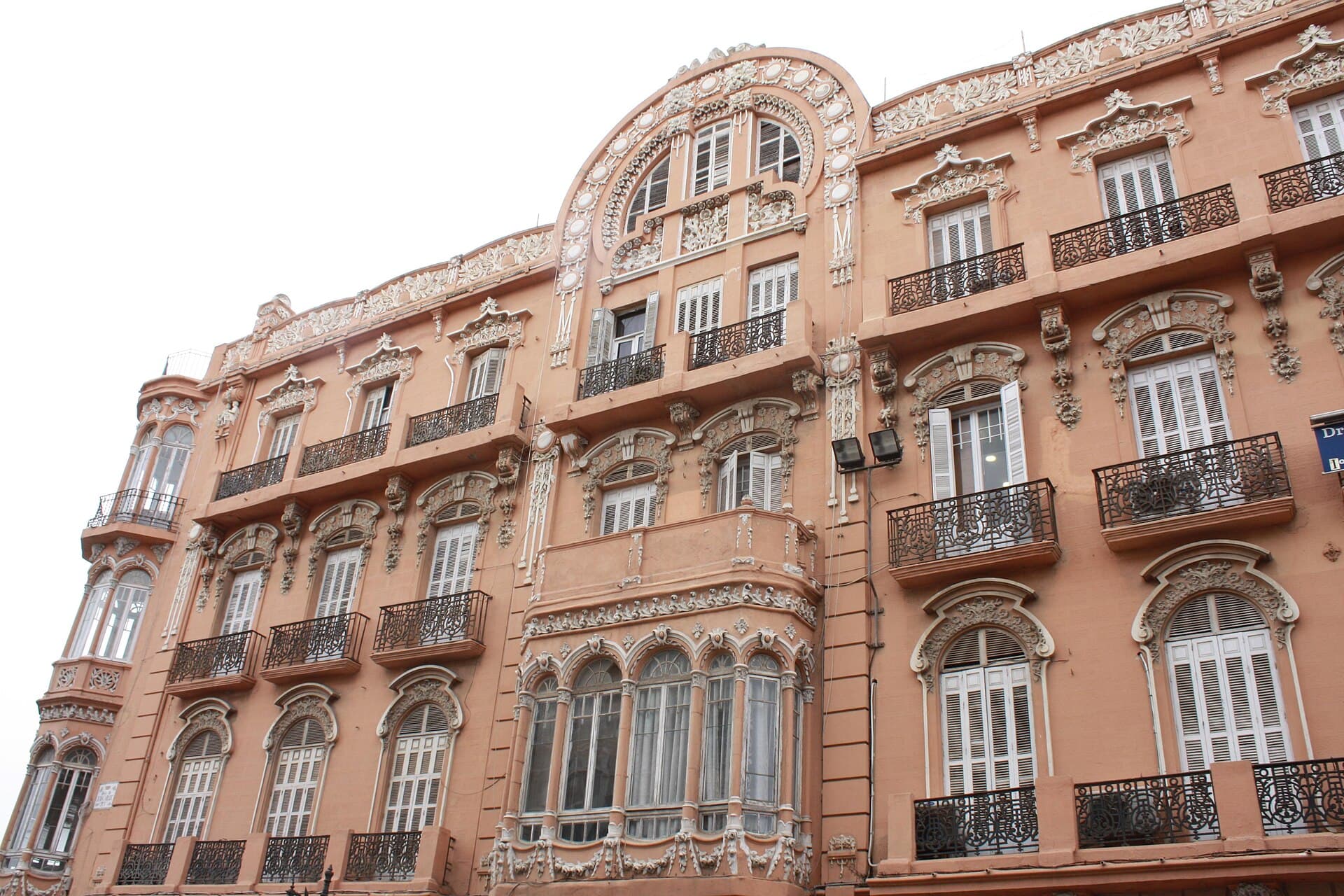
People who come to Melilla expecting a garrison town find one, and then find something they were not told about. Behind the fortress on the promontory, the streets of the early twentieth-century extension are lined with facades of floral stucco, curved gables, stained glass and wrought iron: Catalan modernisme, the style of Barcelona's Eixample, built on the North African coast from about 1910 into the 1950s. There are several hundred such buildings in a city of twelve square kilometres, and it is generally reckoned the largest concentration of the style in Spain after Barcelona itself.
Most of it came from one man. Enrique Nieto y Nieto trained in Barcelona, worked in Antoni Gaudí's studio on the Casa Milà, arrived in Melilla in 1909 as a young architect with no prospects at home, and spent forty-five years there, signing well over a thousand projects and eventually serving as the city's municipal architect. He designed the Palacio de la Asamblea, the Casino Militar, a synagogue, the main mosque and Catholic churches, which is to say that one Catalan modernista built the principal houses of worship for three of Melilla's four religious communities.
Melilla is an autonomous city of Spain on the North African coast, 12.3 square kilometres on the eastern flank of Cape Three Forks, facing the Mediterranean and bordered on its landward side by the Moroccan province of Nador (Britannica). Its population was 87,067 in 2025, divided chiefly between residents of Iberian and Riffian descent, with smaller Sephardi Jewish and Sindhi Hindu communities. Melilla was a municipality of the province of Málaga until its Statute of Autonomy passed in 1995, and it now has its own assembly and president. Like Ceuta it sits inside the Schengen area but outside the European Union customs union, and its port connects by ferry to Málaga, Motril and Almería.
The city's status is disputed, and the two governments describe it in incompatible terms. Melilla has been in Spanish hands since 1497, when it was taken directly by a force acting for the Duke of Medina Sidonia; Ceuta, 400 kilometres west, came to Spain in 1580 from Portugal. Morocco has regarded both as occupied enclaves since its independence in 1956, asked the United Nations in the 1970s to treat them as non-self-governing territories, which the UN declined to do, and keeps raising the matter with Madrid; its justice minister called it in 2026 a pending issue that remains on the table. Spain holds that the cities are integral Spanish territory whose inhabitants are Spanish citizens, notes that its possession predates the modern Moroccan state by centuries, and refuses to open negotiations; diplomatic sources told Euronews in August 2026 that Spain's territorial integrity "has never been and will never be discussed with anyone" (Euronews). Neither city appears on the UN list of non-self-governing territories, and no international court has ruled on the question (Al Jazeera).
Melilla la Vieja. The old town occupies a rocky promontory above the harbour and consists of four fortified enclosures, built and rebuilt between the sixteenth and nineteenth centuries and separated from one another by walls, ditches and gates. Inside are the Church of the Purísima Concepción, the Museum of Melilla, the military museum and the Conventico caves, a warren under the rock used since antiquity and later as a civilian refuge during sieges.
The Ensanche. The modernist extension south and west of the fortress grew after the boundary changes of 1860 and the mining boom that followed. Its densest part, the Golden Triangle around Avenida Juan Carlos I and the streets of Ejército Español and López Moreno, holds most of the city's 148 listed modernist buildings, among them Casa Melul, Casa Tortosa and Casa de los Cristales.
Plaza de España and the port. The circular square where the Ensanche meets the harbour is the city's civic centre, with the Palacio de la Asamblea on one side and Parque Hernández behind it.
The outer forts. Victoria Grande, Rostrogordo and their neighbours ring the city on the high ground, marking the eighteenth and nineteenth-century perimeter and offering the clearest views back to the promontory.
Phoenician seafarers established a trading post here called Rusadir, which continued under Carthage and then under Rome as Rusaddir. The place changed hands repeatedly through late antiquity and the Middle Ages, and by the end of the fifteenth century it lay ruined and largely abandoned after fighting between the kingdoms of Fez and Tlemcen. On 17 September 1497 a force under Pedro de Estopiñán, acting for Juan Alonso Pérez de Guzmán, third Duke of Medina Sidonia, occupied the site without resistance; for the next sixty years Melilla was held as a condominium between the ducal house and the Crown of Castile, passing wholly to the crown in 1556 (Britannica). For most of the early modern period it was a praesidium, a fortified garrison with a small civilian population, supplied by sea and periodically besieged, most seriously by the forces of Sultan Mohammed III in 1774 and 1775.
 Melilla la Vieja is the old fortress town on the rock. The modern city below it holds the second largest concentration of modernist architecture in Spain, after Barcelona. Photograph by AbdellahMJ93, CC BY-SA 4.0, via Wikimedia Commons.
The city Melilla is now dates from the Treaty of Wad Ras in 1860, which extended its limits to their present line. Iron ore was found in the eastern Rif, mining companies followed, the port was rebuilt and given free-zone status, and mainland Spaniards, Sephardi Jews from Morocco and Riffian workers arrived together to fill the new streets (Melilla). Population and money produced the Ensanche and the architecture that came with it.
The mines also produced a war. Riffian attacks on workers building a rail bridge near Melilla in July 1909 drew in Spanish reinforcements and cost more than a thousand casualties within weeks, and after the Treaty of Fez of 1912 made northern Morocco a Spanish protectorate, resistance in the Rif hardened around Abd el-Krim. On 22 July 1921 the Spanish position at Annual collapsed. Thousands of Spanish soldiers were killed in the retreat and at Monte Arruit, the Riffian advance reached the outskirts of Melilla, and the Disaster of Annual is still described as the worst defeat suffered by the modern Spanish army (Battle of Annual). The political crisis that followed brought down governments, produced the suppressed Picasso Report into military failure, contributed to the dictatorship of Primo de Rivera and ended with the abdication of Alfonso XIII a decade later.
What the Spanish army did next is documented and rarely commemorated. From 1921 and on a larger scale from 1923 to 1927, the Army of Africa dropped chemical weapons on the Rif, including mustard gas, in a campaign that historians describe as targeting civilian populations, markets and water sources as well as fighters. The agents were produced at a state factory at La Marañosa near Madrid, built with substantial help from the German chemist Hugo Stoltzenberg, and the operation was kept from the Spanish public; the historian Sebastian Balfour set out the documentary record in Deadly Embrace in 2002, and it is generally treated as the first widespread use of chemical warfare after the First World War (Spanish use of chemical weapons in the Rif War). Spanish governments have not formally acknowledged the campaign, and Riffian associations and Moroccan parliamentarians have repeatedly asked them to.
Melilla appears once more at a hinge of Spanish history. On 17 July 1936 the military rising against the Republic began here, spreading to Ceuta and Tetuán that evening and to the peninsula the next day.
The name is older than any of the powers that have held the city. Rusadir gave way to forms built on an Amazigh root usually connected with the word for white, which produced the Tarifit name Mřič and the Spanish Melilla. Locals will tell you the sense is "the white one", for the limestone.
Spanish is the official language and the language of administration and schooling. Beside it, Tarifit, the Zenati Berber language of the Rif spoken by around 1.2 million people in the Moroccan provinces of Nador, Al Hoceima, Driouch and Berkane, is the second language of the city and the mother tongue of much of its Muslim population (Tarifit). The relationship between the two is a diglossia: Spanish carries the official and written functions, Tarifit the domestic and community ones, and it has no co-official status, no place in the classroom and no settled orthography in Melilla, which is why proposals to recognise it have been argued in the city assembly for years. Haketía, the Judeo-Spanish of northern Morocco, is still heard among older members of the Jewish community, and Sindhi among Hindu families.
Melilla, like Ceuta, calls itself a city of four cultures, and the phrase is worth unpacking here because the proportions differ. Roughly half the population is Muslim and mostly Amazigh, of Riffian origin and often with close family across the border; the Christian half descends largely from mainland Spanish settlers of the mining decades; the Jewish community, once several thousand strong and central to the city's commercial life, now numbers in the hundreds; the Hindu community is small.
The civic calendar reflects the mix. The Day of Melilla falls on 17 September, the anniversary of 1497, and since 2010 Melilla and Ceuta have kept Eid al-Adha as an official public holiday, the first non-Christian religious festival given that standing in modern Spain. The architecture has become the city's other identity card. Melilla promotes itself on the modernisme, publishes routes through it, and lights the facades at night, which for a place better known abroad for its frontier is a deliberate act of self-description.
The Church of the Purísima Concepción, inside the first enclosure of the old fortress, is the oldest church in the city and holds the image of Our Lady of Victory, the patron. Down in the Ensanche the pattern changes, because the buildings of three faiths came from the same drawing board. Nieto drew the Or Zaruah synagogue in 1924, set within the Casa de Yamín Benarroch on Calle López Moreno, a neo-Arabic building that carries both a family home and the main Jewish house of worship in the city (Casa de Yamín Benarroch). In the mid-1940s he designed the Central Mosque on Calle García Cabrelles, the congregational mosque of Melilla, in a language of medieval Islamic reference (Mezquita Central). He also worked for the Catholic Church in the city, and there is a Hindu temple serving the Sindhi families.
That one architect could be trusted with a synagogue, a mosque and Catholic commissions in the same small city says something about how Melilla's communities lived alongside each other in the first half of the twentieth century. Whether they mixed is a different question, and in marriage, schooling and burial they have largely kept to their own.
Melilla buries its dead in separate grounds on the same hillside. The municipal cemetery of the Purísima Concepción, on the northern edge of the city near the fort of the same name, is the Catholic burial ground; the Islamic cemetery of Sidi Guariach lies close by, with graves aligned toward Mecca and burial performed within a day, the body washed and shrouded by family members rather than placed in a coffin; the Jewish cemetery is maintained by the community's burial society. Catholic families keep All Saints on 1 November, Muslim families visit before the two Eids, and the three cemeteries are within a short walk of one another.
Holy Week is the largest public act of remembrance in the Christian calendar here, and its most particular feature is where it happens: several brotherhoods process inside Melilla la Vieja, through the enclosures and out under the gates, so that the images pass along walls built to withstand siege.
The Rif War is the other memory, and it is unfinished. The dead of Annual and Monte Arruit are commemorated at monuments in the city, and Melilla is full of streets, barracks and plaques named for the campaigns in Africa. The clearest recent illustration is the bronze statue of Francisco Franco that stood in the city from 1978, put up to mark his command of the Spanish Legion in the Rif and left standing on the argument that it showed him before the Civil War and the dictatorship. Melilla's assembly voted to remove it under Spain's historical memory legislation, and it came down on 23 February 2021, at which point the city government noted it had been the last public statue of Franco anywhere in Spain (BBC News). On the other side of the border, associations in the Rif continue to ask for acknowledgement of the gas campaign, and for the dead of that war to be counted.
Melilla has been Spanish since 1497, longer than Spain has been in the Americas, and its records reflect a garrison town that became a city.
Parish registers and municipal records run from the early modern period, held locally and in the Spanish national archives, with the military series documenting a fortress that was besieged repeatedly by its hinterland.
The city grew fastest between 1860 and 1930, and its modernist architecture, the second largest such collection in Spain after Barcelona, dates from that boom. That growth was fed by immigration from Andalusia and from the Rif, and by the mining concessions in Moroccan territory that Spain worked from Melilla.
The Rif War is in the archive. The disaster at Annual in 1921, in which Spanish forces were routed with the loss of somewhere over ten thousand men, was investigated in the Picasso file, which named officers and units and became one of the political scandals that ended the Restoration monarchy. The dead of that campaign are documented in military records and the cemetery here.
The Jewish community, which arrived largely from Morocco in the nineteenth century, kept its own registers and cemetery; the Amazigh Muslim population, a large share of the city, gained Spanish nationality mainly in the 1980s, and the documentation of that process is the founding paperwork for many Melillan families.
The border with Nador is the modern record, and it is made by others about people trying to cross it.
The whole of Melilla la Vieja and much of the Ensanche are protected as a Conjunto Histórico, Spain's designation for a historic urban ensemble, with 148 modernist buildings individually listed. The fortress has been under systematic restoration since the late 1990s, managed by the Fundación Melilla Ciudad Monumental, a public body set up to conserve, research and interpret the city's monumental heritage; its work has recovered enclosures, gates, cisterns and the Conventico caves and returned much of the promontory to public use (Melilla Monumental).
The Museum of Melilla, formally the Museum of History, Archaeology and Ethnography, occupies the Almacén de las Peñuelas, an eighteenth-century warehouse inside the first enclosure, and holds the Rusadir material together with the medieval and modern collections (Museo de Melilla). The modernist route, published by the city and by Spain's national tourism body, is the other half of the preservation effort, since the buildings on it are mostly private homes and shops whose survival depends on owners maintaining stucco and ironwork that are expensive to repair (spain.info).
For a city this size the online record is respectable and getting better. The Fundación Melilla Ciudad Monumental publishes its museums, restoration reports and interpretive material through its own portal, which is the single best starting point for the fortress. The city had its own press early: El Telegrama del Rif, founded in 1902, is one of the main printed records of the mining decades and the Rif War (El Telegrama del Rif), and Spanish papers of those years can be read in the national library's Hemeroteca Digital (Hemeroteca Digital). Military and colonial records touching Melilla, including material from the protectorate years, are catalogued through the state archive portal PARES (PARES). Families tracing Sephardi lines find the Melilla registers connect outward to Tetuán, Nador, Oran, Gibraltar and Israel within two generations, which is a fair description of how that community moved.
Melilla's economy has been reshaped twice in a decade by decisions taken across the border. Morocco closed the commercial customs post at Beni Ansar in August 2018, ending the legal channel for goods and leaving the city's trade dependent on the informal carriage of bales through the passenger crossing, which in turn was ended and then interrupted by the pandemic closure of 2020. A roadmap agreed by Madrid and Rabat brought the customs post back into use on 27 January 2023, the same day a customs post opened in Ceuta for the first time (Spanish Ministry of Foreign Affairs).
The frontier itself is a fenced perimeter of some twelve kilometres, and on 24 June 2022 around 2,000 people attempted to cross it at the Barrio Chino post near Nador. At least 23 people died, according to Moroccan authorities, in a crowd surge and the response to it; the Moroccan Association for Human Rights in Nador recorded at least 27 dead and more than 70 still missing. Morocco's National Human Rights Council published preliminary findings in July 2022 that broadly followed the authorities' account, and Spain's ombudsman concluded that the risk that day had been foreseeable; both Human Rights Watch and a BBC Africa Eye investigation broadcast that November said the investigations were inadequate and that neither state's forces had been held to account (Human Rights Watch). For residents, the border is mostly a matter of work permits, family visits and the price of vegetables, and Melilla's own unemployment rate is among the highest in Spain.
A style saved by inventory. Melilla identified and listed 148 modernist buildings, published routes through them and made the architecture a matter of civic pride rather than a curiosity, which is why so much of it survives in use.
A fortress brought back. Twenty-five years of work by the Fundación Melilla Ciudad Monumental have recovered the enclosures, gates and caves of Melilla la Vieja and reopened the promontory to the city.
Rusadir under one roof. The Museum of Melilla gathers the Phoenician and Roman material with the medieval and modern collections in an eighteenth-century warehouse inside the walls.
A statue taken down by vote. The last public statue of Franco in Spain stood in Melilla until the city's own assembly voted to remove it in February 2021.
Melilla la Vieja is the old fortress town on the rock. The modern city below it holds the second largest concentration of modernist architecture in Spain, after Barcelona. Photograph by AbdellahMJ93, CC BY-SA 4.0, via Wikimedia Commons.
The city Melilla is now dates from the Treaty of Wad Ras in 1860, which extended its limits to their present line. Iron ore was found in the eastern Rif, mining companies followed, the port was rebuilt and given free-zone status, and mainland Spaniards, Sephardi Jews from Morocco and Riffian workers arrived together to fill the new streets (Melilla). Population and money produced the Ensanche and the architecture that came with it.
The mines also produced a war. Riffian attacks on workers building a rail bridge near Melilla in July 1909 drew in Spanish reinforcements and cost more than a thousand casualties within weeks, and after the Treaty of Fez of 1912 made northern Morocco a Spanish protectorate, resistance in the Rif hardened around Abd el-Krim. On 22 July 1921 the Spanish position at Annual collapsed. Thousands of Spanish soldiers were killed in the retreat and at Monte Arruit, the Riffian advance reached the outskirts of Melilla, and the Disaster of Annual is still described as the worst defeat suffered by the modern Spanish army (Battle of Annual). The political crisis that followed brought down governments, produced the suppressed Picasso Report into military failure, contributed to the dictatorship of Primo de Rivera and ended with the abdication of Alfonso XIII a decade later.
What the Spanish army did next is documented and rarely commemorated. From 1921 and on a larger scale from 1923 to 1927, the Army of Africa dropped chemical weapons on the Rif, including mustard gas, in a campaign that historians describe as targeting civilian populations, markets and water sources as well as fighters. The agents were produced at a state factory at La Marañosa near Madrid, built with substantial help from the German chemist Hugo Stoltzenberg, and the operation was kept from the Spanish public; the historian Sebastian Balfour set out the documentary record in Deadly Embrace in 2002, and it is generally treated as the first widespread use of chemical warfare after the First World War (Spanish use of chemical weapons in the Rif War). Spanish governments have not formally acknowledged the campaign, and Riffian associations and Moroccan parliamentarians have repeatedly asked them to.
Melilla appears once more at a hinge of Spanish history. On 17 July 1936 the military rising against the Republic began here, spreading to Ceuta and Tetuán that evening and to the peninsula the next day.
The name is older than any of the powers that have held the city. Rusadir gave way to forms built on an Amazigh root usually connected with the word for white, which produced the Tarifit name Mřič and the Spanish Melilla. Locals will tell you the sense is "the white one", for the limestone.
Spanish is the official language and the language of administration and schooling. Beside it, Tarifit, the Zenati Berber language of the Rif spoken by around 1.2 million people in the Moroccan provinces of Nador, Al Hoceima, Driouch and Berkane, is the second language of the city and the mother tongue of much of its Muslim population (Tarifit). The relationship between the two is a diglossia: Spanish carries the official and written functions, Tarifit the domestic and community ones, and it has no co-official status, no place in the classroom and no settled orthography in Melilla, which is why proposals to recognise it have been argued in the city assembly for years. Haketía, the Judeo-Spanish of northern Morocco, is still heard among older members of the Jewish community, and Sindhi among Hindu families.
Melilla, like Ceuta, calls itself a city of four cultures, and the phrase is worth unpacking here because the proportions differ. Roughly half the population is Muslim and mostly Amazigh, of Riffian origin and often with close family across the border; the Christian half descends largely from mainland Spanish settlers of the mining decades; the Jewish community, once several thousand strong and central to the city's commercial life, now numbers in the hundreds; the Hindu community is small.
The civic calendar reflects the mix. The Day of Melilla falls on 17 September, the anniversary of 1497, and since 2010 Melilla and Ceuta have kept Eid al-Adha as an official public holiday, the first non-Christian religious festival given that standing in modern Spain. The architecture has become the city's other identity card. Melilla promotes itself on the modernisme, publishes routes through it, and lights the facades at night, which for a place better known abroad for its frontier is a deliberate act of self-description.
The Church of the Purísima Concepción, inside the first enclosure of the old fortress, is the oldest church in the city and holds the image of Our Lady of Victory, the patron. Down in the Ensanche the pattern changes, because the buildings of three faiths came from the same drawing board. Nieto drew the Or Zaruah synagogue in 1924, set within the Casa de Yamín Benarroch on Calle López Moreno, a neo-Arabic building that carries both a family home and the main Jewish house of worship in the city (Casa de Yamín Benarroch). In the mid-1940s he designed the Central Mosque on Calle García Cabrelles, the congregational mosque of Melilla, in a language of medieval Islamic reference (Mezquita Central). He also worked for the Catholic Church in the city, and there is a Hindu temple serving the Sindhi families.
That one architect could be trusted with a synagogue, a mosque and Catholic commissions in the same small city says something about how Melilla's communities lived alongside each other in the first half of the twentieth century. Whether they mixed is a different question, and in marriage, schooling and burial they have largely kept to their own.
Melilla buries its dead in separate grounds on the same hillside. The municipal cemetery of the Purísima Concepción, on the northern edge of the city near the fort of the same name, is the Catholic burial ground; the Islamic cemetery of Sidi Guariach lies close by, with graves aligned toward Mecca and burial performed within a day, the body washed and shrouded by family members rather than placed in a coffin; the Jewish cemetery is maintained by the community's burial society. Catholic families keep All Saints on 1 November, Muslim families visit before the two Eids, and the three cemeteries are within a short walk of one another.
Holy Week is the largest public act of remembrance in the Christian calendar here, and its most particular feature is where it happens: several brotherhoods process inside Melilla la Vieja, through the enclosures and out under the gates, so that the images pass along walls built to withstand siege.
The Rif War is the other memory, and it is unfinished. The dead of Annual and Monte Arruit are commemorated at monuments in the city, and Melilla is full of streets, barracks and plaques named for the campaigns in Africa. The clearest recent illustration is the bronze statue of Francisco Franco that stood in the city from 1978, put up to mark his command of the Spanish Legion in the Rif and left standing on the argument that it showed him before the Civil War and the dictatorship. Melilla's assembly voted to remove it under Spain's historical memory legislation, and it came down on 23 February 2021, at which point the city government noted it had been the last public statue of Franco anywhere in Spain (BBC News). On the other side of the border, associations in the Rif continue to ask for acknowledgement of the gas campaign, and for the dead of that war to be counted.
Melilla has been Spanish since 1497, longer than Spain has been in the Americas, and its records reflect a garrison town that became a city.
Parish registers and municipal records run from the early modern period, held locally and in the Spanish national archives, with the military series documenting a fortress that was besieged repeatedly by its hinterland.
The city grew fastest between 1860 and 1930, and its modernist architecture, the second largest such collection in Spain after Barcelona, dates from that boom. That growth was fed by immigration from Andalusia and from the Rif, and by the mining concessions in Moroccan territory that Spain worked from Melilla.
The Rif War is in the archive. The disaster at Annual in 1921, in which Spanish forces were routed with the loss of somewhere over ten thousand men, was investigated in the Picasso file, which named officers and units and became one of the political scandals that ended the Restoration monarchy. The dead of that campaign are documented in military records and the cemetery here.
The Jewish community, which arrived largely from Morocco in the nineteenth century, kept its own registers and cemetery; the Amazigh Muslim population, a large share of the city, gained Spanish nationality mainly in the 1980s, and the documentation of that process is the founding paperwork for many Melillan families.
The border with Nador is the modern record, and it is made by others about people trying to cross it.
The whole of Melilla la Vieja and much of the Ensanche are protected as a Conjunto Histórico, Spain's designation for a historic urban ensemble, with 148 modernist buildings individually listed. The fortress has been under systematic restoration since the late 1990s, managed by the Fundación Melilla Ciudad Monumental, a public body set up to conserve, research and interpret the city's monumental heritage; its work has recovered enclosures, gates, cisterns and the Conventico caves and returned much of the promontory to public use (Melilla Monumental).
The Museum of Melilla, formally the Museum of History, Archaeology and Ethnography, occupies the Almacén de las Peñuelas, an eighteenth-century warehouse inside the first enclosure, and holds the Rusadir material together with the medieval and modern collections (Museo de Melilla). The modernist route, published by the city and by Spain's national tourism body, is the other half of the preservation effort, since the buildings on it are mostly private homes and shops whose survival depends on owners maintaining stucco and ironwork that are expensive to repair (spain.info).
For a city this size the online record is respectable and getting better. The Fundación Melilla Ciudad Monumental publishes its museums, restoration reports and interpretive material through its own portal, which is the single best starting point for the fortress. The city had its own press early: El Telegrama del Rif, founded in 1902, is one of the main printed records of the mining decades and the Rif War (El Telegrama del Rif), and Spanish papers of those years can be read in the national library's Hemeroteca Digital (Hemeroteca Digital). Military and colonial records touching Melilla, including material from the protectorate years, are catalogued through the state archive portal PARES (PARES). Families tracing Sephardi lines find the Melilla registers connect outward to Tetuán, Nador, Oran, Gibraltar and Israel within two generations, which is a fair description of how that community moved.
Melilla's economy has been reshaped twice in a decade by decisions taken across the border. Morocco closed the commercial customs post at Beni Ansar in August 2018, ending the legal channel for goods and leaving the city's trade dependent on the informal carriage of bales through the passenger crossing, which in turn was ended and then interrupted by the pandemic closure of 2020. A roadmap agreed by Madrid and Rabat brought the customs post back into use on 27 January 2023, the same day a customs post opened in Ceuta for the first time (Spanish Ministry of Foreign Affairs).
The frontier itself is a fenced perimeter of some twelve kilometres, and on 24 June 2022 around 2,000 people attempted to cross it at the Barrio Chino post near Nador. At least 23 people died, according to Moroccan authorities, in a crowd surge and the response to it; the Moroccan Association for Human Rights in Nador recorded at least 27 dead and more than 70 still missing. Morocco's National Human Rights Council published preliminary findings in July 2022 that broadly followed the authorities' account, and Spain's ombudsman concluded that the risk that day had been foreseeable; both Human Rights Watch and a BBC Africa Eye investigation broadcast that November said the investigations were inadequate and that neither state's forces had been held to account (Human Rights Watch). For residents, the border is mostly a matter of work permits, family visits and the price of vegetables, and Melilla's own unemployment rate is among the highest in Spain.
A style saved by inventory. Melilla identified and listed 148 modernist buildings, published routes through them and made the architecture a matter of civic pride rather than a curiosity, which is why so much of it survives in use.
A fortress brought back. Twenty-five years of work by the Fundación Melilla Ciudad Monumental have recovered the enclosures, gates and caves of Melilla la Vieja and reopened the promontory to the city.
Rusadir under one roof. The Museum of Melilla gathers the Phoenician and Roman material with the medieval and modern collections in an eighteenth-century warehouse inside the walls.
A statue taken down by vote. The last public statue of Franco in Spain stood in Melilla until the city's own assembly voted to remove it in February 2021.
National Overview
Notable Cities
Historical Foundations
Linguistic and Etymological Roots
Cultural Identity
Religion and Spirituality
Remembrance and Mourning Traditions
Tracing a Family in Melilla
Heritage Preservation Efforts
Digital Heritage
Contemporary Cultural Influences
Success Stories
References and resources
- Encyclopaedia Britannica, Melilla: geography, the 1497 capture, government.
- Al Jazeera, why Europe's African border remains a flashpoint: the sovereignty positions and the UN status.
- Melilla, Wikipedia: Rusadir, the condominium, Wad Ras and demography.
- Melilla la Vieja, Wikipedia: the fortified enclosures and what they contain.
- Enrique Nieto, Wikipedia: training under Gaudí, the Melilla career.
- Battle of Annual, Wikipedia: 22 July 1921 and its political consequences.
- Rif War, Wikipedia: the 1909 fighting near Melilla to the surrender of Abd el-Krim.
- Spanish use of chemical weapons in the Rif War, Wikipedia: the campaign, its supply chain and the documentary record.
- Tarifit, Wikipedia: the Rifian language and its place in Melilla.
- Melilla Monumental: the foundation's museums, restoration and visitor information.
- Museo de Melilla, Spanish Wikipedia: the collection and the Almacén de las Peñuelas.
- Modernist routes in Melilla, spain.info: the buildings on the route and their architects.
- BBC News, Melilla removes the last Franco statue: the 1978 monument and the 2021 vote.
- Human Rights Watch, no justice for deaths at the Melilla border: the June 2022 deaths and the investigations.
- Spanish Ministry of Foreign Affairs, customs posts in Ceuta and Melilla: the 2023 reopening.