Heritage · Country
Ceuta Culture and Heritage
Ceuta sits on the African shore of the Strait of Gibraltar, fourteen kilometres from Europe, behind fortifications whose moat is deep enough to sail. This is a guide to its heritage: the Roman name that became Sabta, the Portuguese landing of 1415, and four religious communities sharing eighteen square kilometres.Written to last.
By Confinity Heritage Editorial · Updated 2026-08-17 · 8-minute readQuiet tools, kept out of the way.
Ceuta is a city built around a crossing. Fourteen kilometres of water separate it from the Spanish mainland, and for as long as anyone has written about this coast they have written about who was going across and in which direction: Phoenician traders working the shore, a Roman garrison town on the seven hills, the army that sailed north in 711 and did not come back, the Portuguese fleet that arrived from the opposite direction in August 1415. The peninsula of La Almina ends in Monte Hacho, which one long tradition names as the southern Pillar of Hercules, though Jebel Musa further west has an equally old claim on the title.
About 83,000 people live in eighteen and a half square kilometres of hill, harbour and beach: Catholic families whose ancestors came from Andalusia, Muslim families here since before the Portuguese came or arrived later from the Rif and the Jebala, a small Sephardi Jewish community, and Hindu families of Sindhi origin whose grandparents ran shops on the main street. The Royal Walls still cut the isthmus, the moat below them still fills with seawater, and the city buries its dead by four different customs.
Ceuta is an autonomous city of Spain on the North African coast, 18.5 square kilometres of ground at the eastern end of the Strait of Gibraltar, with a land border with Morocco on one side and the Mediterranean and Atlantic meeting off the other (Britannica). It was governed as an ordinary municipality of the province of Cádiz until its Statute of Autonomy passed in March 1995, and now has its own assembly and president. Spanish is the official language, roughly half the population is Muslim, and the economy runs on public employment, the port, the ferry to Algeciras and a tax regime that keeps Ceuta outside the EU customs union while inside the Schengen area.
The status of the city is disputed. Ceuta has been held by Spain since 1580, when it passed to the Spanish crown with Portugal at the Iberian Union and then chose to stay Spanish after Portugal broke away again in 1640; Melilla, 400 kilometres east along the same coast, was taken directly in 1497. Morocco regards both as occupied enclaves that should return to Moroccan sovereignty, petitioned the United Nations in the 1970s to place them on the list of non-self-governing territories, a request the UN did not grant, and says the question should be settled by dialogue. Spain treats them as integral Spanish territory whose inhabitants are Spanish citizens, points out that Spanish possession predates the modern Moroccan state by centuries, and declines to negotiate; diplomatic sources told Euronews in August 2026 that Spain's territorial integrity "has never been and will never be discussed with anyone" (Euronews). The international lawyer Jamie Trinidad, quoted by Al Jazeera, reads Morocco's case as a political claim rather than a legal one, and comparable in that respect to Spain's own claim to Gibraltar across the strait (Al Jazeera).
Plaza de África and the old town. The ceremonial square sits on the isthmus between two seas, with the cathedral on one side, the Sanctuary of Saint Mary of Africa on the other, and the Royal Walls a few minutes west. Beneath it lie the Byzantine, Islamic and Portuguese layers in sequence.
La Almina. The peninsula east of the isthmus holds most of the modern city: the port, the fish market, the shopping streets, the Hindu temple on Calle Echegaray and the Sidi Embarek mosque with the Muslim cemetery behind. It rises to Monte Hacho, crowned by a fortress that successive rulers rebuilt and by the hermitage of San Antonio.
The Medina quarter and Benzú. Northwest of the isthmus, on the ground of the old city, the medieval public baths and stretches of the Marinid walls sit inside a working residential neighbourhood. At the western end of the territory, the fishing village of Benzú looks across at Jebel Musa.
Phoenician traders settled the Almina peninsula, and the settlement continued under Carthage and then under Rome, which knew the place as Septem Fratres, "seven brothers", after the seven hills. Byzantine forces took the coast during Justinian's western campaigns and held it into the seventh century, after which Ceuta passed to the early caliphates, was destroyed in the Berber Revolt of the 740s, and was rebuilt in the ninth century by the Majkasa Ghomara (Britannica). In 711 an army under Tariq ibn Ziyad crossed from this coast into Iberia, an event that reshaped the peninsula for eight centuries and began, according to the chroniclers, with the local governor deciding not to stop it.
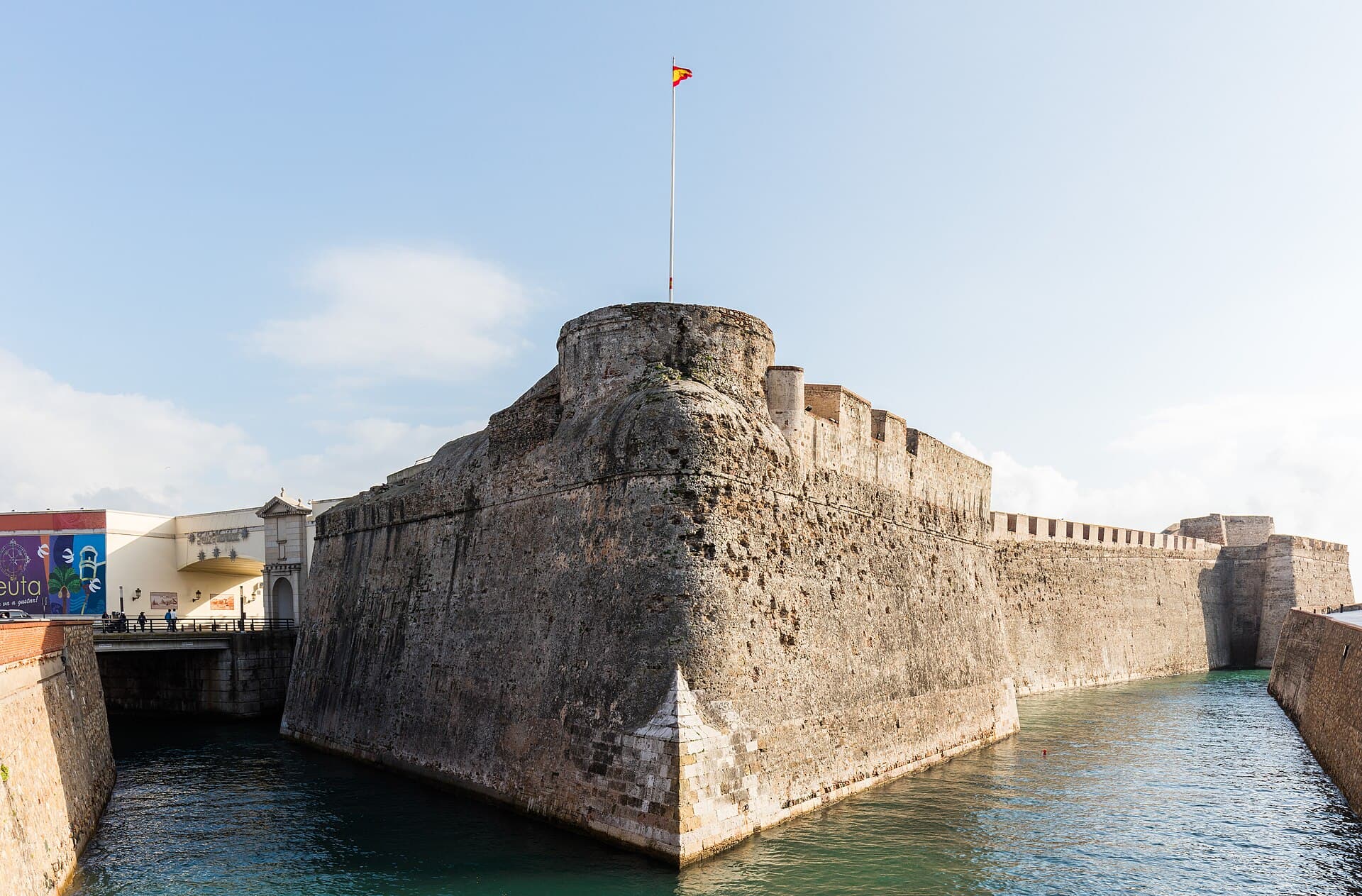
 The Royal Walls carry a moat that ships can enter, one of very few in the world, built up by successive Portuguese and Spanish engineers on Byzantine and Islamic foundations. Photograph by Diego Delso, CC BY-SA 4.0, via Wikimedia Commons.
Medieval Ceuta was a port worth fighting for, and the powers on both sides of the water fought for it through the long contest Spanish historians call the Battle of the Strait. It was also a place of learning. The jurist Qadi Iyad, born here in 1083 and still widely read in the Maliki school, was known as al-Sabti, "the man from Sabta", and so was the geographer Muhammad al-Idrisi, born in Ceuta around 1100, who made the Tabula Rogeriana for Roger II of Sicily (Britannica).
On 21 August 1415 a Portuguese fleet under King John I took the city from the Marinid Sultanate after a carefully prepared attack, and the king knighted his three sons in the captured city, among them the prince later known as Henry the Navigator (Portuguese conquest of Ceuta). The date matters well beyond Ceuta. Historians generally read the capture as the first act of Portuguese overseas expansion and the opening of European colonial empire, the point from which the voyages down the African coast and eventually to India and Brazil follow. Portugal held the city through a Marinid attempt to retake it in 1419, and held it for 165 years.
What made Ceuta Spanish rather than Portuguese was a succession crisis. Philip II took the Portuguese crown in 1580, and for sixty years the two kingdoms shared a monarch; when Portugal restored its own dynasty in 1640, Ceuta declined to follow and swore loyalty to Spain, a choice Portugal formally recognised in the Treaty of Lisbon of 1668. Moroccan forces under Moulay Ismail then blockaded the city from October 1694, and the blockade and its sequel ran, with one interruption, until April 1727, a span usually described as the longest siege in recorded history (Wikipedia). The Royal Walls took their final shape in those decades, and the city lost most of its remaining Portuguese character.
The boundaries Ceuta has today were fixed by the Treaty of Wad Ras in 1860, after a war between Spain and Morocco. In July 1936 the military rising against the Spanish Republic began in Melilla on the seventeenth and reached Ceuta the same evening; the city fell to the rebels at once, and its harbour became a point from which the Army of Africa was ferried to the peninsula.
The name travelled through three languages without ever losing its shape. Latin Septem Fratres shortened to Septem, which Arabic speakers rendered as Sabta, and Sabta came into Castilian as Ceuta; Moroccans still call the city Sebta today. The seven hills that Rome counted are still there, and the city's Arabic and Spanish names are the same word two thousand years apart.
Spanish is the sole official language and the language of the courts, schools and administration. Alongside it, roughly forty per cent of the population speaks Ceuta Arabic, the local variety of Moroccan Arabic that everyone calls Darija, and which is the first language of close to two thirds of Muslim residents. It shares its features with the Jebala dialects of the nearby Moroccan hills, carries a heavy load of Spanish borrowings, and is spoken with constant code-switching into Spanish in the same sentence. It has been in Ceuta since at least the mid-eighteenth century, it has no written standard, and it has no place in schooling or in official business, which is why linguists describe its position as a marginalised one and expect the number of first-language speakers to fall (Ceuta Arabic). Two smaller inherited languages sit behind household doors: Haketía, the Judeo-Spanish of northern Morocco, among older members of the Jewish families, and Sindhi among the Hindu ones.
Ceuta describes itself, in its tourism material and its school curriculum alike, as a city of four cultures. The phrase is civic policy as much as description, and worth being precise about: a Christian majority of mainland Spanish descent, a Muslim population of comparable size, a Jewish community numbering in the hundreds, and a Hindu community of a few dozen families, sharing a small territory, separate places of worship and burial, and a set of public holidays no other Spanish city keeps.
The civic calendar is unusually specific. The Day of Ceuta falls on 2 September, marking the day in 1415 when Pedro de Meneses was installed as the city's first governor, and the patronal feast of Our Lady of Africa falls on 5 August, when the image is carried through the streets. Since 2010 Ceuta and Melilla have also kept Eid al-Adha as an official public holiday, the first non-Christian religious festival given that standing anywhere in modern Spain. The kitchen carries the same mixture, with Andalusian frying and Moroccan tagines on the same menus.
The Cathedral of Saint Mary of the Assumption occupies a site that has been sacred for at least fifteen centuries. A Byzantine church stood here, some researchers connecting it with a foundation of Justinian; the Great Mosque of Ceuta replaced it and was described by medieval writers as a building of great richness; the Portuguese converted the mosque into a church after 1415; and when war and time had ruined that building, a new church designed by Juan de Ochoa was begun in 1686 and consecrated in 1726 (Ceuta Cathedral). Across the square, the Sanctuary of Saint Mary of Africa keeps the image that Prince Henry sent to Ceuta in 1421 with instructions that it be venerated there. Pius XII confirmed Our Lady of Africa as the city's patron in 1949 (Santuario de Santa María de África).
Islam is the faith of about half the population, and the Sidi Embarek mosque on La Almina, beside the Muslim cemetery, is the best known of the city's mosques. The Jewish community, Sephardi and long connected to Tetuán and Tangier, worships at the Bet-El synagogue, built in the 1970s to replace an older one. The Hindu temple on Calle Echegaray, laid out according to the conventions of Hindu sacred architecture, serves a community that grew from Sindhi merchants who reached Ceuta by way of the trading networks of the strait, most of them arriving in the middle of the twentieth century (Hinduism in Spain).
Catholic mourning here follows the Andalusian pattern: a rosary at home, a funeral Mass, burial in the Christian cemetery, and a Mass said again a month later. Holy Week is when that memory becomes public, and the brotherhoods carry their images through the old town across several nights, passing within a few streets of a mosque, a synagogue and a Hindu temple without anyone finding it remarkable.
Muslim burial follows the practice of the wider Maghreb, and Ceuta has been able to keep it whole in a way that Muslim communities on the Spanish mainland often cannot. The body is washed and shrouded by family members of the same sex, prayed over, and buried without a coffin within a day where possible, in the Muslim cemetery beside the Sidi Embarek mosque, where graves are aligned toward Mecca and marked simply. Families visit on the Fridays before the two Eids. The Jewish community keeps its own burial ground and its own chevra kadisha, and observes shiva and the year of mourning that follows.
Then there is the memory nobody agrees on. The rising of July 1936 began in the Spanish Protectorate, Ceuta was among the first places the rebels held, and thousands of men left this port to fight in a war that killed the Republic. Under Spain's Historical Memory Law of 2007 and the Democratic Memory Law of 2022, Francoist symbols have been coming down across the country, and disputes over which street names and monuments in Ceuta fall under those laws have run for years in the city assembly, between neighbours whose families were on both sides.
Ceuta's records are the record of a city that has changed hands and religions and stayed in the same place.
The city was Muslim, then Portuguese from 1415, then Spanish from 1668, and it has been Spanish ever since, which makes it the oldest continuously held Spanish possession in Africa. Parish registers begin under Portuguese rule and continue under Spanish, and the municipal archive holds the administrative series, with older material in Lisbon and Simancas.
The garrison is the working record. Ceuta was a presidio, a fortress town, and for centuries a penal colony as well: convicts were sent here to labour on the fortifications, and their dossiers survive in the Spanish military and prison archives. Soldiers posted here left service records, and many families descend from men who came for a tour and stayed.
The city's population is roughly half Christian and half Muslim, with small Jewish and Hindu communities, and the Muslim population's records are the most complicated, because Spanish nationality was extended to many Ceutan Muslims only in the 1980s. Families who had lived in the city for generations had to document it, and the process left its own paper trail.
The frontier with Morocco is the modern archive. Ceuta is one of the European Union's two land borders with Africa, and the records made there now are made by border agencies about people trying to cross, which is a different kind of family history and an unfinished one.
The Royal Walls are the city's principal monument and its principal conservation project. The oldest fabric goes back to 962 and the newest to the eighteenth century, the line survives largely intact apart from some outworks, and it carries Spain's highest heritage designation as a Property of Cultural Interest (Royal Walls of Ceuta). The feature people remember is the Foso Real, the moat cut through the isthmus from sea to sea and filled with seawater, wide and deep enough that small boats work along it; navigable moats of this kind are rare anywhere in the Mediterranean. Restoration since the 1990s has consolidated the bastions and turned the ground beside the moat into public space.
The museums divide the work. The Museum of Ceuta, in the old military pavilion of the Revellín barracks, holds an archaeological collection covering the strait from antiquity to the early modern period (Museum of Ceuta). The permanent story is told at the Museum of the Late Roman Basilica, built around a fourth-century Christian basilica and its burials found during construction work and opened on 1 November 2006; the remains are the only Christian structure of that date known on this shore of the Mediterranean (spain.info). The medieval public baths at the edge of the old Medina quarter, in use from the eleventh century, were excavated in 2000 and 2004, recovering the sequence of changing room, cold room and hot room (Arab Baths, Ceuta).
Ceuta's documentary record is split across three national traditions, and its digitisation follows the same split. Spanish material sits in the state archive portal PARES (PARES); Portuguese material on 1415 and the century and a half after it sits in Lisbon; Arabic sources on Sabta sit elsewhere again. The Instituto de Estudios Ceutíes has put much of its back catalogue online, and that is where local scholarship now begins. Historic Spanish newspapers covering the strait, the protectorate and the garrison are searchable in the national library's Hemeroteca Digital (Hemeroteca Digital). For families, the practical archives are the cathedral's parish registers, the military records of a garrison town, and the memories of people who moved freely between Ceuta and Tetuán.
Ceuta's border has changed shape three times in seven years, and each change altered how residents live. Until 2019 a large informal trade crossed at Tarajal, carried on the backs of porters, most of them women, who walked bales of goods through the frontier so that they entered Morocco as personal luggage rather than as imports. Morocco ended that trade on 9 October 2019, and thousands of livelihoods on both sides went with it. The frontier then closed altogether in March 2020 for the pandemic and stayed shut for two years, reopening to travellers on 17 May 2022. On 27 January 2023 a commercial customs post operated in Ceuta for the first time in the city's history, part of a roadmap agreed between Madrid and Rabat (Spanish Ministry of Foreign Affairs).
The city has also twice seen large and sudden crossings. In May 2021, during a diplomatic rupture between Spain and Morocco over the hospital treatment in Spain of the Polisario Front leader Brahim Ghali, Moroccan border control eased and about 8,000 people entered Ceuta in two days, many by swimming around the Tarajal breakwater; a large share were minors, and most were returned within days. On 30 and 31 July 2026 a far larger crossing took place, which Spain's interior ministry put at close to 50,000 people, after a Supreme Court ruling of 29 June barring summary returns of people arriving by sea circulated widely on Moroccan social media. At least 67 died, by drowning or crushed at the breakwater; the ministry said more than 48,300 had returned to Morocco by the following evening, and Ceuta's president, Juan Jesús Vivas, described the city's reception centres as overwhelmed (TIME). Between such episodes the border is a daily commute, and thousands of Moroccans from the neighbouring province hold cross-border worker permits that Ceuta's shops depend on.
A fortification kept whole. The Royal Walls survive with their bastions, ravelins and seawater moat intact, protected at the highest level of Spanish heritage law and consolidated by three decades of restoration.
A fourth-century basilica saved from a building site. The late Roman basilica found during construction was excavated in place, roofed over and opened as a museum in 2006.
A language described at last. Ceuta Arabic, spoken by two thirds of the city's Muslim residents and absent from every official register, has lately acquired a scholarly literature of its own.
Four calendars in one city hall. In 2010 Ceuta and Melilla became the first places in modern Spain to give a non-Christian religious festival the standing of an official public holiday.
The Royal Walls carry a moat that ships can enter, one of very few in the world, built up by successive Portuguese and Spanish engineers on Byzantine and Islamic foundations. Photograph by Diego Delso, CC BY-SA 4.0, via Wikimedia Commons.
Medieval Ceuta was a port worth fighting for, and the powers on both sides of the water fought for it through the long contest Spanish historians call the Battle of the Strait. It was also a place of learning. The jurist Qadi Iyad, born here in 1083 and still widely read in the Maliki school, was known as al-Sabti, "the man from Sabta", and so was the geographer Muhammad al-Idrisi, born in Ceuta around 1100, who made the Tabula Rogeriana for Roger II of Sicily (Britannica).
On 21 August 1415 a Portuguese fleet under King John I took the city from the Marinid Sultanate after a carefully prepared attack, and the king knighted his three sons in the captured city, among them the prince later known as Henry the Navigator (Portuguese conquest of Ceuta). The date matters well beyond Ceuta. Historians generally read the capture as the first act of Portuguese overseas expansion and the opening of European colonial empire, the point from which the voyages down the African coast and eventually to India and Brazil follow. Portugal held the city through a Marinid attempt to retake it in 1419, and held it for 165 years.
What made Ceuta Spanish rather than Portuguese was a succession crisis. Philip II took the Portuguese crown in 1580, and for sixty years the two kingdoms shared a monarch; when Portugal restored its own dynasty in 1640, Ceuta declined to follow and swore loyalty to Spain, a choice Portugal formally recognised in the Treaty of Lisbon of 1668. Moroccan forces under Moulay Ismail then blockaded the city from October 1694, and the blockade and its sequel ran, with one interruption, until April 1727, a span usually described as the longest siege in recorded history (Wikipedia). The Royal Walls took their final shape in those decades, and the city lost most of its remaining Portuguese character.
The boundaries Ceuta has today were fixed by the Treaty of Wad Ras in 1860, after a war between Spain and Morocco. In July 1936 the military rising against the Spanish Republic began in Melilla on the seventeenth and reached Ceuta the same evening; the city fell to the rebels at once, and its harbour became a point from which the Army of Africa was ferried to the peninsula.
The name travelled through three languages without ever losing its shape. Latin Septem Fratres shortened to Septem, which Arabic speakers rendered as Sabta, and Sabta came into Castilian as Ceuta; Moroccans still call the city Sebta today. The seven hills that Rome counted are still there, and the city's Arabic and Spanish names are the same word two thousand years apart.
Spanish is the sole official language and the language of the courts, schools and administration. Alongside it, roughly forty per cent of the population speaks Ceuta Arabic, the local variety of Moroccan Arabic that everyone calls Darija, and which is the first language of close to two thirds of Muslim residents. It shares its features with the Jebala dialects of the nearby Moroccan hills, carries a heavy load of Spanish borrowings, and is spoken with constant code-switching into Spanish in the same sentence. It has been in Ceuta since at least the mid-eighteenth century, it has no written standard, and it has no place in schooling or in official business, which is why linguists describe its position as a marginalised one and expect the number of first-language speakers to fall (Ceuta Arabic). Two smaller inherited languages sit behind household doors: Haketía, the Judeo-Spanish of northern Morocco, among older members of the Jewish families, and Sindhi among the Hindu ones.
Ceuta describes itself, in its tourism material and its school curriculum alike, as a city of four cultures. The phrase is civic policy as much as description, and worth being precise about: a Christian majority of mainland Spanish descent, a Muslim population of comparable size, a Jewish community numbering in the hundreds, and a Hindu community of a few dozen families, sharing a small territory, separate places of worship and burial, and a set of public holidays no other Spanish city keeps.
The civic calendar is unusually specific. The Day of Ceuta falls on 2 September, marking the day in 1415 when Pedro de Meneses was installed as the city's first governor, and the patronal feast of Our Lady of Africa falls on 5 August, when the image is carried through the streets. Since 2010 Ceuta and Melilla have also kept Eid al-Adha as an official public holiday, the first non-Christian religious festival given that standing anywhere in modern Spain. The kitchen carries the same mixture, with Andalusian frying and Moroccan tagines on the same menus.
The Cathedral of Saint Mary of the Assumption occupies a site that has been sacred for at least fifteen centuries. A Byzantine church stood here, some researchers connecting it with a foundation of Justinian; the Great Mosque of Ceuta replaced it and was described by medieval writers as a building of great richness; the Portuguese converted the mosque into a church after 1415; and when war and time had ruined that building, a new church designed by Juan de Ochoa was begun in 1686 and consecrated in 1726 (Ceuta Cathedral). Across the square, the Sanctuary of Saint Mary of Africa keeps the image that Prince Henry sent to Ceuta in 1421 with instructions that it be venerated there. Pius XII confirmed Our Lady of Africa as the city's patron in 1949 (Santuario de Santa María de África).
Islam is the faith of about half the population, and the Sidi Embarek mosque on La Almina, beside the Muslim cemetery, is the best known of the city's mosques. The Jewish community, Sephardi and long connected to Tetuán and Tangier, worships at the Bet-El synagogue, built in the 1970s to replace an older one. The Hindu temple on Calle Echegaray, laid out according to the conventions of Hindu sacred architecture, serves a community that grew from Sindhi merchants who reached Ceuta by way of the trading networks of the strait, most of them arriving in the middle of the twentieth century (Hinduism in Spain).
Catholic mourning here follows the Andalusian pattern: a rosary at home, a funeral Mass, burial in the Christian cemetery, and a Mass said again a month later. Holy Week is when that memory becomes public, and the brotherhoods carry their images through the old town across several nights, passing within a few streets of a mosque, a synagogue and a Hindu temple without anyone finding it remarkable.
Muslim burial follows the practice of the wider Maghreb, and Ceuta has been able to keep it whole in a way that Muslim communities on the Spanish mainland often cannot. The body is washed and shrouded by family members of the same sex, prayed over, and buried without a coffin within a day where possible, in the Muslim cemetery beside the Sidi Embarek mosque, where graves are aligned toward Mecca and marked simply. Families visit on the Fridays before the two Eids. The Jewish community keeps its own burial ground and its own chevra kadisha, and observes shiva and the year of mourning that follows.
Then there is the memory nobody agrees on. The rising of July 1936 began in the Spanish Protectorate, Ceuta was among the first places the rebels held, and thousands of men left this port to fight in a war that killed the Republic. Under Spain's Historical Memory Law of 2007 and the Democratic Memory Law of 2022, Francoist symbols have been coming down across the country, and disputes over which street names and monuments in Ceuta fall under those laws have run for years in the city assembly, between neighbours whose families were on both sides.
Ceuta's records are the record of a city that has changed hands and religions and stayed in the same place.
The city was Muslim, then Portuguese from 1415, then Spanish from 1668, and it has been Spanish ever since, which makes it the oldest continuously held Spanish possession in Africa. Parish registers begin under Portuguese rule and continue under Spanish, and the municipal archive holds the administrative series, with older material in Lisbon and Simancas.
The garrison is the working record. Ceuta was a presidio, a fortress town, and for centuries a penal colony as well: convicts were sent here to labour on the fortifications, and their dossiers survive in the Spanish military and prison archives. Soldiers posted here left service records, and many families descend from men who came for a tour and stayed.
The city's population is roughly half Christian and half Muslim, with small Jewish and Hindu communities, and the Muslim population's records are the most complicated, because Spanish nationality was extended to many Ceutan Muslims only in the 1980s. Families who had lived in the city for generations had to document it, and the process left its own paper trail.
The frontier with Morocco is the modern archive. Ceuta is one of the European Union's two land borders with Africa, and the records made there now are made by border agencies about people trying to cross, which is a different kind of family history and an unfinished one.
The Royal Walls are the city's principal monument and its principal conservation project. The oldest fabric goes back to 962 and the newest to the eighteenth century, the line survives largely intact apart from some outworks, and it carries Spain's highest heritage designation as a Property of Cultural Interest (Royal Walls of Ceuta). The feature people remember is the Foso Real, the moat cut through the isthmus from sea to sea and filled with seawater, wide and deep enough that small boats work along it; navigable moats of this kind are rare anywhere in the Mediterranean. Restoration since the 1990s has consolidated the bastions and turned the ground beside the moat into public space.
The museums divide the work. The Museum of Ceuta, in the old military pavilion of the Revellín barracks, holds an archaeological collection covering the strait from antiquity to the early modern period (Museum of Ceuta). The permanent story is told at the Museum of the Late Roman Basilica, built around a fourth-century Christian basilica and its burials found during construction work and opened on 1 November 2006; the remains are the only Christian structure of that date known on this shore of the Mediterranean (spain.info). The medieval public baths at the edge of the old Medina quarter, in use from the eleventh century, were excavated in 2000 and 2004, recovering the sequence of changing room, cold room and hot room (Arab Baths, Ceuta).
Ceuta's documentary record is split across three national traditions, and its digitisation follows the same split. Spanish material sits in the state archive portal PARES (PARES); Portuguese material on 1415 and the century and a half after it sits in Lisbon; Arabic sources on Sabta sit elsewhere again. The Instituto de Estudios Ceutíes has put much of its back catalogue online, and that is where local scholarship now begins. Historic Spanish newspapers covering the strait, the protectorate and the garrison are searchable in the national library's Hemeroteca Digital (Hemeroteca Digital). For families, the practical archives are the cathedral's parish registers, the military records of a garrison town, and the memories of people who moved freely between Ceuta and Tetuán.
Ceuta's border has changed shape three times in seven years, and each change altered how residents live. Until 2019 a large informal trade crossed at Tarajal, carried on the backs of porters, most of them women, who walked bales of goods through the frontier so that they entered Morocco as personal luggage rather than as imports. Morocco ended that trade on 9 October 2019, and thousands of livelihoods on both sides went with it. The frontier then closed altogether in March 2020 for the pandemic and stayed shut for two years, reopening to travellers on 17 May 2022. On 27 January 2023 a commercial customs post operated in Ceuta for the first time in the city's history, part of a roadmap agreed between Madrid and Rabat (Spanish Ministry of Foreign Affairs).
The city has also twice seen large and sudden crossings. In May 2021, during a diplomatic rupture between Spain and Morocco over the hospital treatment in Spain of the Polisario Front leader Brahim Ghali, Moroccan border control eased and about 8,000 people entered Ceuta in two days, many by swimming around the Tarajal breakwater; a large share were minors, and most were returned within days. On 30 and 31 July 2026 a far larger crossing took place, which Spain's interior ministry put at close to 50,000 people, after a Supreme Court ruling of 29 June barring summary returns of people arriving by sea circulated widely on Moroccan social media. At least 67 died, by drowning or crushed at the breakwater; the ministry said more than 48,300 had returned to Morocco by the following evening, and Ceuta's president, Juan Jesús Vivas, described the city's reception centres as overwhelmed (TIME). Between such episodes the border is a daily commute, and thousands of Moroccans from the neighbouring province hold cross-border worker permits that Ceuta's shops depend on.
A fortification kept whole. The Royal Walls survive with their bastions, ravelins and seawater moat intact, protected at the highest level of Spanish heritage law and consolidated by three decades of restoration.
A fourth-century basilica saved from a building site. The late Roman basilica found during construction was excavated in place, roofed over and opened as a museum in 2006.
A language described at last. Ceuta Arabic, spoken by two thirds of the city's Muslim residents and absent from every official register, has lately acquired a scholarly literature of its own.
Four calendars in one city hall. In 2010 Ceuta and Melilla became the first places in modern Spain to give a non-Christian religious festival the standing of an official public holiday.
National Overview
Notable Cities
Historical Foundations
Linguistic and Etymological Roots
Cultural Identity
Religion and Spirituality
Remembrance and Mourning Traditions
Tracing a Family in Ceuta
Heritage Preservation Efforts
Digital Heritage
Contemporary Cultural Influences
Success Stories
References and resources
- Encyclopaedia Britannica, Ceuta: geography and history.
- Ceuta, Wikipedia: Phoenician foundation, the 1580 and 1640 transitions.
- Portuguese conquest of Ceuta, Wikipedia: the attack of 21 August 1415.
- Sieges of Ceuta, Wikipedia: the blockade of 1694 to 1727.
- Royal Walls of Ceuta, Wikipedia: dates and protected status.
- Ceuta Cathedral, Wikipedia: the Byzantine church, the Great Mosque, the building of 1686 to 1726.
- Santuario de Santa María de África, Spanish Wikipedia: the image of 1421 and the patronage of 1949.
- Museum of the Late Roman Basilica, spain.info: the fourth-century remains and the 2006 opening.
- Arab Baths, Ceuta, Wikipedia: the medieval baths and their excavation.
- Ceuta Arabic, Wikipedia: speaker numbers and sociolinguistic position.
- Spanish Ministry of Foreign Affairs, customs posts in Ceuta and Melilla: the 2023 openings.
- Al Jazeera, why Spain has enclaves in North Africa: the competing sovereignty claims.
- TIME, explainer on the July 2026 Ceuta crossings: figures and official responses.