Heritage · Country
Zanzibar Culture and Heritage
A semi-autonomous archipelago with its own president, parliament and courts, whose capital is a UNESCO World Heritage Site built on the profits of cloves and of people. This guide follows Zanzibari heritage from the Swahili coast and the carved doors to the market site now under a cathedral floor.Written to last.
By Confinity Heritage Editorial · Updated 2026-08-17 · 8-minute readQuiet tools, kept out of the way.
The Anglican cathedral in Stone Town was built on the site of the slave market, and the men who built it meant that literally. Bishop Edward Steere laid the foundation stone at Christmas 1873, months after the market was closed, and the altar was placed where the whipping post is said to have stood. Beneath a building next door are the low chambers where people were held before sale, and in the churchyard five concrete figures stand chained in a pit, cut by the Swedish sculptor Clara Sörnäs in 1998.
Zanzibar is an archipelago of about 2,462 square kilometres off the coast of Tanzania, and it's one of the great crossroads of the Indian Ocean: a Swahili society, Muslim for a thousand years, shaped by Oman, Persia, Gujarat, the African mainland and Britain in turn. It's also a place whose wealth came from cloves and from the largest slave trade in East Africa, and whose modern politics begin with a revolution nobody has finished counting.
Most readers assume Zanzibar is simply part of Tanzania. The position is more particular. Zanzibar and mainland Tanganyika joined on 26 April 1964 to form what became the United Republic of Tanzania, and the articles of that union reserved a listed set of union matters, among them defence, foreign affairs and citizenship, to the union government while leaving everything else to Zanzibar. So the islands keep a president of their own, elected separately, currently Hussein Mwinyi since November 2020; a House of Representatives of 81 members; a Revolutionary Council; their own courts for non-union matters, and their own budget and flag. A 2010 referendum approved by about 66 per cent created a government of national unity in which the runner-up party takes the first vice-presidency (Wikipedia). How much sovereignty this amounts to is itself argued about on the islands and on the mainland.
Two main islands carry almost everyone. Unguja, which outsiders usually call Zanzibar, holds the capital and about two-thirds of the population; Pemba, greener, hillier and more agricultural, holds most of the rest and grows the larger share of the cloves. The 2022 census counted 1,889,773 residents in all. About 98 per cent are Muslim, overwhelmingly Sunni of the Shafi'i school, with long-established Ibadi, Ismaili, Hindu and Christian minorities.
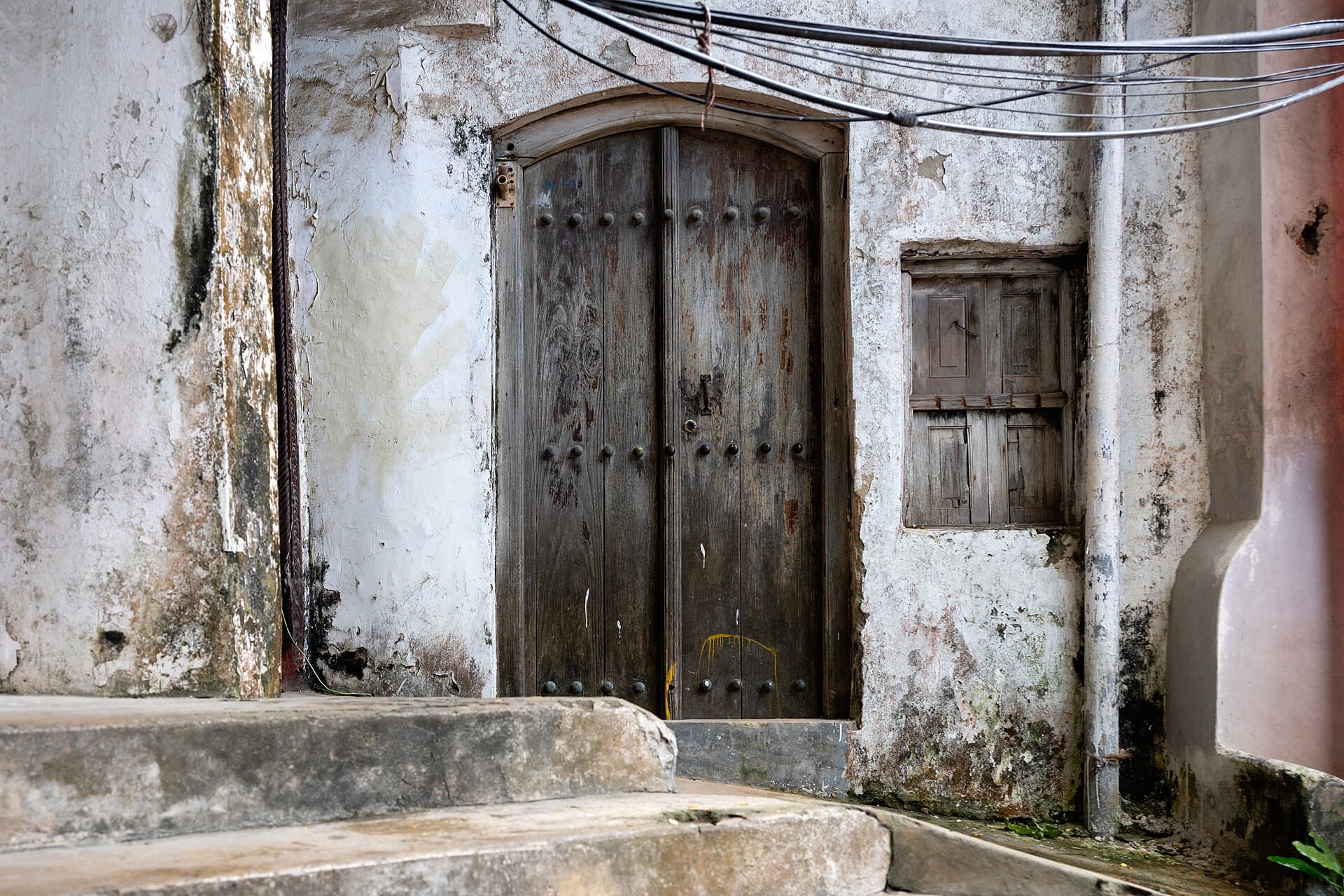
Stone Town. The historic core of Zanzibar City was inscribed on the World Heritage List in 2000 under criteria (ii), (iii) and (vi), the last of them citing the archipelago's symbolic importance in the suppression of slavery, since it was both a principal slave-trading port and the base from which the abolitionists worked (UNESCO). It's built of coral rag quarried from the reef and set in lime mortar, plastered white, with shuttered upper storeys, carved balconies and stone benches, the baraza, running along the street fronts where men still sit in the evening. Its doors are the town's signature: heavy frames of teak or local hardwood, carved with lotus, chain and fish motifs, some studded with brass bosses in a Gujarati fashion that had everything to do with prestige.
The seafront. The Old Fort, raised by the Omanis around 1699 on the ruins of a Portuguese chapel, stands beside the House of Wonders, Beit al-Ajaib, completed in 1883 for Sultan Barghash and the first building in Zanzibar with electric light and the first in East Africa with a lift. Next along are the Palace Museum and the Old Dispensary, and behind them the lanes of Kiponda and Shangani.
Chake Chake and the Pemba sites. Pemba's main town sits above a creek, and the island keeps the deepest Swahili archaeology: Ras Mkumbuu with its tenth-century mosque and pillar tombs, the mosque and tombs at Chwaka, and the earthworks of Pujini.
Kizimkazi. At the southern tip of Unguja stands a mosque with a Kufic inscription dated 1107, the oldest known Islamic inscription in East Africa, in a building still used for prayer though largely rebuilt in the eighteenth century (Wikipedia).
Zanzibar belongs to the Swahili coast, the chain of Muslim trading towns from Somalia to Mozambique whose people spoke a Bantu language, built in coral and lime, and traded across the monsoon system with Arabia, India and China. Many coastal families claim descent from Shirazi settlers said to have come from Persia; historians generally read the Shirazi tradition as a local idiom of Islamic legitimacy grown up on the coast rather than a record of literal migration, and the argument has not entirely closed.
 The Omanis built the fort in the 1690s on the site of a Portuguese church, and the slave market that made Stone Town rich stood a short walk from it. Photograph by Erasmus Kamugisha, CC BY-SA 4.0, via Wikimedia Commons.
The Portuguese held the coast from about 1500 until Omani forces drove them from Mombasa in 1698. Oman then governed Zanzibar at a distance until Sayyid Said bin Sultan made it the centre of his realm, moving his court from Muscat and settling there permanently by 1840. He built the clove economy that followed: from 1828 landowners were required to plant cloves, and the plantations of Unguja and Pemba made the islands the world's leading producer for over a century.
That economy ran on enslaved labour. Zanzibar became the principal entrepôt of the East African and Indian Ocean slave trade, drawing captives from caravan routes reaching as far as Lake Tanganyika and selling them into the islands' own plantations and onward to Arabia, Persia and the Mascarenes. By the 1850s something like two-thirds of the archipelago's own population was enslaved, and imports were still running at thousands a month in the 1870s (Wikipedia). Britain closed the trade in stages by treaty: Moresby in 1822, Hamerton in 1845, and the Frere Treaty of 1873, which shut the Stone Town market outright. Abolition itself came slowly. A decree of 1897 removed slavery's legal status, and concubinage, which held many women in bondage after the rest of the system was dismantled, was not covered until 1909.
Britain declared a protectorate in 1890, and on 27 August 1896 Royal Navy ships settled a disputed succession by shelling the palace, in an exchange lasting under forty minutes that is the shortest war on record. Independence came on 10 December 1963 under Sultan Jamshid bin Abdullah.
The sultanate lasted a month. On 12 January 1964 armed insurgents led by John Okello overthrew it, the sultan fled by yacht, and Abeid Karume became president. What followed was widespread killing of Arab and South Asian Zanzibaris, and the death toll is genuinely unknown and sharply disputed. Okello himself broadcast figures in the thousands and Leo Kuper cites his claim of 11,995 killed; the American diplomat Donald Petterson put the toll at around 5,000, mostly Arabs; Seif Sharif Hamad, later a Zanzibari politician, said he was told the figure exceeded 13,000; scholarly estimates in circulation run from a few hundred to about 20,000, and the historian Jonathan Glassman writes that a quarter or more of the Arab population was lost to murder, flight or expulsion by the end of 1964 (Wikipedia). Around 10,000 people left the islands, many for Oman and Britain. The union with Tanganyika was signed on 22 April 1964 and proclaimed four days later. Zanzibaris of different backgrounds describe these events in incompatible terms, and this page reports the range without adopting any side's framing.
Swahili, Kiswahili to its speakers, is a Bantu language of the coast that took in a large body of Arabic vocabulary through a millennium of trade and Islamic learning, along with Persian, Gujarati, Portuguese, German and English words. Zanzibar's own dialect, Kiunguja, spoken in and around Stone Town, was chosen in the 1920s as the basis of standard written Swahili, which is why Zanzibaris commonly say the purest Swahili is theirs, a claim of prestige rather than of linguistics. Older Swahili was written in Arabic script, and the coast produced a substantial verse literature in it before the Latin alphabet arrived with the missionaries and the colonial administration.
The names carry the history plainly. Zanzibar comes through Arabic from the Persian Zangibar, coast of the Zanj, the term outsiders used for the Black peoples of East Africa, and it supplies the Zan in Tanzania. Unguja is the Swahili name for the main island, and Pemba is thought to derive from a word for green. Stone Town is Mji Mkongwe, the old town, so called against Ng'ambo, the other side, the quarter of mud and thatch across the creek where the freed and the poor lived.
Taarab is Zanzibar's own music, sung Swahili poetry over an orchestra of oud, qanun, violin, accordion, ney and percussion, its name from the Arabic for the state of being moved by music. Sultan Barghash is credited with importing Egyptian players in the 1870s, and within two generations it had become a Swahili art with its own subject matter, above all mafumbo, the veiled allusions by which a singer addresses a rival or a lover without naming them.
Its central figure was born enslaved. Siti binti Saad, born Mtumwa around 1880 at Fumba to formerly enslaved parents, came to Stone Town as a potter's daughter and became the first East African to make commercial recordings, travelling to Bombay in 1928 to record for His Master's Voice and producing more than 250 discs over her career. She sang taarab in Swahili when the form was still performed in Arabic, and in doing so made a courtly music into a popular one (Wikipedia). Bi Kidude, who sang until shortly before her death in 2013 and claimed Siti as her teacher, carried the line into the present.
Alongside taarab runs ngoma, the drum-and-dance traditions of the villages, used for weddings, initiations and the unyago teaching of brides, and kidumbak, taarab's small, rough-edged street cousin. The year turns through Ramadan and Eid and, at Makunduchi in the south, through Mwaka Kogwa, the Shirazi new year at which men beat each other with banana stalks to work off the year's grievances before a feast. The food is Indian Ocean cooking: pilau and biryani, coconut curries, cassava and octopus, and the spices that give the islands their tourist name. Farrokh Bulsara, later Freddie Mercury, was born to a Parsi family in Stone Town on 5 September 1946.
Islam arrived on the coast by the eighth century and has been the islands' overwhelming faith ever since, Sunni of the Shafi'i school for most Zanzibaris, with an Ibadi minority descended from the Omani ruling class and Ismaili, Bohra and Hindu communities that came with the Gujarati merchant trade. Stone Town holds mosques of all of them within a few streets, along with Anglican and Catholic cathedrals and a Hindu temple.
The devotional life of the islands centres on the maulidi, the sung celebration of the Prophet's birth. Zanzibaris keep it not only in the month of Rabi al-Awwal but at weddings, house-blessings, circumcisions and memorials, with congregations reciting the Barzanji text through the night and the Maulidi ya Homu performed with swaying movement in rows. Sufi orders, the Qadiriyya and Shadhiliyya above all, spread through the islands from the late nineteenth century and drew in many of the newly freed, which is part of why maulidi practice is so deeply rooted here. Quranic schooling, the chuo, remains near-universal for children.
Zanzibari funerals follow Muslim practice, and speed is part of the respect. The body is washed, wrapped in a plain white sanda, and buried the same day where possible, usually before sunset, with the funeral prayer said at the mosque or graveside and the grave dug so the body lies on its right side facing Mecca. Graves are kept deliberately simple, often no more than two upright coral stones, and mourners are cautioned against display.
The gathering that follows is the matanga. Relatives, neighbours and colleagues come to the bereaved home for a mourning period of three days, and often longer, sitting with the family, cooking, reciting Quran and covering costs; attendance is a social obligation and absence is noticed. A hitima, the completion of a Quran reading for the deceased, is held on the third day and again at forty days and at the year, and a widow observes eda, the four months and ten days of seclusion prescribed in Islamic law. Graves are visited on the eve of Eid and during Ramadan.
Pemba keeps the oldest funerary architecture in the islands. At Ras Mkumbuu and Chwaka stand the coral-stone tombs of the medieval Swahili towns, including pillar tombs, tall fluted columns rising from a walled grave that are found nowhere outside the Swahili coast and that were built for men of standing between roughly the fourteenth and sixteenth centuries. They are ruins now, but people still know whose ground they are.
Two collective memories sit less comfortably. The slave trade is marked, and marked deliberately: the cathedral over the market, the chambers beneath, the Sörnäs sculpture, and since 2016 a heritage centre at the site that connects the historical trade to modern trafficking. The revolution of 1964 has no comparable memorial. Its dead were buried quickly and in many cases unrecorded, the families who fled took their accounts to Oman and Britain, and public commemoration on the islands marks the revolution as a founding event rather than the killings that followed it. Whether and how those deaths should be named remains an open political question in Zanzibar.
Zanzibar's archive is one of the best in East Africa and it documents two things the islands would rather were separate.
The Zanzibar National Archives hold the sultanate's records, the British protectorate files and a substantial body of Arabic material, and they are unusually well organised. Sharia court registers hold marriage, divorce and inheritance for the Muslim population, which is nearly everyone, and because Islamic inheritance requires naming heirs precisely, an estate file is a family tree.
The clove plantations are the other half. Zanzibar was the centre of the East African slave trade in the nineteenth century, with the market at Stone Town supplying the mainland trade and the islands' own plantations, and the British consular records, the anti-slavery patrol reports and the manumission certificates issued after abolition name individuals. Those certificates are frequently the earliest document for families descended from the enslaved.
Omani, Indian, Comorian and Shirazi families each kept their own records, and the Indian merchant communities in particular left business papers that document trade across the western Indian Ocean.
The break is January 1964. The revolution killed thousands, mostly Arabs and South Asians, and drove out much of both communities. Their records went with them, to Oman, to Britain, to India, so a Zanzibari family's papers may be in Muscat, and a Zanzibari house in Stone Town may be owned by someone who has never seen it.
The Stone Town conservation programme, and the House of Wonders' long restoration, are the physical version of the same problem.
Stone Town is a living town of some sixteen thousand people, and its fabric is fragile: coral rag is soft, lime plaster needs constant renewal, and cement repairs trap moisture and accelerate decay. The Stone Town Conservation and Development Authority regulates building inside the conservation area, and the Aga Khan Trust for Culture has run the most visible interventions, restoring the Old Dispensary, the extravagant Indian-influenced building put up by the merchant Tharia Topan between 1887 and 1894 and left to decay after 1964, in a campaign completed in April 1994 (Wikipedia).
The House of Wonders is the live crisis. Part of its veranda came down in 2012, and on 25 December 2020 the front facade and the clock tower collapsed while renovation funded by Oman was under way, killing two workers. The director of the UNESCO World Heritage Centre called it a sudden and significant loss and said the Centre was in contact with the conservation authority over emergency assessment (UNESCO). Reconstruction has proceeded slowly since, with Omani funding and technical support, laser and photogrammetric surveys of the ruin, and a UNESCO-backed scientific committee; the building remains closed and no completion date has been announced. UNESCO's own monitoring has separately flagged port development and unsuitable new construction on the waterfront as threats to the property's integrity.
Because the coral-rag buildings can fail without warning, measured digital records have become a form of insurance. The Zamani Project, based at the University of Cape Town, has laser-scanned and photogrammetrically documented Zanzibari monuments including the House of Wonders, producing point clouds and drawings precise enough to guide reconstruction; that work was extended after the 2020 collapse (Zamani Project).
The intangible record is being gathered too. The Dhow Countries Music Academy teaches and records taarab, kidumbak and ngoma repertoires that were close to being lost, and archival recordings of Siti binti Saad and her successors circulate digitally. Swahili itself has an unusually strong online presence for an African language, supported across translation and voice platforms and taught worldwide, which puts Zanzibar's literature and song within reach of anyone with a connection.
Zanzibar has built a cultural calendar that carries its heritage outward. The Zanzibar International Film Festival, running since 1997 in and around the Old Fort, is billed as the largest cultural event in East Africa, and Sauti za Busara, held each February since 2004, brings African musicians to the same walls. The Dhow Countries Music Academy, founded in 2002, has taught thousands of students and won international recognition for reviving the islands' own forms.
Tourism is now the largest industry, and it cuts both ways: it pays for conservation and pushes property prices in Stone Town beyond the reach of the families whose houses these are, while spice tours and beach resorts package the islands in ways that can flatten what they're selling. The diaspora in Oman, the Gulf and Britain keeps its own Zanzibari societies, taarab evenings and memory of the islands, including memories the islands themselves have not settled.
A market turned into a memorial. The Stone Town slave market was neither built over nor forgotten: the cathedral sits on it, the holding chambers are open, the Sörnäs sculpture stands in the churchyard, and a heritage centre added in 2016 links the trade to its modern forms.
A ruined building brought back. The Old Dispensary, derelict after 1964, was restored by the Aga Khan Trust for Culture in a campaign completed in 1994 and is now one of the best-conserved buildings on the seafront.
A music saved by teaching it. The Dhow Countries Music Academy has trained more than three thousand students in taarab, kidumbak and ngoma since 2002, taking traditions that were nearly gone back into working practice.
A town measured before it falls. Laser scanning and photogrammetry have produced exact records of Stone Town's most vulnerable monuments, so that the House of Wonders can be rebuilt from data rather than from memory.
The Omanis built the fort in the 1690s on the site of a Portuguese church, and the slave market that made Stone Town rich stood a short walk from it. Photograph by Erasmus Kamugisha, CC BY-SA 4.0, via Wikimedia Commons.
The Portuguese held the coast from about 1500 until Omani forces drove them from Mombasa in 1698. Oman then governed Zanzibar at a distance until Sayyid Said bin Sultan made it the centre of his realm, moving his court from Muscat and settling there permanently by 1840. He built the clove economy that followed: from 1828 landowners were required to plant cloves, and the plantations of Unguja and Pemba made the islands the world's leading producer for over a century.
That economy ran on enslaved labour. Zanzibar became the principal entrepôt of the East African and Indian Ocean slave trade, drawing captives from caravan routes reaching as far as Lake Tanganyika and selling them into the islands' own plantations and onward to Arabia, Persia and the Mascarenes. By the 1850s something like two-thirds of the archipelago's own population was enslaved, and imports were still running at thousands a month in the 1870s (Wikipedia). Britain closed the trade in stages by treaty: Moresby in 1822, Hamerton in 1845, and the Frere Treaty of 1873, which shut the Stone Town market outright. Abolition itself came slowly. A decree of 1897 removed slavery's legal status, and concubinage, which held many women in bondage after the rest of the system was dismantled, was not covered until 1909.
Britain declared a protectorate in 1890, and on 27 August 1896 Royal Navy ships settled a disputed succession by shelling the palace, in an exchange lasting under forty minutes that is the shortest war on record. Independence came on 10 December 1963 under Sultan Jamshid bin Abdullah.
The sultanate lasted a month. On 12 January 1964 armed insurgents led by John Okello overthrew it, the sultan fled by yacht, and Abeid Karume became president. What followed was widespread killing of Arab and South Asian Zanzibaris, and the death toll is genuinely unknown and sharply disputed. Okello himself broadcast figures in the thousands and Leo Kuper cites his claim of 11,995 killed; the American diplomat Donald Petterson put the toll at around 5,000, mostly Arabs; Seif Sharif Hamad, later a Zanzibari politician, said he was told the figure exceeded 13,000; scholarly estimates in circulation run from a few hundred to about 20,000, and the historian Jonathan Glassman writes that a quarter or more of the Arab population was lost to murder, flight or expulsion by the end of 1964 (Wikipedia). Around 10,000 people left the islands, many for Oman and Britain. The union with Tanganyika was signed on 22 April 1964 and proclaimed four days later. Zanzibaris of different backgrounds describe these events in incompatible terms, and this page reports the range without adopting any side's framing.
Swahili, Kiswahili to its speakers, is a Bantu language of the coast that took in a large body of Arabic vocabulary through a millennium of trade and Islamic learning, along with Persian, Gujarati, Portuguese, German and English words. Zanzibar's own dialect, Kiunguja, spoken in and around Stone Town, was chosen in the 1920s as the basis of standard written Swahili, which is why Zanzibaris commonly say the purest Swahili is theirs, a claim of prestige rather than of linguistics. Older Swahili was written in Arabic script, and the coast produced a substantial verse literature in it before the Latin alphabet arrived with the missionaries and the colonial administration.
The names carry the history plainly. Zanzibar comes through Arabic from the Persian Zangibar, coast of the Zanj, the term outsiders used for the Black peoples of East Africa, and it supplies the Zan in Tanzania. Unguja is the Swahili name for the main island, and Pemba is thought to derive from a word for green. Stone Town is Mji Mkongwe, the old town, so called against Ng'ambo, the other side, the quarter of mud and thatch across the creek where the freed and the poor lived.
Taarab is Zanzibar's own music, sung Swahili poetry over an orchestra of oud, qanun, violin, accordion, ney and percussion, its name from the Arabic for the state of being moved by music. Sultan Barghash is credited with importing Egyptian players in the 1870s, and within two generations it had become a Swahili art with its own subject matter, above all mafumbo, the veiled allusions by which a singer addresses a rival or a lover without naming them.
Its central figure was born enslaved. Siti binti Saad, born Mtumwa around 1880 at Fumba to formerly enslaved parents, came to Stone Town as a potter's daughter and became the first East African to make commercial recordings, travelling to Bombay in 1928 to record for His Master's Voice and producing more than 250 discs over her career. She sang taarab in Swahili when the form was still performed in Arabic, and in doing so made a courtly music into a popular one (Wikipedia). Bi Kidude, who sang until shortly before her death in 2013 and claimed Siti as her teacher, carried the line into the present.
Alongside taarab runs ngoma, the drum-and-dance traditions of the villages, used for weddings, initiations and the unyago teaching of brides, and kidumbak, taarab's small, rough-edged street cousin. The year turns through Ramadan and Eid and, at Makunduchi in the south, through Mwaka Kogwa, the Shirazi new year at which men beat each other with banana stalks to work off the year's grievances before a feast. The food is Indian Ocean cooking: pilau and biryani, coconut curries, cassava and octopus, and the spices that give the islands their tourist name. Farrokh Bulsara, later Freddie Mercury, was born to a Parsi family in Stone Town on 5 September 1946.
Islam arrived on the coast by the eighth century and has been the islands' overwhelming faith ever since, Sunni of the Shafi'i school for most Zanzibaris, with an Ibadi minority descended from the Omani ruling class and Ismaili, Bohra and Hindu communities that came with the Gujarati merchant trade. Stone Town holds mosques of all of them within a few streets, along with Anglican and Catholic cathedrals and a Hindu temple.
The devotional life of the islands centres on the maulidi, the sung celebration of the Prophet's birth. Zanzibaris keep it not only in the month of Rabi al-Awwal but at weddings, house-blessings, circumcisions and memorials, with congregations reciting the Barzanji text through the night and the Maulidi ya Homu performed with swaying movement in rows. Sufi orders, the Qadiriyya and Shadhiliyya above all, spread through the islands from the late nineteenth century and drew in many of the newly freed, which is part of why maulidi practice is so deeply rooted here. Quranic schooling, the chuo, remains near-universal for children.
Zanzibari funerals follow Muslim practice, and speed is part of the respect. The body is washed, wrapped in a plain white sanda, and buried the same day where possible, usually before sunset, with the funeral prayer said at the mosque or graveside and the grave dug so the body lies on its right side facing Mecca. Graves are kept deliberately simple, often no more than two upright coral stones, and mourners are cautioned against display.
The gathering that follows is the matanga. Relatives, neighbours and colleagues come to the bereaved home for a mourning period of three days, and often longer, sitting with the family, cooking, reciting Quran and covering costs; attendance is a social obligation and absence is noticed. A hitima, the completion of a Quran reading for the deceased, is held on the third day and again at forty days and at the year, and a widow observes eda, the four months and ten days of seclusion prescribed in Islamic law. Graves are visited on the eve of Eid and during Ramadan.
Pemba keeps the oldest funerary architecture in the islands. At Ras Mkumbuu and Chwaka stand the coral-stone tombs of the medieval Swahili towns, including pillar tombs, tall fluted columns rising from a walled grave that are found nowhere outside the Swahili coast and that were built for men of standing between roughly the fourteenth and sixteenth centuries. They are ruins now, but people still know whose ground they are.
Two collective memories sit less comfortably. The slave trade is marked, and marked deliberately: the cathedral over the market, the chambers beneath, the Sörnäs sculpture, and since 2016 a heritage centre at the site that connects the historical trade to modern trafficking. The revolution of 1964 has no comparable memorial. Its dead were buried quickly and in many cases unrecorded, the families who fled took their accounts to Oman and Britain, and public commemoration on the islands marks the revolution as a founding event rather than the killings that followed it. Whether and how those deaths should be named remains an open political question in Zanzibar.
Zanzibar's archive is one of the best in East Africa and it documents two things the islands would rather were separate.
The Zanzibar National Archives hold the sultanate's records, the British protectorate files and a substantial body of Arabic material, and they are unusually well organised. Sharia court registers hold marriage, divorce and inheritance for the Muslim population, which is nearly everyone, and because Islamic inheritance requires naming heirs precisely, an estate file is a family tree.
The clove plantations are the other half. Zanzibar was the centre of the East African slave trade in the nineteenth century, with the market at Stone Town supplying the mainland trade and the islands' own plantations, and the British consular records, the anti-slavery patrol reports and the manumission certificates issued after abolition name individuals. Those certificates are frequently the earliest document for families descended from the enslaved.
Omani, Indian, Comorian and Shirazi families each kept their own records, and the Indian merchant communities in particular left business papers that document trade across the western Indian Ocean.
The break is January 1964. The revolution killed thousands, mostly Arabs and South Asians, and drove out much of both communities. Their records went with them, to Oman, to Britain, to India, so a Zanzibari family's papers may be in Muscat, and a Zanzibari house in Stone Town may be owned by someone who has never seen it.
The Stone Town conservation programme, and the House of Wonders' long restoration, are the physical version of the same problem.
Stone Town is a living town of some sixteen thousand people, and its fabric is fragile: coral rag is soft, lime plaster needs constant renewal, and cement repairs trap moisture and accelerate decay. The Stone Town Conservation and Development Authority regulates building inside the conservation area, and the Aga Khan Trust for Culture has run the most visible interventions, restoring the Old Dispensary, the extravagant Indian-influenced building put up by the merchant Tharia Topan between 1887 and 1894 and left to decay after 1964, in a campaign completed in April 1994 (Wikipedia).
The House of Wonders is the live crisis. Part of its veranda came down in 2012, and on 25 December 2020 the front facade and the clock tower collapsed while renovation funded by Oman was under way, killing two workers. The director of the UNESCO World Heritage Centre called it a sudden and significant loss and said the Centre was in contact with the conservation authority over emergency assessment (UNESCO). Reconstruction has proceeded slowly since, with Omani funding and technical support, laser and photogrammetric surveys of the ruin, and a UNESCO-backed scientific committee; the building remains closed and no completion date has been announced. UNESCO's own monitoring has separately flagged port development and unsuitable new construction on the waterfront as threats to the property's integrity.
Because the coral-rag buildings can fail without warning, measured digital records have become a form of insurance. The Zamani Project, based at the University of Cape Town, has laser-scanned and photogrammetrically documented Zanzibari monuments including the House of Wonders, producing point clouds and drawings precise enough to guide reconstruction; that work was extended after the 2020 collapse (Zamani Project).
The intangible record is being gathered too. The Dhow Countries Music Academy teaches and records taarab, kidumbak and ngoma repertoires that were close to being lost, and archival recordings of Siti binti Saad and her successors circulate digitally. Swahili itself has an unusually strong online presence for an African language, supported across translation and voice platforms and taught worldwide, which puts Zanzibar's literature and song within reach of anyone with a connection.
Zanzibar has built a cultural calendar that carries its heritage outward. The Zanzibar International Film Festival, running since 1997 in and around the Old Fort, is billed as the largest cultural event in East Africa, and Sauti za Busara, held each February since 2004, brings African musicians to the same walls. The Dhow Countries Music Academy, founded in 2002, has taught thousands of students and won international recognition for reviving the islands' own forms.
Tourism is now the largest industry, and it cuts both ways: it pays for conservation and pushes property prices in Stone Town beyond the reach of the families whose houses these are, while spice tours and beach resorts package the islands in ways that can flatten what they're selling. The diaspora in Oman, the Gulf and Britain keeps its own Zanzibari societies, taarab evenings and memory of the islands, including memories the islands themselves have not settled.
A market turned into a memorial. The Stone Town slave market was neither built over nor forgotten: the cathedral sits on it, the holding chambers are open, the Sörnäs sculpture stands in the churchyard, and a heritage centre added in 2016 links the trade to its modern forms.
A ruined building brought back. The Old Dispensary, derelict after 1964, was restored by the Aga Khan Trust for Culture in a campaign completed in 1994 and is now one of the best-conserved buildings on the seafront.
A music saved by teaching it. The Dhow Countries Music Academy has trained more than three thousand students in taarab, kidumbak and ngoma since 2002, taking traditions that were nearly gone back into working practice.
A town measured before it falls. Laser scanning and photogrammetry have produced exact records of Stone Town's most vulnerable monuments, so that the House of Wonders can be rebuilt from data rather than from memory.
National Overview
Notable Cities
Historical Foundations
Linguistic and Etymological Roots
Cultural Identity
Religion and Spirituality
Remembrance and Mourning Traditions
Tracing a Family in Zanzibar
Heritage Preservation Efforts
Digital Heritage
Contemporary Cultural Influences
Success Stories
References and resources
- UNESCO, Stone Town of Zanzibar: inscribed 2000 under criteria (ii), (iii) and (vi).
- UNESCO, Early notification of collapse of House of Wonders: the statement of 25 December 2020.
- Slavery in Zanzibar, Wikipedia: the trade, the treaties of 1822, 1845 and 1873, and abolition in 1897 and 1909.
- Massacre of Arabs during the Zanzibar Revolution and Zanzibar Revolution, Wikipedia: the attributed death-toll estimates.
- Politics of Zanzibar, Wikipedia: the union of 1964 and the islands' own institutions.
- Christ Church, Zanzibar, Wikipedia: the cathedral on the market site.
- Siti binti Saad and Dhow Countries Music Academy, Wikipedia: taarab and its teaching.
- Kizimkazi Mosque, Wikipedia: the Kufic inscription of 1107.
- Old Dispensary (Zanzibar), Wikipedia: the Aga Khan restoration completed in 1994.
- House of Wonders and Anglo-Zanzibar War, Wikipedia.
- Zamani Project: laser scanning and photogrammetry of Zanzibari monuments.
- Encyclopaedia Britannica, Zanzibar.