Heritage · Country
Jersey Culture and Heritage
A ravine in Jersey's south-west cliffs holds the longest Neanderthal record in north-west Europe, and the island above it kept the English crown when Normandy fell in 1204. This is a guide to Jersey's heritage, its Norman language and the memorials of its occupation.Written to last.
By Confinity Heritage Editorial · Updated 2026-08-17 · 8-minute readQuiet tools, kept out of the way.
On Jersey's south-west coast, a granite headland splits into a narrow ravine open to the sea. Neanderthals sheltered in it, on and off, across something close to a quarter of a million years, and deep in its floor excavators found bones and teeth of woolly mammoth and woolly rhinoceros stacked in heaps against the rock. La Cotte de St Brelade preserves the most extensive sequence of Middle to Late Pleistocene activity known anywhere in north-west Europe, including more than 74,000 stone artefacts from a single campaign of digging and eleven human teeth whose mixed features have kept specialists arguing about who left them (La Cotte de St Brelade).
The island above that ravine is 119 square kilometres of granite, sand and steep lanes, closer to France than to England, and governed by nobody but itself. Jersey is a Crown Dependency: it has never been part of the United Kingdom, was never a member of the European Union, and runs its own courts, taxes and legislature under an arrangement dating from a single decision taken in 1204. Its inherited language is Norman, its law still carries Norman-French formulae, and one of its oldest remedies requires a person to kneel in the road and shout for the help of a dead duke.
Jersey is the largest of the Channel Islands, about 119.6 square kilometres, roughly nine miles by five, lying some fourteen miles off the Cotentin peninsula of France and about a hundred miles from England. The 2021 census counted 103,267 residents. The island slopes from high northern cliffs, topping out around 143 metres, down to wide southern bays, and its tidal range is among the largest in the world, so that at low water Jersey nearly doubles in area and the sea withdraws far enough to expose reefs, wrecks and offshore towers. Twelve parishes divide the island, each led by an elected Connétable who also sits in the legislature. The States Assembly is unicameral, the Bailiff presides over it and heads the judiciary, and a Lieutenant Governor represents the King, styled Duke of Normandy here by custom. The United Kingdom handles defence and formal international representation; everything else, taxation included, is Jersey's own. Financial services account for close to forty per cent of gross value added. English is the working language, with Jèrriais and Jersey Legal French also official (Jersey).
St Helier. The capital takes its name from a sixth-century hermit said to have lived on a rock in the bay and been killed there by raiders in 555. The town grew from a fishing village around the harbour and now holds most of the island's population and nearly all of its offices. Its centre is the Royal Square, once the marketplace and site of the Battle of Jersey in 1781, where the German surrender was announced in 1945 and where a stonemason working under occupation cut a large V into the paving. Liberation Square and the Maritime and Jersey Museums are minutes away.
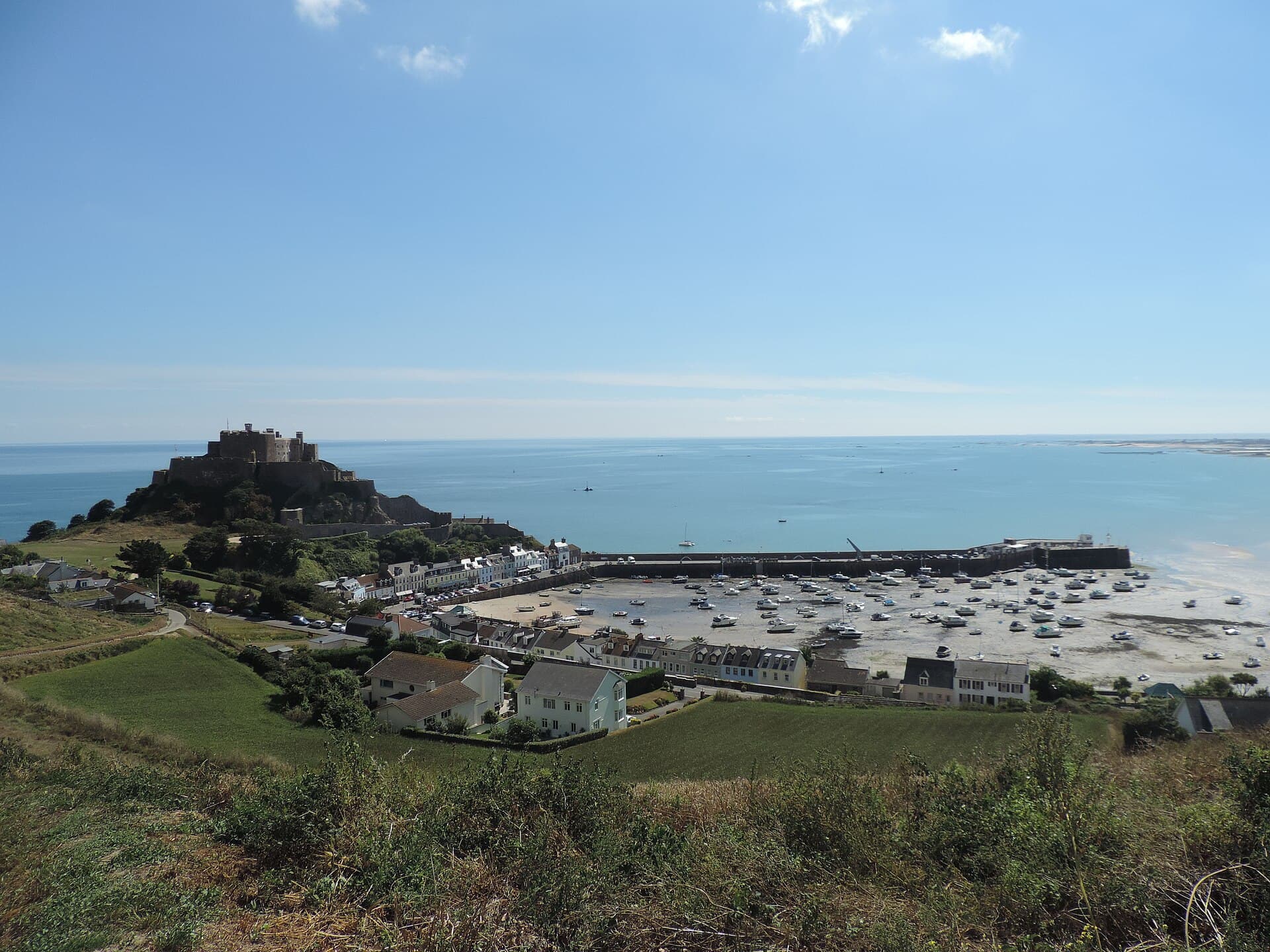
Gorey. On the east coast, a row of painted houses curves beneath Mont Orgueil, the castle that guarded the shortest crossing to France for four centuries. The harbour below it once shipped oysters by the thousand tons and now shelters small boats on the sand at low tide.
St Aubin and the country parishes. St Aubin is a granite harbour village built by merchants in the cod-trade years. Inland, St Ouen, St Mary, St John and Trinity hold the older farmhouses, the deepest lanes and the last strongholds of everyday Jèrriais speech.
Jersey's record begins earlier than almost anywhere else in the region. La Cotte de St Brelade was occupied intermittently from perhaps 250,000 years ago, and its long depositional sequence, the stacked mammoth and rhinoceros bone, and the eleven teeth recovered by Robert Marett before the First World War have made it one of the richest Middle Palaeolithic sites in Europe. La Hougue Bie, a passage grave built around 3500 BC, runs a stone-lined passage more than twenty metres into a mound twelve metres high, aligned so that light reaches the back recess at the equinoxes (La Hougue Bie). In 2012 two metal detectorists in Grouville, after some thirty years searching one field, lifted a clay mass of about three quarters of a tonne holding an estimated 70,000 Iron Age coins with gold torcs and silver jewellery, buried by the Coriosolitae around the time Caesar came north (Grouville Hoard).
The constitutional story starts in 933, when William Longsword annexed the Cotentin and the islands to Normandy, and Jersey was simply part of the duchy until 1204. Then King John lost mainland Normandy to Philip Augustus, and the islands, choosing between a duke who had become a French vassal and a duke who was also King of England, stayed with the English crown. Everything constitutionally odd about Jersey follows from that: the island kept Norman customary law, its own courts and its own assembly, and never became part of the kingdom it had chosen. Mont Orgueil was raised on the eastern headland to hold the new frontier, and it held. When Bertrand du Guesclin attacked in 1373 with two thousand men, the outer defences fell and the inner walls, set on bedrock, did not (Mont Orgueil).
Gunpowder eventually made the old castle useless, and from 1594 a new fortress went up on the tidal islet off St Helier, named Elizabeth Castle by Sir Walter Raleigh during his governorship. Raleigh also declined to pull Mont Orgueil down for its stone, remarking that it would be a pity to cast it down, which is why Jersey still has both (Elizabeth Castle). Charles II sheltered in the new castle in 1649 and was proclaimed king there, and in January 1781 a French force seized St Helier before being beaten in the Royal Square. Then came a century of shipbuilding, cod fleets and granite quarrying, and after it the five years that still shape how the island talks about itself.
Jèrriais is the island's Norman language, a langue d'oïl descendant carried here from the duchy and salted with Old Norse vocabulary. The old habit of calling it Jersey French misleads, since it descends from Norman rather than from the standard language of Paris. It has western and eastern varieties, and the speech of Sark descends from a group of St Ouen families who colonised that island in 1565. The written tradition reaches back to the twelfth-century poet Wace, and its modern foundation is Frank Le Maistre's Dictionnaire Jersiais-Français of 1966, compiled over decades of fieldwork (Jèrriais).
The decline was fast and recent. Roughly half the population still spoke Jèrriais fluently when the war began; the last adults with no English probably died in the 1950s; the 2011 census recorded about 1,900 native speakers, most of them elderly, and UNESCO classes the language as severely endangered. Wartime evacuation, English-medium schooling, immigration and the collapse of the old agricultural economy all pulled the same way. The recovery effort is real but young. On 13 February 2019 the States adopted Jèrriais as an official language, L'Office du Jèrriais teaches it in primary and secondary schools, banknotes have carried Jèrriais denominations since 2010, and the language now appears on signage, in radio slots and in the States chamber.
Place names read as a Norman map. The island's own name ends in the Old Norse element -ey, meaning island, as do Guernsey, Alderney and Chausey, while the first syllable is unexplained and the old antiquarian identification with Roman Caesarea has no support. On the ground you get la hougue for a mound, le câtel for a fort, les landes for heathland, and names in vraic, côtil and pré for seaweed gathering, steep slopes and meadow. Jersey Legal French, an archaic administrative register, survives in Royal Court procedure and in the formulae by which the States record decisions.
The parish is the unit that organises Jersey life. Each of the twelve elects a Connétable, a Procureur du Bien Public and a body of honorary police, the Centeniers and Vingteniers, unpaid parishioners with real powers of charge and arrest, and the annual Parish Assembly still sets rates in a meeting anyone on the rate roll can attend. Older still is the Clameur de Haro, a remedy that lets a person facing an immediate wrong to their property stop it on the spot: kneeling before witnesses, at the place of the wrong, the criant cries "Haro! Haro! Haro! À l'aide, mon Prince, on me fait tort", recites the Lord's Prayer in French, and then registers the act with the Royal Court. Tradition holds that the cry appeals to Rollo, the first Norman duke, though philologists mostly derive haro from a general Old French shout of alarm. The effect is real: work must stop until a court rules, and a criant who raises it without grounds pays a penalty. Jersey has seen it invoked within the last few years over an eviction and over the cutting of trees (Clameur de haro).
The rest of the inheritance is agricultural and stubborn. The Jersey cow, bred on a closed island herd protected by import bans from 1789, and the Jersey Royal potato, grown on steep south-facing côtils and manured with seaweed, are the two exports that carry the island's name. Autumn brings the making of nièr beurre, black butter, when cider apples are simmered in a copper for a day and a night with people taking turns at the stirrer. The calendar also holds the Battle of Flowers, begun on 9 August 1902 for Edward VII's coronation and now a two-day parade of flower-covered floats built by the parishes, with a lit Moonlight Parade added in 1989 (Jersey Battle of Flowers).
Christianity in Jersey is attached to a name and a rock. Helier, a hermit from Tongeren in what is now Belgium, is said to have settled on a tidal islet in the bay, lived in a hollow of the stone and been killed by raiders in 555; the ruined medieval chapel over St Helier's Bed still stands on the Hermitage rock beside Elizabeth Castle, and every July the town and the island churches walk out at low tide for the municipal and ecumenical pilgrimage to it (Helier).
The twelve parish churches are medieval, granite, low and thick-walled, and each parish is still a church parish as well as a civil one. The Reformation arrived in a Calvinist form through refugee ministers from France, so Jersey worshipped in a presbyterian pattern for decades before Anglican order was imposed in the early seventeenth century. Methodism came in 1774 and took deep root among farming and fishing families, in large part because it preached and sang in Jèrriais when the established church did not, which gave the language a pulpit for another century and a half. Roman Catholic parishes grew with French, Irish, Portuguese and Polish migration, and Portuguese-language Masses are now a normal part of the island's Sunday.
Jersey buries its dead by parish. Families keep plots in the churchyard they belong to, headstones carry Norman-French surnames that repeat down the same lanes for centuries, and inscriptions in Jèrriais and in French can be read in the older ground. The honorary parish offices extend to death as well, so the body that knows who lies where is the parish itself.
 La Hougue Bie is a passage grave of about 4000 BC with a chapel built on the mound above it, so a Christian building sits directly on top of a tomb five thousand years older. Photograph by Man vyi, public domain, via Wikimedia Commons.
The occupation gave Jersey a second layer of remembrance, and it is not a comfortable one. Britain demilitarised the islands in June 1940; German aircraft bombed the harbours on 28 June, killing forty-four islanders, and Jersey surrendered on 1 July. Evacuation was left to individual choice and the island government advised people to stay, so only about 6,600 of roughly 50,000 left. In September 1942, on Hitler's order, around 1,200 Jersey residents born outside the islands, with their families, were shipped from the Albert Pier to internment camps in Germany, most families ending up at Wurzach and unattached men at Laufen (German occupation of the Channel Islands). Islanders who kept radios, sheltered escaped Soviet labourers or defied German orders were tried and sent to prisons on the continent, and twenty-one of them died there.
Those twenty-one have their own monument. The lighthouse that stood on St Catherine's breakwater for over a century was decommissioned in 1996 and re-erected outside the Maritime Museum on the New North Quay, with the names of the Jersey dead cut into the plinth around its base; wreaths are laid there each 27 January for Holocaust Memorial Day (Jersey Heritage). Liberation Day on 9 May is the island's national day, marked in Liberation Square with a service, a parade and, since 1995, a re-enactment of the raising of the flag over the Pomme d'Or Hotel. What is remembered has changed over time. Archive releases from the 1990s onward brought out the anonymous denunciations written by islanders, the registration of Jewish residents by the island's own administration, and the question of how far the civil authorities cooperated, so the conduct of some islanders under occupation remains genuinely contested in Jersey.
Jersey's records are Norman in origin, English in administration and unusually complete for an island of its size.
Parish registers for the twelve parishes begin in the sixteenth century, and civil registration was introduced in 1842, held by the Superintendent Registrar rather than in London. Jersey Archive holds the public series and has catalogued and digitised extensively.
The distinctive Jersey sources are property and law. Land transfers were passed before the Royal Court and recorded in the Public Registry from 1602, in French, and because Norman customary law governed inheritance in a fixed way, those contracts name relationships precisely. Jersey conveyancing is still done in the Royal Court on a Friday, and the register is continuous for four hundred years.
Jersey French, and the Jèrriais language, are in the older documents, and the parish system, with its constables and honorary police, still organises civic life.
The Occupation is the twentieth century's defining record. Jersey was occupied by German forces from 1940 to 1945, and the administration kept registering: identity cards for the whole population with photographs, the registration of Jewish residents, the deportation lists of 1942 and 1943 when over a thousand islanders were sent to camps in Germany. Those files survive, and they are the reason the Occupation is one of the best-documented periods in Jersey history and one of the most argued about.
Emigration to Canada, particularly the Gaspé fisheries, and to Australia, is the other trail.
Two institutions carry most of the work. The Société Jersiaise, founded on 28 January 1873 to preserve the island's archaeological, historical and linguistic record, began excavating La Cotte de St Brelade in 1905, bought La Hougue Bie in 1919 and dug it in 1924, and still owns collections, a photographic archive of roughly 100,000 images and the Lord Coutanche Library. In 1987 it handed museum operation to the new Jersey Heritage while keeping ownership of what it had gathered (Société Jersiaise).
Jersey Heritage now runs Mont Orgueil, Elizabeth Castle, La Hougue Bie, the Jersey and Maritime Museums, the Hamptonne country life farm and the Jersey Archive. Its £3 million restoration of Mont Orgueil, completed in 2006, opened parts of the castle shut for generations and added new stairs, roofs and commissioned artworks rather than pretending the building had a single authentic date. Since 2014 it has also managed La Cotte de St Brelade for the Société, running engineering stabilisation and renewed excavation as the cliff face erodes, work for which the then Prince of Wales became patron in 2022. The Grouville hoard, bought by the States in December 2021 for £4.25 million, is being conserved coin by coin in public view at La Hougue Bie.
The Jersey Heritage online catalogue carries more than 750,000 descriptions of documents and objects, searchable free, with scanned images available by subscription or single payment (Jersey Heritage family history research). Its most used series is a product of the occupation itself. Under the Registration and Identification of Persons (Jersey) Order of 1940, every resident had to register with name, address, date and place of birth, occupation and photograph, and the German administration's own set of those cards survives in the Jersey Archive. Digitised and indexed, it gives almost any Jersey family a photograph of a grandparent taken on a fixed date under a regime that meant it as surveillance. Parish registers, wills and Royal Court records sit alongside it, the Société Jersiaise photographic archive covers the island from the mid-nineteenth century, and L'Office du Jèrriais publishes dictionaries, lessons and recordings online, so learners can hear the language as people born in the nineteenth century spoke it.
The dominant fact of modern Jersey is finance. Bank deposits stood at £39 million in 1960 and reached £470 million by 1971, after the States abolished the 1771 interest cap and the London merchant banks began to arrive; by 2000 financial services accounted for more than half of gross value added, and today they make up close to forty per cent of it and form the island's largest employer (Jersey Finance industry timeline). The consequences run through everything else. Population grew from about 57,000 in 1951 to more than 103,000 in 2021, housing costs became among the highest in the British Isles, agriculture and tourism shrank into supporting roles, and the island has spent three decades answering international scrutiny of its tax and transparency arrangements with successive rounds of regulation. Jersey people argue about all of this openly, and the argument is itself part of the island's culture now. Gentler exports continue alongside it: Gerald Durrell founded his zoo at Les Augrès Manor in 1959 and turned it into the Durrell Wildlife Conservation Trust, whose captive-breeding programmes have returned species to the wild in a dozen countries.
A Palaeolithic site pulled back from the cliff. La Cotte de St Brelade, eroding into the sea, has been under stabilisation and fresh excavation since 2014, keeping the longest Neanderthal sequence in north-west Europe available to study.
A language given legal standing. The States adopted Jèrriais as an official language in February 2019, and L'Office du Jèrriais now teaches it through the school system.
A hoard bought for the island. The 70,000-coin Grouville hoard was purchased for Jersey in 2021 for £4.25 million and is being conserved in front of the public at La Hougue Bie.
Faces returned to families. The occupation registration cards, made as an instrument of control, have been digitised and indexed so that Jersey families can find a dated photograph of relatives who left no other portrait.
La Hougue Bie is a passage grave of about 4000 BC with a chapel built on the mound above it, so a Christian building sits directly on top of a tomb five thousand years older. Photograph by Man vyi, public domain, via Wikimedia Commons.
The occupation gave Jersey a second layer of remembrance, and it is not a comfortable one. Britain demilitarised the islands in June 1940; German aircraft bombed the harbours on 28 June, killing forty-four islanders, and Jersey surrendered on 1 July. Evacuation was left to individual choice and the island government advised people to stay, so only about 6,600 of roughly 50,000 left. In September 1942, on Hitler's order, around 1,200 Jersey residents born outside the islands, with their families, were shipped from the Albert Pier to internment camps in Germany, most families ending up at Wurzach and unattached men at Laufen (German occupation of the Channel Islands). Islanders who kept radios, sheltered escaped Soviet labourers or defied German orders were tried and sent to prisons on the continent, and twenty-one of them died there.
Those twenty-one have their own monument. The lighthouse that stood on St Catherine's breakwater for over a century was decommissioned in 1996 and re-erected outside the Maritime Museum on the New North Quay, with the names of the Jersey dead cut into the plinth around its base; wreaths are laid there each 27 January for Holocaust Memorial Day (Jersey Heritage). Liberation Day on 9 May is the island's national day, marked in Liberation Square with a service, a parade and, since 1995, a re-enactment of the raising of the flag over the Pomme d'Or Hotel. What is remembered has changed over time. Archive releases from the 1990s onward brought out the anonymous denunciations written by islanders, the registration of Jewish residents by the island's own administration, and the question of how far the civil authorities cooperated, so the conduct of some islanders under occupation remains genuinely contested in Jersey.
Jersey's records are Norman in origin, English in administration and unusually complete for an island of its size.
Parish registers for the twelve parishes begin in the sixteenth century, and civil registration was introduced in 1842, held by the Superintendent Registrar rather than in London. Jersey Archive holds the public series and has catalogued and digitised extensively.
The distinctive Jersey sources are property and law. Land transfers were passed before the Royal Court and recorded in the Public Registry from 1602, in French, and because Norman customary law governed inheritance in a fixed way, those contracts name relationships precisely. Jersey conveyancing is still done in the Royal Court on a Friday, and the register is continuous for four hundred years.
Jersey French, and the Jèrriais language, are in the older documents, and the parish system, with its constables and honorary police, still organises civic life.
The Occupation is the twentieth century's defining record. Jersey was occupied by German forces from 1940 to 1945, and the administration kept registering: identity cards for the whole population with photographs, the registration of Jewish residents, the deportation lists of 1942 and 1943 when over a thousand islanders were sent to camps in Germany. Those files survive, and they are the reason the Occupation is one of the best-documented periods in Jersey history and one of the most argued about.
Emigration to Canada, particularly the Gaspé fisheries, and to Australia, is the other trail.
Two institutions carry most of the work. The Société Jersiaise, founded on 28 January 1873 to preserve the island's archaeological, historical and linguistic record, began excavating La Cotte de St Brelade in 1905, bought La Hougue Bie in 1919 and dug it in 1924, and still owns collections, a photographic archive of roughly 100,000 images and the Lord Coutanche Library. In 1987 it handed museum operation to the new Jersey Heritage while keeping ownership of what it had gathered (Société Jersiaise).
Jersey Heritage now runs Mont Orgueil, Elizabeth Castle, La Hougue Bie, the Jersey and Maritime Museums, the Hamptonne country life farm and the Jersey Archive. Its £3 million restoration of Mont Orgueil, completed in 2006, opened parts of the castle shut for generations and added new stairs, roofs and commissioned artworks rather than pretending the building had a single authentic date. Since 2014 it has also managed La Cotte de St Brelade for the Société, running engineering stabilisation and renewed excavation as the cliff face erodes, work for which the then Prince of Wales became patron in 2022. The Grouville hoard, bought by the States in December 2021 for £4.25 million, is being conserved coin by coin in public view at La Hougue Bie.
The Jersey Heritage online catalogue carries more than 750,000 descriptions of documents and objects, searchable free, with scanned images available by subscription or single payment (Jersey Heritage family history research). Its most used series is a product of the occupation itself. Under the Registration and Identification of Persons (Jersey) Order of 1940, every resident had to register with name, address, date and place of birth, occupation and photograph, and the German administration's own set of those cards survives in the Jersey Archive. Digitised and indexed, it gives almost any Jersey family a photograph of a grandparent taken on a fixed date under a regime that meant it as surveillance. Parish registers, wills and Royal Court records sit alongside it, the Société Jersiaise photographic archive covers the island from the mid-nineteenth century, and L'Office du Jèrriais publishes dictionaries, lessons and recordings online, so learners can hear the language as people born in the nineteenth century spoke it.
The dominant fact of modern Jersey is finance. Bank deposits stood at £39 million in 1960 and reached £470 million by 1971, after the States abolished the 1771 interest cap and the London merchant banks began to arrive; by 2000 financial services accounted for more than half of gross value added, and today they make up close to forty per cent of it and form the island's largest employer (Jersey Finance industry timeline). The consequences run through everything else. Population grew from about 57,000 in 1951 to more than 103,000 in 2021, housing costs became among the highest in the British Isles, agriculture and tourism shrank into supporting roles, and the island has spent three decades answering international scrutiny of its tax and transparency arrangements with successive rounds of regulation. Jersey people argue about all of this openly, and the argument is itself part of the island's culture now. Gentler exports continue alongside it: Gerald Durrell founded his zoo at Les Augrès Manor in 1959 and turned it into the Durrell Wildlife Conservation Trust, whose captive-breeding programmes have returned species to the wild in a dozen countries.
A Palaeolithic site pulled back from the cliff. La Cotte de St Brelade, eroding into the sea, has been under stabilisation and fresh excavation since 2014, keeping the longest Neanderthal sequence in north-west Europe available to study.
A language given legal standing. The States adopted Jèrriais as an official language in February 2019, and L'Office du Jèrriais now teaches it through the school system.
A hoard bought for the island. The 70,000-coin Grouville hoard was purchased for Jersey in 2021 for £4.25 million and is being conserved in front of the public at La Hougue Bie.
Faces returned to families. The occupation registration cards, made as an instrument of control, have been digitised and indexed so that Jersey families can find a dated photograph of relatives who left no other portrait.
National Overview
Notable Cities
Historical Foundations
Linguistic and Etymological Roots
Cultural Identity
Religion and Spirituality
Remembrance and Mourning Traditions
Tracing a Family in Jersey
Heritage Preservation Efforts
Digital Heritage
Contemporary Cultural Influences
Success Stories
References and resources
- La Cotte de St Brelade, Wikipedia: the Neanderthal sequence, the bone heaps and the eleven teeth.
- La Hougue Bie, Wikipedia: the passage grave and the chapels on the mound.
- Grouville Hoard, Wikipedia: the 2012 Coriosolitae hoard and its purchase for the island.
- Jersey, Wikipedia: geography, population and constitutional status.
- Jèrriais, Wikipedia: the Norman language, its decline and the 2019 recognition.
- Clameur de haro, Wikipedia: the wording, the kneeling and recent invocations.
- Mont Orgueil, Wikipedia: the castle after 1204 and Raleigh's reprieve.
- German occupation of the Channel Islands, Wikipedia: evacuation, deportation and liberation.
- Jersey Heritage, Jersey resistance during the Occupation: the Jersey 21 and the Lighthouse Memorial.
- Société Jersiaise, Wikipedia: the 1873 society and its excavations.
- Jersey Heritage, family history research: the online catalogue, occupation registration cards and parish records.
- Jersey Finance industry timeline: the offshore sector's growth from the 1960s.
- Helier, Wikipedia: the hermit, the Hermitage rock and the July pilgrimage.