Heritage · Country
Hawaii Culture and Heritage
Hawaiʻi keeps its heritage in chant, in navigation without instruments, and above all in the care of ancestral bones. This is a guide to the islands' past: the kingdom overthrown in 1893, a language brought back from the edge, and burial grounds defended by their descendants.Written to last.
By Confinity Heritage Editorial · Updated 2026-08-17 · 8-minute readQuiet tools, kept out of the way.
Hawaiians say that mana, spiritual power, rests in the bones. That belief explains much about how heritage works here: why ancestral remains were once buried in places only two or three people knew, why a hotel excavation in 1988 became a state crisis, and why the return of iwi kūpuna from museum drawers is treated as an obligation owed to named relatives.
The islands also carry a political memory that has not settled. A sovereign kingdom recognised by treaty was overthrown in 1893 with the help of American troops, annexed five years later, and made a state in 1959; in 1993 Congress apologised for the overthrow. Alongside that sits one of the most successful indigenous language revivals anywhere, a canoe that crossed to Tahiti without instruments, and a hula tradition that survived being driven out of public view.
Hawaiʻi is a chain of volcanic islands and atolls in the central Pacific, roughly 3,800 kilometres from the North American mainland, the most isolated substantial landmass on earth. Eight main islands carry almost all of the population of about 1.4 million: Hawaiʻi Island, Maui, Oʻahu, Kauaʻi, Molokaʻi, Lānaʻi, Niʻihau and the uninhabited Kahoʻolawe, with Mauna Kea rising 4,207 metres above the sea and far higher from the ocean floor. Northwest of them stretch the small islands and reefs of Papahānaumokuākea.
The islands became the fiftieth state in 1959. Both English and Hawaiian are official languages under the state constitution, the only such arrangement among the states, and Native Hawaiians make up roughly a fifth of residents when part-Hawaiian ancestry is counted.
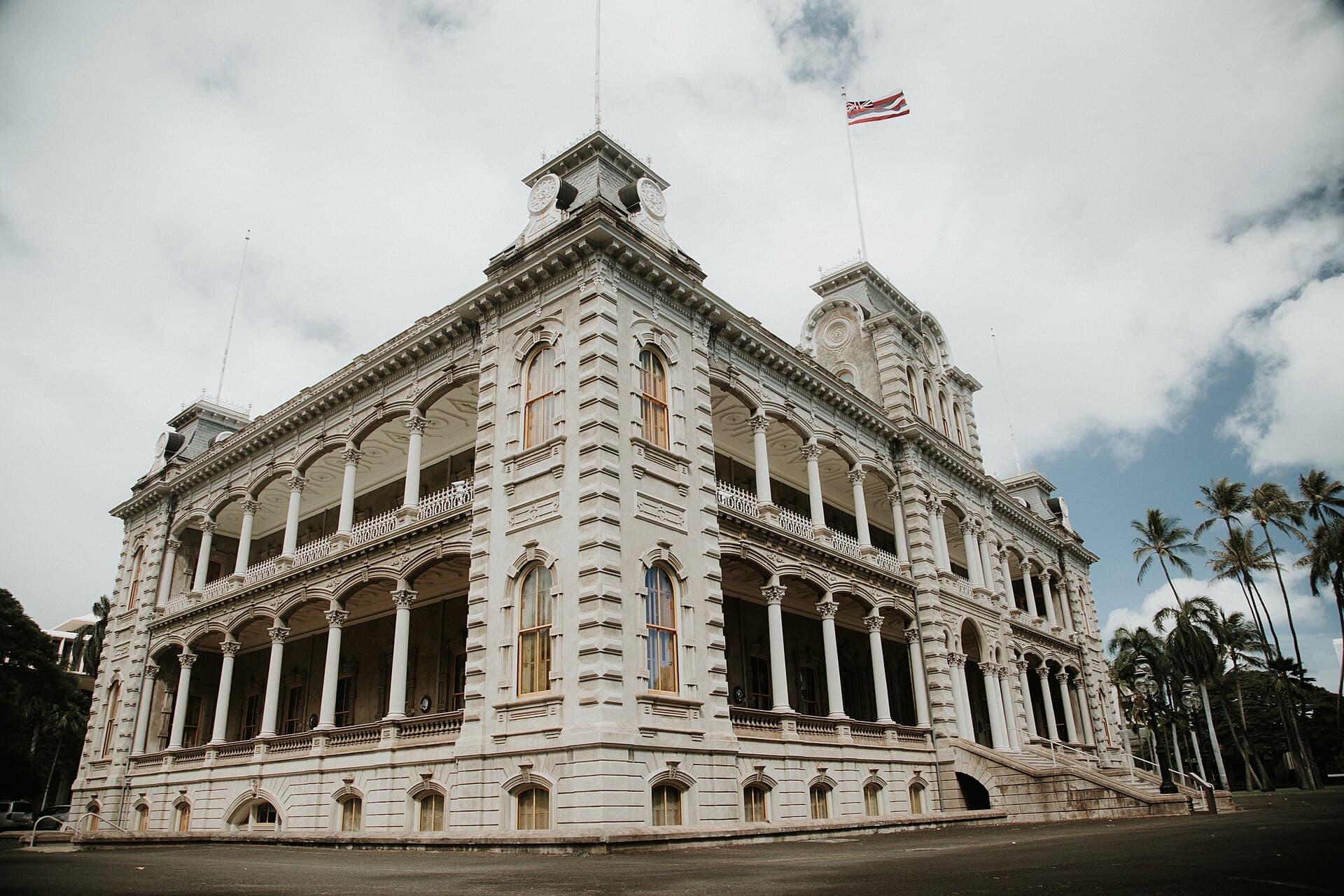
Honolulu. The capital and only large city, on the south shore of Oʻahu, holds ʻIolani Palace, the royal residence completed in 1882 and the only palace on American soil; Kawaiahaʻo Church, built of coral blocks in the 1840s; the Bishop Museum; and Mauna ʻAla, the Royal Mausoleum, where most of the aliʻi of the last two dynasties lie.
Hilo. The old sugar port on the wet windward side of Hawaiʻi Island is home to the Merrie Monarch Festival, the foremost hula competition anywhere, and to ʻImiloa, an astronomy centre built to hold Hawaiian navigation and modern science in one building.
Lahaina. The royal capital of the kingdom in the early nineteenth century, on the west coast of Maui, a whaling port and later a plantation town, and the site of the fire of August 2023.
Polynesian voyagers reached these islands by open-ocean sailing canoe, navigating by stars, swells and birds; current archaeology places settlement around 1000 to 1200 CE, most likely from the Marquesas and later from Tahiti, though the dating is debated. They built a highly organised society with no metal and no writing. Land was divided into ahupuaʻa, wedge-shaped districts running from the mountain ridge to the reef so that each community held forest, farmland, shoreline and fishing ground together. Social and religious order rested on the kapu system, a code of sacred restrictions governing rank, food, gender and access to places, with heiau, stone temple platforms, as its ceremonial centres.
The islands were separate chiefdoms until Kamehameha I of Hawaiʻi Island, using traditional warfare together with Western guns and advisers, conquered Maui, Molokaʻi and Oʻahu in the 1790s and secured the cession of Kauaʻi and Niʻihau in 1810. Within a decade of his death the old religious order was abolished from within, when Kaʻahumanu and Liholiho broke the eating kapu in 1819; Protestant missionaries arrived the following year into that opening. The kingdom modernised fast, with a written constitution, a legislature, near-universal literacy in Hawaiian, and recognition from Britain, France and the United States. It also lost most of its people to introduced disease, and the Māhele of 1848 turned communal land tenure into private title, much of which passed within a generation to foreigners and sugar planters.
On 16 January 1893 a group of mostly American businessmen and lawyers calling itself the Committee of Safety obtained the support of the United States minister John L. Stevens, who ordered sailors and marines from the USS Boston ashore at Honolulu. The next day the committee declared the monarchy ended and proclaimed a provisional government. Queen Liliʻuokalani yielded under protest, addressing her surrender to the United States rather than to the committee and asking that its government undo the act. President Grover Cleveland's investigator found that the American minister had acted improperly, and Cleveland called for her restoration, but Congress did not act; after a failed royalist attempt in January 1895 the queen was tried and confined for months in an upstairs room of her own palace. The United States annexed the islands by joint resolution in 1898.
A century later Congress revisited it. Public Law 103-150, the Apology Resolution of 1993, acknowledged that the overthrow was illegal, that it occurred with the participation of United States diplomatic and military representatives, and that the Native Hawaiian people never directly relinquished their claims to inherent sovereignty over their national lands, and it apologised on behalf of the United States. What follows from that apology is contested. Sovereignty organisations hold a range of positions: some seek federal recognition of a Native Hawaiian governing entity comparable to tribal nations on the mainland, some argue the kingdom was never lawfully extinguished and seek an independent state, and others pursue land and self-governance claims within existing law. The resolution states that nothing in it settles any claim. These arguments are live in Hawaiian politics and in the courts, and this page does not take a side.
Statehood followed a plebiscite in June 1959 that approved admission by a very large majority, on a ballot offering only statehood or continued territorial status and no option of independence; the United Nations removed Hawaiʻi from its list of non-self-governing territories that year. Critics argue those options did not meet standards later applied elsewhere; supporters point to the size of the majority.
ʻŌlelo Hawaiʻi is a Polynesian language, closest to Marquesan and Tahitian. Written down by missionaries in the 1820s, it uses eight consonants including the ʻokina, a glottal stop written as a turned comma and counted as a full consonant, and five vowels that may carry the kahakō, a macron marking length. Both marks change meaning, so omitting them is a spelling error rather than a style choice. Place names are transparent to speakers: Honolulu is the sheltered bay, Mauna Kea the white mountain, Haleakalā the house of the sun.
The kingdom was among the most literate societies of its century. More than a hundred Hawaiian-language newspaper titles appeared between 1834 and 1948, filling something like a million pages with history, genealogy, chant, obituary and political argument, an archive of Hawaiian thought written by Hawaiians.
Then the language was shut out of the schools. After the overthrow, Act 57 of the Republic of Hawaiʻi in 1896 required English as the medium of instruction, and Hawaiian-speaking children were punished for using their own language at school. Within three generations transmission had nearly stopped: by the early 1980s there were on the order of two thousand native speakers, most of them elderly, with fewer than fifty children among them outside the Hawaiian-speaking community of Niʻihau. The 1978 constitutional convention made Hawaiian an official language of the state, and in 1983 a group of educators founded ʻAha Pūnana Leo, opening the first Pūnana Leo, or language nest, preschool at Kekaha on Kauaʻi in 1984, where elders and teachers spoke only Hawaiian to the children. The ban on Hawaiian-medium teaching was repealed in 1986, and schooling in the language was built upward year by year to university degrees. Speaker numbers now run into the thousands, and the language is heard again in households where it had been silent for two generations.
Hula is the body of the culture. It began as sacred performance bound to chant, genealogy and the gods, and it was driven out of public view after the conversion of the chiefs, restricted by the missionary-influenced authorities of the 1830s and kept up in private for decades. King Kalākaua, remembered as the Merrie Monarch, brought it back into public life in the 1880s, at a time when doing so was itself a political statement. The Merrie Monarch Festival at Hilo, which grew from a small event in the 1960s into a competition Hawaiian communities everywhere follow, now sets the standard for both hula kahiko, danced to chant and percussion, and hula ʻauana, the modern form with stringed instruments.
Chant carries what dance shows. Mele are the composed songs and poems; oli is unaccompanied chant, used to record genealogy, to ask permission to enter a place, to name a child, to mourn. Material heritage is as exact: kapa, cloth beaten from wauke bark and printed with carved bamboo stamps, and the featherwork of the aliʻi, the ʻahu ʻula cloaks and mahiole helmets made from hundreds of thousands of feathers.
The recovery of ocean navigation belongs here too. In 1976 the voyaging canoe Hōkūleʻa sailed from Hawaiʻi to Tahiti without instruments, guided by Mau Piailug of Satawal in Micronesia, one of the last men alive who held the full system of wayfinding by stars, swell, wind and bird. He later trained Nainoa Thompson and a generation of Hawaiian navigators, breaking a taboo in his own tradition against teaching outsiders because he judged the knowledge would otherwise die.
The older Hawaiian religion recognised four principal akua, Kāne, Kū, Lono and Kanaloa, along with many lesser deities and ʻaumakua, ancestral guardians who might appear as a shark, an owl or a lizard and who linked a family to its dead. Pele, who lives in the volcano, is the best known and is still addressed with offerings at Kīlauea. Worship centred on heiau, whose stone platforms survive across the islands, and on the kapu.
 Kamehameha built Pu'ukohola in 1790 and 1791 on a prophecy that it would let him take all the islands. The stones were passed hand to hand along a human chain from a valley miles away. Photograph by Ken Lund, CC BY-SA 2.0, via Wikimedia Commons.
That order was abolished in 1819, and Congregational missionaries arrived in 1820 to a society whose temples had just been dismantled. Christianity took hold quickly among the chiefs and then the people; the Belgian priest Damien de Veuster, who died in 1889 among the people forcibly settled at Kalaupapa on Molokaʻi because of leprosy, was canonised in 2009, and plantation immigration later brought Buddhist and Shinto temples. Today many Hawaiians hold Christian practice and older observance together, opening events with oli, asking permission of a place before entering, and keeping the obligations owed to ʻaumakua.
Because mana was understood to reside in the bones, iwi kūpuna, ancestral remains, were treated with extreme care. Chiefly bones were cleaned, wrapped and hidden in caves or cliffs by one or two trusted people who kept the location secret for life, so that no enemy could take the mana or desecrate the dead. Ordinary burials went into house sites, sand dunes and family land, which is why so many are found near the shore. Grief was voiced in kanikau, mourning chants naming the dead person, the places walked together and the things now missing, many printed in the Hawaiian newspapers and surviving as a body of elegiac literature. ʻOhana obligation runs through all of it: the duty to care for the dead is owed by descendants, and descent is traced with precision.
Development and collecting broke that care on a large scale. Remains were dug from the dunes for museums and universities: from the Mokapu peninsula on Oʻahu alone, over a thousand individuals were removed between 1915 and the 1990s and held at the Bishop Museum. The federal Native American Graves Protection and Repatriation Act of 1990 obliged institutions to inventory human remains and funerary objects and return them to descendant communities, and Native Hawaiian organisations, in particular Hui Mālama I Nā Kūpuna O Hawaiʻi Nei, founded in 1989, spent decades reclaiming iwi kūpuna from museums at home and abroad and reburying them. The Mokapu remains went back into the ground after litigation, and the Office of Hawaiian Affairs continues this work.
The case that changed the law was Honokahua. In 1987 and 1988, excavation for a resort in the sand dunes at Honokahua Bay on Maui disturbed more than a thousand burials, removed one after another as the work went on. Families and community members protested, held a vigil at the state capitol, and refused to accept that the dead could be treated as an archaeological obstacle. The state halted the excavation, the developer moved the hotel inland, and the remains were reinterred where they had lain; the site is protected in perpetuity. In 1990 the legislature passed Act 306, which gave Native Hawaiians decision-making authority over previously identified unmarked burials more than fifty years old and created the island burial councils, community bodies that decide whether remains found on a development site are preserved in place or moved. Hawaiʻi's burial-protection law is among the strongest in the country, and it exists because of what people did at Honokahua.
Modern funerals blend Christian services with Hawaiian practice: oli and mele for the dead, lei placed on the casket or urn, and often the scattering of ashes at sea, with the family paddling out and casting flowers on the water. The USS Arizona Memorial at Pearl Harbor stands over the sunken ship and the sailors still inside her.
Hawaiian genealogy is the most consequential in the United States, because it decides who is entitled to land.
Mo'okū'auhau, genealogy, is central to Native Hawaiian identity and was recited as chant long before it was written. The Kumulipo, the great cosmogonic chant, is a genealogy that runs from the origin of the world to a living chief, and the ali'i traced descent through it. Commoners kept theirs too.
Writing came fast after 1820. Hawaiians became one of the most literate populations on earth within a generation, and the Hawaiian-language newspapers, which ran from 1834 to 1948 and fill more than a hundred thousand pages, are full of genealogy, obituaries and disputes over descent. Much of that corpus has been digitised and is searchable, and it is the single best source for nineteenth-century Hawaiian families.
The Māhele of 1848 divided the land and produced the kuleana claims, in which ordinary Hawaiians described their plots and their families in their own words in order to keep them. Those records are the foundation of most Hawaiian genealogical research today, because the Hawaiian Homes Commission Act of 1920 and the programmes that followed require applicants to prove Native Hawaiian ancestry, usually by tracing back to a named ancestor in the nineteenth-century record.
Church registers, the missionary censuses and the Hawaii State Archives hold the rest. The plantation era added Japanese, Chinese, Portuguese, Filipino and Korean labour records, which document the other half of modern Hawai'i.
Papahānaumokuākea, the marine area of the Northwestern Hawaiian Islands, was inscribed by UNESCO in 2010 as a mixed natural and cultural World Heritage Site, for its reefs and for its standing in Hawaiian cosmology as the region where life originates and where the spirits of the dead return; Nihoa and Mokumanamana carry archaeological sites among the most significant in Polynesia.
Closer in, Puʻuhonua o Hōnaunau is a national historical park, and Puʻukoholā Heiau, built by Kamehameha in 1790 and 1791, a national historic site. ʻIolani Palace, used as government offices for decades after the overthrow and stripped of its furnishings, was restored from 1969 by the Friends of ʻIolani Palace, which tracked down original pieces sold at auction; the room where Liliʻuokalani was confined is shown as it was. The Bishop Museum, founded in 1889 by Charles Reed Bishop in memory of his wife, the aliʻi Bernice Pauahi Bishop, holds the largest collection of Hawaiian material anywhere and is now a partner in repatriation as well as a custodian.
Hawaiian-language sources have been brought online with unusual determination, because so much of the record sits in a language most Hawaiians had been prevented from learning. Ulukau, the Hawaiian Electronic Library, publishes dictionaries, books and newspapers in ʻōlelo Hawaiʻi, and in 2011 and 2012 the ʻIke Kūʻokoʻa campaign recruited thousands of volunteers to type out scanned newspaper pages so the text would be searchable rather than merely photographed. The Papakilo Database run by the Office of Hawaiian Affairs brings together land records, māhele documents, genealogical sources and place-name files, so a family can trace an ancestor's land, and sometimes an ancestor's burial, from a browser.
Land, water and kuleana, the word that means both a right and the responsibility that comes with it, sit at the centre of Hawaiian politics: stream water diverted for plantations a century ago is still fought over in the courts, and the waiting list under the Hawaiian Homes Commission Act of 1920 has left many applicants waiting decades for a homestead.
The clearest recent dispute concerns Mauna Kea. Astronomers and the observatory partners hold that the summit is among the best sites on earth for the Thirty Meter Telescope and that the project brings scientific and educational benefit; many Native Hawaiians hold that the mountain is a sacred ancestor, that existing telescopes were built over community objection, and that no further construction should occur. Protests at the access road in 2019 halted the work, and the state has since changed how the summit is governed.
Tourism brings roughly ten million visitors a year to a population of 1.4 million, with consequences for housing costs, water and cultural sites; more Native Hawaiians now live on the mainland than in Hawaiʻi, in large part because of what it costs to stay.
On 8 August 2023 a wind-driven fire destroyed most of Lahaina, and the official death toll settled at 102, the deadliest American wildfire in more than a century. The town it burned was a former royal capital: it held Waiola Church and the Waineʻe cemetery where Queen Keōpūolani and other aliʻi are buried, the old courthouse, the Nā ʻAikane o Maui cultural centre with its documents and artefacts, and the banyan planted in the square in 1873. The banyan was scorched and has been nursed back into leaf; much of the rest, including irreplaceable archives, is gone. Those who died are named at community gatherings each August, and Lahaina residents have insisted that decisions about rebuilding, water and land belong to the community that lived there.
A language brought back. From roughly two thousand mostly elderly native speakers in the early 1980s, ʻōlelo Hawaiʻi now has thousands of speakers of all ages, a Hawaiian-medium school system running from preschool to postgraduate study, and co-official status.
Navigation recovered. Hōkūleʻa's 1976 voyage to Tahiti, guided by Mau Piailug without instruments, showed that Polynesian settlement was deliberate seafaring and restored knowledge within a few years of disappearing.
Burials protected by law. The protests at Honokahua in 1988 led directly to Act 306 of 1990, the island burial councils, and a framework giving descendants authority over unmarked Hawaiian graves.
Ancestors returned. Decades of work under NAGPRA by Hui Mālama I Nā Kūpuna O Hawaiʻi Nei, the Office of Hawaiian Affairs and others have brought iwi kūpuna home from museums.
Kamehameha built Pu'ukohola in 1790 and 1791 on a prophecy that it would let him take all the islands. The stones were passed hand to hand along a human chain from a valley miles away. Photograph by Ken Lund, CC BY-SA 2.0, via Wikimedia Commons.
That order was abolished in 1819, and Congregational missionaries arrived in 1820 to a society whose temples had just been dismantled. Christianity took hold quickly among the chiefs and then the people; the Belgian priest Damien de Veuster, who died in 1889 among the people forcibly settled at Kalaupapa on Molokaʻi because of leprosy, was canonised in 2009, and plantation immigration later brought Buddhist and Shinto temples. Today many Hawaiians hold Christian practice and older observance together, opening events with oli, asking permission of a place before entering, and keeping the obligations owed to ʻaumakua.
Because mana was understood to reside in the bones, iwi kūpuna, ancestral remains, were treated with extreme care. Chiefly bones were cleaned, wrapped and hidden in caves or cliffs by one or two trusted people who kept the location secret for life, so that no enemy could take the mana or desecrate the dead. Ordinary burials went into house sites, sand dunes and family land, which is why so many are found near the shore. Grief was voiced in kanikau, mourning chants naming the dead person, the places walked together and the things now missing, many printed in the Hawaiian newspapers and surviving as a body of elegiac literature. ʻOhana obligation runs through all of it: the duty to care for the dead is owed by descendants, and descent is traced with precision.
Development and collecting broke that care on a large scale. Remains were dug from the dunes for museums and universities: from the Mokapu peninsula on Oʻahu alone, over a thousand individuals were removed between 1915 and the 1990s and held at the Bishop Museum. The federal Native American Graves Protection and Repatriation Act of 1990 obliged institutions to inventory human remains and funerary objects and return them to descendant communities, and Native Hawaiian organisations, in particular Hui Mālama I Nā Kūpuna O Hawaiʻi Nei, founded in 1989, spent decades reclaiming iwi kūpuna from museums at home and abroad and reburying them. The Mokapu remains went back into the ground after litigation, and the Office of Hawaiian Affairs continues this work.
The case that changed the law was Honokahua. In 1987 and 1988, excavation for a resort in the sand dunes at Honokahua Bay on Maui disturbed more than a thousand burials, removed one after another as the work went on. Families and community members protested, held a vigil at the state capitol, and refused to accept that the dead could be treated as an archaeological obstacle. The state halted the excavation, the developer moved the hotel inland, and the remains were reinterred where they had lain; the site is protected in perpetuity. In 1990 the legislature passed Act 306, which gave Native Hawaiians decision-making authority over previously identified unmarked burials more than fifty years old and created the island burial councils, community bodies that decide whether remains found on a development site are preserved in place or moved. Hawaiʻi's burial-protection law is among the strongest in the country, and it exists because of what people did at Honokahua.
Modern funerals blend Christian services with Hawaiian practice: oli and mele for the dead, lei placed on the casket or urn, and often the scattering of ashes at sea, with the family paddling out and casting flowers on the water. The USS Arizona Memorial at Pearl Harbor stands over the sunken ship and the sailors still inside her.
Hawaiian genealogy is the most consequential in the United States, because it decides who is entitled to land.
Mo'okū'auhau, genealogy, is central to Native Hawaiian identity and was recited as chant long before it was written. The Kumulipo, the great cosmogonic chant, is a genealogy that runs from the origin of the world to a living chief, and the ali'i traced descent through it. Commoners kept theirs too.
Writing came fast after 1820. Hawaiians became one of the most literate populations on earth within a generation, and the Hawaiian-language newspapers, which ran from 1834 to 1948 and fill more than a hundred thousand pages, are full of genealogy, obituaries and disputes over descent. Much of that corpus has been digitised and is searchable, and it is the single best source for nineteenth-century Hawaiian families.
The Māhele of 1848 divided the land and produced the kuleana claims, in which ordinary Hawaiians described their plots and their families in their own words in order to keep them. Those records are the foundation of most Hawaiian genealogical research today, because the Hawaiian Homes Commission Act of 1920 and the programmes that followed require applicants to prove Native Hawaiian ancestry, usually by tracing back to a named ancestor in the nineteenth-century record.
Church registers, the missionary censuses and the Hawaii State Archives hold the rest. The plantation era added Japanese, Chinese, Portuguese, Filipino and Korean labour records, which document the other half of modern Hawai'i.
Papahānaumokuākea, the marine area of the Northwestern Hawaiian Islands, was inscribed by UNESCO in 2010 as a mixed natural and cultural World Heritage Site, for its reefs and for its standing in Hawaiian cosmology as the region where life originates and where the spirits of the dead return; Nihoa and Mokumanamana carry archaeological sites among the most significant in Polynesia.
Closer in, Puʻuhonua o Hōnaunau is a national historical park, and Puʻukoholā Heiau, built by Kamehameha in 1790 and 1791, a national historic site. ʻIolani Palace, used as government offices for decades after the overthrow and stripped of its furnishings, was restored from 1969 by the Friends of ʻIolani Palace, which tracked down original pieces sold at auction; the room where Liliʻuokalani was confined is shown as it was. The Bishop Museum, founded in 1889 by Charles Reed Bishop in memory of his wife, the aliʻi Bernice Pauahi Bishop, holds the largest collection of Hawaiian material anywhere and is now a partner in repatriation as well as a custodian.
Hawaiian-language sources have been brought online with unusual determination, because so much of the record sits in a language most Hawaiians had been prevented from learning. Ulukau, the Hawaiian Electronic Library, publishes dictionaries, books and newspapers in ʻōlelo Hawaiʻi, and in 2011 and 2012 the ʻIke Kūʻokoʻa campaign recruited thousands of volunteers to type out scanned newspaper pages so the text would be searchable rather than merely photographed. The Papakilo Database run by the Office of Hawaiian Affairs brings together land records, māhele documents, genealogical sources and place-name files, so a family can trace an ancestor's land, and sometimes an ancestor's burial, from a browser.
Land, water and kuleana, the word that means both a right and the responsibility that comes with it, sit at the centre of Hawaiian politics: stream water diverted for plantations a century ago is still fought over in the courts, and the waiting list under the Hawaiian Homes Commission Act of 1920 has left many applicants waiting decades for a homestead.
The clearest recent dispute concerns Mauna Kea. Astronomers and the observatory partners hold that the summit is among the best sites on earth for the Thirty Meter Telescope and that the project brings scientific and educational benefit; many Native Hawaiians hold that the mountain is a sacred ancestor, that existing telescopes were built over community objection, and that no further construction should occur. Protests at the access road in 2019 halted the work, and the state has since changed how the summit is governed.
Tourism brings roughly ten million visitors a year to a population of 1.4 million, with consequences for housing costs, water and cultural sites; more Native Hawaiians now live on the mainland than in Hawaiʻi, in large part because of what it costs to stay.
On 8 August 2023 a wind-driven fire destroyed most of Lahaina, and the official death toll settled at 102, the deadliest American wildfire in more than a century. The town it burned was a former royal capital: it held Waiola Church and the Waineʻe cemetery where Queen Keōpūolani and other aliʻi are buried, the old courthouse, the Nā ʻAikane o Maui cultural centre with its documents and artefacts, and the banyan planted in the square in 1873. The banyan was scorched and has been nursed back into leaf; much of the rest, including irreplaceable archives, is gone. Those who died are named at community gatherings each August, and Lahaina residents have insisted that decisions about rebuilding, water and land belong to the community that lived there.
A language brought back. From roughly two thousand mostly elderly native speakers in the early 1980s, ʻōlelo Hawaiʻi now has thousands of speakers of all ages, a Hawaiian-medium school system running from preschool to postgraduate study, and co-official status.
Navigation recovered. Hōkūleʻa's 1976 voyage to Tahiti, guided by Mau Piailug without instruments, showed that Polynesian settlement was deliberate seafaring and restored knowledge within a few years of disappearing.
Burials protected by law. The protests at Honokahua in 1988 led directly to Act 306 of 1990, the island burial councils, and a framework giving descendants authority over unmarked Hawaiian graves.
Ancestors returned. Decades of work under NAGPRA by Hui Mālama I Nā Kūpuna O Hawaiʻi Nei, the Office of Hawaiian Affairs and others have brought iwi kūpuna home from museums.
National Overview
Notable Cities
Historical Foundations
Linguistic and Etymological Roots
Cultural Identity
Religion and Spirituality
Remembrance and Mourning Traditions
Tracing a Family in Hawaii
Heritage Preservation Efforts
Digital Heritage
Contemporary Cultural Influences
Success Stories
References and resources
- Apology Resolution, Public Law 103-150 (1993): the congressional apology for the 1893 overthrow.
- UNESCO, Papahānaumokuākea: the mixed World Heritage inscription of 2010.
- NAGPRA, National Park Service: the 1990 repatriation statute.
- Office of Hawaiian Affairs, iwi kūpuna repatriation: the return of ancestral remains.
- ʻAha Pūnana Leo: the language nests and Hawaiian-medium schools.
- Ulukau, the Hawaiian Electronic Library: books and newspapers in ʻōlelo Hawaiʻi.
- Papakilo Database: land, genealogy and place-name records.
- Polynesian Voyaging Society: Hōkūleʻa and non-instrument wayfinding.
- Merrie Monarch Festival: the hula competition at Hilo.
- ʻIolani Palace: the restored royal residence.
- Puʻuhonua o Hōnaunau, National Park Service: the place of refuge.