Heritage · Country
Wallonia Culture and Heritage
On 8 August 1956 a fire in the Bois du Cazier pit at Marcinelle killed 262 men, 136 of them Italian, and both countries still mark the date. A guide to Walloon heritage, from Neolithic flint mines and hydraulic boat lifts to the Gilles of Binche and a coal valley after coal.Written to last.
By Confinity Heritage Editorial · Updated 2026-08-17 · 8-minute readQuiet tools, kept out of the way.
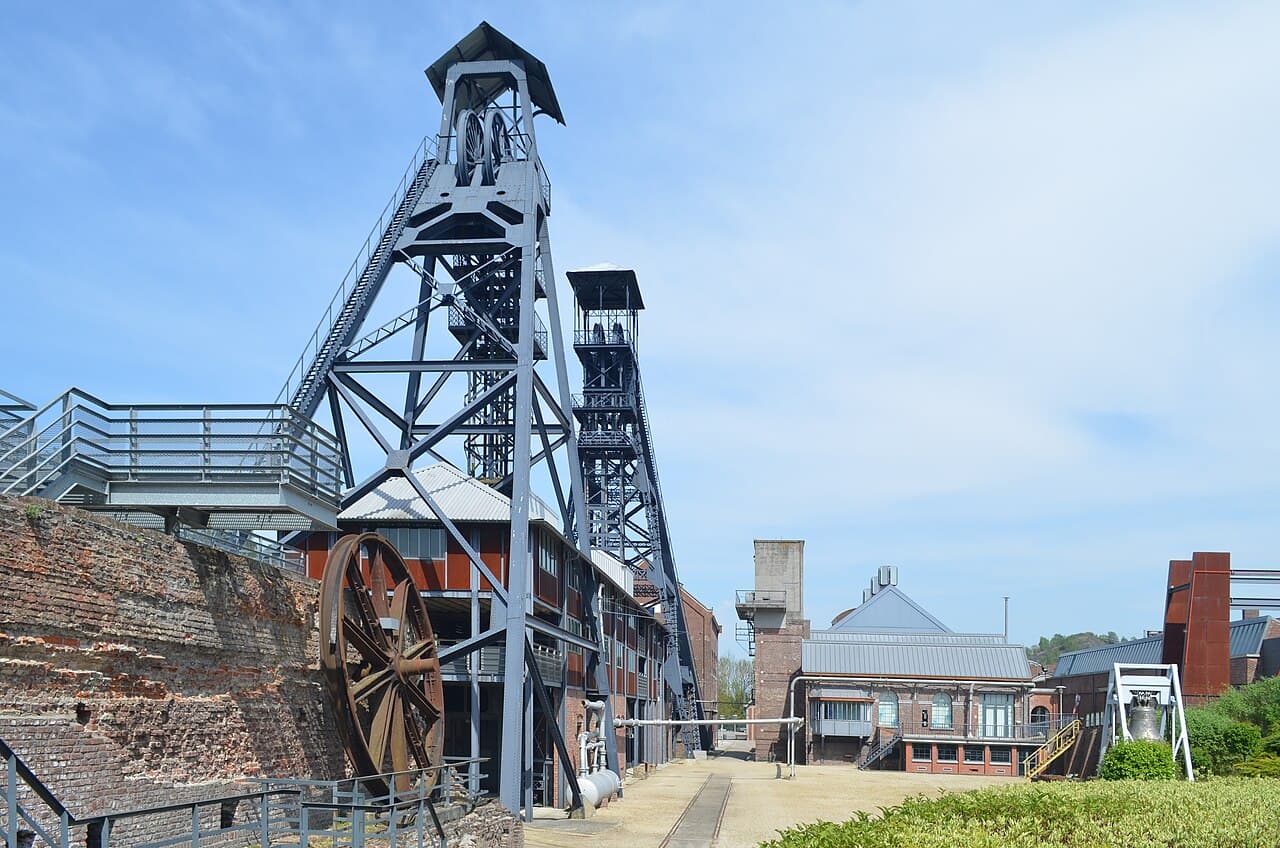
At ten past eight on the morning of 8 August 1956, a cage was hoisted at the Bois du Cazier pit in Marcinelle before a coal wagon had been fully loaded into it. The wagon caught, sheared an oil pipe and a power cable, and the fire that followed filled the workings with smoke. Of the 275 men underground, 262 died. A hundred and thirty-six of them were Italian, brought to Belgium under an agreement of 1946 by which Italy sent men and Belgium sent coal. Ninety-five were Belgian, and the rest came from Poland, Greece, Germany, France, Hungary, England, the Netherlands, Russia and Ukraine. The headframes are still there, and the yard is now a museum and a World Heritage Site.
Wallonia was one of the first regions of continental Europe to industrialise, and the coal and iron corridor along the Sambre and the Meuse made it rich a century before it made it poor. But the mines are the most recent layer. Under the fields outside Mons are flint mines worked from 4300 BC; at Binche and Mons the same processions have gone through the streets since the Middle Ages; and in the Ardennes the winter of 1944 left a memory Americans and Belgians keep together.
Wallonia is the southern region of Belgium, 16,901 square kilometres and 55 per cent of the country's territory, with 3,692,283 residents at the start of 2024, roughly 31 per cent of the Belgian population. Its capital is Namur, at the meeting of the Sambre and the Meuse, and its largest city is Charleroi. Five provinces make it up: Hainaut, Liège, Luxembourg, Namur and Walloon Brabant. The land runs from the farmland of Hainaut and the Hesbaye across the old industrial furrow of the Sambre and Meuse, up through the limestone Condroz into the forested Ardennes and the peat moor of the Hautes Fagnes. French is the official language across nearly all of it, and German is official in nine municipalities in the east.
Liège. A prince-bishopric from 985 until the French Revolution, governed by its bishop and repeatedly in revolt against him, Liège became a steel city in the nineteenth century. It keeps a puppet-theatre tradition and a fifteen-day August festival in the Outremeuse quarter.
Namur. The regional capital, with a citadel above the confluence besieged for two thousand years and the parliament of Wallonia beneath it.
Charleroi. Founded as a Spanish fortress in 1666 and named for a boy king, Charleroi became the centre of the coal and glass country of Hainaut. Its slag heaps are now wooded hills and its Musée de la Photographie is among the largest in Europe.
Mons. The Hainaut capital, with the belfry that Victor Hugo called an enormous coffee pot and the annual Doudou in its streets.
Tournai. One of the oldest cities in Belgium and capital of the Frankish king Childeric, whose grave was found here in 1653. Its five-towered cathedral is inscribed by UNESCO.
The Walloon provinces were never one polity. In the Middle Ages they were the counties of Hainaut and Namur, the duchy of Luxembourg and, largest and strangest, the prince-bishopric of Liège, a state of the Holy Roman Empire ruled by its bishop until French troops swept it away in the 1790s. The rest passed to Burgundy, then the Habsburgs, and all of it to France, to the Netherlands and finally to Belgium in 1830.
What changed everything was coal. Seams had been dug in the Borinage and around Liège since the Middle Ages, but from the 1820s the region industrialised at a speed matched nowhere on the Continent. The English engineer William Cockerill and his son John built machine works at Seraing, where the first coke-fired blast furnace outside Britain went into blast in the 1820s. Belgium opened continental Europe's first steam railway between Brussels and Mechelen in 1835, largely to carry Walloon coal and iron, and the corridor along the Sambre and Meuse filled with pits, coke ovens, glassworks, rolling mills and terraced housing. By the middle of the century Wallonia was, in proportion to its size, the second industrial power in the world after Britain.
The twentieth century took it apart. Coal grew expensive as the good seams ran out, the postwar economy moved north to the Flemish ports, and the pits closed one after another until the Roton at Farciennes wound its last cage to the surface on 30 September 1984. Steel followed. A Walloon movement grew out of that industrial world: Jules Destrée's open letter to King Albert in 1912 told him bluntly that there were no Belgians, only Flemings and Walloons, and the general strike of the winter of 1960 and 1961, led from Liège by the union figure André Renard, turned Walloon demands toward federalism as the region's industry began to fail. Belgium's political architecture changed with the economics: language laws fixed the border between Dutch-speaking and French-speaking Belgium in 1962 and 1963, and six state reforms between 1970 and 2014 turned a unitary kingdom into a federation of three regions and three language communities with real legislative powers. Brussels is its own bilingual region, separate from Wallonia and from Flanders, and belongs to neither.
The name is blunt. It comes from the Germanic walh, meaning a foreigner and more precisely a speaker of Latin or Celtic, the same root that gave English Wales and Welsh and the Wallachia of the Balkans. Germanic speakers used it for the Romance speakers across the line, and the Romance speakers took it for themselves.
Walloon itself is a language, a Romance tongue of the langue d'oïl family, related to French but not descended from it, with a printed literature since the sixteenth century and a golden age of theatre and verse in the nineteenth. It has four dialect groups: central around Namur, eastern around Liège and the most conservative, western around Charleroi, and southern near Bastogne. It is also in serious trouble. UNESCO's atlas classes it as definitely endangered; a 2007 estimate put around 600,000 people as having some knowledge of it, but the age profile tells the story, with roughly three-quarters of those over sixty able to speak it against about one in ten of those under thirty. The French Community of Belgium recognised it in 1990 as a langue régionale endogène to be taught and encouraged, and the Union Culturelle Wallonne holds together more than two hundred amateur companies performing in it, alongside a Walloon Wikipedia opened in 2003.
Three other Romance varieties survive under the same protection: Picard in the west around Tournai and Mons, Lorrain or Gaumais in the far south, and Champenois in a small corner near the French border. In the east there is a fourth language with a different standing altogether. Nine municipalities in the cantons of Eupen and Sankt Vith, about 79,500 people over 854 square kilometres, form the German-speaking Community, Belgium's third official language community. The territory passed from Germany to Belgium in 1920 under the Treaty of Versailles, after a consultation of the population that has been criticised ever since; the community has had an elected parliament in Eupen since 1973 and runs its schools, culture and much of its social policy while lying inside the Walloon Region for regional matters. Its nine municipalities must in turn provide facilities in French. Walloon French keeps its own markers too, including septante and nonante where France says seventy and ninety the long way round.
Two processions carry more of Walloon identity than any museum. On Trinity Sunday, Mons holds the Ducasse, known to everyone as the Doudou. The shrine of Saint Waltrude is brought out of the collegiate church on the Saturday evening, carried through the town next morning on a gilded dray called the Car d'Or, and then hauled up the cobbled Rampe Sainte-Waudru by hundreds of townspeople pushing behind the horses, because the year is held to go badly if the car fails to reach the top in one attempt. At noon on the Grand-Place, Saint George fights a ten-metre dragon in a choreographed combat called the Lumeçon, with men in white handling the tail, devils armed with cow bladders and figures dressed in ivy. The custom traces to a plague procession of 1349, and UNESCO inscribed it in 2008 within a joint Belgian and French listing of processional giants and dragons.
The other is the Carnival of Binche, first written down in 1394 and inscribed by UNESCO in 2003 and 2008. Its Gilles number up to a thousand, they must be men born or long resident in Binche, and on Shrove Tuesday they appear at dawn in wax masks with green spectacles and moustaches, in stuffed linen suits in the Belgian colours hung with bells, dancing to drums in clogs. In the afternoon they wear hats of white ostrich plumes that cost hundreds of euros to hire and throw oranges into the crowd; throwing one back is an insult. The Ducasse of Ath was part of the same listing until 2 December 2022, when the committee removed it, with Belgium's eventual agreement, after complaints from several African states about a character called the Sauvage, a white performer in blackface wearing a nose ring and a chain.
Elsewhere the calendar runs on the cwarmê of Malmedy, held in Walloon, and on the puppet theatres of Liège, where Tchantchès, a stubborn boy of Outremeuse with a broken nose and a bad temper, has heckled Charlemagne on a string stage since the nineteenth century. The table is regional: boulets at Liège, tarte au sucre, and the Trappist beers of Chimay, Orval and Rochefort.
Wallonia is historically Catholic and now among the least observant regions in western Europe, and alongside that runs an organised secular tradition unusual in its formality. Belgium recognises and part-funds organised secularism as a philosophical community with its own paid counsellors and funeral officiants, and in the old industrial towns of the Sambre and Meuse, where socialist and liberal anticlericalism ran deep, that network is often the stronger of the two.
The Catholic inheritance in stone is nonetheless considerable. Tournai's Notre-Dame carries five towers over the crossing, a Romanesque nave of the twelfth century and a soaring Gothic choir begun in 1242; a tornado tore into it in 1999 and the repair has run for a quarter of a century. Orval and Villers-la-Ville record the monastic centuries, the first a working Cistercian abbey with a brewery, the second a vast Gothic ruin. Saint Hubert in the Ardennes draws hunters on the saint's day in November, and the Fêtes de Wallonie each September in Namur are now a civic feast.
Family remembrance in Wallonia follows the French Catholic pattern, thinned by secularisation. Deaths are announced on printed cards and on posters in the village, funerals are as often civil as religious, cremation is common, and graves are held on renewable concession from the commune. On 1 November, Toussaint, families go to the cemetery to wash the stone and set out pots of chrysanthemums, the one day the whole country is in its graveyards.
 262 men died at Bois du Cazier on 8 August 1956, from twelve nationalities, more than half of them Italian. The pit is kept as a memorial and the names are read out each year. Photograph by Nenea hartia, CC BY-SA 4.0, via Wikimedia Commons.
The dead of the pits are remembered collectively, and Marcinelle is where that is done. The Bois du Cazier holds a ceremony every 8 August at ten past eight, with the bell rung 262 times, and the site's museum lists the men by name and nationality. Italy has made the same date a national day, the Giornata nazionale del sacrificio del lavoro italiano nel mondo, established in 2001 to commemorate Italians who died working abroad, so a Belgian pit fire is marked each year by a state on the other side of the Alps. For the Italian families of Charleroi, La Louvière and the Borinage, whose grandfathers came under the 1946 accord and whose grandchildren are Belgian, Marcinelle is the founding event of the community.
The Ardennes carry a second layer. In the winter of 1944 the German counter-offensive through the forest became the Battle of the Bulge, and Bastogne was surrounded and held. The Mardasson Memorial above the town, a five-pointed star raised in 1950 and carrying the names of the American states, draws visitors from the United States every December. At the Baugnez crossroads outside Malmedy, men of Kampfgruppe Peiper shot 84 American prisoners of the 285th Field Artillery Observation Battalion on 17 December 1944; the bodies lay in the snow behind German lines until American troops recovered them on 14 January 1945, and the killings were tried at Dachau in 1946. Older wounds sit under these: on 23 August 1914 German troops shot 674 civilians at Dinant, and Tamines and Andenne lost 383 and 211 in the same weeks.
Walloon records are Belgian records in French, and they are free.
Civil registration began in 1796 under French annexation and parish registers run from the sixteenth century, both digitised and published by the State Archives. The population registers from 1846, which track each household's moves, work here as they do in Flanders and are the reason internal migration is traceable.
The prince-bishopric of Liège is the older archive. It was an independent state within the Holy Roman Empire for eight centuries until 1795, with its own law, coinage and records, and the Liège state archives hold a body of material that has nothing to do with the rest of Belgium's history.
Industry is the modern record. The Walloon coalfield and the steel valleys of the Sambre and Meuse were among the first industrial regions in continental Europe, and the mining companies kept employment, housing and accident records covering a workforce that came from Flanders, then Italy, Poland, Morocco and Turkey. The Italian immigration after 1946, under an agreement that traded miners for coal, is documented on both sides.
Two disasters name people precisely. Marcinelle in 1956 killed 262 men, 136 of them Italian, and the list is a document Italian families still consult. And the Ardennes, fought over in 1914, 1940 and 1944, holds war cemeteries and the records of civilian massacres at Dinant and elsewhere in 1914, which were investigated and named.
Heritage is a regional competence in Belgium, and since 1 January 2018 a single body, the Agence wallonne du Patrimoine, has handled it for the region, formed by merging the Walloon Heritage Institute with the heritage arm of the regional public service. It maintains around 4,000 classified monuments and sites and an inventory of more than 30,000 buildings.
Wallonia's World Heritage is unusually weighted toward work and industry. The Neolithic flint mines at Spiennes, outside Mons, were inscribed in 2000: the largest and earliest concentration of ancient mines yet found in north-western Europe, worked from about 4300 to 2200 BC over roughly a hundred hectares, with shafts more than ten metres deep. Tournai cathedral was inscribed the same year. The four hydraulic boat lifts on the old Canal du Centre, designed by the British engineer Edwin Clark and built between 1885 and 1917, were inscribed in 1998 and still work alongside the modern Strépy-Thieu lift that replaced them for commercial traffic. In 2012 UNESCO inscribed the Major Mining Sites of Wallonia: Grand-Hornu, whose neoclassical workers' town was laid out by Bruno Renard in the 1820s; Bois-du-Luc, one of the oldest collieries in the country, worked until 1973; the Bois du Cazier at Marcinelle; and Blegny-Mine in Liège province, the last pit in its province to close, in 1980. Six belfries on the Belgium and France listing stand in Wallonia, and Spa is part of the Great Spa Towns of Europe inscribed in 2021.
The federal State Archives have digitised the parish and civil registers of the Walloon communes, which is where family history in the region begins, and the portal is free. CegeSoma, the Belgian centre for the study of war and society, digitises records and testimony of both world wars. The portal Connaître la Wallonie publishes a dated timeline, biographies and dossiers, and the Agence wallonne du Patrimoine puts its inventory online so any listed farmhouse or pithead can be looked up by address.
Two things matter especially. The Bois du Cazier keeps the personnel and casualty records of the 1956 fire and publishes the list of the dead with nationalities, which is what an Italian or Greek family looking for a grandfather actually needs. And Walloon has moved much of its survival online, into the Wikipedia, digitised dictionaries and recorded speech, so that a language spoken mainly by the old is written down while there are speakers to check it.
Wallonia exports more culture than its economy suggests. Georges Simenon of Liège wrote some 200 novels; the Dardenne brothers, from the steel town of Seraing, have twice taken the Palme d'Or at Cannes for films shot among the people the mills left behind; and the summer festivals at Spa, Dour and Liège draw big crowds.
The hard argument is about what comes after coal and steel. Wallonia's income per head sits well below the Belgian average and near 85 per cent of the EU average, and the reconversion has been partial: biotech in Walloon Brabant, logistics, and heritage tourism on the old sites, where Grand-Hornu houses a design museum and the slag heaps of Charleroi are nature reserves. Then in July 2021 the Vesdre and its neighbours flooded after 271.5 millimetres of rain fell in 48 hours at Jalhay, a Belgian record. Thirty-nine people died, 209 of Wallonia's 262 communes were affected, and 3,326 homes were hit in Verviers alone and 1,291 in Pepinster, where houses collapsed into the river. Listed buildings, parish churches, museum collections and communal archives along the valley were soaked or destroyed, and the salvage that followed has become a case study in what climate risk means for heritage held in ordinary buildings.
A pit turned into a place of record. The Bois du Cazier could have been cleared like the other collieries of the valley. Instead it was kept, opened as a museum, inscribed by UNESCO in 2012 and made the site of a ceremony held in two countries.
Boat lifts still working after a century. The four hydraulic lifts on the Canal du Centre, inscribed in 1998, still raise boats, one of very few places where Victorian hydraulic engineering still does its job.
The oldest mines, opened to visitors. Spiennes was inscribed in 2000 and given an interpretation centre in 2015, from which visitors descend a shaft into a flint mine worked six thousand years ago.
A language written down while it can be. More than two hundred amateur companies still perform in Walloon, and the dictionaries, recordings and Wikipedia built since the 1990 recognition give an endangered tongue a documentary record.
262 men died at Bois du Cazier on 8 August 1956, from twelve nationalities, more than half of them Italian. The pit is kept as a memorial and the names are read out each year. Photograph by Nenea hartia, CC BY-SA 4.0, via Wikimedia Commons.
The dead of the pits are remembered collectively, and Marcinelle is where that is done. The Bois du Cazier holds a ceremony every 8 August at ten past eight, with the bell rung 262 times, and the site's museum lists the men by name and nationality. Italy has made the same date a national day, the Giornata nazionale del sacrificio del lavoro italiano nel mondo, established in 2001 to commemorate Italians who died working abroad, so a Belgian pit fire is marked each year by a state on the other side of the Alps. For the Italian families of Charleroi, La Louvière and the Borinage, whose grandfathers came under the 1946 accord and whose grandchildren are Belgian, Marcinelle is the founding event of the community.
The Ardennes carry a second layer. In the winter of 1944 the German counter-offensive through the forest became the Battle of the Bulge, and Bastogne was surrounded and held. The Mardasson Memorial above the town, a five-pointed star raised in 1950 and carrying the names of the American states, draws visitors from the United States every December. At the Baugnez crossroads outside Malmedy, men of Kampfgruppe Peiper shot 84 American prisoners of the 285th Field Artillery Observation Battalion on 17 December 1944; the bodies lay in the snow behind German lines until American troops recovered them on 14 January 1945, and the killings were tried at Dachau in 1946. Older wounds sit under these: on 23 August 1914 German troops shot 674 civilians at Dinant, and Tamines and Andenne lost 383 and 211 in the same weeks.
Walloon records are Belgian records in French, and they are free.
Civil registration began in 1796 under French annexation and parish registers run from the sixteenth century, both digitised and published by the State Archives. The population registers from 1846, which track each household's moves, work here as they do in Flanders and are the reason internal migration is traceable.
The prince-bishopric of Liège is the older archive. It was an independent state within the Holy Roman Empire for eight centuries until 1795, with its own law, coinage and records, and the Liège state archives hold a body of material that has nothing to do with the rest of Belgium's history.
Industry is the modern record. The Walloon coalfield and the steel valleys of the Sambre and Meuse were among the first industrial regions in continental Europe, and the mining companies kept employment, housing and accident records covering a workforce that came from Flanders, then Italy, Poland, Morocco and Turkey. The Italian immigration after 1946, under an agreement that traded miners for coal, is documented on both sides.
Two disasters name people precisely. Marcinelle in 1956 killed 262 men, 136 of them Italian, and the list is a document Italian families still consult. And the Ardennes, fought over in 1914, 1940 and 1944, holds war cemeteries and the records of civilian massacres at Dinant and elsewhere in 1914, which were investigated and named.
Heritage is a regional competence in Belgium, and since 1 January 2018 a single body, the Agence wallonne du Patrimoine, has handled it for the region, formed by merging the Walloon Heritage Institute with the heritage arm of the regional public service. It maintains around 4,000 classified monuments and sites and an inventory of more than 30,000 buildings.
Wallonia's World Heritage is unusually weighted toward work and industry. The Neolithic flint mines at Spiennes, outside Mons, were inscribed in 2000: the largest and earliest concentration of ancient mines yet found in north-western Europe, worked from about 4300 to 2200 BC over roughly a hundred hectares, with shafts more than ten metres deep. Tournai cathedral was inscribed the same year. The four hydraulic boat lifts on the old Canal du Centre, designed by the British engineer Edwin Clark and built between 1885 and 1917, were inscribed in 1998 and still work alongside the modern Strépy-Thieu lift that replaced them for commercial traffic. In 2012 UNESCO inscribed the Major Mining Sites of Wallonia: Grand-Hornu, whose neoclassical workers' town was laid out by Bruno Renard in the 1820s; Bois-du-Luc, one of the oldest collieries in the country, worked until 1973; the Bois du Cazier at Marcinelle; and Blegny-Mine in Liège province, the last pit in its province to close, in 1980. Six belfries on the Belgium and France listing stand in Wallonia, and Spa is part of the Great Spa Towns of Europe inscribed in 2021.
The federal State Archives have digitised the parish and civil registers of the Walloon communes, which is where family history in the region begins, and the portal is free. CegeSoma, the Belgian centre for the study of war and society, digitises records and testimony of both world wars. The portal Connaître la Wallonie publishes a dated timeline, biographies and dossiers, and the Agence wallonne du Patrimoine puts its inventory online so any listed farmhouse or pithead can be looked up by address.
Two things matter especially. The Bois du Cazier keeps the personnel and casualty records of the 1956 fire and publishes the list of the dead with nationalities, which is what an Italian or Greek family looking for a grandfather actually needs. And Walloon has moved much of its survival online, into the Wikipedia, digitised dictionaries and recorded speech, so that a language spoken mainly by the old is written down while there are speakers to check it.
Wallonia exports more culture than its economy suggests. Georges Simenon of Liège wrote some 200 novels; the Dardenne brothers, from the steel town of Seraing, have twice taken the Palme d'Or at Cannes for films shot among the people the mills left behind; and the summer festivals at Spa, Dour and Liège draw big crowds.
The hard argument is about what comes after coal and steel. Wallonia's income per head sits well below the Belgian average and near 85 per cent of the EU average, and the reconversion has been partial: biotech in Walloon Brabant, logistics, and heritage tourism on the old sites, where Grand-Hornu houses a design museum and the slag heaps of Charleroi are nature reserves. Then in July 2021 the Vesdre and its neighbours flooded after 271.5 millimetres of rain fell in 48 hours at Jalhay, a Belgian record. Thirty-nine people died, 209 of Wallonia's 262 communes were affected, and 3,326 homes were hit in Verviers alone and 1,291 in Pepinster, where houses collapsed into the river. Listed buildings, parish churches, museum collections and communal archives along the valley were soaked or destroyed, and the salvage that followed has become a case study in what climate risk means for heritage held in ordinary buildings.
A pit turned into a place of record. The Bois du Cazier could have been cleared like the other collieries of the valley. Instead it was kept, opened as a museum, inscribed by UNESCO in 2012 and made the site of a ceremony held in two countries.
Boat lifts still working after a century. The four hydraulic lifts on the Canal du Centre, inscribed in 1998, still raise boats, one of very few places where Victorian hydraulic engineering still does its job.
The oldest mines, opened to visitors. Spiennes was inscribed in 2000 and given an interpretation centre in 2015, from which visitors descend a shaft into a flint mine worked six thousand years ago.
A language written down while it can be. More than two hundred amateur companies still perform in Walloon, and the dictionaries, recordings and Wikipedia built since the 1990 recognition give an endangered tongue a documentary record.
National Overview
Notable Cities
Historical Foundations
Linguistic and Etymological Roots
Cultural Identity
Religion and Spirituality
Remembrance and Mourning Traditions
Tracing a Family in Wallonia
Heritage Preservation Efforts
Digital Heritage
Contemporary Cultural Influences
Success Stories
References and resources
- UNESCO, Neolithic Flint Mines at Spiennes: inscribed 2000.
- UNESCO, Notre-Dame Cathedral in Tournai: inscribed 2000.
- UNESCO, The Four Lifts on the Canal du Centre: inscribed 1998.
- UNESCO, Major Mining Sites of Wallonia: four collieries, inscribed 2012.
- UNESCO, Carnival of Binche: the Gilles, inscribed 2008.
- UNESCO, Processional giants and dragons: the Doudou of Mons.
- Le Bois du Cazier: the Marcinelle site and the 1956 records.
- Agence wallonne du Patrimoine: the heritage agency and its inventory.
- State Archives of Belgium: digitised parish and civil registers.
- CegeSoma: the centre for war and society.
- Connaître la Wallonie: the regional history portal.
- Union Culturelle Wallonne: the federation of Walloon-language companies.
- Encyclopaedia Britannica, Wallonia: geography, history and institutions.