Heritage · Country
Transylvania Culture and Heritage
Transylvanian Saxons spent eight hundred years building fortified churches to keep their villages alive, and then left almost entirely within a decade after 1989. This is a guide to Transylvanian heritage, to seven UNESCO villages whose churches now have keys but few keyholders, and to the Hungarian, Romanian and Roma layers beside them.Written to last.
By Confinity Heritage Editorial · Updated 2026-08-20 · 8-minute readQuiet tools, kept out of the way.
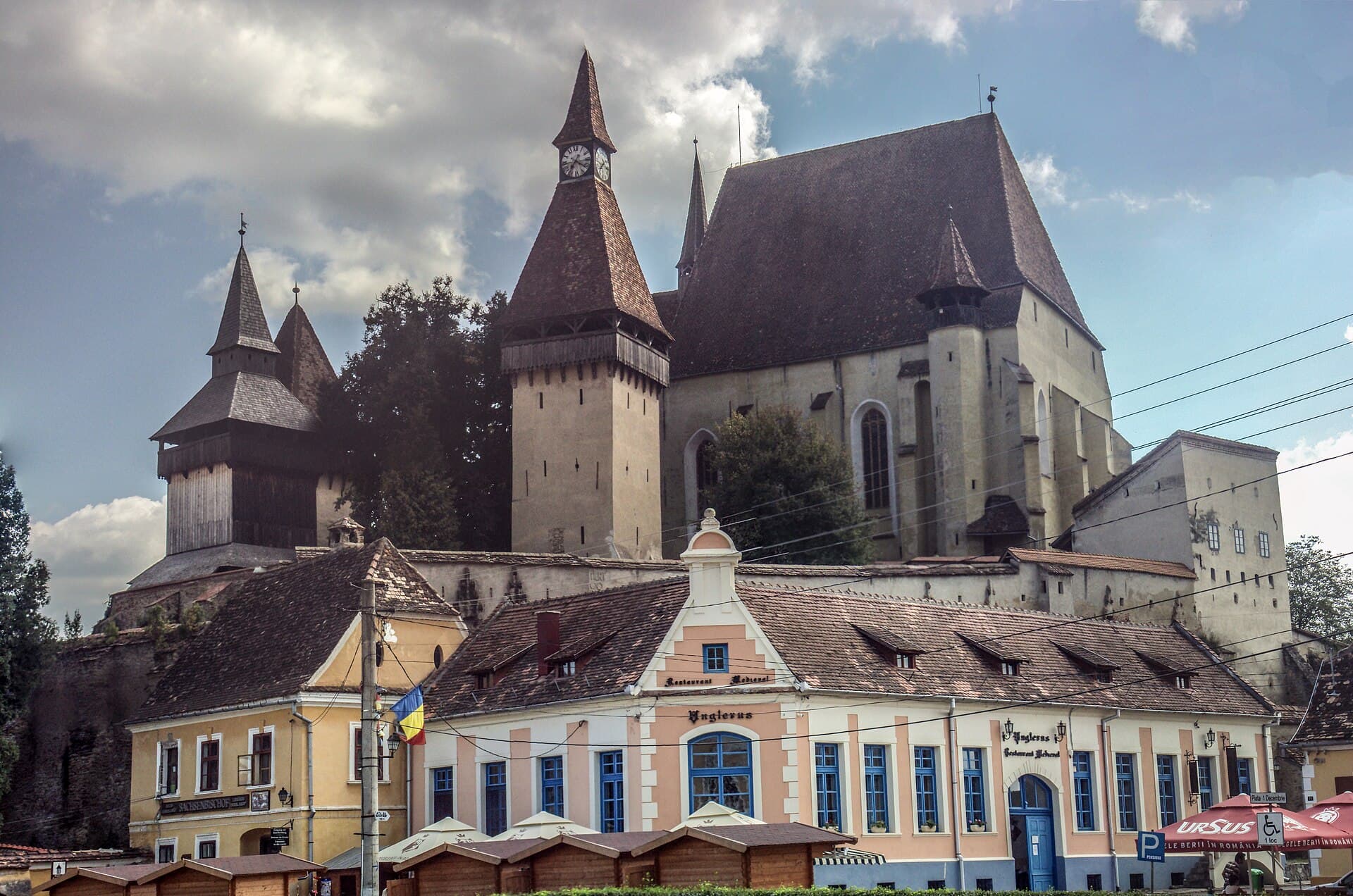
A Transylvanian Saxon fortified church was the village strongbox. Three rings of wall at Biertan, towers with rooms in them, and inside the tower a wall of small numbered wooden compartments, one per household, where each family hung its bacon and kept its grain. When raiders came, the community and its food went inside together. The building was designed on the assumption that the village would still be there in two hundred years and would need somewhere to keep what mattered.
The villages are still there. The Saxons are not. There were around 237,000 Transylvanian Saxons in 1930 and roughly 12,000 by the 2011 census, the great majority having left for Germany in the few years after Ceausescu fell. What remains is one of the most complete medieval village landscapes in Europe, seven villages of it on the UNESCO list, largely without the community that built it.
Transylvania is the plateau in the centre and north-west of Romania, ringed on the east and south by the Carpathians, which is what made it a distinct polity for most of its history. Definitions vary: Transylvania proper is around 55,000 square kilometres, while the term is often used loosely for the whole of Romania west of the Carpathians including Banat, Crisana and Maramures, which together run to roughly 100,000 square kilometres and about 6.7 million people.
It has been part of Romania since the union proclaimed at Alba Iulia on 1 December 1918, confirmed by the Treaty of Trianon in 1920. Northern Transylvania was transferred to Hungary by the Second Vienna Award in 1940 and returned after the Second World War. It remains the most ethnically mixed part of Romania, with a Hungarian population of roughly 1.2 million nationally, concentrated here and forming local majorities in the Szekely counties of Harghita and Covasna, alongside Romanians, a substantial Roma population and the remnant German communities.
Cluj-Napoca is the largest city and the region's economic and university centre.
Cluj-Napoca. Kolozsvar in Hungarian, Klausenburg in German. The intellectual capital of the region, with Babes-Bolyai University teaching in Romanian, Hungarian and German, and the Gothic church of St Michael in the main square.
 Sighisoara is the best preserved small Saxon town in Transylvania, and its guilds each had a tower on the wall to defend. Photograph by Albertdoris, CC BY-SA 4.0, via Wikimedia Commons.
Sibiu. Hermannstadt, the historic Saxon capital and seat of the Lutheran bishop, with an intact upper town, the Brukenthal Museum, one of the oldest public art collections in central Europe, and the ASTRA open-air museum of Romanian village architecture.
Brasov. Kronstadt, at the foot of the mountains, with the Black Church, the largest Gothic church between Vienna and Istanbul, named for the soot it took in a fire of 1689.
Sighisoara. Schassburg, a walled hill town whose historic centre is inscribed by UNESCO in its own right, and the best surviving example of a small fortified Saxon town.
Alba Iulia. The old Transylvanian capital, with an enormous Vauban-style star fort, and the place where the union with Romania was proclaimed in 1918, which makes it the region's most politically charged site.
Transylvania was the core of Dacia, conquered by Trajan in the early second century, and the fortresses the Dacians built in the Orastie Mountains are a World Heritage site. What happened to the population after Rome withdrew in the 270s is the single most disputed question in Romanian and Hungarian historiography, and the argument, over whether a Latin-speaking population remained continuously or Romanian speakers arrived later from the south, has always been about who has the prior claim. This profile records that the dispute exists and does not adjudicate it.
Hungarian rule was established by around the eleventh century. From the mid twelfth century Hungarian kings invited German settlers, later called Saxons though most came from the Rhineland and Luxembourg, to hold and develop the frontier, granting them extensive self-government in a charter of 1224. The Szekely, a Hungarian-speaking group with their own military obligations and privileges, held the eastern edge. Medieval Transylvania was governed by an arrangement of three recognised nations, the Hungarian nobility, the Saxons and the Szekely, from which the Romanian-speaking majority was excluded, an exclusion that shaped everything after.
After the Ottoman defeat of Hungary in 1526, Transylvania became an autonomous principality under Ottoman suzerainty, and in that period it did something unusual: the Diet at Turda in 1568 granted legal recognition to four received religions, Catholic, Lutheran, Calvinist and Unitarian, at a moment when western Europe was killing over the same question. Habsburg rule followed from the end of the seventeenth century, then the union with Romania in 1918.
The twentieth century removed the Saxons in stages. Around 70,000 ethnic Germans were deported from Romania to forced labour in the Soviet Union in 1945, and their property was confiscated. Emigration to West Germany followed for decades, latterly under an arrangement in which the Federal Republic paid the Romanian state per person. When the border opened in 1990 more than 60,000 left in that year alone.
Romanian is the state language, a Romance language whose survival in this position is itself the historical question described above. Hungarian is spoken by around 1.2 million people in Romania, with constitutional and local-government language rights in areas above a population threshold, and it is a Uralic language with no relatives in the region at all.
The Szekely preserved something remarkable: the Old Hungarian script, a runiform alphabet written right to left, survives in Transylvania in a small number of medieval church inscriptions, including at Darjiu, one of the seven UNESCO villages and the only Szekely one among them. It has since been revived as an identity marker on town signs.
Transylvanian Saxon, Siebenbuergisch-Saechsisch, is a German dialect closer to Luxembourgish and Moselle Franconian than to standard German, which is the linguistic evidence for where the settlers actually came from. It is now spoken mainly in Germany by emigrants and their children rather than in Transylvania, and it is classified as severely endangered.
Romani is spoken by a large but uncertain number of people in the region, its speakers systematically undercounted in censuses, and it carries its own dialect divisions and its own long history of exclusion, including the enslavement of Roma in the Romanian principalities until the nineteenth century.
The Saxon village was an unusually organised thing. Households belonged to a Nachbarschaft, a neighbourhood association with written statutes, elected officers and a chest for its records, which allocated labour, settled disputes, maintained the church and the fortifications, and, critically, took responsibility for funerals: the neighbourhood dug the grave, carried the coffin, and attended in a fixed order. Membership was compulsory and non-attendance was fined. The result was a system in which no household could be buried badly, and it is the closest European parallel to the mutual burial societies described elsewhere in this series.
Szekely villages developed their own visual language, above all the carved wooden gate, the Szekely kapu, a covered gateway with a dovecote and inscribed dates set in front of the house, and the kopjafa, a carved wooden grave post. Romanian village culture in the region runs to the painted and carved wooden architecture best preserved in neighbouring Maramures, and to a strong tradition of icon painting on glass.
Textile, pottery and furniture traditions were distinct by community and remain identifiable: Saxon painted furniture and blue-glazed stoneware, Hungarian embroidery of Kalotaszeg, Romanian woven rugs. The ASTRA museum at Sibiu, one of the largest open-air museums in Europe, was built specifically to hold this material as whole buildings rather than as objects in cases.
Transylvania is the most religiously plural region of Romania and the pluralism is old. The Saxons became Lutheran almost in a body during the Reformation; the Hungarians divided between Calvinist, Unitarian and Roman Catholic; Romanians are largely Orthodox, with a Greek Catholic church that was suppressed by the communist state in 1948 and restored after 1989, its property still the subject of litigation.
The Unitarian church deserves a mention because it exists almost nowhere else in Europe as a historic body. It was founded here in the sixteenth century under Ferenc David and was one of the four religions recognised by the Diet of Turda in 1568, and its congregations continue in the Szekely counties.
The fortified church was the physical expression of all this. Roughly 150 survive of the several hundred built, and Biertan was the seat of the Lutheran bishops of Transylvania from 1572 until 1867. The church was the village's refuge, granary, arsenal and treasury at once, and the reason it looks like a castle is that Ottoman and Tatar raids were an expected feature of life for three centuries.
Saxon funerals were run by the neighbourhood rather than the family, on written rules. The Nachbarschaft was notified, the grave was dug by members in rotation, the bells were rung according to the age and status of the dead, the coffin was carried by neighbours and the association attended as a body. Graves were tended collectively. The church tower usually held the community's records, and the parish registers, kept continuously in many villages from the sixteenth or seventeenth century, are among the most complete village-level genealogical records in central Europe.
What happened to those graveyards after 1990 is the sharpest heritage problem here. When almost an entire community emigrates, the dead stay. Saxon cemeteries across southern Transylvania are now maintained, where they are maintained at all, by a handful of remaining parishioners, by Romanian and Roma neighbours, by heritage foundations, or by descendants who return once a year from Germany. Some are kept immaculately. Others are under scrub. The registers themselves have largely been secured, gathered into church and state archives and microfilmed, which means the record of who is buried where survives even where the ground has not been visited in thirty years.
Hungarian and Szekely practice centres on the carved kopjafa grave post, its notches and shapes indicating the age, sex and status of the person, and on a strong tradition of the funeral wake and of formal verse lament. Romanian Orthodox practice runs on the pomana, the memorial meal and distribution of food and goods given for the soul on the third, ninth and fortieth days, at six months, at a year, and then annually, with a body of sung laments performed by women. In Romanian villages the obligation to give away food on behalf of the dead is understood quite literally as provisioning them.
The three systems sat side by side for centuries in the same landscape, and the surviving cemeteries, often three separate ones in one village, are the clearest map of how those communities related to each other.
Transylvanian records are excellent and they are in five languages, which is the whole problem and the whole interest.
Parish registers survive from the sixteenth and seventeenth centuries for Catholic, Lutheran, Calvinist, Unitarian and Orthodox communities, each keeping its own, and Jewish registers from the eighteenth. Hungarian civil registration began on 1 October 1895 and applies here because Transylvania was part of the Kingdom of Hungary until 1920. The registers are in Latin, Hungarian, German and Romanian depending on period and confession, and place names exist in all of those.
The Romanian National Archives hold the county series, and FamilySearch has microfilmed a substantial part.
The Saxon record is the one with an end date. The Transylvanian Saxons kept their own church books, town archives and guild records from the medieval period, some of the best-documented communities in eastern Europe. There were around 237,000 of them in 1930 and roughly 12,000 by 2011, most having left for Germany after 1989 under an arrangement in which the Federal Republic had for years paid the Romanian state per person. Their registers largely stayed. The Evangelical Church in Sibiu holds them, and German descendants come back to read them.
The Roma record is the difficult one, because Roma were held in slavery in the neighbouring principalities until 1856 and the documentation is in deeds of sale.
UNESCO inscribed the Villages with Fortified Churches in Transylvania in 1993 and extended the listing in 1999. It now covers seven villages, six Saxon and one Szekely: Biertan, Calnic, Darjiu, Prejmer, Saschiz, Valea Viilor and Viscri. The historic centre of Sighisoara and the Dacian Fortresses of the Orastie Mountains were both inscribed in 1999.
Rosia Montana was inscribed in 2021 for its Roman gold-mining galleries, the most extensive known anywhere, and was placed on the List of World Heritage in Danger at the same moment, an unusual simultaneous decision reflecting the site's long threat from an open-cast mining project that a sustained public campaign had blocked.
The practical preservation problem is straightforward and hard: the fortified churches were maintained by their congregations, and the congregations left. The Evangelical Church of the Augsburg Confession in Romania holds hundreds of buildings with a membership in the low tens of thousands. Support has come from German and Romanian state funding, from foundations, and from private initiative, most visibly the Mihai Eminescu Trust, whose work restoring Saxon village houses using traditional lime, timber and craft methods has been backed by King Charles III, who owns property at Viscri and Zalanpatak and has drawn considerable attention to the region.
Roof and wall collapse in unheated, unused churches is the everyday reality, and the choice being made across southern Transylvania is which buildings can realistically be kept and what the others should become.
The parish registers are the region's most valuable digital asset. Saxon, Hungarian and Romanian church books have been microfilmed and progressively digitised, and because Saxon registers in particular are long-running and meticulous, they support genealogical research for a diaspora now living mostly in Germany. For a community that no longer occupies its villages, the register is the thing that keeps the connection specific rather than sentimental.
Building documentation has become urgent. Photographic and measured surveys of the fortified churches, including the painted furniture, the medieval frescoes uncovered under later plaster, and the Anatolian carpets that Saxon congregations hung in their churches and which form one of the largest collections of Ottoman carpets outside Turkey, have been carried out by Romanian and German institutions, on the understanding that not every building will survive.
Language and folklore documentation covers Transylvanian Saxon, recorded largely in Germany, and Hungarian and Romanian dialect and music collections, including the field recordings made by Bartok and Kodaly in this region in the early twentieth century, which are digitised and remain a foundational corpus for European ethnomusicology.
Transylvania's global brand is a novel written by an Irishman who never went there, and Bram Stoker's Dracula continues to bring visitors to Bran Castle, which has little connection to the historical Vlad III and none to the novel's plot. Romanians treat this with tolerant irony and take the revenue.
The real cultural export is quieter. Sibiu was European Capital of Culture in 2007 and runs a large international theatre festival; Cluj has become a significant film and technology city; and the region's village landscape, with its hay meadows and horse-drawn agriculture, has become a reference point in European conservation for what a functioning low-intensity farmed landscape looks like.
The Saxon diaspora has not disengaged. Annual meetings in Germany, village associations, funded restoration and return visits keep the connection working, and a small number of families have moved back. Meanwhile Romanian and Roma families who moved into Saxon houses over the past thirty years are now the people actually maintaining the fabric, and the more thoughtful heritage projects in the region have organised themselves around that fact rather than against it: the buildings will be kept by whoever lives in them.
Seven villages listed while still inhabited. The 1993 and 1999 inscriptions protect the fortified churches together with the village plots and streets around them, treating the settlement rather than the monument as the heritage.
A mining landscape inscribed and protected in one motion. Rosia Montana was added to the World Heritage List and to the List of World Heritage in Danger simultaneously in 2021, after a public campaign stopped an open-cast project.
Registers that outlived the congregations. Saxon parish books, kept continuously for centuries, have been gathered and digitised, so a community that left almost entirely can still trace who is buried in the villages it left.
Restoration done with the original materials. The Mihai Eminescu Trust's work on Saxon village houses, using lime render, hand-made tile and local timber, has kept craft skills in employment rather than importing conservation from outside.
Sighisoara is the best preserved small Saxon town in Transylvania, and its guilds each had a tower on the wall to defend. Photograph by Albertdoris, CC BY-SA 4.0, via Wikimedia Commons.
Sibiu. Hermannstadt, the historic Saxon capital and seat of the Lutheran bishop, with an intact upper town, the Brukenthal Museum, one of the oldest public art collections in central Europe, and the ASTRA open-air museum of Romanian village architecture.
Brasov. Kronstadt, at the foot of the mountains, with the Black Church, the largest Gothic church between Vienna and Istanbul, named for the soot it took in a fire of 1689.
Sighisoara. Schassburg, a walled hill town whose historic centre is inscribed by UNESCO in its own right, and the best surviving example of a small fortified Saxon town.
Alba Iulia. The old Transylvanian capital, with an enormous Vauban-style star fort, and the place where the union with Romania was proclaimed in 1918, which makes it the region's most politically charged site.
Transylvania was the core of Dacia, conquered by Trajan in the early second century, and the fortresses the Dacians built in the Orastie Mountains are a World Heritage site. What happened to the population after Rome withdrew in the 270s is the single most disputed question in Romanian and Hungarian historiography, and the argument, over whether a Latin-speaking population remained continuously or Romanian speakers arrived later from the south, has always been about who has the prior claim. This profile records that the dispute exists and does not adjudicate it.
Hungarian rule was established by around the eleventh century. From the mid twelfth century Hungarian kings invited German settlers, later called Saxons though most came from the Rhineland and Luxembourg, to hold and develop the frontier, granting them extensive self-government in a charter of 1224. The Szekely, a Hungarian-speaking group with their own military obligations and privileges, held the eastern edge. Medieval Transylvania was governed by an arrangement of three recognised nations, the Hungarian nobility, the Saxons and the Szekely, from which the Romanian-speaking majority was excluded, an exclusion that shaped everything after.
After the Ottoman defeat of Hungary in 1526, Transylvania became an autonomous principality under Ottoman suzerainty, and in that period it did something unusual: the Diet at Turda in 1568 granted legal recognition to four received religions, Catholic, Lutheran, Calvinist and Unitarian, at a moment when western Europe was killing over the same question. Habsburg rule followed from the end of the seventeenth century, then the union with Romania in 1918.
The twentieth century removed the Saxons in stages. Around 70,000 ethnic Germans were deported from Romania to forced labour in the Soviet Union in 1945, and their property was confiscated. Emigration to West Germany followed for decades, latterly under an arrangement in which the Federal Republic paid the Romanian state per person. When the border opened in 1990 more than 60,000 left in that year alone.
Romanian is the state language, a Romance language whose survival in this position is itself the historical question described above. Hungarian is spoken by around 1.2 million people in Romania, with constitutional and local-government language rights in areas above a population threshold, and it is a Uralic language with no relatives in the region at all.
The Szekely preserved something remarkable: the Old Hungarian script, a runiform alphabet written right to left, survives in Transylvania in a small number of medieval church inscriptions, including at Darjiu, one of the seven UNESCO villages and the only Szekely one among them. It has since been revived as an identity marker on town signs.
Transylvanian Saxon, Siebenbuergisch-Saechsisch, is a German dialect closer to Luxembourgish and Moselle Franconian than to standard German, which is the linguistic evidence for where the settlers actually came from. It is now spoken mainly in Germany by emigrants and their children rather than in Transylvania, and it is classified as severely endangered.
Romani is spoken by a large but uncertain number of people in the region, its speakers systematically undercounted in censuses, and it carries its own dialect divisions and its own long history of exclusion, including the enslavement of Roma in the Romanian principalities until the nineteenth century.
The Saxon village was an unusually organised thing. Households belonged to a Nachbarschaft, a neighbourhood association with written statutes, elected officers and a chest for its records, which allocated labour, settled disputes, maintained the church and the fortifications, and, critically, took responsibility for funerals: the neighbourhood dug the grave, carried the coffin, and attended in a fixed order. Membership was compulsory and non-attendance was fined. The result was a system in which no household could be buried badly, and it is the closest European parallel to the mutual burial societies described elsewhere in this series.
Szekely villages developed their own visual language, above all the carved wooden gate, the Szekely kapu, a covered gateway with a dovecote and inscribed dates set in front of the house, and the kopjafa, a carved wooden grave post. Romanian village culture in the region runs to the painted and carved wooden architecture best preserved in neighbouring Maramures, and to a strong tradition of icon painting on glass.
Textile, pottery and furniture traditions were distinct by community and remain identifiable: Saxon painted furniture and blue-glazed stoneware, Hungarian embroidery of Kalotaszeg, Romanian woven rugs. The ASTRA museum at Sibiu, one of the largest open-air museums in Europe, was built specifically to hold this material as whole buildings rather than as objects in cases.
Transylvania is the most religiously plural region of Romania and the pluralism is old. The Saxons became Lutheran almost in a body during the Reformation; the Hungarians divided between Calvinist, Unitarian and Roman Catholic; Romanians are largely Orthodox, with a Greek Catholic church that was suppressed by the communist state in 1948 and restored after 1989, its property still the subject of litigation.
The Unitarian church deserves a mention because it exists almost nowhere else in Europe as a historic body. It was founded here in the sixteenth century under Ferenc David and was one of the four religions recognised by the Diet of Turda in 1568, and its congregations continue in the Szekely counties.
The fortified church was the physical expression of all this. Roughly 150 survive of the several hundred built, and Biertan was the seat of the Lutheran bishops of Transylvania from 1572 until 1867. The church was the village's refuge, granary, arsenal and treasury at once, and the reason it looks like a castle is that Ottoman and Tatar raids were an expected feature of life for three centuries.
Saxon funerals were run by the neighbourhood rather than the family, on written rules. The Nachbarschaft was notified, the grave was dug by members in rotation, the bells were rung according to the age and status of the dead, the coffin was carried by neighbours and the association attended as a body. Graves were tended collectively. The church tower usually held the community's records, and the parish registers, kept continuously in many villages from the sixteenth or seventeenth century, are among the most complete village-level genealogical records in central Europe.
What happened to those graveyards after 1990 is the sharpest heritage problem here. When almost an entire community emigrates, the dead stay. Saxon cemeteries across southern Transylvania are now maintained, where they are maintained at all, by a handful of remaining parishioners, by Romanian and Roma neighbours, by heritage foundations, or by descendants who return once a year from Germany. Some are kept immaculately. Others are under scrub. The registers themselves have largely been secured, gathered into church and state archives and microfilmed, which means the record of who is buried where survives even where the ground has not been visited in thirty years.
Hungarian and Szekely practice centres on the carved kopjafa grave post, its notches and shapes indicating the age, sex and status of the person, and on a strong tradition of the funeral wake and of formal verse lament. Romanian Orthodox practice runs on the pomana, the memorial meal and distribution of food and goods given for the soul on the third, ninth and fortieth days, at six months, at a year, and then annually, with a body of sung laments performed by women. In Romanian villages the obligation to give away food on behalf of the dead is understood quite literally as provisioning them.
The three systems sat side by side for centuries in the same landscape, and the surviving cemeteries, often three separate ones in one village, are the clearest map of how those communities related to each other.
Transylvanian records are excellent and they are in five languages, which is the whole problem and the whole interest.
Parish registers survive from the sixteenth and seventeenth centuries for Catholic, Lutheran, Calvinist, Unitarian and Orthodox communities, each keeping its own, and Jewish registers from the eighteenth. Hungarian civil registration began on 1 October 1895 and applies here because Transylvania was part of the Kingdom of Hungary until 1920. The registers are in Latin, Hungarian, German and Romanian depending on period and confession, and place names exist in all of those.
The Romanian National Archives hold the county series, and FamilySearch has microfilmed a substantial part.
The Saxon record is the one with an end date. The Transylvanian Saxons kept their own church books, town archives and guild records from the medieval period, some of the best-documented communities in eastern Europe. There were around 237,000 of them in 1930 and roughly 12,000 by 2011, most having left for Germany after 1989 under an arrangement in which the Federal Republic had for years paid the Romanian state per person. Their registers largely stayed. The Evangelical Church in Sibiu holds them, and German descendants come back to read them.
The Roma record is the difficult one, because Roma were held in slavery in the neighbouring principalities until 1856 and the documentation is in deeds of sale.
UNESCO inscribed the Villages with Fortified Churches in Transylvania in 1993 and extended the listing in 1999. It now covers seven villages, six Saxon and one Szekely: Biertan, Calnic, Darjiu, Prejmer, Saschiz, Valea Viilor and Viscri. The historic centre of Sighisoara and the Dacian Fortresses of the Orastie Mountains were both inscribed in 1999.
Rosia Montana was inscribed in 2021 for its Roman gold-mining galleries, the most extensive known anywhere, and was placed on the List of World Heritage in Danger at the same moment, an unusual simultaneous decision reflecting the site's long threat from an open-cast mining project that a sustained public campaign had blocked.
The practical preservation problem is straightforward and hard: the fortified churches were maintained by their congregations, and the congregations left. The Evangelical Church of the Augsburg Confession in Romania holds hundreds of buildings with a membership in the low tens of thousands. Support has come from German and Romanian state funding, from foundations, and from private initiative, most visibly the Mihai Eminescu Trust, whose work restoring Saxon village houses using traditional lime, timber and craft methods has been backed by King Charles III, who owns property at Viscri and Zalanpatak and has drawn considerable attention to the region.
Roof and wall collapse in unheated, unused churches is the everyday reality, and the choice being made across southern Transylvania is which buildings can realistically be kept and what the others should become.
The parish registers are the region's most valuable digital asset. Saxon, Hungarian and Romanian church books have been microfilmed and progressively digitised, and because Saxon registers in particular are long-running and meticulous, they support genealogical research for a diaspora now living mostly in Germany. For a community that no longer occupies its villages, the register is the thing that keeps the connection specific rather than sentimental.
Building documentation has become urgent. Photographic and measured surveys of the fortified churches, including the painted furniture, the medieval frescoes uncovered under later plaster, and the Anatolian carpets that Saxon congregations hung in their churches and which form one of the largest collections of Ottoman carpets outside Turkey, have been carried out by Romanian and German institutions, on the understanding that not every building will survive.
Language and folklore documentation covers Transylvanian Saxon, recorded largely in Germany, and Hungarian and Romanian dialect and music collections, including the field recordings made by Bartok and Kodaly in this region in the early twentieth century, which are digitised and remain a foundational corpus for European ethnomusicology.
Transylvania's global brand is a novel written by an Irishman who never went there, and Bram Stoker's Dracula continues to bring visitors to Bran Castle, which has little connection to the historical Vlad III and none to the novel's plot. Romanians treat this with tolerant irony and take the revenue.
The real cultural export is quieter. Sibiu was European Capital of Culture in 2007 and runs a large international theatre festival; Cluj has become a significant film and technology city; and the region's village landscape, with its hay meadows and horse-drawn agriculture, has become a reference point in European conservation for what a functioning low-intensity farmed landscape looks like.
The Saxon diaspora has not disengaged. Annual meetings in Germany, village associations, funded restoration and return visits keep the connection working, and a small number of families have moved back. Meanwhile Romanian and Roma families who moved into Saxon houses over the past thirty years are now the people actually maintaining the fabric, and the more thoughtful heritage projects in the region have organised themselves around that fact rather than against it: the buildings will be kept by whoever lives in them.
Seven villages listed while still inhabited. The 1993 and 1999 inscriptions protect the fortified churches together with the village plots and streets around them, treating the settlement rather than the monument as the heritage.
A mining landscape inscribed and protected in one motion. Rosia Montana was added to the World Heritage List and to the List of World Heritage in Danger simultaneously in 2021, after a public campaign stopped an open-cast project.
Registers that outlived the congregations. Saxon parish books, kept continuously for centuries, have been gathered and digitised, so a community that left almost entirely can still trace who is buried in the villages it left.
Restoration done with the original materials. The Mihai Eminescu Trust's work on Saxon village houses, using lime render, hand-made tile and local timber, has kept craft skills in employment rather than importing conservation from outside.
National Overview
Notable Cities
Historical Foundations
Linguistic and Etymological Roots
Cultural Identity
Religion and Spirituality
Remembrance and Mourning Traditions
Tracing a Family in Transylvania
Heritage Preservation Efforts
Digital Heritage
Contemporary Cultural Influences
Success Stories
References and resources
- UNESCO, Villages with Fortified Churches in Transylvania: the 1993 inscription, extended 1999, and the seven villages.
- UNESCO, Historic Centre of Sighisoara: the 1999 inscription.
- UNESCO, Dacian Fortresses of the Orastie Mountains: the 1999 inscription.
- Rosia Montana, Wikipedia: the Roman galleries, the 2021 inscription and the danger listing.
- Transylvanian Saxons, Wikipedia: the settlement, the privileges and the population collapse.
- Villages with fortified churches in Transylvania, Wikipedia: the buildings and their defensive function.
- Edict of Torda, Wikipedia: the 1568 recognition of four religions.
- Szekelys, Wikipedia: the Szekely, their privileges and the Old Hungarian script.
- Old Hungarian script, Wikipedia: the runiform alphabet and its Transylvanian inscriptions.
- Transylvania, Wikipedia: geography, history and the competing accounts of continuity.