Heritage · Country
Ivory Coast Culture and Heritage
From the masked funerals of the Senufo to the marble dome that rises over Yamoussoukro, Ivory Coast keeps its memory in wood, cloth and song. This archive traces the peoples, places and customs of grief that a West African nation carries forward.Written to last.
By Confinity Heritage Editorial · Updated 2026-07-31 · 8-minute readQuiet tools, kept out of the way.
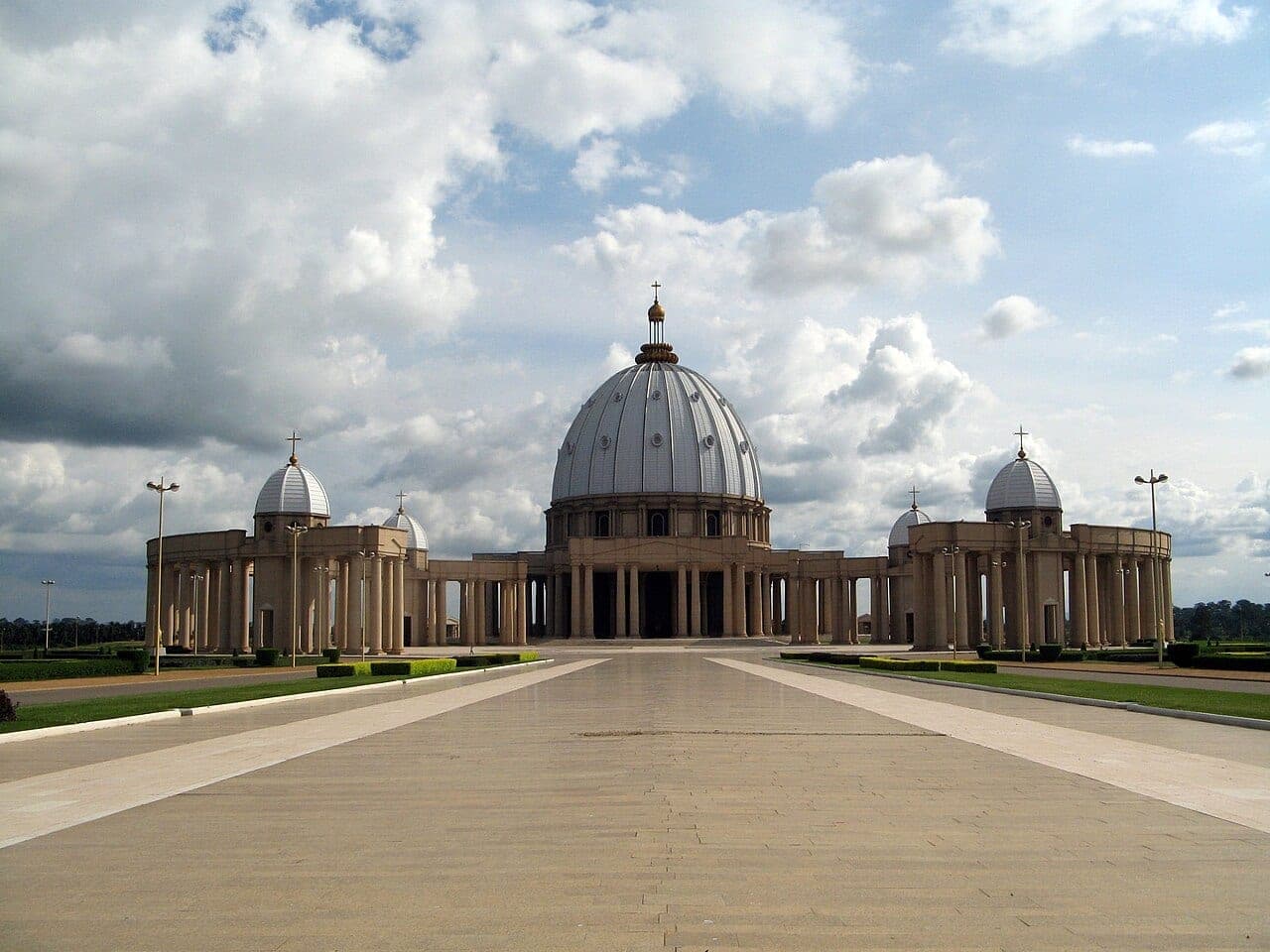
Ivory Coast, known in French as Cote d'Ivoire, is a West African nation whose very name records a single commodity that European traders once prized along this stretch of the Gulf of Guinea. Behind that trading label lies a country of many peoples: Akan goldsmiths and the Baoule who broke away from Ashanti kingship, Senufo carvers of the northern savanna, Mande merchants who carried Islam and long-distance trade, and Dan dancers of the western forests. Above them all, in the planned capital of Yamoussoukro, rises one of the largest churches on earth.
This archive gathers what Ivorians remember and how they choose to remember it. It records the masked ceremonies that guide the dead toward the ancestors, the coffee and cocoa groves that remade an economy, the languages spoken in market and mosque and church, and the customs of grief that hold families together through loss. What follows is a record of places, peoples and practices, written so that later generations can trace where they came from and what their elders held sacred.
Ivory Coast sits on the West African coast, bordered by Liberia and Guinea to the west, Mali and Burkina Faso to the north, and Ghana to the east. Its population passed roughly 31.5 million by the mid-2020s, making it the third-most populous country in West Africa (Wikipedia). The nation keeps two capitals: Yamoussoukro is the official political capital, while Abidjan remains the largest city and the economic center of the country.
The population is drawn from several broad groupings. Akan peoples, who include the Baoule, form the largest share at close to 38 percent; Northern Mande peoples, among them the Malinke and Dioula, and Voltaic or Gur peoples such as the Senufo each account for about a fifth; Kru peoples, including the Dan or Yacouba and the Guere, make up around nine percent (Wikipedia). French is the official language, shared alongside some 78 indigenous tongues. Islam, Christianity and traditional religions are all widely practiced.
Agriculture shaped the modern nation. Ivory Coast is the world's largest producer and exporter of cocoa, and coffee long ran beside it as a second pillar of export wealth (Wikipedia). These crops, expanded during and after the colonial period, funded the roads, schools and monuments that define the country's public heritage today.
Abidjan is the commercial heart of Ivory Coast and one of the largest urban areas in French-speaking Africa. Built around the Ebrie Lagoon, its Plateau district of towers, the Cocody residential quarter, and the Treichville and Adjame markets carry the memory of a port town that grew into a regional capital. St. Paul's Cathedral and the national museum anchor its cultural life.
Yamoussoukro, birthplace of the country's first president, became the official capital in 1983. It is best known for the Basilica of Our Lady of Peace, whose dome rises 158 meters and whose interior, at roughly 30,000 square meters, is listed by Guinness World Records as the largest church building in the world (Wikipedia).
Grand-Bassam, about 40 kilometers east of Abidjan, served as the first French colonial capital between 1893 and 1896. Its preserved colonial quarter and the neighboring N'zima fishing village earned it inscription on the UNESCO World Heritage List in 2012 (UNESCO).
Bouake, in the center of the country, is a major crossroads and market city and the second-largest urban area. It sits within Baoule country and became a focal point during the civil conflicts of the 2000s.
Korhogo, in the far north, is the principal Senufo city and a center of craft heritage. It gives its name to the hand-painted Korhogo cloth, whose figures of animals, hunters and masks are drawn in fermented mud pigment on handwoven cotton (Wikipedia).
The land that became Ivory Coast was settled over many centuries by peoples who moved into its forests and savannas from surrounding regions. Senufo and other Gur-speaking communities established farming and craft villages in the north. From the fourteenth century onward, Mande traders extended long-distance commerce and Islam southward, while later waves brought Akan peoples, including the Baoule, who according to tradition migrated westward from Ashanti lands in the eighteenth century under Queen Abla Pokou.
 Grand-Bassam was the French colonial capital until yellow fever drove the administration inland, and the town it left behind is the reason the place survives as heritage. Public domain, via Wikimedia Commons.
In the north, the Kong empire rose around 1710 under Seku Ouattara, a Dyula warrior and trader, becoming a Muslim commercial state that linked the savanna to trans-Saharan routes (Exodus). Along the coast, European ships had traded since the fifteenth century for gold, pepper and, above all, ivory, the commodity that gave the shoreline its lasting name.
France established formal control in the late nineteenth century, and Grand-Bassam became the colonial capital from 1893 to 1896 before a yellow fever epidemic pushed the administration elsewhere (UNESCO). Colonial rule reorganized land and labor around export crops and left deep social divisions, a period this archive records soberly rather than celebrates.
Ivory Coast gained independence from France on 7 August 1960 under Felix Houphouet-Boigny, who governed until his death in 1993 (Wikipedia). His long presidency brought decades of relative stability and economic growth. The years that followed were harder. A coup in 1999 was succeeded by armed conflict from 2002 to 2007 and a post-election crisis in 2010 and 2011 that briefly split the country. A new constitution was adopted in 2016. These events are noted here in brief, as part of a shared past that many Ivorian families lived through and still mourn.
French, inherited from the colonial era, is the official language and the medium of government, schooling and much of public life. Beside it live dozens of indigenous languages grouped into the Kwa, Mande, Gur and Kru families. Among these, Dioula, a Mande trade language closely related to Bambara, serves as a widely understood lingua franca in markets across much of the country (Wikipedia).
The country's name is itself a historical record. European mariners divided the Gulf of Guinea coastline by the goods traded there, naming the Gold Coast, the Grain Coast, the Slave Coast and the Ivory Coast. The French form, Cote d'Ivoire, translates directly as "coast of ivory." Since 1986 the government has asked that the French name be used in all languages, without translation, so that "Cote d'Ivoire" and "Ivory Coast" both remain in common use.
Ivory Coast is celebrated across the art world for its carving and masking traditions. The Baoule are known for finely finished portrait masks and for figures of the spirit spouse, the blolo bian and blolo bla, along with the Goli festival, a day-long celebration whose four masks mark the generations of the community (Bradt Guides). The Dan, or Yacouba, of the western forests carve smooth-featured masks that embody nature spirits and ancestors and appear at funerals, weddings and village feasts.
In the north, the Senufo carve some of the most recognizable sculpture in Africa: the rhythm pounder, the hornbill figure, the Kpelie face mask, and the Kponyungo helmet mask known as the firespitter (PLU). Senufo craft also lives in Korhogo cloth, whose stylized figures are painted in mud pigment on cotton woven by Dyula neighbors (Wikipedia).
Performance carries the culture as much as carving. The Zaouli dance of the Guro communities joins mask, costume, music and rapid footwork in a homage to feminine beauty, and it was inscribed on the UNESCO list of intangible cultural heritage in 2017 (UNESCO). In the modern era, Ivory Coast gave the continent coupe-decale, a dance-music style created around 2002 and 2003 by Douk Saga and his circle, which offered younger Ivorians an outlet during the years of unrest (CNN). At the table, the national kitchen is anchored by attieke, a fermented cassava couscous, alongside kedjenou chicken, foutou, and fried plantain.
Ivory Coast is one of the most religiously balanced countries in West Africa. Islam, most widespread in the north and among Mande and Gur peoples, is followed by roughly 42 percent of the population; Christianity, strongest in the south and among Akan communities, by close to 40 percent (Wikipedia). Roman Catholicism has a particularly visible presence, expressed most grandly in the Yamoussoukro basilica.
Traditional African religions continue alongside and often within these faiths. Belief in a creator god, in nature and bush spirits, and in the enduring presence of ancestors shapes daily conduct across many communities. Among the Senufo, initiation societies such as the Poro for men and the Sandogo for women instruct the young in honoring elders, ancestors and supernatural forces (Yorks Shona Gallery). Many Ivorians move comfortably between mosque or church and these older practices of the compound and the sacred grove.
Across Ivory Coast, funerals are among the most important events a family can hold, understood not only as farewells but as passages that settle the dead among the ancestors. Among the Senufo, this responsibility belongs to the Poro society. From a sacred grove outside the village, Poro elders oversee two days of drumming and masking that accompany the burial and guide the wandering soul away from the community and into the afterworld (Britannica). The Kponyungo firespitter helmet mask, with its composite animal features, presides over these rites; larger masks may charge through the village to clear the way for the departed spirit.
Among the Dan, carved masks appear at funerals to honor the deceased and to help their spirit make the transition to the ancestral world (Wikipedia). Baoule and other Akan communities mark death with extended mourning, drumming and the gathering of kin from far away, treating a proper funeral as a duty owed to the elder and to the living who remain. In each case the underlying belief is one of continuity: those who have died pass into the realm of the ancestors, from which they watch over their descendants.
Christian families observe these losses through a wake, a church service and burial, often blending liturgy with local customs of song and communal gathering. Muslim families follow Islamic practice: the body is washed and shrouded, the funeral prayer is offered, and burial follows quickly and simply, with a defined period of mourning for close relatives. Across all three traditions, the shared value is that no one should be forgotten, and that the community carries the memory of the dead together.
Ivorian records are French colonial and the family systems underneath them run in more than one direction.
The Akan peoples of the south and east, the Baoulé above all, are matrilineal: descent, inheritance and succession pass through the mother, and a man's heir is his sister's son. The Mandé and Voltaic peoples of the north and west are largely patrilineal. So there is no single Ivorian way to draw a family tree, and getting the direction wrong will produce a wrong one.
The griot tradition covers the Mandé north, and the Akan states kept stool histories and court genealogies as in Ghana.
A French état civil ran here from the 1890s and reached the coast far better than the interior; the files are divided between Abidjan and Aix-en-Provence. Cocoa built the twentieth-century economy and drew millions of workers from Burkina Faso, Mali and Guinea, whose descendants are Ivorian in every practical sense.
Which is where the archive becomes political. The doctrine of ivoirité, advanced from the 1990s, made national origin a qualification for office and for land, and identity documents became the instrument of it. The crises of 2002 and 2010 to 2011 were fought partly over who counted as Ivorian, and hundreds of thousands of people, particularly in the north and among migrant-descended communities, have had difficulty obtaining documents. Establishing a grandfather's birthplace is not an antiquarian question here.
Ivory Coast holds four UNESCO World Heritage sites, one cultural and three natural. The Historic Town of Grand-Bassam, inscribed in 2012, preserves the planned quarters of the first colonial capital and the adjoining N'zima village as evidence of exchange between Europe and Africa and of the road toward independence (UNESCO).
Tai National Park, listed in 1982, protects one of the last large blocks of primary rainforest in West Africa, home to pygmy hippopotamus and chimpanzees. Comoe National Park, inscribed in 1983, is the largest protected area in West Africa at roughly 11,500 square kilometers, spanning a transition from Guinea savanna to the drier Sudanian zone; it was placed on the List of World Heritage in Danger from 2003 to 2017 during the years of conflict and then restored (UNESCO). The Mount Nimba Strict Nature Reserve, shared with Guinea and first inscribed in 1981 and 1982, protects a mountain of exceptional biodiversity and has been listed as endangered since 1992 (UNESCO). Beyond built and natural sites, the Zaouli dance carries formal international recognition on the intangible heritage list.
Digital efforts are widening access to Ivorian heritage. UNESCO maintains detailed online records, maps and periodic reports for Grand-Bassam and the three natural sites, so that their condition can be followed from anywhere. Museum and university collections abroad, including African art holdings in Europe and North America, increasingly publish photographs and catalog data for Baoule, Senufo, Dan and Guro objects, allowing communities and researchers to study works held far from home.
For families, this same shift makes personal remembrance more durable. Photographs of an elder, recordings of a funeral drum or a Zaouli performance, and the names and histories of the dead can now be kept and shared across a diaspora that reaches from Abidjan to Paris and beyond. Confinity's own purpose belongs to this movement: to help people gather the stories, images and voices of those they have lost, so that memory is not left to chance.
Modern Ivorian culture reaches well past its borders. Coupe-decale spread from the nightclubs of the Ivorian diaspora into a pan-African dance phenomenon, and its rhythms and slang continue to shape West African popular music. Abidjan has grown into a regional media and fashion hub, and Ivorian footballers, among them a celebrated generation of national-team players, carried the country's name across the world's stadiums.
At home, artisans still carve masks and weave and paint Korhogo cloth, now sold to collectors and travelers as well as used in ceremony. Festivals such as the masked gatherings of the west and the cultural events of Korhogo and Man draw visitors and renew the transmission of craft to younger generations. This meeting of inherited form and contemporary life keeps Ivorian identity in motion rather than fixed in the past.
The Basilica of Our Lady of Peace remains the country's most striking act of ambition made permanent. Built between 1985 and 1989 and consecrated by Pope John Paul II in 1990, designed by the architect Pierre Fakhoury and commissioned by Houphouet-Boigny in his birthplace, it draws pilgrims and visitors to Yamoussoukro and holds the Guinness record as the largest church in the world (Wikipedia).
Heritage recovery is a success story of a quieter kind. The removal of Comoe National Park from the List of World Heritage in Danger in 2017, after years of degraded management during conflict, showed that a damaged site can be brought back through renewed protection (UNESCO). The international recognition of Zaouli in the same year gave the Guro communities a formal stake in safeguarding their own tradition. Together these achievements suggest a country steadily reclaiming and honoring the many strands of its inheritance.
Grand-Bassam was the French colonial capital until yellow fever drove the administration inland, and the town it left behind is the reason the place survives as heritage. Public domain, via Wikimedia Commons.
In the north, the Kong empire rose around 1710 under Seku Ouattara, a Dyula warrior and trader, becoming a Muslim commercial state that linked the savanna to trans-Saharan routes (Exodus). Along the coast, European ships had traded since the fifteenth century for gold, pepper and, above all, ivory, the commodity that gave the shoreline its lasting name.
France established formal control in the late nineteenth century, and Grand-Bassam became the colonial capital from 1893 to 1896 before a yellow fever epidemic pushed the administration elsewhere (UNESCO). Colonial rule reorganized land and labor around export crops and left deep social divisions, a period this archive records soberly rather than celebrates.
Ivory Coast gained independence from France on 7 August 1960 under Felix Houphouet-Boigny, who governed until his death in 1993 (Wikipedia). His long presidency brought decades of relative stability and economic growth. The years that followed were harder. A coup in 1999 was succeeded by armed conflict from 2002 to 2007 and a post-election crisis in 2010 and 2011 that briefly split the country. A new constitution was adopted in 2016. These events are noted here in brief, as part of a shared past that many Ivorian families lived through and still mourn.
French, inherited from the colonial era, is the official language and the medium of government, schooling and much of public life. Beside it live dozens of indigenous languages grouped into the Kwa, Mande, Gur and Kru families. Among these, Dioula, a Mande trade language closely related to Bambara, serves as a widely understood lingua franca in markets across much of the country (Wikipedia).
The country's name is itself a historical record. European mariners divided the Gulf of Guinea coastline by the goods traded there, naming the Gold Coast, the Grain Coast, the Slave Coast and the Ivory Coast. The French form, Cote d'Ivoire, translates directly as "coast of ivory." Since 1986 the government has asked that the French name be used in all languages, without translation, so that "Cote d'Ivoire" and "Ivory Coast" both remain in common use.
Ivory Coast is celebrated across the art world for its carving and masking traditions. The Baoule are known for finely finished portrait masks and for figures of the spirit spouse, the blolo bian and blolo bla, along with the Goli festival, a day-long celebration whose four masks mark the generations of the community (Bradt Guides). The Dan, or Yacouba, of the western forests carve smooth-featured masks that embody nature spirits and ancestors and appear at funerals, weddings and village feasts.
In the north, the Senufo carve some of the most recognizable sculpture in Africa: the rhythm pounder, the hornbill figure, the Kpelie face mask, and the Kponyungo helmet mask known as the firespitter (PLU). Senufo craft also lives in Korhogo cloth, whose stylized figures are painted in mud pigment on cotton woven by Dyula neighbors (Wikipedia).
Performance carries the culture as much as carving. The Zaouli dance of the Guro communities joins mask, costume, music and rapid footwork in a homage to feminine beauty, and it was inscribed on the UNESCO list of intangible cultural heritage in 2017 (UNESCO). In the modern era, Ivory Coast gave the continent coupe-decale, a dance-music style created around 2002 and 2003 by Douk Saga and his circle, which offered younger Ivorians an outlet during the years of unrest (CNN). At the table, the national kitchen is anchored by attieke, a fermented cassava couscous, alongside kedjenou chicken, foutou, and fried plantain.
Ivory Coast is one of the most religiously balanced countries in West Africa. Islam, most widespread in the north and among Mande and Gur peoples, is followed by roughly 42 percent of the population; Christianity, strongest in the south and among Akan communities, by close to 40 percent (Wikipedia). Roman Catholicism has a particularly visible presence, expressed most grandly in the Yamoussoukro basilica.
Traditional African religions continue alongside and often within these faiths. Belief in a creator god, in nature and bush spirits, and in the enduring presence of ancestors shapes daily conduct across many communities. Among the Senufo, initiation societies such as the Poro for men and the Sandogo for women instruct the young in honoring elders, ancestors and supernatural forces (Yorks Shona Gallery). Many Ivorians move comfortably between mosque or church and these older practices of the compound and the sacred grove.
Across Ivory Coast, funerals are among the most important events a family can hold, understood not only as farewells but as passages that settle the dead among the ancestors. Among the Senufo, this responsibility belongs to the Poro society. From a sacred grove outside the village, Poro elders oversee two days of drumming and masking that accompany the burial and guide the wandering soul away from the community and into the afterworld (Britannica). The Kponyungo firespitter helmet mask, with its composite animal features, presides over these rites; larger masks may charge through the village to clear the way for the departed spirit.
Among the Dan, carved masks appear at funerals to honor the deceased and to help their spirit make the transition to the ancestral world (Wikipedia). Baoule and other Akan communities mark death with extended mourning, drumming and the gathering of kin from far away, treating a proper funeral as a duty owed to the elder and to the living who remain. In each case the underlying belief is one of continuity: those who have died pass into the realm of the ancestors, from which they watch over their descendants.
Christian families observe these losses through a wake, a church service and burial, often blending liturgy with local customs of song and communal gathering. Muslim families follow Islamic practice: the body is washed and shrouded, the funeral prayer is offered, and burial follows quickly and simply, with a defined period of mourning for close relatives. Across all three traditions, the shared value is that no one should be forgotten, and that the community carries the memory of the dead together.
Ivorian records are French colonial and the family systems underneath them run in more than one direction.
The Akan peoples of the south and east, the Baoulé above all, are matrilineal: descent, inheritance and succession pass through the mother, and a man's heir is his sister's son. The Mandé and Voltaic peoples of the north and west are largely patrilineal. So there is no single Ivorian way to draw a family tree, and getting the direction wrong will produce a wrong one.
The griot tradition covers the Mandé north, and the Akan states kept stool histories and court genealogies as in Ghana.
A French état civil ran here from the 1890s and reached the coast far better than the interior; the files are divided between Abidjan and Aix-en-Provence. Cocoa built the twentieth-century economy and drew millions of workers from Burkina Faso, Mali and Guinea, whose descendants are Ivorian in every practical sense.
Which is where the archive becomes political. The doctrine of ivoirité, advanced from the 1990s, made national origin a qualification for office and for land, and identity documents became the instrument of it. The crises of 2002 and 2010 to 2011 were fought partly over who counted as Ivorian, and hundreds of thousands of people, particularly in the north and among migrant-descended communities, have had difficulty obtaining documents. Establishing a grandfather's birthplace is not an antiquarian question here.
Ivory Coast holds four UNESCO World Heritage sites, one cultural and three natural. The Historic Town of Grand-Bassam, inscribed in 2012, preserves the planned quarters of the first colonial capital and the adjoining N'zima village as evidence of exchange between Europe and Africa and of the road toward independence (UNESCO).
Tai National Park, listed in 1982, protects one of the last large blocks of primary rainforest in West Africa, home to pygmy hippopotamus and chimpanzees. Comoe National Park, inscribed in 1983, is the largest protected area in West Africa at roughly 11,500 square kilometers, spanning a transition from Guinea savanna to the drier Sudanian zone; it was placed on the List of World Heritage in Danger from 2003 to 2017 during the years of conflict and then restored (UNESCO). The Mount Nimba Strict Nature Reserve, shared with Guinea and first inscribed in 1981 and 1982, protects a mountain of exceptional biodiversity and has been listed as endangered since 1992 (UNESCO). Beyond built and natural sites, the Zaouli dance carries formal international recognition on the intangible heritage list.
Digital efforts are widening access to Ivorian heritage. UNESCO maintains detailed online records, maps and periodic reports for Grand-Bassam and the three natural sites, so that their condition can be followed from anywhere. Museum and university collections abroad, including African art holdings in Europe and North America, increasingly publish photographs and catalog data for Baoule, Senufo, Dan and Guro objects, allowing communities and researchers to study works held far from home.
For families, this same shift makes personal remembrance more durable. Photographs of an elder, recordings of a funeral drum or a Zaouli performance, and the names and histories of the dead can now be kept and shared across a diaspora that reaches from Abidjan to Paris and beyond. Confinity's own purpose belongs to this movement: to help people gather the stories, images and voices of those they have lost, so that memory is not left to chance.
Modern Ivorian culture reaches well past its borders. Coupe-decale spread from the nightclubs of the Ivorian diaspora into a pan-African dance phenomenon, and its rhythms and slang continue to shape West African popular music. Abidjan has grown into a regional media and fashion hub, and Ivorian footballers, among them a celebrated generation of national-team players, carried the country's name across the world's stadiums.
At home, artisans still carve masks and weave and paint Korhogo cloth, now sold to collectors and travelers as well as used in ceremony. Festivals such as the masked gatherings of the west and the cultural events of Korhogo and Man draw visitors and renew the transmission of craft to younger generations. This meeting of inherited form and contemporary life keeps Ivorian identity in motion rather than fixed in the past.
The Basilica of Our Lady of Peace remains the country's most striking act of ambition made permanent. Built between 1985 and 1989 and consecrated by Pope John Paul II in 1990, designed by the architect Pierre Fakhoury and commissioned by Houphouet-Boigny in his birthplace, it draws pilgrims and visitors to Yamoussoukro and holds the Guinness record as the largest church in the world (Wikipedia).
Heritage recovery is a success story of a quieter kind. The removal of Comoe National Park from the List of World Heritage in Danger in 2017, after years of degraded management during conflict, showed that a damaged site can be brought back through renewed protection (UNESCO). The international recognition of Zaouli in the same year gave the Guro communities a formal stake in safeguarding their own tradition. Together these achievements suggest a country steadily reclaiming and honoring the many strands of its inheritance.
National Overview
Notable Cities
Historical Foundations
Linguistic and Etymological Roots
Cultural Identity
Religion and Spirituality
Remembrance and Mourning Traditions
Tracing a Family in Ivory Coast
Heritage Preservation Efforts
Digital Heritage
Contemporary Cultural Influences
Success Stories
References and resources
- Ivory Coast, Wikipedia
- Basilica of Our Lady of Peace, Wikipedia
- Historic Town of Grand-Bassam, UNESCO World Heritage Centre
- Tai National Park, Wikipedia
- Comoe National Park, UNESCO World Heritage Centre
- Mount Nimba Strict Nature Reserve, UNESCO World Heritage Centre
- Zaouli, UNESCO Intangible Cultural Heritage
- Korhogo cloth, Wikipedia
- Art and tradition: the masks of Ivory Coast, Bradt Guides
- Senufo art and ritual, Encyclopaedia Britannica
- Coupe-decale and its origins, CNN