Heritage · Country
Ashanti Culture and Heritage
The Asante kept their ancestors in furniture. When a ruler dies the stool he sat on is blackened and moved to a room where it is fed every forty-two days, which makes the office continuous and the dead reachable. This is a guide to Ashanti heritage, from ten shrines that survived because nobody stopped using them to the gold that came home in 2024 on a three-year loan.Written to last.
By Confinity Heritage Editorial · Updated 2026-08-20 · 8-minute readQuiet tools, kept out of the way.
In a room at Kumasi that most people will never enter, a row of wooden stools sits blackened with soot, egg and animal blood. Each one belonged to a ruler who is dead. On a fixed cycle they are addressed, given food and drink, and asked for things, because in Asante practice the stool is where the ancestor stays. This is why the language of Asante politics is furniture: a person does not take a throne, they are enstooled, and a ruler who is removed is destooled.
The Asante built a state on that idea and lost most of its physical fabric to a series of British wars, the last of which was fought over a stool. What survived did so for a particular reason: ten shrine buildings at village sites, listed by UNESCO in 1980, are the last of their kind because their congregations never stopped using them, while the grander buildings that were merely important were destroyed.
Ashanti is one of the sixteen regions of Ghana, covering about 24,400 square kilometres of forest and transitional country in the centre and south of the country, with a population of roughly 5.4 million at the 2021 census, which makes it the most populous region in Ghana. The regional capital is Kumasi.
It is also something the map does not show. The Asante kingdom continues to exist alongside the Ghanaian state, with its own ruler, the Asantehene, its own hierarchy of paramount and divisional chiefs, its own courts for customary matters, and its own calendar of ceremonies. Ghana's constitution recognises chieftaincy and guarantees the institution, so the arrangement is not folklore; the current Asantehene, Otumfuo Osei Tutu II, was enstooled in April 1999 and has been an active figure in national mediation. Gold, cocoa and timber made the region rich, and Kumasi remains the commercial hub of the interior.
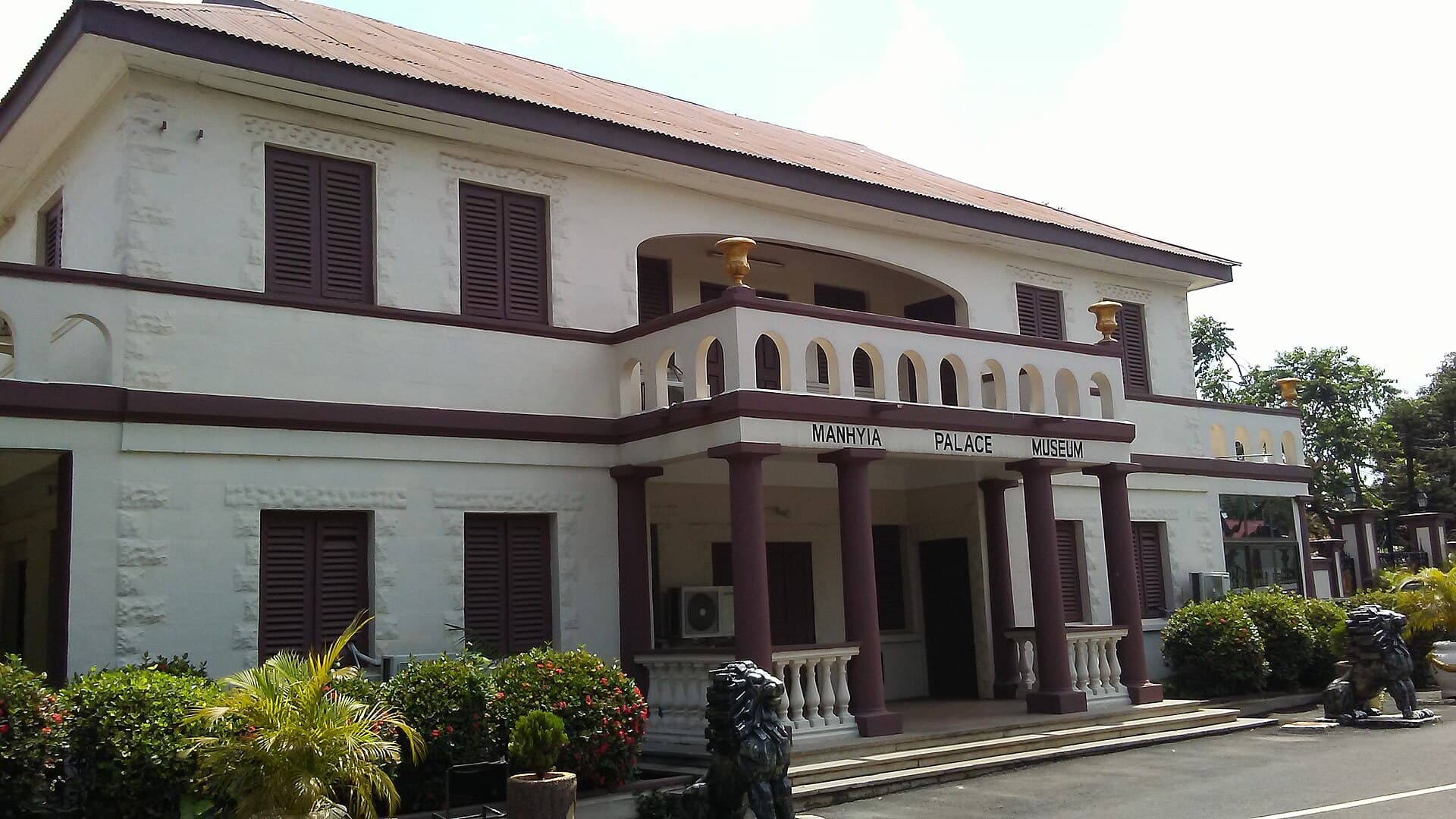
Kumasi. Founded around 1680 as the capital of the kingdom and still its centre. Manhyia Palace, built in 1925 for the return of the exiled Asantehene Prempeh I, is now the Manhyia Palace Museum, and the Prempeh II Jubilee Museum sits at the Cultural Centre. Kejetia is among the largest open-air markets in West Africa, and the colonial-era Kumasi Fort houses the armed forces museum.
Ntonso. The adinkra town, north of Kumasi, where the stamps are still cut from calabash and the dye is boiled from the bark of the badie tree. Cloth is printed here for funerals as it has been for two centuries.
Bonwire. The kente village, where the narrow-strip weaving associated worldwide with Ghana is produced on horizontal treadle looms and where particular patterns remain associated with particular families and offices.
Ejisu. The seat of Yaa Asantewaa, the queen mother who led the 1900 rising, and close to Besease, one of the ten shrine houses on the World Heritage list.
Obuasi. The gold town in the south of the region, worked industrially since the 1890s and by Asante miners long before that, and the reason a great deal of Asante wealth existed in the first place.
The Asante state was formed around 1701, when Osei Tutu united the Akan chiefdoms of the forest under Kumasi. The founding act was religious as much as political: the priest Okomfo Anokye is said to have called down from the sky a stool of solid gold, the Sika Dwa Kofi, which held the sunsum, the soul, of the whole nation. No one has ever sat on it. It is not a throne but the container of the people's collective existence, and that distinction becomes the hinge of the later history.
The kingdom grew into the dominant power of the region, controlling trade routes to the coast and the interior, and fought a long series of wars with Britain across the nineteenth century. In 1874 a British force under Wolseley entered Kumasi, looted the palace and blew it up. In 1895 the same campaign destroyed the royal mausoleum at Bantama, where the remains of previous Asantehenes were kept. In 1896 the Asantehene Prempeh I was deposed and exiled, eventually to the Seychelles.
Then in 1900 the British governor, Frederick Hodgson, sat down in Kumasi and demanded the Golden Stool to sit on. The demand revealed that he had understood nothing about what he was asking for, and the Asante rose. Yaa Asantewaa, queen mother of Ejisu, led the resistance in what is remembered as the War of the Golden Stool. The rising was defeated, the region annexed in 1902, and Yaa Asantewaa exiled to the Seychelles where she died. The stool itself was never found by the British; it had been hidden, and it survives.
Prempeh I was allowed home in 1924 and restored as ruler of Kumasi in 1926, and the Asante Confederacy was formally restored in 1935. That sequence, destruction followed by negotiated restoration, is why so much Asante heritage exists as a reconstruction of something with a documented gap in the middle.
The language is Asante Twi, a dialect of Akan, spoken by several million people in the region and understood far beyond it; Akan as a whole is the most widely spoken language in Ghana and is used in broadcasting, schooling and popular music. Unlike most of the languages covered in this series, it is not endangered, and the interesting heritage questions here concern writing rather than survival.
The Asante wrote in symbols before they wrote in letters. Adinkra is a corpus of several hundred stamped designs, each carrying a name and a proverb, so that a cloth is a text: Gye Nyame, except for God; Sankofa, go back and get it, a bird turning its head to take an egg from its own back, which has become the general emblem of retrieving what was left behind. Adinkra was originally and specifically funerary cloth, and the name is usually connected to a root meaning farewell. The same symbols appear in the bas-relief plasterwork of the shrine buildings, which is how a UNESCO listing of architecture is also a listing of writing.
Names carry information too. Akan personal names record the day of the week a person was born, so that Kofi is a Friday-born male and Ama a Saturday-born female, and the Golden Stool's own name, Sika Dwa Kofi, marks it as having arrived on a Friday.
Asante society is matrilineal. A person belongs to their mother's abusua, one of eight clans, and inherits position and property through that line, so the heir to a stool is typically a sister's son rather than a son. Alongside this runs the ntoro, inherited from the father, which carries spiritual character. Queen mothers, the ohemaa of each stool, are not consorts but office-holders with the constitutional right to nominate candidates and the standing to object, which is the office Yaa Asantewaa held.
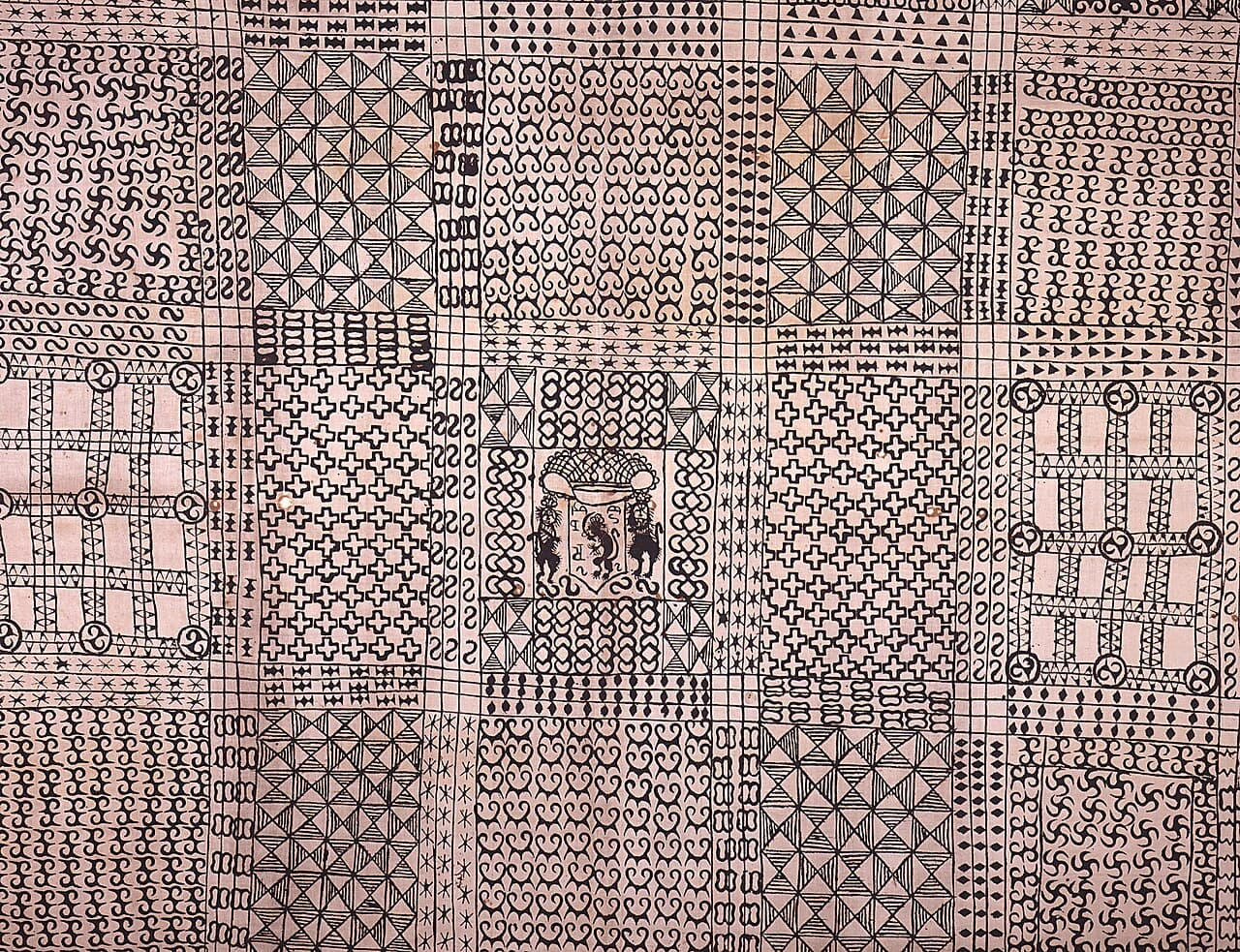 Adinkra recorded in 1825, each stamp carrying a name and a proverb. The cloth was funerary before it was anything else. Public domain, via Wikimedia Commons.
Time is organised on the adaduanan, a forty-two-day cycle, and the ceremonial year turns on the Adae. Akwasidae falls on a Sunday and Awukudae on a Wednesday within each cycle, and on these days the Asantehene appears in public, the blackened stools are given offerings in private, and the court, its drums and its regalia are on display. The larger Adae Kese is celebrated at longer intervals. For a visitor, Akwasidae at Manhyia is the most accessible entry into Asante ceremony, and it is a working religious occasion rather than a performance.
The crafts are court crafts and remain in production: kente weaving at Bonwire, adinkra printing at Ntonso, goldweights cast in brass by the lost-wax method for weighing gold dust, and the stools themselves, carved from a single block of osese wood with a design that indicates the owner's rank.
Most people in the Ashanti Region are Christian, and there is a Muslim minority of long standing in Kumasi's northern quarters. Alongside and often within that, Asante traditional religion continues to operate. It recognises a distant supreme god, Nyame, a body of lesser deities called abosom who occupy rivers, lakes and groves and who are served by priests at shrine houses, and the nsamanfo, the ancestors, who are the closest and most consulted of the three.
Lake Bosumtwi, a meteorite crater lake south-east of Kumasi, is the most important natural sacred site. The dead are believed to take leave of the abosom there, and rules have long governed how it may be fished and approached.
The ancestors are not an abstraction. They are individual, named, and remembered as people who once held a specific office, and they are expected to take an interest in the living community's affairs. This is what makes the stool room a functional institution rather than a museum: the offerings made there are made to somebody in particular, on a schedule, and the failure to make them is a failure with consequences.
The Asante funeral is the largest thing that happens in most people's lives, and it happens after they die. Rites run in stages: a burial, an eighth-day observance usually called the one week, a fortieth-day rite, and an anniversary, with the main public funeral often held weeks or months after death so that relatives can travel and money can be raised. Funerals are typically held on Saturdays, and in Kumasi the Saturday funeral is a fixture of the week that shapes traffic, catering, printing and cloth-selling.
The colours are red and black. Black is worn through the period of mourning and red on the day itself, or the two are divided by closeness of relationship, and mourners wear adinkra cloth stamped with symbols chosen to say something specific about the dead person. Deep red, kobene, marks the closest bereaved. White is worn instead when the person died very old, because that death is understood as a completion rather than a loss.
Cost is a genuine social problem and is discussed as one in Ghana. Families borrow to hold funerals of a scale that reflects on the lineage, donations are recorded publicly and reciprocated at the next funeral, and churches and governments have periodically urged restraint without much effect. The reason the pressure is so strong is that the funeral is where a lineage demonstrates it still exists.
Above all of this sits the blackened stool. When an Asantehene or a chief dies, the stool of the office is smoked and blackened and taken into the stool house, where it becomes the seat of that ancestor and receives offerings at each Adae. The ruler's body is buried; the ruler's office and presence continue in an object that can be fed. That is why the destruction of the Bantama mausoleum in 1895 registered as an attack rather than a demolition, and why a British governor's request to sit on the Golden Stool started a war.
Asante keeps its ancestors in furniture, and the furniture is the archive.
When a ruler dies, the stool he sat on is blackened with soot, eggs and animal fat and moved to the stool house, where it is fed every forty-two days on the adae. The stools are kept in order of succession, so the room is a genealogy in objects, and the linguist's staff, the drum texts and the oral historians attached to each stool carry the names. The Golden Stool itself is not sat on by anyone: it holds the soul of the nation and was the object of the war of 1900, fought because a British governor demanded to sit on it.
The Manhyia Palace archives in Kumasi hold the written record of the Asantehene's court, including the material assembled after the exile of Prempeh I to the Seychelles in 1896.
The British took a great deal in 1874 and 1896. In 2024 pieces of the looted royal regalia returned from the British Museum and the Victoria and Albert Museum on a three-year loan, renewable, while seven items from the Fowler Museum in Los Angeles were returned outright. The distinction matters and Asante commentators have made it repeatedly.
For ordinary families the record is the abusua, the matrilineal clan, of which there are eight, and descent runs through the mother. The funeral is where a family's connections are stated publicly.
The Asante Traditional Buildings were inscribed by UNESCO in 1980. The listing covers ten shrine houses at village sites around Kumasi, built of timber, bamboo and mud plaster in a wattle-and-daub technique, their lower walls carrying bold bas-relief patterns drawn from the adinkra corpus. They are the last surviving examples of a style that once covered Asante towns, and UNESCO's own account is explicit that they survived because traditional worship continued at them, which meant they went on being maintained. The recognised threat is the reverse of that: as religious use declines, the maintenance cycle that keeps a mud building standing declines with it, and the material is unforgiving of a missed season.
Restitution is the other live front. In 2024 the Manhyia Palace Museum, reopened after refurbishment, mounted an exhibition called Homecoming, bringing together seventeen items from the Victoria and Albert Museum, fifteen from the British Museum and seven that had been in the Fowler Museum in California. Almost all had been taken from Kumasi in 1874 or 1896. The British material returned on a three-year loan with an option to extend, not as a transfer of ownership, because United Kingdom law restricts what national museums may permanently give up; the Fowler items were returned outright. Opinion in Ghana on whether a loan of stolen property is an adequate outcome is divided, and the Asantehene's approach has been to accept the loan and continue the argument.
The Manhyia Palace Museum, opened in 1995 in the 1925 palace, and the Prempeh II Jubilee Museum at the Kumasi Cultural Centre are the principal institutional collections, alongside the National Museum in Accra.
The most substantial digital record of Asante material culture sits in the institutions that hold it, which means the catalogues of the British Museum, the V&A and other European and American collections are, in practice, a large part of the searchable inventory of Asante gold, brass and textiles. The British Museum publishes a page on the contested status of the Asante regalia in its collection. This is an uncomfortable arrangement and is recognised as one: the online record of a heritage is most complete where the objects were taken to.
Ghanaian digitisation is growing from a smaller base. Adinkra symbol sets have been catalogued and encoded for design and teaching use, which has given the corpus a second life in software, textiles and branding well beyond its funerary origin. Manhyia Palace Museum has developed its own publishing and exhibition programme around the 2024 return, and Ghanaian universities hold oral history and chieftaincy records that are being catalogued.
The gap is in the stool houses, and it is deliberate. Much of what is kept there is not photographed or published, because access is restricted by the institution itself rather than by any shortage of technology.
Kente is probably the single most recognisable African textile in the world, worn at graduations across the United States and adopted as a general emblem of African descent, a use that has almost nothing to do with the Asante rank system that originally governed which patterns a person could wear. Adinkra symbols have travelled just as far, into logos, tattoos and typefaces, with Sankofa in particular becoming a widely used idea in the African diaspora.
Within Ghana, the Asantehene's office functions as a national institution rather than a regional one, with a record of mediating in disputes including the long-running conflict in Dagbon, and the enstoolment and jubilee ceremonies at Manhyia are major national events.
The funeral economy is the most argued-about contemporary expression of the tradition. Printing, cloth, brass bands, catering, video and event management form a substantial sector, obituary posters are a genuine popular art form, and the same practice draws steady criticism at home for the debt it produces. Both the pride and the criticism are internal to Ghana, and this profile records the argument rather than settling it.
Ten buildings kept standing by being used. The 1980 World Heritage listing protects the last Asante shrine houses, which survived precisely because worship at them never stopped and maintenance continued with it.
A stool that was never surrendered. The Golden Stool was hidden rather than handed over, survived the annexation, and remains the object in which the Asante locate their collective existence.
Regalia back in Kumasi after 150 years. The 2024 Homecoming exhibition returned thirty-nine looted items to Manhyia, and the argument about the terms of that return continues in the open.
A restored institution with real functions. The Asantehene's court, abolished in effect in 1896 and restored in 1935, now operates within Ghana's constitutional order with recognised customary jurisdiction and a national mediating role.
Adinkra recorded in 1825, each stamp carrying a name and a proverb. The cloth was funerary before it was anything else. Public domain, via Wikimedia Commons.
Time is organised on the adaduanan, a forty-two-day cycle, and the ceremonial year turns on the Adae. Akwasidae falls on a Sunday and Awukudae on a Wednesday within each cycle, and on these days the Asantehene appears in public, the blackened stools are given offerings in private, and the court, its drums and its regalia are on display. The larger Adae Kese is celebrated at longer intervals. For a visitor, Akwasidae at Manhyia is the most accessible entry into Asante ceremony, and it is a working religious occasion rather than a performance.
The crafts are court crafts and remain in production: kente weaving at Bonwire, adinkra printing at Ntonso, goldweights cast in brass by the lost-wax method for weighing gold dust, and the stools themselves, carved from a single block of osese wood with a design that indicates the owner's rank.
Most people in the Ashanti Region are Christian, and there is a Muslim minority of long standing in Kumasi's northern quarters. Alongside and often within that, Asante traditional religion continues to operate. It recognises a distant supreme god, Nyame, a body of lesser deities called abosom who occupy rivers, lakes and groves and who are served by priests at shrine houses, and the nsamanfo, the ancestors, who are the closest and most consulted of the three.
Lake Bosumtwi, a meteorite crater lake south-east of Kumasi, is the most important natural sacred site. The dead are believed to take leave of the abosom there, and rules have long governed how it may be fished and approached.
The ancestors are not an abstraction. They are individual, named, and remembered as people who once held a specific office, and they are expected to take an interest in the living community's affairs. This is what makes the stool room a functional institution rather than a museum: the offerings made there are made to somebody in particular, on a schedule, and the failure to make them is a failure with consequences.
The Asante funeral is the largest thing that happens in most people's lives, and it happens after they die. Rites run in stages: a burial, an eighth-day observance usually called the one week, a fortieth-day rite, and an anniversary, with the main public funeral often held weeks or months after death so that relatives can travel and money can be raised. Funerals are typically held on Saturdays, and in Kumasi the Saturday funeral is a fixture of the week that shapes traffic, catering, printing and cloth-selling.
The colours are red and black. Black is worn through the period of mourning and red on the day itself, or the two are divided by closeness of relationship, and mourners wear adinkra cloth stamped with symbols chosen to say something specific about the dead person. Deep red, kobene, marks the closest bereaved. White is worn instead when the person died very old, because that death is understood as a completion rather than a loss.
Cost is a genuine social problem and is discussed as one in Ghana. Families borrow to hold funerals of a scale that reflects on the lineage, donations are recorded publicly and reciprocated at the next funeral, and churches and governments have periodically urged restraint without much effect. The reason the pressure is so strong is that the funeral is where a lineage demonstrates it still exists.
Above all of this sits the blackened stool. When an Asantehene or a chief dies, the stool of the office is smoked and blackened and taken into the stool house, where it becomes the seat of that ancestor and receives offerings at each Adae. The ruler's body is buried; the ruler's office and presence continue in an object that can be fed. That is why the destruction of the Bantama mausoleum in 1895 registered as an attack rather than a demolition, and why a British governor's request to sit on the Golden Stool started a war.
Asante keeps its ancestors in furniture, and the furniture is the archive.
When a ruler dies, the stool he sat on is blackened with soot, eggs and animal fat and moved to the stool house, where it is fed every forty-two days on the adae. The stools are kept in order of succession, so the room is a genealogy in objects, and the linguist's staff, the drum texts and the oral historians attached to each stool carry the names. The Golden Stool itself is not sat on by anyone: it holds the soul of the nation and was the object of the war of 1900, fought because a British governor demanded to sit on it.
The Manhyia Palace archives in Kumasi hold the written record of the Asantehene's court, including the material assembled after the exile of Prempeh I to the Seychelles in 1896.
The British took a great deal in 1874 and 1896. In 2024 pieces of the looted royal regalia returned from the British Museum and the Victoria and Albert Museum on a three-year loan, renewable, while seven items from the Fowler Museum in Los Angeles were returned outright. The distinction matters and Asante commentators have made it repeatedly.
For ordinary families the record is the abusua, the matrilineal clan, of which there are eight, and descent runs through the mother. The funeral is where a family's connections are stated publicly.
The Asante Traditional Buildings were inscribed by UNESCO in 1980. The listing covers ten shrine houses at village sites around Kumasi, built of timber, bamboo and mud plaster in a wattle-and-daub technique, their lower walls carrying bold bas-relief patterns drawn from the adinkra corpus. They are the last surviving examples of a style that once covered Asante towns, and UNESCO's own account is explicit that they survived because traditional worship continued at them, which meant they went on being maintained. The recognised threat is the reverse of that: as religious use declines, the maintenance cycle that keeps a mud building standing declines with it, and the material is unforgiving of a missed season.
Restitution is the other live front. In 2024 the Manhyia Palace Museum, reopened after refurbishment, mounted an exhibition called Homecoming, bringing together seventeen items from the Victoria and Albert Museum, fifteen from the British Museum and seven that had been in the Fowler Museum in California. Almost all had been taken from Kumasi in 1874 or 1896. The British material returned on a three-year loan with an option to extend, not as a transfer of ownership, because United Kingdom law restricts what national museums may permanently give up; the Fowler items were returned outright. Opinion in Ghana on whether a loan of stolen property is an adequate outcome is divided, and the Asantehene's approach has been to accept the loan and continue the argument.
The Manhyia Palace Museum, opened in 1995 in the 1925 palace, and the Prempeh II Jubilee Museum at the Kumasi Cultural Centre are the principal institutional collections, alongside the National Museum in Accra.
The most substantial digital record of Asante material culture sits in the institutions that hold it, which means the catalogues of the British Museum, the V&A and other European and American collections are, in practice, a large part of the searchable inventory of Asante gold, brass and textiles. The British Museum publishes a page on the contested status of the Asante regalia in its collection. This is an uncomfortable arrangement and is recognised as one: the online record of a heritage is most complete where the objects were taken to.
Ghanaian digitisation is growing from a smaller base. Adinkra symbol sets have been catalogued and encoded for design and teaching use, which has given the corpus a second life in software, textiles and branding well beyond its funerary origin. Manhyia Palace Museum has developed its own publishing and exhibition programme around the 2024 return, and Ghanaian universities hold oral history and chieftaincy records that are being catalogued.
The gap is in the stool houses, and it is deliberate. Much of what is kept there is not photographed or published, because access is restricted by the institution itself rather than by any shortage of technology.
Kente is probably the single most recognisable African textile in the world, worn at graduations across the United States and adopted as a general emblem of African descent, a use that has almost nothing to do with the Asante rank system that originally governed which patterns a person could wear. Adinkra symbols have travelled just as far, into logos, tattoos and typefaces, with Sankofa in particular becoming a widely used idea in the African diaspora.
Within Ghana, the Asantehene's office functions as a national institution rather than a regional one, with a record of mediating in disputes including the long-running conflict in Dagbon, and the enstoolment and jubilee ceremonies at Manhyia are major national events.
The funeral economy is the most argued-about contemporary expression of the tradition. Printing, cloth, brass bands, catering, video and event management form a substantial sector, obituary posters are a genuine popular art form, and the same practice draws steady criticism at home for the debt it produces. Both the pride and the criticism are internal to Ghana, and this profile records the argument rather than settling it.
Ten buildings kept standing by being used. The 1980 World Heritage listing protects the last Asante shrine houses, which survived precisely because worship at them never stopped and maintenance continued with it.
A stool that was never surrendered. The Golden Stool was hidden rather than handed over, survived the annexation, and remains the object in which the Asante locate their collective existence.
Regalia back in Kumasi after 150 years. The 2024 Homecoming exhibition returned thirty-nine looted items to Manhyia, and the argument about the terms of that return continues in the open.
A restored institution with real functions. The Asantehene's court, abolished in effect in 1896 and restored in 1935, now operates within Ghana's constitutional order with recognised customary jurisdiction and a national mediating role.
National Overview
Notable Cities
Historical Foundations
Linguistic and Etymological Roots
Cultural Identity
Religion and Spirituality
Remembrance and Mourning Traditions
Tracing a Family in Ashanti
Heritage Preservation Efforts
Digital Heritage
Contemporary Cultural Influences
Success Stories
References and resources
- UNESCO, Asante Traditional Buildings: the 1980 inscription of the ten shrine houses.
- Asante Traditional Buildings, Wikipedia: construction, adinkra reliefs and the reason for their survival.
- British Museum, Asante gold regalia: the museum's account of the contested objects.
- Manhyia Palace Museum, Homecoming: the 2024 exhibition and its loans.
- Golden Stool, Wikipedia: the Sika Dwa Kofi and the 1900 war.
- Yaa Asantewaa, Wikipedia: the queen mother of Ejisu and the rising.
- Adinkra symbols, Wikipedia: the corpus, its funerary origin and its meanings.
- Akwasidae Festival, Wikipedia: the forty-two-day cycle and the ceremony at Manhyia.
- Ashanti Empire, Wikipedia: the founding, the wars and the restoration.
- Ashanti Region, Wikipedia: area, population and administration.