Heritage · Country
Ireland Culture and Heritage
From Newgrange and the Book of Kells to the wake, the caoineadh and the digitised folk memory of dúchas.ie, Ireland keeps one of the world's great cultural memories. A guide to the island's heritage and to how the Irish remember their dead, their language and their scattered millions.Written to last.
By Confinity Heritage Editorial · 2026-07-10 · 8-minute readQuiet tools, kept out of the way.
Few nations have made remembering so central a craft as Ireland. A tomb in the Boyne Valley was catching the winter solstice sunrise a thousand years before the pyramids rose; monks on the island's edge copied the classical and Christian inheritance of Europe while the continent burned; and in the 1930s the Irish state sent schoolchildren into every parish to write down the stories of their elders, creating one of the largest folklore archives on earth, now free to read online. Between the megalith and the database run the seanchaí's fireside tales, the illuminated page, the lament sung over a coffin and the ballad carried to Boston and Sydney.
Ireland's memory is also a memory of loss: a language pushed to the western shore, a famine that killed a million people and scattered millions more, an emigration so constant that farewells were mourned like deaths. Precisely because so much was nearly lost, the Irish have become world leaders in getting it back, reviving, recording and digitising with an energy that makes this island a model for every community that wants to keep its past.
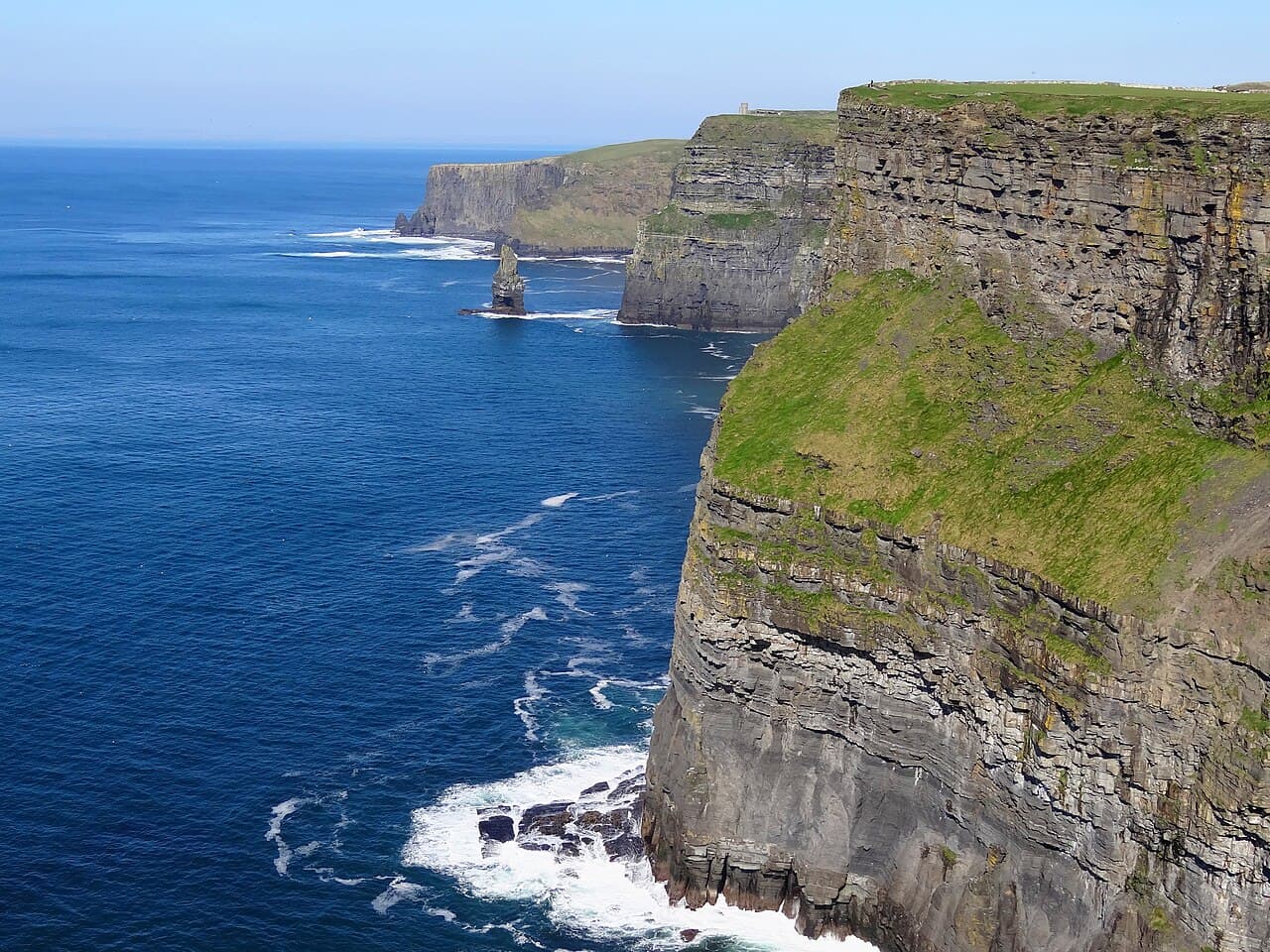
Ireland lies at the north-western edge of Europe, an island of about 84,000 square kilometres in the Atlantic, of which the Republic of Ireland occupies twenty-six counties and some 70,273 square kilometres; the six counties of Northern Ireland, partitioned in 1921, remain part of the United Kingdom. The landscape is a bowl: a limestone central plain of bogs, lakes and pasture ringed by coastal mountains, rising to Carrauntoohil in Kerry at 1,038 metres, and edged by a fretted Atlantic coast of cliffs, bays and islands, under the mild, wet climate that grows the grasslands of the Emerald Isle.
The Republic's population passed 5.1 million at the 2022 census, the first time it had exceeded five million since 1851, a statistic that quietly contains the whole story of the Famine and emigration. Once remarkable for homogeneity, Ireland is now visibly diverse, with roughly one in eight residents born abroad, alongside the indigenous Irish Traveller minority, formally recognised as an ethnic group in 2017. Irish (Gaeilge) is the first official language and English the second; Ireland has been a member of the European Union since 1973, and it is the only country in the world whose national emblem is a musical instrument, the harp. The four ancient provinces, Leinster, Munster, Connacht and Ulster, survive in sport, speech and self-description long after losing any administrative role.
Dublin. The capital grew from a Viking longphort founded in 841 beside the dark tidal pool, Dubh Linn, that named it; its Irish name, Baile Átha Cliath, remembers an older ford of hurdles on the Liffey. Its layers run from the Viking and medieval streets around Christ Church and St Patrick's cathedrals through the Georgian squares to the General Post Office, headquarters of the 1916 Rising. Trinity College, founded in 1592, displays the Book of Kells in its Old Library; the National Museum on Kildare Street keeps the Ardagh Chalice, the Tara Brooch and the eerie bog bodies; and Kilmainham Gaol holds the memory of the independence struggle. A UNESCO City of Literature since 2010, Dublin claims three of Ireland's four Nobel laureates in literature as native sons.
Cork. Ireland's second city began as a sixth-century monastery of St Finbarr on marshy islands in the River Lee. A medieval trading port and later the greatest butter market in the world, it keeps its commercial soul in the English Market, trading since 1788, and its voice in the bells of Shandon. Its stubborn republicanism in the War of Independence, when British forces burned its centre in 1920, earned it the name of the rebel city.
Galway. The City of the Tribes, after the fourteen merchant families who ruled it, faces the Atlantic at the mouth of the River Corrib. The Claddagh, the old fishing village at its edge, gave the world the Claddagh ring, and the city is the urban gateway to the Connemara Gaeltacht and the Aran Islands, which makes it the most Irish-speaking of Ireland's cities. Its arts festival and race week fill the summer, and it served as European Capital of Culture in 2020.
Limerick. Founded by Vikings on an island in the Shannon, Limerick is guarded by King John's Castle and remembered in the Treaty Stone across the river, where the Treaty of Limerick of 1691 ended the Williamite war and opened the era of the Penal Laws. Georgian streets, rugby and Frank McCourt's Angela's Ashes layer its modern identity.
Waterford. Ireland's oldest city, founded by Vikings in 914, keeps the country's finest Viking and medieval quarter in the Viking Triangle, crowned by Reginald's Tower, and a craft tradition made world-famous by Waterford Crystal.
People have lived on the island for around ten thousand years. Neolithic farmers arrived about 4000 BC and left astonishing monuments: the Céide Fields in Mayo, the most extensive Stone Age field system known anywhere, and the passage tombs of Brú na Bóinne, where Newgrange, built around 3200 BC, older than Stonehenge and the Great Pyramid, admits a beam of sunrise light into its burial chamber for a few minutes each winter solstice. The complex, with Knowth and Dowth, has been a UNESCO World Heritage Site since 1993, and its spirals and lozenges are Europe's greatest concentration of megalithic art.
Iron Age Ireland spoke a Celtic language and organised itself into túatha, petty kingdoms, under sacral kings; the island was never conquered by Rome, which is why its early literature preserves an archaic European world found nowhere else. Christianity arrived in the fifth century, associated above all with St Patrick, and fused with Gaelic society to produce the monastic golden age: from the sixth to the ninth centuries, monasteries such as Clonmacnoise, Glendalough and sea-girt Sceilg Mhichíl (a World Heritage Site since 1996) made Ireland the "island of saints and scholars", sending missionaries like Colmcille and Columbanus across Britain and the continent while scribes produced the high crosses, metalwork and manuscripts of insular art, culminating in the Book of Kells around the year 800.
Viking raids began in 795 and brought Ireland its first towns, Dublin, Waterford, Wexford, Cork, Limerick, before Brian Boru broke Norse power at Clontarf in 1014. The Anglo-Norman invasion of 1169 opened eight centuries of English involvement, but it was the Tudor and Stuart conquests that broke Gaelic Ireland: defeat at Kinsale in 1601, the Flight of the Earls in 1607, the Plantation of Ulster, Cromwell's devastation, and after 1691 the Penal Laws that dispossessed the Catholic majority. The Great Famine of 1845 to 1852, when the potato crop failed under blight, killed around a million people and drove more than a million abroad; the population fell from over eight million and did not stop falling for a century. Out of that trauma came both mass emigration and cultural revival: the Gaelic Athletic Association (1884), the Gaelic League (1893) and the Abbey Theatre (1904) rebuilt Irish self-belief, and the Easter Rising of 1916, the War of Independence, the Treaty of 1921 and a bitter civil war produced the independent state, declared a republic in 1949. The Troubles in Northern Ireland (1969 to 1998) ended with the Good Friday Agreement, whose architecture of shared identity still frames the island's politics of memory.
Irish is one of Europe's oldest living literary languages. A Goidelic Celtic tongue, it was first written in the ogham alphabet, strokes cut along the edges of standing stones from around the fourth century, and by the seventh century monks were writing Irish in the Latin alphabet, giving the language the oldest vernacular literature in western Europe north of the Alps. From Irish come the island's names for itself: Éire derives from Ériu, a goddess of the land in the mythological cycle, and English "Ireland" simply adds "land" to her name, while the Romans knew the island as Hibernia. The map remains a Gaelic text: Dublin's Baile Átha Cliath, every "Bally" (baile, homestead), "Kil" (cill, church), "Dun" (dún, fort) and "Knock" (cnoc, hill) on the island records the language that named the landscape.
The language's modern history is one of catastrophe and stubborn recovery. Still the majority tongue around 1800, Irish collapsed in the nineteenth century under anglicised schooling, poverty and above all the Famine, which struck Irish-speaking districts hardest and sent their survivors into the English-speaking world. The Gaelic League, founded in 1893 by Douglas Hyde, made revival a national cause, and the independent state made Irish its first official language, compulsory in schools and constitutive of identity. Today the picture is mixed and genuinely alive: at the 2022 census 1.87 million people, some forty per cent of the population, reported the ability to speak Irish, while around 72,000 speak it daily outside the education system, roughly 20,000 of them in the Gaeltacht, the officially designated Irish-speaking districts along the western seaboard where the language remains the thread of community life. Gaelscoileanna, Irish-medium schools, flourish in the cities; the television station TG4 has broadcast in Irish since 1996; and on 1 January 2022 Irish became a full official working language of the European Union.
Irish identity was carried for centuries less by institutions than by performance: the story told, the tune played, the game contested. The seanchaí, the traditional storyteller, was the living archive of the community, keeper of genealogies, place-lore and the great tale-cycles; Peig Sayers of the Blasket Islands, from whom the Irish Folklore Commission collected several hundred tales running to thousands of manuscript pages, was described by its archivist as one of the greatest women storytellers of modern times. The tales the seanchaithe kept stretch back to the Ulster Cycle and its great saga, the Táin Bó Cúailnge, the cattle raid of Cooley, with the boy-hero Cú Chulainn, and to the Fenian tales of Fionn mac Cumhaill, alongside a dense folk world of fairies, holy wells and the otherworld that shaped daily behaviour into living memory.
Traditional music remains the most sociable expression of Irishness: reels and jigs on fiddle, flute, uilleann pipes and bodhrán, slow airs, and the unaccompanied sean-nós singing of the Gaeltacht, sustained by the pub session and by Comhaltas Ceoltóirí Éireann, founded in 1951, whose annual Fleadh Cheoil draws crowds in the hundreds of thousands. Set dancing and céilí dancing fill halls, and Riverdance, born as a Eurovision interval act in Dublin in 1994, carried Irish dance to the world's arenas. The Gaelic Athletic Association organises the national games, hurling, believed to have been played in some form for as much as three millennia, Gaelic football and camogie, around parish and county; All-Ireland final day in the 82,300-seat Croke Park is as close as the state comes to a secular high holy day. Add the literary inheritance, four Nobel laureates in Yeats, Shaw, Beckett and Heaney, Joyce's Ulysses mapping a single Dublin day, and a global St Patrick's Day, and the result is a small country with a cultural signature recognised everywhere on earth.
Christianity has shaped Ireland for over 1,500 years, and for most of the modern era Irish identity and Catholicism were nearly synonymous, welded together by the experience of the Penal Laws, when Mass was said at hidden Mass rocks in the fields. At the 2022 census 69 per cent of the Republic's population identified as Catholic, a share falling steadily as those declaring no religion rose to 14 per cent, while the Church of Ireland, Presbyterian, Orthodox, Muslim and other communities make up the remainder. The scandals of recent decades have transformed the Church's public standing, yet the ritual architecture of Irish life, baptisms, first communions, funerals above all, remains substantially Catholic in practice.
 Skellig Michael, where monks built drystone cells on a rock eleven kilometres out in the Atlantic and stayed for six hundred years. Photograph by dconvertini, CC BY-SA 4.0, via Wikimedia Commons.
Older strata show through everywhere. The pre-Christian festivals of Samhain, Imbolc, Bealtaine and Lughnasa survive translated: Samhain became Halloween, which Irish emigrants carried to America, and Imbolc became the feast of St Brigid, whose woven rush crosses still go up over doorways and whose day became, in 2023, Ireland's first public holiday named for a woman. Pilgrimage is vigorous: tens of thousands climb Croagh Patrick, many barefoot, on Reek Sunday each July; penitents keep the medieval three-day vigil on Lough Derg; and Knock, site of an apparition in 1879, is a national Marian shrine. Some three thousand holy wells, many still dressed with rags, coins and votive offerings on pattern days, connect parish devotion to a sacred landscape far older than any parish.
Nowhere is Irish heritage deeper than in how Ireland handles death. The Irish wake, tórramh, is among the most complete mourning institutions surviving in the western world. Traditionally the dead person was washed and laid out at home, candles lit, clocks stopped at the hour of death, mirrors covered or turned to the wall, and a window opened to let the soul depart. Then the house filled. Neighbours, kin and strangers came through the open door for a night or two of prayer and presence: the Rosary said around the corpse, tea, sandwiches, drink and tobacco shared, and, crucially, talk, stories of the dead person told until laughter and grief sat side by side. In older centuries wakes included games and amusements so exuberant that the Church condemned them for hundreds of years, a whole repertoire recorded in Seán Ó Súilleabháin's classic study Irish Wake Amusements. The underlying conviction endures: the dead should leave the world accompanied, from a house full of people. In much of rural Ireland the home wake continues today, and even in the cities the funeral remains a mass civic event, with removal, sympathy queues, hundreds of handshakes and the murmured formula "sorry for your trouble".
Skellig Michael, where monks built drystone cells on a rock eleven kilometres out in the Atlantic and stayed for six hundred years. Photograph by dconvertini, CC BY-SA 4.0, via Wikimedia Commons.
Older strata show through everywhere. The pre-Christian festivals of Samhain, Imbolc, Bealtaine and Lughnasa survive translated: Samhain became Halloween, which Irish emigrants carried to America, and Imbolc became the feast of St Brigid, whose woven rush crosses still go up over doorways and whose day became, in 2023, Ireland's first public holiday named for a woman. Pilgrimage is vigorous: tens of thousands climb Croagh Patrick, many barefoot, on Reek Sunday each July; penitents keep the medieval three-day vigil on Lough Derg; and Knock, site of an apparition in 1879, is a national Marian shrine. Some three thousand holy wells, many still dressed with rags, coins and votive offerings on pattern days, connect parish devotion to a sacred landscape far older than any parish.
Nowhere is Irish heritage deeper than in how Ireland handles death. The Irish wake, tórramh, is among the most complete mourning institutions surviving in the western world. Traditionally the dead person was washed and laid out at home, candles lit, clocks stopped at the hour of death, mirrors covered or turned to the wall, and a window opened to let the soul depart. Then the house filled. Neighbours, kin and strangers came through the open door for a night or two of prayer and presence: the Rosary said around the corpse, tea, sandwiches, drink and tobacco shared, and, crucially, talk, stories of the dead person told until laughter and grief sat side by side. In older centuries wakes included games and amusements so exuberant that the Church condemned them for hundreds of years, a whole repertoire recorded in Seán Ó Súilleabháin's classic study Irish Wake Amusements. The underlying conviction endures: the dead should leave the world accompanied, from a house full of people. In much of rural Ireland the home wake continues today, and even in the cities the funeral remains a mass civic event, with removal, sympathy queues, hundreds of handshakes and the murmured formula "sorry for your trouble".
 Newgrange is a tomb older than the pyramids, built so that the midwinter sunrise runs the length of its passage and lights the chamber for a few minutes a year. Photograph by Stanley Howe, CC BY-SA 2.0, via Wikimedia Commons.
Around the wake stood the caoineadh, the keen, one of Europe's great vanished art forms. Keening women, mná caointe, led the community's grief in improvised sung lament over the body, praising the dead, addressing them directly, crying out in a wail that visitors found unearthly. The finest surviving example, the Caoineadh Airt Uí Laoghaire, lamenting Art Ó Laoghaire, killed in 1773, was composed in the keening tradition by his wife Eibhlín Dubh Ní Chonaill and is often called the greatest Irish poem of its century. Clerical disapproval and social change silenced keening by the mid-twentieth century, but it has returned as a subject of revival: singers, artists and researchers now study the few early recordings, teach the lament in workshops, and restore keening to contemporary funerals and grief rituals, an act of remembrance about remembrance itself.
The calendar of the dead extends long past burial. The month's mind, a memorial Mass held about a month after the death, gathers the community again just as the first numbness lifts; anniversary Masses follow each year, and November, the month of the Holy Souls opening with All Saints and All Souls, is given to visiting and blessing graves, with parishes holding annual cemetery Sunday devotions among the headstones. Local newspapers still carry columns of first-anniversary memorial verses, and the death notice remains essential social infrastructure: RIP.ie, the online register of deaths, is consistently among the most consulted websites in the country, because in Ireland knowing who has died, and going to the funeral, is a duty of belonging.
Two great collective griefs shape national remembrance. The Famine is commemorated in an annual National Famine Commemoration, at the National Famine Museum at Strokestown Park, in the gaunt bronze walkers of Rowan Gillespie's Famine memorial on Dublin's quays, and in the quiet mass graves and workhouse plots of every county, a memory that framed how Irish people understand hunger and displacement everywhere. And emigration itself was mourned as death: the "American wake", held on the eve of a departure for America, waked the living emigrant with song, dance and keening, because families knew they would likely never meet again. That is why a candle burns permanently in a window of Áras an Uachtaráin, placed there by President Mary Robinson for the Irish abroad, a state's night-light for its scattered dead and living alike.
Irish family research is shaped by a single morning. On 30 June 1922, in the opening engagement of the Civil War, the Record Treasury at the Four Courts in Dublin was destroyed and seven centuries of public records went with it: the census returns from 1821 to 1851, thousands of wills, and most Church of Ireland parish registers. Anyone who has been told that the Irish records all burned has been told something close enough to true to be discouraging.
What survived, survived because it was somewhere else. Civil registration of births and deaths began on 1 January 1864, with non-Catholic marriages from 1845, and those volumes sat in the Registrar General's office on what is now Parnell Square, along with the 1901 and 1911 censuses. All of it came through. All of it is free to search, the censuses at census.nationalarchives.ie and the civil registers at irishgenealogy.ie, which carries images of the register pages rather than transcriptions of them.
Catholic parish registers are the main body of evidence before 1864. The National Library of Ireland digitised its microfilm of them in 2015 and put the images online at no charge; most parishes begin in the 1820s or 1830s, a few of the towns considerably earlier.
The loss itself has become the most ambitious reconstruction of its kind anywhere. The Virtual Record Treasury of Ireland opened on 27 June 2022, the centenary of the fire, built by Trinity College Dublin with the National Archives in Dublin and London, the Public Record Office of Northern Ireland and others. It gathers the copies, transcripts and abstracts that clerks and antiquarians made before 1922, scattered since across dozens of archives, and reassembles them in the shape of the building that burned. Records described as lost for a hundred years are being read again.
The Republic protects its built heritage through the National Monuments Service and the Office of Public Works, which manages hundreds of monuments in state care from Newgrange to the Rock of Cashel, with the legal framework recently modernised by the Historic and Archaeological Heritage Act of 2023. The Heritage Council, established in 1995, funds community heritage work and runs National Heritage Week each August, while Heritage Ireland 2030, adopted in 2022, sets the national strategy. Ireland holds two UNESCO World Heritage Sites, Brú na Bóinne and Sceilg Mhichíl, with further candidates on its tentative list, and the state has embraced the intangible-heritage convention with unusual energy: uilleann piping was inscribed on UNESCO's Representative List in 2017, hurling and camogie in 2018 and Irish harping in 2019, and a National Inventory of Intangible Cultural Heritage now records living practices from currach-building to lace-making.
Language preservation is heritage policy of the most intimate kind: the Official Languages Act, the twenty-year strategy for Irish, Údarás na Gaeltachta's economic development of Irish-speaking districts and state support for Gaelscoileanna all treat the language as infrastructure to be maintained. The memory institutions are correspondingly strong: the National Museum, the National Library, the National Archives, the Irish Traditional Music Archive, and the National Folklore Collection at University College Dublin, which grew from the Irish Folklore Commission founded in 1935 and now holds around two million manuscript pages, half a million index cards, twelve thousand hours of sound and eighty thousand photographs, recognised on UNESCO's Memory of the World Register in 2017. Civil society has repeatedly led where the state followed: it was a voluntary committee that saved Kilmainham Gaol from ruin before handing it to the nation.
Ireland has produced one of the world's exemplary folk-memory digitisation projects. Dúchas.ie, launched in 2013 by University College Dublin and Dublin City University's Fiontar & Scoil na Gaeilge, is putting the National Folklore Collection online, beginning with the Schools' Collection of 1937 to 1939, in which senior primary pupils in five thousand schools interviewed parents, grandparents and neighbours and wrote down some 750,000 pages of stories, cures, prayers, place-lore and local history in Irish and English. Hundreds of thousands of those pages are now freely searchable, and through the Meitheal Dúchas.ie initiative, named for the old communal work party, volunteers around the world transcribe the handwritten pages themselves, the descendants of the children who wrote them now typing them out. It is hard to imagine a purer expression of what digital heritage can be: a nation's grandparents, interviewed by its children, published by its universities, transcribed by its diaspora.
The rest of the record is following. Trinity College Dublin has re-digitised the Book of Kells in high resolution, freely viewable page by page in its digital collections. Irish Script on Screen photographs the island's medieval manuscripts; logainm.ie opens the Placenames Database of Ireland; the censuses of 1901 and 1911 are free online through the National Archives, feeding the vast genealogical work of the diaspora. Most remarkable of all is the Virtual Record Treasury of Ireland, launched in June 2022 on the centenary of the destruction of the Public Record Office in the opening battle of the Civil War: an international research consortium is digitally reconstructing seven centuries of burned archives from surviving copies and transcripts scattered across the world. Community projects such as the Irish Community Archive Network extend the same logic to parish level, helping local groups build their own online collections.
Contemporary Ireland punches extraordinarily far above its weight in the culture of the English-speaking world, and increasingly in Irish too. Its novelists, from Colm Tóibín, Anne Enright and Claire Keegan to Sally Rooney, fill the prize lists, with Booker Prizes for Anna Burns (2018) and Paul Lynch (2023); its theatre and poetry remain a production line running from the Abbey to Heaney's heirs. Irish film has entered a golden age: An Cailín Ciúin (The Quiet Girl) became the first Irish-language film nominated for an Academy Award in 2023, and Kneecap, the anarchic film about the Belfast Irish-language rap trio, took a Sundance audience award in 2024 and made the language urgently cool for a new generation. In music the line runs from the Chieftains and Planxty through U2 and Sinéad O'Connor to Hozier and the dark folk of Lankum, with the session tradition feeding it all underneath.
The diaspora remains the great amplifier: some seventy million people worldwide claim Irish descent, and their memory practices, tracing townlands, funding local restoration, marching on St Patrick's Day, streaming home funerals, bind them to the island. Institutions have grown to meet them, from the Irish Emigration Museum in Dublin's docklands, to the genealogy services of the national cultural institutions. Culture flows back as well as out: the returned and the arriving are reshaping Irishness itself, and a Dublin schoolyard now holds accents from every continent learning Peig Sayers's language in gaelscoil classrooms.
The children's archive comes home. The Schools' Collection, three-quarters of a million pages of folk memory gathered by schoolchildren in the 1930s, has been digitised on dúchas.ie and opened to the world, with volunteers transcribing the handwriting through Meitheal Dúchas.ie; in 2017 the National Folklore Collection joined UNESCO's Memory of the World Register. Families routinely find the actual handwriting of their own grandparents among its pages.
An archive raised from the ashes. A century after the Public Record Office and seven hundred years of records burned in 1922, the Virtual Record Treasury of Ireland has digitally reconstructed vast swathes of what was lost from duplicates and transcripts in archives across the globe, turning the most infamous catastrophe in Irish archival history into a showcase of digital restitution.
The pipes that would not die. In the 1960s the uilleann pipes, Ireland's most sophisticated instrument, were close to extinction. Na Píobairí Uilleann rebuilt the tradition, training players and pipe-makers, until UNESCO inscribed uilleann piping on its Representative List of the Intangible Cultural Heritage of Humanity in 2017; there are now thousands of pipers across dozens of countries.
A language finds a new voice. Written off for generations, Irish entered the 2020s as a full official EU language, the medium of an Oscar-nominated film in An Cailín Ciúin, the weapon of choice of the rap group Kneecap, and the daily language of a growing network of city schools, proof that a minoritised language can be carried forward by desire rather than duty.
Keening returns. The caoineadh, silenced by the mid-twentieth century, is being revived by singers, researchers and communities who teach and perform the old laments at funerals and commemorations, restoring to Irish mourning the sound it kept for a thousand years.
Newgrange is a tomb older than the pyramids, built so that the midwinter sunrise runs the length of its passage and lights the chamber for a few minutes a year. Photograph by Stanley Howe, CC BY-SA 2.0, via Wikimedia Commons.
Around the wake stood the caoineadh, the keen, one of Europe's great vanished art forms. Keening women, mná caointe, led the community's grief in improvised sung lament over the body, praising the dead, addressing them directly, crying out in a wail that visitors found unearthly. The finest surviving example, the Caoineadh Airt Uí Laoghaire, lamenting Art Ó Laoghaire, killed in 1773, was composed in the keening tradition by his wife Eibhlín Dubh Ní Chonaill and is often called the greatest Irish poem of its century. Clerical disapproval and social change silenced keening by the mid-twentieth century, but it has returned as a subject of revival: singers, artists and researchers now study the few early recordings, teach the lament in workshops, and restore keening to contemporary funerals and grief rituals, an act of remembrance about remembrance itself.
The calendar of the dead extends long past burial. The month's mind, a memorial Mass held about a month after the death, gathers the community again just as the first numbness lifts; anniversary Masses follow each year, and November, the month of the Holy Souls opening with All Saints and All Souls, is given to visiting and blessing graves, with parishes holding annual cemetery Sunday devotions among the headstones. Local newspapers still carry columns of first-anniversary memorial verses, and the death notice remains essential social infrastructure: RIP.ie, the online register of deaths, is consistently among the most consulted websites in the country, because in Ireland knowing who has died, and going to the funeral, is a duty of belonging.
Two great collective griefs shape national remembrance. The Famine is commemorated in an annual National Famine Commemoration, at the National Famine Museum at Strokestown Park, in the gaunt bronze walkers of Rowan Gillespie's Famine memorial on Dublin's quays, and in the quiet mass graves and workhouse plots of every county, a memory that framed how Irish people understand hunger and displacement everywhere. And emigration itself was mourned as death: the "American wake", held on the eve of a departure for America, waked the living emigrant with song, dance and keening, because families knew they would likely never meet again. That is why a candle burns permanently in a window of Áras an Uachtaráin, placed there by President Mary Robinson for the Irish abroad, a state's night-light for its scattered dead and living alike.
Irish family research is shaped by a single morning. On 30 June 1922, in the opening engagement of the Civil War, the Record Treasury at the Four Courts in Dublin was destroyed and seven centuries of public records went with it: the census returns from 1821 to 1851, thousands of wills, and most Church of Ireland parish registers. Anyone who has been told that the Irish records all burned has been told something close enough to true to be discouraging.
What survived, survived because it was somewhere else. Civil registration of births and deaths began on 1 January 1864, with non-Catholic marriages from 1845, and those volumes sat in the Registrar General's office on what is now Parnell Square, along with the 1901 and 1911 censuses. All of it came through. All of it is free to search, the censuses at census.nationalarchives.ie and the civil registers at irishgenealogy.ie, which carries images of the register pages rather than transcriptions of them.
Catholic parish registers are the main body of evidence before 1864. The National Library of Ireland digitised its microfilm of them in 2015 and put the images online at no charge; most parishes begin in the 1820s or 1830s, a few of the towns considerably earlier.
The loss itself has become the most ambitious reconstruction of its kind anywhere. The Virtual Record Treasury of Ireland opened on 27 June 2022, the centenary of the fire, built by Trinity College Dublin with the National Archives in Dublin and London, the Public Record Office of Northern Ireland and others. It gathers the copies, transcripts and abstracts that clerks and antiquarians made before 1922, scattered since across dozens of archives, and reassembles them in the shape of the building that burned. Records described as lost for a hundred years are being read again.
The Republic protects its built heritage through the National Monuments Service and the Office of Public Works, which manages hundreds of monuments in state care from Newgrange to the Rock of Cashel, with the legal framework recently modernised by the Historic and Archaeological Heritage Act of 2023. The Heritage Council, established in 1995, funds community heritage work and runs National Heritage Week each August, while Heritage Ireland 2030, adopted in 2022, sets the national strategy. Ireland holds two UNESCO World Heritage Sites, Brú na Bóinne and Sceilg Mhichíl, with further candidates on its tentative list, and the state has embraced the intangible-heritage convention with unusual energy: uilleann piping was inscribed on UNESCO's Representative List in 2017, hurling and camogie in 2018 and Irish harping in 2019, and a National Inventory of Intangible Cultural Heritage now records living practices from currach-building to lace-making.
Language preservation is heritage policy of the most intimate kind: the Official Languages Act, the twenty-year strategy for Irish, Údarás na Gaeltachta's economic development of Irish-speaking districts and state support for Gaelscoileanna all treat the language as infrastructure to be maintained. The memory institutions are correspondingly strong: the National Museum, the National Library, the National Archives, the Irish Traditional Music Archive, and the National Folklore Collection at University College Dublin, which grew from the Irish Folklore Commission founded in 1935 and now holds around two million manuscript pages, half a million index cards, twelve thousand hours of sound and eighty thousand photographs, recognised on UNESCO's Memory of the World Register in 2017. Civil society has repeatedly led where the state followed: it was a voluntary committee that saved Kilmainham Gaol from ruin before handing it to the nation.
Ireland has produced one of the world's exemplary folk-memory digitisation projects. Dúchas.ie, launched in 2013 by University College Dublin and Dublin City University's Fiontar & Scoil na Gaeilge, is putting the National Folklore Collection online, beginning with the Schools' Collection of 1937 to 1939, in which senior primary pupils in five thousand schools interviewed parents, grandparents and neighbours and wrote down some 750,000 pages of stories, cures, prayers, place-lore and local history in Irish and English. Hundreds of thousands of those pages are now freely searchable, and through the Meitheal Dúchas.ie initiative, named for the old communal work party, volunteers around the world transcribe the handwritten pages themselves, the descendants of the children who wrote them now typing them out. It is hard to imagine a purer expression of what digital heritage can be: a nation's grandparents, interviewed by its children, published by its universities, transcribed by its diaspora.
The rest of the record is following. Trinity College Dublin has re-digitised the Book of Kells in high resolution, freely viewable page by page in its digital collections. Irish Script on Screen photographs the island's medieval manuscripts; logainm.ie opens the Placenames Database of Ireland; the censuses of 1901 and 1911 are free online through the National Archives, feeding the vast genealogical work of the diaspora. Most remarkable of all is the Virtual Record Treasury of Ireland, launched in June 2022 on the centenary of the destruction of the Public Record Office in the opening battle of the Civil War: an international research consortium is digitally reconstructing seven centuries of burned archives from surviving copies and transcripts scattered across the world. Community projects such as the Irish Community Archive Network extend the same logic to parish level, helping local groups build their own online collections.
Contemporary Ireland punches extraordinarily far above its weight in the culture of the English-speaking world, and increasingly in Irish too. Its novelists, from Colm Tóibín, Anne Enright and Claire Keegan to Sally Rooney, fill the prize lists, with Booker Prizes for Anna Burns (2018) and Paul Lynch (2023); its theatre and poetry remain a production line running from the Abbey to Heaney's heirs. Irish film has entered a golden age: An Cailín Ciúin (The Quiet Girl) became the first Irish-language film nominated for an Academy Award in 2023, and Kneecap, the anarchic film about the Belfast Irish-language rap trio, took a Sundance audience award in 2024 and made the language urgently cool for a new generation. In music the line runs from the Chieftains and Planxty through U2 and Sinéad O'Connor to Hozier and the dark folk of Lankum, with the session tradition feeding it all underneath.
The diaspora remains the great amplifier: some seventy million people worldwide claim Irish descent, and their memory practices, tracing townlands, funding local restoration, marching on St Patrick's Day, streaming home funerals, bind them to the island. Institutions have grown to meet them, from the Irish Emigration Museum in Dublin's docklands, to the genealogy services of the national cultural institutions. Culture flows back as well as out: the returned and the arriving are reshaping Irishness itself, and a Dublin schoolyard now holds accents from every continent learning Peig Sayers's language in gaelscoil classrooms.
The children's archive comes home. The Schools' Collection, three-quarters of a million pages of folk memory gathered by schoolchildren in the 1930s, has been digitised on dúchas.ie and opened to the world, with volunteers transcribing the handwriting through Meitheal Dúchas.ie; in 2017 the National Folklore Collection joined UNESCO's Memory of the World Register. Families routinely find the actual handwriting of their own grandparents among its pages.
An archive raised from the ashes. A century after the Public Record Office and seven hundred years of records burned in 1922, the Virtual Record Treasury of Ireland has digitally reconstructed vast swathes of what was lost from duplicates and transcripts in archives across the globe, turning the most infamous catastrophe in Irish archival history into a showcase of digital restitution.
The pipes that would not die. In the 1960s the uilleann pipes, Ireland's most sophisticated instrument, were close to extinction. Na Píobairí Uilleann rebuilt the tradition, training players and pipe-makers, until UNESCO inscribed uilleann piping on its Representative List of the Intangible Cultural Heritage of Humanity in 2017; there are now thousands of pipers across dozens of countries.
A language finds a new voice. Written off for generations, Irish entered the 2020s as a full official EU language, the medium of an Oscar-nominated film in An Cailín Ciúin, the weapon of choice of the rap group Kneecap, and the daily language of a growing network of city schools, proof that a minoritised language can be carried forward by desire rather than duty.
Keening returns. The caoineadh, silenced by the mid-twentieth century, is being revived by singers, researchers and communities who teach and perform the old laments at funerals and commemorations, restoring to Irish mourning the sound it kept for a thousand years.
National Overview
Notable Cities
Historical Foundations
Linguistic and Etymological Roots
Cultural Identity
Religion and Spirituality
Remembrance and Mourning Traditions
Tracing a Family in Ireland
Heritage Preservation Efforts
Digital Heritage
Contemporary Cultural Influences
Success Stories
References and resources
- dúchas.ie, The National Folklore Collection online, the digitised Schools' Collection, photographs and folklore archive, with the Meitheal transcription project.
- National Folklore Collection, UCD, UNESCO Memory of the World, the 2017 inscription and the scale of the collection.
- UNESCO World Heritage Centre, Ireland, state-party page for Brú na Bóinne and Sceilg Mhichíl.
- Trinity College Dublin Digital Collections, The Book of Kells, the complete manuscript in high resolution.
- Central Statistics Office, Census 2022 Profile 8: The Irish Language and Education, current data on Irish speakers and the Gaeltacht.
- UNESCO Intangible Cultural Heritage, Ireland, uilleann piping, hurling and Irish harping inscriptions.
- National Famine Museum, Strokestown Park, the Great Famine archive and museum, host of National Famine Commemorations.
- Virtual Record Treasury of Ireland, the digital reconstruction of the Public Record Office destroyed in 1922.
- McLaughlin, Mary, "Keening the Dead: Ancient History or a Ritual for Today?", Religions (2019), scholarship on the caoineadh and its contemporary revival.
- Encyclopaedia Britannica, Ireland, geography, history and political background.