Heritage · University
Trinity College Dublin: History and Overview
Founded in 1592 by royal charter of Elizabeth I, Trinity College Dublin is Ireland's oldest university and the sole college of the University of Dublin. Its Old Library keeps the Book of Kells, a Gospel manuscript illuminated around the year 800, beneath the vaulted expanse of the Long Room.Written to last.
By Confinity Heritage Editorial · Updated 2026-07-31 · 8-minute readQuiet tools, kept out of the way.
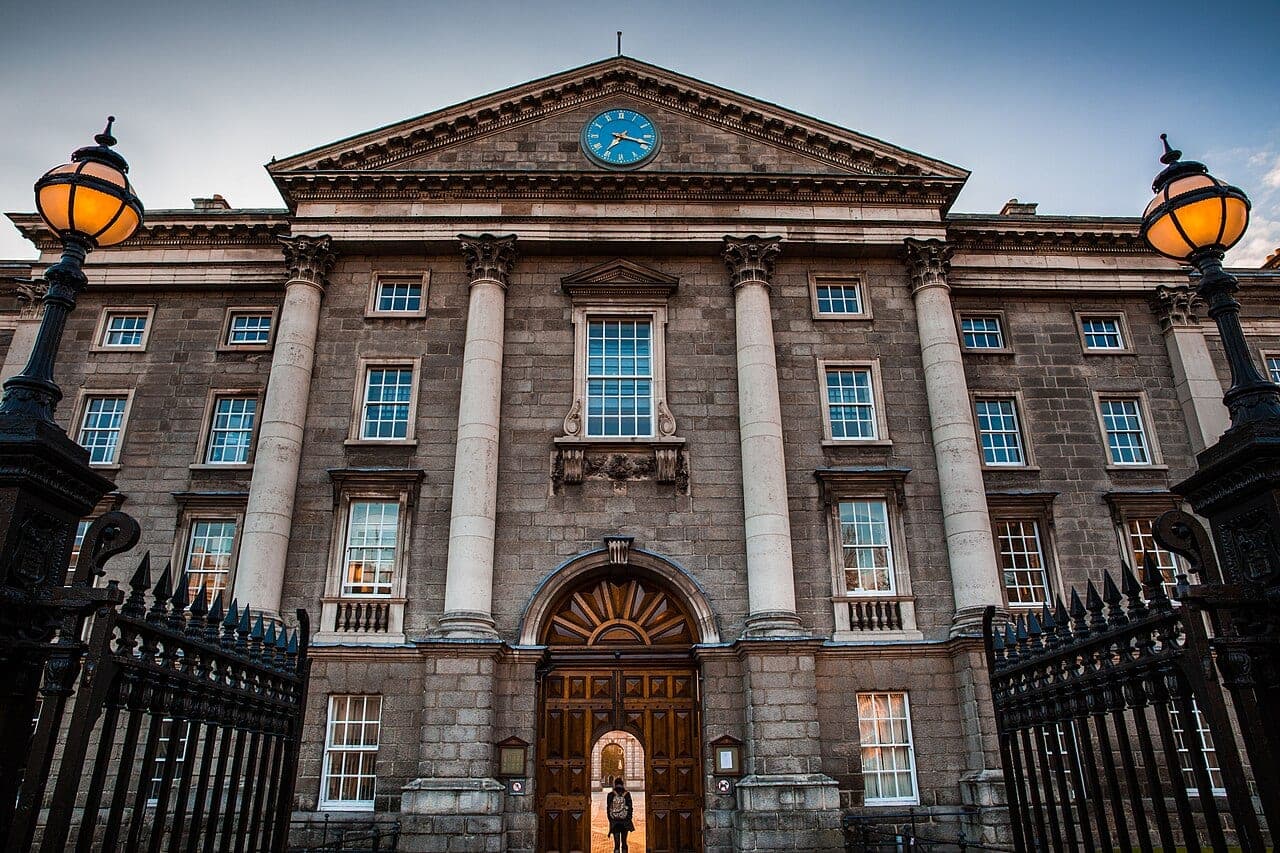
Trinity College Dublin is Ireland's oldest university and the only college of the University of Dublin, a distinction it has held since the reign of Elizabeth I. Its formal name, the College of the Holy and Undivided Trinity of Queen Elizabeth near Dublin, records both its founding sovereign and the year it received its charter, 1592. The college occupies a walled campus of roughly 47 acres in the centre of the modern city, its cobbled squares and grey stone reading as a self-contained older world a few steps from the traffic of College Green.
For an archive concerned with memory, Trinity is an unusually literal keeper of it. Behind the columns of its eighteenth-century library lies the Book of Kells, a Gospel manuscript illuminated around the year 800, and above it runs the Long Room, a barrel-vaulted hall lined with two hundred thousand of the library's oldest volumes. The buildings hold the record of four centuries of Irish scholarship, and also the record of who was allowed to take part in it and who, for long stretches, was kept out.
Elizabeth I granted the founding charter on 3 March 1592, answering a petition from the citizens of Dublin for a place of learning modelled on the collegiate universities of Oxford and Cambridge. The plan imagined a university of many colleges, but only one was ever built, which is why Trinity College and the University of Dublin remain, in practice, a single institution. Dublin Corporation provided the site: the grounds of the former Priory of All Hallows, a monastery east of the walled city that had been dissolved under Henry VIII. Adam Loftus, the Archbishop of Dublin, became the first provost, and teaching began a few years after the charter was sealed.
The college grew slowly at first and then, through the eighteenth century, with confidence, acquiring the squares and classical facades that give the campus its present character. It was founded as a Protestant institution, and for most of its history religious affiliation governed access to it. Catholics were permitted to enter and take degrees only from 1793, when the Roman Catholic Relief Act removed the oath that had barred them, yet fellowships, professorships and scholarships stayed reserved for members of the established church. Those remaining tests were abolished in 1873, opening the college's offices to men of any denomination.
The last barrier came from the opposite direction. The Catholic Church itself discouraged its members from studying at Trinity, and from 1871 the Archbishop of Dublin maintained a formal prohibition under which a Catholic needed special permission to attend. That episcopal ban was not lifted until 1970, after which Catholic enrolment rose sharply and the student body expanded through the decade that followed. Women reached the college earlier than that older restriction suggests: Trinity admitted them to degrees in 1904, before either Oxford or Cambridge did the same. The modern era saw the college widen from a small, largely clerical foundation into a secular research university open, at last, to all denominations and none.
The heart of the campus is a sequence of squares laid out over centuries. Parliament Square, usually called Front Square, opens beyond the main gate on College Green; behind it lie Library Square, Fellows' Square and New Square, each framed by ranges of Georgian and Victorian building. At the meeting point of the main squares rises the Campanile, a granite bell tower designed by Sir Charles Lanyon and completed in 1853. It stands about 30.5 metres tall over the approximate centre of the old college and has become the image most associated with the place; students still repeat the superstition that walking beneath it as its bell rings will cost them their examinations.
The Old Library, begun in 1712 by the architect Thomas Burgh and finished around 1732, is the college's most visited building. Its principal chamber is the Long Room, a hall of nearly 65 metres lined on both sides with marble busts and dark oak cases holding the library's oldest collections. The room did not always look as it does now. In 1860 the flat ceiling was removed and the roof raised to build the present barrel vault and the upper gallery of bookcases, creating the tall, cathedral-like proportions visitors see today. As a legal deposit library, Trinity has the right to claim a copy of every book published in Ireland and the United Kingdom, and its holdings run into the millions of printed items and manuscripts.
Alongside the historic core, the college operates as a full research university across three faculties covering arts, humanities and social sciences; engineering, mathematics and science; and health sciences, together with a business school and a medical school. Around twenty thousand students study there, split between undergraduate and postgraduate programmes.
The Book of Kells is an illuminated manuscript of the four Gospels, written in Latin and decorated in the Insular style that flourished in the monasteries of early medieval Ireland and Britain. Scholars generally date its creation to around the year 800. It is associated with the Columban monastic family founded by Saint Columba, and the prevailing view holds that work began at the monastery on the island of Iona, off the west coast of Scotland, and was continued or completed at the Abbey of Kells in County Meath, from which the book takes its name.
 The Long Room holds around 200,000 of the library's oldest books. The barrel ceiling is not original: it was raised in the 1860s because the shelves had reached the roof. Photograph by Beyourbest2, CC BY-SA 4.0, via Wikimedia Commons.
The manuscript runs to 340 folios, and since a rebinding in 1953 it has been kept in four volumes. Its pages carry some of the most intricate ornament in Western art: full-page portraits of the evangelists, densely woven initials, and interlaced figures of animals and humans worked in pigments carried from far beyond Ireland. The book came to Trinity around 1661, when Henry Jones, then bishop of Meath, presented it to the college, and it has remained there ever since.
Today the Book of Kells is displayed in the Old Library, where it draws hundreds of thousands of visitors a year and ranks among Ireland's most visited cultural attractions. Because the manuscript is fragile, only one volume is shown at a time, opened to two pages that are turned on a regular rotation so that no single opening is exposed to light for long. The library has also digitised the manuscript in full, so that the pages not on view can still be studied.
Trinity's alumni include some of the most recognised names in the English literary canon. Jonathan Swift, author of Gulliver's Travels, took his degree there in the seventeenth century; the statesman and political thinker Edmund Burke studied there in the eighteenth. The college educated the playwright and wit Oscar Wilde, the novelist Bram Stoker, who wrote Dracula, and Samuel Beckett, who went on to win the Nobel Prize in Literature in 1969. The philosopher George Berkeley and the revolutionary Wolfe Tone are counted among its graduates as well.
Its scientific contribution is anchored by Ernest Walton, who studied at Trinity and later held the chair of natural and experimental philosophy there. With John Cockcroft he built the apparatus that first split the atomic nucleus by artificial means in 1932, and the two shared the Nobel Prize in Physics in 1951. Walton remains the only Irish-born winner of a Nobel Prize in the sciences. In public life, Mary Robinson read law at Trinity and taught there before becoming, in 1990, the first woman elected President of Ireland, and afterward the United Nations High Commissioner for Human Rights.
Trinity is consistently ranked Ireland's leading university and places within the upper ranks of the major international league tables. Its student population of roughly twenty thousand was recorded at 14,085 undergraduates and 6,405 postgraduates in the 2023/24 year. The college is a member of the League of European Research Universities and the Coimbra Group of long-established European institutions, and its research spans immunology, neuroscience, nanotechnology, the humanities and Irish studies.
The historic library is the focus of a major conservation and redevelopment project. The Old Library is being renewed to protect its collections against fire and environmental damage, and the two hundred thousand volumes of the Long Room have been carefully removed for cleaning and safekeeping during the work. In 2021 the college elected Linda Doyle as its provost, the first woman to hold the office in more than four centuries.
Trinity sits at College Green in the centre of Dublin, and the grounds are open for visitors to walk through its squares free of charge. The Book of Kells and the Long Room are the main ticketed attraction; entry is timed, and booking ahead is advisable in the busy summer months, though parts of the display may vary while the Old Library redevelopment continues. The college also runs student-led walking tours of the campus. Front Square and the Old Library are the visitors' half of the college; the residential staircases and lecture rooms behind them keep their quiet, most of all in examination season.
The Long Room holds around 200,000 of the library's oldest books. The barrel ceiling is not original: it was raised in the 1860s because the shelves had reached the roof. Photograph by Beyourbest2, CC BY-SA 4.0, via Wikimedia Commons.
The manuscript runs to 340 folios, and since a rebinding in 1953 it has been kept in four volumes. Its pages carry some of the most intricate ornament in Western art: full-page portraits of the evangelists, densely woven initials, and interlaced figures of animals and humans worked in pigments carried from far beyond Ireland. The book came to Trinity around 1661, when Henry Jones, then bishop of Meath, presented it to the college, and it has remained there ever since.
Today the Book of Kells is displayed in the Old Library, where it draws hundreds of thousands of visitors a year and ranks among Ireland's most visited cultural attractions. Because the manuscript is fragile, only one volume is shown at a time, opened to two pages that are turned on a regular rotation so that no single opening is exposed to light for long. The library has also digitised the manuscript in full, so that the pages not on view can still be studied.
Trinity's alumni include some of the most recognised names in the English literary canon. Jonathan Swift, author of Gulliver's Travels, took his degree there in the seventeenth century; the statesman and political thinker Edmund Burke studied there in the eighteenth. The college educated the playwright and wit Oscar Wilde, the novelist Bram Stoker, who wrote Dracula, and Samuel Beckett, who went on to win the Nobel Prize in Literature in 1969. The philosopher George Berkeley and the revolutionary Wolfe Tone are counted among its graduates as well.
Its scientific contribution is anchored by Ernest Walton, who studied at Trinity and later held the chair of natural and experimental philosophy there. With John Cockcroft he built the apparatus that first split the atomic nucleus by artificial means in 1932, and the two shared the Nobel Prize in Physics in 1951. Walton remains the only Irish-born winner of a Nobel Prize in the sciences. In public life, Mary Robinson read law at Trinity and taught there before becoming, in 1990, the first woman elected President of Ireland, and afterward the United Nations High Commissioner for Human Rights.
Trinity is consistently ranked Ireland's leading university and places within the upper ranks of the major international league tables. Its student population of roughly twenty thousand was recorded at 14,085 undergraduates and 6,405 postgraduates in the 2023/24 year. The college is a member of the League of European Research Universities and the Coimbra Group of long-established European institutions, and its research spans immunology, neuroscience, nanotechnology, the humanities and Irish studies.
The historic library is the focus of a major conservation and redevelopment project. The Old Library is being renewed to protect its collections against fire and environmental damage, and the two hundred thousand volumes of the Long Room have been carefully removed for cleaning and safekeeping during the work. In 2021 the college elected Linda Doyle as its provost, the first woman to hold the office in more than four centuries.
Trinity sits at College Green in the centre of Dublin, and the grounds are open for visitors to walk through its squares free of charge. The Book of Kells and the Long Room are the main ticketed attraction; entry is timed, and booking ahead is advisable in the busy summer months, though parts of the display may vary while the Old Library redevelopment continues. The college also runs student-led walking tours of the campus. Front Square and the Old Library are the visitors' half of the college; the residential staircases and lecture rooms behind them keep their quiet, most of all in examination season.
History
Campus and academics
The Book of Kells