Heritage · Country
Isle of Man Culture and Heritage
Ellan Vannin sits in the middle of the Irish Sea, a self-governing Crown Dependency whose parliament still proclaims each year's new laws from an open-air turf mound, in Manx and in English. This is a guide to its heritage, from the Norse memorial crosses to a language its children brought back.Written to last.
By Confinity Heritage Editorial · Updated 2026-08-17 · 8-minute readQuiet tools, kept out of the way.
Every July, on a green at St John's in the middle of the Isle of Man, the members of Tynwald walk from the chapel to a four-tiered mound of turf and sit in the open air while the year's new laws are read out to the people, first in Manx and then in English. An Act that has not been proclaimed on that hill within eighteen months of passing is void. It is the oldest surviving ceremony of its kind in these islands, and it is not a re-enactment: the legal effect is real, and the crowd on the field includes anyone who wants to hand up a petition.
The island that keeps this custom is neither part of the United Kingdom nor a country in its own right, but a Crown Dependency of some 84,000 people in the middle of the Irish Sea, with its own parliament, its own courts, its own currency and a language brought back from the edge of loss by the generation that came after its last native speaker died. Ellan Vannin, as it is called in Manx, holds Celtic and Norse layers on top of each other, sometimes in the same carved stone.
The Isle of Man covers about 572 square kilometres in the Irish Sea, roughly equidistant from England, Scotland, Wales and Ireland, and on a clear day from the summit of Snaefell at 621 metres you can see all four along with the island itself. Around 84,000 people live there, more than a third of them in Douglas, the capital on the east coast. Constitutionally the island is a self-governing Crown Dependency: the King holds the ancient title Lord of Mann, the United Kingdom is responsible for defence and represents the island internationally, and Tynwald legislates for everything else, including tax, which is why the island has a large insurance, banking and e-gaming sector. Tynwald has two branches, the directly elected House of Keys with twenty-four members and the indirectly chosen Legislative Council, which sit separately and then together. English and Manx Gaelic are both official. In 2016 UNESCO designated the whole island, land and territorial sea together, as a Biosphere Reserve, the first entire jurisdiction to hold that status (UNESCO Biosphere Isle of Man).
Douglas. The capital grew from a herring port into a Victorian resort, and its two-mile sweep of seafront terraces, the horse-drawn tram that has run along the promenade since 1876 and the Gaiety Theatre of 1900 all date from the decades when steamers brought holidaymakers from Lancashire by the hundred thousand. The Manx Museum sits above the town and functions as the island's national museum and archive.
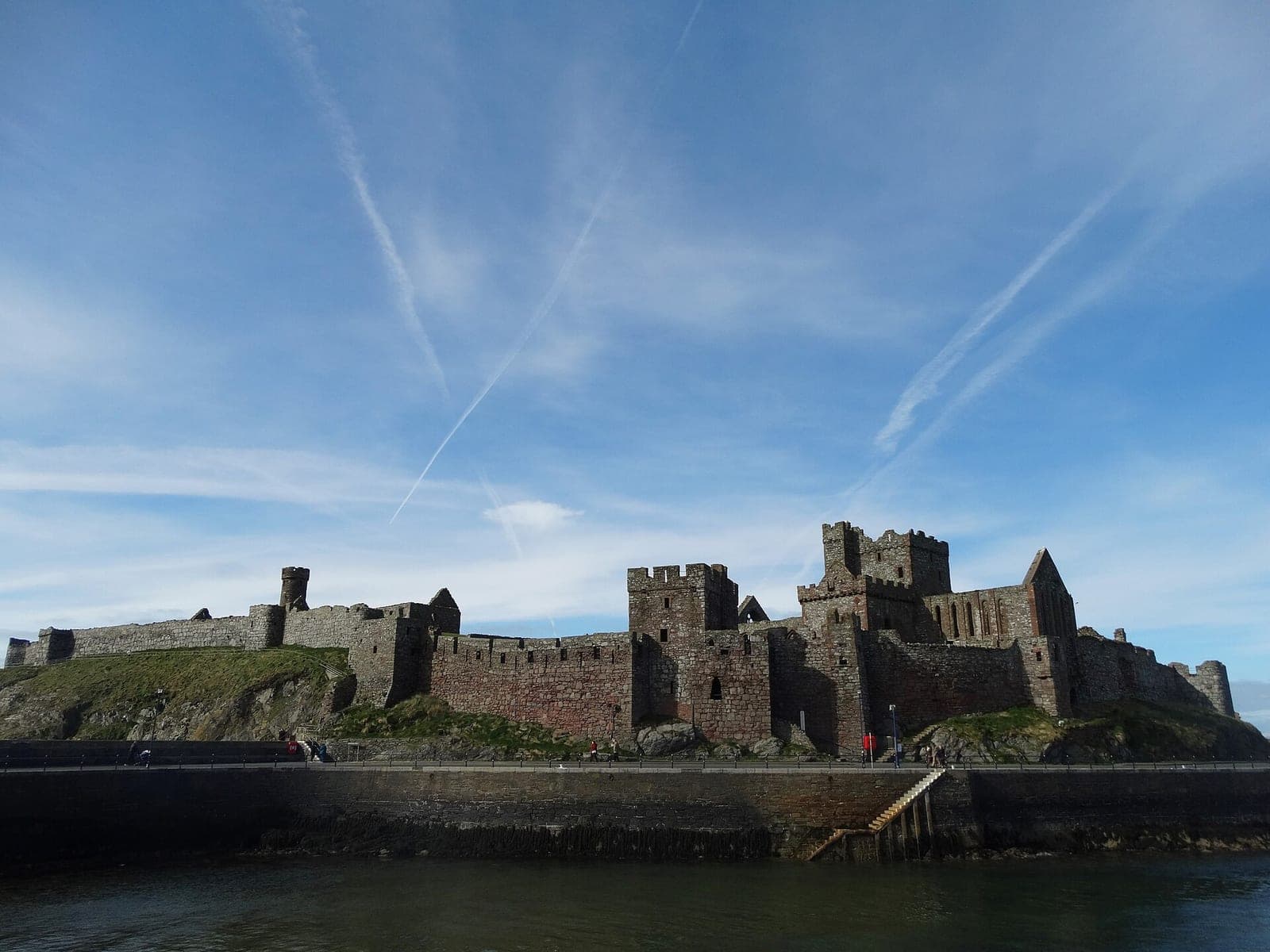
Peel. On the west coast, Peel is the fishing town, the kipper town and the site of Peel Castle on St Patrick's Isle, where a Celtic monastic settlement, a round tower of Irish type, the ruined Cathedral of St German and Norse graves occupy a single tidal islet.
Castletown. The island's capital until 1869, gathered around Castle Rushen, a limestone keep begun in the thirteenth century and among the best-preserved medieval castles anywhere in the British Isles, with its original oak roof timbers and a working seventeenth-century clock.
Ramsey and St John's. Ramsey is the northern port beneath the mountains; St John's, inland, is a small village whose importance is entirely ceremonial and constitutional, since Tynwald Hill and the Royal Chapel stand there.
People have lived on the island since the Mesolithic, and Neolithic chambered tombs such as Cashtal yn Ard and King Orry's Grave still stand in field corners. By the early medieval period the island spoke a Goidelic Celtic language and was thickly settled with keeills, small stone chapels serving a few farms each. Norse settlers arrived from the late eighth century, and their impact was structural: place names across the north and east are Scandinavian, the sheading and treen land divisions are Norse, and the assembly itself takes its name from the Old Norse thingvöllr, the field of the assembly.
Tynwald describes itself as the oldest parliament in the world in continuous existence, a claim that rests on continuity of sitting rather than on the date of foundation. Iceland's Althing was established earlier, in 930, but its sittings lapsed between 1800 and its restoration in the following century, whereas Tynwald has met without a recorded break. The conventional Manx date of 979 should be treated with care: it was chosen by officials in the nineteenth century for a millennium celebration, no record survives of an assembly held that year, the place-name is first attested in the thirteenth or fourteenth century, and the earliest description of the assembly's composition comes from the early fifteenth (Tynwald). What is not in doubt is that an open-air Norse-derived assembly on that mound has been making and proclaiming Manx law for many centuries, and does so still.
Godred Crovan, remembered in Manx tradition as King Orry, took the island in 1079 and founded a dynasty that ruled the Kingdom of Mann and the Isles from Peel and Castletown, holding the Hebrides as well. The Treaty of Perth transferred the kingdom to Scotland in 1266; English and Scottish forces contested it for a century and a half; and in 1405 Henry IV granted the lordship to Sir John Stanley, whose family and then the Dukes of Atholl held it as a private possession until the British crown bought them out under the Revestment Act of 1765, a transaction Manx people long called the Mischief. The nineteenth century brought lead and zinc mining at Laxey and Foxdale, a fishing fleet of hundreds of boats and then mass tourism. In both world wars the island held internment camps for enemy aliens, among them artists and scholars whose work in the Hutchinson camp at Douglas is now a subject of study in its own right.
The Manx name for the island is Ellan Vannin, the island of Mannin, and the older name Mann is generally connected with Manannán mac Lir, the sea god of Irish and Manx tradition who is said to shroud the island in mist to hide it from enemies. Manx Gaelic is a Goidelic language, close to Scottish Gaelic and to the Irish of Ulster, and mutually intelligible with neither at speed. Its most unusual feature is on the page: instead of the historical spelling used for Irish and Scottish Gaelic, seventeenth and eighteenth-century Manx was written down by churchmen using English and Welsh conventions, which is why the Manx for "God" is Jee and the Manx for "good morning" is moghrey mie.
The language declined sharply through the nineteenth century as English took over trade and schooling, and on 27 December 1974 Ned Maddrell died at the age of ninety-seven, the last person who had grown up in a Manx-speaking household (Manx language). He had been recorded in the 1940s by the Irish Folklore Commission and later by the Manx Museum, so his voice survives. Yn Çheshaght Ghailckagh, the Manx Language Society, had been founded in 1899, and its learners kept teaching through the decades when there were no native speakers left at all. Norse and Gaelic sit side by side across the map: Laxey, Ramsey, Snaefell and the many names ending in -by are Scandinavian, while Ballasalla, Ballaugh and the Kirk names are Gaelic and ecclesiastical, so that a short drive crosses two settlement languages several times.
The island's emblem is the triskelion, three armoured legs joined at the thigh and running clockwise, which has been the arms of Mann since the thirteenth century and carries the Latin motto Quocunque Jeceris Stabit, whichever way you throw it, it will stand. The Manx cat, tailless by an old genetic mutation, and the four-horned Loaghtan sheep are both island breeds. Since 1907 the Isle of Man TT has run motorcycles at speed over a 60-kilometre course of public roads through villages and over the mountain, a fortnight that fills the island every summer and that has cost many riders their lives, commemorated at memorials along the course.
Industrial heritage carries as much affection here as the castles do. The Laxey Wheel, named Lady Isabella after the Lieutenant Governor's wife and built in 1854 to pump water out of the Great Laxey Mines from 1,500 feet down, is 72 feet 6 inches across and remains the largest surviving working waterwheel in the world (Laxey Wheel). The steam railway to Port Erin, the electric railway to Ramsey and the Snaefell Mountain Railway all still run on Victorian rolling stock. In the kitchen the island means kippers smoked over oak in Peel, queenie scallops, bonnag and Manx broth, and in the calendar it means Hop-tu-Naa on the last night of October, when children carry carved turnips and sing Jinnie the Witch, and Hunt the Wren on St Stephen's Day.
Christianity reached the island early, probably from Ireland, and its physical trace is the keeill: at least 174 of these small chapels are recorded and there may once have been more than two hundred, of which around thirty-five can still be made out, generally as the stone footings of four walls inside a small burial enclosure (Keeill). St Maughold, whose parish holds the island's largest collection of early crosses, and St Patrick, remembered at Peel, anchor the founding stories.
The Diocese of Sodor and Man, whose name preserves the Norse Suðreyjar or southern isles, is one of the oldest dioceses in the British Isles and remains a diocese of the Church of England; its bishop sits in Tynwald's Legislative Council, so the church retains a seat in the legislature. Methodism took deep root in the fishing and mining communities from the eighteenth century, and chapel culture shaped Manx hymn singing. Beneath the churches runs a persistent folk tradition of the Little People, ny mooinjer veggey, whom it was thought unwise to name directly; drivers still greet them when crossing the Fairy Bridge on the road to Castletown, and the bugganes and the sea-mist of Manannán belong to the same inheritance.
The most striking Manx monuments to the dead are the carved stone crosses. Around two hundred survive, some pre-Norse and Celtic in style, and about twenty-six carrying runic inscriptions, a concentration comparable to whole Scandinavian regions. Sixteen of the runic stones follow one formula, that a named person raised this cross in memory of another, usually a father, a mother, a wife or a son, and one at Kirk Michael carries the sculptor's own signature, that Gaut made this and all in Mann. Thorwald's Cross at Andreas shows a bearded figure with a spear, his foot in the mouth of a wolf, which is read as Odin devoured by Fenrir at Ragnarök, carved on the same slab as a figure of Christ triumphant (Manx runestones). Whoever commissioned it was memorialising the dead in two theologies at once, and the church of the day evidently did not object. The stones are now sheltered in cross houses at Andreas, Braddan, Kirk Michael and Maughold and in the Manx Museum.
 The national war memorial stands beside Tynwald Hill, the mound where the island's parliament has met in the open air every year for more than a thousand years and where new laws are still read aloud in Manx and English. Photograph by Otter, CC BY-SA 4.0, via Wikimedia Commons.
Pagan Norse burial survives too. At Balladoole a man was laid in a ship, its outline marked by rivets in the ground, on top of an existing Christian cemetery; at Knock y Doonee a boat burial held a smith's tools and a horse. The keeill enclosures, some of them older than the chapels they surround, kept parish communities burying their dead in the same small plots for a thousand years.
Later Manx funeral custom was communal and long. A. W. Moore's Folk-Lore of the Isle of Man, published in 1891, describes the wake, at which neighbours sat up with the body while the parish clerk led a psalm; the funeral procession, where a hundred horsemen and twice as many on foot might follow the coffin; the long tables of cold food and drink afterwards; and the practice, shared with Cornwall, of singing hymns as the corpse was carried through the churchyard to the grave (Moore, Folk-Lore of the Isle of Man). Carvals, the long Manx carols sung at the Oie'll Verrey service on Christmas Eve, kept the same voices in use at the other end of life. Manx parish registers of burials run from 1601, and headstone inscriptions in Manx Gaelic can still be read in the older churchyards. The Manx National War Memorial stands on Tynwald Field itself, so the ceremony of the island's law each July is held within sight of the names of its dead.
The Isle of Man kept its own records for a thousand years and kept them separately, which is the whole point.
Manx parish registers begin in the seventeenth century, and civil registration was introduced in the nineteenth, held by the General Registry in Douglas rather than by the General Register Office in London. Manx National Heritage holds the archives and library, and a great deal is digitised and searchable free.
The island's older record is legal. Tynwald claims continuous existence as a parliament for more than a thousand years, and the deemsters administered Manx customary law, which included a distinctive system of land tenure. The manorial rolls and the setting quests record who held which quarterland across centuries, and because Manx land descended in a fixed way, those rolls are effectively a genealogical series.
The ecclesiastical courts are the Manx speciality. They handled wills and probate until 1884, and their records are unusually complete, so a Manx family's inheritance can often be followed continuously from the seventeenth century.
Two things narrow the field usefully. The population was small, and Manx surnames are distinctive and heavily concentrated, so a name will often place a family in a parish immediately. And emigration was heavy: Manx families went to Ohio, Cleveland, Australia and South Africa in the nineteenth century, and the receiving records complete the lines.
The Manx language died as a community tongue in the twentieth century and was revived; the last native speakers were recorded, which is its own kind of family record.
Manx National Heritage, founded in 1951 as the Manx Museum and National Trust, holds the island's collections and cares for around 3,000 acres of coast and countryside along with thirteen visitor sites, among them Castle Rushen, Peel Castle, Rushen Abbey, the Laxey Wheel, the House of Manannan at Peel and the Manx Museum in Douglas. It presents these together as the Story of Mann, a single narrative running from the Ice Age to the present that lets a visitor follow one thread across a dozen buildings rather than treating each as a separate attraction. Cregneash, in the far south, is a preserved crofting village kept as a working landscape with Loaghtan sheep and thatched cottages, and it matters twice over: it is the fullest surviving picture of nineteenth-century Manx rural life, and it stands in the district where the last generation of native Manx speakers lived.
The whole-island UNESCO Biosphere designation of 2016 was unusual in scope, covering the entire jurisdiction and its territorial waters rather than a reserve within a country, and it commits government, business and community groups to a shared programme on landscape, marine habitat and cultural continuity. The island submitted its first ten-year periodic review to UNESCO in 2024. Archaeological work continues under the Manx Museum, and the keeill sites, cross houses and Norse burial grounds are protected as ancient monuments.
The iMuseum, run by Manx National Heritage, has put an unusually complete national record online and made the core of it free. Its newspaper archive covers the most complete run of Isle of Man papers from 1792 to 1960, fully searchable and downloadable. Its family history collections index roughly 370,000 named individuals from the censuses of 1841 to 1911, close to 200,000 baptisms from 1600, more than 110,000 marriages from 1589, some 180,000 burials from 1601 to 1920, over 73,000 parties named on registered deeds, and files on the internees of both world wars (iMuseum). For a population this size, that means most Manx families can follow a line back three centuries in an afternoon without leaving home. Alongside it, A Manx Notebook has for years published transcriptions of Manx historical texts, parish accounts and antiquarian works, and Culture Vannin distributes Manx language recordings, including the archived voices of the last native speakers, so that learners can hear how the language sounded before the break.
The island's best-known export is the TT, watched worldwide and central to the summer economy. Its financial and e-gaming sector has drawn people from across Europe, and its film-friendly tax arrangements brought a run of productions and a small local industry. Manx Gaelic has an ordinary public presence now: bilingual road signs, weather forecasts, place-name signage, a Manx-language primary school and adult classes with waiting lists. The Bee Gees were born in Douglas, the writer Hall Caine was the island's best-selling Victorian novelist and built Greeba Castle, and Yn Chruinnaght brings Manx, Irish, Scottish, Welsh, Cornish and Breton musicians together each summer for an inter-Celtic festival. Pressure on the island runs the other way as well: a small population, high property prices and the pull of work off-island make continuity a live question rather than a settled one.
A language reclassified. UNESCO listed Manx as extinct in 2009. Children at the Bunscoill Ghaelgagh, the Manx-medium primary school at St John's, wrote to ask what language they were writing in; the classification was changed to critically endangered, and census returns have risen from about 1,500 speakers in 2001 to 2,223 in 2021.
A parliament that never stopped. Tynwald's open-air promulgation at St John's still carries legal force, and an Act unproclaimed within eighteen months lapses, keeping a medieval ceremony load-bearing rather than ornamental.
A whole nation as a biosphere. In 2016 the Isle of Man became the first entire jurisdiction designated a UNESCO Biosphere Reserve, land and sea together, and submitted its first periodic review in 2024.
A national archive anyone can search. The iMuseum has made newspapers from 1792 and parish registers from 1589 free to search, so tracing Manx ancestors no longer requires a trip to Douglas.
The national war memorial stands beside Tynwald Hill, the mound where the island's parliament has met in the open air every year for more than a thousand years and where new laws are still read aloud in Manx and English. Photograph by Otter, CC BY-SA 4.0, via Wikimedia Commons.
Pagan Norse burial survives too. At Balladoole a man was laid in a ship, its outline marked by rivets in the ground, on top of an existing Christian cemetery; at Knock y Doonee a boat burial held a smith's tools and a horse. The keeill enclosures, some of them older than the chapels they surround, kept parish communities burying their dead in the same small plots for a thousand years.
Later Manx funeral custom was communal and long. A. W. Moore's Folk-Lore of the Isle of Man, published in 1891, describes the wake, at which neighbours sat up with the body while the parish clerk led a psalm; the funeral procession, where a hundred horsemen and twice as many on foot might follow the coffin; the long tables of cold food and drink afterwards; and the practice, shared with Cornwall, of singing hymns as the corpse was carried through the churchyard to the grave (Moore, Folk-Lore of the Isle of Man). Carvals, the long Manx carols sung at the Oie'll Verrey service on Christmas Eve, kept the same voices in use at the other end of life. Manx parish registers of burials run from 1601, and headstone inscriptions in Manx Gaelic can still be read in the older churchyards. The Manx National War Memorial stands on Tynwald Field itself, so the ceremony of the island's law each July is held within sight of the names of its dead.
The Isle of Man kept its own records for a thousand years and kept them separately, which is the whole point.
Manx parish registers begin in the seventeenth century, and civil registration was introduced in the nineteenth, held by the General Registry in Douglas rather than by the General Register Office in London. Manx National Heritage holds the archives and library, and a great deal is digitised and searchable free.
The island's older record is legal. Tynwald claims continuous existence as a parliament for more than a thousand years, and the deemsters administered Manx customary law, which included a distinctive system of land tenure. The manorial rolls and the setting quests record who held which quarterland across centuries, and because Manx land descended in a fixed way, those rolls are effectively a genealogical series.
The ecclesiastical courts are the Manx speciality. They handled wills and probate until 1884, and their records are unusually complete, so a Manx family's inheritance can often be followed continuously from the seventeenth century.
Two things narrow the field usefully. The population was small, and Manx surnames are distinctive and heavily concentrated, so a name will often place a family in a parish immediately. And emigration was heavy: Manx families went to Ohio, Cleveland, Australia and South Africa in the nineteenth century, and the receiving records complete the lines.
The Manx language died as a community tongue in the twentieth century and was revived; the last native speakers were recorded, which is its own kind of family record.
Manx National Heritage, founded in 1951 as the Manx Museum and National Trust, holds the island's collections and cares for around 3,000 acres of coast and countryside along with thirteen visitor sites, among them Castle Rushen, Peel Castle, Rushen Abbey, the Laxey Wheel, the House of Manannan at Peel and the Manx Museum in Douglas. It presents these together as the Story of Mann, a single narrative running from the Ice Age to the present that lets a visitor follow one thread across a dozen buildings rather than treating each as a separate attraction. Cregneash, in the far south, is a preserved crofting village kept as a working landscape with Loaghtan sheep and thatched cottages, and it matters twice over: it is the fullest surviving picture of nineteenth-century Manx rural life, and it stands in the district where the last generation of native Manx speakers lived.
The whole-island UNESCO Biosphere designation of 2016 was unusual in scope, covering the entire jurisdiction and its territorial waters rather than a reserve within a country, and it commits government, business and community groups to a shared programme on landscape, marine habitat and cultural continuity. The island submitted its first ten-year periodic review to UNESCO in 2024. Archaeological work continues under the Manx Museum, and the keeill sites, cross houses and Norse burial grounds are protected as ancient monuments.
The iMuseum, run by Manx National Heritage, has put an unusually complete national record online and made the core of it free. Its newspaper archive covers the most complete run of Isle of Man papers from 1792 to 1960, fully searchable and downloadable. Its family history collections index roughly 370,000 named individuals from the censuses of 1841 to 1911, close to 200,000 baptisms from 1600, more than 110,000 marriages from 1589, some 180,000 burials from 1601 to 1920, over 73,000 parties named on registered deeds, and files on the internees of both world wars (iMuseum). For a population this size, that means most Manx families can follow a line back three centuries in an afternoon without leaving home. Alongside it, A Manx Notebook has for years published transcriptions of Manx historical texts, parish accounts and antiquarian works, and Culture Vannin distributes Manx language recordings, including the archived voices of the last native speakers, so that learners can hear how the language sounded before the break.
The island's best-known export is the TT, watched worldwide and central to the summer economy. Its financial and e-gaming sector has drawn people from across Europe, and its film-friendly tax arrangements brought a run of productions and a small local industry. Manx Gaelic has an ordinary public presence now: bilingual road signs, weather forecasts, place-name signage, a Manx-language primary school and adult classes with waiting lists. The Bee Gees were born in Douglas, the writer Hall Caine was the island's best-selling Victorian novelist and built Greeba Castle, and Yn Chruinnaght brings Manx, Irish, Scottish, Welsh, Cornish and Breton musicians together each summer for an inter-Celtic festival. Pressure on the island runs the other way as well: a small population, high property prices and the pull of work off-island make continuity a live question rather than a settled one.
A language reclassified. UNESCO listed Manx as extinct in 2009. Children at the Bunscoill Ghaelgagh, the Manx-medium primary school at St John's, wrote to ask what language they were writing in; the classification was changed to critically endangered, and census returns have risen from about 1,500 speakers in 2001 to 2,223 in 2021.
A parliament that never stopped. Tynwald's open-air promulgation at St John's still carries legal force, and an Act unproclaimed within eighteen months lapses, keeping a medieval ceremony load-bearing rather than ornamental.
A whole nation as a biosphere. In 2016 the Isle of Man became the first entire jurisdiction designated a UNESCO Biosphere Reserve, land and sea together, and submitted its first periodic review in 2024.
A national archive anyone can search. The iMuseum has made newspapers from 1792 and parish registers from 1589 free to search, so tracing Manx ancestors no longer requires a trip to Douglas.
National Overview
Notable Cities
Historical Foundations
Linguistic and Etymological Roots
Cultural Identity
Religion and Spirituality
Remembrance and Mourning Traditions
Tracing a Family in Isle of Man
Heritage Preservation Efforts
Digital Heritage
Contemporary Cultural Influences
Success Stories
References and resources
- Tynwald, Wikipedia: the assembly, the 979 date and the continuity claim.
- Tynwald, the Manx parliament: official record of the legislature and Tynwald Day.
- Manx language, Wikipedia: Ned Maddrell, the revival and census speaker numbers.
- Manx runestones, Wikipedia: the memorial formula, Gaut's signature and Thorwald's Cross.
- Keeill, Wikipedia: the early chapels and their burial enclosures.
- A. W. Moore, Folk-Lore of the Isle of Man: the wake, the funeral procession and graveside hymn singing, 1891.
- Manx National Heritage: the museums, monuments and the Story of Mann.
- iMuseum: newspapers, censuses, baptisms, marriages and burials online.
- Laxey Wheel, Wikipedia: Lady Isabella, its 1854 construction and its dimensions.
- UNESCO Biosphere Isle of Man: the 2016 whole-island designation and its programme.
- Isle of Man, Wikipedia: geography, population, status and institutions.
- A Manx Notebook: transcribed Manx historical texts, parish records and antiquarian works.