Heritage · Country
Kuwait Culture and Heritage
At the head of the Persian Gulf sits a country whose memory is held in the sea, in the pearl banks and dhow yards that fed it for centuries. This is a guide to Kuwait's layered past and to the customs through which Kuwaitis keep their divers, their dead and their martyrs present.Written to last.
By Confinity Heritage Editorial · Updated 2026-07-31 · 8-minute readQuiet tools, kept out of the way.
Kuwait is a small country carrying a long relationship with the sea. Set at the north-western corner of the Persian Gulf, on a shallow bay that gave it a fine natural harbour, it grew from a fortified watering place into a merchant town whose men sailed to India and East Africa and dived each summer for pearls. For two hundred years the wooden dhow and the pearl banks were the country's fortune, until oil was found beneath the desert in 1938 and remade the emirate within a single lifetime. That double inheritance, of the sea and of sudden wealth, shapes how Kuwaitis remember who they were.
Memory here sits close to the surface. Families still name the boats their grandfathers sailed and the reefs where divers were lost; the ground loom and the diving chant survive as heritage even where the trades that made them have gone; and the country carries a shared grief from the seven months of Iraqi occupation in 1990 and 1991, marked each year and worked at still by those who search for the missing.
Kuwait occupies about 17,818 square kilometres at the head of the Persian Gulf, bordered by Iraq to the north and west and by Saudi Arabia to the south, with the Gulf to the east (Britannica). It is one of the smaller and flatter states of the Arabian Peninsula, a country of gravel plain and low desert with almost no fresh water, so that survival long depended on wells, imported dates and the sea. Offshore lie a scatter of islands, among them Bubiyan, the largest, and Failaka, the oldest inhabited.
The population is estimated at around five million, but only a minority are Kuwaiti citizens; the majority are expatriate workers from across the Arab world and South Asia, a fact that colours every question of national identity (Britannica). The state is a hereditary emirate ruled by the Al Sabah family, with one of the region's more assertive elected parliaments, the National Assembly. Oil funds a generous welfare state, and the currency is the Kuwaiti dinar. Islam is the religion of the citizen population, which is mostly Sunni with a significant Shia minority.
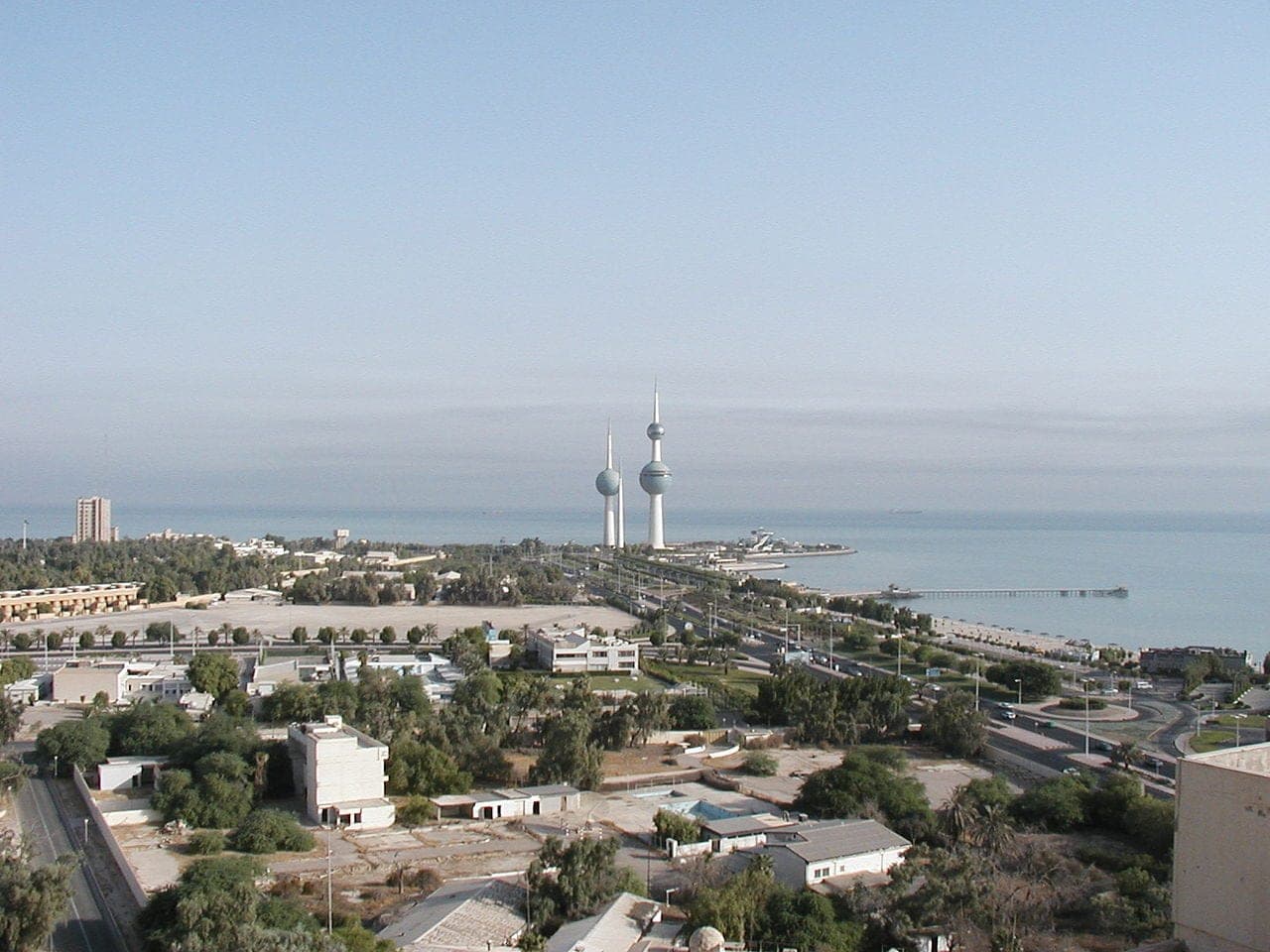
Kuwait City. The capital sits on the southern shore of Kuwait Bay and holds the government, the ruling family's palaces and the country's memory of itself. Its old waterfront, the Seif, was once lined with the houses of pearl merchants and the yards where dhows were built, and the covered lanes of Souq Al-Mubarakiya still trade in spices, cloth, gold and dates on the site of the pre-oil market. Along the modern corniche rise the Kuwait Towers and the National Cultural District (Wikipedia), so the city reads as a single line from the age of sail to the age of oil.
 The towers are water reservoirs, opened in 1979, shot up and burned during the occupation of 1990 and 1991 and repaired afterwards, which is why they read as a national emblem rather than as infrastructure. Photograph by Zairon, CC BY 4.0, via Wikimedia Commons.
Hawalli. Immediately south-east of the capital, Hawalli is one of the most densely settled areas of the country and long the heart of its expatriate population, historically home to a substantial Palestinian community. It records the social history of the oil boom, when hundreds of thousands of newcomers built their lives in Kuwait.
Jahra. West of the capital at the head of the bay, Jahra is a farming oasis and the site of a defining episode in the founding of the modern state. Its Red Fort, Al Qasr Al Ahmar, built of mud brick during the reign of Sheikh Mubarak, was the strongpoint at the Battle of Jahra on 10 October 1920, when a Kuwaiti force held off a much larger raiding army (Wikipedia). The battle prompted the third town wall, whose surviving gates still mark the old edge of Kuwait City.
Failaka Island. About twenty kilometres off the coast, Failaka is the country's principal archaeological landscape, layered with Bronze Age, Greek, Christian and Islamic remains. Its villages were inhabited until 1990, when the occupying army expelled the population and used the island for military purposes; it has never been fully resettled, and today it is visited chiefly for its ruins and its memory (Wikipedia).
Settlement in Kuwait is older than the town itself. On Failaka, occupation followed a fall in sea level after about 2000 BC, and the island became a northern outpost of Dilmun, the Bronze Age trading civilisation of the Gulf; the islanders knew their home as Agarum, land of the god Enzak, and Mesopotamian merchants from Ur built there in a style familiar from southern Iraq, leaving hundreds of stamp and cylinder seals behind them (Wikipedia). Some sixteen centuries later the island entered the Greek world. After the campaigns of Alexander the Great, Hellenistic settlers, most likely under the early Seleucid kings, fortified Failaka and named it Ikaros; they raised a fortress and temples, including a shrine associated with Artemis, and left Greek inscriptions, the easternmost reach of a classical culture born in the Aegean. A Danish expedition uncovered much of this in the late 1950s, and Failaka remains the only place in the Gulf where Dilmun and Hellenistic Greece can be read in the same ground.
The town of Kuwait was founded in the early eighteenth century, when families of the Bani Utub, a section of the Anizah confederation, migrated from the interior of the peninsula and settled by the bay (Britannica). Around the middle of the century the settlers chose a leader from the Al Sabah family, and Sabah I became the first ruler of a line that governs still. The community lived by fishing, trade and above all pearling: Kuwaiti dhows sailed each summer to the pearl banks and traded as far as India and East Africa, and by the nineteenth century Kuwait was a prosperous independent port. In 1899 Sheikh Mubarak Al-Sabah placed Kuwait's foreign relations under British protection, a bond that shielded the emirate for more than sixty years.
The pearling economy collapsed within a generation, undone by the world depression and the Japanese cultured pearl, only for oil to be discovered in the Burgan field in 1938, one of the largest reserves on earth (Wikipedia). Exports after the Second World War funded schooling, medicine and a wholesale rebuilding of the city, and Kuwait became fully independent on 19 June 1961 (Britannica). Three decades later that independence was violently interrupted: on 2 August 1990 Iraqi forces invaded and annexed the country, and for seven months Kuwait was occupied. A United States-led coalition liberated it on 26 February 1991. The retreating army set fire to more than six hundred oil wells, and the human cost, in killed, missing and imprisoned, remains central to national memory. That episode is treated with the seriousness it demands in the sections below.
Arabic is the official language of Kuwait and the language of its people. The everyday speech is Kuwaiti Arabic, a Gulf dialect whose vocabulary carries the record of the sea trade in loanwords from Persian, Hindi and English, a maritime memory embedded in ordinary talk. Classical Arabic remains the language of the Qur'an, of formal writing and of the courts, so that Kuwaitis live between the high written language and the spoken dialect of home.
The name of the country is itself a small history. Kuwait, in Arabic al-Kuwayt, is the diminutive of kut, a word for a fort or fortified house near water, so the name means, roughly, "the little fort" (Britannica). It recalls a fortified building said to have stood by the bay before the Bani Utub arrived, when the site was valued as a stronghold and a watering place before it was a town.
Kuwaiti culture grew from the sea and the desert, and both survive in its symbols. The dhow, in its Kuwaiti forms the deep-sea boom and the smaller sambuk, was the instrument of the country's fortune, and the memory of the pearling voyages is tended with care. Each spring the fleets sailed for the four-month diving season; the diver, the ghais, went down on a weighted rope, and the rhythm of the work was set by the nahham, the ship's singer, whose sea chants are preserved today as heritage. When pearling ended, its songs and vocabulary did not, and an annual heritage sailing keeps the practice in living memory.
In the desert the defining craft is sadu, the ground-loom weaving of the Bedouin, worked by women in bands of red, black, white and brown wool patterned with geometric designs that carry meaning and name (UNESCO). Sadu produced the tents, rugs and camel trappings of nomadic life, and its motifs are now a national visual language. Beside these crafts stands an institution unique in its Kuwaiti form: the diwaniya, a reception room, often a building of its own beside the family house, where men gather in the evenings to talk of politics, business and the affairs of the day. Historically the fastest channel for news in the country, and open by custom to callers without invitation, the diwaniya remains a real forum of public life (Arab Times); Nabati poetry is recited and prized there.
At the table the national dish is machboos, spiced basmati rice cooked with chicken, lamb or fish and flavoured with cardamom, cinnamon, cloves, saffron and the sour dried lime, loomi, that marks Gulf cooking (Wikipedia). Harees, a smooth wheat and meat porridge, appears at weddings and in Ramadan; gers ogaili, a saffron and cardamom cake, is the classic sweet; and hospitality turns on rounds of cardamom coffee and sweet tea, the Persian, Indian and East African spice recording the sailing centuries.
Islam is the religion of Kuwaiti citizens and the frame of the country's public and family life. The population is predominantly Sunni, following mainly the Maliki school, with a substantial and long-established Shia community whose mosques, husseiniyat and observances, above all the mourning of Ashura, are an accepted part of the national fabric.
The principal house of worship is the Grand Mosque of Kuwait, on the shore of the bay in the capital. Opened in 1986 after seven years of building, it is the largest mosque in the country, covering some 45,000 square metres, with a main prayer hall that can hold around eleven thousand worshippers (Wikipedia). It hosts the state's major religious occasions and the Eid prayers that draw the largest congregations of the year. Kuwait also permits places of worship for its large Christian and other minority communities, mostly expatriate, so that churches serve the same streets as the mosques.
Death in Kuwait is met in the manner of Islam, quickly and communally. The body is washed by relatives or trusted attendants of the same sex in the ritual ghusl, wrapped in a plain white shroud, the kafan, and carried without delay to the funeral prayer, the salat al-janazah, performed by the gathered community. Burial follows on the same day where possible, the deceased laid on the right side facing Mecca in a simple grave, marked plainly and without ostentation, in keeping with the Islamic preference for humility before God and the equality of the dead.
What follows is the condolence period, the aza, one of the firmest customs of Kuwaiti social life. For three days the family receives callers, men and women in separate gatherings, often in the diwaniya or a marquee raised for the purpose, where the Qur'an is recited and the refrain of condolence, that all belong to God and to Him return, is repeated. Neighbours provide food so that the mourning household need not cook. A widow observes the Qur'anic waiting period, the iddah, of four months and ten days, and charity given in the name of the dead extends remembrance beyond the funeral.
Over this personal grief lies a national one. The Iraqi occupation of 1990 and 1991 left Kuwait with its own roll of martyrs, of citizens killed in the resistance and of hundreds taken away and never returned. The Al Qurain Martyrs Museum preserves a suburban house where, in the last days of the occupation, a group of young resistance fighters held out for hours against the occupying army; the bullet-scarred walls are kept as they were found, and the site remembers those who died there (Atlas Obscura). The state maintains a martyrs' bureau, and the search for those still missing continues, with forensic identification of remains so that families may at last bury their dead by name. Liberation Day, on 26 February, is observed each year alongside the National Day of 25 February, so that the country's freedom and its losses are remembered together.
Kuwaiti records are court records, pearl records and, since 1959, one of the most consequential citizenship registers in the Gulf.
Before oil, the town lived on pearling and trade, and the tawwash merchants kept accounts of divers and crews, advances and debts, which are the fullest surviving record of who worked the boats. Sharia court registers hold marriage, inheritance and property, and because Islamic inheritance requires naming heirs precisely, an estate file is a family tree.
The Nationality Law of 1959 fixed who counted as Kuwaiti by reference to residence before 1920, and everything since has followed from it. Families who could document that residence became citizens; families who could not, mostly the Bedouin who moved seasonally and had no reason to hold papers, became the bidoon, stateless residents whose number runs to the tens of thousands and whose children inherit the condition. For those families, genealogy is not a pastime: it is the evidence they have spent sixty years being asked for.
Tribal genealogy is precise and matters socially and politically, and Kuwaiti families place themselves by tribe and by whether they are hadhar, the settled townspeople, or badu.
The invasion of 1990 and 1991 removed archives, museum collections and the national record along with a great deal else. Some material was returned under United Nations supervision after 1994, and the process of establishing what is still missing has never fully closed.
The central institution for heritage is the National Council for Culture, Arts and Letters, which oversees the state museums and the archaeological sites. The Kuwait National Museum, designed by the French architect Michel Écochard and opened in 1983, was looted and burned during the occupation, losing much of its Islamic art collection, and has been restored and reopened in stages since (Wikipedia). The story of the private Tareq Rajab Museum is a rescue: when the invasion came, its custodians bricked up the entrance to disguise it, hid the collection in crates, and so saved most of a remarkable holding of Islamic calligraphy, ceramics and jewellery, reopening in 1991 (Wikipedia).
Bedouin weaving has been sustained by deliberate revival. The Sadu House, a cooperative and museum in the capital, was established to keep the ground-loom craft alive by gathering weavers, recording their patterns and teaching new hands. In 2020 the traditional weaving of Al Sadu, in a file shared by Kuwait and Saudi Arabia, was inscribed on the UNESCO Representative List of the Intangible Cultural Heritage of Humanity, the second Kuwaiti element listed after the country's participation in the multinational date palm inscription (UNESCO). On Failaka, archaeology has resumed since the occupation, with Kuwaiti and successive Italian, French, Georgian, Slovak and Danish missions excavating the Dilmun and Hellenistic remains and returning the island to the map of Gulf scholarship (Wikipedia).
Kuwait has invested heavily in cultural institutions that carry heritage into digital form. The Abdullah Al-Salem Cultural Centre, part of the National Cultural District opened in the last decade, is among the largest museum complexes in the region, presenting the natural and human history of Kuwait and the Arab and Islamic worlds through interactive and immersive galleries rather than cases alone.
Beyond the galleries, museums and archives have begun to publish their holdings online, and the sea heritage in particular, the pearling songs and the shipwright's craft, has been recorded in audio and film so that this knowledge survives the passing of its last practitioners. UNESCO's own documentation of the diwaniya and of Al Sadu weaving, produced for their inscription, adds an internationally accessible record of living Kuwaiti practice, part of a growing digital memory of a country that changed faster than almost any other.
Kuwait has long carried cultural weight in the Gulf out of proportion to its size. Its television dramas are watched across the peninsula, and its theatre and press were, for much of the twentieth century, among the freest and most influential in the Arab world. That literary energy continues: the novelist Saud Alsanousi won the International Prize for Arabic Fiction in 2013 for The Bamboo Stalk, a novel about a young man of Kuwaiti and Filipino parentage caught between two societies. Earlier writers such as Ismail Fahd Ismail, a founder of the Kuwaiti novel, and contemporaries such as Bothayna Al-Essa keep the country's fiction at the centre of Arab letters.
The performing and visual arts have gained a home in the Sheikh Jaber Al-Ahmad Cultural Centre, a large opera house and concert complex on the capital's waterfront that anchors the National Cultural District. Alongside these institutions, a younger scene of musicians, film-makers, designers and photographers draws on heritage as working material, reworking sadu geometry, the shapes of the dhow and the memory of old Kuwait in contemporary form.
Al Sadu weaving joins the world list. Decades of patient work by the Sadu House cooperative, gathering weavers and recording their patterns, culminated in the 2020 UNESCO inscription of Al Sadu weaving on the Representative List of the Intangible Cultural Heritage of Humanity, giving international standing to a Bedouin craft at risk of dying out (UNESCO).
A collection saved by its keepers. The survival of the Tareq Rajab Museum, hidden behind a bricked-up doorway through the occupation and reopened within months of liberation, preserved one of the finest private holdings of Islamic art in the Gulf and became a small emblem of cultural resistance (Wikipedia).
Failaka returns to scholarship. Once depopulated and mined, the island has drawn a succession of international archaeological missions since the 1990s, and its Bronze Age Dilmun and Hellenistic Greek remains are again being excavated, conserved and studied (Wikipedia).
A Kuwaiti novel wins the Arab world's leading prize. Saud Alsanousi's The Bamboo Stalk took the International Prize for Arabic Fiction in 2013, confirming Kuwait's place at the front of contemporary Arabic literature and carrying its questions of identity to readers far beyond the Gulf.
The towers are water reservoirs, opened in 1979, shot up and burned during the occupation of 1990 and 1991 and repaired afterwards, which is why they read as a national emblem rather than as infrastructure. Photograph by Zairon, CC BY 4.0, via Wikimedia Commons.
Hawalli. Immediately south-east of the capital, Hawalli is one of the most densely settled areas of the country and long the heart of its expatriate population, historically home to a substantial Palestinian community. It records the social history of the oil boom, when hundreds of thousands of newcomers built their lives in Kuwait.
Jahra. West of the capital at the head of the bay, Jahra is a farming oasis and the site of a defining episode in the founding of the modern state. Its Red Fort, Al Qasr Al Ahmar, built of mud brick during the reign of Sheikh Mubarak, was the strongpoint at the Battle of Jahra on 10 October 1920, when a Kuwaiti force held off a much larger raiding army (Wikipedia). The battle prompted the third town wall, whose surviving gates still mark the old edge of Kuwait City.
Failaka Island. About twenty kilometres off the coast, Failaka is the country's principal archaeological landscape, layered with Bronze Age, Greek, Christian and Islamic remains. Its villages were inhabited until 1990, when the occupying army expelled the population and used the island for military purposes; it has never been fully resettled, and today it is visited chiefly for its ruins and its memory (Wikipedia).
Settlement in Kuwait is older than the town itself. On Failaka, occupation followed a fall in sea level after about 2000 BC, and the island became a northern outpost of Dilmun, the Bronze Age trading civilisation of the Gulf; the islanders knew their home as Agarum, land of the god Enzak, and Mesopotamian merchants from Ur built there in a style familiar from southern Iraq, leaving hundreds of stamp and cylinder seals behind them (Wikipedia). Some sixteen centuries later the island entered the Greek world. After the campaigns of Alexander the Great, Hellenistic settlers, most likely under the early Seleucid kings, fortified Failaka and named it Ikaros; they raised a fortress and temples, including a shrine associated with Artemis, and left Greek inscriptions, the easternmost reach of a classical culture born in the Aegean. A Danish expedition uncovered much of this in the late 1950s, and Failaka remains the only place in the Gulf where Dilmun and Hellenistic Greece can be read in the same ground.
The town of Kuwait was founded in the early eighteenth century, when families of the Bani Utub, a section of the Anizah confederation, migrated from the interior of the peninsula and settled by the bay (Britannica). Around the middle of the century the settlers chose a leader from the Al Sabah family, and Sabah I became the first ruler of a line that governs still. The community lived by fishing, trade and above all pearling: Kuwaiti dhows sailed each summer to the pearl banks and traded as far as India and East Africa, and by the nineteenth century Kuwait was a prosperous independent port. In 1899 Sheikh Mubarak Al-Sabah placed Kuwait's foreign relations under British protection, a bond that shielded the emirate for more than sixty years.
The pearling economy collapsed within a generation, undone by the world depression and the Japanese cultured pearl, only for oil to be discovered in the Burgan field in 1938, one of the largest reserves on earth (Wikipedia). Exports after the Second World War funded schooling, medicine and a wholesale rebuilding of the city, and Kuwait became fully independent on 19 June 1961 (Britannica). Three decades later that independence was violently interrupted: on 2 August 1990 Iraqi forces invaded and annexed the country, and for seven months Kuwait was occupied. A United States-led coalition liberated it on 26 February 1991. The retreating army set fire to more than six hundred oil wells, and the human cost, in killed, missing and imprisoned, remains central to national memory. That episode is treated with the seriousness it demands in the sections below.
Arabic is the official language of Kuwait and the language of its people. The everyday speech is Kuwaiti Arabic, a Gulf dialect whose vocabulary carries the record of the sea trade in loanwords from Persian, Hindi and English, a maritime memory embedded in ordinary talk. Classical Arabic remains the language of the Qur'an, of formal writing and of the courts, so that Kuwaitis live between the high written language and the spoken dialect of home.
The name of the country is itself a small history. Kuwait, in Arabic al-Kuwayt, is the diminutive of kut, a word for a fort or fortified house near water, so the name means, roughly, "the little fort" (Britannica). It recalls a fortified building said to have stood by the bay before the Bani Utub arrived, when the site was valued as a stronghold and a watering place before it was a town.
Kuwaiti culture grew from the sea and the desert, and both survive in its symbols. The dhow, in its Kuwaiti forms the deep-sea boom and the smaller sambuk, was the instrument of the country's fortune, and the memory of the pearling voyages is tended with care. Each spring the fleets sailed for the four-month diving season; the diver, the ghais, went down on a weighted rope, and the rhythm of the work was set by the nahham, the ship's singer, whose sea chants are preserved today as heritage. When pearling ended, its songs and vocabulary did not, and an annual heritage sailing keeps the practice in living memory.
In the desert the defining craft is sadu, the ground-loom weaving of the Bedouin, worked by women in bands of red, black, white and brown wool patterned with geometric designs that carry meaning and name (UNESCO). Sadu produced the tents, rugs and camel trappings of nomadic life, and its motifs are now a national visual language. Beside these crafts stands an institution unique in its Kuwaiti form: the diwaniya, a reception room, often a building of its own beside the family house, where men gather in the evenings to talk of politics, business and the affairs of the day. Historically the fastest channel for news in the country, and open by custom to callers without invitation, the diwaniya remains a real forum of public life (Arab Times); Nabati poetry is recited and prized there.
At the table the national dish is machboos, spiced basmati rice cooked with chicken, lamb or fish and flavoured with cardamom, cinnamon, cloves, saffron and the sour dried lime, loomi, that marks Gulf cooking (Wikipedia). Harees, a smooth wheat and meat porridge, appears at weddings and in Ramadan; gers ogaili, a saffron and cardamom cake, is the classic sweet; and hospitality turns on rounds of cardamom coffee and sweet tea, the Persian, Indian and East African spice recording the sailing centuries.
Islam is the religion of Kuwaiti citizens and the frame of the country's public and family life. The population is predominantly Sunni, following mainly the Maliki school, with a substantial and long-established Shia community whose mosques, husseiniyat and observances, above all the mourning of Ashura, are an accepted part of the national fabric.
The principal house of worship is the Grand Mosque of Kuwait, on the shore of the bay in the capital. Opened in 1986 after seven years of building, it is the largest mosque in the country, covering some 45,000 square metres, with a main prayer hall that can hold around eleven thousand worshippers (Wikipedia). It hosts the state's major religious occasions and the Eid prayers that draw the largest congregations of the year. Kuwait also permits places of worship for its large Christian and other minority communities, mostly expatriate, so that churches serve the same streets as the mosques.
Death in Kuwait is met in the manner of Islam, quickly and communally. The body is washed by relatives or trusted attendants of the same sex in the ritual ghusl, wrapped in a plain white shroud, the kafan, and carried without delay to the funeral prayer, the salat al-janazah, performed by the gathered community. Burial follows on the same day where possible, the deceased laid on the right side facing Mecca in a simple grave, marked plainly and without ostentation, in keeping with the Islamic preference for humility before God and the equality of the dead.
What follows is the condolence period, the aza, one of the firmest customs of Kuwaiti social life. For three days the family receives callers, men and women in separate gatherings, often in the diwaniya or a marquee raised for the purpose, where the Qur'an is recited and the refrain of condolence, that all belong to God and to Him return, is repeated. Neighbours provide food so that the mourning household need not cook. A widow observes the Qur'anic waiting period, the iddah, of four months and ten days, and charity given in the name of the dead extends remembrance beyond the funeral.
Over this personal grief lies a national one. The Iraqi occupation of 1990 and 1991 left Kuwait with its own roll of martyrs, of citizens killed in the resistance and of hundreds taken away and never returned. The Al Qurain Martyrs Museum preserves a suburban house where, in the last days of the occupation, a group of young resistance fighters held out for hours against the occupying army; the bullet-scarred walls are kept as they were found, and the site remembers those who died there (Atlas Obscura). The state maintains a martyrs' bureau, and the search for those still missing continues, with forensic identification of remains so that families may at last bury their dead by name. Liberation Day, on 26 February, is observed each year alongside the National Day of 25 February, so that the country's freedom and its losses are remembered together.
Kuwaiti records are court records, pearl records and, since 1959, one of the most consequential citizenship registers in the Gulf.
Before oil, the town lived on pearling and trade, and the tawwash merchants kept accounts of divers and crews, advances and debts, which are the fullest surviving record of who worked the boats. Sharia court registers hold marriage, inheritance and property, and because Islamic inheritance requires naming heirs precisely, an estate file is a family tree.
The Nationality Law of 1959 fixed who counted as Kuwaiti by reference to residence before 1920, and everything since has followed from it. Families who could document that residence became citizens; families who could not, mostly the Bedouin who moved seasonally and had no reason to hold papers, became the bidoon, stateless residents whose number runs to the tens of thousands and whose children inherit the condition. For those families, genealogy is not a pastime: it is the evidence they have spent sixty years being asked for.
Tribal genealogy is precise and matters socially and politically, and Kuwaiti families place themselves by tribe and by whether they are hadhar, the settled townspeople, or badu.
The invasion of 1990 and 1991 removed archives, museum collections and the national record along with a great deal else. Some material was returned under United Nations supervision after 1994, and the process of establishing what is still missing has never fully closed.
The central institution for heritage is the National Council for Culture, Arts and Letters, which oversees the state museums and the archaeological sites. The Kuwait National Museum, designed by the French architect Michel Écochard and opened in 1983, was looted and burned during the occupation, losing much of its Islamic art collection, and has been restored and reopened in stages since (Wikipedia). The story of the private Tareq Rajab Museum is a rescue: when the invasion came, its custodians bricked up the entrance to disguise it, hid the collection in crates, and so saved most of a remarkable holding of Islamic calligraphy, ceramics and jewellery, reopening in 1991 (Wikipedia).
Bedouin weaving has been sustained by deliberate revival. The Sadu House, a cooperative and museum in the capital, was established to keep the ground-loom craft alive by gathering weavers, recording their patterns and teaching new hands. In 2020 the traditional weaving of Al Sadu, in a file shared by Kuwait and Saudi Arabia, was inscribed on the UNESCO Representative List of the Intangible Cultural Heritage of Humanity, the second Kuwaiti element listed after the country's participation in the multinational date palm inscription (UNESCO). On Failaka, archaeology has resumed since the occupation, with Kuwaiti and successive Italian, French, Georgian, Slovak and Danish missions excavating the Dilmun and Hellenistic remains and returning the island to the map of Gulf scholarship (Wikipedia).
Kuwait has invested heavily in cultural institutions that carry heritage into digital form. The Abdullah Al-Salem Cultural Centre, part of the National Cultural District opened in the last decade, is among the largest museum complexes in the region, presenting the natural and human history of Kuwait and the Arab and Islamic worlds through interactive and immersive galleries rather than cases alone.
Beyond the galleries, museums and archives have begun to publish their holdings online, and the sea heritage in particular, the pearling songs and the shipwright's craft, has been recorded in audio and film so that this knowledge survives the passing of its last practitioners. UNESCO's own documentation of the diwaniya and of Al Sadu weaving, produced for their inscription, adds an internationally accessible record of living Kuwaiti practice, part of a growing digital memory of a country that changed faster than almost any other.
Kuwait has long carried cultural weight in the Gulf out of proportion to its size. Its television dramas are watched across the peninsula, and its theatre and press were, for much of the twentieth century, among the freest and most influential in the Arab world. That literary energy continues: the novelist Saud Alsanousi won the International Prize for Arabic Fiction in 2013 for The Bamboo Stalk, a novel about a young man of Kuwaiti and Filipino parentage caught between two societies. Earlier writers such as Ismail Fahd Ismail, a founder of the Kuwaiti novel, and contemporaries such as Bothayna Al-Essa keep the country's fiction at the centre of Arab letters.
The performing and visual arts have gained a home in the Sheikh Jaber Al-Ahmad Cultural Centre, a large opera house and concert complex on the capital's waterfront that anchors the National Cultural District. Alongside these institutions, a younger scene of musicians, film-makers, designers and photographers draws on heritage as working material, reworking sadu geometry, the shapes of the dhow and the memory of old Kuwait in contemporary form.
Al Sadu weaving joins the world list. Decades of patient work by the Sadu House cooperative, gathering weavers and recording their patterns, culminated in the 2020 UNESCO inscription of Al Sadu weaving on the Representative List of the Intangible Cultural Heritage of Humanity, giving international standing to a Bedouin craft at risk of dying out (UNESCO).
A collection saved by its keepers. The survival of the Tareq Rajab Museum, hidden behind a bricked-up doorway through the occupation and reopened within months of liberation, preserved one of the finest private holdings of Islamic art in the Gulf and became a small emblem of cultural resistance (Wikipedia).
Failaka returns to scholarship. Once depopulated and mined, the island has drawn a succession of international archaeological missions since the 1990s, and its Bronze Age Dilmun and Hellenistic Greek remains are again being excavated, conserved and studied (Wikipedia).
A Kuwaiti novel wins the Arab world's leading prize. Saud Alsanousi's The Bamboo Stalk took the International Prize for Arabic Fiction in 2013, confirming Kuwait's place at the front of contemporary Arabic literature and carrying its questions of identity to readers far beyond the Gulf.
National Overview
Notable Cities
Historical Foundations
Linguistic and Etymological Roots
Cultural Identity
Religion and Spirituality
Remembrance and Mourning Traditions
Tracing a Family in Kuwait
Heritage Preservation Efforts
Digital Heritage
Contemporary Cultural Influences
Success Stories
References and resources
- Encyclopaedia Britannica: Kuwait
- Encyclopaedia Britannica: Kuwait, History
- Wikipedia: Failaka Island
- Wikipedia: Burgan field
- Wikipedia: Battle of Jahra
- Wikipedia: Grand Mosque of Kuwait
- Wikipedia: Kuwait National Museum
- Wikipedia: Tareq Rajab Museum
- Wikipedia: Kuwaiti cuisine
- UNESCO: Al Sadu traditional weaving inscribed on the Representative List
- Atlas Obscura: Al-Qurain Martyrs Museum
- Arab Times: the Kuwaiti diwaniya and hospitality culture